Denouncing the Doctrine of Discovery as the basis for exploitation of indigenous peoples
Papal bull that granted those European monarchs the right to claim sovereignty over these newly “discovered” lands occupied by non-Christian “barbarous nations.”
the Doctrine of Discovery is the basis for all Indian land law in this country, and it has imposed similar burdens on indigenous peoples all over the world — in Canada, Australia and New Zealand, in Africa, in Latin America and in the island nations of the Caribbean and Oceania.
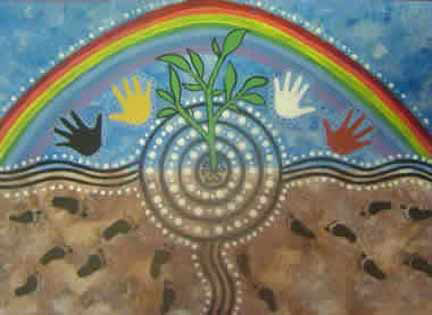 Stand for Human Rights for Indigenous Peoples and Renounce the ’Doctrine of Discovery’ HUFFINGTON POST, Tadodaho Sid HillSpiritual Leader, Haudenosaunee (Six Nations/Iroquois Confederacy), 15 May 12,
When the United Nations Permanent Forum on Indigenous Issues convened on May 7th in New York, native peoples around the world turned their eyes to the most important effort to renounce the Doctrine of Discovery, a 15th century Papal bull that has been exploited for five centuries to deny the human rights of hundreds of millions of people who continue to be subject to its power. Continue reading
Australia’s Aborigines fight laws that will take more of their land for mining
 NT elders fight Stronger Futures law plans, THE AUSTRALIAN AAP , May 02, 2012 ABORIGINAL leaders from Arnhem Land communities have threatened a revolt against the Federal Government’s Stronger Futures laws by refusing to participate in land lease negotiations or give the nod to mining exploration licences. Continue reading
Solar energy- a new economy for Navajo tribes
 There’s a strong desire in Indian Country to step out of the role of just a landlord that is collecting rents to being involved in the equity ownership,” MacCourt said.Erny Zah, spokesman for Navajo
The 30-megawatt solar photovoltaic plant planned for the outlying Navajo community of To’Hajiilee would cover more than 200 acres.
Navajo community banks on proposed solar array, Bloomberg, By SUSAN MONTOYA BRYAN, 26 April 12, TO’HAJIILEE, N.M. This flat, dusty stretch of prairie in central New Mexico is where the leaders of a remote, sparsely populated American Indian community envision a sea of solar panels capable of producing enough electricity for more than 10,000 homes miles away from the reservation.

The To’Hajiilee solar project is one of 19 energy projects that will share in $6.5 million recently awarded by the U.S. Department of Energy to spur renewable energy development on tribal lands. About two-thirds of the money is earmarked for tribes in the West, and most of that will be going toward getting projects in New Mexico andArizona off the ground…… At stake is a wealth of untapped potential. Continue reading
Navajo’s continuing cancer danger from uranium mines
Navajos will continue to be exposed to uranium and its decay products, radon and radium. This means that they are at great risk for bone, liver, breast, and lung cancer, among other health problems….
Uranium Mines Still Pose Serious Health Threat on Navajo Land, Web Wire 12 April 12, In 2010, a Navajo cattle rancher named Larry Gordy discovered an abandoned uranium mine in the middle of his grazing land in Cameron, AZ, according to the New York Times. The Environmental Protection Agency (EPA) visited the site and found dangerously high levels of uranium, but the agency has yet to begin the clean-up.
The EPA found that the radioactivity there measured one million counts per minute, meaning that two days there would expose a person to more external radiation than the Nuclear Regulatory Commission considers safe for an entire year. A dose would lead directly to malignant tumors and other health problems. Continue reading
Addressing Climate Change: lessons from Indigenous Peoples
“Modern education and knowledge is mainly about how to better dominate nature. It is never about how to live harmoniously with nature.”
“Living well is all about keeping good relations with Mother Earth and not living by domination or extraction.”
Indigenous Peoples Can Show the Path to Low-Carbon Living If Their Land Rights Are Recognized http://newswatch.nationalgeographic.com/2012/04/04/indigenous-peoples-can-show-the-path-to-low-carbon-living-if-their-land-rights-are-recognized/ National Geographic, by Stephen Leahy in Climate Change and Indigenous Peoples April 4, 2012 Indigenous peoples are living examples of societies living, sustainable low-carbon lifestyles. Successfully meeting the global climate change challenge requires that much of the world shift from high carbon-living to low.
This shift is daunting. Current emissions for Australia and United States average about 20 tonnes of carbon dioxide per person. In the coming decades that needs to fall to two tonnes per person as it is currently in Brazil or Dominican Republic.
Emissions from most Indigenous peoples are even lower and are amongst the lowest in the world. Continue reading
Hypocrisy and racism – Australia’s sorry nuclear history
 Dumping on Traditional Owners: the ugly face of Australian racism The Drum, 29 March 12 The nuclear industry has been responsible for some of the crudest racism in Australia’s history.
This racism dates from the British nuclear bomb tests in the 1950s but it can still be seen today.
The British government conducted 12 nuclear bomb tests in Australia in the 1950s, most of them at Maralinga in South Australia. Permission was not sought from affected Aboriginal groups such as the Pitjantjatjara, Yankunytjatjara, Tjarutja and Kokatha. Thousands of people were adversely affected and the impact on Aboriginal people was particularly profound.
Many Aboriginal people suffered from radiological poisoning. There are tragic accounts of families sleeping in the bomb craters. So-called ‘Native Patrol Officers’ patrolled thousands of square kilometres to try to ensure that Aboriginal people were removed before nuclear tests took place. Signs were erected in some places – written in English, which few in the affected Indigenous communities could understand. The 1985 Royal Commission found that regard for Aboriginal safety was characterised by “ignorance, incompetence and cynicism”. Many Aboriginal people were forcibly removed from their homelands and taken to places such as the Yalata mission in South Australia, which was effectively a prison camp.
In the late-1990s, the Australian government carried out a clean-up of the Maralinga nuclear test site. It was done on the cheap and many tonnes of debris contaminated with kilograms of plutonium remain buried in shallow, unlined pits in totally unsuitable geology. As nuclear engineer and whistleblower Alan Parkinson said of the ‘clean-up’ on ABC radio in August 2002:
“What was done at Maralinga was a cheap and nasty solution that wouldn’t be adopted on white-fellas land.”
Despite the residual contamination, the Federal Government has off-loaded responsibility for the land onto the Maralinga Tjarutja Traditional Owners. The Government portrays this land transfer as an act of reconciliation, but the real agenda was spelt out in a 1996 government document which states that the clean-up was “aimed at reducing Commonwealth liability arising from residual contamination.”….. http://www.abc.net.au/unleashed/3919296.html
Indigenous peoples have knowledge to help deal with climate change
Indigenous peoples have not been involved in discussions about climate change in most countries said Henrietta Marrie, a Aboriginal leader of the Gimuy-Walubarra Yidinji Nation of Cairns. Indigenous and local peoples collectively represent more than a billion people
The IPCC and United Nations University (UNU) have organized this week’s main workshop to incorporate and “credibly validate” indigenous people’s traditional knowledge
Indigenous Peoples Needed to Meet the Challenge of Climate Change (includes VIDEO)National Geographic, by Stephen Leahy, March 25, 2012 “Planning is not part of our culture. You just get up in the morning and do what you need to do for the day,” said Marilyn Wallace of the Kuku Nyungka ‘mob’ (aboriginal nation) in northern Queensland, Australia.
“Bama” or caring for their local territory is an important part of aboriginal culture and identity Wallace told participants at a mini-workshop in Cairns, Australia today Sunday March 25th prior to the start of the main workshop Climate Change Mitigation with Local Communities and Indigenous peoples on Monday.
Caring for the land includes monitoring the impacts of climate change and using traditional knowledge to keep or sequester carbon she said.
Indigenous peoples and local communities are the least responsible for climate-altering emissions of carbon but they can play an important role helping to reduce emissions through the way they manage their lands. Continue reading
Indigenous peoples’ new network to oppose nuclear waste dumping on Aboriginal land
It mentioned the Tao, who live on the outlying island of Lanyu (蘭嶼, also known as Orchid Island), as well as Aboriginal tribes in the US and Australia, as examples of indigenous people becoming victims of nuclear waste disposal on their traditional lands.

Groups to propose Aborigine network, Taipei Times, 23 March 12 SENEGAL CONGRESS:The network would give voice to the global Aboriginal community and focus on issues like nuclear waste disposal, environmental groups said. Environmental and Aboriginal groups yesterday said they would propose the establishment of an Aboriginal network at an upcoming congress in Senegal, with the aim of uniting global support for Aboriginal people on environmental issues. Continue reading
Indigenous opposition to uranium mining in Grand Canyon
Grand Canyon Uranium Mining Ban Defended By Havasupai Tribe, Conservation Coalition ENews Park Forest, , 13 MARCH 2012 Denver, CO– Arizona’s Havasupai Tribe joined conservation groups joined in filing legal papers on Monday to defend the U.S. Department of the Interior’s 20-year ban on new uranium mining claims across 1 million acres of public lands adjacent to the Grand Canyon. Uranium pollution already plagues the Grand Canyon and surrounding area. Proposals for new mining have prompted protests, litigation and proposed legislation. (Neil Jacklin) Continue reading
Indigenous peoples fight against nuclear waste dumping on their land
 No nuclear Northwest: Grand Chiefs Kenora Daily Miner and News, By Jon Thompson, 10 Jan 12 Grand chiefs representing every inch of Northwestern Ontario are publicly taking a hard line against burying nuclear waste in their traditional territory, claiming it would violate international law. Continue reading
Radioactive shipments: Canadian Nuclear Safety Commission did not consult First Nations
The Council of Canadians is calling on the Canadian Nuclear Safety Commission to hold another public hearing on the matter before renewing Bruce Power’s permits to ship the nuclear waste across the Great Lakes to Sweden.
the CNSC has not fulfilled its duty to consult with First Nations by obtaining free, prior and informed consent.
Bruce Power cannot ship nuclear waste until permit is renewed, Rabble Ca, BY EMMA LUI | DECEMBER 30, 2011 Bruce Power will not be able to ship 16 radioactive steam generators until they renew their permit with the Canadian Nuclear Safety Commission (CNSC) As of tomorrow, December 31, 2011, the Welland Canal is officially closed to all vessels, preventing Bruce Power from proceeding with the nuclear waste shipment until the spring.
Bruce Power had planned to ship 16 bus-sized radioactive steam generators from Owen Sound, through Lake Huron and Lake Erie, then along the Welland Canal and
through Lake Ontario and the St. Lawrence Seaway. The shipment would end up in Sweden where Studsvik, the Swedish company contracted by Bruce Power, would decontaminate the waste in order to sell the scrap metal back onto consumer markets.
On February 4, 2010, Bruce Power had received the necessary CNSC permits to ship the nuclear waste to Sweden. However, the permits are only good for one year and will expire on February 3, 2012 — before the Welland Canal re-opens again for the shipping season. The Canal generally re-opens for shipping sometime in March….. Continue reading
Risk of radioactive uranium pollution on indigenous Americans’ land and water
Uranium Mining Could Leave Toxic Waste in Occoquan Watershed LakeRidge-Occoquan Patch. 31 Dec 11 The Fairfax County Water Authority assesses the risks of uranium mining in Virginia.Lifting Virginia’s ban on uranium mining could open the door to toxic and radioactive waste in the Potomac and Occoquan Watersheds, according to a recent study by the Fairfax County Water Authority.
Though mineral mining occurs throughout the U.S. near water supplies, the study said, “Uranium mining and milling represent unique risks that require additional process controls to prevent impacts from toxic and radioactive byproducts.”…. “uranium mining and milling activities initiated in the Potomac and/or Occoquan watersheds have the potential to increase the risk of negative impacts to Fairfax Water’s source water quality and water supply reliability.”
The Washington Post reported that the National Academy of Sciences and the National Academy of Engineering also found that “steep hurdles” would need to be crossed before the ban should be lifted.
“A study commissioned by the Danville Regional Foundation also came out this month,” the Post article read. “It concluded that uranium mining could have economic benefits but also environmental risks.” http://lakeridge.patch.com/articles/uranium-mining-could-leave-toxic-waste-in-occoquan-watershed
Canadian tribes say NO to nuclear waste
No nuclear waste here, North Shore Tribal Council says,SooToday.com, December 20, 2011 Chiefs of the North Shore Tribal Council say no! to a multi-billion dollar nuclear waste disposal project in their territory CUTLER, ON – The First Nations of the North Shore Tribal Council strongly reject the prospect of the North Shore of Lake Huron becoming a site for the long-term storage of nuclear waste for the Nuclear Waste Management Organization (NWMO). The City of Elliot Lake has publicly expressed interest in possibly becoming one of the sites for the long-term disposal of nuclear waste for Canada’s nuclear industry.
Elliot Lake has a long history of uranium mining that resulted in the boom and bust of the city, as well as significant and lasting environmental damage to the local watershed and nearby ceremonial grounds. In addition, there are dozens of tailings ponds surrounding Elliot Lake currently waiting for a solution for their safe disposal.
“We cannot idly stand by and watch as they inject Mother Earth with this cancer,” says Chief Lyle Sayers, chairman of the North Shore Tribal Council. “We must ensure that the future natural resources of this area are there for our children, generations to come, and businesses alike.”
The half-life of this material is hundreds of thousands of years old and could impact generation after generation. No site can ever be totally safe for nuclear waste storage. “Natural disasters sometimes happen, such as we’ve seen in Japan. It could make this whole area a nuclear wasteland suitable for only that industry,” says Chief Sayers.
Our statement to the Canadian Nuclear Safety Commission and to the Nuclear Waste Management Organization is: Do not waste your financial resources if you plan to conduct a study in this area because a nuclear waste dump is not going to happen here.
The North Shore Tribal Council represents seven First Nation communities across the North Shore of Lake Huron.Chief Lyle Sayers is the chief of the Garden River First Nation and also the chairman of the North Shore Tribal Council. http://www.sootoday.com/content/news/details.asp?c=37141
American Indians enthusiastic about potential for renewable energy industris
Indian Country welcomes renewable energy by Martin LaMonica December 4, 2011 JEMEZ PUEBLO, N.M.–American Indian tribes see renewable energy as a way to capitalize on their natural resources.
The Department of Energy last week proposed a rule that would speed up decisions regarding land used for renewable energy projects, many of which have been derailed by bureaucracy. The rule would require decisions within a 60-day limit for business-related leases, such as developing solar and wind projects on Indian land.
“It will require the government to act,” said Interior Secretary Ken Salazar last Monday, according to reports. “The government cannot sit on its hands, as it has often done.” Indian lands have significant resources, including solar and wind, but little has been developed, according to the National Congress of American Indians. “We’re ready to strengthen our economies now and jumpstart the clean energy economy in Indian Country. This is something the entire country can get behind,” said NCAI president Jefferson Keel in a statement….
For tribes with the resources, renewable energy holds the prospect of bringing in much-needed tax revenue, jobs, and potentially lower electricity costs, said Carolyn Stewart, managing partner at Red Mountain Energy Partners, which advises tribes on renewable energy.
“[Tribes] are very interested in controlling the pace of the development on the reservation, which they have not been able to do in the past for the most part with oil and gas, coal, or uranium mining [which] had significant environmental impacts,” she said….. http://news.cnet.com/8301-11128_3-57335065-54/indian-country-welcomes-renewable-energy/
500 abandoned uranium mines contaminated Navajo land
Summit focuses on uranium contamination on Navajo land, News 13 FARMINGTON, N.M. (AP) – Tuesday marks the start of a yearly summit focused on the Navajo Nation’s problems with uranium contamination. Six federal agencies, along with tribal officials and others are gathering in Farmington, N.M., for the 3-day summit. Jared Blumenfeld of the U.S. Environmental Protection Agency and Navajo President Ben Shelly are set to give keynote speeches.
The reservation has more than 500 abandoned mines. Federal and tribal officials have screened hundreds of structures for potential contamination, replacing some of them. They’ve also tested unregulated water sources. Officials who developed a 5-year plan to address the contamination are expected to give progress reports this week.
Concerns over safety and the health of its people led the Navajo Nation to ban uranium mining on the reservation in 2005. http://www.kold.com/story/15983987/summit-focuses-on-uranium-contamination-on-navajo
1 This Month

of the week – Shut Down Drone Warfare!


Tell the Ukrainian Government to Drop Prosecution of Peace Activist Yurii Sheliazhenko

Petition to revoke the licensing of the Near Surface Nuclear Disposal Facility (NSDF) at Chalk River. https://www.ourcommons.ca/petitions/en/Petition/Details?Petition=e-7247
To see nuclear-related stories in greater depth and intensity – go to https://nuclearinformation.wordpress.com
-
Archives
- March 2026 (251)
- February 2026 (268)
- January 2026 (308)
- December 2025 (358)
- November 2025 (359)
- October 2025 (376)
- September 2025 (257)
- August 2025 (319)
- July 2025 (230)
- June 2025 (348)
- May 2025 (261)
- April 2025 (305)
-
Categories
- 1
- 1 NUCLEAR ISSUES
- business and costs
- climate change
- culture and arts
- ENERGY
- environment
- health
- history
- indigenous issues
- Legal
- marketing of nuclear
- media
- opposition to nuclear
- PERSONAL STORIES
- politics
- politics international
- Religion and ethics
- safety
- secrets,lies and civil liberties
- spinbuster
- technology
- Uranium
- wastes
- weapons and war
- Women
- 2 WORLD
- ACTION
- AFRICA
- Atrocities
- AUSTRALIA
- Christina's notes
- Christina's themes
- culture and arts
- Events
- Fuk 2022
- Fuk 2023
- Fukushima 2017
- Fukushima 2018
- fukushima 2019
- Fukushima 2020
- Fukushima 2021
- general
- global warming
- Humour (God we need it)
- Nuclear
- RARE EARTHS
- Reference
- resources – print
- Resources -audiovicual
- Weekly Newsletter
- World
- World Nuclear
- YouTube
-
RSS
Entries RSS
Comments RSS
 nuclear-news