“Uranium widows country” – prolonged task of cleaning up Navajo land
 Uranium cleanup on Navajo Nation complicated by scope, history of problem 19, 2012 By MARYANN BATLLE Cronkite News WASHINGTON – For seven weeks this fall, workers and scientists labored from 7:30 a.m. to 5 p.m., six days a week, digging up and hauling off thousands of cubic yards of uranium-tainted soil in Cove, Ariz., and sealing what remained.
The $1.5 million project by the U.S. Environmental Protection Agency was an emergency measure to clean up two former uranium transfer stations because of their proximity to a day school, a house – which sat on top of one station – and a highway on the Navajo Nation.
The goal was to remove the immediate threat of uranium contamination, stabilize the soil and keep uranium from becoming windborne.
It’s a stopgap measure on two tainted sites among at least 500 – possibly more than 2,000 – that pose a threat to people on the Navajo reservation that spans parts of Utah, New Mexico and Northern Arizona.
More than six decades after the first mines opened on Navajo lands, it is still unclear how many sites need to be cleaned up, how many people may be suffering from the effects of uranium exposure and what can be done to contain all the hazardous material in these communities – if that’s even possible.
What everyone can agree on is that overcoming the legacy of uranium mining will take a long, long time.
“They say it’s a widow community,” Eugene Esplain said of Cove, where this fall’s cleanup took place. “So many men have died from the impacts of uranium mining.”….. http://cronkitenewsonline.com/2012/12/uranium-cleanup-on-navajo-nation-complicated-by-scope-history-of-problem/
.Mining uranium – A recent history of uranium on Navajo lands
 Uranium cleanup on Navajo Nation complicated by scope, history of problem 19, 2012 By MARYANN BATLLE Cronkite News “…..
• 1940s: The mining and milling of uranium ore for U.S defense and energy begins on the Navajo Nation. Continue reading
Cree Nation stand against uranium mining in Quebec
many concerned groups and individuals are now joining the Crees in urging the Quebec government to conduct an independent and comprehensive assessment of the long-term environmental, social and ethical challenges presented by the uranium industry
When the mining is done and the profits have been taken, these tailings will be left behind in my people’s backyard, where we have lived for thousands of years, and where we hunt, fish and trap, raise our children and bury our dead.
It is indisputable that these uranium tailings will remain radioactive and highly toxic for hundreds of thousands of years.
The Cree Nation will not be intimidated or silenced
Quebec should support Cree moratorium on uranium mining http://www.montrealgazette.com/news/Opinion+Quebec+should+support+Cree+moratorium+uranium+mining/7695600/story.html By Matthew Coon Come, Montreal Gazette December 13, 2012 This summer, my people, the James Bay Cree Nation, enacted a permanent moratorium on uranium exploration, mining, milling and waste emplacement in our territory on the east shore of James Bay, Eeyou Istchee. I was
mandated to take all necessary steps to ensure full recognition of our stand. Continue reading
Cameco and AREVA ‘s deal with indigenous people, to silence criticism of uranium mining
 The agreement would prohibit Pinehouse from criticizing the companies now or in the future, a measure that amounts to an indefinite “gag order”
- Pinehouse promises to “fully support” Cameco and Areva’s current, proposed and future projects in public, to investors, to regulators and with other groups. Pine-house leaders must make reasonable efforts to ensure community members “do not say or do anything that interferes with or delays” the companies’ operations.
- Pinehouse agrees to not make any future financial requests or claims against the companies.
Uranium firms offer deal to Sask. community Agreement sparks opposition By Jason Warick, The StarPhoenix November 27, 2012 An offer by uranium giants Cameco Corp. and Areva could soon deliver jobs, cash payments and other benefits to the northern community of Pinehouse, but some residents worry it’s a thinly veiled attempt to buy their silence. Continue reading
What uranium mining and milling have done to Navajo lands
The Curse of the Yellow Powder, Bacon’s Rebellion, by Rose Jenkins December 2, 2012 Is it possible to restore a landscape damaged by uranium? Ask the Navajo in New Mexico. “……There are 520 abandoned uranium mines in the Navajo Nation. Navajo territory extends over 27,000 square miles in the Four Corners area of the American Southwest. In this sparsely populated desert, approximately 30% of the population is not connected to a public water supply, so people drink from the sources available, including springs and private wells.
Out of approximately 375 Navajo water sources tested by various agencies, according to data compiled by SRIC, more than a quarter contain excess levels of contaminants that could derive from uranium operations — including arsenic in 17% and uranium in 10%.
In response, the EPA shut down three of the most contaminated sources. The agency is also working with local partners, including SRIC,to publicize warnings about hazardous water sources and to provide safe drinking water for thousands of homes. That addresses people’s immediate needs, but it doesn’t resolve the underlying problem — the polluted groundwater.
I asked the EPA if there was any chance the groundwater could ever be treated enough to be safe to drink.
“Our first goal is to make sure people are not being exposed to contaminated groundwater,” Rusty Harris-Bishop, an EPA spokesperson, told me………
In Yellow Dirt, journalist Judy Pasternak describes how thoroughly the leavings of uranium operations infiltrated Navajo people’s lives. Pregnant women drank water from lakes left by pit mines. Families built foundations and stucco walls out of the sandy mine wastes. Children played on tailings piles. Livestock grazed around the mouths of unreclaimed mines (and still do, according to a recentNew York Times article). Pasternak chronicles case after case of lung cancer, stomach cancer, children with deformities — death after death.
The Navajo decided that they have reason enough to be done with uranium extraction, at least while so many problems remain. In 2005, the tribe passed the Diné Natural Resources Protection Act, banning uranium mining and milling on their lands. The act states as its purpose: “to ensure that no further damage to the culture, society and economy of the Navajo Nation occurs because of uranium mining… [and] processing, until all adverse environmental, economic and human health impacts from past uranium mining and processing have been eliminated or substantially reduced.”……” http://www.baconsrebellion.com/2012/12/the-curse-of-the-yellow-powder.html
Australia’s Aboriginal Mirrar people warn about uranium mining
 Gundjeihmi Aboriginal Corporation November 23rd 2012 Traditional owners directly affected by uranium mining in the Northern Territory, the Mirarr people of Kakadu, have rejected suggestions that the Ranger uranium mine provides a model for Queensland to follow and called on others to heed their experience.
Supporters of the LNP’s decision to open Queensland to uranium mining, including the Australian Uranium Association head Michael Angwin, have made public claims about the ‘excellent’ track record of Ranger uranium mine.
“The suggestion that Ranger provides a blueprint for Queensland must be contested,” said Justin O’Brien, executive officer of Gundjeihmi Aboriginal Corporation, the organisation established and operated by the Mirarr to represent their rights and interests.
The Mirarr, traditional owners of lands in the Kakadu region, including the Ranger and Jabiluka uranium deposits, have the longest lived experience of uranium mining in Australia. The Ranger mine was imposed on Mirarr against their strong opposition and has been operating for 30 years.
“Despite three decades of mining royalties, the socioeconomic standing of local Indigenous people remains below that of the NT average and well below the national standard. It is only in very recent years that income from Ranger has been adequately invested in social and cultural development programs,” Mr O’Brien said.
“The suggestion that Ranger’s track record confirms the high environmental standard of Australia’s uranium mining industry is in stark contrast to the Mirarr experience of mining on their land. Water and tailings management at the mine continue to cause serious concerns and what environmental gains we have secured have been hard fought for over decades.
“In addition, the Mirarr hold grave concerns about the legacy of uranium mining as well as the impact of its products. The fact that Australian uranium was in the failed reactors at Fukushima that have caused so much damage and human misery remains a source of great sadness for the Mirarr.
Tragedy of the displaced Bikini Atoll residents, following atomic bomb tests
 PARADISE WITH AN ASTERISK, OUTSIDE MAGAZINE, OCTOBER 17, 2012“…”………WHAT HAPPENED TO THE displaced islanders after 1946 was a tragedy of neglect. There was never enough food on Rongerik: the reef fish were poisonous; a fire damaged the island’s coconut trees. There was not enough water. By 1948, they were starving to death, even though the United States had committed to taking care of them. In March of that year, the Bikinians were moved to Kwajalein Island, home to a new U.S. naval base, where they camped miserably on a small strip of grass next to the runway. A few months later they were relocated yet again, this time to the island of Kili.
This was a disaster, too, but of a different kind. Kili was a true island, which meant that there was no ring of coral, no protected lagoon, no jungle-fringed outer islands to fish and hunt, just the big waves of the Pacific crashing up against rugged shores. Fishing was nearly impossible. “It was just a small piece of rock in the middle of the ocean with some coconuts growing on it,” says Alson. Once again food supplies were intermittent. At one point, the island’s new inhabitants required an emergency airdrop. The Bikinian exile continued for another 20 years, long after the last bomb, code-named Fig, was detonated in August of 1958……
The final devastating blow came in 2010, when the Bikinians lost their largest lawsuit against the U.S. government. In 2001, the Nuclear Claims Tribunal—a body established in 1983, as part of the Compact of Free Association, to handle Marshall Islands complaints—awarded the Bikinians $563 million in compensation. But the tribunal was never adequately funded to pay a claim of that size. The Bikinians sued to force payment, but the effort failed when the Supreme Court refused to hear the case in 2010, claiming it doesn’t have the right to rule over international agreements. The U.S. courts are now closed to them. “It was absolutely devastating,” says Niedenthal. “We always had the idea and the hope that we were fighting for something. When we got the final rejection by the Supreme Court, that was it. We’re done.”http://www.outsideonline.com/outdoor-adventure/nature/Paradise-With-An-Asterisk.html?168980656
Radiation exposure to Nevada’s Native American communities
The assessment of radiation exposures in Native American communities (Nevada) http://nuclearhistory.wordpress.com/2012/09/28/the-assessment-of-radiation-exposures-in-native-american-communities-nevada/
http://www.ncbi.nlm.nih.gov/pubmed/10795343
Risk Anal. 2000 Feb;20(1):101-11.
The assessment of radiation exposures in Native American communities from nuclear weapons testing in Nevada.
Frohmberg E, Goble R, Sanchez V, Quigley D.
Source
Clark University, Center for Technology, Environment, George Perkins Marsh Institute, Worcester, MA 01610, USA.
Abstract
Native Americans residing in a broad region downwind from the Nevada Test Site during the 1950s and 1960s received significant radiation exposures from nuclear weapons testing. Because of differences in diet, activities, and housing, their radiation exposures are only very imperfectly represented in the Department of Energy dose reconstructions. There are important missing pathways, including exposures to radioactive iodine from eating small game. The dose reconstruction model assumptions about cattle feeding practices across a year are unlikely to apply to the native communities as are other model assumptions about diet. Thus exposures from drinking milk and eating vegetables have not yet been properly estimated for these communities. Through consultations with members of the affected communities, these deficiencies could be corrected and the dose reconstruction extended to Native Americans. An illustration of the feasibility of extending the dose reconstruction is provided by a sample calculation to estimate radiation exposures to the thyroid from eating radio-iodine-contaminated rabbit thyroids after the Sedan test. The illustration is continued with a discussion of how the calculation results may be used to make estimates for other tests and other locations.
PMID: 10795343 [PubMed – indexed for MEDLINE]
Savannah River Nuclear Bomb Plant – home of Radioactive Racism

 Race and Radiation: The Equal Opportunity Killer at the Savannah River Site DC Bureau By Joseph Trento, September 6th, 2012 The old Atomic Energy Commission did not give much thought to where they were going to put their new nuclear weapons processing plant in the 1950s other than it needed to be on the other side of the country from their World War II era facility in Hanford, Washington…..
At SRS, five reactors, two separation plants, thousands of miles of pipes and high level nuclear waste storage facilities were built on what amounts to a swamp with the worst earthquake fault in the South running under it. Towns were relocated and the orchards, hunting and fishing grounds that sustained the lives of poor residents were taken over by a country fighting a new kind of war – a cold war. The reactors were built five miles apart so if the Soviets attacked one, the others could survive and keep producing plutonium. Production wastes – deadly to humans – were buried in cardboard boxes in open trenches.
The ugliest of America’s nuclear weapons history is the cavalier way in which the old Atomic Energy Commission and later Department of Energy management allowed African American workers to be deliberately exposed to radiation at the sprawling Savannah River Site while sparing white workers from the same dangers. Continue reading
Film reveals the secret story of nuclear research on the Marshall Islands people

The long term study of the human health effects of exposure to fallout and remaining nuclear waste in the Marshallese environment extended over four decades with a total of 72 research excursions to the Marshall Islands involving Marshallese citizens from Rongelap, Utrik, Likiep, Enewetak and Majuro Atolls. Some 539 men, women, and children were subject to studies documenting and monitoring the varied late effects of radiation. In addition to the purposeful exposure of humans to the toxic and radioactive waste from nuclear weapons, some Marshallese received radioisotope injections, underwent experimental surgery, and were subject to other procedures in experiments addressing scientific questions which, at times, had little or no relevance to medical treatment needs and in some instances involved procedures that were detrimental to their health.
Human Rights, Environment and Nuclear Disaster Nuclear Savages http://www.counterpunch.org/2012/06/01/nuclear-savages/ Counter Punch by BARBARA ROSE JOHNSTON, June 2012 also at http://snippits-and-slappits.blogspot.com.au/2012/06/nuclear-savages.html (with video) Are you wondering about the disconcerting contradictions in the nuclear news in recent weeks?…. We have been here before, in a world blanketed with nuclear fallout, where massive amounts of iodine, cesium, strontium and other radioactive isotopes moved through the marine and terrestrial food chain and the human body, in well-documented ways, with degenerative and at times deadly outcomes. Yet, for many reasons, while the environmental and biomedical trajectory of such exposures are well documented, the human experience and associated public health risks are largely suppressed, classified, or simply and persistently denied.
Sometimes clarity is best achieved by stepping back, taking pause, and considering the historical antecedents and experiences that have brought us to these chaotic times. A new documentary film by Adam Horowitz offers an opportunity to do just that.
 Premiering June 2, at 6:30 pm at the Lincoln Center in New York City, Nuclear Savage: The Islands of Secret Project 4.1 is a poignant, provocative, and deeply troubling look at lingering and lasting effects of nuclear disaster and the human consequences of US government efforts to define, contain, and control public awareness and concern.
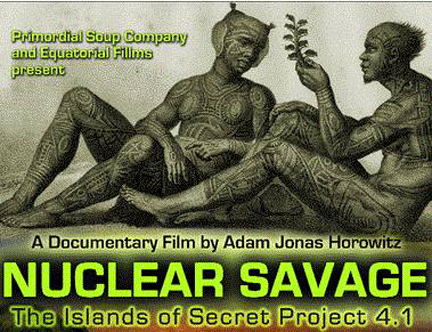
Nuclear Savage recounts the experiences of the Marshallese nation in the years following World War II, as they played host to the US’s Pacific Proving Grounds and served as human subjects in the classified, abusive pseudoscience that characterized the US government medical response to civilian exposures from the 1954 Bravo Test, the largest and dirtiest hydrogen bomb detonated by the United States. Detonated in the populated nation of the Marshall Islands.
Here is the story: Continue reading
Permanent ban on uranium determined by James Bay Cree Nation
 James Bay Cree Nation enacts permanent uranium moratorium in James Bay territory, The First Perspective (Canada) Crees “determined to protect our way of life against the unique and grave threat posed by uranium mining and waste, today and for thousands of years to come”. Waskaganish, QC, Aug. 9, 2012 – The James Bay Cree Nation has declared a Permanent Moratorium on uranium exploration, uranium mining and uranium waste emplacement in Eeyou Istchee, the James Bay Cree territory. The permanent moratorium was enacted unanimously by the Annual Cree Nation General Assembly in Waskaganish.
“The risks inherent in uranium exploration, mining, milling, refining and transport, and in radioactive and toxic uranium mining waste, are incompatible with our stewardship responsibilities in Eeyou Istchee,” the Resolution declares.
“The Cree Nation is determined to protect our economies and way of life against the unique and grave threat posed by uranium mining and uranium waste, today and for thousands of years to come,” said Grand Chief Dr. Matthew Coon Come. “We are not opposed to sustainable and equitable mining and other industrial and resource development activities in Eeyou Istchee – but the toxic and radiation risks created by uranium mining and uranium waste are unique in scale and duration.” Continue reading
Navajo Nation determined to get uranium cleanup
The Navajo Nation Diné Natural Resources Protection Act of 2005 prohibits uranium mining within Navajo Indian Country.
Uranium Cleanup is Priority for Navajos NEW MINING IS SECONDARY OFFICIALS SIGN AGREEMENT , Cibola Beacon, July 31, 2012 By Donald Jaramillo Beacon Managing Editor CIBOLA COUNTY – The Navajo Nation and many of its members have stated it loud and clear, no new uranium mining until cleanup is complete on Navajo lands.
An agreement was signed on July 19 between the Navajo Nation and Hydro Resources, Inc. (HRI), a subsidiary of Uranium Resources, Inc. (URI). Continue reading
BHP’s contempt for Aboriginal rights in Australia
BHP has shown similar contempt for taking responsibility for the impacts of its actions in Australia. The recently amended Indenture Act which will apply to the new mine continues to exempt BHP from the Aboriginal Heritage Act 1988, which applies elsewhere in the state.
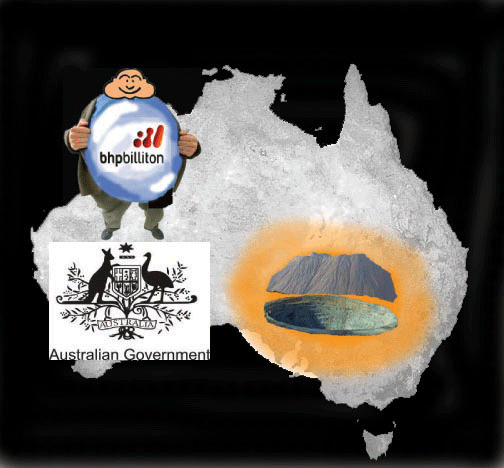
It is clearly a conflict of interest to have a corporation with a commercial interest in a piece of land also making decisions as to whether this same piece of land has competing non-commercial values.
Uncle Kevin Buzzacott is an Arabunna elder. Arabunna land lies North of the mine site. The borefields which extract water for the mine from the Great Artesian Basin are located on Arabunna land. The recent recognition of the Arabunna peoples long standing Native Title claim does not give the Arabunna people any rights to contest the location of the borefields. The GAB feeds the mound springs scattered throughout the Lake Eyre region. The springs are integral to the desert ecosystem and sacred to the Arabunna people. They have already been impacted by the water usage of the current mine.
by Nectaria Calan, 9 July 12, The Lizards Revenge was first announced on the 10th October 2011, coinciding with the State and Federal approvals of the Olympic Dam expansion. Since then, Rio + 20 in June this year has highlighted the failure of the concept of sustainable development and the failure of individual governments and the international community to genuinely address the ongoing environmental destruction that has become a feature of our age. Continue reading
Indian Country communities to strengthen economies by hosting solar energy project
“Tribal lands hold great renewable energy potential, and smart development of these resources has the power to strengthen tribal economies, create jobs and generate clean electricity for communities across Indian Country,”
 Solar energy project approved on tribal land near Las Vegas, Las Vegas Sun, By Conor Shine , June 21, 2012 The federal government on Thursday approved a massive 350-megawatt solar energy project to be built on land in Clark County belonging to the Moapa Band of Paiute Indians Tribe.
It would be the first utility-scale solar project on tribal lands. The project, covering about 2,000 acres, would be located 30 miles north of Las Vegas and occupy about 3 percent of the tribe’s land, which is held in trust by the U.S. government.
The operation would generate enough electricity to power 100,000 homes, the Department of the Interior said in a statement. Continue reading
Cree people say No to uranium mining and nuclear power
Chief Shecapio explained that the Crees “have always been the guardians and protectors of the land and will continue to be. For the Crees of Mistissini, the land is a school of its own and the resources of the land are the material and supplies they need. Cree traplines are the classrooms. What is taught on these traplines to the youth is the Cree way of life, which means living in harmony with nature.
“We do not believe that nuclear energy, which is the primary use for uranium in Canada, is a sustainable form of energy. We do not want to see a resource extracted from our land be responsible for causing pollution and waste. We do not want this to be our impact on the world..
Uranium Exploration: Mistissi Says “No” and Calls for a Moratorium MISTISSINI, Market Watch, EEYOU ISTCHEE, Jun 05, 2012 (MARKETWIRE via COMTEX) 5 June 12, — The Chief of Cree Nation of Mistissini, Richard Shecapio, made it clear at the Canadian Nuclear Safety Commission’s (CNSC) public hearing, held today (June 5) in Mistissini, that his
community is firmly against uranium development in Eeyou Istchee. “We want to put an end to the question of uranium development once and for all, right now. We know where this is going and we don’t want any uranium mining at all”, said Chief Shecapio. Continue reading
1 This Month

of the week – Shut Down Drone Warfare!


Tell the Ukrainian Government to Drop Prosecution of Peace Activist Yurii Sheliazhenko

Petition to revoke the licensing of the Near Surface Nuclear Disposal Facility (NSDF) at Chalk River. https://www.ourcommons.ca/petitions/en/Petition/Details?Petition=e-7247
To see nuclear-related stories in greater depth and intensity – go to https://nuclearinformation.wordpress.com
-
Archives
- March 2026 (251)
- February 2026 (268)
- January 2026 (308)
- December 2025 (358)
- November 2025 (359)
- October 2025 (376)
- September 2025 (257)
- August 2025 (319)
- July 2025 (230)
- June 2025 (348)
- May 2025 (261)
- April 2025 (305)
-
Categories
- 1
- 1 NUCLEAR ISSUES
- business and costs
- climate change
- culture and arts
- ENERGY
- environment
- health
- history
- indigenous issues
- Legal
- marketing of nuclear
- media
- opposition to nuclear
- PERSONAL STORIES
- politics
- politics international
- Religion and ethics
- safety
- secrets,lies and civil liberties
- spinbuster
- technology
- Uranium
- wastes
- weapons and war
- Women
- 2 WORLD
- ACTION
- AFRICA
- Atrocities
- AUSTRALIA
- Christina's notes
- Christina's themes
- culture and arts
- Events
- Fuk 2022
- Fuk 2023
- Fukushima 2017
- Fukushima 2018
- fukushima 2019
- Fukushima 2020
- Fukushima 2021
- general
- global warming
- Humour (God we need it)
- Nuclear
- RARE EARTHS
- Reference
- resources – print
- Resources -audiovicual
- Weekly Newsletter
- World
- World Nuclear
- YouTube
-
RSS
Entries RSS
Comments RSS
 nuclear-news