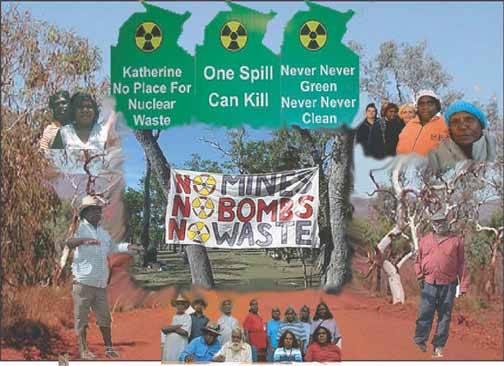
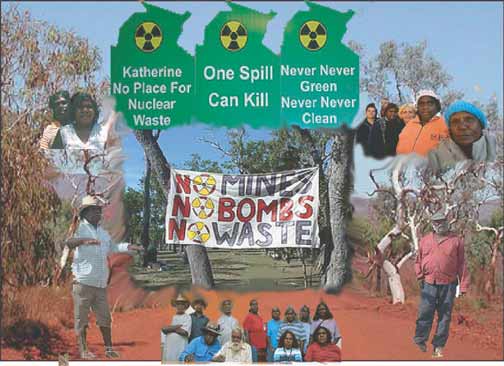
Legal case continues over Australian govt’s plan to dump nuclear waste on Aboriginal land
Indigenous land owners accuse lawyer of manipulating nuclear waste storage report June 4, 2014 – Jane Lee Legal Affairs Reporter for The Age A lawyer who was key to the Howard government’s plan to store nuclear waste on indigenous land has been accused of manipulating the legal process required to ensure its approval.
Traditional owners from four indigenous clans are challenging the Ngapa clan’s 2007 nomination of Muckaty Station for the dump site in the Federal Court in Melbourne. The owners, including Aboriginal elders, argue they did not consent to the nomination, were not consulted on the agreement reached and were misled on the government’s proposal for the nuclear storage site.
Ron Levy was then the chief legal counsel for the Northern Land Council, which was set up to help indigenous people in the Northern Territory acquire and manage traditional lands. Mr Levy will be called as a witness later in the five-week case before Justice Anthony North.
Ron Merkel, QC, for the traditional owers, told the court on Thursday that Mr Levy “personally edited” anthropologists’ views in a Council report which concluded that only the Ngapa Lauder clan owned the site. Mr Levy also wrote a new section in the final report, reflecting his view that the Land Commissioner could depart from judges’ previous decisions on land claims, “if relevant material was before the commissioner.”
Mr Merkel said that he did this “(so) that the Lauder Ngupas would be recognised by the Northern Land Council as the only traditional owners of the site so their consent could be secured.” The site nomination could then “jump a hurdle” of having to consult in more detail about about the plan with other clans, he said………..
Mr Merkel told the court on Tuesday that Mr Levy, who controlled the consultation process, also failed to tell the full Northern Land Council or traditional owners about the only up-front $200,000 payment given to traditional owners for the site nomination or the terms of their agreement.
But he later told the federal goverrnment that he had all traditional owners’ full consent.
Mr Merkel said there was no explanation for this “unless … Mr Levy had a plan from the outset about how to achieve the end result and he did”. http://www.smh.com.au/federal-politics/political-news/indigenous-land-owners-accuse-lawyer-of-manipulating-nuclear-waste-storage-report-20140604-39jk8.html#ixzz33nhZjp26.
In Australian Federal Court, Aborigines continue the fight against radioactive waste dumping on their land
 Nuclear waste dump on Aboriginal land invalid, court told The West Australian, 3 June 14. Sydney (AFP) – The earmarking of a remote Australian outback area as a nuclear waste dump was invalid because officials failed to contact all traditional Aboriginal landowners affected, a court heard Monday.Muckaty Station in the Northern Territory was nominated in early 2007 as a site to store low and intermediate radioactive waste under a deal negotiated with the Aboriginal Ngapa clan.
While Australia does not use nuclear power, it needs a site to store waste, including processed fuel rods from the country’s only nuclear reactor at Lucas Heights, on the outskirts of Sydney,…..Opponents have fought against the dump for years, with a trial starting in the Federal Court in Melbourne Monday alleging Muckaty’s nomination was invalid due to a failure of the government and the land council to obtain the consent of all Aboriginal owners.
“What we’re here to say is ‘no more’ and that this process was so legally flawed that it is invalid,” Ron Merkel, who is representing traditional owners, told the court.
“The opposition is in no small part based on a spiritual affiliation to the land and that radioactive waste will poison the land,” he said in comments cited by Australian Associated Press.
The court was told the consent of all groups with a claim to the land was required for the facility to go ahead, but some Aboriginals whose country was affected have never had a chance to voice their concerns until now……..Speaking to reporters, Kylie Sambo, of the Warlmanpa people, said the idea of a waste facility on the land, which is in the centre of the country, was “poison”.
“We don’t want it to spoil our country because we love our land and we’ve been there for centuries,” she said. “My uncle once told me, ‘You may think you own the land, but in fact the land owns us’.”
The Australian Conservation Foundation said the case raised questions about the country’s management of long-lived radioactive waste.
“Australia has never has an independent assessment of how best to manage radioactive waste; now we urgently need one,” campaigner Dave Sweeney said.
The case is set to run for five weeks. https://au.news.yahoo.com/thewest/world/a/24084083/nuclear-waste-dump-on-aboriginal-land-invalid-court-told/
Uranium – the invisible killer
 Uranium Contamination Across America: Holding the Silent Killers Of Environmental Destruction Accountable By Kevin Zeese and Margaret Flowers Global Research, April 29, 2014 PopularResistance.org The findings of the most recent IPCC report are sobering. We have 15 years to mitigate climate disaster. It is up to us to make a major transition to a carbon-free, nuclear-free energy economy within that time-frame. Big Energy and our plutocratic government are not going to do it without effective pressure from a people-powered movement.
More people are getting this concept. This year, there are several major campaigns around Earth Day, for example the Global Climate Convergence and the Cowboy Indian Alliance camp in Washington, DC. We celebrated Earth Day by launching a new national campaign to clean up the thousands of abandoned uranium mines (AUMs) scattered throughout the Great Plains and West Coast.
Uranium: The Invisible Killer
In the days leading up to the launch of Clean Up the Mines campaign, our team of eleven organizers toured Southwest South Dakota to learn more about the AUMs. Our tour was led by Charmaine White Face, a scientist and coordinator of Defenders of the Black Hills, who took us to various sites and brought her Geiger counters. There are 272 AUMs in South Dakota that continue to emit radiation, radon and toxic elements into the air, water and land. The mines were abandoned by corporations like Kerr McGee and Atlantic Richfield who walked away from them when the Uranium Rush that started in the early 1950s was over. We described this in more detail in our previous article about how uranium mines are poisoning the breadbasket of America.
The Northern Great Plains Region of Colorado, Montana, Wyoming, North and South Dakota contain more than 3,000 AUMs. There are more than 1,000 AUMs in Arizona and New Mexico. In total, in the 15 western states there are estimated to be more than 10,000 AUMs. One in 7 people in the western US live within 50 miles of an AUM, according to the EPA. This is a national environmental crisis – a silent Fukushima – for which responsibility needs to be taken………..
Accountability for Silent Killers
Exploring the legacy of uranium mining – for Earth destroying weapons of mass destruction and risky nuclear energy – reminded us how far humans have come in environmental destruction. It also showed, once again, how all is related. The Gaia theory of the Earth as a living being where all is connected is evident in the uranium toxicity that spreads through water, air and food
There is a growing movement that links native peoples with the descendants of those who colonized them. Now, many non-natives follow the lead of native peoples against fossil fuel and mineral extraction throughout the continent. It is this kind of solidarity and unity that will not only clean up the mines but will also make even greater changes in our economy, environment and government.
The toxicity of AUMs also reminds us of the cost of living under the rule of an illegitimate governmentwhere money, not the people, rule; of big finance capitalism that puts profit ahead of people and planet – and is enabled by the corrupt corporate government. The experience of the uranium mines shows us that even if it means people will die younger than they should, profit is king when we live under the ‘rule of money.’ It shows us we have an even larger task – ending a plutocratic oligarchy and creating a real democracy where the people rule……http://www.globalresearch.ca/uranium-contamination-across-america-holding-the-silent-killers-of-environmental-destruction-accountable/5379605
Clean up Hanford nuclear waste – strong directive from Yakama Nation
 Yakama Nation Tells DOE to Clean Up Nuclear Waste By Michelle Tolson YAKAMA NATION, Washington State, U.S. , Apr 14 2014 (IPS) – The Department of Energy (DOE), politicians and CEOs were discussing how to warn generations 125,000 years in the future about the radioactive waste at Hanford Nuclear Reservation, considered the most polluted site in the U.S., when Native American anti-nuclear activist Russell Jim interrupted their musings: “We’ll tell them.”
He tells IPS “they looked around and saw me. I said, ‘We’ve been here since the beginning of time, so we will be here then.’ That was when they knew they’d have a fight on their hands.” With his long braids, the 78-year-old director of the Environmental Restoration & Waste Management Programme (ERWM) for the Yakama tribes cuts a striking figure, sitting calmly in his office located on the arid lands of his sovereign nation.
The Yakama Reservation in southeast Washington has 1.2 million acres with 10,000 federally recognised tribal members and an estimated 12,000 feral horses roaming the desert steppe. Down from the 12 million acres ceded by force to the U.S. government in 1855, it is just 20 miles west from the Hanford nuclear site.
Though the nuclear arms race ended in 1989, radioactive waste is the legacy of the various sites of the former Manhattan Project spread across the U.S.
While the Yakama have successfully protected their sacred fishing grounds from becoming a repository for nuclear waste from other project sites by invoking the treaty of 1855 which promises access to their “usual and accustomed places,” Hanford is far from clean, though the DOE promised to restore the land.
“The DOE is trying to reclassify the waste as ‘low activity.’ They are trying to leave it here and bury it in shallow pits. Scientists are saying that it needs to be buried deep under the ground,” Jim explains.
Tom Carpenter of Hanford Challenge watchdog group tells IPS “it is a battle for Washington State and the tribes to get the feds to keep their promise to remove the waste. There are 42 miles of trenches that are 15 feet wide and 20 feet deep full of boxes, crates and vials of waste in unlined trenches.”
There are a further 177 underground tanks of radioactive waste and six are leaking. Waste is supposed to be moved within 24 hours from leak detection or whenever is “practicable” but the contractors say there is not enough space.
Three whistleblowers working on the cleanup raised concerns and were fired. Closely followed by a local news station, it is an issue that is largely neglected by mainstream media and the Yakama’s fight seems all but ignored. “We used to have a media person on staff but the DOE says there is no need as ‘everything is going fine,” says Russell Jim. His department lost 80 percent of its funding in 2012 after cutbacks. His tribe doesn’t fund ERWM, the DOE does. “The DOE crapped it up, so they should pay for it.”
But everything is not fine. With radioactive groundwater plumes making their way toward the river, the Yakama and watchdog groups says it is an emergency. Some plumes are just 400 yards from the river where the tribe accesses Hanford Reach monument, according to treaty rights.
Hanford Reach nature reserve, a buffer zone for the site, is the Columbia’s largest spawning grounds for wild fall Chinook salmon
Washington State reports highly toxic radioactive contamination from uranium, strontium 90 and chromium in the ground water has already entered the Columbia River.
“There are about 150 groundwater ‘upwellings’ in the gravel of the Columbia River coming from Hanford that young salmon swim around,” explains Russell Jim………..
“The DOE tells congress the river corridor is clean. It’s not clean but they are afraid of damages being filed against them.” A cancer survivor, Jim’s tribe received no compensation for damages from radioactive releases from 1944 to 1971 into the Columbia as high as 6,300,000 curies of Neptunium-239……….
teven G. Gilbert, a toxicologist with Physicians for Social Responsbility, tells IPS there is a lack transparency and data on the Hanford cleanup. “It is a huge problem,” he says, adding that contaminated groundwater at Hanford still interacts with the Columbia River, based on water levels.
Though eight of the nine nuclear reactors next to the river were decommissioned, the 1,175-megawatt Energy Northwest Energy power plant is still functioning
“Many people don’t know there is a live nuclear reactor on the Columbia. It’s the same style as Fukushima,” Gilbert explains.
In the middle of the fight are the tribes, which are sovereign nations. Russell Jim says they are often erroneously described as “stakeholders” when they are separate governments.
“We were the only tribe to take on the nuclear issue and testify at the 1980 Senate subcommittee. In 1982 we immediately filed for affected tribe status. The Umatilla and the Nez Perce tribes later joined.”,,,,,,,,http://www.ipsnews.net/2014/04/yakama-nation-tells-doe-clean-nuclear-waste/
At long Last, some compensation to Navajo for uranium mining’s disastrous legacy
Navajo to benefit from $1B for uranium  cleanup http://www.chron.com/news/science/article/Navajo-to-benefit-from-1B-for-uranium-cleanup-5374413.php By FELICIA FONSECA, Associated Press | April 3, 2014 FLAGSTAFF, Ariz. (AP) — More than $1 billion is going to help clean up abandoned uranium mines that have left a legacy of disease and death on the Navajo Nation.
The money is part of a $5.15 billion settlement that the federal government reached with Anadarko Petroleum Corp. for the cleanup of thousands of long-contaminated sites nationwide. The settlement announced Thursday resolves a legal battle over Tronox Inc., a 2005 spinoff of Kerr-McGee Corp. that Anadarko acquired in 2006.
Kerr-McGee once operated about 50 uranium mines in the Lukachukai Mountains of northeastern Arizona near Cove and a uranium mill in Shiprock, N.M. Uranium waste was thrust over the mountain side and carried by rainwater across the land used by hikers, anglers, medicine men and Navajo shepherds, said David Taylor, an attorney with the Navajo Nation Department of Justice.
“I have a feeling of just deep appreciation for the Navajo children, who literally are playing in uranium piles today who aren’t going to have to do that in the future,” he said.
But, Taylor added: “The path before us is still monumental. We’ve got a good start now, and I hope we can build on that.”
The more than $1 billion will address about 10 percent of the tribe’s inventory of abandoned uranium mines. About 4 million tons of uranium ore were mined from the reservation from 1944 to 1986 for wartime weapons. Many families still live among the contamination and fear drinking water polluted by uranium. Navajo President Ben Shelly said the settlement will ease some concerns about public health.
About $1 billion of the money benefiting the Navajo Nation will be administered by the U.S. Environmental Protection Agency in San Francisco. Of that, nearly $87 million will be set aside specifically for two sites known as the Quivira Mines near Church Rock, N.M. The Navajo Nation separately will receive $43 million to address Shiprock mill, where uranium ore was processed near the San Juan River, the EPA said.
The federal government has been working for years with the Navajo Nation to address the more than 500 abandoned uranium mines on the reservation, but they’ve been hampered by the costs of remediation and the unwillingness of some companies to pay for cleanup of their previous operations.
Jared Blumenfeld, the EPA’s regional administrator in San Francisco, said federal agencies spent about $100 million as part of a five-year cleanup plan. The EPA is drafting a second, five-year plan, but the budget is expected to be much less, he said.
“The mess that’s on the Navajo Nation in terms of abandoned uranium mines should never have been put there, and all of us have been waiting for this day to start to make a big dent in the cleanup,” he said.
The mountainous sites near Cove rarely are visited, but a network of roads established for mining, logging and firewood gathering provide access. Tribal officials say Navajo medicine men gather plants and herbs for prayer and healing purposes from the mountains, and families set up summer camps where sheep graze nearby.
The federal government initially sought $25 billion to clean up decades of contamination at dozens of sites. A U.S. bankruptcy judge in New York ruled in December that Kerr-McGee improperly shifted its environmental liabilities to Tronox and should pay between $5.15 billion and $14.2 billion, plus attorneys’ fees.
Anadarko CEO Al Walker said the settlement eliminates the uncertainty of the dispute.
Blumenfeld said Navajos have struggled with the legacy of uranium contamination for too long. He said dozens of tribal members already have been trained in how to properly dispose of and transport contaminated waste, and they soon can be put to work.
“It’s one of those environmental justice burdens that has garnered a lot of attention and, thankfully, now it’s garnering a lot of money,” Blumenfeld said.
Uranium mining – environmental racism
Uranium Mining http://www.berkeleydailyplanet.com/issue/2014-03-28/article/41964?headline=Uranium-Mining—-By-Tejinder-Uberoi March 28, 2014 In a stark example of environmental racism, Native Indians have become the target of toxic uranium mining. Energy Fuels Resources recently obtained federal approval to reopen a mine in close proximity to the Grand Canyon’s popular South Rim entrance.
Environmental activists have joined forces with Native Navajos to protest the decision siting serious health risks. Earlier uranium mining has scarred the landscape and left deposits of radioactive waste from 1,000 closed mines. The mining companies failed to adequately remove the radioactive wastes which have resulted in a dramatic increase in cancer and other serious ailments.
One native Indian activist, Klee Benally, remarked that “this is really a slow genocide of the people, not just indigenous people of this region, but it’s estimated that there are over 10 million people who are residing within 50 miles of abandoned uranium mines.” The long term impact of contaminated water seepage into groundwater and its impact on wildlife have been ignored. The five-year cleanup plan initiated by the EPA has also been ignored.
San Francisco Peaks, an area considered sacred by 13 Native tribes, has been severely impacted; to compound health concerns is the practice of using treated sewage water to make snow at the popular Snow bowl resort. The future of indigenous tribes has been railroaded over the interests of corporate greed and government watchdogs have fallen asleep at the wheel.
Navajo gather for uranium film event
 Livestream Navajo Window Rock Uranium Film Fest Grassroots Gathering (includs video) http://bsnorrell.blogspot.com.au/2013/12/livestream-navajo-window-rock-uranium.html Live from Navajo Nation: International Uranium Film Festival, with grassroots talks and workshops Dec 2 — 4, 2013. By Brenda Norrell Censored News NAVAJO NATION — The grassroots gathering at the International Uranium Film Festival on the Navajo Nation began this morning, with talks by Native Americans battling uranium mining in their homelands. The festival will also feature 21 films, many focused on the poisoning and disease by Navajoland Cold War uranium mining, on Monday, Tuesday and Wednesday.
Navajo President Ben Shelly spoke during the opening of the three day event.
President Shelly said he is still “talking” with the US about cleaning up the Church Rock, N.M., uranium tailings spill that happened in 1979. Shelly said he is still “talking” about cleaning up the Tuba City dump site too.
The Church Rock spill poisoned the region, and then flowed down the Rio Puerco toward Flagstaff, Arizona, poisoning more land and water on the Navajo Nation and causing cancer and disease. Continue reading
Navajos copped uranium pollution, now they’re to do the clean-up

they always give the dirty jobs to indigenous people
NAU seeks Navajos for uranium cleanup training http://www.sunherald.com/2013/11/25/5146098/nau-seeks-navajos-for-uranium.html BY FELICIA FONSECA Associated PressNovember 25, 2013 FLAGSTAFF, ARIZ. — Northern Arizona University is using federal grant money to address two of the most widespread problems on the Navajo Nation — unemployment and uranium contamination.
A $200,000 grant from the U.S. Environmental Protection Agency will allow the school’s Institute for Tribal Environmental Professionals to train up to 40 people over three years to safely handle radioactive materials and to find a job in a place where the unemployment rate hovers around 50 percent.
About 4 million tons of uranium ore were mined from the reservation from 1944 to 1986 for wartime weapons, leaving a legacy of death and disease. Families still live among the contamination that the tribe and federal government are working toward cleaning up. The top priority is the former Northeast Church Rock Mine near Gallup, N.M. Continue reading
Films show Navajo and Pueblo victims of uranium ndustry
 Navajo Pueblo Nuclear Holocaust Focus of International Uranium Film Festival Southwest By Brenda Norrell Censored News, 5 Nov 13 The International Uranium Film Festival will feature two films focused on the Navajo and Pueblo areas where both Navajos and Pueblos were — and are — victims of Cold War uranium mining and radioactive tailings left behind.
Navajos and Pueblos were sent to their deaths without protective clothing, even though the US government and mining companies knew of the dangers of radiation.
The poisoning of the people did not end there. The dust from the uranium mines blew across their food drying in the sun. The women washed clothes filled with radioactive soot. The runoff poisoned both the wildlife, including the deer that was food, the waterways, and the people.
The legacy of death continues today, as radioactive tailings remain scattered across this region of Pueblos and the Navajo Nation, between Albuquerque, New Mexico and Flagstaff, Arizona. In the Navajo communities of Cove and Red Valley, near Shiprock, N.M. every family had members stricken with respiratory diseases, cancer and other rare diseases. One elderly Navajo woman in her 80s was living in a radioactive hogan, built with radioactive stones.
The film, Dii’go To Baahaane Four Stories about Water, in Dine’ (Navajo) with English subtitles, and the film Tailings, will be shown at the Uranium Film Festival in Albuquerque. Schedules are still being prepared for the festivals in Santa Fe, and in Window Rock on the Navajo Nation……. http://bsnorrell.blogspot.com.au/2013/11/navajo-pueblo-nuclear-holocaust-focus.html
African Americans’ proud history against nuclear weapons
 The Civil Rights Movement and Nuclear Test Ban Treaty HUFFINGTON POST, Vincent Intondi 10/07/2013“………..having the first African American president also advocate for nuclear disarmament should not come as a surprise. President Obama was simply following in the path of those before him. Indeed, since 1945, many in the African American community, including some of the most prominent black leaders in U.S. history, actively supported nuclear disarmament, often connecting the nuclear issue with the fight for racial equality and liberation movements around the world. And it was due, in part, to these black activists, including Dr. Martin Luther King Jr., and his wife, Coretta, that President Kennedy was able to pass the partial nuclear test ban treaty fifty years ago this week. Continue reading
Saugeen Ojibway Nations (SON) community won’t agree to Ontario nuclear waste dump in any hurry
Securing approval for nuclear waste site won’t be ‘quick or easy process’: First Nations “If things go south in a hurry, where do our people go? We do not have the luxury of picking up and leaving.” The Star, By: John Spears Business reporter, on Mon Sep 16 2013 KINCARDINE—First Nations communities near Ontario Power Generation’s proposed nuclear waste disposal facility won’t be rushed into supporting the project, a federal hearing has been told. Continue reading
Australian government colludes with uranium miners in displacing Aboriginals from their homelands
“As an elder of the Yankunytjatjara and the APY Lands I state my absolute disappointment and disgust with the governments of South Australia and the Commonwealth. I say “NO” to mining in APY Lands and I say “NO” to homeless centres being built for our people away from their traditional homelands.”
Elder believes the APY Land is being dismantled http://cooberpedyregionaltimes.files.wordpress.com/2008/11/coober-pedy-regional-times-12-09-2013.pdf, by Yami Lester, (OAM) Order of Australia Medal)
Yankunytjatjara Elder Yami Lester is deeply disturbed by the exodus of Anangu from the APY Lands over the past several years. Big mining has been approved for the area but there are no jobs.. He says many families are not returning, causing a decline in the population of the lands. Lester who was awarded the Order of Australia medal in 1981 for service in the field of Aboriginal Welfare says,“The governments are now impatient to mix Anangu into the mainstream, hundreds of kilometres from their homelands.
Radioactive fallout on Polynesia, from French atomic testing, far greater than they said
 French nuclear tests ‘showered vast area of Polynesia with radioactivity’ http://www.guardian.co.uk/world/2013/jul/03/french-nuclear-tests-polynesia-declassified Angelique Chrisafis in Paris The Guardian, Thursday 4 July 2013
Declassified papers show extent of plutonium fall-out from South Pacific tests of 60s and 70s was kept hidden, says French paper French nuclear tests in the South Pacific in the 1960s and 1970s were far more toxic than has been previously acknowledged and hit a vast swath of Polynesia with radioactive fallout, according to newly declassified ministry of defence documents which have angered veterans and civilians’ groups. Continue reading
Legal fightback by Native Americans against uranium mining
The proposed legislation can be found at the website of Defenders of the Black Hills,
Uranium Mining and Native Resistance: The Uranium Exploration and Mining Accountability Act http://intercontinentalcry.org/uranium-mining-and-native-resistance-the-uranium-exploration-and-mining-accountability-act/ BY CURTIS KLINE • JUL 2, 2013 NATIVE AMERICANS IN THE NORTHERN GREAT PLAINS HAVE THE HIGHEST CANCER RATES IN THE UNITED STATES, PARTICULARLY LUNG CANCER. IT’S A PROBLEM THAT THE UNITED STATES GOVERNMENT HAS WOEFULLY IGNORED, MUCH THE HORROR OF THE MEN AND WOMEN WHO MUST CARRY THE PAINFUL, LIFE-THREATENING BURDEN.
The cancer rates started increasing drastically a few decades after uranium mining began on their territory.
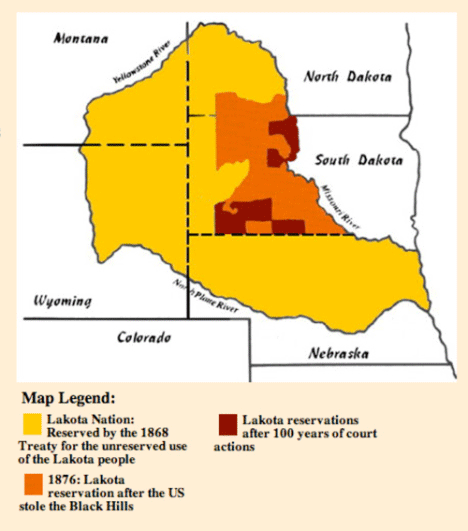
According to a report by Earthworks, “Mining not only exposes uranium to the atmosphere, where it becomes reactive, but releases other radioactive elements such as thorium and radium and toxic heavy metals including arsenic, selenium, mercury and cadmium. Exposure to these radioactive elements can cause lung cancer, skin cancer, bone cancer, leukemia, kidney damage and birth defects.”
Today, in the northern great plains states of Wyoming, Montana and the Dakotas, the memory of that uranium mining exists in the form of 2,885 abandoned open pit uranium mines. All of the abandoned mines can be found on land that is supposed to be for the absolute use of the Great Sioux Nation under the 1868 Fort Laramie Treaty with the United States.
There are also 1,200 abandoned uranium mines in the Navajo Nation, where cancer rates are also significantly disproportionate. In fact, it is estimated that 60 to 80 percent of all uranium in the United States is located on tribal land, and three fourths of uranium mining worldwide is on Indigenous land.
Defenders of the Black Hills, a group whose mission is to preserve, protect, restore, and respect the area of the 1851 and 1868 Fort Laramie Treaties, is calling the health situation in their own territoryAmerica’s Chernobyl. Continue reading
Australia’s scandalous history of disease and death from nuclear bomb testing
A powerful manuscript entitled “The Black Mist and its Aftermath — Oral Histories by Lallie Lennon” (2010) was submitted to the South Australian and federal governments as well as to the International Atomic Energy Agency
Now aged in her 80s, Lallie has never had her health issues properly investigated, much less received any compensation. She continues to suffer from the beta burn-related skin condition to this day.
Professor Sir Ernest Titterton, the duplicitous architect of nuclear testing in Australia, typified the official contempt for survivors when he dismissed the Black Mist event as a “scare campaign”.
More recently, the ultra-right wing Herald Sun columnist Andrew Bolt has repeated this line.
Australian atomic massacre still ignored http://www.greenleft.org.au/node/54394, June 29, 2013 By David T. Rowlands Nearly 60 years have passed since Totem 1, a British nuclear test in the Australian desert, was recklessly conducted in unfavourable meteorological conditions.
Nuclear testing of any sort, even in the most “controlled” of circumstances, is inherently abusive, a crime against the environment and humanity for countless generations to come. Yet the effects of Totem 1 were particularly bad, even by the warped standards of the era.
The mushroom cloud did not behave in the way it was supposed to. Instead of rising uniformly, part of it spread laterally, causing fallout to roll menacingly at ground level over a remote yet still populated corner of South Australia, sowing injury, illness and death in its wake.
The number of casualties is unknown because the secretive and unaccountable nuclear establishment has always declined to investigate the full impact of its own criminal negligence. But it has been suggested by investigators that perhaps 50 short-term Aboriginal fatalities resulted.
In addition to those who died, many others were exposed to harmful levels of radiation. The long-term health effects on these individuals have never been charted — but anecdotal reports of high cancer rates and horrendous birth defects in isolated “downwinder” communities have circulated.
At the time of the tests, it was well known by authorities that communities of Aboriginal people were close by. Yet the official attitude was that the concerns of a “handful of natives” could not be allowed to interfere with the “interests” of the British Commonwealth. Continue reading
1 This Month



Shut down the radiation-damaged Heysham nuclear reactors now
To see nuclear-related stories in greater depth and intensity – go to https://nuclearinformation.wordpress.com

Say No to NASA’s Reckless Nuclear Reactor on the Moon
Say No to NASA’s Reckless Nuclear Reactor on the Moon
-
Archives
- October 2026 (256)
- September 2026 (339)
- August 2026 (330)
- July 2026 (355)
- June 2026 (287)
- May 2026 (306)
- April 2026 (356)
- March 2026 (251)
- February 2026 (267)
- January 2026 (308)
- December 2025 (358)
- November 2025 (359)
-
Categories
- 1
- 1 NUCLEAR ISSUES
- business and costs
- climate change
- culture and arts
- ENERGY
- environment
- health
- history
- indigenous issues
- Legal
- marketing of nuclear
- media
- opposition to nuclear
- PERSONAL STORIES
- politics
- politics international
- Religion and ethics
- safety
- secrets,lies and civil liberties
- spinbuster
- technology
- Uranium
- wastes
- weapons and war
- Women
- 2 WORLD
- ACTION
- AFRICA
- Atrocities
- AUSTRALIA
- Christina's notes
- Christina's themes
- culture and arts
- Events
- Fuk 2022
- Fuk 2023
- Fukushima 2017
- Fukushima 2018
- fukushima 2019
- Fukushima 2020
- Fukushima 2021
- general
- global warming
- Humour (God we need it)
- Nuclear
- RARE EARTHS
- Reference
- resources – print
- Resources -audiovicual
- Weekly Newsletter
- World
- World Nuclear
- YouTube
-
RSS
Entries RSS
Comments RSS