Navajos copped uranium pollution, now they’re to do the clean-up

they always give the dirty jobs to indigenous people
NAU seeks Navajos for uranium cleanup training http://www.sunherald. com/2013/11/25/5146098/nau-seeks-navajos-for-uranium.html BY FELICIA FONSECA Associated PressNovember 25, 2013 FLAGSTAFF, ARIZ. — Northern Arizona University is using federal grant money to address two of the most widespread problems on the Navajo Nation — unemployment and uranium contamination.
A $200,000 grant from the U.S. Environmental Protection Agency will allow the school’s Institute for Tribal Environmental Professionals to train up to 40 people over three years to safely handle radioactive materials and to find a job in a place where the unemployment rate hovers around 50 percent.
About 4 million tons of uranium ore were mined from the reservation from 1944 to 1986 for wartime weapons, leaving a legacy of death and disease. Families still live among the contamination that the tribe and federal government are working toward cleaning up. The top priority is the former Northeast Church Rock Mine near Gallup, N.M. Continue reading
Films show Navajo and Pueblo victims of uranium ndustry
 Navajo Pueblo Nuclear Holocaust Focus of International Uranium Film Festival Southwest By Brenda Norrell Censored News, 5 Nov 13 The International Uranium Film Festival will feature two films focused on the Navajo and Pueblo areas where both Navajos and Pueblos were — and are — victims of Cold War uranium mining and radioactive tailings left behind.
Navajos and Pueblos were sent to their deaths without protective clothing, even though the US government and mining companies knew of the dangers of radiation.
The poisoning of the people did not end there. The dust from the uranium mines blew across their food drying in the sun. The women washed clothes filled with radioactive soot. The runoff poisoned both the wildlife, including the deer that was food, the waterways, and the people.
The legacy of death continues today, as radioactive tailings remain scattered across this region of Pueblos and the Navajo Nation, between Albuquerque, New Mexico and Flagstaff, Arizona. In the Navajo communities of Cove and Red Valley, near Shiprock, N.M. every family had members stricken with respiratory diseases, cancer and other rare diseases. One elderly Navajo woman in her 80s was living in a radioactive hogan, built with radioactive stones.
The film, Dii’go To Baahaane Four Stories about Water, in Dine’ (Navajo) with English subtitles, and the film Tailings, will be shown at the Uranium Film Festival in Albuquerque. Schedules are still being prepared for the festivals in Santa Fe, and in Window Rock on the Navajo Nation……. http://bsnorrell.blogspot.com.au/2013/11/navajo-pueblo-nuclear-holocaust-focus.html
African Americans’ proud history against nuclear weapons
 The Civil Rights Movement and Nuclear Test Ban Treaty HUFFINGTON POST, Vincent Intondi 10/07/2013“………..having the first African American president also advocate for nuclear disarmament should not come as a surprise. President Obama was simply following in the path of those before him. Indeed, since 1945, many in the African American community, including some of the most prominent black leaders in U.S. history, actively supported nuclear disarmament, often connecting the nuclear issue with the fight for racial equality and liberation movements around the world. And it was due, in part, to these black activists, including Dr. Martin Luther King Jr., and his wife, Coretta, that President Kennedy was able to pass the partial nuclear test ban treaty fifty years ago this week. Continue reading
Saugeen Ojibway Nations (SON) community won’t agree to Ontario nuclear waste dump in any hurry
Securing approval for nuclear waste site won’t be ‘quick or easy process’: First Nations “If things go south in a hurry, where do our people go? We do not have the luxury of picking up and leaving.” The Star, By: John Spears Business reporter, on Mon Sep 16 2013 KINCARDINE—First Nations communities near Ontario Power Generation’s proposed nuclear waste disposal facility won’t be rushed into supporting the project, a federal hearing has been told. Continue reading
Australian government colludes with uranium miners in displacing Aboriginals from their homelands
“As an elder of the Yankunytjatjara and the APY Lands I state my absolute disappointment and disgust with the governments of South Australia and the Commonwealth. I say “NO” to mining in APY Lands and I say “NO” to homeless centres being built for our people away from their traditional homelands.”
Elder believes the APY Land is being dismantled http://cooberpedyregionaltimes.files.wordpress.com/2008/11/coober-pedy-regional-times-12-09-2013.pdf, by Yami Lester, (OAM) Order of Australia Medal)
Yankunytjatjara Elder Yami Lester is deeply disturbed by the exodus of Anangu from the APY Lands over the past several years. Big mining has been approved for the area but there are no jobs.. He says many families are not returning, causing a decline in the population of the lands. Lester who was awarded the Order of Australia medal in 1981 for service in the field of Aboriginal Welfare says,“The governments are now impatient to mix Anangu into the mainstream, hundreds of kilometres from their homelands.
Radioactive fallout on Polynesia, from French atomic testing, far greater than they said
 French nuclear tests ‘showered vast area of Polynesia with radioactivity’ http://www.guardian.co.uk/world/2013/jul/03/french-nuclear-tests-polynesia-declassified Angelique Chrisafis in Paris The Guardian, Thursday 4 July 2013
Declassified papers show extent of plutonium fall-out from South Pacific tests of 60s and 70s was kept hidden, says French paper French nuclear tests in the South Pacific in the 1960s and 1970s were far more toxic than has been previously acknowledged and hit a vast swath of Polynesia with radioactive fallout, according to newly declassified ministry of defence documents which have angered veterans and civilians’ groups. Continue reading
Legal fightback by Native Americans against uranium mining
The proposed legislation can be found at the website of Defenders of the Black Hills,
Uranium Mining and Native Resistance: The Uranium Exploration and Mining Accountability Act http://intercontinentalcry.org/uranium-mining-and-native-resistance-the-uranium-exploration-and-mining-accountability-act/ BY CURTIS KLINE • JUL 2, 2013 NATIVE AMERICANS IN THE NORTHERN GREAT PLAINS HAVE THE HIGHEST CANCER RATES IN THE UNITED STATES, PARTICULARLY LUNG CANCER. IT’S A PROBLEM THAT THE UNITED STATES GOVERNMENT HAS WOEFULLY IGNORED, MUCH THE HORROR OF THE MEN AND WOMEN WHO MUST CARRY THE PAINFUL, LIFE-THREATENING BURDEN.
The cancer rates started increasing drastically a few decades after uranium mining began on their territory.
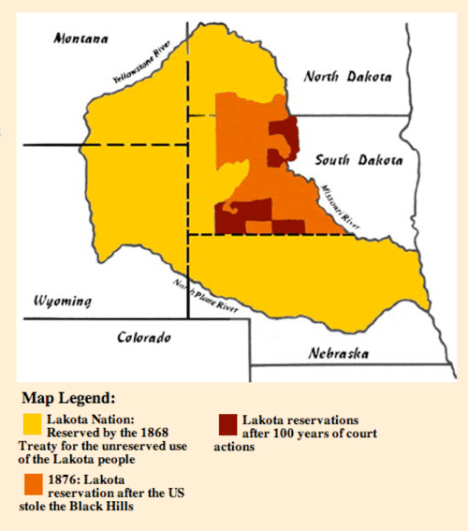
According to a report by Earthworks, “Mining not only exposes uranium to the atmosphere, where it becomes reactive, but releases other radioactive elements such as thorium and radium and toxic heavy metals including arsenic, selenium, mercury and cadmium. Exposure to these radioactive elements can cause lung cancer, skin cancer, bone cancer, leukemia, kidney damage and birth defects.”
Today, in the northern great plains states of Wyoming, Montana and the Dakotas, the memory of that uranium mining exists in the form of 2,885 abandoned open pit uranium mines. All of the abandoned mines can be found on land that is supposed to be for the absolute use of the Great Sioux Nation under the 1868 Fort Laramie Treaty with the United States.
There are also 1,200 abandoned uranium mines in the Navajo Nation, where cancer rates are also significantly disproportionate. In fact, it is estimated that 60 to 80 percent of all uranium in the United States is located on tribal land, and three fourths of uranium mining worldwide is on Indigenous land.
Defenders of the Black Hills, a group whose mission is to preserve, protect, restore, and respect the area of the 1851 and 1868 Fort Laramie Treaties, is calling the health situation in their own territoryAmerica’s Chernobyl. Continue reading
Australia’s scandalous history of disease and death from nuclear bomb testing
A powerful manuscript entitled “The Black Mist and its Aftermath — Oral Histories by Lallie Lennon” (2010) was submitted to the South Australian and federal governments as well as to the International Atomic Energy Agency
Now aged in her 80s, Lallie has never had her health issues properly investigated, much less received any compensation. She continues to suffer from the beta burn-related skin condition to this day.
Professor Sir Ernest Titterton, the duplicitous architect of nuclear testing in Australia, typified the official contempt for survivors when he dismissed the Black Mist event as a “scare campaign”.
More recently, the ultra-right wing Herald Sun columnist Andrew Bolt has repeated this line.
 Australian atomic massacre still ignored http://www.greenleft.org.au/node/54394, June 29, 2013 By David T. Rowlands Nearly 60 years have passed since Totem 1, a British nuclear test in the Australian desert, was recklessly conducted in unfavourable meteorological conditions.
Nuclear testing of any sort, even in the most “controlled” of circumstances, is inherently abusive, a crime against the environment and humanity for countless generations to come. Yet the effects of Totem 1 were particularly bad, even by the warped standards of the era.
The mushroom cloud did not behave in the way it was supposed to. Instead of rising uniformly, part of it spread laterally, causing fallout to roll menacingly at ground level over a remote yet still populated corner of South Australia, sowing injury, illness and death in its wake.
The number of casualties is unknown because the secretive and unaccountable nuclear establishment has always declined to investigate the full impact of its own criminal negligence. But it has been suggested by investigators that perhaps 50 short-term Aboriginal fatalities resulted.
In addition to those who died, many others were exposed to harmful levels of radiation. The long-term health effects on these individuals have never been charted — but anecdotal reports of high cancer rates and horrendous birth defects in isolated “downwinder” communities have circulated.
At the time of the tests, it was well known by authorities that communities of Aboriginal people were close by. Yet the official attitude was that the concerns of a “handful of natives” could not be allowed to interfere with the “interests” of the British Commonwealth. Continue reading
Australia destroyed Aboriginals’ reputation, to get land for uranium mining
Government had made it clear that it wished to re-engage itself more directly in the control of community land through leasing options as well as to open up Aboriginal land for development and mining purposes.
The plan was to empty the homelands, and this has not changed. However, it was recognised that achieving this would be politically fraught – it would need to be accomplished in a manner that would not off-side mainstream Australia. Removing Aboriginal people from their land and taking control over their communities would need to be presented in a way that Australians would believe it to be to Aboriginal advantage, whatever the tactics.
So began the campaign to discredit the people and to publicly stigmatise Aboriginal men of the Northern Territory
And even in 2009 when the CEO of the Australian Crime Commission, John Lawler, reported that his investigation had shown there were no organised paedophile rings operating in the NT, no formal apology was ever made to the Aboriginal men and their families who were brutally shamed by the false claims.
Sixth Anniversary of the Northern Territory Intervention – Striking the Wrong Note Lateral Love Australia‘concerned Australians’ Michele Harris, 21 June 13 Aboriginal advocate Olga Havnen, in her Lowitja O’Donoghue oration has asked a critical question. She asks what has been the psychological impact of the Intervention on Aboriginal people of the Northern Territory. It is surprising that so little attention has been given to this critical, yet in some ways tenuous, link before now.
Even before the Intervention began in June 2007, government had long planned a new approach to the ‘management’ of Aboriginal people in the Northern Territory. It was no longer part of government thinking that self-determination and Aboriginal control over land could be allowed to continue. These were the Whitlam notions of 1975 and they were no longer acceptable. Continue reading
Corporate land grabbing from indigenous peoples
Ultimately, the most affected aren’t the [indigenous] leaders who are comfortable in their palaces –most of them for more than two decades in power. The real losers in this are ordinary people in African countries.
As the G8 meet in Northern Ireland, the spotlight has been brought back to taxes and role of multi-nationals in developing countries. It is not just tax evasion and tax holidays that governments provide them that hurt developing economies but land grabbing has also become an every day reality in most African countries. Some companies involved are from these G8 countries.
More work on the ground needs to be done for local communities to have their rights to land well kept as governments push in favour of foreign companies
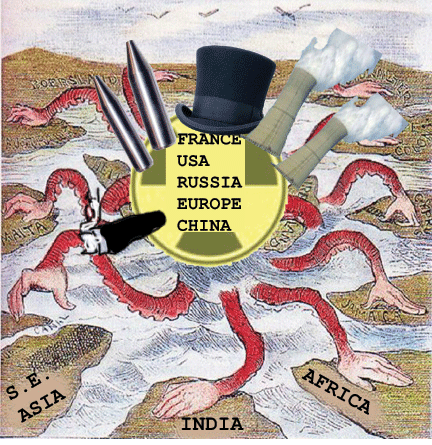
Push for transparency at G8 alone will not solve land grabs in Africa Rose Bell’s blog JUNE 17, 2013 In 2012, a few months before he passed away, Ethiopian Prime Minister Meles Zenawi while attending the World Economic Forum on Africa was asked a question that intrigues most African citizens. Why do African leaders- revolutionaries turn to looting their own countries once in power? The brainy later leader of Ethiopia responded by highlighting foreign corporations’ role in impoverishing Africa. He hinted that African leaders, in their quest to find jobs for an increasing unemployed population, were being held hostage by corporations that come in to invest.
Global indigenous movement challenging mining interests
Consider that when global actors invest in Canadian or Australian mines – or indeed, when Canadian mining companies seek to operate in Latin America – they do so on the premise that title to the lands and
resources is assured. Increasingly, that premise is being called into question, as Indigenous people use domestic and international law, the press and the mechanisms of environmental activism to shut down mine sites…….
Toward an Aboriginal Grand Strategy, Global Brief, DOUGLAS SANDERSON June 21, 2013 “Classical wampum diplomacy may be dead and gone. But North America’s Indigenous people are once again power players…….today, in the year 2013, Indigenous people are resurgent: their claims to protection of their lands and interests are increasingly being heeded by the courts. Indeed, these Aboriginal interests are intersecting decisively with the economic interests of states and the profitability of major companies. Continue reading
Northern Territory of Australia hosted first World Indigenous Network Conference
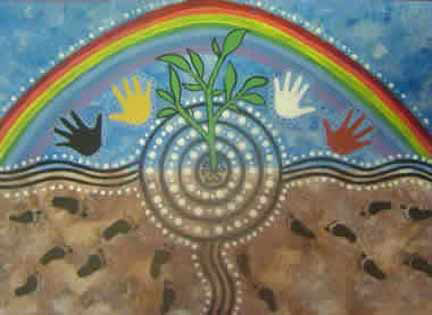 …a worldwide movement of Indigenous Peoples to highlight their strong connections to ancestral territories and waters and ever greater recognition by governments and international community of the importance of these connections”.
Summary of ICCA Consortium participation at World Indigenous Network (WIN) Conference http://iccaconsortium.wordpress.com/2013/06/13/summary-of-icca-consortium-participation-at-world-indigenous-network-win-conference/ June 13, 2013 Darwin, Australia – A small yet strategic group comprising 10 delegates from countries such as Iran, Philippines, Nepal, Pakistan, Taiwan, Zimbabwe and Australia associated with ICCA Consortium participated in the first World Indigenous Network (WIN) Indigenous and Local Communities Land and Sea Mangers’ Conference, May 26-30 in Darwin, Australia. Continue reading
Uranium mining continues to radioactively poison land and water in USA
Uranium Mine Pits Continue to Leak Radiation Today
Radiation and heavy metals from uranium mines continue to pollute the land, air and water today and very little action is being taken to stop it.
America’s “Secret Fukushima”: Uranium Mining is Poisoning the Bread Basket of the World By Margaret Flowers and Kevin Zeese Global Research, June 07, 2013 Truthout Early in the morning of July 16, 1979, a 20-foot section of the earthen dam blocking the waste pool for the Church Rock Uranium Mill caved in and released 95 million gallons of highly acidic fluid containing 1,100 tons of radioactive material. The fluid and waste flowed into the nearby Puerco River, traveling 80 miles downstream, leaving toxic puddles and backing up local sewers along the way.

Although this release of radiation, thought to be the largest in US history, occurred less than four months after the Three Mile Island partial nuclear meltdown that sent radioactive gases and iodine into the air, the Church Rock spill received little media attention. In contrast, the Three Mile Island accident made the headlines. And when the residents of Church Rock asked their governor to declare their community a disaster area so they could get recovery assistance, he refused. Continue reading
Heavy illness price paid by indigenous people in uranium mining
A few decades after uranium mining began in the Navajo Nation, increased numbers of cancer cases, lung cancer in particular, began to show up in the miners. A 2008 literature review in New Mexico found that the “Risk of lung cancer among male Navajo uranium miners was 28 times higher than in Navajo men who never mined, and two-thirds of all new lung cancer cases in Navajo men between 1969 and 1993 was attributable to a single exposure — underground uranium mining. Through 1990, death rates among Navajo uranium miners were 3.3 times greater than the U.S. average for lung cancer and 2.5 times greater for pneumoconioses and silicosis.”
America’s “Secret Fukushima”: Uranium Mining is Poisoning the Bread Basket of the World By Margaret Flowers and Kevin Zeese Global Research, June 07, 2013 Truthout
“……..Thousands of open uranium mines excavated beginning in the 1950s continues to release radiation today. There have been inadequate measurements but the limited measures done show ongoing leaks larger than Fukushima. How did we get here?
It is estimated that 60 to 80 percent of uranium in the US is located on tribal land, particularly in the lands of the Navajo and Great Sioux Nations. After WWII, the United States Atomic Energy Commission (AEC) was created so that the US could obtain uranium for weapons production domestically. The AEC guaranteed that it would purchase all uranium that was mined. A uranium boom ensued. Private corporations jumped in and, in areas of South Dakota, individuals started mining for uranium on their private lands unaware of the dangers.
Private corporations set up thousands of underground and open pit uranium mines on tribal lands and hired local native Indians at low wages. Other than jobs, the uranium mines brought little benefit to these nations because the lands were given to non-Indian companies such as Kerr-McGee, Atlantic Richfield, Exxon and Mobil. Native Indians had little control over what took place. Continue reading
The fight to save Grand Canyon from uranium radioactive contamination
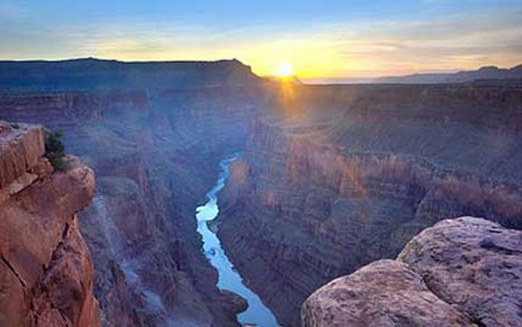 Tribes, Enviros Fight Uranium Mining Near Grand Canyon KPBS, June 3, 2013 By Laurel Morales “……environmentalists and Indian tribes oppose mining near the canyon. On a recent sunny day EcoFlight pilot Gary Kraft steered the six-seat Cessna onto the tarmac of the Grand Canyon Airport and gracefully took off. He flew a group over the Grand Canyon to check out mines from above.
“As Gary brings the plane around we’ll get a little better look at the site,” said Grand Canyon Trust’s Roger Clark who served as our guide.
He has been fighting uranium mining companies for many years. Last year he scored a victory. The Obama Administration put a ban on any new mining claims on federal land surrounding the park. In the 1980s and 1990s a dozen mines pocked the landscape surrounding the park. All but a few have been cleaned up and reseeded. But a handful of older claims are still being mined. Continue reading
1 This Month

of the week – Shut Down Drone Warfare!


Tell the Ukrainian Government to Drop Prosecution of Peace Activist Yurii Sheliazhenko

Petition to revoke the licensing of the Near Surface Nuclear Disposal Facility (NSDF) at Chalk River. https://www.ourcommons.ca/petitions/en/Petition/Details?Petition=e-7247
To see nuclear-related stories in greater depth and intensity – go to https://nuclearinformation.wordpress.com
-
Archives
- March 2026 (244)
- February 2026 (268)
- January 2026 (308)
- December 2025 (358)
- November 2025 (359)
- October 2025 (376)
- September 2025 (257)
- August 2025 (319)
- July 2025 (230)
- June 2025 (348)
- May 2025 (261)
- April 2025 (305)
-
Categories
- 1
- 1 NUCLEAR ISSUES
- business and costs
- climate change
- culture and arts
- ENERGY
- environment
- health
- history
- indigenous issues
- Legal
- marketing of nuclear
- media
- opposition to nuclear
- PERSONAL STORIES
- politics
- politics international
- Religion and ethics
- safety
- secrets,lies and civil liberties
- spinbuster
- technology
- Uranium
- wastes
- weapons and war
- Women
- 2 WORLD
- ACTION
- AFRICA
- Atrocities
- AUSTRALIA
- Christina's notes
- Christina's themes
- culture and arts
- Events
- Fuk 2022
- Fuk 2023
- Fukushima 2017
- Fukushima 2018
- fukushima 2019
- Fukushima 2020
- Fukushima 2021
- general
- global warming
- Humour (God we need it)
- Nuclear
- RARE EARTHS
- Reference
- resources – print
- Resources -audiovicual
- Weekly Newsletter
- World
- World Nuclear
- YouTube
-
RSS
Entries RSS
Comments RSS
 nuclear-news