The bitter history of Malaysia’s Bukit Merah rare earths project.
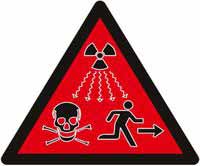 Some of the surviving residents of Bukit Merah are still plagued with severe health problems. Until this very day, the Malaysian authorities refuse to acknowledge that the radioactive waste was responsible for the sudden escalation of health problems among the residents
Today, the government is the official custodian of this repository in Bukit Merah. This site in Bukit Merah is declared as a restricted and dangerous dump site for radioactive materials but a curtain of official silence has descended on it. Has the government not learnt from Bukit Merah?
The Lynas project is likely to be a replay of the ARE fiasco but on a much larger scale.
The benefits gained by Malaysia from the Lynas investment are very little relative to the risks involved. Whilst the profits of the project go to Lynas (untaxed) and the few Malaysian companies that are involved in the construction of and the provision of supplies to the Gebeng rare earth plant, the radioactive waste will remain in
Malaysian soil for hundreds of years.
 Lynas issue: Not learning from bitter experience —The Malaysian Insider, Richard Pendragon, April 12, 2012 “……..Bukit Merah The history of the rare earth industry in Malaysia is little known to most Malaysians. Most Malaysians in fact think that the Lynas project in Pahang is the first time Malaysia has been associated with this industry.
Few Malaysians actually know that there was a rare earth plant in Bukit Merah, Perak, which has been closed some 10 or more years ago, following a ruling by the High Court of Malaysia that the company involved was in negligence, and that the radioactive waste generated by the plant was dangerous and had to be removed and secured in a safe
place away from people for hundreds of years.
The evidence of the hazardous legacy of this rare earth plant is still present in our midst as a reminder to every one of the risks involved. Continue reading
Mystery of USA’s lost nuclear attack submarine
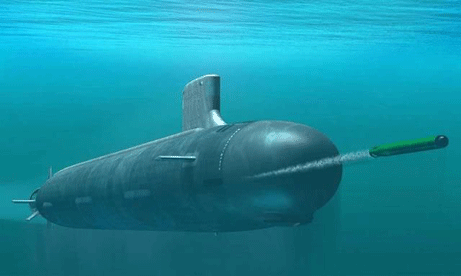 Experts out to solve deep-sea mystery of the USS Scorpion By Dan Vergano, USA TODAY 12 April 12, Shipwreck disaster experts are calling for a deep-sea expedition to a lost U.S. nuclear attack sub, the USS Scorpion, in an effort to verify a new theory on what caused the Cold War vessel to sink. Continue reading
The Czech Republic’s cruel history of uranium mining
Around 80,000 people are believed to have been sentenced to work in the uranium mines by the Czechoslovak communist regime
A cheap and plentiful source of labor was concocted by the communist regime as it turned on its real and imaginary enemies after taking power…. Brutal conditions in the mines and the camps
Czech historian produces death tally for communist uranium camps Czech historian says he has drawn up the first accurate death tally for the former communist regime’s uranium labor camps Czech Position.com Chris Johnstone | 05.04.2012 A Czech historian has drawn up the first list of prisoners who perished in the Czechoslovak communist regime’s infamous network of uranium mining camps. Continue reading
Hypocrisy and racism – Australia’s sorry nuclear history

 Dumping on Traditional Owners: the ugly face of Australian racism The Drum, 29 March 12 The nuclear industry has been responsible for some of the crudest racism in Australia’s history.
This racism dates from the British nuclear bomb tests in the 1950s but it can still be seen today.
The British government conducted 12 nuclear bomb tests in Australia in the 1950s, most of them at Maralinga in South Australia. Permission was not sought from affected Aboriginal groups such as the Pitjantjatjara, Yankunytjatjara, Tjarutja and Kokatha. Thousands of people were adversely affected and the impact on Aboriginal people was particularly profound.
Many Aboriginal people suffered from radiological poisoning. There are tragic accounts of families sleeping in the bomb craters. So-called ‘Native Patrol Officers’ patrolled thousands of square kilometres to try to ensure that Aboriginal people were removed before nuclear tests took place. Signs were erected in some places – written in English, which few in the affected Indigenous communities could understand. The 1985 Royal Commission found that regard for Aboriginal safety was characterised by “ignorance, incompetence and cynicism”. Many Aboriginal people were forcibly removed from their homelands and taken to places such as the Yalata mission in South Australia, which was effectively a prison camp.
In the late-1990s, the Australian government carried out a clean-up of the Maralinga nuclear test site. It was done on the cheap and many tonnes of debris contaminated with kilograms of plutonium remain buried in shallow, unlined pits in totally unsuitable geology. As nuclear engineer and whistleblower Alan Parkinson said of the ‘clean-up’ on ABC radio in August 2002:
“What was done at Maralinga was a cheap and nasty solution that wouldn’t be adopted on white-fellas land.”
Despite the residual contamination, the Federal Government has off-loaded responsibility for the land onto the Maralinga Tjarutja Traditional Owners. The Government portrays this land transfer as an act of reconciliation, but the real agenda was spelt out in a 1996 government document which states that the clean-up was “aimed at reducing Commonwealth liability arising from residual contamination.”….. http://www.abc.net.au/unleashed/3919296.html
Misunderstanding, wrong translation of Ahmadinejad’s supposed words “Israel must be wiped off the map”
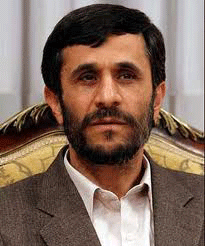 from Wikileaks: Translation controversy Many news sources repeated the Islamic Republic of Iran Broadcasting statement by Ahmadinejad that “Israel must be wiped off the map”,[5][6] an English idiom which means to “cause a place to stop existing”,[7] or to “obliterate totally”,[8] or “destroy completely”.[9]
Ahmadinejad’s phrase was “بايد از صفحه روزگار محو شود” according to the text published on the President’s Office’s website.[10]
The translation presented by the official Islamic Republic News Agency has been challenged by Arash Norouzi, who says the statement “wiped off the map” was never made and that Ahmadinejad did not refer to the nation or land mass of Israel, but to the “regime occupying Jerusalem”. Norouzi translated the original Persian to English, with the result, “the Imam said this regime occupying Jerusalem must vanish from the page of time.”[11] Juan Cole, a University of Michigan Professor of Modern Middle East and South Asian History, agrees that Ahmadinejad’s statement should be translated as, “the Imam said that this regime occupying Jerusalem (een rezhim-e eshghalgar-e qods) must [vanish from] the page of time (bayad az safheh-ye ruzgar mahv shavad).[12] According to Cole, “Ahmadinejad did not say he was going to ‘wipe Israel off the map’ because no such idiom exists in Persian.” Instead, “he did say he hoped its regime, i.e., a Jewish-Zionist state occupying Jerusalem, would collapse.”[13] The Middle East Media Research Institute (MEMRI) translated the phrase similarly, as “this regime” must be “eliminated from the pages of history.”[14]
Iranian government sources denied that Ahmadinejad issued any sort of threat. On 20 February 2006, Iran’s foreign minister Manouchehr Mottaki told a news conference: “How is it possible to remove a country from the map? He is talking about the regime. We do not recognize legally this regime.”[15][16][17]
Historical record shows that USA’s Republicans cut nuclear arms
GOP takes lead in nuclear arms cuts, Times Union .com Associated Press, February 18, 2012 WASHINGTON — The Obama administration’s consideration of severe cuts in nuclear weapons generated a flurry of GOP criticism — “reckless lunacy” in the words of Arizona Rep. Trent Franks. But the historical record shows that in the two decades since the Cold War ended, Republicans have been the boldest cutters of the nuclear arsenal.
“Republican presidents seem to have a thing for 50 percent nuclear reductions,” says Hans Kristensen, a nuclear arms specialist with the Federation of American Scientists, a think tank founded by many of the scientists who built the first atomic bombs.
On President George H.W. Bush‘s watch, the number of deployed weapons as well as those held in reserve was nearly cut in half, from 22,217 to 13,708 warheads, according to official government figures. President George W. Bush went further, cutting the total stockpile by 50 percent, from 10,526 to 5,273 warheads.
Democratic President Bill Clinton trimmed just a little more than 2,000 warheads from the stockpile…… Read more: http://www.timesunion.com/news/article/GOP-takes-lead-in-nuclear-arms-cuts-3341848.php#ixzz1mxcZGzul
Spain wants USA to clean up plutonium pollution B-52 bomber accident
 two of the bombs that hit the ground detonated, spreading seven pounds of plutonium over a 200 hectares (490 acres).
US and Spain discuss cleanup of nuclear radiation, PhysOrg.com, February 5, 2012 The United States is offering technical assistance to Spain to clean up land contaminated by radiation from undetonated nuclear bombs that accidentally fell on the area in 1966, Continue reading
Nuclear bombing of Hiroshima immoral and unnecessary
 the Americans and British had long crossed the moral frontier about terror-bombing civilians…
The Americans didn’t want the Japanese to surrender before they had a chance to drop the bomb.
 Weapon of choice, Review By Hamish Mcdonald,December 17, 2011 “……. Now Paul Ham, already established as the best of Australia’s popular war historians, has painted more detail on a wider canvas. Through individual stories, he doesn’t spare us the horrifying reality on the
ground. Almost as excruciatingly, he takes us through the practical and moral decisions about using the bomb……..
Many of the scientists who had urged the development of the atomic bomb to pre-empt Hitler became opposed to its use against Japan. Some petitioned for a demonstration explosion instead. ….. Continue reading
American complicity in Japan’s secret nuclear weapons plans
Kishi uttered the famous statement that “nuclear weapons are not expressly prohibited” under the postwar Constitution’s Article 9 prohibiting war-making powers. His words were repeated two years ago by his grandson, then Prime Minister Shinzo Abe.
Secret Weapons Program Inside Fukushima Nuclear Plant? Global Research, 12/4/11 by Yoichi Shimatsu“…….During the Japanese militarist occupation of northeast China in the 1930s, the puppet state of Manchukuo was carved out as a fully modern economic powerhouse to support overpopulated Japan and its military machine……
After clawing his way into the good graces of Cold Warrior John Foster Dulles, Eisenhower’s secretary of state, Kishi was elected prime minister in 1957. His protégé Yasuhiro Nakasone, the former naval officer and future prime minister, spearheaded Japan’s campaign to become a nuclear power under the cover of the Atomic Energy Basic Law.
American Complicity Kishi secretly negotiated a deal with the White House to permit the U.S. military to store atomic bombs in Okinawa and Atsugi naval air station outside Tokyo. Continue reading
Background to India’s Koodankulam anti nuclear campaign
Heat rises beyond the smog in India AMANDA HODGE, SOUTH ASIA CORRESPONDENT : The Australian November 26, 2011 “ “…..The nucleus of the campaign to stop Koodankulam can be found near India’s southern-most tip in the Tamil Nadu fishing village of Idinthakarai, and the man driving it is SP Udayakumar. The articulate idealist with a doctorate in political science says that opposition to the project dates back to the late 1980s, when it was conceived as a symbol of the India-Soviet relationship. Continue reading
Iran’s history – how the West promoted the tragedy of Iran
 Iran a tragedy of the West’s own making. SMH, November 14, 2011 “…..The tragedy of this now oppressive theocratic state is that it was once the sole exemplary democracy in the Middle East. Its secular democracy was destroyed in 1953 by the US and Britain in a self-interested move to prevent Iran falling under the influence of the Soviet Union during the Cold War.
The imposition by the West of the Shah saw the establishment of a murderous and corrupt regime protected by the West to ensure the survival of Britain’s oil interests.
When the excesses of this regime became an embarrassment the West stood back as the Islamic revolution swept to power. Again the democratic forces were violently repressed by the new government…..
the West later supported the Saddam Hussein government in its war on Iran. Small wonder then that Iranians feel they have strong reasons to distrust and fear the West and its protege, Israel.
And given that the current oppressive Iranian regime has largely destroyed the remnant democratic forces in Iran, any chance of a democratic revolution is remote. The constant threat of military intervention and the sanctions imposed play into the hands of the present Iranian government… http://www.smh.com.au/national/letters/iran-a-tragedy-of-the-wests-own-making-20111113-1ndx3.html#ixzz1djIAWf2u
How corporate America, the CIA and Walt Disney talked Japan into nuclear technology
 The plan had the advantage of making allies dependent on technology from corporate giants General Electric Co. and Westinghouse,
 Tepco ‘Deal With Devil’ Signals End to Japan’s Postwar Era Bloomberg, October 21, 2011,“……….Hiroshima Bombing Japan’s development into the world’s third-biggest user of nuclear energy dates from the last days of the war. Yasuhiro Nakasone, who would later become Prime Minister and a powerful advocate of atomic energy, was serving as a naval officer in Japan when Hiroshima was bombed. After the war, he began the work of persuading the U.S. to sell Japan nuclear technology…..
Japan’s interest coincided with U.S. concern about what to do with its own surplus of weapons-grade plutonium, and the suspicion that created in the Soviet Union, Laura E. Hein wrote in “Fueling Growth — The Energy Revolution and Economic Policy in Postwar Japan.”
U.S. President Dwight Eisenhower’s solution was the “Atoms for Peace” program to use U.S. plutonium to provide nuclear fuel for its allies. Continue reading
South Korea’s history of seeking nuclear weapons
 CIA documents shed light on S Korea’s nuke ambition in 1970s, The Korea Herald/Asia News Network, Sep 26, 2011 As the international community continues to grapple with how best to thwart North Korea’s nuclear ambitions, a Seoul-based publication has revealed declassified US Central Intelligence Agency documents shedding light on South Korea’s own efforts to acquire nuclear weapons four decades ago.
Global Asia, a publication of the East Asia Foundation in Seoul, said the previously secret US documents show that South Korea continued to develop nuclear weapons at least two years after Washington thought it had ceased during the 1970s……..
Park’s efforts to acquire nuclear weapons may have influenced North Korea’s own threat perception at the time, and fuelled the North’s desire to acquire its own nuclear weapons ? a fact that continues to be relevant today……
 these historical documents illustrate that engaging North Korea from a position of political, economic and military strength ? not extended nuclear deterrence ? remains the best policy option…http://www.asiaone.com/News/Latest%2BNews/Asia/Story/A1Story20110926-301465.html
Nuclear energy got huge startup subsidies, renewable energy gets pittance
Early subsidies to nuclear dwarf all others
Energy subsidy showdown: Fossil fuels, nuclear, biofuels vs. renewables, Smart PlanetBy Kirsten Korosec | September 23, 2011 Renewable energy has snagged just a fraction of the federal subsidies that fossil fuels and nuclear received when they were emerging technologies, according to a new report from venture capital firm DBL Investors. Continue reading
Radiation effects of Hiroshima and Nagasaki on WW2’s American soldiers
When the servicemen returned to the United States, many of them suffered from strange rashes and sores. Years later some were afflicted with disease (such as thyroid problems and leukemia) or cancer associated with radiation exposure. Little could be proven beyond a doubt, and all of their disability and compensation claims were denied,
 The Last Great Untold Story of World War II—and the Lingering Effects Today, THE NATION, Greg Mitchell, August 19, 2011 ”……..Most of the [U.S.]troops in Hiroshima were based in camps on the edge of the city, but a larger number did set up camps inside Nagasaki. Because of the alleged absence of residual radiation, no one was urged to take precautions. Some bunked down in buildings close to ground zero, even slept on the earth and engaged in cleanup operations, including disposing bodies, without protective gear. Few if any wore radiation detection badges.
“We walked into Nagasaki unprepared…. Really, we were ignorant about what the hell the bomb was,” one soldier would recall. Another vet said: “Hell, we drank the water, we breathed the air, and we lived in the rubble. We did our duty.” Continue reading
1 This Month
6 June – WEBINAR- Get Inspired by Protests Against Military Bases!


Cuba Is Not a Failed State – It Is a Besieged State
PETITION: “Global Appeal to Endorse Palestinian Right of Return of Refugees”


of the week– Nuclear Reactor Information Task Force
To see nuclear-related stories in greater depth and intensity – go to https://nuclearinformation.wordpress.com
-
Archives
- June 2026 (34)
- May 2026 (306)
- April 2026 (356)
- March 2026 (251)
- February 2026 (268)
- January 2026 (308)
- December 2025 (358)
- November 2025 (359)
- October 2025 (376)
- September 2025 (257)
- August 2025 (319)
- July 2025 (230)
-
Categories
- 1
- 1 NUCLEAR ISSUES
- business and costs
- climate change
- culture and arts
- ENERGY
- environment
- health
- history
- indigenous issues
- Legal
- marketing of nuclear
- media
- opposition to nuclear
- PERSONAL STORIES
- politics
- politics international
- Religion and ethics
- safety
- secrets,lies and civil liberties
- spinbuster
- technology
- Uranium
- wastes
- weapons and war
- Women
- 2 WORLD
- ACTION
- AFRICA
- Atrocities
- AUSTRALIA
- Christina's notes
- Christina's themes
- culture and arts
- Events
- Fuk 2022
- Fuk 2023
- Fukushima 2017
- Fukushima 2018
- fukushima 2019
- Fukushima 2020
- Fukushima 2021
- general
- global warming
- Humour (God we need it)
- Nuclear
- RARE EARTHS
- Reference
- resources – print
- Resources -audiovicual
- Weekly Newsletter
- World
- World Nuclear
- YouTube
-
RSS
Entries RSS
Comments RSS
 nuclear-news