Savannah River nuclear plant connected to unsuccessful diplomacy
Officials in Washington thought they had clinched a deal with Moscow to ensure that the Russian plutonium stockpile would shrink, only to discover after years of delay that Russia had other plans
How a Massive Nuclear Nonproliferation Effort Led to More Proliferation, The Atlantic, More than a decade of negotiations with Russia produced a clear winner, and it was not the United States. DOUGLAS BIRCH AND R. JEFFREY SMITHJUN 24 2013 SAVANNAH RIVER SITE, South Carolina “……The huge new nuclear fuel plant at Savannah River reached this shaky stage via a convoluted path. The idea behind it grew out of a crisis. Arms control agreements in the 1980s had left both the U.S. and the Soviet Union with huge stockpiles of fissile materials from dismantled warheads. The collapse of the Soviet economy left workers at vast weapons production complexes without heat, power or paychecks, a circumstance that threatened security and raised the risk of nuclear smuggling.
At least four times between 1994 and 2000, small amounts of smuggled plutonium were recovered by law-enforcement officials in Europe, the Caucasus and Central Asia, according to the International Atomic Energy Agency –all at the height of the Russian economic meltdown.
The United States and its allies worried these cases were the tip of an iceberg. Princeton physicist Frank von Hippel, a key player in the early push for a disposal agreement, recalls his surprise on visiting the huge Mayak nuclear complex in western Siberia in 1994. There, he found 30 metric tons of plutonium oxide from civilian reactors capable of being fashioned into bombs, stored in 12,000 tea-kettle-sized containers. A fence surrounded the reservation, but inside the gates all that stood between a thief and the plutonium was a padlock on the warehouse door and a nervous conscript guard.
A distinguished panel concluded in a special 2001 report for the Energy Secretary that the threat of diverted weapons materials from the former Soviet Union “is a clear and present danger, to the international community as well as to American lives and liberties.”
Nor has the risk of nuclear terror diminished since then, U.S. officials say. “Two decades after the end of the Cold War, we face a cruel irony of history –the risk of a nuclear confrontation between nations has gone down, but the risk of nuclear attack has gone up,” President Obama warned on the eve of an April 2010 global summit on nuclear security in Washington. Former vice president Dick Cheney told the American Enterprise Institute the following year that a terrorist with nuclear materials and know-how was “the most dangerous threat” the U.S. faced.
But even though the United States and Russia worked together to stem nuclear security problems in the 1990s, the two countries disagreed from the start about controlling plutonium. The U.S. view, initially, was that the best way to prevent the explosive from being used in new bombs was to lock it away in ceramic and glass.
Russia, though, was eager to tap the vast riches locked in its Cold War detritus. The country pressed to use its plutonium as fuel for a type of nuclear reactor that can actually produce more plutonium than it burns, in a form that is more easily used in nuclear explosives – a reactor known as a “breeder” that many Western experts say can promote a dangerous international trade in the nuclear explosive.
In a long struggle to resolve this disagreement, the Russians got the better of Washington, according to some experts who followed it closely. As a result, the South Carolina plant’s troubles partly reflect the fact that soaring U.S. national security ambitions were brought to earth by unsuccessful diplomacy. Officials in Washington thought they had clinched a deal with Moscow to ensure that the Russian plutonium stockpile would shrink, only to discover after years of delay that Russia had other plans…….” http://www.theatlantic.com/international/archive/2013/06/how-a-massive-nuclear-nonproliferation-effort-led-to-more-proliferation/277140/
How USA built a forest in order to atomic bomb it
How Do We Know Nuclear Bombs Blow Down Forests? Because we built a forest in Nevada and blew it down. Slate, By Ann Finkbeiner May 31, 2013, “……. Once the United States had built the first atomic bomb in 1945, it then improved it by building the first hydrogen bomb in 1952. It then began working on building more portable bombs, and since the Soviet Union had done the same, the United States also wondered about the bombs’ effects. So in the early 1950s, the government set up models of all the things that bombs could blow up—houses, bridges, cars, pigs, sheep—and exploded bombs near them. The government did this for at least a decade and didn’t stop until it and the rest of the world banned above-ground testing. The tests, many of them at the Nevada Test Site, were called “shots,” and they had names.
The shot called Encore was on May 8, 1953, and among the many effects it tested was what a nuclear bomb would do to a forest. The Nevada Test Site wasn’t replete with forests, so the U.S. Forest Service brought 145 ponderosa pines from a nearby canyon and cemented them into holes lined up in tidy rows in an area called Frenchman Flat, 6,500 feet from ground zero. Then the Department of Defense air-dropped a 27-kiloton bomb that exploded 2,423 feet above the model forest. The heat set fire to the forest, then the blast wave blew down the trees and put out some fires and started others.Here’s the video.
I’m not sure what I make of this. Certainly in the 1950s nobody was controlling nuclear weapons; they were alive, reproducing, and roaming the world. So knowing precisely what damage they cause might help mitigate that damage. And certainly I’m not going to think about the more distant and longer-term effects of those shots, more than 200 of them above ground, except to say that as a 10-year old girl in Illinois, even I wasn’t safe.
I do know I’m impressed by the amount of directed effort, the thoroughness of thought that went into cutting down 145 ponderosa pines, trucking them out of the canyon, digging holes, filling them with concrete, sticking the trees into them, dropping the bomb, and beginning the measurements. And though the United Nations belatedly began negotiating a ban on above-ground tests in 1955, the Limited Test Ban Treaty didn’t get signed until 1963. That was the limited treaty; the comprehensive one banning all tests everywhere took another 40-plus years, and even now the United States hasn’t ratified it.* I’m most impressed by the contrast between the pointed determination of the test shots and the infinite dithering about the (yes, infinitely more complicated) test bans. I might suspect that human nature and its governments have a dark side.
Add this little public service booklet, illustrated with the drawing above and written by the Atomic Energy Commission to the people of Nevada:
“You are in a very real sense active participants in the Nation’s atomic test program. … Some of you have been inconvenienced by our test operations. At times some of you have been exposed to potential risk from flash, blast, or fall-out. You have accepted the inconvenience or the risk without fuss, without alarm, and without panic. Your cooperation has helped achieve an unusual record of safety.”
Nevada population was exposed to nuclear bomb tests’ radioactive fallout
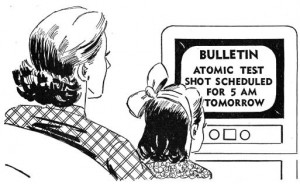 Add this little public service booklet, illustrated with the drawing at left and written by the Atomic Energy Commission to the people of Nevada:
“You are in a very real sense active participants in the Nation’s atomic test program. … Some of you have been inconvenienced by our test operations. At times some of you have been exposed to potential risk from flash, blast, or fall-out. You have accepted the inconvenience or the risk without fuss, without alarm, and without panic. Your cooperation has helped achieve an unusual record of safety.”
As though they were asked.
How Do We Know Nuclear Bombs Blow Down Forests? Because we built a forest in Nevada and blew it down. Slate, By Ann Finkbeiner May 31, 2013, “……. Once the United States had built the first atomic bomb in 1945, it then improved it by building the first hydrogen bomb in 1952. It then began working on building more portable bombs, and since the Soviet Union had done the same, the United States also wondered about the bombs’ effects. So in the early 1950s, the government set up models of all the things that bombs could blow up—houses, bridges, cars, pigs, sheep—and exploded bombs near them. The government did this for at least a decade and didn’t stop until it and the rest of the world banned above-ground testing. The tests, many of them at the Nevada Test Site, were called “shots,” and they had names.
The shot called Encore was on May 8, 1953, and among the many effects it tested was what a nuclear bomb would do to a forest. The Nevada Test Site wasn’t replete with forests, so the U.S. Forest Service brought 145 ponderosa pines from a nearby canyon and cemented them into holes lined up in tidy rows in an area called Frenchman Flat, 6,500 feet from ground zero. Then the Department of Defense air-dropped a 27-kiloton bomb that exploded 2,423 feet above the model forest. The heat set fire to the forest, then the blast wave blew down the trees and put out some fires and started others. Here’s the video. Continue reading
In 1983, nuclear war was only just avoided

While historians have previously noted the high risk of an accidental nuclear war during this period, the new documents make even clearer how the world’s rival superpowers found themselves blindly edging toward the brink of nuclear war through suspicion, belligerent posturing and blind miscalculation.
The USSR and US Came Closer to Nuclear War Than We Thought A series of war games held in 1983 triggered “the moment of maximum danger of the late Cold War.” The Atlantic, DOUGLAS BIRCHMAY 28 2013 An ailing, 69-year-old Yuri Andropov was running the Soviet Union from his Moscow hospital bed in 1983 as the United States and its NATO allies conducted a massive series of war games that seemed to confirm some of his darkest fears.
Two years earlier Andropov had ordered KGB officers around the globe to gather evidence for what he was nearly certain was coming: A surprise nuclear strike by the U.S. that would decapitate the Soviet leadership. …
The Western maneuvers that autumn,called Autumn Forge, , were depicted by the Pentagon as simply a large military exercise. But its scope was hardly routine, as Americans learned in detail this week, for the first time, from declassified documents published by the National Security Archive, a Washington-based nonprofit research organization. Continue reading
USA did nuclear tests to find out effects on animals
Veteran recalls 1940s radiation contamination study http://www.texarkanagazette.com/news/2013/05/27/veteran-recalls-1940s-radiation-contamin-470111.php By: Greg Bischof – Texarkana Gazette John Cary served in the Navy during World War II and participated in Operation Crossroads at Bikini Atoll. The operation consisted of two nuclear weapon tests to determine radiation’s effects on animals.
However, unlike the biblical Noah’s ark, the animals’ placement wasn’t to p…subscribers only
1957 Mayak nuclear disaster – the forgotten event near Ozyorsk
Ozyorsk was and remains a closed town because of its proximity to the Mayak plant,
To consider how insanely radioactive Lake Karachay is, think about this: Chernobyl disaster: 5-12 exabecquerels blown over thousands of square miles Lake Karachay: 4 exabecquerels in this tiny lake, less than a quarter of a mile in diameter. Even approaching the lake will get you a lethal dose within an hour. And they ARE starting to cover it up with concrete and gravel as the water evaporates. As the water recedes, they lay down dirt, gravel and concrete over the area so it can’t fill back in and the sediment doesn’t get disturbed by the wind.
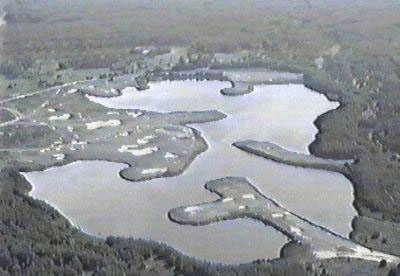
The 10 Worst Civilian Nuclear Accidents in History http://www.neatorama.com/2013/05/21/The-10-Worst-Civilian-Nuclear-Accidents-in-History/ Miss Cellania , May 21, 2013 Quick -how many nuclear accidents can you name? Chernobyl, Three Mile Island, Fukushima …any more? There have been quite a few nuclear accidents of varying danger that you probably never heard of, including some fatal incidents. For example, in 1957, nuclear waste exploded at a reactor near the Soviet town of Ozyorsk.
One of the storage tanks contained around 70 to 80 tons of radioactive liquid waste, and its cooling mechanism stopped working and wasn’t fixed. The tank’s contents, made up mostly of ammonium nitrate and acetates, began to dry out as the liquid heated up and evaporated. Moreover, the temperature increase caused an explosion whose force was equivalent to 70 to 100 tons of TNT, and this sent huge amounts of radioactivity – roughly 20 MCi (800 PBq) – into the environment. The fallout cloud from the explosion contaminated an area of up to 7,722 square miles (20,000 square kilometers).
Over a period of nearly two years, about 10,000 people were evacuated from the surrounding area. In terms of fatalities, the exact cost of the incident is not known, but immediately around the site of the explosion there were 66 diagnosed cases of chronic radiation syndrome.
Read more about the Ozyorsk incident and nine others in a list at Tech Graffiti. Link -via the Presurfer
1983 – how close it came to nuclear war
New Documents Reveal How a 1980s Nuclear War Scare Became a Full-Blown Crisis WIRED.COM, BY ROBERT BECKHUSE 05.16.13
During 10 days in November 1983, the United States and the Soviet Union nearly started a nuclear war. Newly declassified documents from the CIA, NSA, KGB, and senior officials in both countries reveal just how close we came to mutually assured destruction — over a military exercise.
That exercise, Able Archer 83, simulated the transition by NATO from a conventional war to a nuclear war, culminating in the simulated release of warheads against the Soviet Union. NATO changed its readiness condition during Able Archer to DEFCON 1, the highest level. The Soviets interpreted the simulation as a ruse to conceal a first strike and readied their nukes. At this period in history, and especially during the exercise, a single false alarm or miscalculation could have brought Armageddon……. http://www.wired.com/dangerroom/2013/05/able-archer-scare/
The horror of the Hiroshima atomic bombing – nuclear effects, theme for June 19
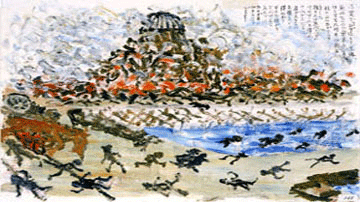 Who Will Drop the Next Nuclear Bomb? We ignore the ever-growing global arsenal of nuclear weapons at our peril. The Nation, Nick Turse May 13, 2013 “……..Nuclear Horror: Then and Now The first nuclear attack on a civilian population center, the U.S. strike on Hiroshima, left that city “uniformly and extensively devastated,” according to astudy carried out in the wake of the attacks by the U.S. Strategic Bombing Survey. “Practically the entire densely or moderately built-up portion of the city was leveled by blast and swept by fire… The surprise, the collapse of many buildings, and the conflagration contributed to an unprecedented casualty rate.” At the time, local health authorities reported that 60% of immediate deaths were due to flash or flame burns and medical investigators estimated that 15%-20% of the deaths were caused by radiation.
Witnesses “stated that people who were in the open directly under the explosion of the bomb were so severely burned that the skin was charred dark brown or black and that they died within a few minutes or hours,” according to the 1946 report. “Among the survivors, the burned areas of the skin showed evidence of burns almost immediately after the explosion. At first there was marked redness, and other evidence of thermal burns appeared within the next few minutes or hours.”

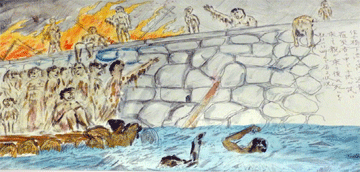 Many victims kept their arms outstretched because it was too painful to allow them to hang at their sides and rub against their bodies. One survivor recalled seeing victims “with both arms so severely burned that all the skin was hanging from their arms down to their nails, and others having faces swollen like bread, losing their eyesight. It was like ghosts walking in procession… Some jumped into a river because of their serious burns. The river was filled with the wounded and blood.”…… http://www.thenation.com/article/174295/who-will-drop-next-nuclear-bomb#
Soldier reveals experience as “guinea pig” for US nuclear radiation tests
 U.S. Army vet reveals 1950s nuclear secret, Rapid City Journal 12 May 13, “…… As impossible as it seems, Shuck said Operation Tumblesnapper involved exploding atomic bombs over the desert in an effort to study and better understand the effects of nuclear radiation.
“Our clothes and shoes were found to be contaminated with radiation, and we were ‘decontaminated’ with an air blower after Shot Charlie,” said Shuck, who drives the Disabled American Veterans bus throughout the Black Hills area.
“We were issued no special or protective clothing. We did wear film badges, which were to measure our exposure to skin radiation. Some personnel were required to shower until skin contamination was lowered to zero, and then put on clean clothing. I was never decontaminated beyond an air blower blowing the sand off my clothing.”
Some of the live animals used in the tests didn’t fare as well, said Shuck. Like the sheep and rabbits that were burned to a crisp on one side, and virtually untouched on the other…….
A stripped B-52 nearby broke right in the middle.
Shuck says he took part in four blasts altogether: Shot Charlie, the 31-kiloton bomb dropped from a C-50 aircraft flying over Yucca Flat; and Shots Easy, Fox, and George, three tower drops. During Shot Charlie, Shuck and his group were stationed about three miles away from “Ground Zero,” and watched the dust storm and fire ball approach and pass over the trenches.
After the blast passed, Shuck’s group marched in formation toward “Ground Zero” within half an hour after the detonation.“On the tower shot, I noticed the sand looked like burnt glass, as if the sand had been melted,” says Shuck.
After the tests, they had to bury the equipment, and not much more was said, Shuck said. “They just wanted to test the bombs and find out more about the effects of radiation. We were guinea pigs.”
Since then, as the dangers of radiation have become more publicized, Shuck pointed to a book called “American Ground Zero: The Secret Nuclear war” which details alleged health, crop, livestock, and private property damage as a result of these and other atomic tests. He and his Army group weren’t the only ones affected, he says.
Shuck, who is currently retired, said that out of that group, only half are left alive.“Many of them have died of cancer or leukemia,” he said, “which are probably effects of the blasts.”….. apidcityjournal.com/news/local/communities/belle_fourche/u-s-army-vet-reveals-s-nuclear-secret/article_1e32b6ef-93b5-5769-9ff4-b48d8db27c7e.html
Itemising radiation experiments on people by USA government
 Humans Used For Radiation Experiments: A Shameful Chapter in US History http://www.citywatchla.com/4box-right/5005-humans-used-for-radiation-experiments-a-shameful-chapter-in-us-history EXPOSE REVISITED 2 May 13, – This year marks the 20th anniversary of the declassification of top-secret studies, the “Human Radiation Experiments,” done over a period of 30 years, in which the US conducted radiation experiments on as many as 20,000 vulnerable US citizens.
 Victims included civilians, prison inmates, federal workers, hospital patients, pregnant women, infants, developmentally disabled children and military personnel — most of them powerless, poor, sick, elderly or terminally ill. Eileen Welsome’s 1999 exposé The Plutonium Files: America’s Secret Medical Experiments in the Cold War details “the unspeakable scientific trials that reduced thousands of men, women, and even children to nameless specimens.”
The program employed industry and academic scientists who used their hapless patients or wards to see the immediate and short-term effects of radioactive contamination — with everything from plutonium to radioactive arsenic. The human subjects were mostly poisoned without their knowledge or consent. Continue reading
How radiation travelled from Bikini atom bomb test to San Franciso
Here’s how radiation from this atomic bomb test got to San Francisc0, 109, ESTHER INGLIS-ARKELL, 10 May 13, This nuclear blast went off in 1946 at Bikini Atoll in Micronesia. How did some of the radiation get back to the United States? Why, we imported it, of course! Has the radiation from nuclear testing abroad come back to haunt the United State via ocean currents and wind patterns? Probably. But we found a more direct way of getting it back home. If you look at the picture above, you’ll notice that there are a lot of boats grouped around the central cylinder of the blast. That close, they are tucked under the cloud.

Although it resembles a mushroom cloud, the sprawling cloud in the picture isn’t caused by the same forces. It’s actually the result of ionizing radiation moving through the atmosphere. The radiation ionizes the particles in the atmosphere, which then attract particles of water and cause large amounts of condensation – an actual cloud. The cloud and the radiation then rain down on the ships. (They are also exposed to direct radiation.)
Muslumovo, a town radioactively poisoned for 60 years
Soviet radiation biology took a different trajectory from science in the United States. American researchers at that time were working with the highly politicized medical studies of Japanese bomb survivors. They narrowed the list of radiation-related illnesses to leukemia, a few cancers, and thyroid disease. Soviet doctors in formulating chronic radiation syndrome had grasped the effects of radiation on the body more holistically. They determined that radiation illness is not a specific, stand-alone disorder, but that its indications relate to other illnesses. They determined that radioactive isotopes weaken immune systems and damage organ tissue and arteries, causing illnesses of the circulation and digestive tracts and making people susceptible to conventional diseases long before they succumb to radiation-related cancers.
 Strange illnesses in one of the most contaminated towns in the world challenge what we think we know about the dangers of radioactivity. Slate, By Kate Brown, April 18, 2013, ”…… the sad fact is that there are irradiated zones that are fully inhabited, and have been since the first years of the nuclear arms race. Despite a media culture enthralled with nuclear accidents, the cameras generally turn off after the first clouds of radioactive vapors dissipate.
“………..For Soviet leaders, the river dwellers were a unique opportunity in the history of health physics—what scientists call “a natural experiment” that promised to answer an important civil defense question about how to survive a nuclear attack. In 1962, the Cheliabinsk branch of the Soviet Institute of Bio-Physics, called FIB-4, started conducting regular medical exams of the Muslumovo population. FIB-4 doctors invited village children playing on the streets to a clinic room to take blood samples. In Cheliabinsk, they set up a repository of irradiated body parts: hearts, lungs, livers, bones. They started a collection of genetically malformed babies who died soon after birth, each infant preserved in a two-quart glass jar. A Dutch photographer, Robert Knoth, visited the repository and saw hundreds of babies in jars. He photographed one infant with skin like patched, rough burlap. Another boy had eyes on top of his head like a frog. During the examinations, doctors did not inform the villagers of their exposures or of diagnoses of radiation-related illness.
In 1986, soon after the Chernobyl disaster, Glufarida Galimova, working as chief doctor at a pediatric clinic in Muslumovo, her native town, was puzzled by the saturation of illness in her community. The illnesses were rare, strange, complex, and often genetic: hydrocephalic children, children with cerebral palsy, missing kidneys, extra fingers, anemia, fatigue, and weak immune systems. Many kids were orphaned or had invalid parents. Continue reading
Zwentendorf Nuclear Power Plant now a Solar Power Plant
 The Zwentendorf Nuclear Power Plant http://en.wikipedia.org/wiki/Zwentendorf_Nuclear_Power_Plant was the first nuclear plant built in Austria, of 6 nuclear plants originally envisaged. The plant atZwentendorf, Austria was finished, but never operated. Start-up of the Zwentendorf plant, as well as construction of the other 5 plants, was prevented by a referendum on 5 November 1978. A narrow majority of 50.47% voted against the start-up.[1][2]
Construction of the plant began in April 1972, as a boiling-water reactor rated at 692 megawatts electric power output. It was built by a joint venture of several Austrian electric power utilities, and was envisioned as the first of several nuclear power plants to be built. The initial cost of the plant was around 14 billions Austrian schillings, about 1 billion Euros today.[3] The ventilation stack chimney of the plant is 110 metres tall. The plant has been partly dismantled. Since 1978 Austria has a law prohibiting fission reactors for electrical power generation.
The plant is now owned by Austrian energy company EVN Group and used as Solar Power Plant and for education purposes.
The Dürnrohr Power Station was built nearby as a replacement thermal power station.
Following the 1978 referendum, no nuclear power plant that was built for the purpose of producing electricity ever went into operation in Austria. However, three small nuclear reactors for scientific purposes have been built and used since the 1960s, with one still being in operation.[4]
A plan to crash plane into Oak Ridge nuclear reactor
Book: Hijackers had airplane in nosedive heading for U.S. nuclear reactor — “A very, very scary situation” -Energy Official http://enenews.com/book-hijackers-had-airplane-in-nosedive-heading-for-u-s-nuclear-reactor-a-very-very-scary-situation-energy-official
 Title: The odd side of Oak Ridge history
Source: Knoxville News
Author: Frank Munger
Date: April 16, 2013
On the morning of Nov. 11, 1972, Oak Ridge stood still — or nearly so — while a hijacked Southern Airways jetliner circled above.
“It was a very, very scary situation,” Jim Alexander, a retired public affairs officer at the Department of Energy, recalled in a 2001 interview.
The hijackers threatened to crash the airplane into the Oak Ridge nuclear facilities if their demands, including $10 million in cash, were not met. […]
The threat was real, according to a 1977 book, “The Odyssey of Terror.”
The author, Ed Blair, wrote that the hijackers went berserk after placing a call to the White House and being shunned by John Ehrlichman, an aide to President Nixon, who apparently was unaware of the crisis. Blair reported that the hijackers held a grenade to the pilot’s head and ordered him to dive the plane toward the Oak Ridge reactor. The plane was actually in a nosedive when a report came over the radio that the money demands were being met […]
See also: Japan Gov’t Experts: Airplane crash affecting Fukushima spent fuel pool a key security issue for future
Inhuman radiation experiements on citizens, by USA government
Contaminated Nation. Inhuman Radiation Experiments, CounterPunch, by JOHN LaFORGE, 12 Aprl 13, This year marks the 20th anniversary of the declassification of top secret studies, done over a period of 60 years, in which the US conducted 2,000 radiation experiments on as many as 20,000 vulnerable US citizens.[i] Continue reading
1 This Month
Chernobyl: The Lost Tapes – A good documentary on Chernobyl on SBS available On Demand for the next 3 weeks– https://www.sbs.com.au/ondemand/tv-program/chernobyl-the-lost-tapes/2352741955560

of the week–London Campaign for Nuclear Disarmament

Tell the Ukrainian Government to Drop Prosecution of Peace Activist Yurii Sheliazhenko
To see nuclear-related stories in greater depth and intensity – go to https://nuclearinformation.wordpress.com
-
Archives
- April 2026 (114)
- March 2026 (251)
- February 2026 (268)
- January 2026 (308)
- December 2025 (358)
- November 2025 (359)
- October 2025 (376)
- September 2025 (257)
- August 2025 (319)
- July 2025 (230)
- June 2025 (348)
- May 2025 (261)
-
Categories
- 1
- 1 NUCLEAR ISSUES
- business and costs
- climate change
- culture and arts
- ENERGY
- environment
- health
- history
- indigenous issues
- Legal
- marketing of nuclear
- media
- opposition to nuclear
- PERSONAL STORIES
- politics
- politics international
- Religion and ethics
- safety
- secrets,lies and civil liberties
- spinbuster
- technology
- Uranium
- wastes
- weapons and war
- Women
- 2 WORLD
- ACTION
- AFRICA
- Atrocities
- AUSTRALIA
- Christina's notes
- Christina's themes
- culture and arts
- Events
- Fuk 2022
- Fuk 2023
- Fukushima 2017
- Fukushima 2018
- fukushima 2019
- Fukushima 2020
- Fukushima 2021
- general
- global warming
- Humour (God we need it)
- Nuclear
- RARE EARTHS
- Reference
- resources – print
- Resources -audiovicual
- Weekly Newsletter
- World
- World Nuclear
- YouTube
-
RSS
Entries RSS
Comments RSS
 nuclear-news