How radiation travelled from Bikini atom bomb test to San Franciso
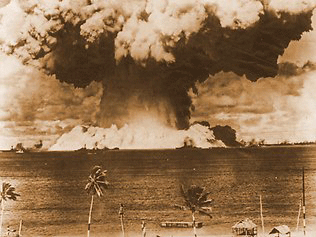
Here’s how radiation from this atomic bomb test got to San Francisc0, 109, ESTHER INGLIS-ARKELL, 10 May 13, This nuclear blast went off in 1946 at Bikini Atoll in Micronesia. How did some of the radiation get back to the United States? Why, we imported it, of course! Has the radiation from nuclear testing abroad come back to haunt the United State via ocean currents and wind patterns? Probably. But we found a more direct way of getting it back home. If you look at the picture above, you’ll notice that there are a lot of boats grouped around the central cylinder of the blast. That close, they are tucked under the cloud.

Although it resembles a mushroom cloud, the sprawling cloud in the picture isn’t caused by the same forces. It’s actually the result of ionizing radiation moving through the atmosphere. The radiation ionizes the particles in the atmosphere, which then attract particles of water and cause large amounts of condensation – an actual cloud. The cloud and the radiation then rain down on the ships. (They are also exposed to direct radiation.)
Muslumovo, a town radioactively poisoned for 60 years
Soviet radiation biology took a different trajectory from science in the United States. American researchers at that time were working with the highly politicized medical studies of Japanese bomb survivors. They narrowed the list of radiation-related illnesses to leukemia, a few cancers, and thyroid disease. Soviet doctors in formulating chronic radiation syndrome had grasped the effects of radiation on the body more holistically. They determined that radiation illness is not a specific, stand-alone disorder, but that its indications relate to other illnesses. They determined that radioactive isotopes weaken immune systems and damage organ tissue and arteries, causing illnesses of the circulation and digestive tracts and making people susceptible to conventional diseases long before they succumb to radiation-related cancers.
 Strange illnesses in one of the most contaminated towns in the world challenge what we think we know about the dangers of radioactivity. Slate, By Kate Brown, April 18, 2013, ”…… the sad fact is that there are irradiated zones that are fully inhabited, and have been since the first years of the nuclear arms race. Despite a media culture enthralled with nuclear accidents, the cameras generally turn off after the first clouds of radioactive vapors dissipate.
“………..For Soviet leaders, the river dwellers were a unique opportunity in the history of health physics—what scientists call “a natural experiment” that promised to answer an important civil defense question about how to survive a nuclear attack. In 1962, the Cheliabinsk branch of the Soviet Institute of Bio-Physics, called FIB-4, started conducting regular medical exams of the Muslumovo population. FIB-4 doctors invited village children playing on the streets to a clinic room to take blood samples. In Cheliabinsk, they set up a repository of irradiated body parts: hearts, lungs, livers, bones. They started a collection of genetically malformed babies who died soon after birth, each infant preserved in a two-quart glass jar. A Dutch photographer, Robert Knoth, visited the repository and saw hundreds of babies in jars. He photographed one infant with skin like patched, rough burlap. Another boy had eyes on top of his head like a frog. During the examinations, doctors did not inform the villagers of their exposures or of diagnoses of radiation-related illness.
In 1986, soon after the Chernobyl disaster, Glufarida Galimova, working as chief doctor at a pediatric clinic in Muslumovo, her native town, was puzzled by the saturation of illness in her community. The illnesses were rare, strange, complex, and often genetic: hydrocephalic children, children with cerebral palsy, missing kidneys, extra fingers, anemia, fatigue, and weak immune systems. Many kids were orphaned or had invalid parents. Continue reading
Zwentendorf Nuclear Power Plant now a Solar Power Plant
 The Zwentendorf Nuclear Power Plant http://en.wikipedia.org/wiki/Zwentendorf_Nuclear_Power_Plant was the first nuclear plant built in Austria, of 6 nuclear plants originally envisaged. The plant atZwentendorf, Austria was finished, but never operated. Start-up of the Zwentendorf plant, as well as construction of the other 5 plants, was prevented by a referendum on 5 November 1978. A narrow majority of 50.47% voted against the start-up.[1][2]
Construction of the plant began in April 1972, as a boiling-water reactor rated at 692 megawatts electric power output. It was built by a joint venture of several Austrian electric power utilities, and was envisioned as the first of several nuclear power plants to be built. The initial cost of the plant was around 14 billions Austrian schillings, about 1 billion Euros today.[3] The ventilation stack chimney of the plant is 110 metres tall. The plant has been partly dismantled. Since 1978 Austria has a law prohibiting fission reactors for electrical power generation.
The plant is now owned by Austrian energy company EVN Group and used as Solar Power Plant and for education purposes.
The Dürnrohr Power Station was built nearby as a replacement thermal power station.
Following the 1978 referendum, no nuclear power plant that was built for the purpose of producing electricity ever went into operation in Austria. However, three small nuclear reactors for scientific purposes have been built and used since the 1960s, with one still being in operation.[4]
A plan to crash plane into Oak Ridge nuclear reactor
Book: Hijackers had airplane in nosedive heading for U.S. nuclear reactor — “A very, very scary situation” -Energy Official http://enenews.com/book-hijackers-had-airplane-in-nosedive-heading-for-u-s-nuclear-reactor-a-very-very-scary-situation-energy-official
 Title: The odd side of Oak Ridge history
Source: Knoxville News
Author: Frank Munger
Date: April 16, 2013
On the morning of Nov. 11, 1972, Oak Ridge stood still — or nearly so — while a hijacked Southern Airways jetliner circled above.
“It was a very, very scary situation,” Jim Alexander, a retired public affairs officer at the Department of Energy, recalled in a 2001 interview.
The hijackers threatened to crash the airplane into the Oak Ridge nuclear facilities if their demands, including $10 million in cash, were not met. […]
The threat was real, according to a 1977 book, “The Odyssey of Terror.”
The author, Ed Blair, wrote that the hijackers went berserk after placing a call to the White House and being shunned by John Ehrlichman, an aide to President Nixon, who apparently was unaware of the crisis. Blair reported that the hijackers held a grenade to the pilot’s head and ordered him to dive the plane toward the Oak Ridge reactor. The plane was actually in a nosedive when a report came over the radio that the money demands were being met […]
See also: Japan Gov’t Experts: Airplane crash affecting Fukushima spent fuel pool a key security issue for future
Inhuman radiation experiements on citizens, by USA government
 Contaminated Nation. Inhuman Radiation
 Experiments, CounterPunch, by JOHN LaFORGE, 12 Aprl 13, This year marks the 20th anniversary of the declassification of top secret studies, done over a period of 60 years, in which the US conducted 2,000 radiation experiments on as many as 20,000 vulnerable US citizens.[i] Continue reading
USA citizens exposed to experimental ionising radiation
 Contaminated Nation. Inhuman Radiation Experiments, CounterPunch, by JOHN LaFORGE, 12 Aprl 13 “………Experiments Spread Cancer Risks Far and Wide In large scale experiments as late as 1985, the Energy Department deliberately produced reactor meltdowns which spewed radiation across Idaho and beyond.[x] The Air Force conducted at least eight deliberate meltdowns in the Utah desert, dispersing 14 times the radiation released by the partial meltdown of Three Mile Island in Pennsylvania in 1979.[xi]
The military even dumped radiation from planes and spread it across wide areas around and downwind of Oak Ridge, Tenn., Los Alamos, New Mexico, and Dugway, Utah. This “systematic radiation warfare  program,” conducted between 1944 and 1961, was kept secret for 40 years.[xii]
“Radiation bombs” thrown from USAF planes intentionally spread radiation “unknown distances” endangering the young and old alike. One such experiment doused Utah with 60 times more radiation than escaped the Three Mile Island accident, according to Sen. John Glen, D-Ohio who released a report on the program 20 years ago.[xiii]
The Pentagon’s 235 above-ground nuclear bomb tests, and the atomic bombings of Hiroshima and Nagasaki, are not officially listed as radiation experiments. Yet between 250,000 and 500,000 U.S. military personnel were contaminated during their compulsory participation in the bomb tests and the post-war occupation of Japan. [xiv]
Documents uncovered by the Advisory Committee show that the military knew there were serious radioactive fallout risks from its Nevada Test Site bomb blasts. The generals decided not to use a safer site in Florida, where fallout would have blown out to sea. “The officials determined it was probably not safe, but went ahead anyway,” said Pat Fitzgerald a scientist on the committee staff.[xv]
Dr. Gioacchino Failla, a Columbia University scientist who worked for the AEC, said at the time, “We should take some risk… we are faced with a war in which atomic weapons will undoubtedly be used, and we have to have some information about these things.”[xvi]
With the National Cancer Institute’s 1997 finding that all 160,000 million US citizens (in the country at the time of the bomb tests) were contaminated with fallout, it’s clear we did face war with atomic weapons — our own. http://www.counterpunch.org/2013/04/12/inhuman-radiation-experiments/
A criminal betrayal of Australian servicemen – British atomic bomb tests “down under”
 With the enthusiastic connivance of the Australian Government (more precisely, prime minister Robert Menzies, who bypassed his cabinet), the British detonated about a dozen nukes in our backyard. More than 8000 servicemen were involved in the tests and the measures for their safety were perfunctory at best and criminal at worst.
‘Death ash’ rains on betrayed men, Courier Mail Terry Sweetman , The Sunday Mail (Qld) February 24, 2013
ONE of the great ironies of history is that the Japanese fishing boat that took 23 men into the fiery breath of America’s first hydrogen bomb was called the Lucky Dragon No 5.
That was on March 1, 1954, which is ancient history to most Australians, but there is a tragic echo right here and right now.
Lucky Dragon was fishing off Bikini Atoll, outside the declared danger zone, when the Castle Bravo thermonuclear device was detonated.
Oops. The blast was about twice as powerful as the boffins had calculated and the Lucky Dragon was showered with radioactive dust, which the Japanese poetically called death ash.
Soon the fishermen began to suffer nausea, pain and skin inflammation and, in September, radio operator Kuboyama Aikichi died.
It was a shocking incident but more shocking was the initial cover-up and official disinformation. Continue reading
The messy history of the Hanford Reservation radioactive mess
.At The Hanford Nuclear Reservation, A Steady Drip Of Toxic Trouble by Eric Nusbaum Feb 24, 2013 Eric Nusbaum tours the largest environmental cleanup operation the United States government has ever undertaken.”,,,,,,,,Late in 2010, crews with the contractor Washington Closure Hanford were set to begin demolition on what had once been the most radioactive structure on the site: Building 324. Located less than half a mile from both the city of Richland and the Columbia River, Building 324 housed a pair of “hot cells,” which are three-story enclosures that scientists use to perform remotely-operated tests of highly unstable materials. One of those cells, B-Cell, was so radioactive in the 1990s that the Seattle Post-Intelligencer reported that “an unprotected person standing inside could have received a fatal dose in less than two seconds.” By 2010, the building’s worst radioactive material had been removed. But when Washington Closure Hanford tested the ground under the site, it found radiation levels significantly higher than surrounding soil, which itself was already contaminated. Needless to say, demolition on Building 324 has not resumed. The site is “currently being deactivated,” says the Hanford website.
There are similar stories to tell about buildings all over the site, messy stories about government bureaucracy and highly radioactive equipment and the troublesome permanence of nuclear waste. The process of producing plutonium at Hanford required the constant transport of highly unstable materials from one facility to another to another, which made containing the mess basically impossible. Continue reading
Little New Zealand stood up to nuclear bully USA
 Flashback: When David stood up to Goliath stuff.co New Zealand, 9 Feb 13, The Dominion Post, TOM HUNT ”,,,,,It may have soured our relationship with Washington and provided a dramatic end to a paradisiacal trip to Tokelau, but it certainly set Lange up as New Zealand’s David versus America’s Goliath.
 February 4, 1985 was the day the New Zealand Government backed overwhelming public anti-nuclear sentiment and effectively became officially nuclear free – even if legislation was still two years away.
”I felt so proud,” long-standing anti-nuclear protester Barney Richards said this week.
”We stood up against the most powerful nation in the world. And we had a major victory.”
He remembers a reporter travelling all the way from Britain ”to see for himself the little country that snubbed its nose to the world”. Continue reading
Atoms for Peace, Problems Forever
 leaves America today with what amounts to over five dozen nominally temporary repositories for high-level radioactive waste – and no defined plan to change that situation anytime soon.
Seventy Years of Nuclear Fission, Thousands of Centuries of Nuclear Waste ,25 January 2013 By Gregg Levine, Truthout “……The Manhattan Project’s goal was a bomb, but soon after the end of the war, scientists, politicians, the military and private industry looked for ways to harness the power of the atom for civilian use, or, perhaps more to the point, for commercial profit. Fifteen years to the day after CP-1 achieved criticality, President Dwight Eisenhower threw a ceremonial switch to start the reactor at Shippingport, Pennsylvania, which was billed as the first full-scale nuclear power plant built expressly for civilian electrical generation.
Shippingport was, in reality, little more than a submarine engine on blocks, but the nuclear industry and its acolytes will say that it was the beginning of billions of kilowatts of power, promoted (without a hint of irony) as “clean, safe and too cheap to meter.” It was also, however, the beginning of what is now a weightier legacy: 72,000 tons of nuclear waste.
Atoms for Peace, Problems Forever
News of Fermi’s initial success was communicated by physicist Arthur Compton to the head of the National Defense Research Committee, James Conant, with artistically coded flair:
Compton: The Italian navigator has landed in the New World.
Conant: How were the natives?
Compton: Very friendly.
But soon after that initial success, CP-1 was disassembled and reassembled a short drive away, in Red Gate Woods. The optimism of the physicists notwithstanding, it was thought best to continue the experiments with better radiation shielding – and slightly removed from the center of a heavily populated campus. The move was perhaps the first necessitated by the uneasy relationship between fissile material and the health and safety of those around it, but if it was understood as a broader cautionary tale, no one let that get in the way of “progress.” Continue reading
Narrow escape – nuclear satellite mishap in 1982
Thirty Years Ago, Everyone Thought A Nuclear Satellite Was Going To Fall From Space And Spread Destruction http://www.businessinsider.com/flashback-how-a-tumbling-nuclear-russian-satellite-held-the-world-in-fear-for-a-month-2013-1#ixzz2J0sLfzPZ Dina Spector | Jan. 24, 2013 Thirty years ago, the world was held hostage by a nuclear-powered Soviet spy satellite tumbling out of control in an orbit close to Earth.
The spiraling spacecraft, named Cosmos 1402, was launched into low-Earth orbit on Aug. 20, 1982.
What made Cosmos particularly scary is that it carried a nuclear reactor with about 100 pounds of enriched uranium. The reactor was used to power a radar system for tracking ships.
To compare, it takes as little as 35 pounds of uranium to make a nuclear bomb. Once the satellite completed its mission, the plan was to boost the 1,000-pound reactor section, including the fuel core, into higher orbit, where it would linger at a safe distance from Earth for many hundreds of years.
But that failed. Continue reading
VIDEO USA’s Atomic Energy Commission’s pointless efforts at “peaceful bombs”
in the least productive but most destructive test, the scientists wanted “to see how big of a hole a nuclear bomb could make.” Motherboard:
“It proved to be a really big hole.”
That test, Project Sedan, spewed radioactive fallout across four states, contaminating “more Americans than any other nuclear test.”
 VIDEO The U.S. Once Wanted To Use Nuclear Bombs as a Construction Tool : http://blogs.smithsonianmag.com/smartnews/2013/01/the-u-s-once-wanted-to-use-nuclear-bombs-as-a-construction-tool/#ixzz2IFsWdcSf Smithsonian. January 16, 2013 In 1962, the Atomic Energy Commission wanted to see how big of a hole they could make with a nuclear bomb. ……..Enter, Project Sedan. the U.S.’s Atomic Energy Commission, Project Plowshare, says Motherboard, was a project in which the nation’s scientists were supposed to find something useful to do with all the nuclear expertise they had acquired throughout World War II and its aftermath. From 1961 through 1973, Project Plowshare saw 27 nuclear detonations. Many of these were at a test site in Nevada, says Motherboard, but some were a bit more experimental. In 1973, Project Rio Blanco, an operation under the banner of Project Plowshare, Continue reading
Ionising radiation a cancer danger in CT scanning
Concerns about exposure to ionising radiation inducing cancer NPS, 15 Jan 13, People are exposed to ionising radiation through medical imaging with X-rays, CT and nuclear medicine scans, including positron-emission tomography (PET).5 While MRI has the advantage of not using ionising radiation4 most of the new MBS items for MRI requested by GPs will require X-ray as a first investigation.2
As there are no completed, large-scale epidemiological studies of cancer risk associated with CT, risk has been approximated using organ doses (or the distribution of dose in the organ) and application of organ-specific cancer incidence and mortality data derived from studies of atomic-bomb survivors on the peripheries of Hiroshima and Nagasaki.6 Risk estimates adjusted to take into account the greater use of CT since 2006 indicate that 1.5–2% of all cancers in the US may be due to radiation from CT.6 Estimating cancer risk from CT remains a contentious issue, and large-scale epidemiological studies are needed for a direct assessment of this risk.6
Imaging is justified if the potential benefits outweigh the risks7…….
Project COW – USA’s bright idea to bomb the moon
A nuclear flash point, Deccan Herald, Jan, 1, 2013: BOMBING THE MOON
Recent reports suggest that during the heydays of the Cold War, the
United States planned to bomb the moon so that the nuclear flash would
intimidate rival powers. Continue reading
Verdi man recalls ‘Operation Crossroads’ nuclear tests of
1946 and ‘unsinkable’ USS Nevada, Guy Clifton: RGJ.com, 23 Dec 12“…..Larson was a
19-year-old sailor assigned to the carrier USS Independence. In July
1946, he was part of the crew that sailed the Independence to Bikini
Atoll in the south Pacific, where it and other aged naval vessels —
including the USS Nevada — were targets in Operations Crossroads, a
series of tests conducted by the U.S. to investigate the effect of
nuclear weapons on naval ships. Continue reading
1 This Month
6 June – WEBINAR- Get Inspired by Protests Against Military Bases!


Cuba Is Not a Failed State – It Is a Besieged State
PETITION: “Global Appeal to Endorse Palestinian Right of Return of Refugees”


of the week– Nuclear Reactor Information Task Force
To see nuclear-related stories in greater depth and intensity – go to https://nuclearinformation.wordpress.com
-
Archives
- June 2026 (34)
- May 2026 (306)
- April 2026 (356)
- March 2026 (251)
- February 2026 (268)
- January 2026 (308)
- December 2025 (358)
- November 2025 (359)
- October 2025 (376)
- September 2025 (257)
- August 2025 (319)
- July 2025 (230)
-
Categories
- 1
- 1 NUCLEAR ISSUES
- business and costs
- climate change
- culture and arts
- ENERGY
- environment
- health
- history
- indigenous issues
- Legal
- marketing of nuclear
- media
- opposition to nuclear
- PERSONAL STORIES
- politics
- politics international
- Religion and ethics
- safety
- secrets,lies and civil liberties
- spinbuster
- technology
- Uranium
- wastes
- weapons and war
- Women
- 2 WORLD
- ACTION
- AFRICA
- Atrocities
- AUSTRALIA
- Christina's notes
- Christina's themes
- culture and arts
- Events
- Fuk 2022
- Fuk 2023
- Fukushima 2017
- Fukushima 2018
- fukushima 2019
- Fukushima 2020
- Fukushima 2021
- general
- global warming
- Humour (God we need it)
- Nuclear
- RARE EARTHS
- Reference
- resources – print
- Resources -audiovicual
- Weekly Newsletter
- World
- World Nuclear
- YouTube
-
RSS
Entries RSS
Comments RSS
 nuclear-news