Nuclear history, and the false promises of Generation IV reactors
Generation IV reactors to the rescue?
Given these problems, some look to new ‘Generation IV’ designs. They are basically new versions of the old designs looked at in the 1950s, 60s and 70s in the USA and elsewhere – and abandoned as unviable, or after accidents.
They include fast neutron plutonium breeders, High Temperature Reactors (HTRs) and Molten Salt Reactors (MSR) possibly using thorium as a fuel and possibly also in scaled down Small Modular Reactor (SMR) format.
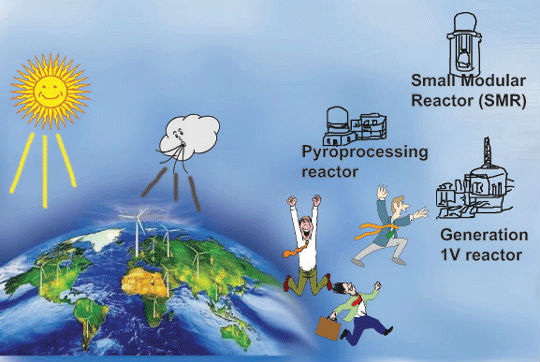
The message from the past is not promising……
False promise: nuclear power: past, present and (no) future http://www.theecologist.org/News/news_analysis/2988856/false_promise_nuclear_power_past_present_and_no_future.html David Elliott 12th April 2017
Nuclear power was originally sold on a lie, writes Dave Elliott. While we were being told it would make electricity ‘too cheap to meter’, insiders knew it cost at least 50% more than conventional generation. Since then nuclear costs have only risen, while renewable energy prices are on a steep decline. And now the nuclear behemoths are crumbling … not a moment too soon.
In a December 1953 speech to the United Nations, President Dwight D. Eisenhower launched the ‘Atoms for Peace’programme, saying:
“The miraculous inventiveness of man shall not be dedicated to his death but consecrated to his life.”
He claimed that “peaceful power from atomic energy is not a dream of the future. That capability, already proved, is here – now – today.” And the USA would help to ensure it could be used worldwide.
However, his advisors soon told him that it wasn’t viable. A classified internal State Department Intelligence Report, circulated in January 1954, ‘Economic Implications of Nuclear Power in Foreign Countries‘, warned that the introduction of nuclear power would
” … not usher in a new era of plenty and rapid economic development as is commonly believed. Nuclear power plants may cost twice as much to operate and as much as 50 percent more to build and equip than conventional thermal plants.” [Quoted by Mara Drogan in ‘The Nuclear Imperative: Atoms for Peace and the Development of U.S. Policy on Exporting Nuclear Power, 1953-1955 Diplomatic History 40 Issue 5 948-974.]
Nonetheless, the nuclear juggernaut rolled on, with, US Atomic Energy Commission Chairman Lewis Strauss, in a 1954 address to science writers, claiming: “It is not too much to expect that our children will enjoy in their homes electrical energy too cheap to meter.”
The USA, followed by the UK, France, Russia and Japan, poured vast resources into nuclear power – new plants and new research projects.
Murphy’s law of nuclear power?
But things didn’t always go to plan. For example, there took place a series of accidents at US experimental reactor test sites, including an explosion at the SL1 project in Idaho in 1961, which killed three operators – one of whom was impaled to the roof by a fuel rod.
Then in 1966, the Fermi fast reactor, near Detroit, suffered a fuel melt down, and in 1979, the Pressurised Water Reactor (PWR) at Three Mile island narrowly avoided a major hydrogen explosion by venting radioactive gas to the air. That signalled the end of nuclear growth in the the USA. The multi-billion dollar plant had to be written off. Opposition mounted. New plants, orders collapsed.
Then came the Chernobyl disaster in the Ukraine in 1986, with the cloud spreading across most of Europe. There was a global meltdown in orders for new plants.
However, it wasn’t just the accidents that were the problem. The poor economics of nuclear gradually became more apparent- as cheaper alternatives began to emerge. It turned out to be too expensive – e.g. it could not compete with cheap gas plants in the UK. As Lord (Walter) Marshall, one- time head of the UK Atomic Energy Authority, when chair of the CEGB in 1987, commented:
“The British Public have never had the cheap electricity that we have always promised from nuclear power. It has been, and continues to be, a case of ‘jam tomorrow, but never today’.”
But for our politicians, the nuclear dream never died
But that didn’t stop Marget Thatcher from pushing ahead with a new nuclear plant (a PWR) at Sizewell, work on it starting in 1987. Or Tony Blair later trying to relaunch a new programme “with a vengence”. That has still yet to happen. But it’s pending, with the £24 billion Hinkley Point C European Pressurised-water Reactor (EPR), if it goes ahead, being the first new UK plant in 30 years.
Fukushima, in 2011, had intervened, slowing the nuclear programme worldwide, and creating liabilities of hundreds of billions of dollars. But the UK has pressed ahead with plans for maybe 18GW of new plant – delivering around 30% of UK electricity in the 2030s.
This expansion is based on so-called ‘Generation III’ reactors, basically upgrades of the Generation II PWRs and similar designs that have been the mainstay of nuclear so far. The new versions are unlikely to be any more competitive against cheap gas and increasingly cheap renewables.
The nuclear industry still has hopes for the French EPR, the Toshiba / Westinghouse AP1000 and the Hitachi ABWR – an upgrade of the Fukushima boiling water reactor design.
But the EPRs being built in France and Finland, Flamanville and Olkiluoto, are both around eight years late and three times over budget. Flamanville’s gigantic stainless steel reactor vessel and dome is also suffering from serious metallurgical flaws which may yet prevent its completion.
The two AP1000s being built in the USA have also been delayed, creating losses of over $10 billion that have pushed Westinghouse into bankruptcy, and its Japanese parent company, Toshiba, into what may prove to be a terminal financial meltdown. The two ABWRs under construction in the US are also seriously behind schedule.
Generation IV reactors to the rescue?
Given these problems, some look to new ‘Generation IV’ designs. They are basically new versions of the old designs looked at in the 1950s, 60s and 70s in the USA and elsewhere – and abandoned as unviable, or after accidents.
They include fast neutron plutonium breeders, High Temperature Reactors (HTRs) and Molten Salt Reactors (MSR) possibly using thorium as a fuel and possibly also in scaled down Small Modular Reactor (SMR) format.
The message from the past is not promising. Most countries (US, UK, France) gave up on fast breeders in the 1980s and 1990s. Japan has now too. The UK tested an HTR in the 1960s with its Dragon project at Winfrith. Germany and the USA had a go too. The US also tested some MSR technology in the 1960s, and also the use of thorium as fuel. SMRs were also tested.
None of these ideas went forward owing to massively escalating costs and successive technical dificulties. But the industry claims that new variants on these old designs will be upgraded, cheaper and safer.
However, in a review of Generation IV options, the French nuclear agency IRSN said that, at the present stage of development, it did not see any evidence that “the systems under review are likely to offer a significantly improved level of safety compared with Generation III reactors, except perhaps for the High Temperature Reactor” – and even that would require “significantly limiting unit power”.
Allison MacFarlane, former chair of the US Nuclear Regulatory Commission, talking about the HTR, said “I do not see past experience pointing at a positive direction.”
She also noted that Fast Breeder Reactors “turn out to be very expensive technologies to build. Many countries have tried over and over. What is truly impressive is that … many governments continue to fund a demonstrably failed technology.”
As nuclear power grows more costly, renewables prices plunge
Cost reduction is clearly vital if any of these ideas is to prosper. That’s one of the arguments used for small modular reactors (SMRs): they would be faster to build and so possibly easier to finance. It might also be possible to use the waste heat from them to supply heat to urban areas – if residents would accept them in or near cities.
But is that likely? SMRs are very unlikely ever to be cheap. The reason why civil nuclear power stations ever got so big as the EPR (1.6GW), ABWR (1.6GW) and AP1000 (1.25GW) is to reap ‘economies of scale’ which would be lost by going small.
And of course there is nothing remotely ‘new’ about SMRs, indeed they are a distinctly mature technology: hundreds of them have been deployed in military submarines and ships, for decades. The reason why they were never used for civil power generation is simple – they cost too much! So what exactly is about to change?
In any case all these Generation IV ideas are a decade or two, or maybe more, away from anything approaching commercial reality. It’s like the situation renewables faced in the 1980s. Renewables did break through and are now viable – wind and PV solar especially. Will Generation IV nuclear be able to do the same? Or do we need to wait until Generation V – fusion? If that ever works. Or do we actually need any of these nuclear ideas?
Renewables have outperformed nuclear across the board – undercutting its cost and delivering over twice its total annual output globally: renewables now supply 24% of global electricity, and are growing rapidly, as against the fairly static 11.5% from nuclear.
Renewables are on the way to 50% of power production in many countries by 2030, and maybe close to 100% by 2050. The resource is huge, and, unlike uranium or thorium, it won’t ever run out, or leave long-term hazardous wastes. That looks like our best future.
It was always a mistake, trying to turn nuclear bomb project into (costly) nuclear power
 Nuclear Power’s Original Mistake: Trying to Domesticate the Bomb, Bloomberg View, APRIL 8, 2017
Colorado’s secret nuclear history
Nuclear secrets you probably didn’t know about Colorado http://www.thedenverchannel.com/news/local-news/nuclear-secrets-you-probably-didnt-know-about-colorado, Robert Garrison Mar 31, 2017 DENVER – You might not know it, but Colorado played a major role in the nuclear arms race during the Cold War.
Hazards of uranium mining have been known for centuries
 Native American uranium miners and the Trump budget, Bulletin of the Atomic Scientists Robert Alvarez, 30 Mar 17, Bulletin of the Atomic Scientists “…….The hazards of uranium mining have been known for centuries. As early as 1556, dust in the Ore Mountain (Erzgebirge) mines bordering Germany and what is now the Czech Republic was reported to have “corrosive qualities… it eats away the lungs and implants consumption in the body…” By 1879, researchers found that 75 percent of the miners in the Ore Mountains had died from lung cancer. By 1932, the Ore Mountain miners were receiving compensation for their cancers from the German government. Uranium mining was convincingly linked to lung cancer by dozens of epidemiological and animal studies by the late 1930s.
In 1942, Wilhelm C. Hueper, the founding director of the environmental cancer section of the National Cancer Institute, brought the European studies to light in the United States—concluding that radon gas was responsible for half of the deaths of European miners after 10 to 20 years of exposure. By this time, uranium had become a key element for the making of the first atomic weapons. Hueper’s superiors blocked him from further publication and discussion in this area; they told him that dissemination of such information was “not in the public interest.”
In fact, withholding information about workplace hazards was deeply embedded in the bureaucratic culture of the early nuclear weapons program. In 1994, the Energy Department made a previously secret document, written in the late 1940s, public. It crystallized the long-held rationale for keeping nuclear workers in the dark: “We can see the possibility of a shattering effect on the morale of the employees if they become aware that there was substantial reason to question the standards of safety under which they are working. In the hands of labor unions, the results of this study would add substance to demands for extra-hazardous pay.”
Kee Begay worked in the mines for 29 years and was dying of lung cancer when I first met him. “The mines were poor and not fit for human beings,” he told me. Begay also lost a son to cancer. “He was one of many children that used to play on the uranium piles during those years. We had a lot of uranium piles near our homes—just about 50 or 100 feet away or so. Can you imagine? Kids go out and play on those piles.”
In 1957, the US Public Health Service reported that the average radiation lung dose to Indian miners was 21 times higher than was allowed in the Atomic Energy Commission’s nuclear weapons plants. In 1962, the Public Health Service revealed that radon exposure in the mines was statistically linked to lung cancer among US miners—at a rate comparable to what Heuper had warned about 20 years earlier.
Lung disease associated with radon exposure was “totally avoidable,” former chief health scientist for the AEC Merrill Eisenbud said in 1979. “The Atomic Energy Commission … is uniquely responsible for the death of many men who developed lung cancer as a result of the failure of the mine operators, who must also bear the blame, because they too had the information, and the Government should not have had to club them into ventilating their mines………..”http://thebulletin.org/native-american-uranium-miners-and-trump-budget10657?platform=hootsuite
59 years ago, a nuclear bomb was accidentally dropped on South Carolina
Nuclear core was unarmed, but 6,000 pounds of explosives detonated
WYFF News 4 Mar 13, 2017, Mars Bluff SC – This weekend was the 59th anniversary of an event many people don’t know happened in South Carolina. On March 11, 1958, a nuclear bomb was accidentally dropped on a small community near Florence.
A U.S. Air Force Boeing Stratojet that was flying out of Hunter Air Force Base took off at about 4:30 p.m. headed for the United Kingdom and then on to Africa. The aircraft was carrying nuclear weapons as a precaution in case war broke out with the Soviet Union.
The captain of the aircraft accidentally pulled an emergency release pin in response to a fault light in the cabin, and a Mark 4 nuclear bomb, weighing more than 7,000 pounds, dropped, forcing the bomb bay doors open. The bomb, which lacked an armed nuclear core, plunged 15,000 feet to the ground below…..http://www.wyff4.com/article/moose-on-the-loose-animal-races-to-catch-up-to-snowboarder/9131703
Declassified US documents suggest Adolf Hitler did have a nuclear bomb in 1944
DID HITLER HAVE A NUKE? Declassified US documents suggest Adolf Hitler successfully tested nuclear bomb during World War Two https://www.thesun.co.uk/news/2938529/declassified-us-documents-suggest-adolf-hitler-successfully-tested-nuclear-bomb-during-world-war-two/ Two pilots claim they witnesses a mushroom cloud while flying over Nazi Germany in 1944 BY ALLAN HALL 23rd February 2017
Claim that Adolph Hitler was close to having and using an atomic bomb

What I DO KNOW for a fact, is that, when war ended, Werner Von Braun and 260 other nuclear scientists were quickly taken to USA to work on America’s atomic bomb project

ADOLF Hitler was on the brink of unleashing a nuclear bomb and plotted to drop the devastating weapons on London. By Henry Holloway / Published 5th February 2017 Nazi scientists were “years” ahead of their Western counterparts as they steamed ahead with developing a nuclear device.As well as the tank divisions sweeping across the Europe and naval war in the Pacific, a secret war was waged between the Allies and the Axis.
World War Two became a race to the nuclear bomb, and the Nazis were on the verge of winning, says respected British author Damien Lewis.
The former war reporter spent dozens of hours trawling through archives and documents as declassified files revealed the true threat from the Nazi nuke.
Hitler’s scientists were “two years” ahead of the allies, he said.
Nazi engineers planned to mount dirty bombs and nuclear warheads on the tips of Hitler’s devastating Vengeance V2 rockets – which could not be shot down by AA guns or chased by fighter planes because they were too fast.
Classified missions and projects to undercut the Nazis to either beat them to the bomb, or stop their nuclear programme saw a secret war waged beneath World War 2. Nazi nukes were a threat right up to the final days of the war when the Americans discovered the Third Reich’s nuclear reactor hidden in a cave beneath a church in the tiny village of Haigerloch, Germany.
“General Groves was the head of the Manhattan Project. In April 1945 he cabled the White House and told them ‘only now can I tell you the threat of a Nazi nuclear strike is over’,” said Mr Lewis.
Winston Churchill and Franklin D. Roosevelt took the threat so seriously the British Prime Minister flew across the Atlantic in a giant flying boat for a meeting about the threat in January, 1942, he adds. Hitler considered nuclear bombs the “ultimate terror weapons” and would have targeted cities such as London and New York.
Daily Star Online revealed Hitler’s obsession with terror weapons such as the monster tank the Panzer-1000 Ratte.
Mr Lewis told Daily Star Online the Germans had the resources and manpower to produce “scores of improvised nuclear devices and they could have engineered a full atom bomb”.
He said: “You are looking at a scenario where the world leaders were very concerned about the technology and its kill-rate.
“So behind the scenes you had special operations prioritising efforts to stop Hitler’s nuclear programme.
“Part of it was the Manhattan Project, part of it was sabotage efforts, and the third part was all about getting ready.” The author revealed reports to the Allies in late 1943 on the Nazi nukes said the Reich “had the technology and the wherewithal”.
“The concern was rooted in absolute science, the Nazis had working reactors, they had the raw materials, and they had the delivery system,” said Mr Lewis.
Both the US and Britain quaked in the face of the nuclear bomb, with discussions about evacuating Washington at Christmas, 1943, and rumours of a successful blast test in Nazi-occupied Russia.
Nazi efforts were hampered by daring Allied missions such as Operation Gunnerside which sabotaged Hitler’s heavy water plant in Norway – one of the key elements needed for atom bombs.
Operation Peppermint was a massive undertaking launched to prepare the troops during the D-Day landings from nuclear attack and analyse V2 detonation sites for radiation. But as the war on the sea, in the air and on land tipped in favour of the allies, Mr Lewis believes the Nazis hoped to use a nuclear weapon as a “bargaining chip” to sue for peace.
However, he says it is a mystery as to why the Third Reich did not use the technology that was tantalisingly within their reach.
“It is a brilliant question,” he said “I cannot give an answer from documents, but there will be an answer in a secret file somewhere which won’t be available for another 50 years.
“There is always back channels, always conversations during a war, so I am sure there must have been something like that.
“The allies must have said ‘if you use the nuclear material you have to hand, we will respond in this way’ – it does not make sense other wise.”
Another British nuclear mishap kept secret – the Scottish cold war nuclear submarine collision

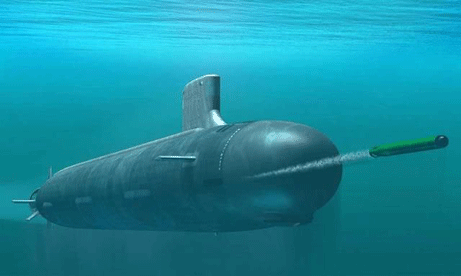 Scottish cold war nuclear submarine collision kept secret for 43 years
Documents published by CIA reveal crash between US and Soviet subs a few miles off coast of Scotland in 1974, Guardian, Matthew Weaver, 26 Jan 17, Two nuclear submarines from rival sides in the cold war collided a few miles off the coast of Scotland in an incident that was covered up for 43 years.
The potentially catastrophic crash occurred in November 1974 when the SSBN James Madison, armed with 16 Poseidon nuclear missiles, was heading out of the US naval base at Holy Loch, 30 miles north-west of Glasgow.
Soon after leaving the port it hit an unidentified Soviet submarine that had been sent to tail it, according to a cable to then US secretary of state Henry Kissinger, marked “secret eyes only” [pdf].
The cable, sent by national security adviser Brent Scowcroft, said: “Have just received word from the Pentagon that one of our Poseidon submarines has just collided with a Soviet submarine.
“The SSBN James Madison was departing Holy Loch to take up station when it collided with a Soviet submarine waiting outside the port to take up trail.
“Both submarines surfaced and the Soviet boat subsequently submerged again. There is no report yet of the extent of damage. Will keep you posted.”
The cable was published by the CIA on 17 January as part of a mass release of more than 12m pages of previously classified reports in 930,000 documents.
The cable corroborates an until-now unconfirmed report on the incident in the Washington Post on 1 January 1975 by the investigative journalist Jack Anderson. He reported that the collision left a 9ft scratch on the side of the James Madison and that the two submarines came within inches of sinking one another.
Another document marked “top secret” [pdf]released in the same batch expressed alarm that the news of the collision had leaked.
It said: “On 3 January, the NID [National Intelligence Daily] ran an item on the collision just off Holy Loch of US Polaris submarine and a Soviet attack submarine. Unfortunately, Jack Anderson had run the same news in the Washington Post a day or two earlier.
“This pre-emption on Anderson’s part forced the surfacing (no pun intended) of a piece of information in a current intelligence 2 months after the event occurred. …..
Kate Hudson, general secretary of the Campaign for Nuclear Disarmament, said the secret cable exposed the “enormous risks” of nuclear weapons.
“The history of nuclear weapons is a history of near misses, accidents, potential catastrophes and cover-ups. This latest example joins 25 other near misses that could have led to nuclear war.”
CND is calling for an inquiry into Trident, the successor to the Poseidon programme, after it emerged that a malfunctioning missile with the potential to carry a nuclear warhead was forced to self-destruct in mid-air off the US coast last June.
Hudson added: “These enormous risks have to be acknowledged particularly when we also now face the increasing likelihood of cyber-attack on nuclear weapons systems. With advancing technological developments added to the already dangerous mix there can be no confidence that nuclear weapons are a credible part of British security in the 21st century……… https://www.theguardian.com/us-news/2017/jan/25/nuclear-submarine-collision-cold-war-cia-scotland
Inside Britain’s secret nuclear bunker
The secret nuclear bunker built as the UK’s last hope, Dug for an underground ‘shadow factory’ for aircraft during World War Two, the Drakelow tunnels were re-purposed as a nuclear bunker to be used by the UK government. We went inside., BBC By William Park 4 January 2017
Deep beneath a hill in the Worcestershire countryside, about 20 miles west of Birmingham, lie a series of hidden tunnels. Once home to a secret aeroplane factory during World War Two, they were later repurposed to protect the UK in the event of a nuclear war: it’s from here that the government would have continued to run the country.
“This would have been the last resort of the UK government,” says Michael Scott, a volunteer with the Drakelow Preservation Trust, which is restoring the site. The Trust’s aim is to reopen parts of the tunnels as a museum to preserve their history in World War Two and the Cold War. But the organisation remains some years away from finishing the work, and without much funding, the volunteers are restricted mostly to repainting walls.
When cities across the UK came under siege during the war, the government needed to find a way to continue production of tanks, aircraft and ammunition. The solution was to build underground factories – also called shadow factories – away from large cities. The Drakelow Tunnels housed one of them. And the same remoteness and fortress-like qualities that made Drakelow an effective underground aircraft factory would later make it the location of choice for responding to nuclear attack in Britain.
Today, the entrance used by Scott and the other volunteers is called Adit A; it’s where the security office would have stood. Most of the hillside around the entrance is bare, revealing a sandstone mass towering above us that would have made this site virtually bomb-proof in World War Two.
Adit A shows many signs of the alterations that were made to Drakelow Tunnels to retrofit it for use as a nuclear bunker – including covered air vents that would have protected those inside from fallout. Through the heavy steel door, visitors would have had to strip, incinerate their clothes and shower as they decontaminated themselves……..
There are examples of similar subterranean shadow factories in Germany, too. The largest was Mittelwerk, Kohnstein, which produced V-1 and V-2 bombs from 1943 to 1945. The move underground was a direct result of the destruction of other, above-ground V-2 production plants, like Peenemunde in northern Germany. Unlike Drakelow, Mittelwerk was left in ruins after the war.
Perhaps the most intriguing underground network of Nazi military tunnels is the series of seven structures that make up Project Riese. Buried in the Owl Mountains – then part of Germany but now in south-west Poland near the Czech border – these sites were never finished and documents about their full purpose seem to have been destroyed…….
Cold comfort
Top-secret military construction did not end with World War Two. In 1949, as the Cold War bloomed, the UK government began to build 15 fortified war rooms across the country.
But in the case of the much bigger threat of a nuclear attack, these buildings would not have been enough to protect their inhabitants. They were too small, making them unable to support a workforce for the extended period of time they’d need to remain indoors to avoid the fallout of a nuclear explosion. They also were built too close to the major cities which could have been a target for an attack: five were built in London, for example.
Having seen the effect of a nuclear attack in Japan, the British government commissioned the Strath Committee, led by head of the Central War Plans Secretariat William Strath, to analyse the potential effects of a nuclear attack on the UK. In 1955 the committee published the Strath Report which found that even a ‘limited’ attack would have devastating consequences. Food and water would be contaminated, the NHS would be overwhelmed with four million serious casualties and 12 million deaths, and industry would shut down. In short, the “social and economic fabric of the country [would be] destroyed”.
Strath recommended the UK invest in a network of nuclear bunkers to protect the population. However, estimates put the cost of such an enormous series of bunkers at £1.25bn (equal to £30.88bn in 2016)……… http://www.bbc.com/future/story/20170103-the-secret-nuclear-bunker-built-as-the-uks-last-hope
Files released show orders to shoot nuclear intruders at Faslane in 1990
Cabinet files reveal plan to shoot nuclear intruders
PM Margaret Thatcher, who was told of the order, said she was “horrified” that the intrusion had succeeded.
The papers are among records filed in 1989 and 1990 and released on Friday……..
‘Grave danger’ at Faslane
Three anti-nuclear demonstrators successfully cut through the perimeter fence at Faslane, on the Clyde, in the early hours of 10 October 1988. The demonstrators went through an open submarine hatch to reach the control room of HMS Repulse, a ballistic missile submarine, where they sprayed anti-nuclear slogans before being arrested.
A fourth demonstrator attempted to swim into the base, but was caught…….
Since the Eighties, anti-nuclear protesters have peacefully camped outsideFaslane, which is now the home of Trident nuclear weapons…….http://www.bbc.com/news/uk-38369742
The world’s 12 largest nuclear explosions
These are the 12 largest nuclear detonations in history http://www.businessinsider.com/largest-nuclear-detonations-in-history-2016-12//?r=AU&IR=T/#youve-seen-the-worlds-largest-man-made-explosions-11 [good maps and pictures] Business Insider
Since the first nuclear test on July 15, 1945, there have been over 2,051 other nuclear weapons tests around the world.
No other force epitomizes the absolute destructive power humanity has unlocked in the way nuclear weapons have. And the weapons rapidly became more powerful in the decades after that first test.
The device tested in 1945 had a 20 kiloton yield, meaning it had the explosive force of 20,000 tons of TNT. Within 20 years, the US and USSR tested nuclear weapons larger than 10 megatons, or 10 million tons of TNT. For scale, these weapons were at least 500 times as strong as the first atomic bomb.
To put the size of history’s largest nuclear blasts to scale, we have used Alex Wellerstein’s Nukemap, a tool for visualizing the terrifying real-world impact of a nuclear explosion.
11 (tie). Soviet Tests #158 and #168
On August 25 and September 19, 1962, less than a month apart, the USSR conducted nuclear tests #158 and #168. Both tests were held over the Novaya Zemlya region of Russia, an archipelago to the north of Russia near the Arctic Ocean.
No film or photographs of the tests have been released, but both tests included the use of 10-megaton atomic bombs. These blasts would have incinerated everything within 1.77 square miles of their epicenters while causing third-degree burns up to an area of 1,090 square miles.
10. Ivy Mike
On November 1, 1952, the US tested Ivy Mike over the Marshall Islands. Ivy Mike was the world’s first hydrogen bomb and had a yield of 10.4 megatons, making it 700 times as strong as the first atomic bomb.
Ivy Mike’s detonation was so powerful that it vaporized the Elugelab Island where it was detonated, leaving in its place a 164-foot-deep crater. The explosion’s mushroom cloud traveled 30 miles into the atmosphere.
9. Castle Romeo
Romeo was the second US nuclear detonation of the Castle Series of tests, which were conducted in 1954. All of the detonations took place over Bikini Atoll. Castle Romeo was the third-most powerful test of the series and had a yield of 11 megatons.
Romeo was the first device to be tested on a barge over open water instead of on a reef, as the US was quickly running out of islands upon which it could test nuclear weapons.
The blast would have incinerated everything within 1.91 square miles.
8. Soviet Test #123
On October 23, 1961, the Soviets conductednuclear test #123 over Novaya Zemlya. Test #123 used a 12.5 megaton nuclear bomb. A bomb of this size would incinerate everything within 2.11 square miles while causing third-degree burns in an area of 1,309 square miles.
No footage or photographs of this nuclear test have been released.
7. Castle Yankee
6. Castle Bravo
Castle Bravo, detonated on February 28, 1954, was the first of the Castle series of tests and the largest US nuclear blast of all time.
Bravo was anticipated as a 6-megaton explosion. Instead, the bomb produced a 15-megaton fission blast. Its mushroom cloud reached 114,000 feet into the air.
The US military’s miscalculation of the test’s size resulted in the irradiation of approximately 665 inhabitants of the Marshall Islands and the radiation poisoning death of a Japanese fisherman who was 80 miles away from the detonation site.
3 (tie). Soviet Tests #173, #174, and #147
From August 5 to September 27, 1962, the USSR conducted a series of nuclear tests over Novaya Zemlya. Tests #173, #174, and #147 all stand out as being the fifth-, fourth-, and third-strongest nuclear blasts in history.
All three produced blasts of about 20 megatons, or about 1,000 times as strong as the Trinity bomb. A bomb of this strength would incinerate everything within 3 square miles.
No footage or photographs of these nuclear tests have been released.
2. Soviet Test #219
On December 24, 1962, the USSR conductedTest #219 over Novaya Zemlya. The bomb had a yield of 24.2 megatons. A bomb of this strength would incinerate everything within 3.58 square miles while causing third-degree burns in an area up to 2,250 square miles.
There are no released photos or video of this explosion.
1. The Tsar Bomba
On October 30, 1961, the USSR detonated the largest nuclear weapon ever tested and created the biggest man-made explosion in history. The blast, 3,000 times as strong as the bomb used on Hiroshima, broke windows 560 miles away, according to Slate.
The flash of light from the blast was visibleup to 620 miles away.
The Tsar Bomba, as the test was ultimately known, had a yield between 50 and 58 megatons, twice the size of the second-largest nuclear blast.
A bomb of this size would create a fireball 6.4 square miles large and would be able to give humans third-degree burns within 4,080 square miles of the bomb’s epicenter.
The first atomic bomb
The first atomic blast was a fraction the size of the Tsar Bomba, but it was still an explosion of almost unimaginable size.
According to the NukeMap, a weapon with a 20-kiloton yield produces a fireball with a radius of 260 meters, making its total width the size of 5 football fields. It would spew deadly radiation over an area 7 miles in width, and would produce third-degree burns in an area over 12 miles in width.
If dropped over lower Manhattan, a bomb of that size would kill over 150,000 people and produce fallout stretching all the way to central Connecticut, according to the NukeMap.
The first atomic bomb was tiny by nuclear weapons standards. But its destructiveness is sill nea lry impossible to grasp.
Climate change: warnings have been given by scientists since 1880 or earlier
A 1912 news article ominously forecasted the catastrophic effects of fossil fuels on climate change http://qz.com/817354/scientists-have-been-forecasting-that-burning-fossil-fuels-will-cause-climate-change-as-early-as-1882/ Akshat Rathi 24 Oct 16, A short news clip from a New Zealand paper published in 1912 has gone viral as an example of an early news story to make the connection between burning fossil fuels and climate change.
The French physicist Joseph Fourier had made the observation in 1824 that the composition of the atmosphere is likely to affect the climate. But Svante Arrhenius’s 1896 study titled, “On the influence of carbonic acid in the air upon the temperature on the ground” was the first to quantify how carbon dioxide (or anhydrous carbonic acid, by another name) affects global temperature. Though the study does not explicitly say that the burning of fossil fuels would cause global warming, there were scientists before him who had made such a forecast.
The earliest such mention that Quartz could find was in the journal Nature in December of 1882. The author HA Phillips writes:
According to Prof Tyndall’s research, hydrogen, marsh gas, and ethylene have the property to a very high degree of absorbing and radiating heat, and so much that a very small proportion, of say one thousandth part, had very great effect. From this we may conclude that the increasing pollution of the atmosphere will have a marked influence on the climate of the world.
Phillips was relying on the work of John Tyndall, who in the 1860s had shown how various gases in the atmosphere absorb heat from the sun in the form of infrared radiation. Now we know that Phillips was wrong about a few scientific details: He ignored carbon dioxide from burning coal and focused more on the by-products of mining. Still, he was drawing the right conclusion about what our demand for fossil fuels might do to the climate.
Newspapers around the world took those words published in a prestigious scientific journal quite seriously. ……..
Nichols found many examples between 1883 and 1912, where newspapers, including the Philadelphia Inquirer, Kansas City Star, and York Daily, wrote articles about what rising carbon dioxide levels would do the climate.
All through the 19th century, the increasing use of coal was hard to miss. Towns and cities across the world were becoming noticeably polluted because of factories, and later steam trains. In this light, it’s not surprising that a tiny New Zealand newspaper carried an article in 1912 about how the ever-increasing use of fossil fuels might change Earth’s climate. http://qz.com/817354/scientists-have-been-forecasting-that-burning-fossil-fuels-will-cause-climate-change-as-early-as-1882/
A personal story of Chernobyl’s environmental effects
 the Prypiat River [Ukraine] flowing through the empty town and nuclear power plant was already a black, dead waterway. Not one bird flew or stray cat mewed….Reindeer [Norway] with ultra-high levels of radioactivity were killed that winter’s day. Many were calves.
Nuclear not for Tassie – The Mercury – The Voice of Tasmania, 26 March, 2011, Two of my own most memorable experiences as a journalist over the past three decades are linked to nuclear energy.
 The first was in late 1986 when, just a few months after the Chernobyl nuclear disaster in the Ukraine region of the then-Soviet Union, I visited the site as one of the first Australian journalists allowed into the area.The burnt and melted-down nuclear reactor had not then been encased in its final concrete sarcophagus; Geiger counters and special suits were mandatory, and the closest we could go was the nearby deserted town of Prypiat.
But it was Prypiat rather than glimpses of the Chernobyl power plant 4km away that left the most chilling impression.
A thriving town of 49,000 people think all of Hobart’s Eastern Shore suburbs combined prior to the April 25, 1986, nuclear catastrophe.
Its residents all had to abandon their homes the following day after radiation reached fatal levels.
Not that the Soviet authorities immediately told locals a disaster was unfolding on their doorsteps, despite the new “glasnost” era of openness and transparency just proclaimed by new-look president Mikhail Gorbachev.
It was only when elevated radiation levels were detected in clouds above Sweden that night that Soviet officials finally admitted an accident and a fire had occurred at Chernobyl’s number 4 nuclear reactor earlier in the afternoon.
Visiting Prypiat a few months later was a haunting experience. Mouldy lunches and mugs still sat on kitchen tables, dusty coats were thrown over armchairs and bedrooms with their crumpled blankets and family snaps looked as if their occupants might return at any moment.

Children’s toys and bikes were scattered around outside the concrete apartment blocks, as rampant weeds reclaimed the ghost town’s city square.
But the Prypiat River flowing through the empty town and nuclear power plant was already a black, dead waterway. Not one bird flew or stray cat mewed.
Just two months later, I was on assignment in the snowy wilds of northern Norway with a family of traditional reindeer herders, in the dark December days of early winter.
For these families, who have for generations grazed their herds up on the mountain tops and who eat reindeer meat for breakfast, lunch and dinner as part of their reindeer-centric tradition 1986 was a terrible watershed year.
Chernobyl’s radioactive cloud had drifted over Norway for several days in late April, dropping its deadly heavy caesium molecules in spring rain and mist.
The lichen that grow above the snowline absorbed the radioactive load; turning these hardy plants into deadly fodder for the deer, which rely on them as food.
For the first time, the semi-wild reindeer herds had to be removed from the mountains, possibly for decades, as the lichen would not be fit to eat for many years. Instead they were ordered into barns to be fed hay brought in from other areas of Norway.
Reindeer with ultra-high levels of radioactivity were killed that winter’s day. Many were calves.
And later that night Norwegian Government experts delivered another fatal blow. They told the same herders reindeer meat could not be safely eaten more than twice a week until years later, when their herds would be free of all radioactive contamination.
It has been impossible not to reflect on my own two sombre brushes with nuclear power gone wrong, as the world has held its breath over the past two weeks wondering how close Japan’s stricken Fukushima nuclear plant has been to the total core meltdown experienced at Chernobyl.
Already water and milk on parts of Japan has been declared unsafe for drinking, leafy vegetables and crops in surrounding farms banned from sale and seaweed from nearby waters found to be contaminated…….
Nuclear not for Tassie Editorial – The Mercury – The Voice of Tasmania
B-52 nuclear bomber disasters
In 1968, a B-52 Bomber Crashed (With 4 Super Lethal Nuclear Weapons Onboard That ‘Exploded’) The National Interest, Matthew Gault December 15, 2016 Throughout the 1950s and ’60s American bombers carrying nuclear weapons crisscrossed the globe, ready at a moment’s notice to fly into the heart of Russia and bomb it back to the stone age. Strategic Air Command — a now defunct branch of the U.S. Air Force — commanded this airborne alert force.
It was once the pride of the American military. For more than a decade, SAC bombers were no more than 15 minutes from nuking Russia. But the shifts on the bombers were long — sometimes more than 24 hours — and keeping such an alert force ready was taxing on pilots and crew.
There were many accidents.
In 1958, a B-47 carrying a nuke collided with an F-86 Sabre in the skies above Savannah, Georgia. The B-47 jettisoned its nuclear payload into the Atlantic Ocean. Authorities never recovered the bomb.
Months later, another B-47 dropped its nuke over South Carolina when a bomb technician aboard accidentally activated the emergency release. The bomb’s conventional explosives detonated and destroyed a nearby house.
Those were bad, but SAC and its airborne alert survived them. Then, in 1968, a B-52 crashed near Thule Monitoring Station in Greenland and spilled its payload all over the ice. It was one disaster too many, and it signaled the end of America’s airborne alert program … and Strategic Air Command’s prestige……..
The Arctic’s climate is harsh and the radar station was fragile. Outages were frequent, and SAC needed redundancy to ensure that it didn’t attack Moscow just because it lost contact with Thule.
So SAC did what it always did. It strapped some nukes on a bomber. The air command sent one of its airborne alert bombers — complete with live nukes — to fly above the Thule monitoring station 24 hours a day … forever.
It seemed silly to keep live nukes in the air above the world’s head all day, every day. It was a sword of Damocles and it dropped in 1968.
On Jan. 21, 1968, fire swept through the cabin of the airborne B-52 watching Thule station. Smoke and flames consumed the plane and the seven crew members ejected. Six survived. The bomber crashed into an ice cap in the bay near the base.
The conventional explosives in the plane’s four hydrogen bombs exploded and cracked their nuclear payloads. Radioactive elements slid out of the bombs and onto the ice.
SAC’s Operation Chrome Dome was already on its last legs. The Thule accident just confirmed what many politicians and military leader already thought — keeping a fleet of nuclear-armed bombers in the air at all times was dangerous and insane……….
Only one of the B-52’s crew died during the Thule disaster, but his death wasn’t the end of the tragedy. The hydrogen bombs spread jet fuel and radioactive materials across the ice cap. It busted up the flow of the sea, blackened the ice and spread plutonium, uranium, americium and tritium into the ice and water……..
the Danish workers who helped clean up the site are dying of cancer. Crested Ice was a rush job done under pressure from the international community, and its leadership cut corners. American and Danish workers didn’t have the protective gear they needed to work with the radioactive materials.
The Danes tried to sue the United States for compensation and 1987, but failed. In 1995, Copenhagen paid a settlement to 1,700 members of the crew. Crested Ice, the plight of its workers and the possibility that America left contaminated material behind is a recurring story in the Danish press to this day……..This first appeared in WarIsBoring here. http://nationalinterest.org/blog/the-buzz/1968-b-52-bomber-crashed-4-super-lethal-nuclear-weapons-18746
No room for wives in BBC’s staff nuclear cold war bunker
 BBC staff offered chance to survive nuclear holocaust – but wives left at
  home http://www.telegraph.co.uk/news/2016/07/23/bbc-staff-offered-chance-to-survive-nuclear-holocaust—but-wive/ Telegraph Reporters 23 JULY 2016
BBC employees were offered the chance to survive a nuclear holocaust by broadcasting from an underground bunker, but they could not tell their wives, newly released files reveal.
The broadcaster secretly drew up plans during the Cold War for how it would run a Wartime Broadcasting System in the event of a major disaster.
Early versions of the plan – known as the ‘War Book’ – say that staff were “assigned” or “designated” to go underground, but later editions suggest they were “invited”. Chosen workers were informed not to tell their wives or bring them to the bunker, the files released by the BBC reveal.
“My clearest memory is of a discussion about whether people with spouses could bring them along,” Bob Doran, an experienced editor in Radio News in the 1980s, who attended a civil service seminar in Yorkshire said. The answer was no.
BBC bosses planned to set up 11 protected bunkers – known as ‘Regional Seats of Government’ – spread across the UK, each with a studio and five staff from nearby local radio stations.
A bunker at the Engineering Training Department at Wood Norton in Worcestershire would be a headquarters staffed by 90 BBC staff including engineers, announcers, 12 news editors and sub-editors.
The output would be controlled by the government, but the BBC made a collection of cassette tapes of old radio comedies to entertain the public.
Shows chosen to amuse listeners during Armageddon included the Goon Show, Just a Minute and Round the Horne.
1 This Month

of the week – Shut Down Drone Warfare!


Tell the Ukrainian Government to Drop Prosecution of Peace Activist Yurii Sheliazhenko

Petition to revoke the licensing of the Near Surface Nuclear Disposal Facility (NSDF) at Chalk River. https://www.ourcommons.ca/petitions/en/Petition/Details?Petition=e-7247
To see nuclear-related stories in greater depth and intensity – go to https://nuclearinformation.wordpress.com
-
Archives
- April 2026 (114)
- March 2026 (251)
- February 2026 (268)
- January 2026 (308)
- December 2025 (358)
- November 2025 (359)
- October 2025 (376)
- September 2025 (257)
- August 2025 (319)
- July 2025 (230)
- June 2025 (348)
- May 2025 (261)
-
Categories
- 1
- 1 NUCLEAR ISSUES
- business and costs
- climate change
- culture and arts
- ENERGY
- environment
- health
- history
- indigenous issues
- Legal
- marketing of nuclear
- media
- opposition to nuclear
- PERSONAL STORIES
- politics
- politics international
- Religion and ethics
- safety
- secrets,lies and civil liberties
- spinbuster
- technology
- Uranium
- wastes
- weapons and war
- Women
- 2 WORLD
- ACTION
- AFRICA
- Atrocities
- AUSTRALIA
- Christina's notes
- Christina's themes
- culture and arts
- Events
- Fuk 2022
- Fuk 2023
- Fukushima 2017
- Fukushima 2018
- fukushima 2019
- Fukushima 2020
- Fukushima 2021
- general
- global warming
- Humour (God we need it)
- Nuclear
- RARE EARTHS
- Reference
- resources – print
- Resources -audiovicual
- Weekly Newsletter
- World
- World Nuclear
- YouTube
-
RSS
Entries RSS
Comments RSS
 nuclear-news