Controversial brachytherapy treatment for breast cancer
“It’s important for any woman really to discuss with her physician the risks and benefits of either approach,”
 More women need breasts removed after brachytherapy By Genevra Pittman NEW YORK May 1, 2012 (Reuters Health) – Women who got seed radiation as part of their breast cancer treatment were more likely to have an infection or breast pain than those who were treated with whole-breast irradiation, in a new study.
And more patients treated with the quicker and more local radiation technique, also called brachytherapy, went on to need a mastectomy as well — but there was no difference in their chance of dying in the few years after treatment. “The decision of whether a patient was treated with brachytherapy or whole-breast irradiation was the single most important factor in whether a patient had a mastectomy,” said study author Dr. Benjamin Smith, who called that result “surprising.” Continue reading
Fukushima: young women at 5 times greater cancer risk than general population
Nuclear Expert: Fukushima risk underestimated ENE News, — 5% of young girls will get cancer living in 20 milliSv/y for 5 years — “Actually worse than that” — Hot particles NOT included & only counts cancers, not other effects : Cancer Risk To Young Children Near Fukushima Daiichi Underestimated Source: Fairewinds Associates, Inc Author: Arnie Gundersen Transcript Excerpts That gets me to the issue of BIER, Biological Effects of Ionizing Radiation. […]
Now in Japan, the Japanese government is allowing people to go back into these radiation zones, when the radiation exposure is 2 rem. What that means is that they are willing to say that your chances of getting cancer are 1 in 500 if you go back into these areas that are presently off limits, and the exposure levels are 2 rem or 20 milisieverts in a year.
But it is worse than that. The number that we are using in the BIER Report is for the entire population, old people and young. And old people are going to die of something else before a cancer gets to them, whereas young people have rapidly dividing cells and they live a longer time, so they are more likely to get cancer. So if you go into the BIER Report and you look at Table 12-D, you will see that young women have a 5 times that number chance of getting cancer than the population as a whole. So young girls in the Fukushima Prefecture are going to get 5 times the exposure they would get from 2 rem. That means that about one in 100 young girls is going to get cancer as a result of the exposure in Fukushima Prefecture. And that is for every year they are in that radiation zone [at 20 milliSv/y]. If you are in there for 5 years, it is 5 out of 100 young girls will get cancer.
Now the BIER Report only addresses cancer, and of course, there are other effects of radiation that are not included in BIER, so it is actually worse than that.
Two more items: The first is that the BIER Report does not address hot particles. Now we have been over that extensively on the site, and you will see that imbibing it (a kid gets radioactive cesium on their hands and they swallow it, or breathing it in), is not included in the BIER Report.
And the last piece brings us over to Ian Goddard’s video, and that is this assumption by the Japanese and International Atomic Energy Agency, that at some point, this radiation is really so hard to measure that it does not count anymore. Well, the data indicates that just the opposite is happening…… http://enenews.com/gundersen-fukushima-cancer-risk-underestimated-5-of-young-girls-will-get-cancer-living-in-20-millisvy-for-5-years-actually-worse-than-that-hot-particles-not-included-only-counts-cance
A new anti nuclear demographic – mothers
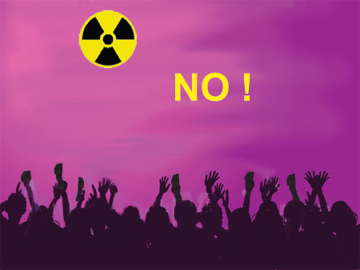 Often, mothers and women want to leave Fukushima and protect their kids, while men tend to accept the line, from the government and the utility, Tepco, that “all is safe.” This can lead to conflict in a culture where women are taught not to challenge their husbands or government, figures of authority.
How a Group of Japanese Mothers Are Saying No to Nuclear Power The Fukushima disaster has brought a powerful new demographic to Japan’s anti-nuclear movement: mothers. AlterNet April 25, 2012 |
On the one-year anniversary of the Fukushima nuclear disaster, Japanese women in New York City gathered for a rally they called Pregnant With Fear of Radiation. Protestors wore fake pregnant bellies, or carried posters with images of pregnant women wearing face masks. Well aware that fetuses, children under five, and women are at the greatest risk from radiation exposure, mothers have emerged as a powerful voice in Japan’s growing anti-nuclear movement. Continue reading
Mothers’ movement against nuclear power spreads beyond Japan
How a Group of Japanese Mothers Are Saying No to Nuclear Power AlterNet April 25, 2012 | “…….The movement isn’t confined to Japan’s borders. In September, 2011, a group of Japanese mothers, including Sachiko Sato, an organic farmer who traveled with her youngest two children) Kaori Izumi, and Aileen Mioko Smith came to New York City to protest Prime Minister Noda’s participation in the UN summit on nuclear safety. “How can you talk about safety?” Sachiko shouted to Noda outside the UN. “You don’t even take care of the children of Fukushima.”
Sachiko, Izumi, and Smith spoke at various anti-nuclear events throughout the New York City area during their visit, urging American citizens to learn a lesson from the disaster in Japan. At one event, Smith stated, “Many Americans live far too close tonuclear power plants that sit on earthquake fault lines—Indian Point in Buchanan, New York, only thirty or so miles from New York City, as well as those on the coast in California. Americans must learn from the Fukushima disaster. You must shut down your own plants, 23 of which are the same design as the Fukushima reactors, GE Mark I. Yes, it can happen here.”
In October 2011, hundreds of mothers in Japan began a protest in Tokyo at the Ministry of Economy, Trade, and Industry. The protest will last 10 months and 10 days (the length of time a pregnancy lasts under Japan’s traditional lunar calendar).
Smith, who is executive director of Green Action, an anti-nuclear NGO based in Kyoto, says the Fukushima accident offers a chance to put an end to nuclear power. Most of Japan’s nuclear reactors were taken offline after the disaster; as of this writing, only one nuclear power plant remains online.
Smith says, “For the first time in 30 years, we have a real opportunity” to shut down nuclear reactors in Japan for good. http://www.alternet.org/world/155154/how_a_group_of_japanese_mothers_are_saying_no_to_nuclear_power
Nuclear radiation is more harmful to women than to men

 Mary Olson on how women are more vulnerable to atomic radiation, http://ifyoulovethisplanet.org/?p=5755 7 April 12 This week’s guest is biologist Mary Olson, Southeast Regional Coordinator with the Nuclear Information and Resource Service (NIRS) in the U.S., an organization that provides information to citizens concerned about nuclear power, radioactive waste, radiation and sustainable energy issues. In her 21st year of this work, Olson has come to focus on the disproportionate impact that exposure to ionizing radiation has on women and children. Her recent paper entitled “Atomic Radiation is More Harmful to Women”reveals information the National Academy of Sciences BEIR (Biological Effects of Ionizing Radiation) VII report includes, but does not discuss.
Older breast cancer patients should not be getting so much radiation treatment
 Radiation still used despite evidence of little benefit to some older breast cancer patients, Health Canal, 6 March, 12 http://www.healthcanal.com/cancers/27253-Radiation-still-used-despite-evidence-little-benefit-some-older-breast-cancer-patients.html By Karen N. Peart – Even though a large clinical study demonstrated that radiation has limited benefit in treating breast cancer in some older women, there was little change in the use of radiation among older women in the Medicare program, Yale School of Medicine researchers report in the March Journal of Clinical Oncology. “We were surprised by these results,” said lead author Dr. Cary P. Gross, associate professor of internal medicine at Yale School ofMedicine. “Clinical trials are considered the gold standard of medical research and in this case the trial was influential enough to lead to a change in treatment guidelines. We expected it to have more of an impact on clinical care at the bedside.” Continue reading
Mothers are turning out to be a threat to the nuclear industry’s future
The leadership of women in civic movements is also unprecedented. Mothers have been leading the demonstrations, with many of them coming out for the first time to gain sympathy and support for their campaign to prevent exposing children to the dangers of radiation….. Mothers Rise Against Nuclear Power , IPS News, By Suvendrini Kakuchi TOKYO, Dec 22, 2011 – Japan’s nuclear power industry, which once ignored opposition, now finds its existence threatened by women angered by official opaqueness on radiation from the Fukushima Daiichi nuclear plant after it was struck by an earthquake- driven tsunami on Mar. 11.
“Mothers are at the forefront of various grassroots movements that are working together to stop the operation of all nuclear plants in Japan from 2012,” Aileen Miyoko Smith, head of Green Action, a non- governmental organisation (NGO) that promotes renewable energy told IPS. Continue reading
Essential to evacuate children and pregnant women from Japan’s radioactive areas
 “At very least pregnant women and children must be evacuated from risky areas until sufficient decontamination is completed…….
“The situation is rapidly spinning out of control, and the Japanese government seems to have abandoned its responsibility to protect its population as it has left local authorities, who lack the necessary knowledge and equipment, to clean up this mess.”
Greenpeace: Relocation of Pregnant Women and Children Exposed to Radiation Vital, December 8, 2011 Tokyo- (PanOrient News) Greenpeace renewed its demand to the Japanese government to urgently relocate pregnant women and children living in contaminated areas of Fukushima City due to the discovery of radioactive hot spots and accused the official decontamination program as being “both uncoordinated and thoroughly inadequate.” Continue reading
Some women may get increased radiation during mammography
Breast-Mammogram Detector Mismatch Results in Excess Radiation By: PATRICE WENDLING, Family Practice News Digital Network 8 Dec 11, CHICAGO – A mismatch between breast size and detector size during mammography resulted in significantly higher doses of radiation for women with large breasts in a study of 886 patients.
On average, women with large breasts screened on a small detector received almost 5 milligray (mGy) of radiation, which exceeds the American College of Radiology guidelines of 3-4 mGy or less for a standard two-view mammogram. When a mismatch occurs, women with large breasts receive significantly higher doses of radiation than women with small breasts or their counterparts with large breasts correctly matched to a large detector, Dr. Cathy Wells said when presenting the award-winning study at the annual meeting of the Radiological Society of North America.
“Women with large breasts should be imaged with a large detector to avoid an unnecessary increase in radiation dose,” she urged….. http://www.familypracticenews.com/news/more-top-news/single-view/breast-mammogram-detector-mismatch-results-in-excess-radiation/1080647c40.html
Medical radiation listed as a top cause of breast cancer
Medical radiation, alcohol, obesity top IOM’s breast cancer risk report. December 08, 2011 by Brendon Nafziger , DOTmed News Associate Editor Medical radiation from CT scans, being overweight, using combination estrogen and progestin hormone therapy and drinking alcohol were among the usual suspects deemed to have the most convincing evidence showing a link with breast cancer risk, according to a new report by the Institute of Medicine examining environmental factors that contribute to the disease.
In a supplement, the group noted that avoiding “inappropriate medical radiation exposure” was a workable risk reduction goal, even though it also said that it should be balanced against the offsetting risk: missing crucial medical information by skipping a scan. …
Japanese mothers demand radiation protection, and closure of nuclear power
The women are calling for two things. First, they want to protect children living in highly contaminated areas by giving them the officially sanctioned ‘right to evacuate.’ This would include government compensation and support that would enable children and their families to relocate on a voluntary basis.
Secondly, they want to close down all nuclear power plants in Japan. “Fukushima women feel very strongly that there is no safe nuclear power,” “This is the lesson to be learned from Fukushima.”
The women have asked for a response from the state by Nov. 11—exactly eight months after the deadly quake.
 Fukushima Women Demand Better Protection for Children Exposed to Radiation, TIME.com , November 3, 2011 Lucy Birmingham. About 100 women from Fukushima, Japan, have started a week-long sit-in at a government office in Tokyo to demand greater protection for children affected by radiation. “Many children and their families are trapped in Fukushima because they can’t afford to move,” explains Ayako Oga, 38, a housewife living in the prefecture and one of the sit-in organizers. “The government has set the accepted radiation exposure rate too high.” Japan’s standard rate for exposure to radiation is 1 millisievert per year. For Fukushima residents alone the accepted exposure rate is up to 20 millisieverts per year. The International Commission on Radiological Protection considers this rate the top level and says it should not be exceeded over the long term.
National and prefectural governments have determined that until the 20 millisieverts level they are not obligated to offer financial support to residents, certain businesses or schools wanting to relocate outside the irradiated areas. At the heart of the debate is the question of who has a ‘right to evacuate.’ “At Chernobyl, the right to evacuate, which means government support, was given from 1 to 5 millisieverts. In Japan it’s 20,” Continue reading
Nuclear radiation more harmful to women
 ATOMIC RADIATION IS MORE HARMFUL TO WOMEN , Nuclear Information and Referral Service, 27 Oct 11, Women as a group suffer significantly more from the impact of ionizing radiation than do men. Today Nuclear Information and Resource Service published a Briefing Paper that focuses on a dramatic fifty-percent greater incidence of cancer and fifty-percent greater rate of death from cancer among women, compared to the same radiation dose
level to men. To be clear: males suffer cancer and cancer death from exposure to ionizing radiation; but gender difference in the level of harm has been to date underreported.
The data leading to this conclusion originally was reported in the National Academy of Sciences 2006 report, “BEIR VII” which is the seventh report in a series on the Biological Effects of Ionizing Radiation. Continue reading
A start to addressing the scandal of Navajo radiation contamination from uranium mining
 The cleanup at the Skyline Mine represents not only a reduced risk of exposure for Begay and her family, but marks the first significant remediation of a mine on the country’s largest American Indian reservation where such sites number in the hundreds.
Tests have found gamma radiation activity greater than two times the background level at 80 locations on the site. In the traditional Navajo home where Begay once lived with two of her sons, the radiation levels were up to 100 times the acceptable level. The two sons have died — one of lung cancer and the other from a tumor.
Navajo woman helps prompt uranium mine cleanup, Houston Chronicle, FELICIA FONSECA, September 5, 2011 MONUMENT VALLEY, Utah (AP) — The stretch of high desert on the Arizona-Utah border gives way to towering rock formations that resemble huge mittens, chimney spires and castles. But to the west of Monument Valley lies a reminder of what has been blamed for much heartache and tragedy in Elsie Mae Begay‘s family: A mesa stained with a gray streak where uranium was mined decades ago. Continue reading
Death of anti nuclear activist,Nora Bredes
Nora Bredes, Long Island nuclear plant foe, dies – WSJ.com, AUGUST 22, 2011, Nora Bredes, Long Island nuclear plant foe, dies ROCHESTER, N.Y. — Nora Bredes, an advocate for women’s leadership, environmental protection and public health who led the fight to keep a nuclear plant from opening on Long Island 25 years ago, has died at age 60.
Bredes died Thursday after a lengthy battle with breast cancer, her family said…..
In the 1980s, Bredes led the push to derail Long Island’s Shoreham nuclear power station. The plant was completed in 1984 for $6 billion but never went into operation due to community opposition.
As a chief organizer of the Shoreham Opponents Coalition, Bredes enlisted New York state in a high-stakes regulatory battle revolving around potential safety concerns, such as how quickly the plant’s heavily populated surroundings could be evacuated in a crisis.
The Long Island Lighting Co., which had drawn backing for the plant from President George H.W. Bush, agreed in 1989 to shut down the plant, which was fully decommissioned in 1994…..Nora Bredes, Long Island nuclear plant foe, dies – WSJ.com
Death of feisty anti-nuclear fighter
Notable deaths around the nation, 14 Aug 11, “….Jackie Hudson, 76, of Bremerton, Wash., a nun and longtime nuclear weapons protester, died Aug. 3 of cancer. The Michigan native moved to Washington in 1993 but remained with the Dominican Sisters of Grand Rapids. She was released in June from a Georgia jail after demonstrating at an Oak Ridge, Tenn., nuclear facility. She was among three convicted in 2003 of damaging a Weld County, Colo., missile silo….” http://blog.oregonlive.com/lifestories/2011/08/notable_deaths_around_nation_w_22.html
1 This Month

of the week – Shut Down Drone Warfare!


Tell the Ukrainian Government to Drop Prosecution of Peace Activist Yurii Sheliazhenko

Petition to revoke the licensing of the Near Surface Nuclear Disposal Facility (NSDF) at Chalk River. https://www.ourcommons.ca/petitions/en/Petition/Details?Petition=e-7247
To see nuclear-related stories in greater depth and intensity – go to https://nuclearinformation.wordpress.com
-
Archives
- April 2026 (57)
- March 2026 (251)
- February 2026 (268)
- January 2026 (308)
- December 2025 (358)
- November 2025 (359)
- October 2025 (376)
- September 2025 (257)
- August 2025 (319)
- July 2025 (230)
- June 2025 (348)
- May 2025 (261)
-
Categories
- 1
- 1 NUCLEAR ISSUES
- business and costs
- climate change
- culture and arts
- ENERGY
- environment
- health
- history
- indigenous issues
- Legal
- marketing of nuclear
- media
- opposition to nuclear
- PERSONAL STORIES
- politics
- politics international
- Religion and ethics
- safety
- secrets,lies and civil liberties
- spinbuster
- technology
- Uranium
- wastes
- weapons and war
- Women
- 2 WORLD
- ACTION
- AFRICA
- Atrocities
- AUSTRALIA
- Christina's notes
- Christina's themes
- culture and arts
- Events
- Fuk 2022
- Fuk 2023
- Fukushima 2017
- Fukushima 2018
- fukushima 2019
- Fukushima 2020
- Fukushima 2021
- general
- global warming
- Humour (God we need it)
- Nuclear
- RARE EARTHS
- Reference
- resources – print
- Resources -audiovicual
- Weekly Newsletter
- World
- World Nuclear
- YouTube
-
RSS
Entries RSS
Comments RSS
 nuclear-news