UN calls on Japan to help Fukushima victims more
UN asks Japan, operator to help nuclear power plant victims Times Live, Sapa-AP | 26 May, 2013 A United Nations expert who investigated the aftermath of Japan’s 2011 nuclear power plant disaster says the government and the operator of the facility should do more to help those affected by the catastrophe.
A report by special rapporteur Anand Grover, posted on the UN Human Rights Council’s website, says the government’s takeover of Tokyo Electric Power Co. allowed the utility to evade full responsibility for the nuclear disaster, the worst since Chernobyl. The report points to problems with the handling of the crisis, including a difficult process for seeking compensation for radiation exposure, a lack of openness about health risks from radiation and inadequate protection for nuclear plant workers.
It urges Japan to improve its emergency preparedness and its handling of compensation claims.
The Geneva-based council is due to discuss the report, compiled after a visit to Japan by Grover late last year, at its general meeting starting Monday.
Japan’s atomic energy industry remains in crisis more than two years after a powerful earthquake and tsunami triggered meltdowns in three reactors at the Fukushima Dai-Ichi nuclear plant…… http://www.timeslive.co.za/scitech/2013/05/26/un-asks-japan-operator-to-help-nuclear-power-plant-victims
Discrimination as well as radiation, for Fukushima’s children
Fukushima activist fights fear and discrimination based on radiation, Japan Times, BY MIZUHO AOKI MAY 9, 2013 Sachiko Banba aches for children in Fukushima Prefecture, who worry whether they can lead a normal life.
“Three frequently asked questions from children are whether they are OK to live in Fukushima after they get married, whether they can give birth to a baby, and whether their baby will be healthy,” said Banba, 52, who runs a cram school in Minamisoma, Fukushima, less than 30 km from the Fukushima No. 1 nuclear plant.
Although tens of thousands of people fled their homes in Fukushima Prefecture following the March 2011 reactor meltdowns, many, including children, still remain. Most heartbreaking to Banba is the discrimination they face based on ignorance, and the likelihood it will follow them the rest of their lives.
Children catch snatches of the adult debates over the health risks of radiation exposure, and sense something bad might happen.“It’s due to people’s ignorance. There are still people who think radiation is something contagious,” Banba said. “By gaining correct knowledge, I hope children in Fukushima will be able to talk about radiation (exposure) when they are asked about it.”
Since last year, Banba and Dr. Masaharu Tsubokura have hosted more than 40 radiation study sessions for 1,500 children and adults, supplying people with the necessary information to counter the arguments of those who would discriminate against them.
Many locals have tales to tell, such as the Fukushima woman whose engagement was broken off due to the strong opposition of her fiance’s family.
Banba herself has felt the sting of intolerance many times outside the prefecture…..
citizens and medical experts like Tsubokura, who has been checking Minamisoma residents’ internal radiation exposure levels at Minamisoma Municipal General Hospital for nearly two years, are also holding study sessions in Fukushima and other prefectures to pass on basic knowledge as well as the latest findings.
Tsubokura said people outside Fukushima know little about radioactive materials. About half his audience at a lecture in Nagoya didn’t know that radioactive substances from Fukushima No. 1 fell to Earth in rain.
“Many thought a beam was emitted directly from the power plant,” Tsubokura said.
Similar discrimination was seen after the 1945 atomic bombings of Hiroshima and Nagasaki. Many people believed survivors were contagious and that marrying hibakusha or their descendants would produce babies with birth defects.
According to a 2008 survey of about 27,000 A-bomb survivors conducted by the city of Hiroshima, the main source of their emotional suffering after their exposure to radioactive “black rain” was discrimination, prejudice and anxiety over long-term health effects.
Even more than 60 years later, they are still haunted by discrimination, said Terumi Tanaka, secretary general of Nihon Hidankyo, an atomic bomb victims’ organization. Speaking at the Japan National Press Club in August 2011, he said the issue of radiation exposure is raised even today when their grandchildren try to marry…… http://www.japantimes.co.jp/news/2013/05/09/national/fukushima-activist-fights-fear-and-discrimination-based-on-radiation/#.UYwbmKJwpLs
Continuing problems for the people of atomic bomb tested Marshall Islands
Complexity abounds in U.S.-Marshallese compact The City Wire , 03/26/2013 story and photos by Kim Souza
It’s been 57 years since the U.S. military performed nuclear missile testing within the Marshall Islands located in far South Pacific and situated roughly halfway between Australia and Hawaii.
The tiny island nation consists of 29 atolls and five small islands and is still economically dependent upon the $100 million it receives in U.S. aid annually. The financial reparations are part of the Compact of Free Association that was signed between the two nations in 1986 and an attempt to support and help the region recover from highly toxic levels of radiation that rendered four of the atolls uninhabitable even today. Continue reading
Tepco demands that Fukushima nuclear victims pay back compensation money!
 AUDIO Company asking Fukushima victims to repay compensation: Greenpeace http://www.radioaustralia.net.au/international/radio/program/connect-asia/company-asking-fukushima-victims-to-repay-compensation-greenpeace/1090696
Title: Company asking Fukushima victims to repay compensation: Greenpeace
Source: ABC Radio Australia
Author: Mark Willacy, North Asia correspondent
Date: February 19, 2013
h/t Pu239
[…] A report by the environmental activist group Greenpeace, to be released later today, points out that the firms that helped design and build the Fukushima reactors [such as General Electric, Toshiba and Hitachi] are not required to pay a cent in compensation and are profiting from the disaster.
Meanwhile, the ABC program AM has learned that the operator – TEPCO – is handing out what’s called ‘temporary’ compensation which victims of the meltdown have to repay.
“We had that money deducted from our compensation. I was surprised, so I called TEPCO and said that they were using dirty tricks, that they were using fraud. Why did they give it to us to if we had to pay it back?” -Yukiko Kameya of Futaba
full broadcast here
Japanese professors remind public of the story of hibakusha
 The next few years will be crucial in collecting oral
histories from hibakusha. I feel a sense of responsibility as the last
generation that can learn directly from the victims.
INTERVIEW: Scholars call for greater cooperation between Hiroshima,
Nagasaki in anti-nuclear push January 20, 2013 THE ASAHI SHIMBUN
Two scholars who have spent their careers collating first-hand
accounts of atomic victims from Hiroshima and Nagasaki and using those
experiences to push for nuclear disarmament sat down with The Asahi
Shimbun to talk about their research into the 1945 attacks.
Taeko Kiriya, 32, is an assistant professor at the Hiroshima Peace
Institute of Hiroshima City University while Keiko Nakamura, 40, is an
associate professor at the Research Center for Nuclear Weapons
Abolition (RECNA) at Nagasaki University.
Excerpts of the interviews follow:…… Continue reading
Physical. mental, social effects of Fukushima radiation
doctors told the women there was no way to determine if
the symptoms were caused by radiation. But the women saw other
patients with similar symptoms at doctors’ offices, Maeshima says.
“They went through a tremendous amount of stress and those symptoms
can be caused by stress,” she says. “There may be a direct impact from
radiation, but no one, no doctor, can tell.
Md. woman sees long-term effects of radiation in Fukushima, WTOP 30 Dec 12,
“……..Maeshima was a school nurse for 25 years in Japan. Relying on
that experience, she has been volunteering for about a year at Mano
Elementary School in Minami Soma City, which was forced to evacuate
after the nuclear plant accident. She sees a range of issues among
children.
“Some struggle to gain weight while others gain too much and become
overweight,” she says. “Insomnia and frequent headaches are causing
some kids to miss school.”
It’s not so much that she sees the physical injuries from radiation.
Instead, she sees children’s lives turned upside down. Continue reading
Okinawa a refuge for Fukushima evacuees fleeing radiation
 risks are several times higher for children and even higher for
fetuses, and may not appear for years.
 Japanese flee Fukushima in fear of nuclear radiation, Mail and Guardian,
22 DEC 2012 – YURI KAGEYAMA, Okinawa is about as far away as one
can get from Fukushima without leaving Japan, and that is why Minaho
Kubota is here.Petrified of the radiation spewing from the Fukushima
Dai-ichi nuclear plant that went into multiple meltdowns last year,
Kubota grabbed her children, left her sceptical husband and moved to
the small southwestern island.
More than 1 000 people from the disaster zone have done the same
thing. “I thought I would lose my mind,” Kubota told The Associated
Press in a recent interview.
“I felt I would have no answer for my children if, after they grew up,
they ever asked me, ‘Mama, why didn’t you leave?'” Continue reading
National Christian Council finds nuclear power incompatible with life and peace
 The science in play is not fiction. Children are growing up forbidden to play outdoors, young women worry that no one will want to marry them, a mother tests her rice harvest to see if she can share it with her children, families are paying off loans on radioactive homes they will never use. These are the kind of stories heard every day at a parish radiation information centre in Aizu Wakamatsu, Japan.
The conference concluded that “there is no safe use of nuclear power, no safe level of exposure to radiation, and no compatibility between nuclear power, life and peace.”
Nuclear tragedy finds a human face in Fukushima, Insights, ON 19 DEC 2012 BY STEPHENW
The everyday effects of radiation borne by survivors of the 2011 Fukushima disaster in Japan add up today to an involuntary experiment with public health, community life and environmental affairs.
An ecumenical conference, called to listen to local residents, found that last year’s chain reaction of earthquake, tsunami and nuclear calamity has generated a “live” human tragedy, across a province, with no end in sight.
The Geiger counters that priests and parishioners pull out of their pockets like cell phones made the local anxieties and fears real for their visitors.
“I cannot tell my children that there will be something good if they live,” one mother told a Buddhist priest. Continue reading
The Work and Spend trap – how we all fell for the consumerist con
One analysis at the University of Melbourne sought to discover the reasons why people are increasingly compelled to work more than 50 hours a week.
The correct answer was consumerism. It was the “work-and-spend” trap, an endless cycle characterised by the desire for higher living standards, linked with greater levels of debt that can only be managed by working longer and harder.
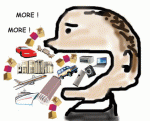 A frenzy of consumerism http://www.theage.com.au/small-business/blogs/work-in-progress/a-frenzy-of-consumerism-20121207-2ayut.html#ixzz2EgEa2wIK The Age, December 7, 2012 James Adonis There was something quite tragic about There was something quite tragic about the Click Frenzy
frenzy, wasn’t there? The same could be said about the Black Friday stampedes in the US, It’s tasteless consumerism to the max, turning ordinary people into ravenous and mindless shoppers, with flow-on effects in the workplace.
But first, let’s go back to 1929. In an article written for Nation’s Business magazine, Charles Kettering – a director of General Motors Research – opined on the need for companies to keep consumers dissatisfied. The moment people are happy with what they have, “almost immediately hard times would be upon us”, he wrote.
And so it is that marketers persevere with advertising to convince us we’re not sexy enough, popular enough, smart enough, or (whatever) enough, unless we purchase what they’re selling. Continue reading
Japan’s displaced people fear to ever return to radiation contaminated areas
In response to a questionnaire sent to Okuma’s evacuees by the town hall in September, only 11 percent of the 3,424 households that responded said they wanted to go back, while 45.6 percent said they had no intention of ever returning, mostly because of radiation fears.
Hopes of Home Fade Among Japan’s Displaced By MARTIN FACKLER NYT, : November 25, 2012 AIZU-WAKAMATSU, Japan — As cold northerly winds sprinkle the first snow on the mountains surrounding this medieval city, those who fled here after last year’s Fukushima nuclear disaster are losing hope that they will ever return to their old homes. Continue reading
Anxiety over radiation causes young Japanese to emigrate
Foreigners tended to assume Japan had bounced back from the triple disaster, and in some areas that was true. But many Japanese now had, for the first time, a deep distrust of their government. The extent of the radiation release from the Fukushima plant, and the barrage of significant aftershocks, have been sources of stress for the Japanese
 a woman in her early 40s, said she wanted to take her family to Australia or New Zealand because of the danger of radiation from the Fukushima disaster and the prospect of another quake.
some radiation-conscious and well-researched New Lifers have even questioned Australia as a destination because it has a nuclear reactor
 Quake, nuke, economy fears chase Japanese overseas BY: RICK WALLACE, TOKYO CORRESPONDENT The Australian November 20, 2012 NEW figures reveal the number of Japanese leaving their homeland for a life abroad has more than tripled in the wake of last year’s earthquake, tsunami and nuclear accident. The number of Japanese living abroad jumped by more than 40,000 in the year to October last year, according to the latest Ministry of Foreign Affairs figures – more than three times the normal rate of growth.
Next year the number is likely to climb further, Continue reading
Plight of Fukushima’s heroic emergency workers
 Nuclear workers in Japan Heroism and humility Meet the “Fukushima 50”, the men on the front line of the nuclear disaster The Economist Oct 27th 2012 | TOKYO | ACCORDING to his friends, the man in charge of the Fukushima Dai-ichi nuclear-power plant during the 2011 disaster, Masao Yoshida, says it felt like being on Iwo Jima. That is the North Pacific island heroically defended by the Japanese in 1945 but doomed to fall to the Americans.
His two underlings, Atsufumi Yoshizawa and Masatoshi Fukura, do not portray the struggle quite so graphically. In their first interviews since the disaster, they spoke of the sense of responsibility of the so-called Fukushima 50, those who risked their lives to fight the soaring levels of radiation coming out of the plant in the hours and days after the earthquake and tsunami on March 11th last year. They were driven, especially, by a desire to protect the local communities in which many of their families lived.
Yet the Fukushima 50, despite heroic efforts, still suffer from the complex of emotions that soldiers might experience when returning from a losing battle. A sense of shame and stigmatisation lingers. Continue reading
Fukushima’s 50 heroes fear discrimination and bullying
The Economist: “Something strange was afoot” during Prime Minister’s visit to plant — Fukushima 50 muzzled http://enenews.com/economist-strange-afoot-during-prime-ministers-visit-plant-fukushima-50-muzzled Title: Japan’s nuclear disaster: Meet the Fukushima 50? No, you can’t
Source: The Economist Author: Banyan Date: Oct 8, 2012
It has taken the Japanese government more than 18 months to pay tribute to a group of brave men, once known as the “Fukushima 50”, who risked their lives to prevent meltdowns at the Fukushima Dai-ichi nuclear power plant from spiralling out of control.
But when the prime minister, Yoshihiko Noda, belatedly offered official thanks to them on October 7th something strange was afoot: six of the eight men he addressed had their backs to the television cameras, refused to be photographed and did not introduce themselves by name, not even to Mr Noda
The reason: officials from the government and from Tokyo Electric Power (Tepco) quietly admitted that the men wanted to keep their identities secret because they were scared of stigmatisation for being involved in the disaster, such as might lead to the bullying of their children and grandchildren. But Tepco is also muzzling them, presumably for fear that what they say will further discredit the now nationalised company. When I asked if I could at least hand my business card to them to see if they wanted to tell their side of the story, an irate Tepco spokesman answered bluntly: “Impossible.”
…Yet even after Mr Noda’s visit, the men do not get the recognition they deserve. Kyodo, a news agency, relegates any mention of them to the bottom of a boring story about decontamination.
East Kazakhstan’s horror nuclear legacy from Soviet times till now
 Josef Stalin’s nuclear legacy remains in East Kazakhstan Scotsman.com, 9 October 2012 Stalin used the area as a nuclear test site and the local population have been paying a terrible price ever since. The plight of these people in East Kazakhstan has touched the heart of Scottish MEP Struan Stevenson, who has campaigned to bring their situation to wider
recognition for 13 years. Now, in an exclusive article for
The Scotsman, he argues Stalin’s actions could have devastating consequences in the future, too Continue reading
Josef Stalin’s nuclear legacy remains in East Kazakhstan Scotsman.com, 9 October 2012 Stalin used the area as a nuclear test site and the local population have been paying a terrible price ever since. The plight of these people in East Kazakhstan has touched the heart of Scottish MEP Struan Stevenson, who has campaigned to bring their situation to wider
recognition for 13 years. Now, in an exclusive article for
The Scotsman, he argues Stalin’s actions could have devastating consequences in the future, too Continue reading
Fukushima residents treated with discrimination, like the hibakusha
the same sort of discrimination is happening to people who were exposed to radiation in Fukushima.
Voices of the “Explosion Covered People” http://www.npr.org/blogs/pictureshow/2012/09/25/161755636/voices-of-the-explosion-covered-people More than 65 years after atom bombs were dropped on Hiroshima and Nagasaki, there are still thousands of people suffering. In addition to experiencing lingering effects from the radiation, many are also considered social outcasts.
The term hibakusha in Japanese means “explosion-covered people” and applies to anyone who came within 2 kilometers (approximately 1.25 miles) of the hypocenter of the bomb — within two weeks of the explosion. Thought to be diseased and contagious, many people hid their experience from friends, family and society at large to avoid being shunned. Continue reading
1 This Month


Tell the Ukrainian Government to Drop Prosecution of Peace Activist Yurii Sheliazhenko

Petition to revoke the licensing of the Near Surface Nuclear Disposal Facility (NSDF) at Chalk River. https://www.ourcommons.ca/petitions/en/Petition/Details?Petition=e-7247


of the week – STOP SMALL MODULAR REACTORS IN CANADA
To see nuclear-related stories in greater depth and intensity – go to https://nuclearinformation.wordpress.com
-
Archives
- March 2026 (183)
- February 2026 (268)
- January 2026 (308)
- December 2025 (358)
- November 2025 (359)
- October 2025 (376)
- September 2025 (258)
- August 2025 (319)
- July 2025 (230)
- June 2025 (348)
- May 2025 (261)
- April 2025 (305)
-
Categories
- 1
- 1 NUCLEAR ISSUES
- business and costs
- climate change
- culture and arts
- ENERGY
- environment
- health
- history
- indigenous issues
- Legal
- marketing of nuclear
- media
- opposition to nuclear
- PERSONAL STORIES
- politics
- politics international
- Religion and ethics
- safety
- secrets,lies and civil liberties
- spinbuster
- technology
- Uranium
- wastes
- weapons and war
- Women
- 2 WORLD
- ACTION
- AFRICA
- Atrocities
- AUSTRALIA
- Christina's notes
- Christina's themes
- culture and arts
- Events
- Fuk 2022
- Fuk 2023
- Fukushima 2017
- Fukushima 2018
- fukushima 2019
- Fukushima 2020
- Fukushima 2021
- general
- global warming
- Humour (God we need it)
- Nuclear
- RARE EARTHS
- Reference
- resources – print
- Resources -audiovicual
- Weekly Newsletter
- World
- World Nuclear
- YouTube
-
RSS
Entries RSS
Comments RSS
 nuclear-news