Eastern European scientists’ studiesshed new light on Chernobyl nuclear radiation
 Perspectives on Chernobyl and Fukushima Health Effects: Journal of Health and Pollution, Vol 3 June 2013 What Can Be Learned From Eastern European Research?
Timothy Mousseau, PhD1
Radiation exposure to endovascular procedure operators
Endovascular interventions exposed operators to more radiation than coronary Healio, Ingwersen M. J Am Coll Cardiol Intv. 2013;6:1095-1102. November 4, 2013
Operators who performed endovascular procedures for pelvic, upper limb and below-the-knee disease experienced increased radiation exposure in the cath lab compared with those who performed coronary procedures…….Although recommended dose limits were not exceeded in our study, radiation exposure may have biological effects depending on the type and frequency of procedures performed, the time lag between the procedures, the fluoroscopy time and a patient’s BMI,” the researchers wrote. “Therefore, protection devices, spectral filtration, pulsed fluoroscopy and low frame rates should be used whenever possible.” http://www.healio.com/cardiology/intervention/news/online/%7B5a58b7e0-ecc4-4957-847a-8f67c3b8edf0%7D/endovascular-interventions-exposed-operators-to-more-radiation-than-coronary
Fukushima radiation reaching Alaskan coast, but it’s not being measured
 Radiation from Japan nuclear plant arrives on Alaska coast http://www.cbc.ca/news/canada/north/radiation-from-japan-nuclear-plant-arrives-on-alaska-coast-1.2335668 Scientists concerned about lack of monitoring plan CBC News Nov 02, 2013 Scientists at the University of Alaska are concerned about radiation leaking from Japan’s damaged Fukushima nuclear plant, and the lack of a monitoring plan.
Some radiation has arrived in northern Alaska and along the west coast. That’s raised concern over contamination of fish and wildlife. More may be heading toward coastal communities like Haines and Skagway.
Douglas Dasher, a researcher at the University of Alaska Fairbanks, says radiation levels in Alaskan waters could reach Cold War levels.”The levels they are projecting in some of the models are in the ballpark of what they saw in the North Pacific in the 1960s,” he said.
John Kelley, a professor emeritus at the University of Alaska Fairbanks, says he’s not sure contamination will reach dangerous levels for humans but says without better data, who will know? “The data they will need is not only past data but current data, and if no one is sampling anything then we won’t really know it, will we?
“The general concern was, is the food supply safe? And I don’t think anyone can really answer that definitively.” He says much of the monitoring is being done pro bono by universities, NGOs and state organizations.
Fukushima radiation alerting world to nuclear radiation danger in oceans
“In terms of the ocean, this is definitely an environmental catastrophe, and it’s still ongoing,”
”though contamination in the most seriously affected areas has been worse than a lot of things that have gone in the past, conscientious testing of seafood can help prevent it from becoming a human health disaster as well.”
“It also shows us that we have to redouble our efforts to fully understand the health consequences of the testing period, because that will help us prepare for the future consequences of Fukushima.”

Christina Macpherson’s websites & blogs
This article has a misleading title. The author does not “downplay” Fukushima radiation hazards. On the contrary, he is pointing out the seriousness of radioactive matter in the oceans, and how this has been ignored in the past
Scientists downplay Fukushima radiation hazards DW 25.10.2013 Julian Ryall, Tokyo Experts agree that the radiation from the Fukushima nuclear plant is an “environmental catastrophe,” but it is only a fraction of the fallout from atmospheric nuclear tests carried out in the 1950s and 1960s, they say…….
Tokyo Electric Power Co. confirmed Tuesday that radioactive cesium had again been detected about one kilometer offshore from the Fukushima nuclear plant, crippled in March 2011 by the Great East Japan Earthquake and the tsunami that it triggered……
People forget that the world we live in already has a lot of cesium-137 in the environment,” Dr. Mitsuo Aoyama, senior scientist in the Oceanography and Geochemistry Department of the Japan Meteorological Research Institute, told DW…….
Dr. Aoyama’s studies show that by 1970, an estimated 290 petabecquerels – an alarming 29 followed by 15 zeroes – of cesium fallout was in the north Pacific ocean from atmospheric weapons tests……
an ongoing study by the Woods Hole Oceanographic Institution, based in Massachusetts, shows that in 1990 the rate in the Black Sea stood at 52 becquerels per cubic meter, at 55 in the Irish Sea – a legacy of problems at Britain’s Sellafield nuclear plant – and at 125 in the Baltic. Continue reading
Radiation Levels Will Concentrate in Pockets at Certain North American West Coast Locations
“Fukushima Is Here”: Nuclear Radiation On the West Coast, from California to Alaska. http://www.globalresearch.ca/fukushima-is-here-nuclear-radiation-on-the-west-coast-from-california-to-alaska/5355851 Excellent graphics. You really need to go to this link to see those.
The ocean will dilute Fukushima radiation By Washington’s Blog Global Research, October 28, 2013
Radiation Levels Will Concentrate in Pockets at Certain West Coast Locations
An ocean current called the North Pacific Gyre is bringing Japanese radiation to the West Coast of North America: While many people assume that the ocean will dilute the Fukushima radiation, a previously-secret 1955 U.S. government report concluded that the ocean may not adequately dilute radiation from nuclear accidents, and there could be “pockets” and “streams” of highly-concentrated radiation.
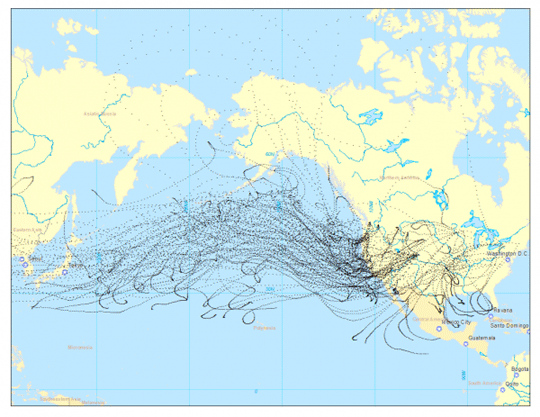
Physicians for Social Responsibility notes: Continue reading
United Nations Scientific Committee on the Effects of Atomic Radiation (UNSCEAR) admits radiation danger to children
Radiation can pose bigger cancer risk for children – UN study http://uk.reuters.com/article/2013/10/25/us-nuclear-radiation-children-idUKBRE99O0M820131025 VIENNA | Fri Oct 25, 2013 (Reuters) by Fredrik Dahl- Infants and children can be more at risk than adults of developing some cancers when exposed to radiation, for example from nuclear accidents, a U.N. scientific report said on Friday. Children were found to be more sensitive than adults for the development of 25 percent of tumor types including leukemia, and thyroid, brain and breast cancer, it said.
“The risk can be significantly higher, depending on circumstances,” theUnited Nations Scientific Committee on the Effects of Atomic Radiation (UNSCEAR) added in a statement. UNSCEAR said it began working on the report in 2011, the same year as Japan‘s Fukushima nuclear accident, although the world’s worst such disaster in 25 years was not mentioned in the statement. The committee said in May that cancer rates were not expected to rise after the Fukushima accident.
Studies into the 1986 accident at Chernobyl in Ukraine have, however, linked thyroid cancer to radioactive iodine. The thyroid is the most exposed organ as radioactive iodine concentrates there. Children are deemed especially vulnerable.
Friday’s report, presented to the U.N. General Assembly, said children and adults should be considered separately following exposure in order to predict risk more accurately. Continue reading
Overuse of medical radiation in the interests of profit
 Overuse of Radiation Therapy Services When Urologists Profit Through Self-Referral Science Daily, Oct. 24, 2013 — A comprehensive review of Medicare claims for more than 45,000 patients from 2005 through 2010 found that nearly all of the 146 percent increase in intensity-modulated radiation therapy (IMRT) for prostate cancer among urologists with an ownership interest in the treatment was due to self-referral, according to new research, “Urologists’ Use of Intensity-Modulated Radiation Therapy for Prostate Cancer,” released today in The New England Journal of Medicine (NEJM) for its October 24, 2013 issue. This study corroborates the increased IMRT treatment rates among self-referrers reported in the Government Accountability Office’s (GAO) August 2013 report, “Medicare: Higher Use of Costly Prostate Cancer Treatment by Providers Who Self-Refer Warrants Scrutiny.”…….
The NEJM report concludes that “men treated by self-referring urologists, as compared with men treated by non-self-referring urologists, are much more likely to undergo IMRT, a treatment with a high reimbursement rate, rather than less expensive options, despite evidence that all treatments yield similar outcomes.” Continue reading
Effect of low energy electrons on DNA
Understanding DNA damage http://esciencenews.com/articles/2013/10/25/understanding.dna.damage?utm_source=feedburner&utm_medium=feed&utm_campaign=Feed%3A+eScienceNews%2Fpopular+(e!+Science+News+-+Popular, October 25, 2013 Every day, all day, our DNA gets beaten up by chemicals and radiation — but remarkably, most of us stay healthy. Now, an investigation by a team of French and Canadian researchers has produced insights into a little-studied but common radiation threat to DNA: low-energy electrons (LEEs), with energies of 0-15 electron volts. The team has devised the first rough model of a close DNA cellular environment under threat from LEEs, revealing for the first time their effects on DNA in natural, biological conditions. Their work appears in The Journal of Chemical Physics, which is produced by AIP Publishing
The team’s work is an important step forward in understanding how LEEs injure DNA because it provides a realistic experimental platform for analysis of results. The goal is to use this knowledge to improve current uses of radiation, such as in cancer treatments.
“The way by which these electrons can damage DNA, and how much damage they inflict, quantitatively, is of major importance not only for general radiation protection purposes, but also for improving the efficiency and safety of therapeutic and diagnostic radiation therapy,” said Michel Fromm, the lead researcher from Université de Franche-Comté in Besançon, France, whose expertise is in creating nanometer-scaled DNA layers. His co-author on the paper is Leon Sanche, of Sherbrooke University Québec, Canada, who is one of the world’s leading authorities on LEE research.
The team explored specific features of a small DNA molecule called a plasmid on a specialized thin film they created, which was irradiated by an electron gun. The impact produced transient particles called anions, which dissociate into “pieces” of DNA. When analyzed, these molecular fragments provide insight into the mechanisms of DNA strand breaks and other DNA injuries that health researchers seek to understand, repair and prevent.
“The fascinating point is that each time the close environment of DNA changes, new mechanisms of interaction of LEEs appear,” Fromm said.
Trade winds and Pacific currents bring Fukushima radiation to North America
Fukushima Radiation Hitting Canada and United States More than Japan http://talesfromthelou.wordpress.com/2013/10/08/fukushima-radiation-hitting-canada-and-united-states-more-than-japan-209/ Oct 8, 2013
ForbiddenKnowledgeTV
Alexandra Bruce
October 5, 2013
Besides the billions of gallons of radioactive water spilling from the abandoned Fukushima Nuclear Energy Plant every day, there is also a steady plume of radio nuclides including Cesium, Cobalt, Uranium and Plutonium, which are steadily being carried across the Pacific via trade winds, with the lion’s share landing (usually, along with the rain) in communities within the US and Canada – and in places beyond, throughout the Northern Hemisphere. Ironically, more fallout is presently occurring in North America than in Japan, the scene of the disaster, due to the trade winds, off the Japanese coast.
It has been calculated that in 1 day, there are 666,733.717599549 bequerels of radiation emitted in every cubic foot of the Pacific, per mile.
There are about 63,800,000 miles in the Pacific Ocean. The average depth is about 2.28 miles. There are 145,464,000 cubic miles in the Pacific Ocean. Cesium-137 has a double decay process 94.6% of the time; first beta rays, then gamma rays.
So each cubic foot of the entire Pacific Ocean will have 218.174056838937 Beta radiation events per day and each cubic foot of the entire Pacific Ocean will have 206.392657769635 Gamma radiation events per day.
34 is the average background radiation of the N. American continent.
The Pacific Ocean will have a “radiation fog” in every cubic foot of water that is 12.47 times HIGHER than the average background radiation count of North American continent.
Sea life will be affected in some manner; perhaps all fish will get cancer. The impact on humanity is a shortage in sea food and no swimming allowed until radiation levels abate to a “safe level”… in about how long???
Fukushima’s small level of radiation in fish can still cause cancers
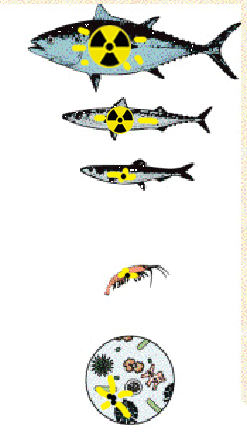 the radiation detected can still cause cancer, according to the U.S. Environmental Protection Agency’s cancer-risk formula, a leading international standard for forecasting cancer risks from radiation.
Cancer risk linked to radiation levels in fish species after Fukushima http://www.straight.com/life/497651/cancer-risk-linked-radiation-levels-fish-species-after-fukushima
In July this year, a sea bass caught in Japan had 1,000 becquerels per kilogram of radioactive cesium—10 times Japan’s ceiling of 100 becquerels per kilo in food. It was the second-highest amount found in a sea bass since the disaster occurred. Continue reading
Pennsylvania water has dangerous levels of radiation due to fracking
Dangerous levels of radiation from fracking found in PA  water http://www.salon.com/2013/10/02/dangerous_levels_of_radiation_from_fracking_found_in_pa_water/singleton/ Researchers found 200 times the normal amount of radium downstream of a treatment plant BY LINDSAY ABRAMS The wastewater released into a Pennsylvania river from a plant that processes fracking wastewater tested positive positive for dangerous contaminants — including radium levels elevated 200 times above normal — Duke University researchers found.
“The radioactivity levels we found in sediments near the outflow are above management regulations in the U.S. and would only be accepted at a licensed radioactive disposal facility,” Robert B. Jackson, one of the researchers, said in a statement.
The study, published in the journal Environmental Science and Technology, compared water and sediment samples from downstream of the Josephine Brine Treatment Facility, located on western Pennsylvania’s Marcellus shale formation, to samples from above the plant. In addition to the extreme levels of radium, it also found two to ten times the amoung of chlorides and bromides in the downstream samples. As Smithsonian Magazine notes, Pennsylvania hosts 74 facilities that treat the radioactive water driven to the surface by fracking. Ostensibly, they’re supposed to remove radium and other contaminants from the water before releasing it into rivers and streams. No national standards, however, exist to regulate the plants, many of which, according to the EPA, “are not properly equipped to treat this type of wastewater.” They’re also not required to test to radiation — so until the Duke researchers stepped in, it’s likely no one was aware of just how poorly this plant was performing.
“Each day, oil and gas producers generate 2 billion gallons of wastewater,” Jackson told Climate Central. “They produce more wastewater than hydrocarbons. That’s the broader implication of this study. We have to do something with this wastewater.”
Breast cancer patients do better with shorter radiation treatments
Breast cancer patients are given unnecessary doses of radiation therapy Information Daily , October 1, 2013 For the first time, researchers have admitted that shorter radiotherapy treatments may be as effective as longer treatments, with fewer side effects.
Scientists have found that longer bouts of radiotherapy are overcompensating for cancer cell growth that occurs overnight and during weekends, causing unnecessary and uncomfortable side effects……..
overall they found that an even shorter one-week radiotherapy schedule could replace the contemporary five to seven week schedules – and could even trump the newly popular three week schedule.
Overall, it is clear that clinicans support this move, arguing that shorter treatment schedules would be more convenient for patients, with benefits including fewer trips to the hospital, and also highly cost-effective for health services.
President of ECCO, Professor Cornelis van de Velde, explained that “this is important research that suggests that the overall treatment time with radiotherapy could make a difference to outcomes for women with early breast cancer”.
“If further investigations confirm that a shorter radiotherapy schedule is as effective as the current standard of care, it will be another step towards making treatments easier and more bearable for patients, and possibly cheaper for healthcare services”.
Lead author, Prof Yarnold, added that, “if confirmed, it means that current trends to deliver shorter radiotherapy schedules are likely to bear fruit in the future”.
However, she emphasised that “current schedules delivered over five weeks or more remain highly effective, and patients should follow recommendations from their specialists”. http://www.theinformationdaily.com/2013/10/01/breast-cancer-patients-are-given-unnecessary-doses-of-radiation-therapy
International concern as USA bans food and fish imports from irradiated areas of Japan
 FDA Import Alert: U.S. bans agricultural and fishery products from 14 prefectures in Japan due to Fukushima radionuclides — Top Newspaper: Concern over contamination is spreading to most countries around Pacific http://enenews.com/fda-import-alert-u-s-bans-japans-agricultural-and-fishery-products-from-14-prefectures-due-to-fukushima-radionuclides-concern-over-contamination-is-spreading-to-most-countries-around-pacific
Dong-A Ilbo, Sept. 28, 2013 (Korea’s top newspaper): […] Concerns over Japan’s radioactive contamination and its seafood is spreading to most countries in the  Pacific basin. The United States has recently banned agricultural and fishery imports from 14 prefectures in Japan, up from eight. South Korea puts a similar ban on fishery imports from eight prefectures, while China and Taiwan does so for 10 and five prefectures, respectively. [… The IAEA’s] upcoming probe needs to shed light on the cause and situation of soil and sea water contamination. […] It would be much better if experts from South Korea, the United States and China participate in the investigation. It is natural for a global organization to intervene in an international issue. […] Continue reading
Large area received Fukushima radiation fallout
Textbook: Fukushima disaster contaminated the territory of Japan, Sea of Japan, Korea — Up to 8 orders of magnitude above global fallout background off prefecture’s coast http://enenews.com/book-fukushima-contaminated-japan-sea-of-japan-korean-peninsula-cesium-137-up-to-8-orders-of-magnitude-above-global-fallout-background-in-coastal-seawater
September 28th, 2013_
Title: Fukushima Accident: Radioactivity Impact on the Environment
Source: Elsevier
Authors: Pavel P. Povinec, Katsumi Hirose, Michio Aoyama
Date: July 9, 2013
Emphasis Added
Apart from the contamination of the Japanese territory (Hirose, 2012; Kanai, 2012; Tanaka et al., 2012), the Japan Sea (Inoue et al., 20I2a), and the Korean Peninsula (Hernandez-Ceballos et al., 2012; Lee et al., 2012), due to prevailing western winds, the radionuclides emitted to the atmosphere were mainly transported from Fukushima over the Pacific Ocean (Kamenik et al., 2013) […]
[…] large quantities of radioactive materials released to the atmosphere and coastal waters following a nuclear accident at the Fukushirna Dai-ichi NPP increased considerably the Cs-137 concentrations in coastal seawater off Fukushima up to eight orders of magnitude above the global fallout background (TEPCO, 2012; MEXT, 2012).
Portions of the book available here
Cloud of radioactive iodine reaches France, from Fukushima
Fukushima Doom Confirmed? France Hit By Iodine-131 Cloud While New Radiation Plume Expected To Hit West Coast Of America On Tuesday http://revolutionradio.org/?p=58394, September 22, 2013 By Paul Martin A cloud of Iodine-131 has reached France while the recent 5.3 Fukushima earthquake is sending a new radiation plume around the world according to a recent story from Bobby1′sBlog. This latest plume is expected to arrive on the West Coast of America on Tuesday, September 24th. With radiation now spreading across the entire Northern hemisphere and no end in sight, are we reaching the ‘beginning of the end’? Two videos below confirm the severity of this ongoing doomsday situation.
An earthquake that rocked Japan just south of the Fukushima area shortly after midnight on September 20 (Japan time) sent a new plume of radiation across the Pacific Ocean. Apparently radiation measurements in this area have temporarily spiked.
This new plume would arrive on the west coast around Tuesday, Sept. 24. Previous earthquakes have also generated plumes. I remember that the one that arrived after the Jan. 1, 2012 quake was really nasty.
In a previous discussion Iodine-131 from latest criticality it was noted that the iodine spike in Chiba prefecture sludge was deposited in the period August 7 through August 20. According to CRIIRAD, Montélimar, France had spikes in alpha and beta atmospheric radiation on September 4-7. Rhône river water in Avignon showed a spike in iodine-131 on Sept. 7. The iodine cloud must have widened and dispersed quite a bit in its journey across the northern hemisphere… and 75% or more of it would have decayed by the time it reached France. So it must have been quite a substantial radioactive cloud.
Fukushima not only affects Japan, but the Pacific ocean, North America, and Europe too. Australia has had average radiation levels increase substantially, also.
1 This Month

of the week – Shut Down Drone Warfare!


Tell the Ukrainian Government to Drop Prosecution of Peace Activist Yurii Sheliazhenko

Petition to revoke the licensing of the Near Surface Nuclear Disposal Facility (NSDF) at Chalk River. https://www.ourcommons.ca/petitions/en/Petition/Details?Petition=e-7247
To see nuclear-related stories in greater depth and intensity – go to https://nuclearinformation.wordpress.com
-
Archives
- April 2026 (103)
- March 2026 (251)
- February 2026 (268)
- January 2026 (308)
- December 2025 (358)
- November 2025 (359)
- October 2025 (376)
- September 2025 (257)
- August 2025 (319)
- July 2025 (230)
- June 2025 (348)
- May 2025 (261)
-
Categories
- 1
- 1 NUCLEAR ISSUES
- business and costs
- climate change
- culture and arts
- ENERGY
- environment
- health
- history
- indigenous issues
- Legal
- marketing of nuclear
- media
- opposition to nuclear
- PERSONAL STORIES
- politics
- politics international
- Religion and ethics
- safety
- secrets,lies and civil liberties
- spinbuster
- technology
- Uranium
- wastes
- weapons and war
- Women
- 2 WORLD
- ACTION
- AFRICA
- Atrocities
- AUSTRALIA
- Christina's notes
- Christina's themes
- culture and arts
- Events
- Fuk 2022
- Fuk 2023
- Fukushima 2017
- Fukushima 2018
- fukushima 2019
- Fukushima 2020
- Fukushima 2021
- general
- global warming
- Humour (God we need it)
- Nuclear
- RARE EARTHS
- Reference
- resources – print
- Resources -audiovicual
- Weekly Newsletter
- World
- World Nuclear
- YouTube
-
RSS
Entries RSS
Comments RSS
 nuclear-news