UNSCEAR not independent, and its April report on atomic radiation is not reliable
 British researcher blasts U.N. report on Fukushima cancer risk as unscientific http://ajw.asahi.com/article/0311disaster/fukushima/AJ201412010036 By MASAKAZU HONDA/ Staff Writer
A British scientist who studied the health effects of the 1986 Chernobyl disaster panned a United Nations report that virtually dismissed the possibility of higher cancer rates caused by the 2011 Fukushima nuclear crisis.
Keith Baverstock, 73, made the comments during a visit to Tokyo at the invitation of a citizens group related to the Fukushima disaster.
In response to questions from The Asahi Shimbun, Baverstock said a report released in April by the U.N. Scientific Committee on the Effects of Atomic Radiation (UNSCEAR) was “not qualified to be called ‘scientific’” because it lacked transparency and independent verification. He added that the committee should be disbanded.
The U.N. report said any increase in overall cancer rates among residents of Fukushima Prefecture due to fallout from the accident was unlikely.
However, Baverstock, former head of the radiation-protection program at the World Health Organization’s Regional Office for Europe, said radiation levels shown in the report were enough to cause a spike in cancer rates.
For example, the report said nearly 10,000 workers at the crippled Fukushima No. 1 nuclear plant were exposed to radiation levels exceeding 10 millisieverts over about 18 months following the outbreak of the crisis in March 2011.
Baverstock said such an exposure level was enough to cause an increase in cancer among about 50 of the workers.
After studying the health effects from the Chernobyl nuclear disaster, Baverstock was the first to point out an increase in thyroid cancer among residents of areas hit by radioactive fallout.
He also questioned UNSCEAR’s neutrality, given that members are nominated by nations that have a vested interest in nuclear power. He noted that such nations provide funds to the committee.
Baverstock also suggested a conflict of interest, as committee members are not required to disclose their history working in the nuclear industry or sign pledges stating that no conflict of interest exists in evaluating radiation risks.
Baverstock said that when he was working for the WHO, he felt constant pressure from the International Atomic Energy Agency, a major promoter of nuclear power. He also questioned why it took more than three years for UNSCEAR to release its Fukushima report.
Referring to what he called inside information, Baverstock raised the possibility that the delay was caused by criticism about the report’s conclusion and the influence of other U.N. agencies, such as the IAEA.
“Radioactive Berkeley: No Safe Dose
 from Kay, 2 Dec 14 The video of Dr. Gofman is excellent. https://www.youtube.com/watch?v=xddNmNR0hG4 Someone at ENENEWS transcribed some of what Dr. Gofman had to say, and his words are so important that I think it’s important to post it here, too, for safekeeping. (It’s a little long, sorry)
Dr. John Gofman:
“What’s the order of magnitude of the problem that’s been created by radiation in the 20th century? Today manmade activities added up in total exceed the dose from natural radiation.”
“Every increment that we add to that natural radiation will exact its price in human health, and human health with respect to some very miserable diseases such as the genetic disorders and heart disease and cancer.”
“50% of all cancers in the 20th century have been caused by ionizing radiation of the type we would call low-level.”
“Recently I wrote a book on the subject of breast cancer and stated that my best estimate backed up by considerable evidence is that about ¾ of all the breast cancers of the 20th century were induced by ionizing radiation of one sort or another, including medical. This is not a small problem and we there therefore need to give attention to every source of low-level radiation exposure to the public.”
“In the early days of the post-war period when radioactivity became available in large quantities as the result of the existence of nuclear reactors, many of the people working in the field said, ‘Well, what dose can we allow people to have which will be safe?’
“I wrestled with that question for over 20 years, and in 1986 on a talk about Chernobyl, I presented to the American Chemical Society, my initial calculations which said:
There cannot be a safe dose, because at the lowest possible dose, which is one radiation track through the cell, I have proved that cancer is the result.”
–> Regarding Tritium:
“Many people thinking about Tritium say ‘oh we don’t have to worry about tritium; the energy of the radiation is so low that we don’t even need to think about it.’ But that is a cardinal error! It is true that the energy of each beta particle emitted by tritium is very low, BUT there’s another problem. When you have a very low energy beta particle interact with biological tissue to produce the damage to genes, the damage to chromosomes, and the risk of future cancers, the lower the energy of the radiation, the WORSE it is in terms of biological hazards. Tritium is FIVE TIMES as hazardous as bomb radiation for the same total amount of energy delivered. And that’s a general law, a rule of physics. I don’t think any person who is reasonable at all can doubt that I have demonstrated THERE IS NO SAFE DOSE because I have shown with a multitude of studies that we get cancers down at the lowest doses. Now that’s been resisted… but the United Nations scientific community in 1993 has come out and joined me in exactly the same kind of analysis. Their conclusion: THERE IS NO SAFE DOSE.”
“Children are most sensitive with respect to the generation of cancer and leukemia from radiation. The study of breast cancer in Hiroshima with radiation from the bomb has shown that children under 20, women under 20, are the most sensitive; that from 20 to 40, they are less sensitive to the breast cancer generation, and beyond 40 even less sensitive. That’s not theory. That’s not speculation. That’s a fact. And the sensitivity of the young being greater means we should exercise every precaution that we protect our children from sources of radiation no matter how small.”
The Invisible Belt That Saves Earth From Radiation
Be Thankful For the Invisible Belt That Saves Earth From Radiation, Gizmodo, 26 Nov 14
Kelsey Campbell-Dollaghan A NASA-led study of the Van Allen radiation belts has uncovered new information about the invisible “shield” that keeps harmful ultrarelativistic electrons from the Earth.
In a study published in Nature, scientists from MIT and the University of Colorado at Boulder detail their analysis of data from NASA’s Van Allen Probes, which are studying the radiation belts around Earth—just last year, the probes reported the existence of a new, previously-unknown third belt thousands of miles above the Earth. In short, these craft are sending back vital information about the space around our planet. And in Nature this week, we found out even more.
In the study, we learn about the existence of a hard barrier at the bottom of the outermost belt, about 7,000 miles above Earth, and something called “plasmaspheric hiss.” This layer of electromagnetic waves stop the high-energy electrons zinging around the Earth from actually getting close to it. MIT News explains that the “hiss” in the phenomenon’s name is actually due to the sound the waves make over the radio, and that they keep us safe from otherwise quite dangerous radiation:…….http://gizmodo.com/be-thankful-for-the-invisible-belt-that-saves-earth-fro-1663882527
Nuclear power promoter DOE to run research into health effects of radiation
 House passes bill to study low-dose radiation http://thehill.com/blogs/floor-action/house/224411-house-passes-bill-to-study-low-dose-radiation
By Cristina Marcos November 17, 2014,The House on Monday passed legislation by voice vote to authorize Department of Energy research on the risks of low-dose ionizing radiation.
Under the measure, H.R. 5544, the Department of Energy’s Office of Science would conduct research on low-dose radiation. Rep. Paul Broun (R-Ga.), the bill’s sponsor, said there isn’t enough scientific data regarding exposure to low levels of radiation.
The director of the Energy Department’s Office of Science would be required establish an agreement with the National Academies on a long-term strategy for low-dose radiation research within 60 day’s of the bill’s enactment. Such a study would have to be completed within 18 months.
The measure encountered no opposition during House floor debate.
Southern Hemisphere has record levels of ultraviolet radiation
Extreme levels of UV radiation in Arequipa, Peru This Week, By Agnes Rivera, 8 Nov 14 The coming months will bring the levels up to 16, the highest in the world……..According to the Regional Health Management of Environmental Health residents in Arequipa should take extra precaution this season towards UV protection.
Executive director of said agency, Zacarías Madariaga, warns that during the months of November and December, Peru’s southern region could reach radiation levels of 16, which would be the highest in the world.
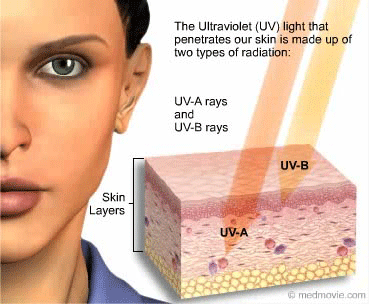
“Usually the high rates are 12 and 14. However, at this time of year there are extreme levels,” says Madariaga, as quote
Human mission to Mars probably impossible, due to killer radiation
 Mars mission could expose astronauts to deadly levels of radiation while travelling to the red planet, study claims, Daily Mail
- A study from the University of New Hampshire suggests missions to Mars might be impossible due to an increased risk of radiation
- Research suggests when sun is less active cosmic rays increase
- This lowers the amount of time an astronaut can safely stay in space
- It is predicted solar activity will continue to decrease in future
- This will mean male astronauts can only stay in space for 320 days
- And for females this is reduced to just 240 days
- These would be too short for a mission to Mars, particularly for women
- Both would be susceptible to radiation sickness, cancer and more
By JONATHAN O’CALLAGHAN FOR MAILONLINE 22 October 2014
Sending people to Mars may be impossible due to an increased radiation risk from cosmic rays, claims a study.
It’s thought that a predicted decrease in solar activity will raise the levels of radiation astronauts are subjected to from cosmic rays on a deep space mission.
This will increase the risk of suffering sickness, cancer and more on lengthy trips to the red planet lasting about a year to levels beyond what is considered safe……
the number of days a human could spend in space before reaching the limit is less than thought……a mission to Mars for a man difficult, but for women it would be all but impossible without them succumbing to serious effects of radiation. ……..http://www.dailymail.co.uk/sciencetech/article-2802937/mars-mission-expose-astronauts-deadly-levels-radiation-travelling-red-planet-study-claims.html
Dental plan to reduce radiation doses to children
 Dentists urged to ‘child-size’ radiation doses for young patients Wave News Oct 06, 2014 LOUISVILLE, KY (WAVE) – The saying goes “The world always looks brighter from behind a smile.” But keeping that smile bright at the wrong hands could hurt your child’s long-term health. That’s the idea behind a new campaign being pushed out to dentists and other dental professionals around the country.
The University of Louisville Dental School’s Director of Radiology and Imaging Science is joining a team of doctors across the country to get that word out to dentists who treat your children………
“They’re up to three to five times as sensitive as myself to radiation,” said dr. William Scarfe, director of Radiology and Imaging Science at UofL’s School of Dentistry.
Scarfe is helping lead an awareness campaign called Image Gently. It asks dentists to consider just how much radiation their young patients are getting.
“Is it necessary is always the first question,” said Scarfe. He says switching from film to digital radiology reduces the dose, as does focusing on a specific region instead of the whole head. “We should reduce the dose to what their size is,” Scarfe said “That’s called child-sizing exposure.”
Parents, Scarfe says, should look for a dentist to use a thyroid collar, a preferred, but not mandated method in Kentucky.”That significantly reduces the dose to children whose thyroids are very sensitive by about 50%,” said Scarfe……….
Scarfe says parents can and should ask questions about the reasons and the way their children are having images taken at the dentist.
The six-step Image Gently plan includes:
- Select x-rays for a patient’s individual needs, not as routine.
- Use the fastest image receptor possible, E- or F-speed film or digital sensors
- Aim the x-ray beam to expose only the area of interest.
- Use thyroid collars
- Child-size the exposure
- Use cone beam computed tomography (CBCT) only when necessary http://www.wave3.com/story/26716108/dentist-urged-to-child-size-radiation-doses-for-young-patients
Russia’s nuclear company Rosatom sends third expedition to monitor Fukushima radiation
Russia sends third expedition to Kuril Islands to monitor radiation levels October 7, 2014 Gleb Fedorov, RBTH Radiation from the Fukushima Nuclear Power Plant does not threaten Russian territory. However, the consequences of the 2011 accident will be felt for decades to come. RBTH spoke to the scientists involved with the third expedition to be sent to the Kuril Islands in the Russian Far East in order to monitor the radiation.
The scientific expedition vessel Professor Khlyustin, carrying Russian scientists, experts and military personnel, left the port of Vladivostok in Russia’s Far East on September 25 and headed east toward the Kuril Islands of Urup and Simushir, where they were due to take samples of soil, freshwater and silt.
……..In the space of a month, the expedition plans on crossing the Sea of Japan and sailing along the eastern shores of the Kuril Islands, a narrow chain of isles stretching 800 miles from Russia’s Kamchatka Peninsula to the Japanese island of Hokkaido. The scientists’ principal aim is to monitor radiation levels in the area affected by the accident at Japan’s Fukushima Nuclear Power Plant on March 11, 2011. This is the third expedition since the disaster. The first one took place right after the catastrophe, the second – a year later. The new expedition is being carried out under the aegis of the Russian Geographical Society and has been organized by the State Oceanographic Institute. Aboard the vessel are collaborators from state nuclear corporation Rosatom, the Ministry of Defense, the Russian Hydro-Meteorological Institute, the Rospotrebnadzor Monitoring Agency and the  Nevelsky Naval University. Results from past expeditions showed that pollution was almost zero and the biggest threat to Russia was the accumulation of radiation in fish.
………The only thing threatening Russia after Fukushima, according to Panchenko, is the accumulation of radiation in various types of commercial fish: “Fukushima’s radioactive discharges polluted the sand in the shallows where we find the little sand eels. Sand eels are caught by fishermen and are eaten by bigger commercial fish, which thus accumulate radiation.”
Source: Russia Beyond the Headlines – http://rbth.com/science_and_tech/2014/10/07/russia_sends_third_expedition_to_kuril_islands_to_monitor_ra_40417.html)
Obama lifts permissable levels of radiation in drinking water!
 Obama Approves Raising Permissible Levels of Nuclear Radiation in Drinking Water. Civilian Cancer Deaths Expected to Skyrocket http://www.globalresearch.ca/obama-approves-raising-permissible-levels-of-nuclear-radiation-in-drinking-water-civilian-cancer-deaths-expected-to-skyrocket/5331224
Rollback in Nuclear Radiation Cleanup By Global Research News, September 19, 2014 by Public Employees for Environmental Responsibility (PEER)
The White House has given final approval for dramatically raising permissible radioactive levels in drinking water and soil following “radiological incidents,” such as nuclear power-plant accidents and dirty bombs. The final version, slated for Federal Register publication as soon as today, is a win for the nuclear industry which seeks what its proponents call a “new normal” for radiation exposure among the U.S population, according Public Employees for Environmental Responsibility (PEER).
Issued by the Environmental Protection Agency, the radiation guides (called Protective Action Guides or PAGs) allow cleanup many times more lax than anything EPA has ever before accepted. These guides govern evacuations, shelter-in-place orders, food restrictions and other actions following a wide range of “radiological emergencies.” The Obama administration blocked a version of these PAGs from going into effect during its first days in office. The version given approval late last Friday is substantially similar to those proposed under Bush but duck some of the most controversial aspects:
In soil, the PAGs allow long-term public exposure to radiation in amounts as high as 2,000 millirems. This would, in effect, increase a longstanding 1 in 10,000 person cancer rate to a rate of 1 in 23 persons exposed over a 30-year period;
- In water, the PAGs punt on an exact new standard and EPA “continues to seek input on this.” But the thrust of the PAGs is to give on-site authorities much greater “flexibility” in setting aside established limits; and
- Resolves an internal fight inside EPA between nuclear versus public health specialists in favor of the former. The PAGs are the product of Gina McCarthy, the assistant administrator for air and radiation whose nomination to serve as EPA Administrator is taken up this week by the Senate.
- Despite the years-long internal fight, this is the first public official display of these guides. This takes place as Japan grapples with these same issues in the two years following its Fukushima nuclear disaster.
-
“This is a public health policy only Dr. Strangelove could embrace. If this typifies the environmental leadership we can expect from Ms. McCarthy, then EPA is in for a long, dirty slog,” stated PEER Executive Director Jeff Ruch, noting that the EPA package lacks a cogent rationale, is largely impenetrable and hinges on a series of euphemistic “weasel words.”
“No compelling justification is offered for increasing the cancer deaths of Americans innocently exposed to corporate miscalculations several hundred-fold.”
Reportedly, the PAGs had been approved last fall but their publication was held until after the presidential election. The rationale for timing their release right before McCarthy’s confirmation hearing is unclear.
Since the PAGs guide agency decision-making and do not formally set standards or repeal statutory requirements, such as the Safe Drinking Water Act and Superfund, they will go into full effect following a short public comment period. Nonetheless, the PAGs will likely determine what actions take place on the ground in the days, weeks, months and, in some cases, years following a radiological emergency.
Florida report showed highest level of Fukushima radioactive material
Newly released data shows Florida hit with highest level of radioactive material from Fukushima measured anywhere in world outside Japan — #1 out of more than 1,500 test results — Total radioactive iodine was up to 500% of amount reported http://dublinsmickdotcom.wordpress.com/2014/09/27/newly-released-data-shows-florida-hit-with-highest-level-of-radioactive-material-from-fukushima-measured-anywhere-in-world-outside-japan-1-out-of-more-than-1500-test-results-tot/
According to remarks included with CTBTO data recently released by the United Nations Scientific Committee on the Effects of Atomic Radiation, the total iodine-131 in the air was up to 500% of the amount shown.
Read entire article here:
The IARC-WHO classification of cell phone radiation is misrepresented by the industry
Use of Cell Phones Increase Cancer Risk, Natural Healing Tools News, (DNA, August 18) Dr Dariusz Leszczynski, Adjunct Professor, Division of Biochemistry and cellphone radiation as possibly carcinogenic, in conversation with Maitri Porecha, reveals how leading cell phone operators and manufacturers are withdrawing funding for research, leading to closing down of laboratories studying effects of radio-frequency electromagnetic fields as emitted by cellphones and cell towers. Excerpts –
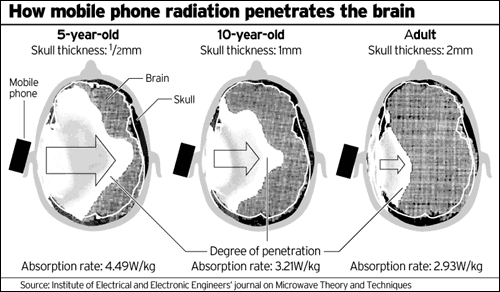
While majority of the funding for such research projects consists of tax payers money and industry pumps in only a part of the money, the advice of industry is highly valued during sanctioning of funds by the government………..
ICNIRP scientists are involved in the WHO report and, therefore, one cannot expect that it will substantially differ from what ICNIRP is saying.
The recent French CERENAT epidemiological study provides, together with Interphone and Hardell studies, is an evidence sufficient to consider cell phone radiation as a probable carcinogen – Group 2A in IARC’s scale of carcinogenicity…..
Brain cancer risk is increased by cellphone use
Cell tower radiation increases risk of brain cancer DNA 21 Sept 14 Busting the myths about lack of evidence on harm caused by cellphone radiation, Finnish scientist Dariusz Leszczynski on Friday said that long-term exposure to cellphone and cell tower radiation, on an average of thirty minutes a day over ten years, causes an increased risk of brain cancer.
Cellphone radiation increases risk of cancer?
“The Interfone, Hardell and the recently concluded CERENAT studies in France have all pointed towards a common risk to increased brain cancer,” said Leszczynski, adjunct professor, biochemistry, University of Helsinki. Leszczynski is one of the members of the expert committee constituted by World Health Organization’s International Agency for Research on Cancer (IARC). WHO has classified electromagnetic frequency radiation emitted by cellphone, cell towers and wi-fi as category 2(B) or possibly carcinogenic…..http://www.dnaindia.com/mumbai/report-cell-tower-radiation-increases-risk-of-brain-cancer-2020015
World Nuclear Association Symposium hears of true dangers of low level radiation
Public needs radiation risk awareness World Nuclear Association, World Nuclear News 12 September 2014 Educating the public on the risks of radiation should be a long-term process and not just take place in the aftermath of a major nuclear accident, a panel of radiation protection experts agreed. Speaking during a panel session at the World Nuclear Association’s 2014 Symposium, Roger Coates, vice president of the International Radiation Protection Association (IRPA), said that the nuclear industry and governments “have not been honest in presenting the risks of radiation at low levels.”

Until at least 2026 radioactive plume will continue to flow across Pacific
 assive Radiation Plume from Fukushima Heading Toward American West Coast According to a Scientific Report By David Gutierrez Global Research, September 11, 2014 According to scientific modeling systems used by the European Union, the radioactive ocean plume released by the 2011 Fukushima nuclear disaster is likely to remain a massive clump of radioactivity until it slams into the West Coast of the United States in late 2017. On March 11, 2011, a massive earthquake and tsunami struck Japan, knocking out power and cooling capability to the Fukushima Daiichi nuclear plant. Within three days, multiple meltdowns and reactor explosions had taken place. By March 25, massive amounts of radioactive material were observed leaking directly into the Pacific Ocean.
In 2013, the Nansen Environmental and Remote Sensing Center in Norway used computer models to project the movement and dispersion of this radioactive plume. Although the results of this study have been cited in official Chinese government documents, they have not been widely publicized.
Levels to remain high through at least 2026
The researchers used two separate scenarios to model leakage of radioactivity from the Fukushima plant into the Pacific. The first scenario assumed continuous and constant leakage for 20 days, while the second assumed continuous and constant leakage for one year.
Although delivering differing estimates of total radiation, both models concluded that the pollution would remain in a relatively unified mass and take the same path across the ocean until crashing up against western North America. Both models show the plume colliding with the U.S. West Coast and beginning to spread out starting around late 2017, with a maximum concentration of radiation hitting the coast toward the end of 2018……..http://www.globalresearch.ca/massive-radiation-plume-from-fukushima-heading-toward-american-west-coast-according-to-a-scientific-report/5401006
Tokyo’s radiation level 0.036 μSv/h before March 2011, now 13μSv/h.
 Radiological Disaster Survey in Tokyo Suburbs: 13μSv/h in Kashiwa, Chiba http://fukushimaemergencywhatcanwedo.blogspot.com.au/2014/08/
 radiological-disaster-survey-in-tokyo_26.html 2014-08-24 osted by dunrenard According to Ministry of Education, Culture, Sports, Science and Technology, the radiation level (gamma ray) in Tokyo was 0.036 μSv/h before 311. And now with the Japan fukushima nuclear
  contamination Tokyo 13μSv/h.


13μSv/h is 388 times more than what the Tokyo government measures at Shinjuku, 176 times more than their measurement in Edogawa-ku.
Here is what the Tokyo government finds at their (concrete and metal) monitoring posts (some of which are conveniently located 23 meters above ground):
http://monitoring.tokyo-eiken.go.jp/en/index.html
Sources:
Radiological Disaster Survey in Tokyo Suburbs: 13μSv/h in Kashiwa, Chiba 2014-08-24
https://www.youtube.com/watch?v=PUAPJc1ZUYU
Radiation back ground level was 0.036 μSv/h in Tokyo before 311
http://fukushima-diary.com/2012/12/radiation-back-ground-level-was-0-036-μsvh-in-tokyo-before-311/
Courtesy of Troy Livingstone and Bruce Brinkman
1 This Month

of the week – Shut Down Drone Warfare!


Tell the Ukrainian Government to Drop Prosecution of Peace Activist Yurii Sheliazhenko

Petition to revoke the licensing of the Near Surface Nuclear Disposal Facility (NSDF) at Chalk River. https://www.ourcommons.ca/petitions/en/Petition/Details?Petition=e-7247
To see nuclear-related stories in greater depth and intensity – go to https://nuclearinformation.wordpress.com
-
Archives
- April 2026 (103)
- March 2026 (251)
- February 2026 (268)
- January 2026 (308)
- December 2025 (358)
- November 2025 (359)
- October 2025 (376)
- September 2025 (257)
- August 2025 (319)
- July 2025 (230)
- June 2025 (348)
- May 2025 (261)
-
Categories
- 1
- 1 NUCLEAR ISSUES
- business and costs
- climate change
- culture and arts
- ENERGY
- environment
- health
- history
- indigenous issues
- Legal
- marketing of nuclear
- media
- opposition to nuclear
- PERSONAL STORIES
- politics
- politics international
- Religion and ethics
- safety
- secrets,lies and civil liberties
- spinbuster
- technology
- Uranium
- wastes
- weapons and war
- Women
- 2 WORLD
- ACTION
- AFRICA
- Atrocities
- AUSTRALIA
- Christina's notes
- Christina's themes
- culture and arts
- Events
- Fuk 2022
- Fuk 2023
- Fukushima 2017
- Fukushima 2018
- fukushima 2019
- Fukushima 2020
- Fukushima 2021
- general
- global warming
- Humour (God we need it)
- Nuclear
- RARE EARTHS
- Reference
- resources – print
- Resources -audiovicual
- Weekly Newsletter
- World
- World Nuclear
- YouTube
-
RSS
Entries RSS
Comments RSS
 nuclear-news