70 years of cancer-causing nuclear pollution in St Louis
 This week, internationally recognized physician Dr. Helen Caldicott reviewed documents and reports concerning the West Lake landfill. She stated in no uncertain terms that the health records and data clearly show that contaminants have been causing cancers in the affected region at elevated levels.
As the recipient of 21 honorary doctoral degrees for her work on the health consequences of exposure to nuclear material including the disasters at Three Mile Island, Chernobyl, and Fukushima, Caldicott is one of the world’s most-respected experts on the topic. With regard to the West Lake site, she concluded that ongoing health dangers demand that, “the [West Lake] site needs to be dealt with immediately. It needs to be cleaned-up this year.”
Radioactive site continues to plague St. Louis residents and region http://www.examiner.com/article/radioactive-site-continues-to-plague-st-louis-residents-and-region, 29 May 15 In North Saint Louis County, Missouri, in the City of Bridgeton, there is a ticking time bomb in the form of several contiguous landfills which contain radioactive waste and all the “daughter products” associated with weapons-grade uranium processing. Most notably, the site in question, the West Lake landfill, has the largest concentration in the nation of one of these highly dangerous daughter products.
 In a 2013 report entitled, The West Lake Landfill: A Radioactive Legacy of the Nuclear Arms Race, Robert Alvarez states, “Of significance is the fact that the largest estimated amount of Thorium-230, a long-lived, highly radiotoxic element, is present at West Lake — more than any other U.S. nuclear weapons storage or disposal site.” Continue reading
Nazi radiation experiments on humans
Nazi Human Experimentation NMR’s Blog 29 May 2015 Nazi human experimentation was medical experimentation on large numbers of people by the German Nazi regime in its concentration camps during World War II. At Auschwitz, under the direction of Dr. Eduard Wirths, selected inmates were subjected to various experiments which were supposedly designed to help German military personnel in combat situations, to aid in the recovery of military personnel that had been injured, and to advance the racial ideology backed by the Third Reich.After the war, these crimes were tried at what became known as the Doctors’ Trial, and revulsion at the abuses perpetrated led to the development of the Nuremberg Code of medical ethics…………..
Inadequate cleaning of Fukushima radioactive water
 Fukushima Daiichi Cleans Most Contaminated Water, Not Really, Simply Info May 28th, 2015 TEPCO announced that they have cleaned most of the contaminated water at Fukushima Daiichi. But thedetails show they are no where near close to being done.
Only cesium 137 & 134 along with strontium 90 have been removed from certain tanks of water. 620,000 tons of water have had these two isotopes removed. 10,000 tons of water currently can not be filtered for an undisclosed reason.
440,000 tons of water have now been run through ALPS with 180,000 tons still needing to be processed. Previous admissions showed that ALPS did not remove cobalt 60, iodine 129 and tritium among possible other isotopes……. http://www.fukuleaks.org/web/?p=14776
Fukushima radioactive contamination will build up in the biosphere
 Fukushima : Build-Up In Biosphere Expected http://yournewswire.com/fukushima-build-up-in-biosphere-expected/ Edmondo Burr April 15
http://yournewswire.com/fukushima-build-up-in-biosphere-expected/#sthash.kMSyx76L.dpuf Scientists have raised concern over the rate of radioactive contamination of the Pacific, due to the Fukushima nuclear accident.
- Expert : Plutonium-241 from Fukushima nearly 70,000 times more than atomic bomb fallout in Japan.
- Officials : Molten fuel now ‘particle-like’, contains ‘special’ nuclear materials.
- Gov’t Labs : Large areas of oceans contaminated by plutonium from events such as Fukushima; Build-up in biosphere expected; Considerable hazard to humans.
Energy News statement :
Detection of long-lived plutonium isotopes in environmental samples by Accelerator Mass Spectrometry (AMS) — Plutonium isotopes 239Pu, 240Pu and 242Pu are anthropogenic radionuclides emitted into the environment by nuclear activities. Pu is accumulated in the human body and hence, poses a considerable hazard to human health. Due to the long half-lives, these isotopes are present in the biosphere on large time scales and abuild-up can be expected. Therefore it is important to study the contamination pathway of Pu into the drinking water… a method to detect long-lived Pu isotopes by Accelerator Mass Spectrometry (AMS) is being developed. AMS requires only few milligrams of sample material… Consequently, more samples from different locations can be taken which is essential when searching for locally increased Pu concentrations as in the Pacific Ocean after the Fukushima accident… Samples from different locations in the Pacific Ocean and from the snow-hydrosphere are planned… Continue reading
Japan raises the ‘acceptable’ radiation level for nuclear emergency workers
 NRA to raise nuclear worker radiation exposure limit for emergencies http://www.japantimes.co.jp/news/2015/05/21/national/nra-raise-nuclear-worker-radiation-exposure-limit-emergencies/#.VV-819KeAXA KYODO
In light of the Fukushima meltdowns, the regulator had been considering raising the limit in the event of another disaster as Japan gets closer to reactivating some of its reactors, which remain offline amid heightened safety concerns.
Shunichi Tanaka, the NRA’s chairman, told a news conference that the current limit could be an obstacle in containing a crisis in the future, and the revision, which will entail a legal amendment, is “a step forward” in addressing the issue.
The regulator said it believes raising the limit to 250 millisieverts is appropriate based on overseas standards and scientific studies.
Radioactive iodine – the forgotten nuclear danger
The nuclear danger of iodine , Chemistry world, 21 May 15
In both the Fukushima and the 1986 Chernobyl accidents, volatile iodine species were released into the environment with tellurium. Of all the fission products, iodine poses a special threat to public health because it has a high fission yield, it can spread as volatile species and in mammals it accumulates readily in the thyroid, a small but vital organ. While the vast majority of iodine radioactivity is short-lived, it can have life-changing effects. A thyroid cancer patient who has lost their thyroid function as a result of surgery or 131I treatment, will require hormone replacement medication for life.
Transport properties
The problem of radioactive iodine is complicated by the variety of different species it can form. Each has different transport properties in the environment. For example, most of the airborne 131I from Chernobyl that reached Japan was in the form of organic iodine compounds.1 Furthermore, some iodine-containing compounds will pass through some accident mitigation systems. A water-filled scrubber will capture iodine oxide aerosols or other iodine-containing solids. Meanwhile, the sodium thiosulfate in the large scrubbers used in Swedish nuclear power plants will capture elemental iodine. However, although alkyl iodides will react with sodium thiosulfate to form Bunte salts, the reaction can be slow, allowing some proportion to escape. It is also important to note that, depending on the species, it is possible for some older sampling methods to underestimate the amount of radioactive iodine released in an accident.
20 May 2015Chemistry WorldOnce in the environment, the potential for human exposure increases with dangerous consequences. Research with 132I has shown that humans retain a large fraction of the iodine in inhaled methyl and ethyl iodide. But iodine can take part in lots of reactions before it even leaves the reactor. During normal operation, the temperature gradients in nuclear fuel pellets cause the iodine and caesium to migrate into the gap between the fuel and the cladding.2 The fission process forms 133Xe, which, with a half-life of 5.2 days, has plenty of time to diffuse into the cooler parts of the fuel. There, the xenon decays to form caesium, which reacts with iodine to form caesium iodide. If the fuel is overheated and damaged, caesium iodide aerosols can be delivered into the containment space.The caesium iodide can be converted by redox reactions into iodine, even without available oxygen gas: as an accident starts, the irradiation of water generates oxidants such as hydroxyl radicals and hydrogen peroxide…..http://www.rsc.org/chemistryworld/2015/05/fukushima-iodine-nuclear-accident
High radio frequency (RF) exposure – a health hazard requiring Radiation Warnings on Cell Phones
California City Will Vote on Requiring Radiation Warnings on Cell Phones http://time.com/3855722/radiation-warnings-cell-phones/ Victor Luckerson @VLuck May 12, 2015 Some scientists have called for further study about the impact of the radiation
The city council in Berkeley, Calif. will vote Tuesday on whether cell phones should come with a warning notice explaining the dangers of high radio frequency (RF) exposure. If the law is passed, retailers in the city would have to warn customers that carrying a phone in a pocket or bra while it is on and connected to a wireless network could expose the user to excessive RF radiation.
Cell phones emit radio frequency energy that can be absorbed by human tissue. There isn’t any conclusive evidence that this type of radiation causes cancer, but some scientists have called for further study into the issue. Cell phone makers such as Apple recommend keeping your cell phone at least 5 to 10 mm away from your body to avoid excessive RF exposure, but these warnings are often buried in phone manuals or deep in settings menus.
Lawmakers have attempted to institute similar ordinances in places such as Maine, Hawaii and New Mexico, but Berkeley would be the first place to actually pass such a law. In Berkeley, 82% of adults would like to know the recommended distance a phone should be kept from their bodies, according to a survey funded by the California Brain Tumor Association.
Scientific warning against health danger from electromagnetic radiation
Scientists warn against mobile phone ‘radiation’ http://www.euronews.com/2015/05/12/scientists-warn-against-mobile-phone-radiation/ Scientists are warning against the constant use of mobile phones, lap tops, tablets and other wireless devices.
They claim too much electromagnetic radiation is being emitted from them which could be a reason for risingcancer rates and an increase in autism and obesity.
Nearly 200 experts are calling on the UN to provide guidelines as they say the radiation is damaging DNA in our cells.Their advice is to turn off devices when not in use.
The scientists, from 39 different countries, are from a group called the International EMF Scientist Appeal.More information about the EMF group can be found here.
A description of the appeal can be found here.
Scientists investigate effects of Fukushima radiation on Pacific Ocean animals
US university testing animals in Pacific for Fukushima radiation — Photos show bodies riddled with tumors, eyes bleeding, covered in lesions — Some are missing testicles, eyeballs — Skin disintegrating, peeling off, turning yellow — Mammals affected by diseases never seen in species (WARNING: Graphic Pics)http://enenews.com/university-testing-animals-pacific-fukushima-radiation-gruesome-photos-show-bodies-riddled-massive-tumors-cysts-bleeding-eyes-covered-lesions-missing-testicles-eyeballs-skin-disintegrating-pe?utm_source=feedburner&utm_medium=email&utm_campaign=Feed%3A+ENENews+%28Energy+News%29
Colorado St. Univ., Apr 13, 2015 (emphasis added): CSU partners with Fukushima University to study radiation effects… Many CSU faculty and researchers are contributing to radiation research in Japan… including Thomas Johnson… professor of health physics, who is testing trace radiation samples in seal populations in thenorthern Pacific Ocean, where radiation from the Fukushima disaster was released.
Alaska Marine Science Symposium presentation, Raphaela Stimmelmayr (Dept. of Wildlife Management, North Slope Borough) & Gay Sheffield (Univ.of Alaska – Fairbanks Marine Advisory Program), 2014:
Incidental Gross Necropsy Findings in Subsistence-Harvested Ice Seals and Walruses
• Reproductive system: adnexal cysts [uterus], uterine and penile melanosis [darkening of skin], cliteromegaly [enlarged clitoris], cryptorchism [testicle(s) absent from scrotum], retained placenta;
• Endocrine system: thyroid cysts, adrenal nodules;
• Musculoskeletal system: synovial cyst [fluid-filled sacs in spine due to degeneration];
• Integumentary system: panniculitis [inflammation of fatty tissue], epidermal molt, skin sloughing;
• Respiratory system: lung tumor, parasitic granulomas [inflammation that forms when immune system is unable to eliminate a substance];
• Digestive system: microdontia [teeth smaller than normal], chronic interstitial pancreatitis [inflammation of pancreas], hepatic cyst [liver], cholestatic jaundice [yellowing of skin caused by thickening of bile or problems in liver], geophagia [eating dirt], and primary diffuse peritoneal tumor [membrane lining abdomen];
• A variety of the observed disease conditions are reported for the first time in ice seals and/or walruses.
• The majority of observed conditions in our material is classified as benign and are mostly inconsequential to the health of the harvested animals.
Astronauts at risk from brain damage due to ionising radiation
 Study: Deep-Space Radiation Could Damage Astronauts’ Brains Cosmic rays could leave travelers to Mars confused, forgetful and slow to react. WSJ, By ROBERT LEE HOTZ May 1, 2015
As NASA develops plans for a manned mission to Mars, scientists said Friday that cosmic rays during an interplanetary voyage could cause subtle brain damage, leaving astronauts confused, forgetful and slow to react to the unexpected.
In a NASA-funded study of radiation-exposed mice published Friday in Science Advances, researchers at the University of California, Irvine and the University of Nevada warned that prolonged bombardment by charged particles in deep space could affect the brain cells involved in decision-making and memory, with implications for possible manned forays into deep space.
“These sorts of cognitive changes could manifest during the mission and could be a real problem,” said Cary Zeitlin at the Southwest Research Institute in San Antonio, who wasn’t involved in the study. In 2013, Dr. Zeitlin reported radiation levels between Earth and Mars detected by the Mars Science Laboratory craft during its cruise to the red planet, and found that the exposure was the equivalent of getting “a whole-body CT scan once every 5 or 6 days.”
Deep-space radiation is a unique mix of gamma rays, high-energy protons and cosmic rays from newborn black holes, and radiation from exploding stars. Earth’s bulk, atmosphere and magnetic field blocks or deflects most deep-space cosmic rays. Shielding on spacecraft also helps.
In 54 years of human spaceflight, astronauts have rarely experienced a full dose. Apollo crews, who ventured furthest from Earth’s protective shield on their journeys to the Moon, reported seeing flashes of light when they closed their eyes, caused by galactic cosmic rays speeding through their retinas………
The researchers found the mice had damaged neurons and synapses in areas associated with memory and decision-making, such as the hippocampus and prefrontal cortex………http://www.wsj.com/articles/study-deep-space-radiation-could-damage-astronauts-brains-1430503356
Tritium is a major radioactive pollutant from Canada’s CANDU nuclear power reactors.

 Tritium Traffic: Deadly Dividends for Nuclear Industry, Peace Magazine By David H MartinIn February, 1934, the British journal, New Scientist, published an article by Tom Wilkie, “Old Age Can Kill the Bomb.” It was an ingenious solution to the arms control nightmare of verification; controlling not only the number of weapons, but the strategic materials that fuel them — mainly plutonium, enriched uranium and tritium. Wilkie focused on tritium, because it turns into non-radioactive helium at a rate of 5.5 per cent per year. A halt of tritium production would rapidly cripple all nuclear arsenals. Thus, attention was rivetted on Ontario Hydro’s plan to produce about 57 kilograms of tritium by 2006. A one megaton thermonuclear warhead (equivalent to one million tons of TN”) may contain as little as one gram of tritium.
Tritium (H3) (a form of hydrogen that emits beta radiation), is a major radioactive pollutant from Canada’s CANDU nuclear power reactors. Unlike American reactor systems, the CANDU uses heavy water as a moderator and coolant. The moderator and the heavy water coolant slows down the neutron release from the uranium fuel in the reactor so that a chain reaction can take place. The active ingredient in heavy water is deuterium, another form of hydrogen. When the deuterium picks up a neutron, some of it is transformed into tritium. The concentration of tritium in the heavy water increases with the age of the reactor.
The CANDU reactor system produces 2400 times as much tritium as the American light water reactor. Continue reading
As hydraulic fracturing (fracking) increases- so do indoor levels of radon
Small increases in radon track natural gas development with fracking in Pennsylvania, The Conversation, Joan A. Casey Robert Wood Johnson Health and Society Scholar at University of California, San Francisco Brian S. Schwartz Professor of Environmental Health Sciences at Johns Hopkins University 11 Apr 15
Historically, Pennsylvania has had one of the biggest indoor radon problems in the country. Why? Much of the bedrock in Pennsylvania contains high levels of uranium, which is radioactive and eventually decays to radium and radon gas. Radon gas can then enter buildings by diffusing through cracks in the foundation or by dissolving in water. It can get trapped in the basement and other areas of the home and can lead to health effects. Radon is the second-leading cause of lung cancer in the United States.
Due to high levels in Pennsylvania, indoor measurements are often taken when buildings are bought and sold with results reported to the state. This created a huge database, with over 1.5 million measurements from 1989 to 2013. The first unconventional natural gas development in Pennsylvania was in 2005, and by 2013 the industry had drilled 7,469 unconventional wells in the Marcellus shale.
Fracking is just one step in the process of unconventional natural gas development. The sheer scale of development in Pennsylvania made us, and others, wonder if the industry might be influencing those indoor radon measurements collected by the state. Once fully developed, some have estimated that there will be over 50,000 wells in the state……….
In our study we sought to take into account the cumulative effect of thousands of wells drilled statewide, and at a location more relevant to health – in buildings where people live, work and play. By contrast, the state study evaluated a few point sources of radiation pollution.
But what happens if a building is surrounded by hundreds of wells, which are each a potential point source? Is there a cumulative impact that the state missed? We believe our study is better suited for that possibility.
As public health professionals, our goal is to protect public health. We discovered that 42% of basement radon levels exceeded the level at which the EPA recommends people take action. Homes using well water had 21% higher radon levels than homes using municipal water.
With upward trends in radon levels, Pennsylvania’s long-standing radon problem certainly hasn’t gone away. We now leave it up to others – health professionals, economists, politicians and community members debating together – to weigh the evidence regarding the risks and benefits of unconventional natural gas development. For now we suggest homeowners continue to measure radon in their homes, the state continue to be vigilant about possible impacts of this industry on pathways and levels, and that future studies move beyond this first look to better understand the relationships that we may have uncovered. http://theconversation.com/small-increases-in-radon-track-natural-gas-development-with-fracking-in-pennsylvania-39991
Nuclear Regulatory Commission trickery on radiation rules favours the nuclear industry, not the public interest
The NRC needs to recall that its name is the Nuclear Regulatory Agency and so its job is to regulate the industry, rather than to work for the nuclear industry. Its job is to help the EPA keep a high safety standard for water, air, soil. They both appear to have forgotten or be oblivious to their purpose, which is to protect the people and environment from radionuclides from the nuclear industry.
Nuclear Facilities also are allowed to emit so many radionuclides, that it takes 50 pages to list them, including plutonium 239 to the air, along with the water. But, like the water, to talk about concentrations in the air – as opposed to amounts – is really meaningless for anything but the shortest-lived radionuclides.
US NRC Radioactive Dilute and Deceive Scam – Comment Deadline June 22nd (Extended) Mining Awareness Plus, 18 Mar 15 US NRC Comment Deadline extended to 22 June 2015:https://www.federalregister.gov/articles/2014/11/20/2014-27519/radiation-protection http://www.regulations.gov/#!documentDetail;D=NRC-2009-0279-0098 “………..The disgusting truth is that research on ionizing radiation has been ongoing since 1895. At the beginning of the nuclear age, focus was on how dangerous radiation was. Many animal and even human experiments have been done. The human experiments were both official experiments and unofficial making the population at large act as guinea pigs. They have known from the beginning the dangers. Somewhere along the way they seem to have switched from doing experiments to see how dangerous it was to doing endless experiments in an attempt at proving that it is safe. Despite their efforts to prove the contrary, they have only succeeded in proving that ionizing radiation is even more dangerous than their early results showed. As the National Academy of Science has stated endlessly in their BEIR reports, there is no safe dose of ionizing radiation. Increased dose is increased risk. This is even more true for high-LET internal alpha radiation and high LET neutrons.
The US EPA has a “clean water” water “standard” for drinking water, though it has none for water emissions from nuclear facilities – which makes no sense. Who, if anyone, pays to clean up the difference between radionuclides emitted by nuclear facilities and that allowed in drinking water?
Furthermore, the “Clean Water” drinking water standard appears to be inadequately protective, as well. It allows 740 Bq/liter of tritium in drinking water. The Canadian nuclear lobby was reportedly satisfied with a 20 Bq/liter standard for tritium in drinking water, recommended by the Ontario Water Advisory Commission (OWAC), even though Canadian CANDU reactors produce more tritium than other reactors. OWAC started with the idea that “the target derived risk level should be 1 in a million or 10-6 (meaning 1 new excess cancer occurrence over existing background cancer rates in 1,000,000 people); the target derived risk level should be over a lifetime of exposure of 70 years, and based on cancer incidences above background (occurrences) rather than mortality (deaths);” This led to models ranging from 7 Bq/L to 109 Bq/L.http://www.odwac.gov.on.ca/reports/052109_ODWAC_Tritium_Report.pdfhttp://www.odwac.gov.on.ca/reports/052109_Tritium_Report_Cover_Letter.pdf
Notice the number was chosen based on cancer morbidity (illness), not just mortality (death). (Unfortunately, if there are cooling towers they could send the balance of tritium out into the air.) Contrary to what TEPCO, AREVA, and EnergySolutions want everyone to believe, there are several ways to filter tritium………
Yes, they need water standards but they need real standards and strict standards, which account for all radionuclides emitted in air and water and per facility. The actual quantities of the radionuclides must be measured and not the concentration! Continue reading
The many ways in which fracking is radioactively contaminated
Radioactive isotopes that contaminate fracking industry waste and its machinery include radon, radium-226, uranium-238, and thorium-232. According to the Health Department’s website, these long-lived radioactive pollutants come in six forms:
* “Produced water” which is injected underground but later brought to the surface as waste;
* “Sulfate scales,” which are hard, insoluble deposits that accumulate on frack sand and inside drilling and processing equipment;
* Contaminated soil and machinery;
* Filter socks, contaminated by filtering “produced water”;
* Synthetic “proppants” or sand; and
* Sludge and “filter cake” solids of mud, sand, scale and rust that precipitate or are filtered out of contaminated “produced water. They build up in “filter socks,” and in waste water pipes and storage tanks that can leak
Fracking Radiation- North Dakota Considers Weaker Landfill Rules, Less Oversight , CounterPunch, MARCH 19, 201 by JOHN LaFORGE Radioactive waste produced by hydraulic fracturing or “fracking” is making headlines all over gas land, particularly in North Dakota’s booming Bakken gas and oil field. Continue reading
Cesium -137 – a particularly dangerous nuclear isotope
 Note the immense inventories of Cesium-137: 150 million Curies that are located in the nearby spent fuel pool at Indian Point Nuclear Power Plant which is about 40 miles from here by road and less than that as the radioactive cloud flies. Many of the 104 US commercial nuclear reactors and power plants have more than 100 million Curies of Cesium-137 in their spent fuel pools. This is many times more than in the spent pools at FukushimaThe Implications of The Massive Contamination of Japan With Radioactive Cesium
  Steven Starr
Senior Scientist, Physicians for Social Responsibility
Director, University of Missouri, Clinical Laboratory Science Program
Helen Caldicott Foundation Fukushima Symposium
New York Academy of Medicine, 11 March 2013 “….. A large number of highly radioactive isotopes released by the destruction of the Fukushima Daiichi nuclear power plant grossly contaminated the Japanese mainland. Most of these radionuclides had short half lives which meant they would essentially disappear in a matter of days or months. For many of those who were exposed to them there will be major health consequences.
However, there were some radioactive elements that will not rapidly disappear. And it is these long-lived radionuclides that will remain to negatively affect the health of all complex life forms that are exposed to them.
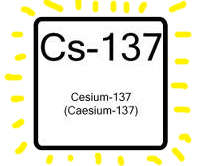 Chief among them is Cesium-137, which has taken on special significance because it is has proven to be the most abundant of the long-lived radionuclides that has remained in the environment following the nuclear disasters at Chernobyl and Fukushima. It has a 30 year radioactive half life which is why it persists in the environment. Scientists now believe that it will be 180 to 320 years before the Cesium-137 around the destroyed Chernobyl reactor actually disappears from the environment.
Cesium is water soluble and quickly makes its way into soils and waters. It is in the same atomic family as potassium and it mimics it, acting as a macronutrient. It quickly becomes ubiquitous in contaminated ecosystems.
It is distributed by the catastrophic accidents at nuclear power plants because large quantities of volatile radioactive cesium build up inside the fuel rods of nuclear reactors. Thus any accident at a nuclear reactor that causes the fuel rods to rupture, melt, or burn will cause the release of highly radioactive cesium gas.
Long-lived radionuclides such as Cesium-137 are something new to us as a species. They did not exist on Earth in any appreciable quantities during the entire evolution of complex life. Although they are invisible to our senses they are millions of times more poisonous than most of the common poisons we are familiar with. They cause cancer, leukemia, genetic mutations, birth defects, malformations, and abortions at concentrations almost below human recognition and comprehension. They are lethal at the atomic or molecular level. Continue reading
1 This Month



26 September – International Day for the Total Elimination of Nuclear Weapons


PLEASE OPPOSE HR 8255 AND S.3639 – bills would accelerate satellite deployment, with no environmental review or safeguards – https://ncstd5li.quorum.us/campaign/169331/
To see nuclear-related stories in greater depth and intensity – go to https://nuclearinformation.wordpress.com
-
Archives
- September 2026 (219)
- August 2026 (330)
- July 2026 (355)
- June 2026 (287)
- May 2026 (306)
- April 2026 (356)
- March 2026 (251)
- February 2026 (267)
- January 2026 (308)
- December 2025 (358)
- November 2025 (359)
- October 2025 (375)
-
Categories
- 1
- 1 NUCLEAR ISSUES
- business and costs
- climate change
- culture and arts
- ENERGY
- environment
- health
- history
- indigenous issues
- Legal
- marketing of nuclear
- media
- opposition to nuclear
- PERSONAL STORIES
- politics
- politics international
- Religion and ethics
- safety
- secrets,lies and civil liberties
- spinbuster
- technology
- Uranium
- wastes
- weapons and war
- Women
- 2 WORLD
- ACTION
- AFRICA
- Atrocities
- AUSTRALIA
- Christina's notes
- Christina's themes
- culture and arts
- Events
- Fuk 2022
- Fuk 2023
- Fukushima 2017
- Fukushima 2018
- fukushima 2019
- Fukushima 2020
- Fukushima 2021
- general
- global warming
- Humour (God we need it)
- Nuclear
- RARE EARTHS
- Reference
- resources – print
- Resources -audiovicual
- Weekly Newsletter
- World
- World Nuclear
- YouTube
-
RSS
Entries RSS
Comments RSS
 nuclear-news