The effects of radiation have haunted the lives of atomic bomb survivors.
The A-bombs fell / Specter of radiation lingers on , Japan News, , August 04, 2015, August 04, 2015 The Yomiuri ShimbunThis is the second installment in a series. “……….When hibakusha (atomic bomb survivors) need treatment due to malignant tumors, leukemia, cardiac infarcts and other ailments, they may be officially recognized as having radiation sickness. This entitles them to a special monthly medical allowance of about ¥140,000, which is provided by the government apart from medical costs.
However, there are certain requirements for receiving the allowance, such as how far they were from Ground Zero when they were exposed. There were a total of 183,519 holders of special hibakusha health-care certificates for the bombings in Hiroshima and Nagasaki as of the end of March, but only 4.8 percent of them, or 8,749, were recognized as having radiation sickness………..
Poverty and discrimination
The effects of radiation have haunted the lives of atomic bomb survivors.

“Just as I expected.” So thought a 72-year-old woman in Kure, Hiroshima Prefecture, when she was diagnosed with malignant lymphoma at a hospital nine years ago.
Her older brother and sister, both hibakusha, died from cancer after the war. The woman was the youngest of seven siblings, a boy and six girls. She experienced the bombing when she was 2 years old, in Ushita-Honmachi, now Higashi Ward, in the city of Hiroshima, about 2.5 kilometers from the blast center.
Looking for her brother and sisters, she entered the central area of the city while being carried by her mother for several days.
Her mother died eight months later, probably as a result of that exposure, while her father also died from a disease. The woman was adopted by another family, but three years later, her brother, who was also exposed to the Hiroshima bombing and had reached the age of 17, took her back……..
The woman was recognized as having radiation sickness in 2009. However, a neighbor told her, “You’re lucky to be a recipient” of the special monthly medical allowance. These words were very painful and in May this year, she refused to accept the money.
She wants people to know about her suffering but does not want them to know that she is hibakusha. This spring, a shadow was also found in her pancreas.
“My family was devastated, and I suffered from poverty and discrimination. My life is bound to the atomic bomb. I want to be freed from this,” she said in a trembling voice http://the-japan-news.com/news/article/0002331263
Canada’s pro nuclear government keeps mum about the dangers of radioactive strontium 90
The government puts labels on cigarettes and warns of the danger to health. People have the right to know and the right to smoke cigarettes if they choose. People have the right to know what is in their milk and decide whether or not they want to drink it.
Could it be that the Canadian government’s involvement in the mining, processing and selling of uranium to other countries, its selling of nuclear technology to the world as well as its profiting from Canada’s own nuclear power plants and nuclear research reactors, makes it not want to draw attention to the dangers of radioactivity?
Canada’s Land of Milk and Strontium 90, Enviro reporter, February 28, 2013
 We live on the Pacific Northwest coast of Canada. By many accounts, our area was particularly hard hit by the radioactive fallout that came directly over to us, in the jet stream, from the triple meltdown and hydrogen explosions at the nuclear power plant at Fukushima Daiichi, Japan, in March of 2011.
In Seattle, it was reported that the air was so contaminated after the accident that people were breathing in five “hot” radioactive particles a day!
The fallout was found to come down heavily in the rain that is so frequent in this rain forest we call home. Initially Simon Fraser University, in British Columbia, detected Iodine 131 in the rainwater on Burnaby Mountain They also found it in the seaweed on the shores of North Vancouver
Eventually we learned that the Air Monitoring Stations on Vancouver Island had picked up Radioactive Iodine 131 at levels 300 times higher than normal background.
A lab in Washington State found levels of radioactive xenon gas 40,000 times higher than normal levels.
So we knew the fallout had reached us. And we knew that there were at least 200 other radioactive substances that came along with the fallout from the nuclear plant accident. What we didn’t know was the level of contamination.
We learned that in California the tuna, milk, pistachios, naval oranges, prunes, wild mushrooms, strawberries, seaweed, beef, kale and spinach had been shown to be contaminated with radioactivity. However, having watched the jet stream patterns, we saw that our area in south western British Columbia was often missed by the atmospheric airflow from Japan.
After the initial study came out from Simon Fraser University, no more radioisotope studies were conducted by the researchers at that university So we set about trying to find out if anyone else was testing for radioactive fallout in Canada. Continue reading
What Strontium 90 does to the body
Canada’s Land of Milk and Strontium 90, Enviro Reporter, February 28, 2013“…….Strontium 90 never occurs naturally. It is man-made by the nuclear fission reaction. Strontium 90 is a “bone seeker.” It mimics calcium and if a bone is deficient in calcium, it will take up Strontium 90 in place of the calcium.
But whereas calcium will make your bones strong, Strontium 90 gets deposited in the bones and bone marrow and causes bone cancer and cancer of the tissues nearby. It can also get into the blood and cause leukemia.
Strontium 90 decays by practically pure beta radiation. When beta particles are ingested, they penetrate cells at the molecular level and are so strong that they can actually change the structure of the molecules they strike. If the molecule it strikes is a DNA molecule, then it can cause a spontaneous mutation.
Babies and pregnant women are the most sensitive to the effects of radiation. If a pregnant woman is drinking milk that has radioactive Strontium 90 in it, the fetus will concentrate that radioactivity. If a woman who is breastfeeding is drinking radioactive milk, the Strontium 90 will concentrate in her breast milk and thus get transferred to her baby.
Young children are the next most affected. Young girls are more affected than young boys. Women are more susceptible to the effects of radiation than men.
Strontium 90 has a half life of 28.79 years so it will be around for about 290 years before it completely decays away to a nonradioactive and risk-free form. That is, any Strontium 90 you ingest and lodges in your bones will remain in your body, decaying away, for your entire life.
There is no question about it – Strontium 90 is a man-made poison that we should never have to consume………http://www.enviroreporter.com/2013/02/canadas-land-of-milk-and-strontium-90/
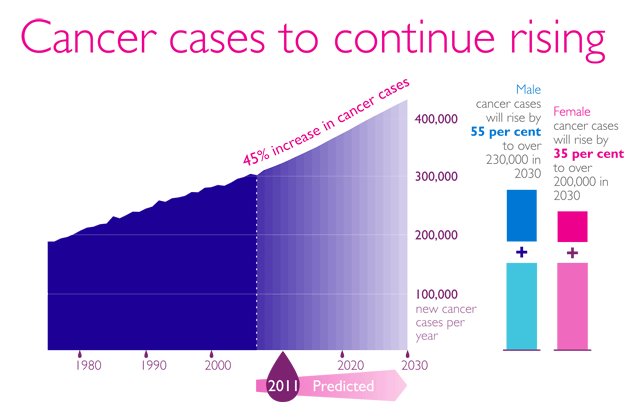
As ionising radiation increases in ecosphere, cancer incidence rises
There are 437 operative nuclear power plants world wide, and another 68 under construction. A dozen more are at the planning stage. Are we really so hungry for electricity that we are willing to risk annihilation to get it? What’s the point if generation after generation will suffer increased cancer rates?

It fairly hard to find historical data on cancer incidence.Cited near the bottom is an article that state circa 1900, 3 of 100 deaths were due to cancer.
A chart from the town of Boston 1811 showed 5 cancer deaths of 942.. Link and picture is at the far bottom herein.What are the current stats on cancer deaths? Honestly I haven’t included any information here except in links. I deem the answer to that question as so absurdly obvious to not deserve energy put into it.
How may people do you know who have cancer right now?
They try to avoid clear presentation of “incidences” of cancer, aka new cases. Some data is out there, but the spin is to try to show how Big Med/Big Pharma is “sucessful”. Continue reading
Increasing low dose ionising radiation increases cancer risk in a linear way with no safe level
 The prestigious Biological Effects of Ionising Radiatioan (BEIR) Report VII states: ‘A comprehensive review of available biological and biophysical data supports a “linear-no-threshold” (LNT) risk model—that the risk of cancer proceeds in a linear fashion at lower doses without a threshold and that the smallest dose has the potential to cause a small increase in risk to humans’ – http://dels.nas.edu/resources/static-assets/materials-based-on-reports/reports-in-brief/beir_vii_final.pdf
The BEIR report is based on huge epidemiological studies, especially on survivors of the Hiroshima and Nagasaki atomic bombing.
By contrast, the USA Department of Energy has been funding poxy little studies such as one at Flinders University, South  Australia, on a small number of mice – to try to prove this quack science “hormesis” idea. http://antinuclear.net/2012/09/03/flinders-university-participates-in-usa-department-of-energys-pro-nuclear-propaganda/
Ionising radiation: there is no safe level
Why There Is No Safe Level of Man Made Radiation, Radiation Prevention, [Good diagrams, photos and video] People on the west coast of North America inhaled an average of 5 hot particles every day during the month of April 2011 alone. Arnie Gundersen, Fairewinds, 8 July 15
Nuclear Myths Abound
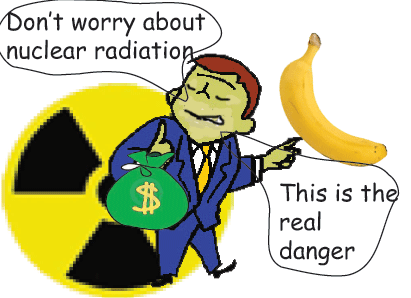
Many public figures like to equate environmental effects of the Nuclear Industry to things such as bananas, X-rays, and even taking a flight to Mexico. Below we will do our best to explain to you, exactly why they are so very, very wrong.
This article is an excerpt of a larger feature coming out in May, and specifically focuses on man made radiation. It isn’t meant to minimise the health affects of natural forms of radiation, as there is no safe dose of radiation.
 Let’s Talk Bananas
There exists in the world, naturally occurring forms of radiation. There are many of them, they come in many different shapes and forms. We have adapted to some of them, others, not so much.
Bananas contain a radioactive isotope called Potassium40 (k40). This isotope is also naturally found in milk, soil, and countless other things. Even oranges, as noted here.
If you have one gram of potassium from a banana, only 0.0117% of that potassium is considered radioactive.
Now to put things in perspective, if you have one gram of cesium (which mimics potassium in our bodies) 100% of that gram is radioactive.
And that’s not all.
I’m sure everyone has heard the term “half life” by now. Without getting too geeky on the subject, I will try to explain exactly what that means below………… http://radiationprevention.com/safe-level-manmade-radiation/#ixzz3fR1xuR8z
Radioactivity detected in 2 places at Czech Temelin nuclear station
Radioactivity unexpectedly detected in 2 places at Czech Temelin nuclear plant, no safety risk http://www.startribune.com/radioactivity-detected-in-2-places-at-czech-nuclear-plant/311569951/Associated Press JULY 3, 2015 PRAGUE — An official says low radioactivity has been unexpectedly detected in two places outside one of the two reactors at a Czech nuclear power plant.
Study of over 300.000 nuclear workers confirms increased health risks from low dose radiation
 Researchers pin down risks of low-dose radiation Large study of nuclear workers shows that even tiny doses slightly boost risk of leukaemia. http://www.nature.com/news/researchers-pin-down-risks-of-low-
 dose-radiation-1.17876 Alison Abbott 30 June 2015 For decades, researchers have been trying to quantify the risks of very low doses of ionizing radiation — the kind that might be received from a medical scan, or from living within a few tens of kilometres of the damaged Fukushima nuclear reactors in Japan. So small are the effects on health — if they exist at all — that they seem barely possible to detect. A landmark international study has now provided the strongest support yet for the idea that long-term exposure to low-dose radiation increases the risk of leukaemia, although the rise is only minuscule (K. Leuraud et al. Lancet Haematol. http://doi.org/5s4; 2015).
The finding will not change existing guidelines on exposure limits for workers in the nuclear and medical industries, because those policies already assume that each additional exposure to low-dose radiation brings with it a slight increase in risk of cancer. But it scuppers the popular idea that there might be a threshold dose below which radiation is harmless — and provides scientists with some hard numbers to quantify the risks of everyday exposures.
“The health risk of low-dose radiation is really very tiny, but the public is very concerned,” says Bill Morgan, who heads a systems-biology programme in low-dose radiation at the Pacific Northwest National Laboratory in Richland, Washington, and chairs the committee on radiation effects at the International Commission on Radiological Protection (ICRP) in Ottawa, Canada. That concern has driven a lot of investment in programmes trying to quantify the risk, he says. The European Commission, for example, has a 20-year road map to assess the problem. “We don’t do a very good job of explaining ourselves to the public, which finds it hard to put radiation risks in context — some people go to radon spas to treat their rheumatism while others won’t board planes for fear of cosmic rays,” he adds.
Radiation risks
Ionizing radiation — the kind that can pull electrons from atoms and molecules and break DNA bonds — has long been known to raise the risks of cancer; the higher the accumulated dose, the greater the damage. But it has proved extremely difficult to determine whether this relationship holds at low doses, because any increase in risk is so small that to detect it requires studies of large numbers of people for whom the dose received is known. A study of more than 300,000 nuclear-industry workers in France, the United States and the United Kingdom, all of whom wore dosimeter badges, has provided exactly these data. A consortium of researchers coordinated by the International Agency for Research on Cancer (IARC) in Lyon, France, examined causes of death in the workers (one-fifth of whom had died by the time of the study) and correlated this with exposure records, some of which went back 60 years. Continue reading
USA military know that nuclear radiation accumulates in biological organisms
 The Bioaccumulation of contamination in plankton, US Armed Forces, 1955 , Paul Langley’s Nuclear History Blog Quote (emphasis added) “Page 59. The problem of radioactive particles falling into the ocean raises the question of their availability to this portion of the biosphere. Plankton normally found in sea water are consumed in large quantities by fish.
These plankton concentrate mineral elements from the water, and it has been found that radioactivity may be concentrated(Page 60) in this manner by as much as a thousand fold. Thus, for example, one gram of plankton could contain a thousand times as much radioactivity as a gram of water adjacent to it. The radioactivity from these plankton which form a portion of fish diet tends to concentrate in the liver of the fish, and, if sufficiently high levels of contamination are encountered, could have a marked effect upon the ecology of an ocean area.
http://www.ncbi.nlm.nih.gov/pubmed/7752105
J Radiat Res. 1994 Dec;35(4):213-21.
Concentration factors for Cs-137 in marine algae from Japanese coastal waters.
Tateda Y, Koyanagi T.
Source
Abiko Research Laboratory, Central Research Institute of Electric Power Industry, Chiba, Japan.
Abstract
Concentration factors (CF: Bq.kg-1 in wet algae/Bq.kg-1 in filtered seawater) for Cs-137 in Japanese coastal algae, were investigated during 1984-1990. Cs-137/Cs(stable) atom ratios were also examined to clarify the distribution equilibrium of Cs-137 in marine algae and sea water. The CFs in marine algae were within the range of 5.4 approximately 92, and the geometric mean of CF was 28 +/- 2 (standard error) in Japanese coastal species. The CFs in edible species were within the range of 5.4 approximately 67, and the geometric mean of CF was 26 +/- 4 (standard error). The values of Cs-137/Cs atom ratios in marine algae and sea water indicated that Cs-137 reached an equilibrium state in partition between algae and sea water. Therefore, the CF value obtained in the present study can be regarded as an equilibrated value. Our results showed that the CF for Cs-137 in Japanese coastal algae were consistent with the Japanese guideline CFs, but were smaller than the recommended value by IAEA.
PMID: 7752105 [PubMed – indexed for MEDLINE] Free full text
end quote.
http://www.dutchdailynews.com/greenpeace-in-japan/………….https://nuclearhistory.wordpress.com/2013/03/16/the-bioaccumulation-of-contamination-in-plankton-us-armed-forces-1955/
Effects of ionising radiation on the brains of space travellers
What happens to your brain on the way to Mars? Science Advances, 1 May 2015 Bioaccumulation of tritiated water in phytoplankton and trophic transfer of organically bound tritium to the blue mussel, “Mytilus edulis.”

July 2012
Highlights
► Tritium was bioaccumulated into organic tritium in phytoplankton cells. ► Green algae incorporated more tritium than the cyanobacteria. ► Organic tritium was transferred from phytoplankton to blue mussels when ingested. ► Linear uptake of tritium into mussels indicates a potential for biomagnification. ► Current legislation may underestimate accumulation of tritium in the environment.
Large releases of tritium are currently permitted in coastal areas due to assumptions that it rapidly disperses in the water and has a low toxicity due to its low energy emissions. This paper presents a laboratory experiment developed to identify previously untested scenarios where tritium may concentrate or transfer in biota relevant to Baltic coastal communities. Phytoplankton populations of Dunaliella tertiolecta and Nodularia spumigena were exposed at different growth-stages, to tritiated water (HTO; 10 MBq l−1). Tritiated D. tertiolecta was then fed to mussels, Mytilus edulis, regularly over a period of three weeks. Activity concentrations of phytoplankton and various tissues from the mussel were determined.
Both phytoplankton species transformed HTO into organically-bound tritium (OBT) in their tissues. D. tertiolecta accumulated significantly more tritium when allowed to grow exponentially in HTO than if it had already reached the stationary growth phase; both treatments accumulated significantly more than the corresponding treatments of N. spumigena. No effect of growth phase on bioaccumulation of tritium was detectable in N. spumigena following exposure.
After mussels were given 3 feeds of tritiated D. tertiolecta, significant levels of tritium were detected in the tissues. Incorporation into most mussel tissues appeared to follow a linear relationship with number of tritiated phytoplankton feeds with no equilibrium, highlighting the potential for biomagnification.
Different rates of incorporation in species from a similar functional group highlight the difficulties in using a ‘representative’ species for modelling the transfer and impact of tritium.
Accumulations of organic tritium into the mussel tissues from tritiated-phytoplankton demonstrate an environmentally relevant transfer pathway of tritium even when water-concentrations are reduced, adding weight to the assertion that organically bound tritium acts as a persistent organic pollutant.
The persistence, potential for biomagnification and the increased toxicity of organic tritium increases the potential impact on the environment following a release of HTO; current legislation does not adequately take into account the nature of organic forms of tritium and therefore may be underestimating accumulation and toxic effect of tritium in the environment.
Such information is necessary to accurately assess the distribution of tritium following routine releases, and to adequately protect the environment and humans.
Source :
http://www.sciencedirect.com/science/article/pii/S0265931X12001890
Significant rise in ionising radiation in atmosphere over Southern California
The first tests of summer also indicate a high presence of alpha radiation which, by itself, comprised 75 percent of the overage with beta making up the other 25 percent. Indeed, the alpha detected alone was over 168 percent of background levels of radiation.
While alpha particles are positively charged and are relatively heavy, blocking them is easier than beta or gamma because they travel a short distance before losing energy. Nevertheless, alpha radiation is between 20 to 1,000 times more dangerous to the human organism due to their “relative biological effectiveness” in causing cell-death and cancer according to numerous sources.
Until the EPA ever gets its RadNet system fully operational, Americans will only have a partial idea of how ‘hot’ with radiation its air is. Failure to maintain this system leaves the country at a huge loss should radiological releases happen due to nuclear plant malfunctions and meltdowns as well as terrorism by an expanding list of American enemies who vow to destroy it.
 Alpha radiation clouds Los Angeles air, Enviro Reporter.com 3 June 15 The first summer air radiation analysis for Southern California shows a significant uptick in alpha and beta according to a dust analysis completed June 1. Results show radiation registering at 325.7 percent of background levels.
This means that the dust reading in its entirety was over three times background. The U.S. Environmental Protection Agency considers radiation three times background or above to be “significant.” Continue reading
70 years of cancer-causing nuclear pollution in St Louis
 This week, internationally recognized physician Dr. Helen Caldicott reviewed documents and reports concerning the West Lake landfill. She stated in no uncertain terms that the health records and data clearly show that contaminants have been causing cancers in the affected region at elevated levels.
As the recipient of 21 honorary doctoral degrees for her work on the health consequences of exposure to nuclear material including the disasters at Three Mile Island, Chernobyl, and Fukushima, Caldicott is one of the world’s most-respected experts on the topic. With regard to the West Lake site, she concluded that ongoing health dangers demand that, “the [West Lake] site needs to be dealt with immediately. It needs to be cleaned-up this year.”
Radioactive site continues to plague St. Louis residents and region http://www.examiner.com/article/radioactive-site-continues-to-plague-st-louis-residents-and-region, 29 May 15 In North Saint Louis County, Missouri, in the City of Bridgeton, there is a ticking time bomb in the form of several contiguous landfills which contain radioactive waste and all the “daughter products” associated with weapons-grade uranium processing. Most notably, the site in question, the West Lake landfill, has the largest concentration in the nation of one of these highly dangerous daughter products.
 In a 2013 report entitled, The West Lake Landfill: A Radioactive Legacy of the Nuclear Arms Race, Robert Alvarez states, “Of significance is the fact that the largest estimated amount of Thorium-230, a long-lived, highly radiotoxic element, is present at West Lake — more than any other U.S. nuclear weapons storage or disposal site.” Continue reading
Nazi radiation experiments on humans
Nazi Human Experimentation NMR’s Blog 29 May 2015 Nazi human experimentation was medical experimentation on large numbers of people by the German Nazi regime in its concentration camps during World War II. At Auschwitz, under the direction of Dr. Eduard Wirths, selected inmates were subjected to various experiments which were supposedly designed to help German military personnel in combat situations, to aid in the recovery of military personnel that had been injured, and to advance the racial ideology backed by the Third Reich.After the war, these crimes were tried at what became known as the Doctors’ Trial, and revulsion at the abuses perpetrated led to the development of the Nuremberg Code of medical ethics…………..
Inadequate cleaning of Fukushima radioactive water
 Fukushima Daiichi Cleans Most Contaminated Water, Not Really, Simply Info May 28th, 2015 TEPCO announced that they have cleaned most of the contaminated water at Fukushima Daiichi. But thedetails show they are no where near close to being done.
Only cesium 137 & 134 along with strontium 90 have been removed from certain tanks of water. 620,000 tons of water have had these two isotopes removed. 10,000 tons of water currently can not be filtered for an undisclosed reason.
440,000 tons of water have now been run through ALPS with 180,000 tons still needing to be processed. Previous admissions showed that ALPS did not remove cobalt 60, iodine 129 and tritium among possible other isotopes……. http://www.fukuleaks.org/web/?p=14776
1 This Month

of the week – Shut Down Drone Warfare!


Tell the Ukrainian Government to Drop Prosecution of Peace Activist Yurii Sheliazhenko

Petition to revoke the licensing of the Near Surface Nuclear Disposal Facility (NSDF) at Chalk River. https://www.ourcommons.ca/petitions/en/Petition/Details?Petition=e-7247
To see nuclear-related stories in greater depth and intensity – go to https://nuclearinformation.wordpress.com
-
Archives
- April 2026 (103)
- March 2026 (251)
- February 2026 (268)
- January 2026 (308)
- December 2025 (358)
- November 2025 (359)
- October 2025 (376)
- September 2025 (257)
- August 2025 (319)
- July 2025 (230)
- June 2025 (348)
- May 2025 (261)
-
Categories
- 1
- 1 NUCLEAR ISSUES
- business and costs
- climate change
- culture and arts
- ENERGY
- environment
- health
- history
- indigenous issues
- Legal
- marketing of nuclear
- media
- opposition to nuclear
- PERSONAL STORIES
- politics
- politics international
- Religion and ethics
- safety
- secrets,lies and civil liberties
- spinbuster
- technology
- Uranium
- wastes
- weapons and war
- Women
- 2 WORLD
- ACTION
- AFRICA
- Atrocities
- AUSTRALIA
- Christina's notes
- Christina's themes
- culture and arts
- Events
- Fuk 2022
- Fuk 2023
- Fukushima 2017
- Fukushima 2018
- fukushima 2019
- Fukushima 2020
- Fukushima 2021
- general
- global warming
- Humour (God we need it)
- Nuclear
- RARE EARTHS
- Reference
- resources – print
- Resources -audiovicual
- Weekly Newsletter
- World
- World Nuclear
- YouTube
-
RSS
Entries RSS
Comments RSS
 nuclear-news