Astronauts 5 times more likely to die from heart disease due to cosmic radiation
 Cosmic radiation: Apollo astronauts 5 times more likely to die from heart disease, says study Rt.com 29 Jul, 2016 The first study of Apollo astronauts – the only people to have traveled beyond Earth’s protective magnetic shield – has found that those who ventured to the moon are five times more likely to die from heart disease.
The NASA and Florida State University study revealed its findings on Thursday. They state that so far three Apollo astronauts, including Neil Armstrong, the first person to walk on the moon, have died from cardiovascular disease, apparently as a result of the extreme cosmic radiation they were exposed to during their missions. The researchers concentrated on a small group for the study: 42 astronauts who flew in space, seven of whom were Apollo veterans, the other 35 being non-flight astronauts.
The study, published in the Scientific Reports journal, found that Apollo astronauts are four to five times more likely to die from cardiovascular disease death than astronauts who either never entered space or only flew on low-altitude missions.
“These data suggest that human travel into deep space may be more hazardous to cardiovascular health than previously estimated,” it said. https://www.rt.com/usa/353865-apollo-study-heart-disease/#.V5smTINhh9Q.facebook
The Genetic Killer – Ionising Radiation
Christopher Busby exposes the fallacy behind the current accepted model of exposure hazard adopted by governments and the nuclear industry since the ‘50s and which he will be challenging in a major legal case in London in June on behalf of nuclear test veterans. This is one of the rare times that I publish someone else’s work to the IMVA.
March saw the publication, in the influential scientific journal Environmental Health and Toxicology, of a landmark analysis of the effects of internal radioactive contamination on the genetic integrity of life.
My German colleagues and I used published data from Chernobyl effects in Europe to dismiss the radiation risk model that is currently employed by governments to limit discharges and exposures.1 This is the model of the International Commission on Radiological Protection (ICRP), which bases its analysis on a different scenario to the fallout from Chernobyl: the survivors of the Hiroshima bomb.
It is claimed that there were no cases of found in those who were there. So the ICRP uses data from mice to give a risk of a doubling of heritable effects after an exposure dose of 1,000 milliSieverts (mSv). To put this in perspective, natural background radiation’s annual dose is about 2mSv so ICRP says you need to have 500 times this dose to risk having a child with a birth defect.
However, our paper shows this is wildly incorrect: that the tiniest doses from ingested or inhaled radioactive materials released by accidents like Chernobyl and Fukushima, produced by the 1960s atmospheric bomb tests, and emitted routinely under licence from nuclear sites like Sellafield and Hinkley Point, kill and deform babies at doses of less than 1mSv.
The Government and the nuclear industry defend the ICRP position by referring to natural background radiation. But, though it is true that life has been exposed to natural background radiation, including radon, throughout evolution, there has never been on Earth, prior to 1945, the new Uranium fission and activation products like Strontium-90, Caesium-137, Tritium, Carbon-14, Plutonium-239 and their nasty ‘daughters’ and relations. These substances and the entirely new, airborne, radioactive, pure particles of uranium and radium only appeared about 70 years ago. Already we can see the terrible damage they have caused to the human genome.
The fallout generation
The first evidence of harm was identified by the late Prof Ernest Sternglass.2 He pointed out that the period of the atmospheric testing of nuclear weapons had caused increases in infant mortality in the USA and the UK. Fig 1 shows a graph of this effect re-plotted by me from a later paper in by a Canadian paediatrician, Robin Whyte.3 The figure also displays the increases in Strontium-90 in milk and in the bones of children aged 0-1 over the fallout period, as measured in autopsies by the United Kingdom Atomic Energy Agency.
The sensitivity of the unborn child to radiation had been demonstrated by Alice Stewart at Birmingham University in 1958, but the authorities could not believe that the 10mSv X-ray doses to mothers could cause the 40% increases in childhood cancer that Stewart demonstrated.4 Nuclear weapons development was in full swing, fallout in the rain everywhere was causing increased measured levels of Strontium-90 in milk and children’s bones and teeth (see Fig 1).
The Cold War needed thermonuclear bombs: so research into the health effects of radiation was rapidly taken from the doctors and given to the nuclear physicists. The Japanese Hiroshima genetic data was manipulated.5 In 1959 an agreement was signed between the medics at the World Health Organisation and the physicists at the International Atomic Energy Agency, leaving all studies of radiation and health to the IAEA; thus the cover-up was sealed. This is why there has been no proper study of the health outcome of Chernobyl.
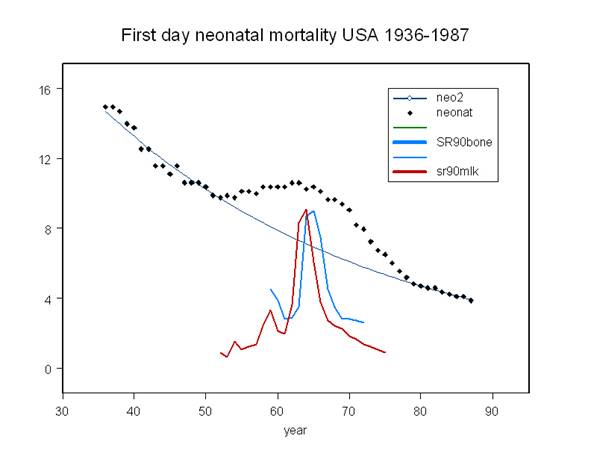
Fig 1. This graph shows first-day neonatal mortality rate per 1,000 births in the USA from 1936 to 1987. The black diamonds line shows the expected background fall in mortality rate based on the period either side of the atmospheric nuclear tests’ fallout. The red line shows the build-up of Strontium-90 in milk in the UK and the blue line, the build-up of Strontium-90 in bones of children in the UK aged 0-1. Mortality data from Robin Whyte’s paper.3 Note: different scales for milk and bone; Strontium-90 in milk (red: Bq/gCa++ x 10) and bone (blue: pCi/gm Ca++, sunshine units) from UK Atomic Energy Authority. 1pCi = 0.037Bq.
Radiation has its effects by causing mutations in the DNA, the material in the cell that carries all the information. If this is germ cell DNA (sperms and eggs), depending on the amount of damage, you get sterility, miscarriage, stillbirth or congenital effects, which can show as malformations at birth, or more silent malformations (eg. heart defects) or cancer later on.
If it is chromosomal DNA in a cell in the body then it can lead to cancer. The lag time between initial DNA damage and cancer is about 20 years. In my 1995 book, Wings of Death, funded by the Joseph Rowntree Charitable Trust, I discussed all this and compared cancer rate trends in Wales with those in England.6 Because of the high rainfall, the cancer rates in Wales, which had been slightly higher than England, suddenly and alarmingly increased about 20 years after the fallout. The correlation was persuasive. Even the effect of the 1959 partial test ban was reflected in the cancer rate trend. The effect was particularly obvious for breast cancer, one of the sites most sensitive to radiation exposures, and I made such a suggestion in a letter published in the BMJ in 1994.7
Of course, the contamination of the planet did not stop with the 1963 Kennedy/Krushchev test ban. Where the testing stopped, the nuclear power contamination began, with releases under licence to the air and the sea. This was followed by the accidents, Windscale, Three Mile Island, Chernobyl and Fukushima, the most infamous of many others. The world has been increasingly bathed with radioactivity since 1945 in a femtosecond of evolutionary time and there seems no sign of governments stopping this unless it can be proved that the radiation risk model is wildly incorrect and is killing people. But we can, as you will see.
Everyone now knows that the age-standardised cancer rates have been increasing alarmingly. Everyone has been touched by this epidemic. What is the cause? In the ‘50s, one in nine people developed cancer. In the 1990s it was one in five. In the last few years it is one in three and according to the WHO (who are not allowed to assess radiation) in 2020 it will be one in two.
None of the big cancer charities nor the Government health departments address the chief cause. Why? Because the main cause is ionising radiation. It is not smoking, nor lifestyle, nor obesity nor even the many chemicals now polluting the environment. The UK’s cancer epidemic began on the west coast in Wales and the west of Scotland with the rain and the fallout, not in the east, where the agrochemicals and insecticides are in greater concentration. This is the first thing I checked. As the late Dr John Gofman, of the US Atomic Energy Commission, wrote: ‘The nuclear industry is waging a war on humanity’.
The highest cancer rates are in those born at the peak of the fallout, from 1959 and 1963, now aged 52-56. The incidence of most cancers increases exponentially with age, but the ages when it is diagnosed are falling fast because everyone born after 1959 has been drinking contaminated milk, water and food as a baby, and building up Strontium-90 in their bones.
Strontium-90 (and uranium) binds chemically to DNA, the target for genetic damage. The effects are most easily seen in breast cancer and the proof that the breast cancer epidemic is caused by radioactive contamination can be seen in the studies of breast cancer near nuclear sites. We have carried out epidemiological studies of three nuclear sites in the UK: Bradwell in Essex, Trawsfynydd in Wales and Hinkley Point in Somerset. All three papers were published in a peer-reviewed journal.8-11 Two used official government mortality data to show there was a 100% excess risk of dying of breast cancer if you lived near the contamination; the other used a questionnaire organised by a TV company making a documentary.
Our new genetic paper, the subject of this article, reviewed all the evidence available from populations exposed to Chernobyl fallout. Increased congenital effects, heart defects, organ defects, limb defects, neurological effects like spina bifida and hydrocephalus, cleft palate, Downs syndrome and those appalling images that have been seen in Iraq after the use of depleted uranium weapons. All were found to increase immediately after the Chernobyl contamination.
Effects were reported from Belarus and Ukraine, but also from Croatia, Turkey, Italy, Germany, Greece, Hungary, the UK, places where the doses from the fallout were less than 1mSv. We also reviewed effects found in radiographers, surgeons using radiation, uranium miners, uranium nuclear workers in France and the UK and, finally, the children of the nuclear test veterans. I draw attention to this latter group because of what I am involved with in the High Court in London in June.
The nuclear test veterans’ case
Since 2004 I have been working with the nuclear test veterans as an expert witness in their cases against the UK Ministry of Defence, in the High Court action (which was lost on appeal) but, most successfully, in the Pensions Appeals. This has been in and out of Tribunals all over the country. I was successful in five cases in reversing the decisions by the Secretary of State for Defence not to grant pensions in cases of cancer, lymphoma and leukemia in veterans of the atmospheric weapons tests in Australia and Christmas Island in the 1950s.
Then the veterans’ solicitors, Rosenblatts, suddenly and unexpectedly dropped the case, a new group of solicitors, Hogan Lovells, took over, and threw me out just before the case was heard in February, 2013. The veterans appealed successfully and the case was remitted for a new hearing, which will occur over three weeks in Court 25 of the Royal Courts of Justice starting on June 14th.
Meanwhile, a proportion of the vets have died (of cancer). In the appeal in 2014, the MoD brought a successful motion to have me dismissed as a witness because they argued that, as an activist, I could not be unbiased. At this point the veterans appointed me as their Representative, so I am still there and the position is more effective than being an expert witness because I can cross-examine the MoD’s experts, something I am looking forward to.
I have already argued successfully in two hearings before a new judge, Sir Nicholas Blake, that we want access to secret material held by the MoD that shows the amounts of radioactivity, particularly uranium, in the bomb fallout. Uranium was not measured at the time, or at least the MoD will not give us any data, but we now know, from the effects of depleted uranium in Iraq and the Balkans, and also a huge amount of new research, that uranium is thousands of times more dangerous than is modelled by ICRP.
One of the effects it has (in uranium miners, workers, battlefield victims and populations, and nuclear test veterans) is that it causes huge amounts of genetic damage, shown as chromosome damage and congenital malformations. And, like Strontium-90, uranium binds to DNA.
The new judge has figured out that this is an issue. He ordered the release of some secret data showing the levels of congenital malformations in children and grandchildren of the veterans. Among his reasons for doing this, he wrote:
Dr Busby, who now represents the appellants Battersby and Smith, raises a number of new points not previously determined. . . The international Radiation Protection Authority’s guidance on the safe maxima in insufficient to screen out all risks to human health arising from explosions of the kind undertaken at Maralinga and Christmas Island.
Biggest public health scandal ever
We can use the secret birth defect data together with the new genetic paper to show that the radiation risk model of the ICRP is in error by about 1,000 times or more. This mistake, which was made in 1952 and has been promulgated ever since through the power and influence of the nuclear industry and the military, is, in the main, responsible for the deaths and agonies of all the people that you yourselves know have developed cancer – from the little, bald children, to the beautiful women suffering the cutting, burning and worse that is now orthodox treatment, to your parents, your own children and, indeed, yourselves.
This exposure is at the base of the loss of fertility and the increased real rates of heritable diseases (in advanced countries detected and aborted). Winning this case will put this issue firmly in front of the legislators. Accepting this combined chess move, the peer-reviewed study and the court case, should, in any unbiased court, result in the shutting down of nuclear energy and nuclear weapons, including the nuclear submarines that deliver them. It is a Big Deal. But the prize is continued life on Earth.
About the author
New radiation guidelines for U.S. Environmental Protection Agency would endanger public health
How much radiation is OK in an emergency? By Rebecca Moss The New Mexican, 19 June 16
New guidelines proposed by the U.S. Environmental Protection Agency would significantly increase the amount of radiation that people can ingest in the days and years following a radiological accident — levels far higher than existing limits set by the Safe Drinking Water Act of 1974.
Watchdog groups, academics and even some EPA officials worry the change could severely compromise public health. The agency’s proposal, released in early June and open for public comment until July 25, suggests a two-tiered system to advise the public when water is too dangerous for consumption after a radiological release — an event ranging from an accident at a nuclear power plant, such as the 1979 reactor meltdown at the Three Mile Island plant in Pennsylvania, to a roadside spill of Cold War-era transuranic waste from Los Alamos to a deliberate act of terrorism. The agency has capped the proposed limits at 500 millirems per year for people over 15, and no more than 100 millirems for younger children, the elderly, and pregnant or nursing women.
The new emergency guidelines are at least 25 times higher than the current guidelines, which cap public consumption of radiation at 4 millirems per year. Opponents of the proposal say it will allow radiation exposure equivalent to 250 chest X-rays each year without medical need or consent……
The EPA proposal has significant ramifications for New Mexico, home to two nuclear weapons research laboratories and the nation’s only permanent underground repository for radioactive waste, all of which were built near underground aquifers.
New Mexico’s highways pose concerns under the new EPA proposal because truck transportation of nuclear waste to the Waste Isolation Pilot Plant near Carlsbad will resume if the now-shuttered underground storage facility reopens, as planned, by the year’s end. When operations restart at the waste site, which has been closed since a radiation leak in February 2014, U.S. 62-180, Interstate 25, Interstate 40 and U.S. 285 would once again be used to transport nuclear waste to WIPP from Los Alamos, as well as from out-of-state defense sites.
In the first decade of the waste plant’s opening, at least 900 trucks carrying transuranic waste traveled those roads to reach the Carlsbad facility. The New Mexico Environment Department documented 29 accidents between 2002 and 2013, though none led to a spill.
Proposals by the U.S. Energy Department show the federal government also plans to store some foreign plutonium at WIPP, after the material has been processed at a facility in South Carolina. Continue reading
America’s EPA lifting the level of radioactivity permitted in drinking water

 EPA Pushing Hike in Radioactive Contamination in Drinking Water http://www.corporatecrimereporter.com/news/200/epa-pushing-hike-in-drinking-water-radioactivity/ By Editor June 7th, 2016
The Environmental Protection Agency (EPA) has unveiled a plan allowing radioactive contamination in drinking water at concentrations vastly greater than the levels permitted by the Safe Drinking Water Act for long periods following release of nuclear materials.
The new guidance would permit radiation exposures equivalent to 250 chest X-rays a year for the general population for an unlimited time period.
EPA’s “Protective Action Guides” (or PAGs) dramatically relax allowable doses of radioactive material in public drinking water following a Fukushima-type meltdown or “dirty bomb” attack.
They cover the “intermediate phase” after “releases have been brought under control” – an unspecified period that may last for weeks, months or even years.
The agency has declared that the strict limits for chemical exposure in the Safe Drinking Water Act “may not be appropriate…during a radiation incident.”
EPA states that it “expects that the responsible party…will take action to return to compliance with the Safe Drinking Water Act maximum contaminant levels as soon as practicable” but during the indefinite meantime –
The general population may be exposed to radioactive iodine-131 at 10,350 pico-curies per liter of water.
By contrast, the current limit is 3, resulting in a 3,450-times increase; The current strontium-90 limit of 8 pico-curies per liter would be allowed a 925-fold increase; and
In an attempt to shield “sensitive populations,” the plan proposes 500 millirem per year for the general population but only 100 millirem for children under 15, pregnant or nursing mothers without explaining how these latter groups will get access to less contaminated water.
“Given this monstrous proposal, it unclear what lessons EPA learned from the contaminated water calamity of Flint, Michigan,” said. Public Employees for Environmental Responsibility (PEER) executive director Jeff Ruch. “It is unfathomable that a public health agency would prescribe subjecting people to radioactive concentrations a thousand times above Safe Drinking Water Act limits as a ‘protective’ measure.”
Internal EPA documents obtained under Freedom of Information Act litigation brought by PEER show that EPA itself concluded that proposed concentrations “would exceed MCLs [Maximum Contaminant Limits of the Safe Drinking Water Act] by a factor of 100, 1000, and in two instances, 7 million.”
The internal analysis estimated for one radionuclide that drinking only one small glass of water “would result in an exposure that corresponds to a lifetime of drinking liters of water per day at the MCL level.”
The Bush Administration in its last days unsuccessfully tried to put forward similar proposals, which the incoming Obama Administration pulled back.
Now, in the waning months of the Obama Administration, those plans are moving forward with new exposure limits higher than the Bush plan it had rejected.
“President Obama goes to Hiroshima to urge a nuclear-free world while his EPA facilitates a nuclear-ridden water supply,” added Ruch. “It speaks volumes that the current Obama drinking water plan is less protective than his predecessor’s.”
Timing is all important, for iodine tablets to be effective against ionising radiation
North Rhine-Westphalia prepares for Belgium nuclear accident with iodine tablets, DW, 2q4 May 16“…….In the case of a nuclear disaster, timing is paramount in the administration of iodine tablets. The medication works by supplying the thyroid gland with a concentrated amount of “healthy” iodine. In theory, this should prevent the gland from absorbing any radioactive iodine released into the air in a nuclear accident.
Taken too early, however, “healthy” iodine will already have been partially or even completely broken down. Taken too late, the radioactive iodine will have already been absorbed by the thyroid – potentially increasing the risk of thyroid cancer.
The only nuclear accident to date, which called for the use of iodine tablets was the 1986 Chernobyl disaster. In Poland, some 10.5 million children and 7 million adults were successfully administered the “healthy” iodine, with later examinations reaping only positive results. In Belarus, however, where no iodine tablets were administered, thyroid cancer in children – which is usually extremely rare – was reported 100 times higher than normal. http://www.dw.com/en/north-rhine-westphalia-prepares-for-belgium-nuclear-accident-with-iodine-tablets/a-19279950
How ionising radiation affects our bodies

The high-energy radiation given off by radioactive decay can take the form of very high speed particles (electrons in the case of beta radiation; two protons and two neutrons in alpha radiation) or waves (gamma or X-rays).
Regardless of the form it takes, all nuclear radiation has enough energy to strip electrons off atoms and molecules that it interacts with, earning it the name ionising radiation.
It is this electron-stripping (ionising) property that does the damage to our cells and tissues.
As well as generating heat, the removal of electrons can break chemical bonds. When that happens in a molecule of DNA it can cause mutations, which can lead to cancer down the track. And ionising a protein can mess with its shape and function — not something you want in the molecules that coordinate most of the chemistry in our cells.
Those effects are compounded when water molecules (H2O) in our bodies are ionised into the high energy free radicals OH– and H+, which can go on to attack other nearby molecules and cells.
Our bodies are full of water, and almost all cells have DNA, but some cells and tissues are more susceptible to damage from nuclear radiation than others.
Which cells in the body are most affected by radiation?The cells and organs that are most affected by nuclear radiation are the ones that are actively reproducing, because the DNA is more exposed when the cell is in the process of dividing.
Blood cells have the highest turnover rate in our bodies, so the tissue where they are produced — the rapidly dividing cells of the bone marrow — is the most susceptible to radiation damage.
The damage to bone marrow in high doses — and complete destruction of it in very high doses — impairs our immune system by not replacing our white blood cells.
Long-term exposure to lower doses can lead to cancerous DNA mutations in the marrow, which can lead to the blood cancer leukaemia in people exposed through work or location………
Developing foetuses are, of course, incredibly susceptible to radiation, ……
Exposure to external radiation is one thing, but ingesting radioactive particles takes the damage to another level.
Inhaling or swallowing radioactive material delivers the source of radiation directly to your cells, increasing the risk of cancer developing in the tissues where they accumulate.
Radioactive iodine (iodine-131) blown into the atmosphere by the 1986 Chernobyl explosion caused a large number of cases of thyroid cancer in people who drank contaminated milk. (Having been released in the clouds of radioactive material following the explosion, the iodine — a by-product of nuclear fission reactions — landed on fields where it was swallowed by cows).
Iodine is essential for the normal function of the thyroid gland, and with its knack for attracting iodine the gland gets a concentrated dose of iodine-131 when contaminated milk is drunk. Thankfully, thyroid cancer is treatable by removal of the gland, although a lifetime of hormone supplements follows. With a half-life of just eight days, the level of radioactive iodine fell off quickly after the accident, so the risk of exposure dropped within weeks of the disaster.
Not so with the radioactive isotope of caesium-137, which has a half-life of 30 years. Caesium is very soluble in water, so when it enters our bloodstream via contaminated food or water it ends up spreading throughout our bodies, and concentrating in muscle tissue in particular. Our bodies eventually turn over these tissues, but it takes three months to reduce the amount of caesium in our muscles by half, so the long-term exposure to beta and gamma radiation increases the chances of cancer developing in those tissues.
With a half-life of 29 years, strontium-90 joins caesium-137 as a long-lasting source of harmful radiation after nuclear accidents.
Strontium is chemically very similar to calcium, so if you ingest food contaminated with radioactive strontium isotopes like strontium-90, it ends up wherever calcium normally would — primarily in the bones.
In adults, strontium accumulates mainly on the surface of bones, but in children it can be incorporated into the growing bone itself. The beta radiation given off as the radioactive atoms decay into more stable forms can damage the bone marrow and lead to bone cancer. http://www.abc.net.au/news/2016-04-22/what-nuclear-radiation-does-to-your-body/7346324
Fukushima – the irradiation of a nation
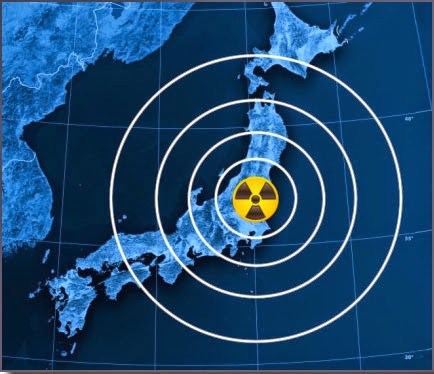 Top Official: Over 60 million Japanese irradiated by Fukushima — Nuclear Expert: 50,000 sq. miles of Japan highly contaminated… Many millions need to be evacuated… Gov’t has decided to sacrifice them, it’s a serious crime — TV: More than 70% of country contaminated by radiation (VIDEOS) http://enenews.com/top-official-60-million-japanese-irradiated-fukushima-nuclear-expert-50000-square-miles-country-highly-contaminated-many-millions-be-evacuated-govt-decided-sacrifice-serious-crime-professor-70-l?utm_source=feedburner&utm_medium=email&utm_campaign=Feed%3A+ENENews+%28Energy+News%29
Interview with nuclear engineer Hiroaki Koide (translation by Prof. Robert Stolz, transcription by Akiko Anson), published Mar 8, 2016 (emphasis added): [Radioactive] material has been dispersed, contaminating Tohoku, Kanto [Tokyo area], and western Japan… [The law says] that absolutely nothing may be removed from a radioactive management area in which the levels exceed 40,000 Becquerels per square meter… [H]ow much area has been contaminated beyond 40,000 Bq/m2… that answer is 140,000 km^2 [54,054 square miles]… Indeed, while centered on Fukushima, parts of Chiba and Tokyo have also been contaminated. The number of people living in what must be called a radiation-controlled area is in the millions, and could exceed ten million… I believe the government has the responsibility to evacuate these entire communities… the government decided to leave them exposed to the real danger of radiation. In my view, Fukushima should be declared inhabitable… but if that were to be done, it would likely bankrupt the country… They’ve decided to sacrifice people… In my view, this is a serious crime committed by Japan’s ruling elite… [F]undamentally, people must not be forced to live in contaminated areas… First must come complete evacuation… [W]hen it comes to radiation… “removal of contaminants” is impossible… This stuff contaminates everything.
Naoto Kan, former Prime Minister of Japan, Apr 11, 2016 (at 2:15 in): The molten material broke through the pressure vessel and accumulated low down in the containment. Now what would have happened if this molten material had escaped from the containment?… A radius of 250 kilometers — which includes the city of Tokyo — anyone living in this area, if you count them up it comes to 50 million or 40% of the Japanese population, and they would all have had to be evacuated. As we know from Chernobyl, not just a couple of weeks, but 30 years or 40 years — it would have virtually meant the end of Japan. [Note: Many nuclear experts believe the molten fuel did in fact escape from the containment] Half the population was subject to radiation [Japan Population: 127 million]. That’s something that could just be imagined, for instance the event of losing a major war.
Arirang (Gov’t-funded Korean TV network), ‘Fukushima and Its Aftermath’, Mar 16, 2016 (at 6:45 in) —Prof. Kim Ik-Jung, Medical College at Dongguk Univ.: “When you look at the contamination map, about 70% of Japan is contaminated by radiation. That means that 70% of Japan’s agricultural and marine products are contaminated.”… According to PNAS, one of the five major scientific journals, over 70% of the land in Japan is contaminated by radiation.
Self styled “Pro Nuclear Environmentalists (PNEs) are just not credible on Chernobyl radiation
 Evidence of PNE ignorance abounds. For the most part, PNEs had a shaky understanding of the radiation/health debates (and other nuclear issues) before they joined the pro-nuclear club, and they have a shaky understanding now.
the WHO, IAEA and other UN agencies estimated 9,000 deaths in ex-Soviet states in their 2005/06 reports, and more recently UNSCEAR has adopted the position that the long-term death toll is uncertain.
Radiation harm deniers? Pro-nuclear environmentalists and the Chernobyl death toll, Ecologist, Dr Jim Green 7th April 2016 “……….the self-styled pro-nuclear environmentalists (PNEs). We should note in passing that some PNE’s have genuine environmental credentials while others – such as Patrick Moore and Australian Ben Heard – are in the pay of the nuclear industry.
James Hansen and George Monbiot cite UNSCEAR to justify a Chernobyl death toll of 43, without noting that the UNSCEAR report did not attempt to calculate long-term deaths. James Lovelock asserts that “in fact, only 42 people died” from the Chernobyl disaster.
Patrick Moore, citing the UN Chernobyl Forum (which included UN agencies such as the IAEA, UNSCEAR, and WHO), states that Chernobyl resulted in 56 deaths. In fact, the Chernobyl Forum’s 2005 report (p.16) estimated up to 4,000 long-term cancer deaths among the higher-exposed Chernobyl populations, and a follow-up study by the World Health Organisation in 2006 estimated an additional 5,000 deaths among people exposed to lower doses in Belarus, the Russian Federation and Ukraine.
Australian ‘ecomodernist‘ academic Barry Brook says the Chernobyl death toll is less than 60. Ben Heard, another Australian ‘ecomodernist’ (in fact a uranium and nuclear industry consultant), claims that the death toll was 43.
In 2010, Mark Lynas said the Chernobyl death toll “has likely been only around 65.” Two years earlier, Lynas said that the WHO estimates “a few thousand deaths” (actually 9,000 deaths) but downplays the death toll by saying it was “indiscernible” in the context of overall deaths. Yes, the Chernobyl death toll is indiscernible … and the 9/11 terrorist attacks accounted for an indiscernible 0.1% of all deaths in the US in 2001.
There doesn’t appear to be a single example of a PNE – or a comparable organisation – providing a credible account of the Chernobyl death toll. They’re perfectly entitled to follow UNSCEAR’s lead and argue that the long-term death toll is uncertain. But conflating or confusing that uncertainty with a long-term death toll of zero clearly isn’t a defensible approach.
The Breakthrough Institute comes closest to a credible account of the Chernobyl death toll (which isn’t saying much), stating that “UN officials say that the death toll could be as high as 4,000”. However the Breakthrough Institute ignores:
- the follow-up UN/WHO study that estimated an additional 5,000 deaths in ex-Soviet states;
- scientific estimates of the death toll beyond ex-Soviet states (more than half of the Chernobyl fallout was deposited beyond the three most contaminated Soviet states);
- scientific literature regarding diseases other than cancer linked to radiation exposure;
- and indirect deaths associated with the permanent relocation of over 350,000 people after the Chernobyl disaster.
Cherry-picking
Cherry-picking is abundantly evident in PNE accounts of the Chernobyl death toll. In a review of Robert Stone’s ‘Pandora’s Promise’ propaganda film, physicist Dr Ed Lyman from the Union of Concerned Scientists writes: Continue reading
Estimating the Chernobyl death toll from radiation – rubbishy opinions from “Pro Nuclear Environmentalists”
 Radiation harm deniers? Pro-nuclear environmentalists and the Chernobyl death toll Jim Green, The Ecologist, 7 April 2016, With few if any exceptions, self-styled pro-nuclear environmentalists peddle flapdoodle and tommyrot regarding the Chernobyl death toll.
Before considering their misinformation, a brief summary of credible positions and scientific studies regarding the Chernobyl cancer death toll (for detail see this earlier article in The Ecologist).
Epidemiological studies are of course important but they’re of limited use in estimating the overall Chernobyl death toll. The effects of Chernobyl, however large or small, are largely lost in the statistical noise of widespread cancer incidence and mortality.
The most up-to-date scientific review is the TORCH-2016 report written by radiation biologist Dr Ian Fairlie. Dr Fairlie sifts through a vast number of scientific papers and points to studies indicative of Chernobyl impacts: an increased incidence of radiogenic thyroid cancers in Austria; an increased incidence of leukemia among sub-populations in ex-Soviet states (and possibly other countries ‒ more research needs to be done); increases in solid cancers, leukemia and thyroid cancer among clean-up workers; increased rates of cardiovascular disease and stroke that might be connected to Chernobyl (more research needs to be done); a large study revealing statistically significant increases in nervous system birth defects in highly contaminated areas in Russia, similar to the elevated rates observed in contaminated areas in Ukraine; and more.
Without for a moment dismissing the importance of the epidemiological record, let alone the importance of further research, suffice it here to note that there is no way that one could even begin to estimate the total Chernobyl death toll from the existing body of studies.
Estimates of collective radiation exposure are available ‒ for example the International Atomic Energy Agency (IAEA) estimates a total collective dose of 600,000 person-Sieverts over 50 years from Chernobyl fallout. And the collective radiation dose can be used to estimate the death toll using the Linear No Threshold (LNT) model.
If we use the IAEA’s collective radiation dose estimate, and a risk estimate derived from LNT (0.1 cancer deaths per person-Sievert), we get an estimate of 60,000 cancer deaths. Sometimes a risk estimate of 0.05 is used to account for the possibility of decreased risks at low doses and/or low dose rates ‒ in other words, 0.05 is the risk estimate when applying a ‘dose and dose rate effectiveness factor’ or DDREF of two. That gives an estimate of 30,000 deaths.
Any number of studies (including studies published in peer-reviewed scientific literature) use LNT ‒ or LNT with a DDREF ‒ to estimate the Chernobyl death toll. These studies produce estimates ranging from 9,000 cancer deaths (in the most contaminated parts of the former Soviet Union) to 93,000 cancer deaths (across Europe).
Those are the credible estimates of the cancer death toll from Chernobyl. None of them are conclusive ‒ far from it ‒ but that’s the nature of the problem we’re dealing with. Moreover, LNT may underestimate risks. The 2006 report of the US National Academy of Sciences’ Committee on the Biological Effects of Ionising Radiation (BEIR) states: “The committee recognizes that its risk estimates become more uncertain when applied to very low doses. Departures from a linear model at low doses, however, could either increase or decrease the risk per unit dose.”
So the true Chernobyl cancer death toll could be lower or higher than the LNT-derived estimate of 60,000 deaths ‒ a point that needs emphasis and constant repetition since the nuclear industry and its supporters frequently conflate an uncertain long-term death toll with a long-term death toll of zero.
Another defensible position is that the long-term Chernobyl cancer death toll is unknown and unknowable because of the uncertainties associated with the science. The UN Scientific Committee on the Effects of Atomic Radiation (UNSCEAR) states (p.64):
“The Committee has decided not to use models to project absolute numbers of effects in populations exposed to low radiation doses from the Chernobyl accident, because of unacceptable uncertainties in the predictions. It should be stressed that the approach outlined in no way contradicts the application of the LNT model for the purposes of radiation protection, where a cautious approach is conventionally and consciously applied.”
Pro-nuclear environmentalists
So there are two defensible positions regarding the Chernobyl cancer death toll ‒ estimates based on collective dose estimates (with or without a DDREF or a margin of error in either direction), and UNSCEAR’s position that the death toll is uncertain.
A third position ‒ unqualified claims that the Chernobyl death toll was just 50 or so, comprising some emergency responders and a small percentage of those who later suffered from thyroid cancer ‒ should be rejected as dishonest or uninformed spin from the nuclear industry and some of its scientifically-illiterate supporters……..www.theecologist.org/News/news_analysis/2987515/radiation_harm_deniers_pronuclear_environmentalists_and_the_chernobyl_death_toll.html
Radioactivity in the Ocean: Diluted, But Far from Harmless
Still, the world has never quite seen an event like the one unfolding now off the coast of eastern Japan, in which thousands of tons of radioactively contaminated water from the damaged Fukushima Daiichi nuclear power plant are pouring directly into the ocean. And though the vastness of the ocean has the capacity to dilute nuclear contamination, signs of spreading radioactive material are being found off Japan, including the discovery of elevated concentrations of radioactive cesium and iodine in small fish several dozen miles south of Fukushima, and high levels of radioactivity in seawater 25 miles offshore.
“Given that the Fukushima nuclear power plant is on the ocean, and with leaks and runoff directly to the ocean, the impacts on the ocean will exceed those of Chernobyl, which was hundreds of miles from any sea,” said Ken Buesseler, senior scientist in marine chemistry at the Woods Hole Oceanographic Institution in Massachusetts. “My biggest concern is the lack of information. We still don’t know the whole range of radioactive compounds that have been released into the ocean, nor do we know their distribution. We have a few data points from the Japanese — all close to the coast — but to understand the full impact, including for fisheries, we need broader surveys and scientific study of the area.”
Buessler and other experts say this much is clear: Both short-lived radioactive elements, such as iodine-131, and longer-lived elements — such as cesium-137, with a half-life of 30 years — can be absorbed by phytoplankton, zooplankton, kelp, and other marine life and then be transmitted up the food chain, to fish, marine mammals, and humans. Other radioactive elements — including plutonium, which has been detected outside the Fukushima plant — also pose a threat to marine life. A key question is how concentrated will the radioactive contamination be. Japanese officials hope that a temporary fishing ban off the northeastern Japanese coast will be enough to avert any danger to human health until the flow of radioactive water into the sea can be stopped…….
Studies from previous releases of nuclear material in the Irish, Kara and Barents Seas, as well as in the Pacific Ocean, show that such radioactive material does travel with ocean currents, is deposited in marine sediment, and does climb the marine food web. In the Irish Sea — where the British Nuclear Fuels plant at Sellafield in the northwestern United Kingdom released radioactive material over many decades, beginning in the 1950s — studies have found radioactive cesium and plutonium concentrating significantly in seals and porpoises that ate contaminated fish. Other studies have shown that radioactive material from Sellafield and from the nuclear reprocessing plant at Cap de la Hague in France have been transported to the North Atlantic and Arctic Oceans. A study published in 2003 found that a substantial part of the world’s radioactive contamination is in the marine environment.
How the radioactive materials released from the Fukushima plants will behave in the ocean will depend on their chemical properties and reactivity, explained Ted Poston, a ecotoxicologist with the Pacific Northwest National Laboratory, a U.S. government facility in Richland, Washington. If the radionuclides are in soluble form, they will behave differently than if they are absorbed into particles, said Poston. Soluble iodine, for example, will disperse rather rapidly. But if a radionuclide reacts with other molecules or gets deposited on existing particulates — bits of minerals, for example — they can be suspended in the water or, if larger, may drop to the sea floor.
“If particulates in the water column are very small they will move with the current,” he explained. “If bigger or denser, they can settle in sediment.”…….http://e360.yale.edu/feature/radioactivity_in_the_ocean_diluted_but_far_from_harmless/2391/
Japanese Government Takes Grave Risks with Radiation Exposure
 How Much Is Too Much? Japanese Government Takes Grave Risks with Radiation Exposure http://www.stuarthsmith.com/how-much-is-too-much-japanese-government-takes-grave-risks-with-radiation-exposure/ 28 Feb 16 Japan’s nuclear crisis isn’t going away – and long-term health impacts from the radiation are now a grave concern as the situation continues to escalate. Dozens of repair workers at the reeling Fukushima-Daiichi nuclear power plant have already been exposed to radiation levels well beyond the country’s legal yearly dose limit. So far, the highest specific exposures reported are from two workers who received – on one day alone – radiation doses of more than three times the internationally recognized annual occupational exposure limit. Reports say the workers had severe rashes on the parts of their bodies exposed to radioactive water. Those troubling revelations prompted an even more troubling response from the Japanese government. In a move that is certain to stunt workers’ lives and potentially plague future generations with increased cancer rates, Japan’s Ministry of Health, Labor and Welfare has lifted the internationally recognized 50-millisievert (mSv) yearly cap on occupational exposure. That specific 50-mSv limit is recognized as the lowest dose that can trigger cancer in adults. It is most definitely not an arbitrary number to be manipulated by short-sighted governments – not even during times of crisis.
Leukaemia risk increased in exposure even to low dose radiation – World Health Organisation
 Even low doses of radiation increase risk of dying from leukaemia in nuclear workers, says IARC http://www.iarc.fr/en/media-centre/pr/2015/pdfs/pr235_E.pdf Lyon, France, 22 June 2015 – A study coordinated by the International Agency for Research on Cancer (IARC), the specialized cancer agency of the World Health Organization, shows that protracted exposure to low doses of ionizing radiation can cause leukaemia. The study, published today in The Lancet Haematology, shows that the risk of death from leukaemia increases linearly with the radiation dose.
Official Canadian report reveals Fukushima radioactive iodine in rain reached West Coast of America
Official Report: West Coast hit with 220,000,000 atoms per liter of Iodine-129 in rain after Fukushima — 15 Million year half-life — Detected in aquifer that supplies drinking water to large number of people — “Transported rapidly” to Canada and US — Elevated levels continued for many months http://enenews.com/official-report-west-coast-hit-220000000-atoms-liter-iodine-129-rain-after-fukushima-15-million-year-half-life-detected-groundwater-transported-rapidly-japan-west-coast-canada-elevated-lev
Matt Herod, Univ, of Ottawa Ph.D Candidate, Dec 21, 2015 (emphasis added): A recently published paper (by myself and colleagues from uOttawa and Environment Canada) investigates… [Iodine-129] which was released by the Fukushima-Daichii [sic] Nuclear Accident… Within 6 days of the FDNA 129I concentrations in Vancouver precipitation increased 5-15 times… sampling of groundwater revealed slight increases in 129I… The results in rain show an increase in 129I concentrations of up to 220 million atoms/L… 129I anomalies [in groundwater wells], which occurred exactly when the recharge age predicted they would, suggests that some of the 129I deposited by Fukushima was reaching the wells… [P]ulses of elevated 129I occurred for another several months. Elevated 129I concentrations were measured in two wells… indicating that 129I from Fukushima can be traced into groundwater… [M]odeling has shown that 129I can be rapidly transported to the water table…
Scientists from Univ. of Ottawa’s Dept. of Earth Science and Environment Canada (Government of Canada), Dec 2015: The atmospheric transport of iodine-129 from Fukushima to British Columbia, Canada and its deposition and transport into groundwater
- The Fukushima-Daiichi nuclear accident (FDNA) released iodine-129 (15.7 million year half-life)… The mean pre-accident 129I concentration in rain was [31,000,000 atoms/L]… following the FDNA, 129I values increased to [211,000,000 atoms/L]… [P]ulses ofelevated 129I continued for several months…
- The 129I in shallow… groundwater showed measurable variability through March 2013 with an average of [3,200,000 atoms/L]… coincident with modeled travel times…
- Radionuclides released from the FDNA have been detected across the globe… [R]eleases of 129I and 131I… travel great distances…
- The Abbotsford-Sumas Aquifer… spans the Canada–U.S. border between [B.C., Canada and Washington, US] and supplies ∼120,000 people with drinking water…
- A pulse of 129I in precipitation with maximum concentrations of [211,000,000 atoms/L] in Vancouver and [221,000,000 atoms/L] at Saturna Island was observed 6 days following the FDNA. A value of [311,000,000 atoms/L] was also measured during the first week of July…
- The high 129I concentrations while the FDNA was ongoing are attributed to the rapid trans-Pacific transport of 129I from Fukushima… This response in 129I concentrations shows that radionuclides from Fukushima were transported rapidly from Japan to the west coast of Canada and the US… [Sampling from Washington State], which is a composite of rainfall events spanning 15 March 2011 to 16 April 2011shows a significantly elevated 129I concentration of [95,000,000 atoms/L]…
- There was a spike in 129I concentration observed in the precipitation sample from the period of 1 July 2011 to 8 July 2011 [which] rose to [311,000,000 atoms/L]… a substantially higher concentration than any other sample… As monitoring at Fukushima detected no pulse of 129I in precipitation in July… this spike is likely due to a… nuclear fuel reprocessing facility. Modeling of the air parcel back trajectories… for the sampling period shows air mass trajectories from Hawaii, north Japan, and Russia…
- The initial increase in 129I concentration at the water table appeared within ∼95 days, with a maximum concentration of [10,500,000 atoms/L]…
- In the model cases, 129I reached the water table very rapidly…
- Groundwater 129I concentrations in two nearby wells showed minor anomalies over the sampling period which could be due to rapid infiltration of the FDNA atmospheric 129Isignal… [M]odeling shows that it was possible for a component of the 129I deposited by the FDNA to be conducted rapidly from the ground surface to the water table… We conclude that it is possible that a fraction of 129I from the FDNA is transported conservatively in this aquifer via preferential flow paths to the water table…
See also: Official in Canada advises public not to drink rainwater coming from Fukushima
And: Rain with 20,000,000 particles of Iodine-131 per liter fell on US (VIDEO)
Fukushima radiation monitored by citizen science
How Citizen Science Changed the Way Fukushima Radiation is Reported, National Geographic by Ari Beser in Fulbright National Geographic Stories on February 13, 2016 Tokyo – “It appears the world-changing event didn’t change anything, and it’s disappointing,”said Pieter Franken, a researcher at Keio University in Japan (Wide Project), the MIT Media Lab (Civic Media Centre), and co-founder of Safecast, a citizen-science network dedicated to the measurement and distribution of accurate levels of radiation around the world, especially in Fukushima. “There was a chance after the disaster for humanity to innovate our thinking about energy, and that doesn’t seem like it’s happened. But what we can change is the way we measure the environment around us.”
Franken and his founding partners found a way to turn their email chain, spurred by the tsunami, into Safecast; an open-source network that allows everyday people to contribute to radiation-monitoring……….
Since their first tour of Koriyama, with the help of a successful Kickstarter campaign, Safecast’s team of volunteers have developed the bGeigie handheld radiation monitor, that anyone can buy on Amazon.com and construct with suggested instructions available online. So far over 350 users have contributed 41 million readings, using around a thousand fixed, mobile, and crowd-sourced devices.
According to Franken, “We’re working with communities to install these sensors in people’s neighborhoods. We’re financed by donations only. We get donations so we put together a plan, volunteers provide space, and Internet access, and agree that the data collected are public.
“What we’ve come to determine in Fukushima is that radiation levels are spotty. They can vary from street corner to street corner. We’ve also been able to determine that the levels over the last five years have reduced, partly because of half life of cesium, and because of environmental factors. We’ve also seen an increase in official government data being released in a similar style to Safecast’s drive-by method versus spot checking.”
According to Franken, “There is no safe dose of radiation as it’s debated by scientists; the higher the level, the higher the risk is that it will trigger a cancer. Though, at low levels the risk is much smaller, it is not zero. ……..
One of the biggest problems in Fukushima is the anxiety and the uncertainty that people are suffering from the incident. I think what were doing is trying to alleviate that by giving them ways to educate themselves about the problem and giving them solutions where they can be empowered to do something about it, as a opposed to just going along with the current of the crisis.” http://voices.nationalgeographic.com/2016/02/13/how-citizen-science-changed-the-way-fukushima-radiation-is-reported/
Low dose ionising radiation takes its toll on living organisms – Timothy Mousseau
Even low radiation dose can take toll: scientist http://www.chinapost.com.tw/taiwan/national/national-news/2016/01/27/457138/Even-low.htm By Enru Lin, The China Post TAIPEI, Taiwan–Animals exposed to even low doses of radiation suffer a higher incidence of physical abnormalities, a world-leading ecologist said in Taipei on Tuesday. Timothy Mousseau, an ecologist at the University of South Carolina, is a pioneering expert on what radiation does to organisms.
For decades, he and his research team have studied Chernobyl, Ukraine — site of the world’s worst nuclear disaster in 1986 — and Fukushima in Japan.
Their studies found that radiation exposure had significant effects on local populations, for instance causing tumors, small brain sizes, sterility and cataracts in birds in Chernobyl.
No Safe Dose?
Findings indicate that radiation, even at low doses, can increase mortality rates and the incidence of physical abnormalities.
“There is no threshold below which there is no effect on organisms,” Mousseau said.
“We need to be very concerned not only about the consequences of nuclear accidents, but also the regular day-to-day operations of nuclear power plants, where radiation is released on a regular basis.”
Call for Taiwan Research
Mousseau was speaking on invitation at a press briefing and forum at the Legislative Yuan, where he was joined by three Democratic Progressive Party (DPP) lawmakers including Tien Chiu-chin (田秋堇).
At the event, anti-nuclear activists called on the central government to commission an independent research team to study effects on people who live near Taiwan’s three operating nuclear power plants.
Birds, Butterflies First
Mousseau said his data suggested that some organisms were far more sensitive to radiation than others.
Studies from Chernobyl and Fukushima showed that the first significant effects of radiation occurred in the same taxonomic groups.
“Birds and butterflies are the two most sensitive groups — we saw immediate large responses in birds and butterflies in Fukushima,” he said.
Other animals, such as grasshoppers and spiders, are less susceptible to the effects of radiation.
On Humans
Meanwhile, there is insufficient research on the human population to make convincing assessments on the impact of low dose radiation.
Mousseau said that in the U.S., studies are thwarted when researchers can’t access the relevant health records.
“There are privacy issues related to health records that are so strong in the United States, and there is a lack of organization of the registries. That makes it very difficult to do solid, hard science,” he said.
1 This Month

of the week – Shut Down Drone Warfare!


Tell the Ukrainian Government to Drop Prosecution of Peace Activist Yurii Sheliazhenko

Petition to revoke the licensing of the Near Surface Nuclear Disposal Facility (NSDF) at Chalk River. https://www.ourcommons.ca/petitions/en/Petition/Details?Petition=e-7247
To see nuclear-related stories in greater depth and intensity – go to https://nuclearinformation.wordpress.com
-
Archives
- April 2026 (57)
- March 2026 (251)
- February 2026 (268)
- January 2026 (308)
- December 2025 (358)
- November 2025 (359)
- October 2025 (376)
- September 2025 (257)
- August 2025 (319)
- July 2025 (230)
- June 2025 (348)
- May 2025 (261)
-
Categories
- 1
- 1 NUCLEAR ISSUES
- business and costs
- climate change
- culture and arts
- ENERGY
- environment
- health
- history
- indigenous issues
- Legal
- marketing of nuclear
- media
- opposition to nuclear
- PERSONAL STORIES
- politics
- politics international
- Religion and ethics
- safety
- secrets,lies and civil liberties
- spinbuster
- technology
- Uranium
- wastes
- weapons and war
- Women
- 2 WORLD
- ACTION
- AFRICA
- Atrocities
- AUSTRALIA
- Christina's notes
- Christina's themes
- culture and arts
- Events
- Fuk 2022
- Fuk 2023
- Fukushima 2017
- Fukushima 2018
- fukushima 2019
- Fukushima 2020
- Fukushima 2021
- general
- global warming
- Humour (God we need it)
- Nuclear
- RARE EARTHS
- Reference
- resources – print
- Resources -audiovicual
- Weekly Newsletter
- World
- World Nuclear
- YouTube
-
RSS
Entries RSS
Comments RSS
 nuclear-news