St Louis city’s atomic poisoning, but authorities have carefully not tested for radiation
 What many did not know was that they were living downstream from a 22-acre field acquired in 1946 by the long-gone Atomic Energy Commission. Hundreds of thousands of tons of waste — much of it radioactive — were dumped there, including some 60 tons of uranium-laced sand from Nazi Germany’s nuclear program that was captured by the United States en route to Japan near the end of WWII.
Soil samples taken by the Army Corps of Engineers in the late 1990s show that soils contaminated with forms of uranium, thorium and radium were found as deep as 20 feet in some places. The creek is near the westernmost boundary of the site and then flows nearly 20 miles through St. Louis County municipalities such as Florissant,  Hazelwood and Black Jack .
Regarding contaminated sites in St. Louis, long-term, low-level exposure to radiation is what poses the greatest threat to human health, said St. Louis County Department of Health Director Faisal Khan. Khan, who is new to the position, has been vocal about this issue, becoming one of the few government officials at any level to call for residents’ concerns about radiation exposure to be addressed.
St. Louis burning: America’s atomic legacy haunts city, Aljazeera America by Ryan Schuessler @RyanSchuessler1 April 29, 2015
County parks, homes, businesses remain open and untested after decades of exposure to potentially contaminated creek This is part one of a three-part series examining the effects of radioactive waste from the Manhattan Project on St. Louis and its suburbs.
HAZELWOOD, Mo. — Karen Nickel had never even heard of lupus before she was diagnosed with the autoimmune disease six years ago.
Today she says she takes as many as 18 pills a day — “and that’s just to make me feel OK.”
“Sometimes I can’t even get out of bed,” Nickel said. “Sometimes I can’t even let someone hug or touch me because it hurts so bad.”
Lupus causes a patient’s immune system to turn on its own body, attacking healthy joint and organ tissues. It is most common in middle-aged women such as Nickel, but has recently been linked to exposure to uranium. Continue reading
Fukushima radiation raises cancer risk for millions of people
Report says 32 million people in Japan are exposed to radiation from the Fukushima nuclear disaster (PRWEB UK) 11 March 2015 Geneva: Approximately 32 million people in Japan are affected by the radioactive fallout from the nuclear disaster in Fukushima, according to the 2015 Fukushima Report now available from Green Cross. This includes people who were exposed to radiation or other stress factors resulting from the accident, and who are consequently at potential risk from both long and short-term consequences.
The 2015 Fukushima Report is available for download in English at http://www.greencross.ch/en/news-info-en/case-studies/fukushima-report.html. Continue reading
Tritium is a major radioactive pollutant from Canada’s CANDU nuclear power reactors.

 Tritium Traffic: Deadly Dividends for Nuclear Industry, Peace Magazine By David H MartinIn February, 1934, the British journal, New Scientist, published an article by Tom Wilkie, “Old Age Can Kill the Bomb.” It was an ingenious solution to the arms control nightmare of verification; controlling not only the number of weapons, but the strategic materials that fuel them — mainly plutonium, enriched uranium and tritium. Wilkie focused on tritium, because it turns into non-radioactive helium at a rate of 5.5 per cent per year. A halt of tritium production would rapidly cripple all nuclear arsenals. Thus, attention was rivetted on Ontario Hydro’s plan to produce about 57 kilograms of tritium by 2006. A one megaton thermonuclear warhead (equivalent to one million tons of TN”) may contain as little as one gram of tritium.
Tritium (H3) (a form of hydrogen that emits beta radiation), is a major radioactive pollutant from Canada’s CANDU nuclear power reactors. Unlike American reactor systems, the CANDU uses heavy water as a moderator and coolant. The moderator and the heavy water coolant slows down the neutron release from the uranium fuel in the reactor so that a chain reaction can take place. The active ingredient in heavy water is deuterium, another form of hydrogen. When the deuterium picks up a neutron, some of it is transformed into tritium. The concentration of tritium in the heavy water increases with the age of the reactor.
The CANDU reactor system produces 2400 times as much tritium as the American light water reactor. Continue reading
As hydraulic fracturing (fracking) increases- so do indoor levels of radon
Small increases in radon track natural gas development with fracking in Pennsylvania, The Conversation, Joan A. Casey Robert Wood Johnson Health and Society Scholar at University of California, San Francisco Brian S. Schwartz Professor of Environmental Health Sciences at Johns Hopkins University 11 Apr 15
Historically, Pennsylvania has had one of the biggest indoor radon problems in the country. Why? Much of the bedrock in Pennsylvania contains high levels of uranium, which is radioactive and eventually decays to radium and radon gas. Radon gas can then enter buildings by diffusing through cracks in the foundation or by dissolving in water. It can get trapped in the basement and other areas of the home and can lead to health effects. Radon is the second-leading cause of lung cancer in the United States.
Due to high levels in Pennsylvania, indoor measurements are often taken when buildings are bought and sold with results reported to the state. This created a huge database, with over 1.5 million measurements from 1989 to 2013. The first unconventional natural gas development in Pennsylvania was in 2005, and by 2013 the industry had drilled 7,469 unconventional wells in the Marcellus shale.
Fracking is just one step in the process of unconventional natural gas development. The sheer scale of development in Pennsylvania made us, and others, wonder if the industry might be influencing those indoor radon measurements collected by the state. Once fully developed, some have estimated that there will be over 50,000 wells in the state……….
In our study we sought to take into account the cumulative effect of thousands of wells drilled statewide, and at a location more relevant to health – in buildings where people live, work and play. By contrast, the state study evaluated a few point sources of radiation pollution.
But what happens if a building is surrounded by hundreds of wells, which are each a potential point source? Is there a cumulative impact that the state missed? We believe our study is better suited for that possibility.
As public health professionals, our goal is to protect public health. We discovered that 42% of basement radon levels exceeded the level at which the EPA recommends people take action. Homes using well water had 21% higher radon levels than homes using municipal water.
With upward trends in radon levels, Pennsylvania’s long-standing radon problem certainly hasn’t gone away. We now leave it up to others – health professionals, economists, politicians and community members debating together – to weigh the evidence regarding the risks and benefits of unconventional natural gas development. For now we suggest homeowners continue to measure radon in their homes, the state continue to be vigilant about possible impacts of this industry on pathways and levels, and that future studies move beyond this first look to better understand the relationships that we may have uncovered. http://theconversation.com/small-increases-in-radon-track-natural-gas-development-with-fracking-in-pennsylvania-39991
Concerns of mothers and children in Fukushima
 Mako Oshidori in Düsseldorf “The Hidden Truth about Fukushima”, Fukushima Voice version 2E 28 May 2014 “…….. Next, I would like to talk about mothers in Fukushima. These mothers (and fathers) live in Iwaki City, Fukushima. They are active on school lunch issues. Currently, Fukushima produce isn’t selling well due to suspected contamination. So the prefectural policy is to encourage the use of Fukushima produce in school lunches, in an attempt to appeal its safety. As a large municipality, Iwaki City had been purchasing produce from distant prefectures instead of Fukushima produce, but after the accident, the policy changed to use Fukushima produce in school lunches in order to appeal safety of Fukushima produce by showing it’s safe enough to give to children.
By the way, the current measure to deal with areas contaminated with a high level of radioactive material is to remove the soil, put it in bags, and place them in an empty lot. It’s not just Fukushima Prefecture. Neighboring prefectures in eastern Japan, such as Ibaraki Prefecture, Gunma Prefecture, Miyagi Prefecture and Iwate Prefecture also have a lot of areas with contamination where people live. They decontaminate, put the soil in bags, and stack them in an empty lot. By the way, these bags look small, but each bag actually weighs 1 ton. It’s rather large. ……
Nuclear Regulatory Commission trickery on radiation rules favours the nuclear industry, not the public interest
The NRC needs to recall that its name is the Nuclear Regulatory Agency and so its job is to regulate the industry, rather than to work for the nuclear industry. Its job is to help the EPA keep a high safety standard for water, air, soil. They both appear to have forgotten or be oblivious to their purpose, which is to protect the people and environment from radionuclides from the nuclear industry.
Nuclear Facilities also are allowed to emit so many radionuclides, that it takes 50 pages to list them, including plutonium 239 to the air, along with the water. But, like the water, to talk about concentrations in the air – as opposed to amounts – is really meaningless for anything but the shortest-lived radionuclides.
US NRC Radioactive Dilute and Deceive Scam – Comment Deadline June 22nd (Extended) Mining Awareness Plus, 18 Mar 15 US NRC Comment Deadline extended to 22 June 2015:https://www.federalregister.gov/articles/2014/11/20/2014-27519/radiation-protection http://www.regulations.gov/#!documentDetail;D=NRC-2009-0279-0098 “………..The disgusting truth is that research on ionizing radiation has been ongoing since 1895. At the beginning of the nuclear age, focus was on how dangerous radiation was. Many animal and even human experiments have been done. The human experiments were both official experiments and unofficial making the population at large act as guinea pigs. They have known from the beginning the dangers. Somewhere along the way they seem to have switched from doing experiments to see how dangerous it was to doing endless experiments in an attempt at proving that it is safe. Despite their efforts to prove the contrary, they have only succeeded in proving that ionizing radiation is even more dangerous than their early results showed. As the National Academy of Science has stated endlessly in their BEIR reports, there is no safe dose of ionizing radiation. Increased dose is increased risk. This is even more true for high-LET internal alpha radiation and high LET neutrons.
The US EPA has a “clean water” water “standard” for drinking water, though it has none for water emissions from nuclear facilities – which makes no sense. Who, if anyone, pays to clean up the difference between radionuclides emitted by nuclear facilities and that allowed in drinking water?
Furthermore, the “Clean Water” drinking water standard appears to be inadequately protective, as well. It allows 740 Bq/liter of tritium in drinking water. The Canadian nuclear lobby was reportedly satisfied with a 20 Bq/liter standard for tritium in drinking water, recommended by the Ontario Water Advisory Commission (OWAC), even though Canadian CANDU reactors produce more tritium than other reactors. OWAC started with the idea that “the target derived risk level should be 1 in a million or 10-6 (meaning 1 new excess cancer occurrence over existing background cancer rates in 1,000,000 people); the target derived risk level should be over a lifetime of exposure of 70 years, and based on cancer incidences above background (occurrences) rather than mortality (deaths);” This led to models ranging from 7 Bq/L to 109 Bq/L.http://www.odwac.gov.on.ca/reports/052109_ODWAC_Tritium_Report.pdfhttp://www.odwac.gov.on.ca/reports/052109_Tritium_Report_Cover_Letter.pdf
Notice the number was chosen based on cancer morbidity (illness), not just mortality (death). (Unfortunately, if there are cooling towers they could send the balance of tritium out into the air.) Contrary to what TEPCO, AREVA, and EnergySolutions want everyone to believe, there are several ways to filter tritium………
Yes, they need water standards but they need real standards and strict standards, which account for all radionuclides emitted in air and water and per facility. The actual quantities of the radionuclides must be measured and not the concentration! Continue reading
The many ways in which fracking is radioactively contaminated
Radioactive isotopes that contaminate fracking industry waste and its machinery include radon, radium-226, uranium-238, and thorium-232. According to the Health Department’s website, these long-lived radioactive pollutants come in six forms:
* “Produced water” which is injected underground but later brought to the surface as waste;
* “Sulfate scales,” which are hard, insoluble deposits that accumulate on frack sand and inside drilling and processing equipment;
* Contaminated soil and machinery;
* Filter socks, contaminated by filtering “produced water”;
* Synthetic “proppants” or sand; and
* Sludge and “filter cake” solids of mud, sand, scale and rust that precipitate or are filtered out of contaminated “produced water. They build up in “filter socks,” and in waste water pipes and storage tanks that can leak
Fracking Radiation- North Dakota Considers Weaker Landfill Rules, Less Oversight , CounterPunch, MARCH 19, 201 by JOHN LaFORGE Radioactive waste produced by hydraulic fracturing or “fracking” is making headlines all over gas land, particularly in North Dakota’s booming Bakken gas and oil field. Continue reading
Cesium -137 – a particularly dangerous nuclear isotope
 Note the immense inventories of Cesium-137: 150 million Curies that are located in the nearby spent fuel pool at Indian Point Nuclear Power Plant which is about 40 miles from here by road and less than that as the radioactive cloud flies. Many of the 104 US commercial nuclear reactors and power plants have more than 100 million Curies of Cesium-137 in their spent fuel pools. This is many times more than in the spent pools at FukushimaThe Implications of The Massive Contamination of Japan With Radioactive Cesium
  Steven Starr
Senior Scientist, Physicians for Social Responsibility
Director, University of Missouri, Clinical Laboratory Science Program
Helen Caldicott Foundation Fukushima Symposium
New York Academy of Medicine, 11 March 2013 “….. A large number of highly radioactive isotopes released by the destruction of the Fukushima Daiichi nuclear power plant grossly contaminated the Japanese mainland. Most of these radionuclides had short half lives which meant they would essentially disappear in a matter of days or months. For many of those who were exposed to them there will be major health consequences.
However, there were some radioactive elements that will not rapidly disappear. And it is these long-lived radionuclides that will remain to negatively affect the health of all complex life forms that are exposed to them.
 Chief among them is Cesium-137, which has taken on special significance because it is has proven to be the most abundant of the long-lived radionuclides that has remained in the environment following the nuclear disasters at Chernobyl and Fukushima. It has a 30 year radioactive half life which is why it persists in the environment. Scientists now believe that it will be 180 to 320 years before the Cesium-137 around the destroyed Chernobyl reactor actually disappears from the environment.
Cesium is water soluble and quickly makes its way into soils and waters. It is in the same atomic family as potassium and it mimics it, acting as a macronutrient. It quickly becomes ubiquitous in contaminated ecosystems.
It is distributed by the catastrophic accidents at nuclear power plants because large quantities of volatile radioactive cesium build up inside the fuel rods of nuclear reactors. Thus any accident at a nuclear reactor that causes the fuel rods to rupture, melt, or burn will cause the release of highly radioactive cesium gas.
Long-lived radionuclides such as Cesium-137 are something new to us as a species. They did not exist on Earth in any appreciable quantities during the entire evolution of complex life. Although they are invisible to our senses they are millions of times more poisonous than most of the common poisons we are familiar with. They cause cancer, leukemia, genetic mutations, birth defects, malformations, and abortions at concentrations almost below human recognition and comprehension. They are lethal at the atomic or molecular level. Continue reading
Greater cancer risk for girls – radioactive fallout from Fukushima
it is very important that we recognize the danger posed to children by the routine ingestion of contaminated food with Cesium-137 where ever they might live. It is also important to prevent further nuclear disasters which release these fiendishly toxic poisons into the global ecosystems. Given the immense amounts of long-lived radionuclides which exist at every nuclear power plant this is an urgent task.
The Implications of The Massive Contamination of Japan With Radioactive Cesium [excellent slides and graphs]
Steven Starr
Senior Scientist, Physicians for Social Responsibility
Director, University of Missouri, Clinical Laboratory Science Program
Helen Caldicott Foundation Fukushima Symposium New York Academy of Medicine, 11 March 2013 “……..So now that we have some idea of the extreme toxicity of Cesium-137, let’s look at the extent of the contamination of the Japanese mainland.
It is now known that the reactors 1, 2, and 3 at Fukushima Daiichi all melted down and melted through the steel reactor vessels within a few days following the earthquake and tsunami of March 11, 2011. This was not made public by either TEPCO or the Japanese government for two months.
The greatest amounts of highly radioactive gases were released shortly after the meltdowns and 80% of this gas released by the reactors is believed to have traveled away from Japan over the Pacific. However the remaining 20% was dispersed over the Japanese mainland.
On March 11th, the US National Nuclear Security Administration offered the use of its NA-42 Aerial Measuring System to the Japanese and US governments. The National Atmospheric Release Advisory Center of the Lawrence Livermore Lab stood up to provide atmospheric modeling projections. The next two slides were produced by Lawrence Livermore and presumably given to the Japanese government.
On March 14th, the easterly winds which had been blowing the highly-radioactive gases and aerosols coming from Fukushima out to sea, shifted and pushed the radioactive plume back over the Japanese mainland. You can see the progression. The red indicates the radioactive plume.
Note that the images indicate that the plume first went south over Tokyo and then reversed and went north as the wind changed. All the areas where the radioactive gases passed over were contaminated. However the heaviest contamination occurred where rainfall was occurring and the radiation rained out. This accounts for the patchy deposition of the radioactive fallout.
Eight months after the disaster, the Japanese Science Ministry released this map, which shows that 11,580 square miles, which is 30,000 square kilometers, which represents 13% of the Japanese mainland, had been contaminated with long-lived radioactive cesium. Note that the official map does not note any Cesium-137 contamination in the Tokyo metropolitan area, unlike an unofficial survey done at about the same time by Professor Yukio Hayakawa of Gunma University. Given the fact that the Japanese government and TEPCO denied for two months that any meltdowns had occurred at Fukushima, one must look at all official data with a healthy degree of skepticism.
4500 square miles (or earlier today we heard 7700 square miles)—which is an area larger than the size of Connecticut—was found to have radiation levels that exceeded Japan’s previously allowable exposure rate of 1 millisievert per year.
Rather than evacuate this area, Japan chose to raise its acceptable radiation-exposure rate by 20 times, from 1 millisievert to 20 millisieverts per year.
However, approximately 300 square miles adjacent to the destroyed Fukushima reactors were so contaminated that they were declared uninhabitable. 159,000 Japanese were evicted from this radioactive “exclusion zone.” They lost their homes, property, and businesses, and most have received only a small compensation to cover the costs of their living as evacuees.
Note here that the criteria used for evacuation is the millisievert. It is not a measured quantity of radiation per unit area that I have described such as the Curie or Becquerel. Rather the Sievert is a calculated quantity. It’s calculated to represent the biological effects of ionizing radiation. In other words, the millisievert is a derived number, based on the mathematical models which are used to convert the absorbed dose to “effective dose.”
So what is the increased health risk to Japanese based upon their exposure to 20 millisieverts per year? Let us examine figures constructed on the basis of data published by the National Academy of Sciences, courtesy of Ian Goddard.
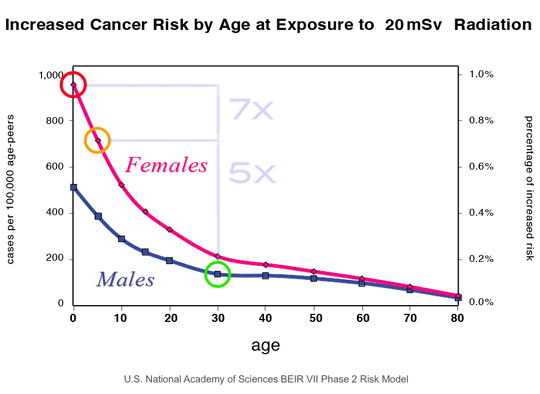
The vertical Y-axis is calibrated to the number of cancer cases per 100,000 age-peers, and the horizontal X-axis depicts the age of the population, beginning at zero years and moving towards old age. Now examine the allegedly safe dose of 20 millisieverts per year.
As a result of this exposure, there will be about 1000 additional cases of cancer in female infants and 500 cases of cancer in infant boys per 100,000 in their age groups. There will be an additional 100 cases of cancer in 30 year old males per 100,000 in this age peer group.
Notice that children, especially girls, are at the most risk from radiation-induced cancer. In fact a female infant has 7 times greater risk and a 5 year old girl has 5 times greater risk of getting a radiation-induced cancer than does a 30 year old man. Continue reading
Very few parents aware of the danger to children from UV radiation
Although 85 % of Americans recognizing that UV rays can damage the eyes, only 65 % wear sunglasses as protection, and ensure even fewer report that their children wear sunglasses* forzest ranbaxy review .
To parents, carers and other help to understand better, the risks to take with UV irradiation to the eyes and UV exposure UV exposure, Healthy Women, the leading independent health information source for women, offers a free education to minimize resource, Fast Facts for your Health related: The Sun & your Eyes: What You Need to Know. It may take years before you can have a harmful effect of the sun on your eyes, but do some damage may occur on short notice, says Elizabeth Battaglino Cahill, Fast Facts Healthy Women. This latest in our series of Fast Facts for Your Health resources can help families understand the potential damage that UV can, can cause to their eyes and eyesight. It’s a quick read on the unexpected sources of UV radiation damage as well as simple, practical advice to reduce the risks of UV radiation. .
Nuclear reactors are not needed for medical isotopes
 For a long time, the nuclear lobby has been touting nuclear medicine a big the reason for having nuclear reactors .
It is not simple nor cheap to set up non nuclear methods of producing medical isotopes . However, it can be done, and in the long run, is less expensive than managing the radioactive waste debt to be passed on to future generations.
The “nuclear medicine” rationale is just a fig leaf tacked on to this dangerous industry
 AUDIO: Reactors avoided in production of medical isotopes http://www.abc.net.au/radionational/programs/scienceshow/reactors-avoided-in-production-of-medical-isotopes/6315814 14 March 2015
Prolonged exposure to radiation is taking health toll on Fukushima’s kids
 TV: Officials lying, many more kids getting cancer after Fukushima — Report: 1,200+ deaths from “illness caused by prolonged exposure” — Mom: “I’m really worried… children not the same… sick… nosebleeds, rashes.. white blood cells decreased” — Radiation by school 100 times normal (VIDEO) http://enenews.com/tv-fukushima-residents-govt-lying-im-really-worried-many-children-same-sick-nosebleeds-rashes-incredible-fatigue-white-blood-cells-decreased-radiation-levels-school-100-times-normal-video?utm_source=feedburner&utm_medium=email&utm_campaign=Feed%3A+ENENews+%28Energy+News%29
ABC (Australia), Mar 11, 2014 (emphasis added): Radiation levels posing cancer risks… Before the disaster, there was just one to two cases of thyroid cancers in a million Japanese children but now Fukushima has more than 100 confirmed or suspected cases, having tested about 300,000 children… It is expected that thyroid cancers could turn up about four to five years after a nuclear disaster… [Megumi] Muto said her daughter and son, like many other children, had not been the same since experiencing the Fukushima fallout. “They had rashes on their bodies then nose bleeds. My son’s white cells have decreased and they both haveincredible fatigue… both have multiple nodulesaround their thyroids. I’m really worried.”… Mutowanted to move her family out of Fukushima city but she said she could not afford to.
News 24 (SAPA), Mar 10, 2015: A total of 1232 deaths in Japan’s Fukushima prefecture over the past year were linked to the nuclear accidentfour years ago, up 18% from a year earlier, a news report said on Tuesday. A death is considered nuclear-related if is not directly resulting from a nuclear accident but is due from an illness caused by prolonged exposure. Namie town, close to the Fukushima Daiichi Nuclear Power Station, had the largest number of deaths at 359, followed by 291 in Tomioka town, which is also near the complex, the Tokyo Shimbun reported.
ABC (Australia) video transcript, Mar 11, 2014:
- Headline: Fukushima residents have taken cancer and radiation testing into their own hands, saying authorities are lying to them about the safety of their community.
- Matthew Carney, ABC correspondent: It’s a heartbreaking time for Megumi Muto. Her daughter is being tested to see if the lumps in her thyroid gland have grown… Megumi isconvinced exposure to high radiation levels after the Fukushima nuclear meltdowns is the cause.
- Megumi Muto, Fukushima mother (translated): I feel angry. I think the authorities hide the real dangers, and now many more children are being diagnosed.
- Carney: Many residents in Fukushima don’t trust the government or TEPCO.
- Muto: Since the disaster my kids have been sick with nosebleeds, rashes and lethargy. Fukushima used to be a safe… area, but not now.
ABC (Australia) audio transcript, Mar 11, 2014:
- Michael Brissenden, ABC: the issue of long term health implications like cancer are causing the greatest concern and controversy in Japan…
- Matthew Carney, ABC correspondent: [Fukushima residents say the local and central] governments failed to protect the children. And they do not trust what the government or TEPCO… are telling them about radiation levels and safety. They’re conducting their own radiation tests and near this school in Fukushima City, the monitor reads 3 mircosieverts an hour. That’s about 100 times the rate of Tokyo.
- Sumio Kunno, nuclear plant engineer: I have to investigate and inform the public of the facts… They’re still not decontaminating areas where children live or play.
1,232 deaths in 2014 in Fukushima Prefecture linked to nuclear disaster
Deaths tied to Fukushima nuclear disaster up 18% Press TV 11 Mar 15 A fresh report in Japan shows the number of deaths by radiation from the country’s Fukushima nuclear power plant disaster in 2011 increased by 18 percent last year.
The report published on Tuesday by the Japanese newspaper Tokyo Shimbunsaid figures from authorities in Fukushima Prefecture showed a total of 1,232 deaths in 2014 were linked to the nuclear disaster.
The highest number of fatalities occurred in the town of Namie near the Fukushima Daiichi Nuclear Power Station, with 359 deaths, followed by 291 cases in Tomioka town also near the plant.
Nuclear radiation exposure can cause serious health problems. The first signs of nuclear radiation exposure are nausea and vomiting.
Exposure increases the probability of developing some other diseases, mainly cancer, tumors, and genetic disorders……..http://www.presstv.ir/Detail/2015/03/10/401156/Deaths-tied-to-Fukushima-disaster-up-18
Medical disability for radiation awarded to airman who attended UFO site 30 years ago

Was this “UFO” in fact part of a secret nuclear military program?
Airman Wins Full VA Benefits For UFO Radiation Exposure http://dailycaller.com/2015/03/06/airman-ufo/ For 30 years, U.S. airman John Burroughs has been trying to convince the military that after investigating a UFO in Rendlesham Forest, he suffered from massive amounts of radiation and ultimately needed heart surgery.
Now, after a long legal battle, the VA is finally giving Burroughs full medical disability for the incident.
The incident took place in December of 1980. At the time, Burroughs, a policeman in the U.S. Air Force stationed in Suffolk, England, was investigating a mysterious craft in the forest, The Inquisitr reports. As Burroughs and his team ventured into the forest and closer to the source, the lights suddenly disappeared, leaving the team grasping for an explanation.
The next day, the lights reappeared, and the team again investigated. Burroughs stated that he came in direct contact with lights flying around the forest—in other words, UFOs. Out of nowhere, the lights beaming down blasted him with a wave of radiation. The UK government eventually confirmed the incredibly high levels of radiation in that exact location.
“I’m still trying to work out what I saw,” Burroughs told The Mirror. “I think this is a phenomenon the government is aware of, but are still trying to work out exactly what it is.
This exposure to radiation left him sick, and since then, he’s been battling the military for over 30 years to receive benefits. For him, it isn’t about proving the existence of UFOs, but rather convincing the military that because he suffered from serious radiation exposure, he should receive the health treatment he needs.
Republican Sen. John McCain eventually decided to advocate for his cause, but was ultimately unable to track down all of the necessary medical records to prove his case.
Finally, the legal team working with Burroughs found documents from the British Ministry of Defense which proved that significant levels of radiation were detected at exactly the location where Burroughs encountered the strange lights. After the documents surfaced, the U.S. government could no longer deny that Burroughs suffered from radiation exposure, and now the Department of Veterans Affairs is set to grant Burroughs full medical disability.
“In citing the [MoD radiation documents] and in granting John Burroughs full disability for his injuries in Rendlesham Forest, the US Government has by de facto acknowledged the existence of unidentified aerial phenomena which, in John Burroughs’ case, resulted in physical injury,” Pat Frascogna, a ‘UFO Lawyer’said in an email to The Mirror.
The nuclear terror motivations of extremists of Salafi jihadists and of White Supremacists
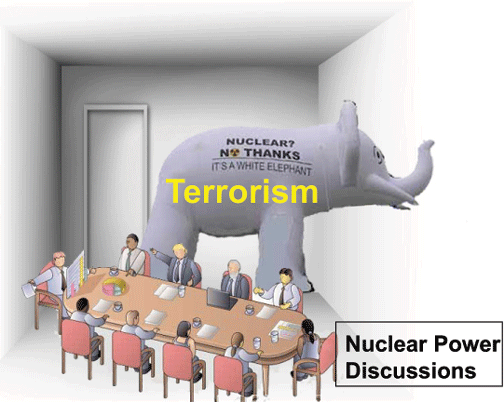 Break-In at Y-12 How a handful of pacifists and nuns exposed the vulnerability of America’s nuclear-weapons sites .New Yorker, BY ERIC SCHLOSSER , 9 March 15 “…….After considering the threat of nuclear terrorism for many years, William C. Potter, the director of the James Martin Center for Nonproliferation Studies, and Gary Ackerman, the director of the Unconventional Weapons and Technology Division, at the University of Maryland, outlined some of the motives that could drive a terrorist group to obtain a nuclear weapon. The group might hope to create mass anxiety or mass casualties. It might want to deter attacks by a state with nuclear weapons. It might want to destroy a large area belonging to an adversary. It might want the prestige that nuclear weapons seem to confer, the status of being a world power. And it might seek to fulfill a religious goal. Groups that have an apocalyptic outlook—that believe “an irremediably corrupt world must be purged to make way for a utopian future,” that celebrate violence as a means of achieving those aims—could be especially drawn to nuclear weapons, Potter and Ackerman found. Today, the number of those groups seems to be multiplying.
“The ruling to kill the Americans and their allies—civilians and military—is an individual duty for every Muslim who can do it in any country in which it is possible to do it,” Osama bin Laden declared in 1998. Al Qaeda’s current leader, Ayman al-Zawahiri, has said that his mood won’t improve until America vanishes. And he quoted, with approval, a radical imam’s view that using a nuclear weapon against the United States would be sanctified by God: “If a bomb were dropped on them, destroying ten million of them and burning as much of their land as they have burned of Muslim land, that would be permissible without any need to mention any other proof.”
The Salafi jihadist world view promoted by Al Qaeda stresses the religious duty to purify corrupt states through violence, drive out infidels, and create a new caliphate—a perfect state in which religious and political leadership will be merged. Seth G. Jones, the director of the International Security and Defense Policy Center at the RAND Corporation, estimates that there are about fifty Salafi jihadist groups worldwide. They focus primarily on local struggles, battling the “near enemy,” not the “far enemy”: the United States. The groups most likely to commit terrorist acts on American soil are Al Qaeda, its offshoot Al Qaeda in the Arabian Peninsula, and the Islamic State in Iraq and al-Sham (ISIS). None have thus far engaged in nuclear terrorism, preferring more conventional and reliable forms of violence.
1 This Month
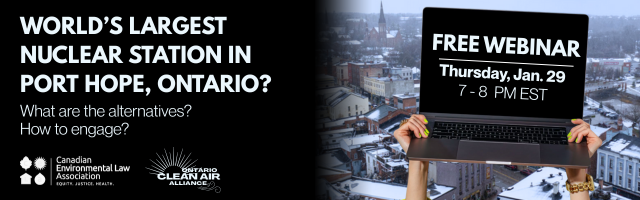
29 Jan. Thursday 7-8 p.m. Webinar – World’s Largest Nuclear Station in Port Hope, ON?
To see nuclear-related stories in greater depth and intensity – go to https://nuclearinformation.wordpress.com/
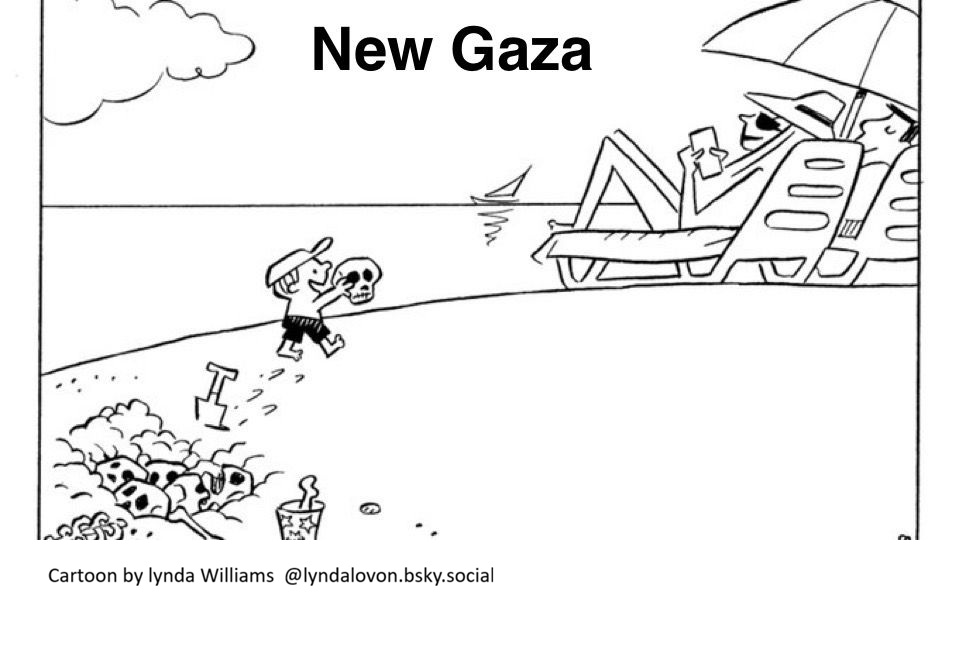

31st January – Challenging the War Machine – a DECLASSIFIED UK SUMMIT


Website of the Week
Now until to February 10, 2026 Radioactive waste storage in France: the debate is finally open! How to participate?
-
Archives
- January 2026 (288)
- December 2025 (358)
- November 2025 (359)
- October 2025 (376)
- September 2025 (258)
- August 2025 (319)
- July 2025 (230)
- June 2025 (348)
- May 2025 (261)
- April 2025 (305)
- March 2025 (319)
- February 2025 (234)
-
Categories
- 1
- 1 NUCLEAR ISSUES
- business and costs
- climate change
- culture and arts
- ENERGY
- environment
- health
- history
- indigenous issues
- Legal
- marketing of nuclear
- media
- opposition to nuclear
- PERSONAL STORIES
- politics
- politics international
- Religion and ethics
- safety
- secrets,lies and civil liberties
- spinbuster
- technology
- Uranium
- wastes
- weapons and war
- Women
- 2 WORLD
- ACTION
- AFRICA
- Atrocities
- AUSTRALIA
- Christina's notes
- Christina's themes
- culture and arts
- Events
- Fuk 2022
- Fuk 2023
- Fukushima 2017
- Fukushima 2018
- fukushima 2019
- Fukushima 2020
- Fukushima 2021
- general
- global warming
- Humour (God we need it)
- Nuclear
- RARE EARTHS
- Reference
- resources – print
- Resources -audiovicual
- Weekly Newsletter
- World
- World Nuclear
- YouTube
-
RSS
Entries RSS
Comments RSS
 nuclear-news