Media failed to report the death and health toll from Chernobyl
Fukushima Not Even Close To Being Under Control, Oil Price, By ZeroHedge Sun, 28 June 2015 “……..As an example of how media fails to deal with disaster blowback, here are some Chernobyl facts that have not received enough widespread news coverage: Over one million (1,000,000) people have already died from Chernobyl’s fallout.
Additionally, the Rechitsa Orphanage in Belarus has been caring for a very large population of deathly sick and deformed children. Children are 10 to 20 times more sensitive to radiation than adults.
Zhuravichi Children’s Home is another institution, among many, for the Chernobyl-stricken: “The home is hidden deep in the countryside and, even today, the majority of people in Belarus are not aware of the existence of such institutions” (Source: Chernobyl Children’s Project-UK).
One million (1,000,000) is a lot of dead people. But, how many more will die? Approximately seven million (7,000,000) people in the Chernobyl vicinity were hit with one of the most potent exposures to radiation in the history of the Atomic Age.
The exclusion zone around Chernobyl is known as “Death Valley.” It has been increased from 30 to 70 square kilometres. No humans will ever be able to live in the zone again. It is a permanent “dead zone.”
Additionally, over 25,000 died and 70,000 disabled because of exposure to extremely dangerous levels of radiation in order to help contain Chernobyl. Twenty percent of those deaths were suicides, as the slow agonizing “death march of radiation exposure” was too much to endure……..http://oilprice.com/Latest-Energy-News/World-News/Fukushima-Not-Even-Close-To-Being-Under-Control.html
US Navy Sailors: Third death from exposure to Fukushima fallout
Attorney for US Navy Sailors: Third death from exposure to Fukushima fallout — Baby with brain cancer has died — Reporters afraid to publish stories related to case — Professor: USS Reagan sailors were first people to be hit by plume outside of plant (VIDEOS) http://enenews.com/attorney-navy-sailors-third-death-exposure-fukushima-fallout-baby-brain-cancer-died-reporters-worried-about-publishing-stories-related-case-professor-uss-reagan-sailors-first-be-hit-plume-plant?utm_source=feedburner&utm_medium=email&utm_campaign=Feed%3A+ENENews+%28Energy+News%29
Attorney Charles Bonner, representing US service members exposed to Fukushima fallout, Jul 21, 2015 (at 10:45 in): We now have a 250+ young sailors with all kinds of illnesses, we’ve had three die. We had one of the sailors who came home and impregnated his wife. They gave birth to a little baby born with brain cancer and cancer down the spine, lived for two years, and just died in March of this year.
Q&A with Charles Bonner, Jul 21, 2015 (at 4:45 in): I was just interviewed by some reporter about this case, he said, “Now, I want to interview you about this case and the current status of your lawsuit — but, you all have won, so do I have anything to worry about? Do I have to look over my shoulder if I do this story, if I publish this story?” I said, “Yeah you do.” Because trillions of dollars do not go away easily. It’s amazing that people are afraid to even do a story on this because they’re afraid of these corporations.
Kyle Cleveland, sociologist at Temple University’s Japan Campus, published Apr 29, 2015 (at 2:00 in): Like everyone else we were seeing what was on the media. The media was very alarmist, and I think ironically, some of what were taken as an overreaction or a panic in the first couple of weeks of the crisis subsequently have been vindicated to be in some ways quite reasonable claims and worries as more information have been revealed, as gov’t reports have been written… Those reports have demonstrated that the situation was really quite more serious at the time than certainly what the government was saying, and certainly what TEPCO was saying at the time. My starting point for my research was looking into the government’s FOIA documents. I was very surprised to see that there is a big difference within the United States government as they were trying to determine just how bad this was. And what I realized in those documents is that the Nuclear Regulatory Commission… was recommending a 50-mile (80 km)exclusionary zone. This was an stark contrast to the Japanese government’s recommendation of 30 km. And also I was very interested to see that the the US Navy Pacific Command and particularly naval reactors, was recommending a 200-mile exclusionary zone. So that’s a rather profound gap between 30 kilometers on the one hand with the Japanese government 80 km from the NRC [and] something like over 300 km for the US Navy… But ironically aside from the staff at the Daiichi plant maybe some at the very first people who were hit by the radioactive plume were sailors who run the United States Ronald Reagan Carrier Strike Group… They detected the plume at about 132 miles distance from the Daiichi plant. The FOIA documents… demonstrate that these government officials… were very concerned about the levels that they were reading. They were indicating that they were about 30 times above background levels, and that they would exceed a ‘protective action guideline’ criteria within about a 10 hour period… The reason the US Navy had recommended a 200-mile exclusionary zone was that the Yokosuka naval base is about a 163 miles from the Daiichi plant… at the same time that the Ronald Reagan aircraft carrier was detecting the nuclear plume, the George Washington aircraft carrier which was ported down near Yokosuka was also detecting a plume and the result that they were getting were really quite alarming to them.
Environmental factors, not genes, cause cancer, as history shows
 Scientists suggest that cancer is purely man-made http://phys.org/news/2010-10-scientists-cancer-purely-man-made.html#jCp October 14, 2010 (PhysOrg.com) –– Cancer is a modern, man-made disease caused by environmental factors such as pollution and diet, a study by University of Manchester scientists has strongly suggested.
The study of remains and literature from ancient Egypt and Greece and earlier periods – carried out at Manchester’s KNH Centre for Biomedical Egyptology and published in Nature Reviews Cancer – includes the first histological diagnosis of cancer in an Egyptian mummy.
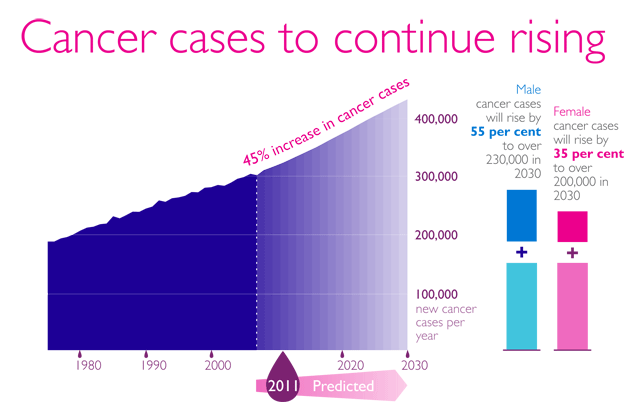
Finding only one case of the disease in the investigation of hundreds of Egyptian mummies, with few references to cancer in literary evidence, proves that cancer was extremely rare in antiquity. The disease rate has risen massively since the Industrial Revolution, in particular childhood cancer – proving that the rise is not simply due to people living longer. Continue reading
As ionising radiation increases in ecosphere, cancer incidence rises
There are 437 operative nuclear power plants world wide, and another 68 under construction. A dozen more are at the planning stage. Are we really so hungry for electricity that we are willing to risk annihilation to get it? What’s the point if generation after generation will suffer increased cancer rates?

It fairly hard to find historical data on cancer incidence.Cited near the bottom is an article that state circa 1900, 3 of 100 deaths were due to cancer.
A chart from the town of Boston 1811 showed 5 cancer deaths of 942.. Link and picture is at the far bottom herein.What are the current stats on cancer deaths? Honestly I haven’t included any information here except in links. I deem the answer to that question as so absurdly obvious to not deserve energy put into it.
How may people do you know who have cancer right now?
They try to avoid clear presentation of “incidences” of cancer, aka new cases. Some data is out there, but the spin is to try to show how Big Med/Big Pharma is “sucessful”. Continue reading
Increasing low dose ionising radiation increases cancer risk in a linear way with no safe level
 The prestigious Biological Effects of Ionising Radiatioan (BEIR) Report VII states: ‘A comprehensive review of available biological and biophysical data supports a “linear-no-threshold” (LNT) risk model—that the risk of cancer proceeds in a linear fashion at lower doses without a threshold and that the smallest dose has the potential to cause a small increase in risk to humans’ – http://dels.nas.edu/resources/static-assets/materials-based-on-reports/reports-in-brief/beir_vii_final.pdf
The BEIR report is based on huge epidemiological studies, especially on survivors of the Hiroshima and Nagasaki atomic bombing.
By contrast, the USA Department of Energy has been funding poxy little studies such as one at Flinders University, South  Australia, on a small number of mice – to try to prove this quack science “hormesis” idea. http://antinuclear.net/2012/09/03/flinders-university-participates-in-usa-department-of-energys-pro-nuclear-propaganda/
Effect of ionising radiation on immune system
Could Nuclear Fallout Make Infectious Diseases More Devastating?, Radiation Prevention, July 15 In this post we explore the adverse health effects of ionizing radiation on the body and its ability to combat disease.
As of late, the spread of deadly contagious diseases have been accelerating, with an increased number of viral outbreaks all within the last few months (February – July 2014).
In contrast, so has the risk of exposure to ionizing radiation, so I decided to take a deeper look at how this exposure might play a role in concurrent viral epidemics and pandemics. There is a domino-effect currently unfolding; nuclear fallout could increase the potency of infectious diseases, in addition to further propelling a heightened cancer epidemic which has been underway for decades.
8 Deadly Outbreaks and Counting…….
With the lifespan of man made radiation measured in the hundreds and thousands of years, there is no doubt in my mind that radiation will have a key role in how quickly viruses spread, and how deadly their efficacy. If this isn’t already happening today, my guess is that it will in the future.
A Correlation?The immune system is responsible for protecting your body from bacterial, viral, and fungal infections, in addition to aiding the body in healing wounds and damage to your skin and internal organs. Your bone marrow makes about one thousand million white blood cells every single day, of varying types, each with a unique purpose. Some of these white blood cells are called macrophages, and they constantly patrol your body and destroy germs as they come across them.
This is your ‘natural’ or inborn immunity. If an infection begins to proliferate, your body fights back with an even more powerful defence of T-cells and B-cells. These cells grant your body an immunity, so that the same germ can never make you as sick again. It’s a pretty genius defence mechanism.
On the other hand, radiation works by damaging DNA cells and killing host bone marrow, where white blood cells come from. Radiation prohibits their ability to replenish themselves, along with other rapidly dividing cells such as hair, or cells lining a hosts gastrointestinal tract —which is why cancer patients receiving radiation therapy lose their hair and throw up often.
With an immune system compromised to such a degree, the host is more susceptible to infections the average person is less susceptible to; Infections such as giardia, toxoplasmosis, cryptococcus, candida, JC virus, progressive multifocal leukoencephalopathy —although you are much more likely to get a common disease before any of these like a strep or staph infection.
Other diseases associated with radiation exposure include non-malignant thyroid nodular disease, parathyroid adenoma, posterior sub capsular cataracts, tumours of the brain and central nervous system, and all other cancers.
Fukushima MonkeysOne recent study of Japanese macaques (Macaca fuscata) compared 61 monkeys living 70km (44 miles) from the the Fukushima Daiichi nuclear power plant with 31 monkeys from the Shimokita Penisula, over 400km (249 miles) from Fukushima. The monkeys from areas in the 70km (44 mile) range impacted by fallout from the Fukushima Daichii meltdown exhibited low white and red blood cell counts, low hemoglobin levels, and tested positive for radioactive caesium.
It is believed that the presence of caesium can be linked to the soil in their habitats, as well as the tree buds and bark which the macaques feed on. This research is considered inconclusive, although both malnutrition and disease were ruled out as causes of the blood abnormalities the monkeys were experiencing. Only through time and the process of elimination will we better understand the adverse health effects on wildlife local to the area.
Source: The Guardian, RT
Common SenseIn conclusion, research is inconclusive and I cannot say there is a scientific correlation between radiation and the proliferation of ‘super viruses’.
I can only make an average joe ‘common sense correlation’: If radiation exposure weakens your immune system, and both a proliferation of deadly viral outbreaks and increased exposure of radioactive isotopes is occurring the world over —it’s pretty clear that anything which lowers our immune system is going to pose a serious challenge for our bodies to overcome this new wave of robust viruses. And because radiation has the potential to do this to us, imagine what it’s doing to weaken the natural systems and defences of the earth and its ocean.http://radiationprevention.com/correlation-radiation-immune-response-super-virus-outbreaks/
Ugly Australians, like Paladin Energy, linked to 100s of deaths in uranium mining in Malawi and Namibia
There is a very strong perception that when Australian mining companies come here they take every advantage of regulatory and compliance monitoring weaknesses, and of the huge disparity in power between themselves and affected communities, and aim to get away with things they wouldn’t even think of trying in Australia,”
 Australian miners linked to hundreds of deaths, injuries in Africa, SMH, July 11, 2015 -Will FitzgibbonAustralian mining companies are linked to hundreds of deaths and injuries in Africa, which can go unreported at home. Some of the Australian Securities Exchange-listed companies include state governments as shareholders. One company recorded 38 worker deaths over an eleven-year period.
 In Malawi, litigation continues against Paladin Africa Limited, a subsidiary of Perth-based Paladin Energy, and its subcontractor after an explosion disfigured one worker with such heat that his skin shattered when touched by rescuers. Two others died in the same incident.
Other allegations include employees in South Africa hacking a woman with a machete and Malian police killing two protesters after a mine worker reportedly asked authorities to dislodge a barricade on the road to the mine.
An investigation by the International Consortium of Investigative Journalists, in collaboration with 13 African reporters, uncovered locally-filed lawsuits, violent protests and community petitions criticising some Australian companies. Continue reading
More deaths from leaukemia as workers exposed to more low level ionising radiation
As cumulative dose of radiation exposure increased, so did the risk of dying from certain kinds of leukemia, the researchers found.
In the new study, the researchers calculate that for each gray (1,000 mGy) of total radiation exposure, a worker’s risk of leukemia rose three-fold.

Long-Term Low-Dose Radiation Exposure May Increase Leukemia Risk, Scientific American, Leukemia was already known to be caused by exposure to high doses of radiation, like that released by the atomic bombs dropped on Japan in 1945 By Kathryn Doyle July 10, 2015 (Reuters Health) – In a long-term study of more than 300,000 workers in France, the U.S. and the U.K., those with many years of exposure to low doses of radiation had an increased risk of dying from leukemia.
Medical workers and even patients are also exposed to much more radiation than was common decades ago, the study authors point out, but it’s unclear what amount of low-level exposure raises cancer risk, they say.
“A lot of epidemiological or radiobiological studies have brought evidence that exposure to ionizing radiation can cause cancer and leukemia,” said lead author Dr. Klervi Leraud of the Radiobiology and Epidemiology Department at Fontenay-aux-Roses in Cedex, France.
Workers exposed to ionizing radiation who are later diagnosed with leukemia can already ask for financial compensation in the U.S., the U.K. or France, Leraud told Reuters Health by email.
Leukemia is known to be caused by exposure to high doses of radiation, like that released by the atomic bombs dropped on Japan in 1945. In the years following those bombings, leukemia cases increased among the survivors, the authors note in The Lancet Haematology, online June 21. But such high doses are rare today.
For the new study, researchers considered 308,297 nuclear energy workers whose radiation exposures were monitored. All had worked for at least a year for the French Atomic Energy Commission or similar employers or for the Departments of Energy and Defense in the U.S., or were members of the National Registry for Radiation Workers in the U.K.
The workers were followed for an average of 27 years, with data on exposure and health status through the early- to mid-2000s, depending on their country. Researchers looked for deaths from leukemia or lymphoma. Continue reading
Ionising radiation: there is no safe level
Why There Is No Safe Level of Man Made Radiation, Radiation Prevention, [Good diagrams, photos and video] People on the west coast of North America inhaled an average of 5 hot particles every day during the month of April 2011 alone. Arnie Gundersen, Fairewinds, 8 July 15
Nuclear Myths Abound
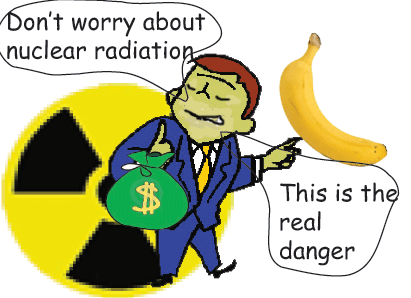
Many public figures like to equate environmental effects of the Nuclear Industry to things such as bananas, X-rays, and even taking a flight to Mexico. Below we will do our best to explain to you, exactly why they are so very, very wrong.
This article is an excerpt of a larger feature coming out in May, and specifically focuses on man made radiation. It isn’t meant to minimise the health affects of natural forms of radiation, as there is no safe dose of radiation.
 Let’s Talk Bananas
There exists in the world, naturally occurring forms of radiation. There are many of them, they come in many different shapes and forms. We have adapted to some of them, others, not so much.
Bananas contain a radioactive isotope called Potassium40 (k40). This isotope is also naturally found in milk, soil, and countless other things. Even oranges, as noted here.
If you have one gram of potassium from a banana, only 0.0117% of that potassium is considered radioactive.
Now to put things in perspective, if you have one gram of cesium (which mimics potassium in our bodies) 100% of that gram is radioactive.
And that’s not all.
I’m sure everyone has heard the term “half life” by now. Without getting too geeky on the subject, I will try to explain exactly what that means below………… http://radiationprevention.com/safe-level-manmade-radiation/#ixzz3fR1xuR8z
Radioactivity detected in 2 places at Czech Temelin nuclear station
Radioactivity unexpectedly detected in 2 places at Czech Temelin nuclear plant, no safety risk http://www.startribune.com/radioactivity-detected-in-2-places-at-czech-nuclear-plant/311569951/Associated Press JULY 3, 2015 PRAGUE — An official says low radioactivity has been unexpectedly detected in two places outside one of the two reactors at a Czech nuclear power plant.
Israel’s Dimona Nuclear Reactor – poisoning Palestinians?
Is waste from Israel’s nuclear programme poisoning Palestinians? http://www.alaraby.co.uk/english/features/2015/6/30/is-waste-from-israels-nuclear-programme-poisoning-palestinians By: Anas Abu Arqoub 30 June, 2015 Israel’s nuclear programme has operated in the shadows with little international oversight. Now it appears accidents and the unsafe disposal of nuclear material could be poisoning the West Bank.
It is the one of the few nuclear facilities in the world not subject to international safety inspections by the International Atomic Energy Agency. The reactor has already been implicated in illnesses and environmental damage among the area’s Israeli population.
Ibrahim, from a small village 11km south of Hebron, told the story of his still-born child. “When the midwife told me my child had died at birth, I was overcome with sadness,” he said. “However, the sadness became easier to bear when I learned that my child was born with one eye and birth defects that would have stayed with him for life.”
Dr Mahmoud Saadah, the head of the Palestine branch of International Physicians for the Prevention of Nuclear War (IPPNW), holds the Dimona nuclear reactor directly responsible for the increase in deformities in the area and surrounding villages. Ignoring Palestinian victims The Dimona nuclear reactor is located 10km southeast of the city of Dimona, the third-largest city in the Negev.

Construction on the nuclear reactor began in 1958 with French assistance, and Israel has another nuclear reactor for research and medical use at the Soreq Nuclear Research Centre.
An Israeli documentary film named The Dark Secret of the Dimona Reactor investigated the facility. The film revealed information about Israelis affected by the reactor and the environmental damage it has caused to the surrounding area.
However, the documentary film ignored Palestinian victims, so al-Araby al-Jadeed set out to discover the harm done to Palestinians from the reactor, in addition to the reason the Israeli military allowed the disclosure of information previously classified.
Al-Araby met Dr Khalil Thabayneh, a nuclear physics researcher at Hebron University. Thabayneh is the only Palestinian specialist who has conducted studies over a number of years to measure radiation levels in the West Bank, using advanced equipment to detenct levels of radioactive material in water, rocks, soil and plants.
Thabayneh’s studies reveal levels exceeding international permitted averages in the Hebron governorate. The most commonly radioactive element in the southern West Bank, according to Thabayneh, is Caesium-137. Any amount of Caesium-137 in the environment is considered dangerous.
“This isotope does not exist in nature and only occurs due to nuclear activity. When found in high concentrations, the source is either nuclear experiments, radioactive leaks or the detonation of nuclear weapons,” said Thabayneh.
“The only places found to have higher concentrations than in the West Bank were after the explosion of the Chernobyl reactor in the Ukraine in 1986 and in Fukushima in 2012. These two cases had the highest recorded levels of Cesium-137 in the world, which means the southern West Bank has the highest levels of Cesium-137 in the world if we exclude areas that have witnessed nuclear disasters,” added Thabayneh.
The dangers
Thabayneh revealed the greatest danger to humans from Caesium-137 is cancer. Other elements such as uranium and polonium aso pose great dangers to children, and can cause cancer and affect the reproductive system, causing infertility in both men and women and cause birth defects and repeated miscarriages.
Dr Saadah, of International Physicians for the Prevention of Nuclear War, has been practicing medicine in the area for decades.
He confirmed Thabayneh’s findings through his personal observations. Saadah confirmed there had been an increase in birth defects among newborns in the southern Hebron region.
“The reason is not a genetic defect, because that would cause one or two cases and would be limited to a family instead of a number of families, as was discovered in the area south of Hebron,” Saadah said.
Birth defects are above average here, and in many cases children were born with only one eye, or with only one hand.
“The families usually don’t announce the issue, especially if the deformed newborn dies, fearing that other families will not marry their other daughters,” said Saadah.
Saadah and a group of volunteers conducted tests in 2005 without the knowledge of the Israeli authorities to discover the levels of radiation in the southern West Bank.
The results showed that radiation levels were four times higher than areas that had not been contaminated. Saadah attributed the high levels to either a radiation leak from the Dimona reactor or to the burial of nuclear waste. Rare cancers
The town of Yatta has the highest reading of Caesium-137 in Hebron region.
This led researchers to focus on Yatta, and, in 2007, an International Physicians for the Prevention of Nuclear War committee documented 280 cases of cancer in the town with a population of approximately 50,000.
The same committee documented 200 cases of cancer in the town al-Dahiriya, 17km away from the reactor, which had a population of 35,000 at the time of the study.
The committee also documented a case of heart cancer in the town, which occurs in five out of each 100,000 people and usually in patients over 50.
However, in that town, it was diagnosed in a young boy. This comes in addition to other rare forms of cancer that were discovered.
Burying nuclear waste
According to the accounts of villagers in the governorate, Israel buries its nuclear waste close to Palestinian towns or in areas along the green line, which Israel plans to withdraw from in return for other areas if a resolution for the Israeli-Palestinian conflict were to take place in the future.
Villagers from Beit al-Roush told Saadah that, in 1989, they saw trucks going into the mountains followed by a cement mixing truck. The trucks would be buried whole, they said. After this time, residents noticed an increase in cancers.
Al-Araby spoke to a number of residents in the Bani Naim area in the governorate of Hebron, who said that, about ten years ago, the Israeli army buried barrels in a cave in the Bani Naim desert – after which the cave was sealed with reinforced concrete.
Access to the area is still restricted by the Israeli army. The residents believe the area contains dangerous nuclear waste, buried in their land.
The head of the Palestinian Environment Quality Authority, Adala al-Atirah, told al-Araby that Israel prevents Palestinian environmental inspectors from visiting areas which residents complain are being used as nuclear dumping grounds by Israel.
Furthermore, Israel does not allow for the import of equipment that could be used to measure radiation – and it prevents international and UN experts in the field from entering the Palestinian territories.
This is an edited translation from our Arabic edition.
– See more at: http://www.alaraby.co.uk/english/features/2015/6/30/is-waste-from-israels-nuclear-programme-poisoning-palestinians#sthash.pcw6PdbY.dpuf
Study of over 300.000 nuclear workers confirms increased health risks from low dose radiation
 Researchers pin down risks of low-dose radiation Large study of nuclear workers shows that even tiny doses slightly boost risk of leukaemia. http://www.nature.com/news/researchers-pin-down-risks-of-low-
 dose-radiation-1.17876 Alison Abbott 30 June 2015 For decades, researchers have been trying to quantify the risks of very low doses of ionizing radiation — the kind that might be received from a medical scan, or from living within a few tens of kilometres of the damaged Fukushima nuclear reactors in Japan. So small are the effects on health — if they exist at all — that they seem barely possible to detect. A landmark international study has now provided the strongest support yet for the idea that long-term exposure to low-dose radiation increases the risk of leukaemia, although the rise is only minuscule (K. Leuraud et al. Lancet Haematol. http://doi.org/5s4; 2015).
The finding will not change existing guidelines on exposure limits for workers in the nuclear and medical industries, because those policies already assume that each additional exposure to low-dose radiation brings with it a slight increase in risk of cancer. But it scuppers the popular idea that there might be a threshold dose below which radiation is harmless — and provides scientists with some hard numbers to quantify the risks of everyday exposures.
“The health risk of low-dose radiation is really very tiny, but the public is very concerned,” says Bill Morgan, who heads a systems-biology programme in low-dose radiation at the Pacific Northwest National Laboratory in Richland, Washington, and chairs the committee on radiation effects at the International Commission on Radiological Protection (ICRP) in Ottawa, Canada. That concern has driven a lot of investment in programmes trying to quantify the risk, he says. The European Commission, for example, has a 20-year road map to assess the problem. “We don’t do a very good job of explaining ourselves to the public, which finds it hard to put radiation risks in context — some people go to radon spas to treat their rheumatism while others won’t board planes for fear of cosmic rays,” he adds.
Radiation risks
Ionizing radiation — the kind that can pull electrons from atoms and molecules and break DNA bonds — has long been known to raise the risks of cancer; the higher the accumulated dose, the greater the damage. But it has proved extremely difficult to determine whether this relationship holds at low doses, because any increase in risk is so small that to detect it requires studies of large numbers of people for whom the dose received is known. A study of more than 300,000 nuclear-industry workers in France, the United States and the United Kingdom, all of whom wore dosimeter badges, has provided exactly these data. A consortium of researchers coordinated by the International Agency for Research on Cancer (IARC) in Lyon, France, examined causes of death in the workers (one-fifth of whom had died by the time of the study) and correlated this with exposure records, some of which went back 60 years. Continue reading
Poor health of Fukushima radiation refugees
Nonprofit Group: “Every single person” we hosted from Japan has had health problems… Blood stains found in almost all of their beds — Japanese Mom: Most mothers I’ve met from Tokyo and Fukushima are suffering thyroid problems, eye problems, nose bleeds… It’s been very surprising (VIDEO) http://enenews.com/video-mothers-ive-met-tokyo-fukushima-suffering-thyroid-problems-eye-problems-nose-bleeds-very-surprising-nonprofit-group-every-single-person-weve-hosted-japan-health-problems-found-blood-stains-ev?utm_source=feedburner&utm_medium=email&utm_campaign=Feed%3A+ENENews+%28Energy+News%29
Interview with Vicki Nelson, founder of Fukushima Friends (nonprofit organization which facilitates trips to Hawaii for Fukushima radiation refugees), Nuclear Hotseat hosted by Libbe HaLevy, Jun 9, 2015 (at 16:30 in):
- Vicki Nelson, founder of Fukushima Friends (emphasis added): We have a home that’s open for them to come and experience some time of respite and eat different food. What we’ve been experiencing also is that every single person that comes has reaction to the change as soon as they come here. There’s been people who have vomited, they’ve been having nosebleeds, they’ve been dizzy, they’ve been very ashen in color.
- Libbe HaLevy, host: This is once they have left Japan? In other words, it is the lack of the radiation that allows them to then have these reactions?
- Nelson: It’s like it is expelling from their body. There’s diarrhea, there’s nosebleeds— almost every single person has had nosebleeds on their pillow. I find blood, andthey don’t want to tell me that they have these reactions, they’re embarrassed. Tokiko’s son [from Koriyama, Fukushima] vomited the whole first week practically, and diarrhea. We actually took him to the hospital because we felt that he was dehydrated. They did run tests, and they said yes he was dehydrated. So he was kept overnight at the Hilo hospital on the big island and cared for.
Meeting hosted by Andrew Cash, member of Canadian parliament, Dec 2012 — Japanese mother (at 2:12:30 in): “My home town is Sapporo [northernmost island in Japan]… In my city, no one thinks about radiation. I found a group of escaped mothers from Tokyo and the Fukushima area, and I was very surprised… Most of them had thyroid problems, or eye problems, or nose bleeds… They are very worried about it. In Japan we knew about the meltdowns two months after the meltdowns happened, so we can have no information about radiation. Now the government is telling us to eat food from Fukushima. We can’t rely on government. The TV said Fukushima is safe, no problem… Fukushima is good to live. They want to invite a lot of tourists to Fukushima.
Full interview with Nelson here | Watch the meeting in Canada here
Canada’s last shipment of weapons grade uranium. Medical radioisotopes to be made in cyclotron, not nuclear reactor
The Chalk River reactor, which began operating in 1957, is one of five major producers of molybdenum-99, which decays into the technetium-99m isotope used in 85 per cent of nuclear medicine procedures such as bone scans and other diagnostic tests.
 Other sources, such as a cyclotron operated by TRIUMF, Canada’s national nuclear laboratory for particle and nuclear physics at the University of British Columbia, are in the works.
Final shipment of weapons-grade uranium due at Ontario facility this year http://www.thestar.com/news/canada/2015/06/29/final-shipment-of-weapons-grade-uranium-due-at-ontario-facility-this-year.html By: Joanna Smith Ottawa Bureau reporter, Jun 29 2015
OTTAWA—The United States has approved what is expected to be the last shipment of weapons-grade uranium to be sent to Canada for the production of medical isotopes. The U.S. Nuclear Regulatory Commission signed an export licence June 23 to transport 8.1 kilograms of highly enriched uranium from Oak Ridge, Tenn., along a secret route to Chalk River, Ont., by the end of this year.
There, for what is expected to be the last time, the uranium will be used to produce target material for the aging National Research Universal (NRU) reactor to irradiate in order to produce medical isotopes used in nuclear medicine.
“The game is over for Canada’s unnecessary and irresponsible use of bomb-grade uranium to produce medical isotopes. Better late than never,” Alan Kuperman, coordinator of the Nuclear Proliferation Prevention Project at the University of Texas at Austin, said in a statement Monday.
THE LAST SHIPMENT Kuperman has long been tracking the controversial U.S. exports of highly enriched uranium to Canada. The Conservative government has committed to shutting down the routine production of medical isotopes at the NRU by Oct. 31, 2016, with the possibility of the NRU retaining licences to operate until March 2018 in case of unexpected shortages. The isotope has a very short lifespan, causing it to disappear within a day of being generated and so it cannot be stockpiled.
Near nuclear power stations, breast cancer rates are 5 times higher
 Breast Cancer Rates Skyrocket Near Nuclear Power Plants http://naturalsociety.com/breast-cancer-rates-skyrocket-near-nuclear-power-plants/ by Robert Harrington
June 26, 2015 Rates as much as 5x higher A scientific research paper in Great Britain asserted that breast cancer rates increased to 5x the normal rate for women who lived near one of three nuclear power plants that they studied. The two others nuclear power plants doubled the incidence for those women living downwind from the reactors.
For decades the American public has been assured that there is very little chance that nuclear radiation escapes from the normal operation of a nuclear power plant. Yes, there may be catastrophic mishaps like Three Mile Island, or Chernobyl, or Fukushima, but absent those once-in-a-decade nuclear disasters, the people living near these plants have nothing to worry about … until now.
“Women living downwind from nuclear power plants are at five times greater risk of developing breast cancer, experts have warned.” [1]
The entire nuclear power industry was launched on the premise that they could be constructed so as to safely contain any and all radiation. Because so many nuclear reactors are relatively close to populated areas, this assumption was key to the promotion of nuclear power generation. If radionuclides could easily escape, then the whole business model and engineering paradigm would be fatally flawed.
“Other forms of cancer showing elevated levels included prostate, leukemia, mesothelioma and pancreas.” [1]
Scientific studies, such as this one conducted by Dr. Chris Busby, are rarely undertaken because the Nuclear Energy Industry would rather not know the true statistics. Were the facts surrounding nuclear discharges to become known to the general public there would be a groundswell of opposition to nuclear power plant sitings anywhere near densely populated areas.
Given that the worst cancer statistics concern carbon dioxide, gas-cooled graphite block reactors, in all likelihood they would be permanently shut down until a durable resolution could be implemented. It is this type of reactor that generates releases into the air which are higher than most other types of nuclear reactors.
Like the U.K., the U.S. nuclear power industry has also seen a great number of reported releases throughout the country over the past few decades. As these nuclear reactors age, they become the victim of a phenomenon known as technospheric breakdown[2]. Since many of them were constructed in the 1970s, those that have not been decommissioned have been operating for a long stretch of time. The average age of commercial reactors in the USA is 34 years.
In view of the extraordinary stresses which exist in the reactor environment, the 40-year license that is granted by the NRC seems far too long. There are several points of inherent weakness within the structural engineering of nuclear reactors, as well as within the controlled atomic fission process that were designed in what could now be described as the nuclear Stone Age. And, yet, the same fatally flawed nuclear energy paradigm is still being promoted worldwide today.
When more studies are conducted, which indicate a spike in cancer rates in locations which have a nuclear power plant nearby, governments across the planet will be forced to respond appropriately. After all, the presence of ionizing radiation will always manifest as various forms of cancer the longer a residential or business area is exposed to it.
Hence, governments will eventually be compelled to remedy the many compromised nuclear power stations which are frequently making these contaminating releases. Not to do so will inevitably translate to an explosion in healthcare costs.
ConclusionJust as the Fukushima nuclear disaster has shown the complete folly of building nuclear power plants on one of the most seismically active (as well as tsunami-prone) group of islands in the world, there are now other well documented serious issues which ought to disqualify plants from being built. It would seem that those reactors with considerably higher rates of nuclear releases would qualify them as menaces to the community. Simply put, they shouldn’t even be there.
Additional Sources:
[1] Daily Mail
1 This Month
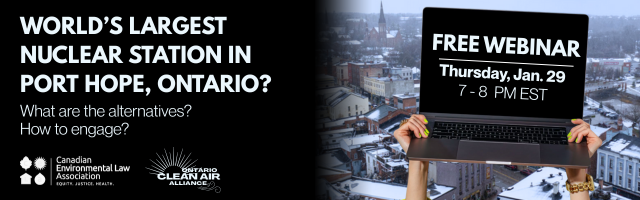
29 Jan. Thursday 7-8 p.m. Webinar – World’s Largest Nuclear Station in Port Hope, ON?
To see nuclear-related stories in greater depth and intensity – go to https://nuclearinformation.wordpress.com/

31st January – Challenging the War Machine – a DECLASSIFIED UK SUMMIT


Website of the Week
Now until to February 10, 2026 Radioactive waste storage in France: the debate is finally open! How to participate?
-
Archives
- January 2026 (288)
- December 2025 (358)
- November 2025 (359)
- October 2025 (376)
- September 2025 (258)
- August 2025 (319)
- July 2025 (230)
- June 2025 (348)
- May 2025 (261)
- April 2025 (305)
- March 2025 (319)
- February 2025 (234)
-
Categories
- 1
- 1 NUCLEAR ISSUES
- business and costs
- climate change
- culture and arts
- ENERGY
- environment
- health
- history
- indigenous issues
- Legal
- marketing of nuclear
- media
- opposition to nuclear
- PERSONAL STORIES
- politics
- politics international
- Religion and ethics
- safety
- secrets,lies and civil liberties
- spinbuster
- technology
- Uranium
- wastes
- weapons and war
- Women
- 2 WORLD
- ACTION
- AFRICA
- Atrocities
- AUSTRALIA
- Christina's notes
- Christina's themes
- culture and arts
- Events
- Fuk 2022
- Fuk 2023
- Fukushima 2017
- Fukushima 2018
- fukushima 2019
- Fukushima 2020
- Fukushima 2021
- general
- global warming
- Humour (God we need it)
- Nuclear
- RARE EARTHS
- Reference
- resources – print
- Resources -audiovicual
- Weekly Newsletter
- World
- World Nuclear
- YouTube
-
RSS
Entries RSS
Comments RSS
 nuclear-news