How world health will benefit from Iran nuclear deal

 Iran nuclear deal will bolster global health Boston Globe, By Dr. Ali Lotfizadeh and Dr. Mohsen Malekinejad SEPTEMBER 15, 2015 National security and regional stability have dominated the political debate over the Iran nuclear accord in recent weeks. Less discussed, however, are the far-reaching, positive implications for public health that will come when sanctions are lifted, as the deal calls for, and Iran’s medical system can begin to cooperate with the West again.
Sanctions for several years have severely restricted access to life-saving medicines for patients in Iran, leading to serious health consequences. Although the US government introduced loopholes to bypass these sanctions for medical purposes, the loopholes have not worked properly and lives have consequently been lost. With the nuclear agreement in place, thousands of Iranians will once again receive treatments for diseases like cancer and hemophilia.
Yet the calming of political tensions will have broader impact than just inside Iran. Since the revolution of 1979, Iran has been at the forefront of advancing primary medical care for rural populations through a system of robust health networks, which comprises more than 17,000 rural health facilities and a health center for every 7,000 rural residents. This network’s success even drew the interest of public health experts in Mississippi, who collaborated a few years ago with colleagues at Shiraz University of Medical Sciences in Iran to reduce health care disparities between rural and urban parts of the state.
Iran has also launched advanced intervention programs for drug users and is home to two out of three HIV surveillance and treatment knowledge hubs for the Eastern Mediterranean region office of the World Health Organization. These hubs are in charge of knowledge transfer to other countries in the region.
Iran’s vast potential to enhance global health is significantly underutilized right now. For example, since 2013, we have trained local ophthalmologists in Tajikistan to treat the main causes of avoidable blindness through a US-based nongovernmental organization. When we sought ophthalmologists who could provide training in Tajikistan, it was only natural to consider enlisting the expertise of Iranian colleagues. Iran, a neighbor of Tajikistan, is home to several reputable training sites sponsored by the International Congress of Ophthalmology. Iranian physicians speak the language and know the culture of Tajikistan and other countries in the region. They are also less expensive to hire than their American counterparts. But current restrictions make even these small-scale collaborations virtually impossible, despite their clear humanitarian purpose……..
proposed health partnerships transcend political ideologies and improve lives from villages in Tajikistan to small towns in Mississippi. But their success depends on the durability of this nuclear agreement. Iran and America do not see eye-to-eye on many political issues, and the current accord will not change that. But support for this agreement can pave the way toward a shared global responsibility to make the world a healthier place.
Dr. Ali Lotfizadeh is a visiting scholar at UCSF School of Medicine’s Institute for Health Policy Studies. Dr. Mohsen Malekinejad is an assistant professor in the same program. https://www.bostonglobe.com/opinion/2015/09/15/iran-nuclear-deal-will-bolster-global-health/YF7Hobo2RJPsu547uC4lGM/story.html, Boston Globe
Even when it’s cold, UV radiation is a risk
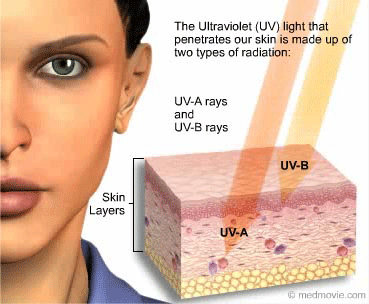 The damages of UV radiation are a daily risk even when you can’t feel the heat of the sun, News Local, Sydney September 12, 2015 IT seems logical to assume that the red hot sunburn we get comes from standing under the hot sun we feel, but it is not quite correct.. Sun damage is a reality that Australians face every day of the year, regardless of how hot the temperature is or how cloudy the sky…….
associate Professor Pablo Fernández-Peñas, who sees the detrimental effects of too much sun exposure.
“We can’t feel UV light and the heat sensation is not related to the amount of UV light,” he said.
“In winter, as days are cooler, people tend to stay longer outdoors.” A 2014 Australian study, “The influence of age and gender in knowledge, behaviours and attitudes towards sun protection”, found the use of sunscreen dropped to between 24 and 49 per cent outside summer.
“When you are just walking from your house to the car or dropping the kids to school, that sun exposure accumulates in the future,” Prof Fernández-Peñas said.
“Australia has the highest mortality of skin cancer in the world.”……..HEALTH EFFECTS OF UV RADIATION
■ Sunburn: can cause permanent and irreversible skin damage that can lay the groundwork for skin cancer
■ Eye damage: photoconjunctivitis, also known as snow blindness or welders flash, and skin cancer of the conjunctiva and skin surrounding the eye
■ Premature ageing: such as skin wrinkling, sagging, blotchiness and roughness …….http://www.dailytelegraph.com.au/newslocal/city-east/why-sunscreen-should-be-a-daily-habit/story-fngr8h22-1227522871234
Outrageous decision of USA’s Nuclear Regulatory Commission (NRC) to cancel research on cancer-nuclear links
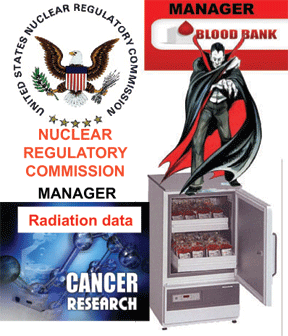 Vital cancer study canceled: NRC will hide the truth about nuclear reactor risks Beyond Nuclear today decried the outrageous decision by the U.S. Nuclear Regulatory Commission (NRC) to cancel a study that would have examined cancer incidence and mortalities and the connection to U.S. nuclear facilities.
“Study after study in Europe has shown a clear rise in childhood leukemia around operating nuclear power facilities, yet the NRC has decided to hide this vital information from the American public,” said Cindy Folkers, radiation and health specialist at Beyond Nuclear.
The study, initiated in 2009 and carried out under the auspices of the National Academy of Sciences (NAS), had completed Phase 1 and was looking at seven pilot nuclear sites around the country, a project that was estimated to cost $8 million.
“An $8 million price tag for the next phase of this study is a drop in the bucket for an agency with a $1 billion annual operating budget,” added Folkers. The NRC identified the “significant amount of time and resources needed and the agency’s current budget constraints” as its excuse for terminating the study.
Folkers noted that, in reality, nuclear industry manipulation, rather than budget constraints, could be behind the NRC’s sudden decision to abandon the NAS study.
In documents obtained by Beyond Nuclear it was revealed that NRC staff had been approached by the president of U.S. National Council on Radiation Protection and Measurements (NCRP), John Boice, offering a cheaper, faster and less sensitive study design to replace the NAS study, although the NRC has not yet agreed to accept the NCRP bid.
Read the full press release and feel free to circulate. http://www.beyondnuclear.org/home/2015/9/8/vital-cancer-study-canceled-nrc-will-hide-the-truth-about-nu.html
IAEA claims ‘no harm from Fukushima’ – they’re wrong
 Why The IAEA Claim Of No Harm In Fukushima Is Wrong http://www.fukuleaks.org/web/?p=15006 September 2nd, 2015
Portions of the new IAEA report on Fukushima have been criticized by the media and roundly slammed by Greenpeace. Much of the dispute is around a contradictory statement about the potential thyroid cancers in evacuees. IAEA admits that the exposure data being used is limited and unclear but went on to give a solid prediction there would be no thyroid cancers from Fukushima related exposures.
UNSCEAR and IAEA have been relying on outdated estimates done by the Fukushima Health Survey. The Fukushima Health Survey adopted a dose estimate scheme created by NIRS. There are a number of problems with this dose estimate scheme.
- The NIRS dose estimate is for external exposure only. The critical portion of any exposure related to thyroid cancer is the internal exposure. Usually by the inhalation or ingestion of iodine 131.
- There are no actual radiation readings used for estimates made for exposures during the first three days of the accident. These first three days are also when some of the largest exposures would have happened
- NIRS uses the source term radiation estimate provided by the Japanese government. This estimate has been proven to be extremely low by later studies including one that used CTBTO radiation monitors to back track estimate the levels of radiation released from the plant.
- NIRS assumed most residents evacuated before radiation levels rose, for many this was not the case as not all residents evacuated early in the disaster
- NIRS admits there is considerable uncertainty in their estimates and that recalculations may be in order if new data shows the source term or radiation levels were higher. This has never been done…………..
How ionising radiation gets into water
 by Gordon Edwards, Ph.D.
(1) When nuclear fuel is used in a nuclear reactor or an atomic bomb, the atoms in the fuel are “split” (or “fissioned”) to produce energy. The fission process is triggered by subatomic particles called neutrons. In a nuclear reactor, when the neutrons are stopped, the fission process also stops. This is called “shutting down the reactor.”
(2) But during the nuclear fission process, hundreds of new varieties of radioactive atoms are created that did not exist before. These unwanted radioactive byproducts accumulate in the irradiated nuclear fuel — and they are, collectively, millions of times more radioactive than the original nuclear fuel.
(3) These newly created radioactive materials are classified as fission products, activation products, and transuranic elements. Fission products — like iodine-131, cesium-137 and strontium-90 — are the broken pieces of atoms that have been split. Activation products— like hydrogen-3 (“tritium”), carbon-14 and cobalt-60 — are the result of non-radioactive atoms being transformed into radioactive atoms after absorbing one or more stray neutrons. Transuranic elements — like plutonium, neptunium, curium and americium — are created by transmutation after a massive uranium atom absorbs one or more neutrons to become an even more massive atom (hence “transuranic,” meaning “beyond uranium”).
(4) Because of these intensely radioactive byproducts, irradiated nuclear fuel continues to generate heat for years after the fission process has stopped. This heat (“decay heat”) is caused by the ongoing atomic disintegration of the nuclear waste materials. No one knows how to slow down or shut off the radioactive disintegration of these atoms, so the decay heat is literally unstoppable. But decay heat does gradually diminish over time, becoming much less intense after about 10 years.
(5) However, in the early years following a reactor shutdown, unless decay heat is continually removed as quickly as it is being produced, the temperature of the irradiated fuel can rise to dangerous levels — and radioactive gases, vapors and particles will be given off into the atmosphere at an unacceptable rate.
(6) The most common way to remove decay heat from irradiated fuel is to continually pour water on it. Tepco is doing this at the rate of about 400 tons a day. That water becomes contaminated with fission products, activation products and transuranic elements. Since these waste materials are radiotoxic and harmful to all living things, the water cannot be released to the environment as long as it is contaminated.
(7) Besides the 400 tons of water used daily by Tepco to cool the melted cores of the three crippled reactors, another 400 tons of ground water is pouring into the damaged reactor buildings every day. This water is also becoming radioactively contaminated, so it too must be stored pending decontamination.
(8) Tepco is using an “Advanced Liquid Processing System” (ALPS) that is able to remove 62 different varieties of radioactive materials from the contaminated water — but the process is slow, removal is seldom 100 percent effective, and some varieties of radioactive materials are not removed at all.
(9) Tritium, for example, cannot be removed. Tritium is radioactive hydrogen, and when tritium atoms combine with oxygen atoms we get radioactive water molecules. No filtration system can remove the tritium from the water, because you can’t filter water from water. Released into the environment, tritium enters freely into all living things.
(10) Nuclear power is the ultimate example of the throwaway society. The irradiated fuel has to be sequestered from the environment of living things forever. The high-quality materials used to construct the core area of a nuclear reactor can never be recycled or reused but must be perpetually stored as radioactive waste. Malfunctioning reactors cannot be completely shut off because the decay heat continues long after shutdown. And efforts to cool a badly crippled reactor that has melted down result in enormous volumes of radioactively contaminated water that must be stored or dumped into the environment. No wonder some have called nuclear power “the unforgiving technology.”…….http://akiomatsumura.com/2013/06/experts-explain-effects-of-radioactive-water-at-fukushima.html
Tritium contamination of water: 9 medical implications
by Helen Caldicott, M.D.
(1) There is no way to separate tritium from contaminated water. Tritium, a soft beta emitter, is a potent carcinogen which remains radioactive for over 100 years. It concentrates in aquatic organisms including algae, seaweed, crustaceans and fish. Because it is tasteless, odorless and invisible, it will inevitably be ingested in food, including seafood, over many decades. It combines in the DNA molecule – the gene – where it can induce mutations that later lead to cancer. It causes brain tumors, birth deformities, and cancers of many organs. The situation is dire because there is no way to contain this radioactive water permanently and it will inevitable leak into the Pacific Ocean for over 50 years or longer along with many other very dangerous isotopes including cesium 137 which lasts for 300 years and causes very malignant muscle cancers –rhabdomyosarcomas, strontium 90 which also is radioactive for 300 years and causes bone cancers and leukemia, amongst many other radioactive elements.
(2) All cancers can be induced by radiation, and because much of the land in Fukushima and beyond is contaminated, the food – tea, beef, milk, green vegetables, rice, etc. – will remain radioactive for several hundred years.
(3) “Cleanup” is a misnomer, radioactively contaminated soil, timber, leaves, and water cannot be decontaminated, just possibly moved to another site there to contaminate it.
(4) Incineration of radioactive waste spreads the cancer-inducing agents to other areas including non-contaminated areas of Japan.
(5) Cancers have a long incubation period – 2 to 80 years after people eat or breath radioactively contaminated food or air.
(6) The IAEA says that decommissioning of these reactors will take 50 to 60 years and some people predict that this mess will never be cleaned up and removed.
(7) Where will Japan put this highly radioactive melted fuel, fuel rods and the like? There is absolutely no safe place to store this deadly material (that must be isolated from the exosphere for one million years according to the US EPA) on an island that is riven by earthquakes.
(8) As these radioactive elements continually seep into the water and the ocean and are emitted into the air the incidence of congenital deformities, cancer and genetic defects will inevitably increase over time and into future generations.
(9) Children are 10 to 20 times more sensitive to the carcinogenic effects of radiation than adults (little girls are twice as sensitive as boys) and fetuses are thousands of times more sensitive – one X ray to the pregnant abdomen doubles the incidence of leukemia in the child. http://akiomatsumura.com/2013/06/experts-explain-effects-of-radioactive-water-at-fukushima.html
Cesium – radioactive contamination in Japan
 I am afraid that there are many Japanese people now living on lands equally
contaminated with radioactive cesium. If Japanese children are allowed to routinely ingest foodstuffs contaminated with Cesium-137, they will likely develop the same health problems that we see now in the children and teenagers of Belarus and Ukraine.
Thus it is very important that we recognize the danger posed to children by the routine ingestion of contaminated food with Cesium-137 where ever they might live. It is also important to prevent further nuclear disasters which release these fiendishly toxic poisons into the global ecosystems. Given the immense amounts of long-lived radionuclides which exist at every nuclear power plant this is an urgent task.
The Implications of The Massive Contamination of Japan With Radioactive Cesium
Steven Starr Senior Scientist, Physicians for Social Responsibility Director, University of Missouri, Clinical Laboratory Science Program Helen Caldicott Foundation Fukushima Symposium New York Academy of Medicine, 11 March 2013 A large number of highly radioactive isotopes released by the destruction of the Fukushima Daiichi nuclear power plant grossly contaminated the Japanese mainland. Most of these radionuclides had short half lives which meant they would essentially disappear in a matter of days or months. For many of those who were exposed to them there will be major health consequences.
However, there were some radioactive elements that will not rapidly disappear. And it is these long-lived radionuclides that will remain to negatively affect the health of all complex life forms that are exposed to them.
 Chief among them is Cesium-137, which has taken on special significance because it is has proven to be the most abundant of the long-lived radionuclides that has remained in the environment following the nuclear disasters at Chernobyl and Fukushima. It has a 30 year radioactive half life which is why it persists in the environment. Scientists now believe that it will be 180 to 320 years before the Cesium-137 around the destroyed Chernobyl reactor actually disappears from the environment. Continue reading
Radiation testing in 4 Bay area cities in USA, by low flying drones

 Low-Flying Government Helicopter Testing For Radiation In 4 Bay Area Cities http://sanfrancisco.cbslocal.com/2015/09/01/helicopter-flying-why-berkeley-san-francisco-oakland-pacifica-energy-radiation-flyover/ September 1, 2015 (CBS SF) — If you see a low-flying helicopter buzzing above the Bay Area this week, don’t freak out. It’s just the U.S. Department of Energy National Nuclear Security Administration (NNSA) testing for radiation.
The government helicopter may seen flying in a grid pattern at 300 feet or higher above Berkeley, San Francisco, Pacifica and Oakland between Tuesday, Sept. 1 and Sunday, Sept. 6.
According to a statement by the City of Berkeley, the federal government is partnering with the Lawrence Berkeley National Lab on a program “to improve the U.S. government’s ability to detect nuclear and radiological material.”
The city posted a notice about the flyover, along with the Bay Area flight schedule for this week.
A similar test measuring for naturally-occurring background radiation was done in August 2012.
NNSA was established by Congress in 2000 as a semi-autonomous agency within the U.S. Department of Energy “responsible for enhancing national security through the military application of nuclear science,”according to a press release.
Women not equally involved in expert discussions on #nuclear disarmament
 In the debate towards nuclear disarmament, where are all the women?, Institute for Security Studies 26 August 2015 This year marks seven decades since the use of nuclear weapons in Hiroshima and Nagasaki. Commemorating this devastating event raises critical questions about efforts to eliminate and curb the spread of nuclear weapons. Among the many debates, there is, however, one pertinent question that is often overlooked: where are all the women?
On the face of it, contexts where nuclear weapons and efforts at disarmament are typically discussed appear to be gender neutral – that is, allowing for the equal participation of women and men.
Organisations such as the United Nations (UN) and the African Union (AU) have come a long way in creating a gender-equitable space in the peace and security arena. The AU, for instance, has dedicated this year to African women’s empowerment and development. Yet, are women and men equally involved in initiatives and forums for eliminating and curbing the spread of nuclear weapons?
An analysis of the level of participation of women and men in two particular forums revealed some compelling findings. The analyses were based on data collected from the lists of participants available online from the Review Conferences of Parties to the Treaty on the Non-Proliferation of Nuclear Weapons (NPT); and the United Nations Programme of Fellowships on Disarmament………..
These analyses make it clear that women and men are differently involved in initiatives, discussions and negotiations in arenas for curbing and eliminating nuclear weapons. There are other factors that might explain the underrepresentation of women, intended or unintended, in nuclear weapons platforms that merit further investigation. Which factors, for example, might dissuade women from considering a career in a field related to disarmament and arms control? Is there a marked shortfall of women with the relevant expertise, and if so, why? Continue reading
Radiation standards: comparison of Hormesis theory versus Linear No Threshold theory
 US Nuclear Regulatory Commission (NRC): Consultation. US Nuclear Regulatory Commission (NRC): Consultation. Dr Ian Fairlie Consultant on Radioactivity in the Environment LONDON United Kingdom www.ianfairlie.org, 28 Aug 15, Dr Ian Fairlie Consultant on Radioactivity in the Environment LONDON United Kingdom www.ianfairlie.org “………..Comments on Hormesis It is true that some cell and animal experiments indicate that if small amounts of radiation were administered before later larger amounts, the damage done is less than if no previous small amount were given. (The word “tickle” is used in radiobiology lingo to denote such small amounts.)
On the other hand, other cell and animal studies using different doses, durations and endpoints fail to show this effect, and there is no human evidence, ie from epidemiology. But it is true that some evidence from chemistry indicates the same effect, and there is some theoretical support for an adaptive effect in animals and plants.
Hormesis advocates typically argue that although radiation attacks DNA and causes mutations, DNA repair mechanisms quickly correct these. These mechanisms are certainly numerous and busy – it is estimated over 15,000 repairs per hour are carried out in each cell – but from the sheer number of repairs, many misrepairs occur and it is the misrepairs that cause the damage.
 But even if the existence of hormesis were accepted, the question remains – what relevance would it have for radiation protection? The answer- as stated repeatedly in official reports by UNSCEAR and BEIR etc – is zero.
For example, do we give “tickle” doses to people about to undergo radiation therapy, or to nuclear workers? Of course, we don’t. And what about background radiation? All of us receive small “tickle” doses of radiation – about 3 mSv per year of which about 1 mSv is from external gamma radiation.
Do these somehow protect us from subsequent radiation? How would we notice? And if it did, so what? That is, what relevance would it have for radiation protection, eg setting radiation standards? The answer is again ….none.
Indeed, as we show below, increasing evidence exists that even background radiation itself is harmful.
Comments on LNT On the other hand, the scientific evidence for the LNT is plentiful, powerful and persuasive. It comes from epidemiological studies, radiobiological evidence, and official reports. Let’s examine these in turn. Continue reading
Dr Ian Fairlie on US Nuclear Regulatory Commission (NRC): Consultation on radiation standards
US Nuclear Regulatory Commission (NRC): Consultation. Dr Ian Fairlie Consultant on Radioactivity in the Environment LONDON United Kingdom www.ianfairlie.org, 28 Aug 15,

Introduction On June 26 2015, the US Nuclear Regulatory Commission (NRC) stated it was seeking public comments by September 8, on petitions stating that the Linear No Threshold theory of radiation’s effects was not a valid basis for setting radiation standards and that the hormesis model should be used instead.
In more detail, the NRC has received three petitions for rulemaking requesting that the NRC amend its “Standards for Protection Against Radiation” regulations and change the basis of those regulations from the Linear No-Threshold (LNT) model of radiation protection to the hormesis model. (See the Appendix for details of the petitions.) The LNT model assumes that biological damage from radiation is linearly related to exposure and is always harmful, ie without a threshold.
The hormesis model assumes that exposures to low radiation levels is beneficial and protects the human body against deleterious effects of high levels of radiation. The NRC has stated it is examining these petitions to determine whether they should be considered in rulemaking and is requesting public comments.
US environmental groups are concerned that, if the NRC agreed with the petitions, it would introduce rules to weaken radiation protection standards at US nuclear facilities. On the other hand, according to two NRC staffers (Brock and Sherbini, 2012), the NRC apparently pays attention to the evidence on risks of low levels of radiation………
No evidence below 100 mSv? It is necessary at this point to directly address the argument often raised by hormesis advocates – that there is little evidence of effects below 100 mSv.
This is incorrect.Older evidence exists -see http://www.ianfairlie.org/news/a-100-msv-threshold-forradiation-effects/for a list of studies and the newer evidence, as we have just seen, clearly shows this fact as well. B. Radiobiological Evidence Current radiobiological theory is consistent with a linear dose-response relationship down to low doses (ie below ~10 mSv). The radiobiological rationale for linearity comes from the stochastic nature of energy deposition of ionising radiation. It was explained by 15 of the world’s most eminent radiation biologists and epidemiologists in a famous article (Brenner et al, 2003) as follows: “1. Direct epidemiological evidence demonstrates that an organ dose of 10 mGy of diagnostic x-rays is associated with an increase in cancer risk………..
The Importance of LNT in Radiation Protection Regardless of dissenting views on LNT, the reality is that most concepts used in radiation protection today are fundamentally based on the LNT theory. For example, LNT underpins the concepts of absorbed dose, effective dose, committed dose, and the use of dose coefficients (ie Sv per Bq of a radionuclide). It also allows radiation doses (i) to be averaged within an organ or tissue, (ii) to be added from different organs, and (iii) to be added over time.
LNT also permits annual dose limits; optimization -ie comparison of practices; radiation risk assessment at low and very low doses; individual dosimetry with passive detectors; collective dose, and dose registers over long periods of time. 9 In fact, the LNT underpins all legal regulations in radiation protection in the US and in the rest of the world.
Indeed, if the LNT were not used, it’s hard to imagine our current radiation protection systems existing at all. However this statement should not be misconstrued to mean that the LNT is used just because it’s convenient: the LNT is used because the scientific evidence for it is comprehensive, cogent and compelling……..
Conclusions
(i) the debate The validity or otherwise of LNT and hormesis have been the subject of hundreds of scientific articles and debates over several decades. Unfortunately, much of the literature on hormesis or adaptive response is based on faulty science or on misconceptions, or on misinterpretations, or on all three.
This is particularly the case with several US and UK journalists who write with confidence on how radiation risks are exaggerated. Their knowledge and experience of radiogenic risks are limited to say the least, but these journalists, almost on a weekly basis, misinform and mislead the public about radiation risks, so the existence of the US petitions is perhaps unsurprising.
However real scientists are increasingly standing up and opposing the poor science used by hormesis advocates. Very recently, four Swiss scientists from the Institute of Social and Preventive Medicine at the University of Bern; the Swiss Tropical and Public Health Institute, Basel and the University of Basel published a study which revealed that exposure to high rates of background radiation resulted in increased cancer risks to children (Spycher et al, 2015). http://ehp.niehs.nih.gov/1408548/
In other words, the petitions appear to be based on preconceptions, or even ideology, rather than the scientific evidence which points in the opposite direction. The petitions should not be used by the NRC to justify weakening regulatory standards at US nuclear facilities. A question remains whether the NRC should have accepted the petitions for review. Presumably the NRC has discretion not to review or to refer back spurious, mischievous, or ill-founded petitions.
No proper assessment of radioactive iodine in Fukushima food and water
 no iodine would be detectable at all, it was announced that a whole body counter study will begin to measure the internal exposure dose of Fukushima residents. Now, however, dose assessment is said to be impossible due to “the lack of direct measurements in residents immediately after the accident.” Government experts should have been well aware of the half-life of iodine 131. Why did they not conduct a thorough survey at the time while iodine 131 was still detectable?
 Oshidori Mako Interviews Experts Regarding Excess Occurrence of Pediatric Thyroid Cancer in Fukushima, Fukushima Voice, English Version 6 Aug 15,”…….Issue to be considered #3:
 Experts now doubt that excess thyroid cancer in Fukushima children is due to “screening effect”
Oshidori Mako Interviews Experts Regarding Excess Occurrence of Pediatric Thyroid Cancer in Fukushima, Fukushima Voice, English Version 6 Aug 15, “………Issue to be considered #2: Fukushima: Excess Occurrence of children’s thyroid cancer not due to overdiagnosis
physicians actually involved with diagnosis during the thyroid examination unanimously agree that “it is not overdiagnosis.” These physicians include Dr. Akira Miyauchi from Kuma Hospital, one of nation’s top thyroid clinicians, as well as Dr. Shinichi Suzuki from Fukushima Medical University, director of thyroid examination in Fukushima Prefecture.
Oshidori Mako Interviews Experts Regarding Excess Occurrence of Pediatric Thyroid Cancer in Fukushima, Fukushima Voice, English Version 6 Aug 15,
This is a translation of an article written by Oshidori Mako and published in the July issue of DAYS JAPAN, posted here with permission of Oshidori Mako. Pediatric Thyroid Cancer in Fukushima
The Thyroid Examination Assessment Subcommittee of
the Prefectural Oversight Committee Meeting for the Fukushima Health Management Survey
Admits Excess Occurrence of Pediatric Thyroid Cancer
In Full-Scale Screening or second round screening, 15 children were newly diagnosed similarly.
Truly independent research on ionising radiation – Concerted Uranium Research Europe (CURE)
After Hiroshima and Nagasaki, a Third Nuclear Atrocity: the Corruption of Science, CounterPunch, by CHRIS BUSBY 19 AUG 15 “………Finally, someone is trying to get to the truth of the matter

In case you think this is all mad stuff, there does at last seem to be some measure of concern evolving in this area of internal radiation, though no one in The Lancet articles mentions it. The European Union radiation research organization MELODI has finally moved into action, led by the French radiation protection agency IRSN.
The matter was raised (by me) at the inaugural MELODI conference in Paris in 2011, but nothing seemed to develop. I said that there are likely to be dose estimation problems associated with internal exposure to nuclides which bind to DNA, and particularly Uranium; that this potentially falsified the Hiroshima risk model.
A hugely expensive European research project has now been proposed. It is CURE: Concerted Uranium Research Europe. In the report launching this development in March 2015 the authors wrote: a large scale integrated collaborative project will be proposed to improve the characterization of the biological and health effects associated with uranium internal contamination in Europe.
In the future, it might be envisaged to extend collaborations with other countries outside the European Union, to apply the proposed approach to other internal emitters and other exposure situations of internal contamination, and to open the reflections to other disciplines interested in the effects of internal contaminations by radionuclides.
In the future, Hiroshima should not be remembered not just for the destruction of its inhabitants, but also for being the flag for the epidemiological cover-up of the biggest public health scandal in human history, whose victims number hundreds of millions – in cancer deaths and miscarriages, infant deaths, loss of fertility and the introduction of genomic instability to all creatures on Earth.
Let us pray that it will not be allowed to sanction the final nuclear exchange, on the mistaken prediction that such an event will be winnable.http://www.counterpunch.org/2015/08/19/after-hiroshima-and-nagasaki-a-third-nuclear-atrocity-the-corruption-of-science/
This article was originally published by RT, and is reproduced by kind permission of the author.
Dr Chris Busby is the Scientific Secretary of the European Committee on Radiation Riskand the author of Uranium and Health – The Health Effects of Exposure to Uranium and Uranium Weapons Fallout (Documents of the ECRR 2010 No 2, Brussels, 2010). For details and current CV see chrisbusbyexposed.org. For accounts of his work see greenaudit.org, llrc.org and nuclearjustice.org. http://www.counterpunch.org/2015/08/19/after-hiroshima-and-nagasaki-a-third-nuclear-atrocity-the-corruption-of-science/
1 This Month
29 Jan. Thursday 7-8 p.m. Webinar – World’s Largest Nuclear Station in Port Hope, ON?
To see nuclear-related stories in greater depth and intensity – go to https://nuclearinformation.wordpress.com/


31st January – Challenging the War Machine – a DECLASSIFIED UK SUMMIT


Website of the Week
Now until to February 10, 2026 Radioactive waste storage in France: the debate is finally open! How to participate?
-
Archives
- January 2026 (288)
- December 2025 (358)
- November 2025 (359)
- October 2025 (376)
- September 2025 (258)
- August 2025 (319)
- July 2025 (230)
- June 2025 (348)
- May 2025 (261)
- April 2025 (305)
- March 2025 (319)
- February 2025 (234)
-
Categories
- 1
- 1 NUCLEAR ISSUES
- business and costs
- climate change
- culture and arts
- ENERGY
- environment
- health
- history
- indigenous issues
- Legal
- marketing of nuclear
- media
- opposition to nuclear
- PERSONAL STORIES
- politics
- politics international
- Religion and ethics
- safety
- secrets,lies and civil liberties
- spinbuster
- technology
- Uranium
- wastes
- weapons and war
- Women
- 2 WORLD
- ACTION
- AFRICA
- Atrocities
- AUSTRALIA
- Christina's notes
- Christina's themes
- culture and arts
- Events
- Fuk 2022
- Fuk 2023
- Fukushima 2017
- Fukushima 2018
- fukushima 2019
- Fukushima 2020
- Fukushima 2021
- general
- global warming
- Humour (God we need it)
- Nuclear
- RARE EARTHS
- Reference
- resources – print
- Resources -audiovicual
- Weekly Newsletter
- World
- World Nuclear
- YouTube
-
RSS
Entries RSS
Comments RSS
 nuclear-news