Dr. Ernest Sternglass – pioneering researcher into radioactive emissions
Nuclear Shutdown News – October 2015, ObRag, by MICHAEL STEINBERG on NOVEMBER 12, 2015 Nuclear Shutdown News chronicles the decline of the nuclear power industry in the US and beyond, and highlights the efforts of those who are working to create a nuclear free future.
Millstone and Me: 2015…… The Millstone Nuclear Power Plant began operating in 1970. It wasn’t long before its notoriety began too, as its design was similar to Fukushima’s.
During the mid 1970s, the plant’s owner and operator, CT’s Northeast Utilities was running Millstone reactor 1, with defective fuel rods, which resulted in massive releases of radiation into the air and water. The US Nuclear Regulator Commission NRC) knew of these releases, but said they were “within acceptable limits.”
Enter Sternglass Knowledge of these massive releases eventually made their way to Dr. Ernest Sternglass – who had been a nuclear energy proponent who worked for Westinghouse, which was building some of the first US nuclear power plants. One of these was Shippingport in Pennsylvania.
At first Sternglass believed that radioactive emissions from this nuke plant would be too low to harm people. Soon, however, he began to question this. First of all, reported releases from the plant were significantly higher than authorities had predicted.
This led Sternglass to examine vital statistics in populations living near the plant. There he found spikes in cancer rates emerging, as well in other health problems such a infant mortality and birth defects.
When Sternglass reported these findings to his employer, he quickly became persona non gratain the nuclear power industry.
Dr. Sternglass went on to become professor of radiological studies at the University of Pittsburgh School of Medicine.
When Sternglass received the information about the Millstone ‘70s radioactive releases, and examined them, he became alarmed. These turned out to be the highest annual releases from a US nuclear power plant with the exception of Three Mile Island during its partial meltdown in 1979.
As with Shippingport, Sternglass analyzed vital statistics in communities surrounding Millstone. Again he found disturbing rises in death rates and infant mortality, as well all cancers and specific ones like leukemia and thyroid cancer.
Dr, Sternglass went public with his findings, and initially they caused quite a stir around Connecticut and New England. There were calls for further investigations and cries for the permanent shutdown of Millstone.
Dr. Ernest Sternglass continued his pioneering work into the effects of radiation on human health, which he reported in his brilliant book Secret Fallout: From Hiroshima To Three Mile Island. Dr. Sternglass died in 2014.
Instead of shutting down Millstone reactor 1, Northeast Utilities started up 2 more reactors. In the1990s chronic mismanagement and harassment of whistle-blowers landed Millstone on the cover of Time Magazine and forced the permanent closure of reactor one.
All its high level nuclear waste, as well as that of the other 2 units, remains on site, making it a massive nuclear dumpsite as well.
Unit 2 turned 40 this year, meaning it has exceeded the years it was designed to operate. Unit 3 will turn 30 next year.
Cancer rates remain high in the region, Dr, Sternglass helped start the Radiation and Public Health Project, which continues his work and has produced studies showing that people living within 50 miles of nuclear plnt are more likely to develop cancer and that after nuclear plants permanently shut down, cancer rates in populations around them begin to fall.
Sources: Millstone and Me: Sex, Lies, and Radiation in Southeast Connecticut; 1998, Black Rain Press.
Radiation and Public Health Project: www.radiation.org http://obrag.org/?p=100956#.VkTv49IrLGg
Highest cancer rate in Kerala, India, – (where natural radiation is high)
 Highest rate of cancer cases in Kerala: Chief Minister Oommen Chandy
South | Press Trust of India January 27, 2014 THIRUVANANTHAPURAM, KERALA: In a shocking revelation, Kerala Chief Minister Oommen Chandy today informed the state Assembly that the state has the highest number of cancer patients in the country.
Out of every one lakh males, 133 persons suffer from the disease while in the case of females, it is 123 for every one lakh females, he said while replying to a calling attention motion on the necessity to set up a cancer institute in Kochi.
As per statistics, nearly 50 per cent of cancer cases could be cured if the disease was identified in the initial stage itself and treatment started, Chandy said.
On the demand for a Cancer Institute, he said the cabinet had already decided to set up a Cancer Research Institute at the campus of Kochi Medical College hospital, which was taken over by the government from the co-operative sector……http://www.ndtv.com/south/highest-rate-of-cancer-cases-in-kerala-chief-minister-oommen-chandy-549016
Legal case over St Louis radioactive trash – 2700 cancer cases from nuclear radiation?
 US Government Secretly Buried Nuclear Waste Near Playground — And Thousands Now Have Cancer http://www.offthegridnews.com/current-events/us-government-secretly-buried-nuclear-waste-near-playground-and-thousands-now-have-cancer/ by: Daniel Jennings November 4, 2015 A government contractor buried tens of thousands of barrels of nuclear waste in two sites around St. Louis that may have caused more than 2,700 cases of cancer, a lawsuit and CBS News are alleging.
“Within a six-house radius, I knew four people with brain cancer, one a child, one a young professor,” resident Jenelle Wright told CBS. “And I just thought, ‘This is really odd.’”
What is truly disturbing is that Wright and others only figured out that something was wrong when they got together on Facebook to plan a school reunion. When they started reconnecting, they noticed that a lot of people they knew had developed cancer.
“If we did not have social media, if Facebook did not exist, we would never have put these pieces together,” Wright said.
Nuclear Waste on Playgrounds
Wright and other residents of North County near St. Louis think the cause of cancer was the tens of thousands of barrels of nuclear waste dumped in the area decades ago by the Mallinckrodt Chemical Company. The company had been hired by the US government agency to process uranium for America’s nuclear weapons program. Then, “under the cover of national security secrecy, the government authorized the company to dump radioactive wastes quietly in the suburbs,” according to a 1990 New York Times article.
The waste was buried in two areas near Coldwater Creek, which runs through the area. One of the sites where the waste was dumped was located near a park where Wright and her friends played as kids. The park is now locked tight and engineers are trying to clean up the mess.
What you see is an environmental health disaster unfolding slowly over decades,” St. Louis County Health Director Dr. Faisal Khan told CBS News. “… The rates of appendix cancer, for instance, which is relatively rare — we see about 800 cases across the nation per year. To find seven or eight cases in one zip code or one small geographic area is rather unusual.”
The study on the soil could take years. That frustrates Mary Oscko, a resident who has stage 4 lung cancer.
“My husband and I had to sit down at night and discuss whether I want to be cremated or buried,” she toldCBS News. “I don’t want to be buried in North County, that’s the one thing I told him — I do not want to be buried where this soil is.”
During World War II Mallinckrodt processed uranium in St. Louis for the world’s first nuclear reactor and the Manhattan Project, which created the atomic bomb.
Thyroid abnormailities in 112 of 173 children in Kashiwa city Chiba
 112 of 173 children diagnosed with thyroid abnormality
  , Fukushima Diary, by Mochizuki , November 4, 2015 On 10/30/2015, Kashiwa city government announced 112 of 173 children were diagnosed with thyroid cyst or nodule.
6 of them were diagnosed with cyst (larger than 5.1 mm) or nodule (larger than 20.1 mm), 11 of them were required to have follow-up test.
The testees are the children born in 1992 ~ 2011. It was implemented from this July to September.
In order to receive the subsidy to have this test, the parents were required to sign the declaration of consent. It declares that the test does not guarantee the potential health state in the future but only represents the present’s state, and also that it is not to evaluate the radiation effect because of the nuclear accident but only alleviate the anxiety for radiation exposure……http://fukushima-diary.com/2015/11/112-of-173-children-diagnosed-with-thyroid-abnormality-in-kashiwa-city-chiba/
Legal case continues, with USS Reagan sailors ill from Fukushima radiation
Fukushima – a Hushed Up Catastrophe, CounterPunch, by ROBERT HUNZIKER , OCTOBER 30, 2015 “……. the pro-nuke school of thought should contemplate: Two hundred U.S. sailors of the USS Reagan have a pending lawsuit against TEPCO, et al claiming that young sailors are already experiencing leukemia, ulcers, gall bladder removals, brain cancer, brain tumors, testicular cancer, dysfunctional uterine bleeding, thyroid illness, stomach ailments and other complaints unusual in such young adults.
The sailors participated in “Operation Tomodachi,” providing humanitarian relief after the March 11th, 2011 Fukushima disaster based upon assurances that radiation levels were okay.
According to plaintiff’s attorneys, more sailors are in the process of coming on board as a tempest of nuclear radiation aftereffects spreads thru the ranks.
Then, it’s little wonder that Einstein prophetically stated: “The unleashed power of the atom has changed everything save our modes of thinking, and we thus drift toward unparalleled catastrophes.”
Unparalleled catastrophes, indeed! http://www.counterpunch.org/2015/10/30/fukushima-a-hushed-up-catastrophe/
World Health Organisation, Dr Alice Stewart, Sr Rosalie Bertell on low Dose Radiation Exposure

 W.H.O. IPHECA report 1995… areas over 5 mSv/year were designated mandatory EVACUATION zones.
http://apps.who.int/iris/bitstream/10665/41801/1/9241561815_eng.pdf
The international standard for external exposure has been 1mSv/year. With the advent of ‘modern medicine’, the use of nuclear chemicals, xrays, dental included, of course…… it is harder for exposure to be limited in this way, but all people should be aware and consider xrays for children especially only when absolutely necessary! Dr. Alice Stewart showed that very low doses for children is far worse and causes cancers in children a few years later! Leukemia being prevalent.
Low Level radiation exposure from Sister Doctor Rosalie Bertell:
“When you are talking about constant low radiation exposure, what you are doing is introducing mistakes into the gene-pool. And those mistakes will eventually turn up by killing that line, that cell line, that species line. The amount of damage determines whether this happens in two generations or in seven generations or 10 generations. So what we are doing by introducing more mistakes into the DNA or the gene pool is we are shortening the number of generations that will be viable on the planet.
We have shortened the number of generations that will follow us. We have shortened that already. So we reduced the viability of living systems on this planet, whether it can recover or not. We don’t have any outside source to get new DNA. So we have the DNA we have, whoever will live on this planet in the future is present right now in the DNA. So if we damage it, we don’t have another place to get it.
There will be no living thing on earth in the future that is not present now in a seed, in a sperm and the ovum of all living plants and animals. So it is all here now. It is not going to come from Mars or somewhere. Living things come from living things. So we carry this very precious seed for the future. And when you damage it you do two things. You produce an organism that is less viable, less harmonized with the environment. At the same time, we are leaving toxic and radioactive waste around. So you are going to have a more hazardous environment and a less capable organism. That is a death syndrome for the species, not only for the individual. It is going to be harder to live. The body will be less able to take stress, and you are increasing the stress at the same time.
We are responsible for what we turn over to the next generation. It is amazing to me because I am the daughter of people that came from Europe, migrated to Canada and the United States for a better life for their children. And it seems that our generation does not care for the future. It is not our heritage. Our heritage was to give something better to our children than what we received. And we seem not to care. I find this very strange, and I think most of our grandparents would turn over in their graves, if they knew what we are doing.”
Dr. Rosalie Bertell 2010 Interview
http://nf2045.blogspot.fr/2014/04/2010-interview-with-rosalie-bertell.html
Uranium industry in Niger from AREVA to Chinese companies
 One uranium mine in Niger says a lot about China’s huge nuclear-power ambitions, Business Insider, 25 Oct 15, ARMIN ROSEN “………the ambitions of the nuclear powers in Niger are still playing out today as Niger’s remote and inhospitable northern desert environment contains the world’s fifth-largest recoverable uranium reserves, some 7% of the global total.
A fourth mine, in a place called Azelik, near the mostly ethnic Tuareg city of In’gall, is currently much smaller than the other three sites.
Like Imouraren, it’s currently shuttered as a partial result of the uranium price dip. But because of its ownership and a checkered recent history, it’s an instructive guide to the future of Niger’s uranium and the global nuclear energy industry at large.
Niger’s Azelik uranium mine, owned and operated by Chinese companies, is at the geographic and economic fringes of a continent-wide wave of Chinese investment, goods, and people. Continue reading
Residents of St Louis County get cancer from long-term exposure to low level radiation
 The threat of low-level radiation http://www.cbsnews.com/news/is-radiation-to-blame-for-st-louis-county-cancer-cases/ VINITA NAIR CBS NEWS October 21, 2015, NORTH ST. LOUIS COUNTY, Mo.— A study released Wednesday by the World Health Organization said long-term exposure to radiation — even low levels — can dramatically increase the risk of dying from cancer.
Carl Chappell lost his 44-year-old son Steven to appendix cancer three months ago. CBS News talked with him and six of his neighbors, all of whom either had cancer or lost a parent or child to it.
They all grew up in North St. Louis County, where radioactive material left over from America’s nuclear weapons program was stored — thousands of dirty barrels — near a creek than ran alongside their playgrounds and backyards.
Using social media, the neighbors said they’ve documented more than 2,700 cases of cancer, auto-immune diseases and tumors in their area. Below: Landfill West Lake, St Louis
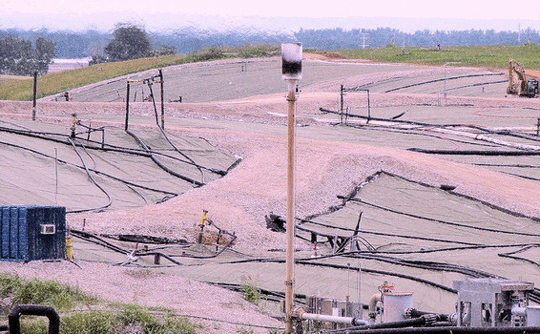
“They’re not statistics and they’re not numbers,” Mary Oscko, who has stage 4 lung cancer, told CBS News. “They were my neighbors.”
Currently, the Army Corps of Engineers lists 24 other sites in 10 states with low-level radioactive contamination that they are in the process of cleaning up. There are three other contaminated sites still under consideration for clean up. A former chemical processing plant in Queens, New York is one of them. Radiation barriers were installed as a “band-aid” solution in 2013.
Michael Feldmann with the Army Corps of Engineers says the cleanup moves slowly for a reason.
“In general, there are things that we need to move at the pace we are performing in order to protect the health and environment of the area,” Feldmann said.
Dr. Fasial Kahn is the director of public health in St. Louis County.
“Some disasters unfold slowly over time, and their true nature and extent and severity only becomes clear in terms of human cost once you start counting people around you,” Kahn said.
In North St. Louis County, neighbors have a list to keep track of who’s gotten sick — including 21 people who lived on the same street.
The residents told CBS News they believe they had long-term exposure to the low level contamination, a type of prolonged exposure that has never been studied.
Many radiation related cancers to come, as Japan confirms Fukushima worker’s radiation caused cancer
“Thyroid cancer is commonly developed as a result of acute exposure to radioactive iodine 131, a product of nuclear fission…”
The British journalist also highlighted that the scientists have failed to mention that other radioactive elements emitted in the accident pose even more of a threat to the population’s health (in particular, 17.5 percent Cesium-137 and 38.5 percent Cesium 134).
Fukushima: Hundreds of Radiation-Related Cancer Cases on the Way in Japan, http://sputniknews.com/asia/20151023/1029014961/fukushima-radiation-cancer-threat-japan.html, 23 Oct 15 The Japanese government has recently admitted that a worker at the Fukushima nuclear plant contracted cancer as a consequence of radiation exposure of 2011, British journalist Oliver Tickell points out, warning that there are many more cases on the way.
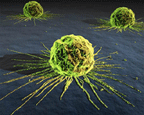 The Japanese government has officially confirmed that a worker at the Fukushima nuclear plant has contracted radiation-related cancer: the man has been diagnosed with acute myelogenous leukaemia.
“But that single ‘official’ cancer case is just the beginning. New scientific research indicates that hundreds more cancers have been and will be contracted in the local population. A 30-fold excess of thyroid cancer has been detected among over 400,000 young people below the age of 18 from the Fukushima area,” British journalist, author and health and environment issue campaigner Oliver Tickell wrote in his article for The Ecologist, citing a report entitled “Thyroid Cancer Detection by Ultrasound Among Residents Ages 18 Years and Younger in Fukushima, Japan: 2011 to 2014.”
The highest incidence rate ratio, using a latency period of 4 years, was observed in the central middle district of the prefecture compared with the Japanese annual incidence (incidence rate ratio = 50; 95% confidence interval [CI] = 25, 90),” the report read.
Tickell noted that during a first screening for thyroid cancer held four years after the Fukushima catastrophe among 298,577 youths, the disease was registered 50 times more frequently among those who lived in the most heavily irradiated zones than among other Japanese youth.
During a second screening carried out in April 2014 among 106,068 young people who lived in less contaminated areas of the Fukushima prefecture, the disease was 12 times more common than for the main population.
“Thyroid cancer is commonly developed as a result of acute exposure to radioactive iodine 131, a product of nuclear fission. Because iodine concentrates in the thyroid gland, thyroid damage including cancer is a characteristic marker of exposure to nuclear fallout,” Tickell elaborated, adding that iodine-131 constituted about 9.1 percent of the radioactive material released during the Fukushima disaster.
Quoting the report, Tickell called attention to the fact that “the incidence of thyroid cancer is high by comparison with the Chernobyl nuclear disaster in 1986,” beating the drums over the possibility of a growing cancer threat in the region in the next four-five years.
That is not all, the British journalist added, emphasizing that the real exposure doses for residents could have been higher than had been reported by the authorities and the World Health Organization.
“We could infer a possibility that exposure doses for residents were higher than the official report or the dose estimation by the World Health Organization, because the number of thyroid cancer cases grew faster than predicted in the World Health Organization’s health assessment report,” the authors of the report underscored, as quoted by Tickell.
The British journalist also highlighted that the scientists have failed to mention that other radioactive elements emitted in the accident pose even more of a threat to the population’s health (in particular, 17.5 percent Cesium-137 and 38.5 percent Cesium 134).
“These longer-lived beta-emitters (30 years and two years respectively) present a major long-term hazard as the element is closely related to potassium and readily absorbed into biomass and food crops,” Tickell stressed.
The author bemoaned the fact the Japanese people also face a danger posed by “long lived alpha emitters like plutonium 239 (which has a half-life of 24,100 years) which is hard to detect.”
“Even tiny nano-scale specks of inhaled plutonium entering the lungs and lymphatic system can cause cancer decades after the event by continuously ‘burning’ surrounding tissues and cells,” Oliver Tickell warned.
Fukushima worker’s leukaemia confirmed as caused by radiation
Fukushima worker diagnosed with leukaemia after shocking radiation leak at nuclear plant, news.com.au OCTOBER 20, 2015 A FORMER Fukushima nuclear plant worker has been diagnosed with radiation-linked cancer, making him the first such confirmation more than four years after the worst atomic accident in a generation.
An official with the health ministry said the ex-employee, who was in his thirties while working at the plant following the 2011 crisis, has developed leukaemia. He is now 41 years old, local media reported.
“The case has met the criteria” to link his illness to the accident, the official told a Tokyo press briefing on condition of anonymity, adding that other possible causes have been ruled out.
“This person went to see a doctor because was not feeling well. That was when he was diagnosed with leukaemia.” The ministry revealed few details about the man, but said he had worked at a destroyed building that housed one of the crippled reactors.
The man, who wore protective equipment during more than a year spent at Fukushima, will be awarded compensation to pay for his medical costs and lost income, the official said, without elaborating on the amount.
Three similar cases of cancer in plant workers are still awaiting confirmation of a link to the accident…….
The announcement Tuesday will likely further inflame widespread public opposition to nuclear power……..
The case was likely to deal another blow to Prime Minister Shinzo Abe’s unpopular attempt to switch on Japan’s stable of atomic reactors………http://www.news.com.au/world/asia/fukushima-worker-diagnosed-with-leukaemia-after-shocking-radiation-leak-at-nuclear-plant/story-fnh81fz8-1227576166328
Media blackout on US sailors made ill by Fukushima radiation
 Total blackout of Fukushima truth by U.S. media; sailors suffer and die while denial continues October 21, 2015, by: J. D. Heyes (NaturalNews) Nearly four years after a major tsunami created the massive tidal wave that destroyed much of Japan’s Fukushima nuclear power complex in the northern part of the country, spewing radioactive waste into the air and surrounding Pacific Ocean, the truth about the after-effects of that disaster continue to reside in the shadows.
For example, one of the most under-reported stories of all pertaining to the disaster — and one that should be of particular interest to Americans — is the fate of a number of crewmembers aboard the USS Ronald Reagan, the U.S. Navy carrier sent to assist Japanese military and civilian authorities in the immediate aftermath of the quake…….
It was Morales’ endocrinologist who asked her the question that made her start to wonder about Fukushima and about the “official line” regarding radiation exposure. He asked if she had been aboard the Reagan during Tomodachi, and she said she had.
The endocrinologist then said he had also removed six thyroid glands from other sailors aboard the Reagan, and it was then that Morales put together her own poor health and her participation in the operation.
Retired Navy Lt. Steve Simmons knows. He, too, has been suffering from illness since serving aboard the Reagan during Tomodachi.
Dozens more sickened
“There are individuals out there who are in very similar situations to myself… progressive muscle weakness that starts in their legs and starts to ascend. There are individuals out there who have developed different forms of cancer, leukemia, children of service members born with birth defects because of their service over there,” he said in a recent interview.
You can see the full interview here.
Others have also come forward. In December 2013, Fox News reported that, at the time, a total of 49 Reagan sailors had developed cancers, thyroid issues and other problems related to radiation exposure:
In a lawsuit filed against Tokyo Electric Power Company (TEPCO), the plaintiffs claim the power company delayed telling the U.S. Navy the tsunami had caused a nuclear meltdown, sending huge amounts of contaminated water into the sea and, ultimately, into the ship’s water system.
That full report is here.
The Daily Kos, citing a report from Al Jazeera, put the number of sailors sickened at 51.
Sources:…….
http://www.naturalnews.com/051651_Fukushima_Navy_sailors_media_blackout.html#ixzz3pcQ4Fsio
The public recognition of a radiation-cancer threat may lead to high compensation payments
Japan Acknowledges First Possible Radiation Casualty at Fukushima Nuclear Plant The public recognition of a radiation-cancer threat may lead to high compensation payments TOKYO, Oct 20 (Reuters) – Japan on Tuesday acknowledged the first possible casualty from radiation at the wrecked Fukushima nuclear power plant, a worker who was diagnosed with cancer after the crisis broke out in 2011.
The health ministry’s recognition of radiation as a possible cause may set back efforts to recover from the disaster, as the government and the nuclear industry have been at pains to say that the health effects from radiation have been minimal.
It may also add to compensation payments that had reached more than 7 trillion yen ($59 billion) by July this year…….
The male worker in his 30s, who was employed by a construction contractor, worked at Tokyo Electric Power Co’s Fukushima Daiichi plant and other nuclear facilities, a health ministry official said.
Of total radiation exposure of 19.8 millisieverts (mSv), the worker received a dose of 15.7 (mSv) between October 2012 and December 2013 working at Fukushima, said the official.
While the exposure amount was lower than the annual 50 mSv limit for nuclear industry workers, the government had decided it cannot be ruled out that the worker’s leukaemia was a result of radiation, the official said.
Tokyo Electric is also facing a string of legal cases seeking compensation over the disaster.
Inside the plant, Tepco has struggled to bring the situation under control. It is estimated removing the melted fuel from the wrecked reactors and cleaning up the site will cost tens of billions of dollars and take decades to complete. ($1 = 119.4200 yen) (Reporting by Kiyoshi Takenaka; Writing by Aaron Sheldrick; Editing by Nick Macfie) http://www.scientificamerican.com/article/japan-acknowledges-first-possible-radiation-casualty-at-fukushima-nuclear-plant/
Fukushima insect study shows there is no safe low level of ionising radiation
 The researchers found that caterpillars that ate radioactive leaves pupated into mutated butterflies that did not live as long, compared with caterpillars that ate non-radioactive leaves. These mutations and increased mortality were seen even in butterflies that consumed only very small doses of radioactive cesium.
Deaths and mutations spike around Fukushima; no safety threshold for radioactive cesium exposure http://theunhivedmind.com/wordpress3/deaths-and-mutations-spike-around-fukushima-no-safety-threshold-for-radioactive-cesium-exposure/October 16, 2015 theunhivedmind Deaths and mutations spike around Fukushima; October 16, 2015 by: David Gutierrez, staff writer
http://www.naturalnews.com/051581_fukushima_radiation_nuclear_power.html
Plants in the area around Fukushima, Japan are widely contaminated with radioactive cesium, which is 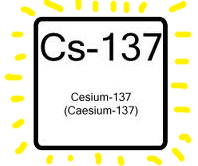
producing mutation and death in local butterflies, according to a study conducted by researchers from the University of the Ryukyus, Okinawa and published in the journal Scientific Reports.
The butterflies were found to experience severe negative effects at all detectable radiation levels, even very low ones.
“We conclude that the risk of ingesting a polluted diet is realistic, at least for this butterfly, and likely for certain other organisms living in the polluted area,” the researchers wrote.
Insects hard hit
The researchers note that although the 2011 meltdown of the Fukushima Daiichi Nuclear Power Plant released “a massive amount of radioactive materials … into the environment,” few studies have looked at the biological effects of this disaster. Researchers have, however, measured elevated radiation levels in the polluted area, and have chronicled the accumulation of radioactive material in both wild and domestic plant and animal life in the region.
Studies have also suggested that insects may be particularly hard-hit by the increased radiation. One study found an increase in morphological abnormalities (physical deformities) in gall-forming aphids. Another found that insect abundance has decreased in the affected region, particularly butterfly abundance. Continue reading
Film ‘The Martian” gets it really wrong about ionising radiation
Here Are The Biggest Health Risks To Humans In Space, Gizmodo MADDIE STONE12 OCTOBER 2015 “…….Radiation And now we get to my One Big Problem with the science of The Martian. OK, we get it: Mark Watney has an extraordinarily sunny disposition and bowels of steel. (Seriously, who can eat protein squares for two years straight and still, you know, fertilize the potatoes?) But nothing can save Watney from the inconvenient truth that Mars has no ozone layer. That means the surface is awash in ultraviolet radiation — the same stuff we use to sterilize hospital clean rooms. And UV loves to rip, shatter, and mutate DNA. As far as we can tell, all life forms are susceptible to its burn.
Giving Mark Watney cancer on Mars probably wouldn’t have made too much sense from a narrative perspective. But radiation is something we worry about on the ISS and it’s certainly something we’ll have to consider if and when we send humans to Mars.
There are a few types of harmful radiation zipping about in outer space. There’s UV, which is several hundred times stronger in orbit than it is beneath Earth’s atmosphere. During Kelly’s year in space, he’s soaking up roughly the same amount of extra radiation (0.16 sieverts) that a regular cigarette smoker does over the course of a year. (For comparison, 1 sievert of radiation is associated with a 5.5 per cent increase in the risk of fatal cancer, and the background daily radiation dose on Earth is on the order of 10 micro-sieverts, or 0.00001 sieverts.)
That’s not great, but it’s also not that bad. The radiation danger gets a lot worse when you leave the protection of Earth’s magnetosphere.
During the trip from Earth to Mars, astronauts will be exposed to other flavours of radiation: namely, high energy subatomic particles from the sun, the Milky Way galaxy and beyond. It’s these solar energetic particles and galactic cosmic rays that we’re most worried about, because they ravage biological tissue very quickly. As an instrument aboard the Curiosity Rover recently revealed, even the shortest round-trip from Earth to Mars could dose our astronauts with 0.66 sieverts of radiation — the equivalent of a whole-body CT scan every five or six days.
Certain materials, including aluminium and polyethylene plastics, can block or slow down radiation, but Shelhamer warns that shielding ourselves could backfire. Slowing down a high-energy cosmic ray could afford it more opportunity to collide with other particles and create dangerous secondary particles. “A particle of galactic radiation might be better off going fast…. if it’s moving slowly, it has the opportunity to create more damage,” he said. “It’s a very tricky situation, and we don’t have a good handle on the extent of the risk and what can we do about it.”
If one thing is clear, it’s that our ability to safely put humans on Mars — no less keep them alive on the radiation-riddled surface — depends very much on whether we can solve this problem.
The Biggest Danger to Humans in Space……“As the Chief Scientist whose job is to oversee this whole thing, the thing that concerns me most is the one danger that we haven’t yet thought of,” Shelhamer said. “What’s the biggest risk? It’s the radiation that causes a mutation in a pathogen when your immune system is compromised, and the medication on board doesn’t work because your metabolism has shifted. It’s the interaction of factors nobody considered.”…..
References
Effects of Prolonged Spaceflight on Human Skeletal Muscle. NASA, 2015.
Gifford, S. Calculated Risk: How Radiation Rules Manned Mars Exploration. Astrobiology Magazine, 2014. http://www.gizmodo.com.au/2015/10/here-are-the-biggest-health-risks-to-humans-in-space/
Don’t be fooled: science shows that low dose ionising radiation harms living organisms
Radiation Impact Studies: Chernobyl and Fukushima, Dissident Voice, by Robert Hunziker / September 23rd, 2015 Some nuclear advocates suggest that wildlife thrives in the highly-radioactive Chernobyl Exclusion Zone, animals like it, and not only that, a little radiation for anybody and everybody is harmless and maybe good, not bad. This
may seem like a senseless argument to tackle were it not for the persistence of positive-plus commentary by nuke lovers. The public domain deserves better, more studied, more crucial answers.
Fortunately, as well as unfortunately, the world has two major real life archetypes of radiation’s impact on the ecosystem: Chernobyl and Fukushima. Chernobyl is a sealed-off 30klm restricted zone for the past 30 years because of high radiation levels, whereas PM Abe’s government in Japan has already started returning people to formerly restricted zones surrounding the ongoing Fukushima nuclear melt-down.
The short answer to the supposition that a “little dab of radiation is A-Okay” may be suggested in the title of a Washington Blog d/d March 12, 2014 in an interview of Dr. Timothy Mousseau, the world-renowned expert on radiation effects on living organisms. The hard answer is included further on in this article.
Dr. Mousseau is former Program Director at the National Science Foundation in Population Biology, Panelist for the National Academy of Sciences’ Panels on Analysis of Cancer Risks in Populations Near Nuclear Facilities and GAO Panel on Health and Environmental Effects from Tritium Leaks at Nuclear Power Plants, and a biology professor – and former Dean of the Graduate School, and Chair of the Graduate Program in Ecology – at the University of South Carolina.
The title of the Washington Blog interview is:
“Chernobyl and Fukushima Studies Show that Radiation Reduces Animal and Plant Numbers, Fertility, Brain Size and Diversity… and Increases Deformities and Abnormalities”
Dr. Mousseau made many trips to Chernobyl and Fukushima, making 896 inventories at Chernobyl and 1,100 biotic inventories in Fukushima. His mission was to test the effects of radiation on plants and animals. The title of his interview (above) handily serves to answer the question of whether radiation is positive for animals and plants. Without itemizing reams and reams of study data, the short answer is: Absolutely not! It is not positive for animals and plants, period.
Moreover, low doses of radiation, aka “radiation hormesis”, is not good for humans, as advocated by certain energy-related outlets. Data supporting their theory is extremely shaky and more to the point, flaky.
Furthermore, according to the Cambridge Philosophical Society’s journalBiological Reviews, including reported results by wide-ranging analyses of 46 peer-reviewed studies published over 40 years, low-level natural background radiation was found to have small, but highly statistically significant, negative effects on DNA and several measures of good health.
Dr. Mousseau, with co-author Anders Møller of the University of Paris-Sud, examined more that 5,000 papers involving background radiation in order to narrow their findings to 46 peer-reviewed studies. These studies examined plants and animals with a large preponderance of human subjects.
The scientists reported significant negative effects in a range of categories, including immunology, physiology, mutation and disease occurrence. The frequency of negative effects was beyond that of random chance.
There is no threshold below which there are no effects of radiation.
With the levels of contamination that we have seen as a result of nuclear power plants, especially in the past, and even as a result of Chernobyl and Fukushima and related accidents, there’s an attempt in the industry to downplay the doses that the populations are getting, because maybe it’s only one or two times beyond what is thought to be the natural background level…. But they’re assuming the natural background levels are fine. And the truth is, if we see effects at these low levels, then we have to be thinking differently about how we develop regulations for exposures, and especially intentional exposures to populations, like the emissions from nuclear power plants…… http://dissidentvoice.org/2015/09/radiation-impact-studies-chernobyl-and-fukushima/
1 This Month
29 Jan. Thursday 7-8 p.m. Webinar – World’s Largest Nuclear Station in Port Hope, ON?
To see nuclear-related stories in greater depth and intensity – go to https://nuclearinformation.wordpress.com/
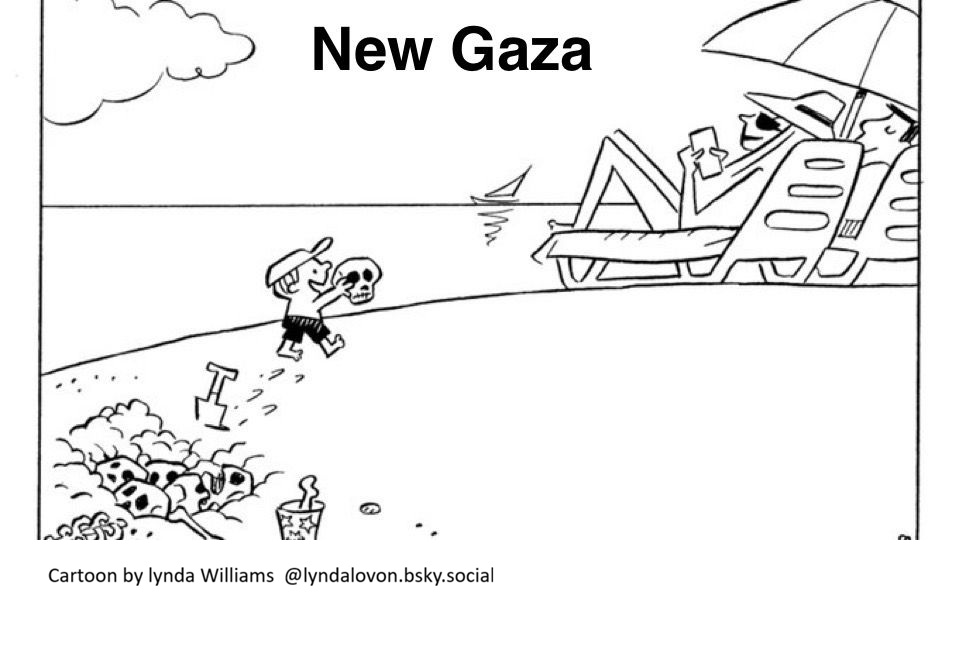


31st January – Challenging the War Machine – a DECLASSIFIED UK SUMMIT


Website of the Week
Now until to February 10, 2026 Radioactive waste storage in France: the debate is finally open! How to participate?
-
Archives
- January 2026 (288)
- December 2025 (358)
- November 2025 (359)
- October 2025 (376)
- September 2025 (258)
- August 2025 (319)
- July 2025 (230)
- June 2025 (348)
- May 2025 (261)
- April 2025 (305)
- March 2025 (319)
- February 2025 (234)
-
Categories
- 1
- 1 NUCLEAR ISSUES
- business and costs
- climate change
- culture and arts
- ENERGY
- environment
- health
- history
- indigenous issues
- Legal
- marketing of nuclear
- media
- opposition to nuclear
- PERSONAL STORIES
- politics
- politics international
- Religion and ethics
- safety
- secrets,lies and civil liberties
- spinbuster
- technology
- Uranium
- wastes
- weapons and war
- Women
- 2 WORLD
- ACTION
- AFRICA
- Atrocities
- AUSTRALIA
- Christina's notes
- Christina's themes
- culture and arts
- Events
- Fuk 2022
- Fuk 2023
- Fukushima 2017
- Fukushima 2018
- fukushima 2019
- Fukushima 2020
- Fukushima 2021
- general
- global warming
- Humour (God we need it)
- Nuclear
- RARE EARTHS
- Reference
- resources – print
- Resources -audiovicual
- Weekly Newsletter
- World
- World Nuclear
- YouTube
-
RSS
Entries RSS
Comments RSS
 nuclear-news