GHOST TOWN , What was the Chernobyl nuclear disaster, did radiation cause animal mutations and is it safe to go there now? Thirty-two years ago, one of four reactors at Chernobyl exploded in the worst nuclear disaster in human history leaving behind a barren town frozen in time, The Sun UK, By Holly Christodoulou24th April 2018
An alarm bellowed out at the nuclear plant on April 26, 1986, as workers looked on in horror at the control panels signalling a major meltdown in the number four reactor.
The safety switches had been switched off in the early hours to test the turbine but the reactor overheated and generated a blast the equivalent of 500 nuclear bombs.
The reactor’s roof was blown off and a plume of radioactive material was blasted into the atmosphere.
As air was sucked into the shattered reactor, it ignited flammable carbon monoxide gas causing a fire which burned for nine days.
The catastrophe released at least 100 times more radiation than the atom bombs dropped on Nagasaki and Hiroshima.
Soviet authorities waited 24 hours before evacuating the nearby town of Pripyat – giving the 50,000 residents just three hours to leave their homes.
After the accident traces of radioactive deposits were found in Belarus where poisonous rain damaged plants and caused animal mutations.
But the devastating impact was also felt in Scandinavia, Switzerland, Greece, Italy, France and the UK.
An 18-mile radius known as the “Exclusion Zone” was set up around the reactor following the disaster.
How many people died in Chernobyl?
At least 31 people died in the accident – including two who were killed at the scene and more who passed away a few months later from Acute Radiation Syndrome.
The actual death toll is hard to predict as mortality rates have been hidden by propaganda and reports were lost when the Soviet Union broke up.
In 2005, the World Health Organisation revealed a total of 4,000 people could eventually die of radiation exposure.
About 4,000 cases of thyroid cancer have been seen since the disaster – mainly in people who were children or teenagers at the time.
Did the Chernobyl radiation cause animal mutations?
Farmers noticed an increase in genetic abnormalities in farm animals immediately after the disaster.
This spiked again in 1990 when around 400 deformed animals were born – sparking fears the sarcophagus, which covers the reactor.
Some animals were born with extra limbs, abnormal colouring and a smaller size.
Animals that remained in the exclusion zone became radioactive – including as many as 400 wolves, which is the highest density wolf population on the entire planet.
The Eurasian lynx – once believed to have disappeared from Europe – thrived in Chernobyl as there were no humans to run them out.
Birds were also affected by radiation, with barn swallows having deformed beaks, albinism and even smaller brains.
Two main types of radiation in space are extremely harmful to humans: protons spewed out by the sun and cosmic rays. These high-energy particles and the secondary radiation they create penetrate deep into cells, promoting chronic and sometimes deadly diseases such as cancer.
Cancer is a major risk of radiation exposure, but there are more immediate and surprising symptoms. Deep-space radiation might promote cataracts and impair eyesight
Animal-based experiments also suggest radiation could damage the nervous system, including the brain, which might impair astronauts’ focus and memory.
But the cosmos teems with invisible, high-energy radiation – particles travelling near light-speed that can pummel human travellers and the surfaces of worlds like tiny bullets.
NASA recently signed on to test a new polymer-based radiation-blocking vest for astronauts, called AstroRad, on its next mission around the moon.
Musk, meanwhile, has said his new Big Falcon Rocket will use water to block radiation, though only during emergencies.
“Ambient radiation damage is not significant for our transit times,” Musk said during an Oct. 2017 chat on Reddit. “Just need a solar storm shelter, which is a small part of the ship.”
But just how bad is the problem of radiation in space?
The graphic below [on original] – created using data provided by NASA, the EPA, FDA, NRC, scientific journals, and other sources – compares various exposure levels in scenarios both familiar and far-flung.
Hover over a category box to see how it compares.
Musk has “aspirational” hopes to launch a round-trip mission to the red planet with humans in 2024, but the trip could total a year, and astronauts may spend about 500 days on Mars’ surface.
The whole journey would expose astronauts to about 1,000 millisieverts – depending on how many solar storms belch high-energy particles toward Mars, and whether the first entity to reach the planet actually lands on it.
This means the first Martian explorers could get roughly eight times the amount of radiation per year of a radiation worker’s annual exposure limit. In total, the space travellers would get about one-third of the way toward hitting a NASA astronaut’s maximum lifetime exposure limit (2,500-3,250 mSv).
Where the radiation comes from – and why cancer isn’t the only danger
Two main types of radiation in space are extremely harmful to humans: protons spewed out by the sun and cosmic rays. These high-energy particles and the secondary radiation they create penetrate deep into cells, promoting chronic and sometimes deadly diseases such as cancer.
Earth’s magnetic field and atmosphere protect us by deflecting and absorbing most of this energy.
“The background radiation rates on the ground are 100 times to 1,000 times smaller than they would be above the atmosphere in free space,” Edward Semones, a radiation health officer at NASA’s Johnson Space Center, previously told Business Insider.
Cancer is a major risk of radiation exposure, but there are more immediate and surprising symptoms. Deep-space radiation might promote cataracts and impair eyesight. Even high-flyingcommercial-airline workers face that risk because of the thinner atmosphere.
Animal-based experiments also suggest radiation could damage the nervous system, including the brain, which might impair astronauts’ focus and memory.
“You’re somehow losing cognitive ability,” Semones said, adding that, over the years, this “may impact conducting the mission.”
Ultimately, colonists may try to terraform Mars – a deliberate and unprecedented act of climate change.
Frozen carbon dioxide at the Martian poles could be turned into greenhouse gases in order to create a radiation-absorbing atmosphere that would insulate the surface. Plants could then convert the thin air into oxygen and, over hundreds of years, temperatures may warm enough to melt hidden water and make it again flow on Mars’ surface. One day, that could even permit spacesuit-free excursions.
Jim Green, the former head of NASA’s planetary science division, has proposed building anartificial magnetic shield for Mars to protect a hypothetical nascent atmosphere from the sun’s proton radiation, which might otherwise blow the air into space.
“This may sound ‘fanciful’ but new research is starting to emerge revealing that a miniature magnetosphere can be used to protect humans and spacecraft,” Green and other researchers wrote in a brief study of the concept in 2017. “If this can be achieved in a lifetime, the colonization of Mars would not be far away.”
Astrobiology Magazine, By Amanda Doyle – Apr 19, 2018
Low-mass stars are currently the most promising targets when searching for potentially habitable planets, but new research has revealed that some of these stars produce significant amounts of ultraviolet (UV) radiation throughout their lifetimes. Such radiation could hinder the development of life on any orbiting planets.
M-dwarfs are stars that are cooler and less massive than stars like our Sun, and are the most common type of star in the Galaxy, meaning that it is vital that we better understand them and the influence they have on their planets.
Detecting terrestrial planets in the habitable zone – the region where liquid water can exist on a planet’s surface – when they pass in front of, or transit, Sun-like stars is difficult. This is partly because we only see a small dip in the light as the planet crosses the star, and also partly because their orbits are long enough that we have to wait several years to observe multiple transits. However, because M-dwarfs are smaller and cooler, the planets in their habitable zone are much closer to their star, resulting in larger and more frequent drops in light, making them easier to detect.
This makes M-dwarfs ideal candidates when searching for potentially habitable planets, which has led to habitable zone terrestrial planets being discovered around M-dwarfs including Proxima Centauri, TRAPPIST-1and Ross 128.
Ultraviolet levels over time
A paperby astrophysicists Adam Schneider and Evgenya Shkolnik from Arizona State University, recently published in The Astronomical Journal,has revealed that the hottest and most massive M-dwarfs, referred to as ‘early type’, emit different amounts of UV radiation over their lifetime compared to the less massive and cooler ‘mid-’ and ‘late-type’ M-dwarfs. The paper used observations from NASA’s Galaxy Evolution Explorer (GALEX) spacecraft to study several populations of M-dwarfs in ultraviolet light.
M-dwarfs are known to emit higher levels of potentially harmful UV radiation than stars like our Sun. UV radiation can erode planetary atmospheres and have a detrimental effect on biology. It can also affect the abundances of molecules in planetary atmospheres, including carbon dioxide, oxygen and ozone……….
News Medical Life Sciences, By Supriya Subramanian, PhD, 10 Apr 18
Solar ultraviolet radiation (UV) exposure triggers DNA damage, a preliminary step in the process of carcinogenesis.
The stability of DNA is extremely important for the proper functioning of all cellular processes. Exposure to UV radiation alters the structure of DNA, affecting the physiological processes of all living systems ranging from bacteria to humans.
Ultraviolet Radiation
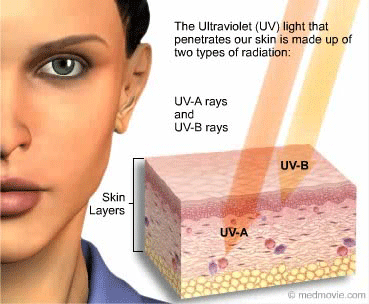
Natural sunlight stimulates the production of vitamin D, an important nutrient for the formation of healthy bones. However, sunlight is also a major source of UV radiation. Individuals who get excessive UV exposure are at a great risk of developing skin cancers. There are three types of UV rays: UVA, UVB and UVC.
UVC rays (100-280 nm) are the most energetic and damaging of the three rays. Fortunately, UVC is absorbed by the ozone layer before reaching the earth’s surface.
UVA rays (315-400 nm) possess the lowest energy and is able to penetrate deep into the skin. Prolonged exposure has been linked to ageing and wrinkling of the skin. UVA is also the main cause of melanomas.
UVB rays (280-315 nm) possess higher energy than UVA rays and affect the outer layer of the skin leading to sunburns and tans. Basal cell carcinoma and squamous cell carcinoma are caused by UVB radiation.
DNA Damage by UV Radiation
DNA is composed of two complementary strands that are wound into a double helix. The hereditary message is chemically coded and made up of the four nucleotides adenine (A), thymine (T), guanine (G) and cytosine (C). UVB light interferes directly with the bonding between the nucleotides in the DNA. ……….
42 Hanford workers contaminated with radiation, Seattle Times, March 24, 2018 The final results of worker tests after a December spread of contamination found that 11 Hanford workers had inhaled or ingested radioactive particles from demolition of the nuclear reservation’s Plutonium Finishing Plant. By Annette Cary Tri-City Herald ioactive contamination from demolition of the nuclear reservation’s Plutonium Finishing Plant.
The final results of worker tests after a December spread of contamination at the plant found 11 Hanford workers had inhaled or ingested radioactive particles, according to information released Thursday
That’s on top of the 31 positive test results after a similar spread of contamination in June at the plant in the center of the nuclear reservation.
Demolition at the plant has been halted since December. It will not restart until the Department of Energy approves a new demolition plan, and a plan is approved and implemented to prevent the airborne spread of small radioactive particles.
The Washington Department of Ecology, a regulator on the project, also has said it will not allow demolition to continue if it is not convinced it can be done safely.
Open-air demolition on the plant began in late 2016 using heavy equipment to tear down its walls. Extensive work already had been done to remove as much contaminated equipment as possible from the plant.
According to a draft report issued earlier in the month by CH2M/Jacobs Engineering with input from the U.S. Department of Energy, an air-monitoring system last fall failed to pick up the spread of radioactive contamination, giving management false assurance that controls were effective.
State monitoring has found that plutonium and americium particles traveled as far as 10 miles from the demolition site, near Richland. Vehicles, office buildings and workers have been tested for traces of radioactive contamination.
A plan for safer demolition has yet to be released.
The project has been troubled with radioactive contamination found outside worker offices at the plant and on worker cars and government vehicles.
The combination of a thinning ozone layer and farming practices in India may add up to more days of extreme ultraviolet radiation across Australia.
A Sun-Herald analysis of daily UV index readings since 1997 in Sydney, Melbourne and Brisbane found the number of days when ultraviolet radiation reached or passed extreme levels had risen slightly.
The amount of UV that hits Australia is influenced by fluctuations in cloud cover, ozone levels and the solar cycle.
In Sydney, four of the 10 highest UV index days since 1996 have been recorded since December 2016. While the ozone layer is recovering over the poles, it is thinning in mid-latitudes from Russia to the Southern Ocean below Australia, a study published last month in the journal Atmospheric Chemistry and Physics found.
“Decreases in ozone are less than we saw at the poles before the Montreal Protocol was enacted [in 1987], but UV radiation is more intense in these regions and more people live there,” said report co-author Joanna Haigh, from Imperial College London.
The weather bureau studied UV radiation in Australia between 1959 and 2009 and found an annual increase of 2 to 6 per cent since the 1990s, above a 1970-80 baseline. The bureau found these changes were related to ozone depletion.
Associate Professor Clare Murphy, from the school of chemistry at Wollongong University, said ozone trends were not fully understood.
“The largest factor involved in mid-latitude ozone depletion is the nitrogen cycle, which operates by nitrous oxide turning into reactive nitrogen in the stratosphere,” Dr Murphy said.
Nitrogen fertiliser is converted into nitrous oxide by soil microbes, creating a stable greenhouse gas that can reach the stratosphere, where the ozone layer protects the earth from most of the sun’s UV radiation,” she said. “However, once in the stratosphere, nitrous oxide is broken down by high energy radiation from the sun to become reactive nitrogen, which can deplete ozone.”
Dr Murphy said that last century, concerns about ozone depletion centred on “chlorine chemistry” (CFCs) because of the massive hole over the poles. “Now it’s nitrous oxide, which almost stopped the Concord from flying because they were worried about reactive nitrogen in the stratosphere.”
Nitrous oxide damage to ozone is ubiquitous, whereas damage from CFCs creates a hole during extreme weather years over the Antarctic, Dr Murphy said.
Nitrous oxide was identified as the most damaging substance to the ozone layer in the 21st century by a 2009 study published in Science. That study also suggested one of the best ways to address the problem was to give insurance to Indian farmers.
“In India, particularly, they’re putting in 10 times more nitrogen fertiliser on their crops than they need to because if a crop fails they may starve,” Dr Murphy said. “Insurance could pick up the loss.”
Robin Schofield, director of Melbourne University’s environmental science hub, said UV in Australia should be trending downwards because factors such as surface ozone, which is contained in smog, is on the rise and there is evidence of a recovery of stratospheric ozone.
The UV Index and skin cancer
The UV index relates to the intensity of sunburn-producing UV radiation. Sun protection is recommended when the UV Index is above 3 in clear sky conditions. The higher the number, the more severe.
11+ = Extreme. Avoid sun exposure between 10am and 4pm due to extreme risk of harm.
8-10 = Very High. Unprotected skin and eyes may be damaged and can burn quickly.
6-7 = High. Protection against skin and eye damage is needed. Reduce time in the sun between 10am and 4pm.
3-5 = Moderate. Stay in the shade near midday when the sun is strongest. Moderate risk of harm.
1-2 = Low. There is a low danger from the sun’s UV rays for the average person.
Note: UV intensity can nearly double with reflection from snow or reflective surfaces such as water, sand and concrete.
Heather Walker, Cancer Council Australia’s skin cancer committee chair, said UV is the most common cause of skin cancer but the council has not seen any evidence of a trend of more extreme or high UV days.
“Queensland is the skin cancer capital of Australia and they get more UV all year round,” Ms Walker said. “Skin cancer rates continue to rise but look like they may be stabilising over the next few years in all age groups except for the under 40s.”
The continued high rate of skin cancer in Australia is partly due to the ageing population, because cancer is a disease of ageing, Ms Walker said.
Brisbane average monthly maximum UV index.Photo: Australian Radiation Protection and Nuclear Safety Agency
But skin cancer rates are falling for people under 40, she said, because they have had the benefit of Sunsmart messages [slip, slop, slap, seek shade and slide on sunglasses], which started in the 1980s.
“This is a message we need to keep reinforcing, because as it was put to me: ‘you don’t tell your children to brush their teeth once and expect them to do it for the rest of their lives’.”
Because UV and heat are not related, people often get sunburnt when there is no sun.
“The heat will rise and continue to rise in the afternoon, whereas UV is more of a bell curve shape that peaks in the middle of the day. And that’s why the advice is to avoid being outside in the middle of the day.
“Cool and cloudy days when the UV is high, that’s when people are most likely to be caught out because they don’t think they need sun protection.”
Italian study links cellphone radiation to heart and-brain tumors https://www.ewg.org/release/italian-study-links-cellphone-radiation-heart-and-brain-tumors#.WrVYStRubGgAlex Formuzis (202) 667-6982 alex@ewg.org, MARCH 22, 2018 WASHINGTON– Laboratory animals exposed to cellphone radiation developed heart and brain tumors similar to the types seen in some studies of human cellphone users, according to an Italian study published today. EWG said the findings reinforce the need for people, especially children, to exercise caution when using cellphones and other radiation-emitting devices.
The study by the Ramazzini Institute, published in the journal Environmental Research, supports the findings of the federal National Toxicology Program. Last month, the NTP reported that male rats exposed to radio-frequency radiation at levels including those emitted by cellphones had a greater chance of developing malignant brain cancer, and tumors in the heart and other organs.
The Ramazzini Institute’s research found that male rats exposed to the radio-frequency radiation emitted by cellphones using GSM networks had a greater chance of developing heart tumors and hyperplasias affecting Schwann cells, which support the peripheral nervous system. Schwann cell tumors were also observed in human epidemiological studies of tumor incidence in cellphone users, and in the NTP studies of lab animals.
“The Italian study reinforces the need for a precautionary approach when it comes to radiation from phones and other devices, especially for young kids,” said Olga Naidenko, Ph.D., senior science advisor at EWG. “Children’s bodies develop through the teenage years and may be more affected by cellphone use. As new telecom networks are built around the country, in-depth assessment of children’s health risks from cellphone radiation is essential.”
In 2011, the World Health Organization’s International Agency for Research on Cancer declared the kind of radiation emitted by cellphones a “possible carcinogen” based on human epidemiological studies that found increased gliomas and acoustic neuromas in long-term cellphone users. The data on health effects of cellphone radiation in laboratory animals collected by the NTP and the Ramazzini Institute studies support the earlier evidence from human studies that cellphone radiation increases the risk of cancer.
EWG has been at the forefront of public interest organizations raising concerns about connections between cellphone use and cancer. EWG’s 2009 Science Review on Cancer Risks and Children’s Health summarized comprehensive studies showing a variety of health harms linked to long-term cellphone use. This included increased risk of brain tumors; lower sperm counts, motility and vitality among men; neurological effects; and changes in brain metabolism.
While the public debate on cellphone radiation risks has focused on cancer, which progresses slowly in response to lifelong exposures, a growing body of research suggests that even shorter exposures could cause harm. In a study published last year, Kaiser Permanente researchers reported that pregnant women exposed to radio-frequency radiation from sources such as wireless devices and cell towers had nearly a threefold greater frequency of miscarriage.
In December 2017, the state of California issued official guidelines advising cellphone users to keep phones away from their bodies. The state Department of Public Health also recommended that parents consider reducing the amount of time their children use cellphones, and encourage kids to turn the devices off at night.
For more information about how studies on laboratory animals can help answer the questions about human health risks from radio-frequency radiation, read EWG’s Comments to the National Toxicology Program on the NTP cellphone radiation study.
NGO Safecast co-founder Pieter Franken explains to schoolgirls how to assemble a Geiger counter kit in their classroom in Koriyama City, Fukushima Prefecture.
Tracking Fukushima’s radiation , https://www.shine.cn/feature/lifestyle/1803181780/Source: AFP Editor: Fu RongBeneath the elegant curves of the roof on the Seirinji Buddhist temple in Japan’s Fukushima region hangs an unlikely adornment: a Geiger counter collecting real-time radiation readings.
The machine is sending data to Safecast, an NGO born after the March 2011 Fukushima nuclear disaster that says it has now built the world’s largest radiation dataset, thanks to the efforts of citizen scientists like Seirinji’s priest Sadamaru Okano.
Like many, Okano lost faith in the government after the nuclear meltdown seven years ago.
“The government didn’t tell us the truth, they didn’t tell us the true measures,” he said.
Okano was in a better position than most to doubt the government line, having developed an amateur interest in nuclear technology 20 years earlier after the Chernobyl disaster. To the bemusement of friends and family, he started measuring local radiation levels in 2007.
“The readings were so high, 50 times higher than natural radiation,” he said of the post-disaster data. “I was amazed. The news told us there was nothing, the administration was telling us there was nothing to worry about.”
That dearth of trustworthy information was the genesis of Safecast, said co-founder Pieter Franken, who was in Tokyo with his family when disaster hit. Franken and friends had the idea of gathering data by attaching Geiger counters to cars and driving around.
“Like how Google does Street View, we could do something for radiation in the same way,” he said. “The only problem was that the system to do that didn’t exist and the only way to solve that problem was to go and build it ourselves. So that’s what we did.”
Within a week, the group had a prototype and got readings that suggested the 20-kilometer exclusion zone declared around the Fukushima plant had no basis in the data, Franken said.
“Evacuees were sent from areas with lower radiation to areas with higher radiation” in some cases, he said.
The zone was eventually redrawn, but for many local residents it was too late to restore trust in the government.
Okano evacuated his mother, wife and son while he stayed with his flock.
A year later, based on his own readings and after decontamination efforts, he brought them back. He learned about Safecast’s efforts and in 2013 installed one of their static counters on his temple.
“I told them: ‘We are measuring the radiation on a daily basis… so if you access the (Safecast) website you can choose (if you think) it’s safe or not’.”
Norio Watanabe has been a Safecast volunteer since 2011. In the days after the disaster evacuees flocked to Koriyama, which was outside the evacuation zone. He assumed his town was safe.
He sent his children away, but stayed behind to look after his mother, a decision he believes may have contributed to his 2015 diagnosis of thyroid cancer.
“As a scientist, I think the chance that it was caused by the Fukushima accident might be 50-50, but in my heart, I think it was likely the cause,” he said.
His thyroid was removed and is now healthy, but Watanabe worries about his students, who he fears “will carry risk with them for the rest of their lives.”
“If there are no people like me who continue to monitor the levels, it will be forgotten.”
Safecast now has around 3,000 devices worldwide and data from 90 countries. Its counters come as a kit that volunteers can buy through third parties and assemble at home.
EUROPEAN COMMISSION JOINT RESEARCH CENTRE , Spurred on by climate change, international travel and international trade, disease-bearing insects are spreading to ever-wider parts of the world.
This means that more humans are exposed to viral infections such as Dengue fever, Chikungunya, Zika, West Nile fever, Yellow fever and Tick-borne encephalitis.
For many of these diseases, there are as yet no specific antiviral agents or vaccines.
Global warming has allowed mosquitoes, ticks and other disease-bearing insects to proliferate, adapt to different seasons, migrate and spread to new niche areas that have become warmer.
Iraq, 15 years On: A Toxic US Legacy,March 18, 2018, by Middle East EyeFifteen years ago this month, the United States spearheaded a fantastically bloody war on Iraq as part of its ongoing effort to ensure the Iraqi nation’s perpetual misery. Common Dreams, by Belén Fernández, Fifteen years ago this month, the United States spearheaded a fantastically bloody war on Iraq ….
Increasing rates of cancer and birth defects …..
Consider, for instance, Cockburn’s 2010 article for The Independent, headlined “Toxic legacy of US assault on Fallujah ‘worse than Hiroshima'”. In it, he outlined the results of a study by British scientist Chris Busby and colleagues Malak Hamdan and Entesar Ariabi on the increase in reports of cancer, birth defects, infant mortality and other forms of suffering in the Iraqi city of Fallujah, the focus of a particularly vicious US assault.
To be sure, as one of the top polluters on the entire planet, the US military has never been thrilled about acknowledging what would appear to be obvious: that saturating the environment with toxic materials will have repercussions on both environmental and human health, including the health of the United States’ own warriors, as underlined by the afflictions affecting veterans of the Vietnam War and first Gulf War, among other imperial escapades.
According to Mozhgan Savabieasfahani, an award-winning toxicologist based in Michigan, “around six billion bullets were expended into the Iraqi environment” between 2002 and 2005 alone – which, along with bombs, have led to “public contamination with … toxic metals”.
Depleted uranium: a long-term hazard
But the US military arsenal extends far beyond traditional guns and bombs. In 2012, Robert Fisk wrote about a 14-month-old Iraqi named Sayef who had a severely enlarged head, was blind, paralysed and unable to swallow. Noting that much blame for the rise in congenital birth defects in Fallujah had been directed at the United States’ use of white phosphorus there, Fisk was nonetheless forced to include the caveat: “No one, of course, can produce cast-iron evidence that American munitions have caused the tragedy of Fallujah’s children.”
Yet the possibility of a cause-and-effect relationship becomes more and more difficult to deny. Already in 2009, the Guardian had reported that doctors in Fallujah were “dealing with up to 15 times as many chronic deformities in infants” as the previous year, such as a baby born with two heads.
In 2013, Al Jazeera quoted Sharif al-Alwachi of the Babil Cancer Centre in southern Iraq, who attributed escalating cancer rates since 2003 on the US military’s use of depleted uranium (DU) weapons. Al Jazeera also threw in the following uplifting note: “The remaining traces of DU in Iraq represent a formidable long-term environmental hazard, as they will remain radioactive for more than 4.5 billion years.”
Indeed, DU constitutes a can of worms unto itself. A 2016 Washington Spectator essay titled “Irradiated Iraq,” by Washington, DC-based investigative journalist Barbara Koeppel, remarks on the convenient US classification of its own uranium weapons as “conventional” when in fact “they are radioactive and chemically toxic”.
Destructive capacity
This is the same US, of course, that goes into warmongering hissy-fits each and every time the word “radioactive” comes up in the context of Iran while also engaging in countless other varieties of hypocritical rampage.
Koeppel cites former United Nations weapons inspector Scott Ritter‘s observation: “The irony is we invaded Iraq in 2003 to destroy its non-existent WMD [weapons of mass destruction]. To do it, we fired these new weapons, causing radioactive casualties.”
Luckily for the US, there are plenty of members of the national media and wider domestic landscape willing to succumb to the notion that DU is simply Something We Don’t Talk About; you might even say the issue itself is radioactive.
Others, however, have wholeheartedly embraced the destructive wonders of DU, as was the case with a US special operations soldier I spoke with earlier this year. This young man had just completed tours of duty in Iraq and Syria, where the US recently came under criticism for its renewed use of DU; he expressed dismay that sectors of the international community had failed to appreciate the effectiveness of the weaponry in question.
Back in 2001, the International Committee of the Red Cross offered some watered-down thoughts on DU, gently suggesting that international humanitarian law “prohibit[s] weapons, means or methods of warfare of a nature to cause superfluous injury or unnecessary suffering, which have indiscriminate effects or which cause widespread, long-term and severe damage to the natural environment”…..https://www.commondreams.org/views/2018/03/18/iraq-15-years-toxic-us-legacy
Nuclear power is unsuited for a populated planet for three reasons; radiation, waste, and economics. Nuclear fission of a radioactive atom produces two smaller pieces (daughter products) and radiation of energetic debris consisting of gamma rays, beta and alpha particles, and neutrons. The bombs dropped on Japan were detonated at altitude to maximize the blast damage. The radiation damage was from gamma rays, which irradiate the entire body. Biologists were not involved in the development of the atom bomb, so radiation devastation was unexpected. Radiation deaths continued long after the armistice, but this information was overshadowed by the enthusiasm of using the bomb to end the war.
Three years later, a detailed study examined the health impact of radiation. Since Hiroshima and Nagasaki were obliterated and people had moved, it was difficult to track effects accurately, but damage correlated inversely with radiation dosage. One conclusion, which ignored long-term results, was the idea of a “safe” level of radiation exposure with no cause for concern.
External radiation exposure from a single blast differs in effect from long-term exposure to radiation from material ingested by breathing, drinking, or eating. Radioactive isotopes concentrate in different parts of the body and decay at different rates, some long lasting. Internal beta and alpha exposure is very damaging, increasing the likelihood of disease, cancer, and genetic mutation.
Physicians for Nuclear Responsibility have campaigned for decades against the idea of a safe level for ingesting radioactive material. However, the idea of a “safe” level is important to governments and corporations that build nuclear power plants, because all aspects of the nuclear process release radioactive material into the environment. The fiction of a safe level means that no one takes responsibility for the health problems associated with radiation.
The three worst nuclear power accidents released untold amounts of radioactive material into the environment. At Three Mile Island, the reactor experienced a partial core meltdown in 1979, which vented contamination to the surrounding area for over 12 hours. Onsite radiation instruments quickly went off scale and couldn’t measure how much radioactive material was released. To this day, the Nuclear Regulatory Commission (NRC) states that only low amounts were released, and no people were harmed. The many reports of health damage were dismissed as hysteria. Recent studies by independent investigators indicate the NRC understated the radiation exposure by a factor of 1000.
At Chernobyl, in 1986, the graphite core burned for more than a week, consuming over five percent of the nuclear fuel. As there was no containment structure, a radioactive plume spread across western Russia and much of Europe. The Chernobyl area is still contaminated, and requires constant investment to keep it contained.
The 2011 Japanese earthquake and resulting tsunami led to the core meltdown and containment breach in three of six reactors at the Fukushima complex, and an explosive release from a spent fuel pool. The contamination of air, land, and water by highly radioactive hot particles was widespread, extending to Tokyo, 150 miles away. Contaminated water continues to flow into the Pacific Ocean, but the US government has never measured radiation in the ocean or the air off the west coast.
While large contaminations due to accidents have been rare, reactors are aging and growing more vulnerable to failure. Even normal reactor operation releases radiation into the environment. The mining, refining, and enriching of uranium fuel releases radioactive material. Mountains of radioactive mine tailings sit next to the Colorado River, the source of drinking water for millions.
The efficiency of a uranium reactor core is reduced by contamination from the daughter products of nuclear decay. Within a few years, when as little as 10 percent of the uranium has been consumed, this “spent fuel” is removed to cooling pools, and fresh fuel rods are installed. Even though most of the uranium is still useful, it is expensive to reprocess the spent fuel by removing the daughter products, and reconstituting fresh fuel rods. Everywhere this has been tried, massive radioactive environmental contamination has resulted.
Every reactor has a designed life span, after which, it must be decommissioned, and the site cleaned of radioactive material. There are 449 large commercial power reactors in operation globally. Another 150 have been shut-down, but only 17 very small plants have been completely decontaminated. The decommissioning of all the rest will introduce massive amounts of radioactive material into the environment.
Dualistic economics, and the fiction of safe levels of radioactivity, guarantees that.
University of New Hampshire researchers recently concluded there’s at least 30 percent more dangerous radiation in our solar system than previously thought, which could pose a significant risk to both humans and satellites who venture there.
In their study, published Feb. 22 in the journal Space Weather, the researchers found that astronauts could experience radiation sickness or possibly more serious long-term health effects, including cancer and damage to the heart, brain, and central nervous system, said Nathan Schwadron, a space plasma physics professor at UNH and lead author of the study.
“Both concerns are very serious, but what we’re seeing in deep space is that over time, radiation seems to be getting worse,” Schwadron said.
Why is it getting worse? The sun’s activity has been low, the lowest it’s ever been during the Space Age, which began in 1957 with the launching of Sputnik, the world’s first satellite.
That’s bad because an active sun intensifies the sun’s magnetic field, which shields our solar system from cosmic rays, the university said in a statement.
“When we started sending human beings to the moon in the late 50s, the solar activity cycles were fairly strong, so the number of cosmic rays were lower,” Schwadron said. “But now the cosmic rays number is going up.”
Scientists expect the solar activity levels to vary, but they don’t know why the current activity is so weak, he said.
Seven years after the Fukushima, Japan nuclear disaster began, forcing evacuations of at least 160,000 people, research has uncovered significant health impacts affecting monkeys living in the area and exposed to the radiological contamination of their habitat.
Shin-ichi Hayama, a wild animal veterinarian, has been studying the Japanese macaque (Macaca fuscata), or snow monkey, since before the Fukushima nuclear disaster. Now, his research has shown that monkeys in Fukushima have significantly low white and red blood cell counts as well as a reduced growth rate for body weight and smaller head sizes.
Hayama, who began his macaque research in 2008, had access to monkeys culled by Fukushima City as a crop protection measure. He continued his work after the Fukushima nuclear explosions. As a result, he is uniquely positioned to discover how low, chronic radiation exposure can affect generations of monkeys.
The macaque is an old world monkey native to Japan, living in the coldest climates of all of the non-human primates. Like humans, macaques enjoy a good soak in the mountain hot springs in the region. It is even said that they have developed a “hot tub culture” and enjoy time at the pools to get warm during winter.
However, snow monkeys and humans share more than a love of hot springs. Human DNA differs from rhesus monkeys, a relative of the snow monkey, by just 7%. While that 7% can mean the difference between building vast cities to living unsheltered and outdoors, for basic processes like reproduction, these differences begin to fade. Consequently, what is happening to the macaques in Fukushima should send a warning about the implications for human health as well, and especially for evacuees now returning to a region that has been far from “cleaned up” to any satisfactory level.
Hayama’s research group has published two studies, each comparing data before and after the nuclear catastrophe began, and also between exposed and unexposed monkey populations. In a 2014 study, researchers compared monkeys from two regions of Japan, one group of monkeys from the Shimokita region, 400 Km north of Fukushima, and a second group of monkeys from contaminated land in Fukushima.
The monkeys in Fukushima had significantly low white and red blood cell counts. Other blood components were also reduced. The more a radioactive isotope called cesium was present in their muscles, the lower the white blood cell count, suggesting that the exposure to radioactive material contributed to the damaging blood changes. These blood levels have not recovered, even through 2017, meaning that this has become a chronic health issue.
Changes in blood are also found in people inhabiting contaminated areas around Chernobyl. Having a diminished number of white blood cells, which fight disease, can lead to a compromised immune system in monkeys as well as people, making both species unable to fight off all manner of disease.
Hayama followed up his 2014 study with another in 2017 examining the differences in monkey fetus growth before and after the disaster. The researchers measured fetuses collected between 2008 and 2016 from Fukushima City, approximately 70 km from the ruined reactors. Comparing the relative growth of 31 fetuses conceived prior to the disaster and 31 fetuses conceived after the disaster revealed that body weight growth rate and head size were significantly lower in fetuses conceived after the disaster. Yet, there was no significant difference in maternal nutrition, meaning that radiation could be responsible.
Smaller head size indicates that the fetal brain was developmentally retarded although researchers could not identify which part was affected. The mothers’ muscles still contained radioactive cesium as in the 2014 study, although the levels had decreased. These mothers had conceived after the initial disaster began, meaning that their fetuses’ health reflects a continuing exposure from environmental contamination. This study mirrors human studies around Chernobyl that show similar impacts as well as research from atomic bomb survivors. Studies of birds in Chernobyl contaminated areas show that they have smaller brains.
Although Hayama has approached radiation experts to aid with his research, he claims they have rejected it, saying they don’t have resources or time, preferring to focus on humans. But humans can remove themselves from contaminated areas, and many have chosen to stay away despite government policies encouraging return. Tragically, monkeys don’t know to leave, and relocating them is not under discussion, making study of radiation’s impact on their health vital to inform radiation research on humans, the environment, and any resettlement plans the government of Japan may have.
Hayama presented his work most recently as part of the University of Chicago’scommemoration of the 75th Anniversary of the first man-made controlled nuclear chain reaction. His work follows a long, important, and growing line of research demonstrating that radiation can not only damage in the obvious ways we have been told, but in subtle, yet destructive ways that were unexpected before. The implications for humans, other animals, and the environment, are stark. Cindy Folkers is the radiation and health specialist at Beyond Nuclear.
This month marks the seventh anniversary of the triple disaster that hit the east coast of Japan on March 11, 2011, when a 9.1 magnitude quake and tsunami led to a meltdown at the Fukushima Daiichi Nuclear Power Plant. Almost 16,000 people were declared dead.
While the nuclear disaster is becoming a distant memory for most Japanese, for some others it is their everyday reality. Nuclear refugees and evacuees face discrimination, separation from loved ones, and in some cases, they are even forced to return to the former evacuation zone.
The government, worried about people getting exposed to radiation, declared a 20-km evacuation zone around the plant and uprooted close to 165,000 people. As of today, there are still 50,000 people who haven’t returned to Fukushima.
Keiko Owada, 66, is one of them. When I meet her in Tokyo, she refers to the Japanese capital as her home for the past seven years. That will soon change due to the government’s decision to withdraw her free housing subsidies.
Because decontamination work has made progress and food declared safe from radiation, it has been deemed safe to return to most villages within the evacuation zone. The same goes for Owada’s village Naraha, where the evacuation order was lifted two years ago.
Owada is not excited about the prospect of returning to Naraha. “Would I continue to get financial support for my apartment here in Tokyo, I would have stayed here, yes. I’ll tell you why: there is no hospital in Naraha, only a small hospital for first aid. There is no supermarket, only a small convenience store. And the reason is simple: only a few people have returned.”
Life as an evacuee hasn’t always been easy, Owada explains. “It wasn’t like people were treating me any different, but my neighbors never greeted me. I think it’s because of the compensation I received and the free housing. They knew I was from Fukushima, that’s why.”
According to Owada, some of the other evacuees in Tokyo she knows have faced harsher treatment. “I know of others whose cars were damaged on purpose because they had a Fukushima license plate. That’s why I never parked my car in the middle of the parking lot, but always in a corner, so no one could see it.”
If anything, Owada’s story illustrates how many evacuees continued to live in fear. Displaced from their homes, dropped in a new community—the disaster is anything but over for them.
As an evacuee in Tokyo, Owada went back to Fukushima on numerous occasions. She can still recall her first time back in June 2011. The town of Naraha was still a no-go-area, and she and her family only had one hour to visit. “We wore protective clothes against radiation, with only a small plastic bag for gathering some personal belongings. We had too little time, and the bag was too little for our entire family. But I can remember the smell—[there were] rats everywhere and small animals’ feces.”
Of course, there are things she misses about her old town, like growing vegetables and fruits on her land. But it doesn’t take away the concerns she has about the dangers of radiation exposure, despite the government’s reassurance that it is safe to live there.
“Even though the streets and houses are decontaminated, they didn’t even touch with mountains and forests. Radiation hasn’t been cleaned everywhere. My house is right next to the mountains, so my house might get contaminated.”
Akiko Kamata, 66, still remembers how she was surprised by the alarm warning for a tsunami in her village of Odaka. When I meet her at a Tokyo café, she recalls how she sheltered in Fukushima the first few weeks after the disaster. “I still remember taking my first bath after 10 days, it felt so good.”
When Kamata got in touch with relatives living in other parts of Japan, she was shocked to hear one sister-in-law’s initial response. “After the disaster, I wanted to flee to Chiba [a prefecture next to Tokyo], my sister-in-law picked up the telephone and told me I didn’t have to come to their house. ‘You’re contaminated,’ she told me.”
Eventually she did manage to find a place in Chiba, the region she grew up in as a child. “People were nice to us in Chiba. But still I noticed some skepticism. After I asked the regional authorities for financial support their answer was, ‘No, people in Chiba are victims of the earthquake as well.’”
Kamata did receive a one-off compensation payment from TEPCO: 7 million yen per person, or just over $65,600. Her husband received a similar amount.
Although Kamata is thankful for the financial support, they have not been compensated for the loss of income from their family business in Odaka. “I’m thinking about calling in the help of an organization that specializes evacuees with these type of claims,” she says.
Kamata has decided not to return to Odaka. Her husband’s illness (he suffers from a nerve disease that makes him reliant on Kamata’s support) got worse during the evacuation. She fears that it might worsen if they move back to Fukushima.
As Kamata remembers what life was like back in Fukushima, she uses a handkerchief to wipe a tear from her cheek. She barely speaks to her friends anymore.
“The disaster divided our communities, both physically as well as mentally. People got separated. One friend of mine in Chiba is thinking about divorcing her husband. He wants her to come back to Fukushima, but she doesn’t want this. One reason is exposure to radiation, but there are more reasons, such as her child’s school and the fact that they’ve gotten used to life in Tokyo.”
There is one more story she would like to share, Kamata says while crying. “One friend of mine is a farmer in Odaka. She had 10 cows. They evacuated to Chiba just like me and couldn’t go back to Fukushima to feed the cows. Once they could return for the first time to check on the animals, only three of them were still alive. The others died from starvation, and they were all looking at the same direction—the road the farmers would come from to feed them.”
Safecast operates using measurements captured by volunteers. Data is verified and validated when two randomly selected people take the same measurement of the same place. Safecast’s reliable system means local people could count on its data and stay informed. Around 3,000 Safecast devices are deployed worldwide, and 100 to 150 volunteers regularly contribute their time and effort to the project.
As Safecast’s power and influence in society — both inside and outside of Japan — expanded, so did its technologies.
“We are a pro-data group, we are not an activist group,”
Back in 2011, soon after the 3/11 disaster, Safecast was born. Today, the global volunteer-centered citizen science organization is home to the world’s largest open data set of radiation measurements.
Safecast was a response to the lack of publicly available, accurate and trustworthy radiation information. The group initially set out to collect radiation measurements from many sources and put them on a single website. What the volunteers quickly realized was that there was simply not enough official data available.
Soon after the disaster, members attached a homemade Geiger counter to the side of their car and drove around Fukushima taking measurements. They quickly noticed that radiation levels were radically different even between streets, and that the government-issued city averages were far from sufficient as data that could be used by citizens to determine the safety of their areas.
Within weeks the group’s members decided to build their own Geiger counters and collect the data themselves. They picked the name Safecast the following month.
For months after the nuclear disaster began, the government released only very limited information about the spread of radiation. The first informative map of radiation levels in Fukushima, based on aerial surveys, was not available until May 2011. The first map with an adequate level of detail to show contamination in the Tokyo metropolitan area, including infamous “hot spots” in cities such as Kashiwa, Chiba Prefecture, was not released until October that year. As confusion spread and triggered panic among citizens, Safecast was determined to commit itself to one thing: openness. “What Safecast proves is that all the preparation in the world — all the money in the world — still fails if you don’t have a rapid, agile, resilient system,” explains Joi Ito, Safecast co-founder and director of MIT Media Lab, on Safecast’s website.
In 2012, Safecast began working with municipal governments in Fukushima to put Geiger counters on postal delivery cars and collect data. As international attention on the group’s activities grew, Safecast was invited to present its findings at an expert meeting at the International Atomic Energy Agency in February 2014.
Safecast operates using measurements captured by volunteers. Data is verified and validated when two randomly selected people take the same measurement of the same place. Safecast’s reliable system means local people could count on its data and stay informed. Around 3,000 Safecast devices are deployed worldwide, and 100 to 150 volunteers regularly contribute their time and effort to the project. “How do you make a trustworthy system where the people don’t have to trust each other?” Azby Brown, Safecast’s lead researcher, asked during a recent interview at its Shibuya office.
As Safecast’s power and influence in society — both inside and outside of Japan — expanded, so did its technologies. The group’s first mobile device, named “bGeigie” with b standing for bento (boxed lunch), was built and deployed in April 2011. The first of these needed to be tethered to a laptop for data collection. But the group soon developed all-in-one devices. They were gradually shrunk, and the “bGeigie Nano” sold as a kit is now the organization’s main machine. It’s compact and able to accumulate all of the data it captures onto a memory card.
In December, Safecast members were given a special tour of Tokyo Electric Power Co. Holdings’ gutted Fukushima No. 1 nuclear power plant. The operator allowed them, for the first time ever, to bring their sensors on site and openly measure radiation there during the hourlong tour, with the clear understanding that they would publish the data and radiation maps openly online. “We consider it an important step towards transparency on Tepco’s part,” Brown said in an email. Then in January, Safecast managed to install a “Solarcast Nano,” a solar-powered real-time radiation monitor, on the fence of an abandoned facility for the elderly about 2 km from Fukushima No. 1. It is the closest independent real-time data-collection point to the crippled plant. Over the years, the group has collected over 90 million data points worldwide. Each data point comes with a string of data containing the time, GPS coordinates and a radiation measurement.
It’s been seven years since the devastating earthquake and tsunami, and the subsequent meltdown of the nuclear power plant, so why is Safecast’s work still relevant today?
“We are a pro-data group, we are not an activist group,” said Pieter Franken, another Safecast founding member. Safecast is constantly supplying local people with up-to-date information on radiation conditions, allowing them to make crucial decisions such as where and when evacuees can move back. Many locals are also volunteers, motivated by their emotional attachment to the area and determined to do their part in rebuilding their hometown, the group said.
While most of Safecast’s volunteers in Japan are Japanese who wanted to help out as much and as quickly as they could with the skills that were available, the unique composition of the group’s core members — many of whom are non-Japanese and hailing from diverse academic and professional backgrounds — has given the group the advantage of an outside perspective, and an agility that locals lacked. Franken is a computer scientist who has worked in the financial industry for over 25 years, while another founding member, Sean Bonner, has worked in community activism and is currently an associate professor of media and governance at Keio University. And Brown, who is a senior adviser at the Kanazawa Institute of Technology and also teaches at other Japanese universities, is a design and architecture expert. “A true Japanese company would have spent two years making the perfect Geiger counter before they would have released anything,” said Franken. “You need a little bit of extra impulse,” he added. “I think that is where, if you look at the composition of this group, some of us were in a unique position because of our ability to work in Japan, but also work with people outside to provide that spark to go and do it.”
In fact, as Brown explained, they have the ability to work as foreigners in Japan — without facing the social consequences of speaking out, criticizing or breaking rules that have prevented many Japanese and local firms from being able to help out as much as they wanted to. At the same time, most key members of Safecast are long-term residents of Japan and their desire to help amid the disaster was deeply rooted. “Not one of us flew away or would even think of abandoning our home just because there is a disaster. We live in Japan; this is our home,” said Joe Moross, a Safecast engineer and expert on radiation and environmental sensors.
Unfortunately, the environmental effects of the nuclear disaster will persist for decades. Brown believes that because cesium is known to migrate slowly into the soil, there is a possibility that some plants and trees will show higher levels of radioactivity in five to 10 years as the cesium reaches their roots.”We have to keep the pressure up and the only way to do this is to consistently keep on going, even if there is no disaster,” explained Franken. Holding workshops for high school and college students both in Japan and around the world, Safecast is continuing to expand its dominance in the field of independent radiation monitoring. Franken explained that by hosting these events, Safecast hopes to increase its volunteers and people’s awareness about the nuclear issues at hand.
“It’s been an amazing experience to be able to create something positive out of something so negative,” Franken said.
There’s no slowing down for Safecast. “Globally, we still have a lot to fill in,” said Bonner, noting there are still many places that have no or little data, such as Russia and China. “(At the) beginning of last year we started to measure air quality as well, so that’s another effort that we’re starting to reach out to. Between those two things, that’s a significant amount of stuff.
“We haven’t finished what we started,” he said. “We can’t even begin to think of what’s the next thing. We still have a lot of work to do that we’re still deeply engaged in doing.”








 nuclear-news