Violence of nuclear power – from start to finish in the very very long future
Born Violent: The Origins of Nuclear Power, Asian Journal of Peacebuildling, 2019, Robert (Bo) Jacob 
Please excuse the “t”s and “f”s which have somehow turned into squares – my copying problems.
(Copious references are provided on the original) “…his article traces the origins o nuclear power technology as it was speciically developed to produce nuclear weapons or use against a civilian population in war……
It will trace numerous radiological disasters during the production history o the Hanord reactor fleet and at other military plutonium production reactor sites during the early Cold War.It will describe the later emergence o the nuclear power production industry which used nuclear reactors to also produce energy or civilian use and the history o partial and ull nuclearuel meltdowns that accompanied that industry……..
Hanford during the Cold War…..During the Cold War, the United States produced over 60,000 nuclear weapons, most o them with the plutonium produced at Hanord. This includes both ission weapons like the one used in the nuclear attack on Nagasaki, and also in thermonuclear weapons. While nuclear weapons were not used in wararea ater 1945, over 2,000 weapons have been detonated in nuclear tests, roughly hal o those (1,054) by the United States. The United States tested 928 nuclear weapons at the Nevada est Site, and another 67 at the Pacific Proving Grounds in the Marshall Islands. wo hundred and sixteen o those tests were in the atmosphere, which distributed vast quantities o radioactive allout in heavy quantities close to the test sites, and also globally when the atmospheric clouds reached the upper atmosphere.
A 2015 article in The Lancet describes how “risk modelling studies o exposure to ionising radiation rom the Nevada est Site in the United States suggest that an extra 49,000 (95 percent CI 11 300–212 000)cases o thyroid cancer would be expected to occur among U.S. residents alive at the time o the testing—an excess o about 12 percent over the 400,000 cases othyroid cancer expected to develop in the absence o allout” (Simon and Bouville 2015, 407-408).
The Marshall Islands had ar ewer tests than the Nevada test site, however the United States tested its thermonuclear weapons exclusively at the Pacific Proving Ground which resulted in massive amounts o radioactive allout aecting the local population and also entering into the Paciic Ocean rom which the radionuclides could disperse throughout the Pacific Rim.
One test, the Bravo test o 1954, which was the largest weapon ever tested by the United States, created a vast and lethal allout cloud that enguled numerous Marshallese atolls. he entire population o Rongelap Atoll suered rom radiation sickness after the Bravo test. The Japanese tuna fishing boat the DaigoFukuryu Maru , among many others, was also exposed to the allout cloud. When it came to port in Yaizu, Japan two weeks after the test, its crew was hospitalized or radiation sickness. One crew member, radioman Aikichi Kuboyama, died ocomplications rom his exposure six months later,even though he was physically located about 100km rom the actual detonation point. All of these illnesses and deaths can be traced back to the nuclear reactors at Hanford.
During its years o production, Hanord was the site o numerous substantial radiological releases that endangered the local population as well as those downwind. …….. Large releases o radiation into the nearby ecosystem would be routine during the operation o the Hanord reactors and especially the plutonium extraction procedures. hese activities would leave a disastrous legacy once the plants were closed……
Historical Disasters at Plutonium Production Sites
Hanord did not suffer a major uel meltdown or catastrophic fire. However, all other nuclear weapon states have also operated multiple plutonium production reactors and the first two large-scale nuclear disasters occurred in such reactor complexes, happening within two weeks o each other.
On September 29, 1957, writes Kate Brown, as a soccer game was beingplayed in a stadium in Ozersk, in the Chelyabinsk Oblast near the Ural Mountainsin Central Russia, where the Mayak Production Association was located, a loudexplosion was heard nearby.Te source o the blast was an underground storage tank holding highly radioactivewaste that overheated and blew, belching up a 160-ton cement cap buried twenty-oureet below the ground and tossing it seventy-five eet in the air. Te blast smashedwindows in the nearby barracks and tore the metal gates off the perimeter ence.
The explosion and subsequent radiological disaster, known as the KyshtymDisaster, occurred just eight years and one month after the detonation o the firstnSoviet nuclear weapon made with plutonium produced at Mayak, the plutonium production that was the target o surveillance motivating the Green Run at Hanord.
he radioactive cloud rom the explosion, “settled over an area o 20,000square kilometers, home to 270,000 people” (Rabl 2012). Te Soviet authorities were slow to react to the crisis. “A week after the explosion,” writes Brown, who did extensive fieldwork in the region as well as at Hanord, “radiologists ollowed the cloud to the downwind villages, where they ound people living normally,children playing bareoot. hey measured the ground, arm tools, animals and people. he levels o radioactivity were astonishingly high” (Brown 2013, 239-240). he contaminated area would eventually be known as the East Urals Radioactive race (Ichikawa 2015).
Eleven days later a fire ignited in one o the reactors at the Windscale Works, the plutonium production site o the United Kingdom located in Cumbria in Northwest England. he ire burned inside o the reactor or three days and released massive amounts o radiation blanketing surrounding communities and downwind areas. “While the authorities denied large releases o radioactivity at the time, this was not a correct portrayal o the situation…On 12 October, authorities stopped the distribution o milk originating rom seventeen areaarms. However, just three days later, milk rom a ar wider area (200 square miles compared to the previous 80) was restricted” (Makhijani et al. 1995, 418). Falloutrom the accident was detected in Ireland, and the confiscated milk was dumped into the Irish Sea (Bertell 1985)
The Establishment of Commercial Nuclear Power……. Many o these plants would experience occasional leaks or releases oradiation into their local ecosystems. Several would have catastrophic nuclear accidents. In addition to the accidents at plutonium production reactors citedabove, partial core meltdowns would occur at Santa Susana in Simi Valley,Caliornia (1957), Fermi-1 in Detroit, Michigan (1966), the Lucens reactor inVaud, Switzerland (1969), Leningrad-1 in Leningrad, USSR (1975), and hreeMile Island-2 in Harrisburg, Pennsylvania (1979). A ull, catastrophic nuclearmeltdown occurred at Chernobyl-4 (1986) and three ull meltdowns occurred at Fukushima 1-2-3 in 2011.
In addition to these dire nuclear accidents, the spent uel rom normal operations at nuclear power plants pose a vexing problem or tens o thousands o generations. hese spent uel rods will need to be eectively contained or millennia as they will remain highly dangerous or over 10,000 years, and seriously dangerous or over 100,000 years. Almost all o this spent uel, millions o tons, sit in temporary or intermediate storage on the grounds o the reactors where the uel was burned. Finland will be the very irst nation to attempt to permanently store the spent uel rom its very limited nuclear power program in deep geological storage at the Onkalo site on the Baltic Sea, beginning in the2020s. All o the spent nuclear uel rom the long history o operation at Hanord still sits in temporary storage, some o it or over seventy years now (Deense Nuclear Facilities Saety Board 1997).
he challenges o containing this highly toxic waste or millennia and insuring that the sites are not damaged by geologicalorces or breached by uture human societies is speculative at best. The ongoing capacity o nuclear power to damage the health o human beings and other creatures or millennia, through the risks posed by this waste, means that we can never adequately grasp the ull violence that will result rom its production (Jacobs2018). o date, over seventy years after the successul operation o CP-1, not one spent uel rod has been placed in “permanent” storage anywhere on the planet………
Western governments in denial of Chronic Radiation Syndrome affecting nuclear test veterans
The concept of a Chronic Radiation Syndrome was first reported by Japanese doctors who observed survivors of the atomic bombs dropped upon Japan in 1945. There, the name for the syndrome is Bura Bura disease. It is not accepted by the West.
the USA was in possession of the 1971 Soviet description of Chronic Radiation Syndrome in 1973 at the latest.
In 1994 the US Armed Forces Radiobiology Research Institute Bethesda, Maryland, published “Analysis of Chronic Radiation Sickness Cases in the Population of the Southern Urals”.
From the 1950s, nuclear veterans and civilian Downwinders reported syndromes of ill health similar to Chronic Radiation Syndrome to their governments. This includes the government of the USA and the government of Australia. These reports certainly did not result in Chronic Radiation Syndrome entering the Western medical lexicon.
During the 40-year period of operations at Mayak, all studies on radiation exposure of personnel at the plant and of the off-site population, the doses of exposure, and the possible health effects from radiation exposure were classified for national security reasons”.
anyone who spoke of the reality of disease and disablement suffered by those afflicted by the nuclear weapons tests in Australia were subject to threats of imprisonment by government and to attempts of censorship by the British and Australian authorities (Marsden, cited in Cross). It took 3 decades for the Australian government to release nuclear veterans from the threat of legal action and imprisonment if they spoke.
 Chronic Radiation Syndrome, https://nuclearexhaust.wordpress.com/2014/05/01/chronic-radiation-syndrome/ Paul Langley, 9 June 19 The claim that Australian nuclear veterans suffer enhanced risk of cancer has been confirmed by the Australian Government only as recently as 2006. The official government position is that the enhanced risk suffered by the nuclear test veterans is shown in health survey results. However the Australian government refuses to acknowledge that radiation exposures due to the testing of nuclear weapons as the cause of this increased risk.
Scientists under contract to the Australian government located at Adelaide performed the analysis of the 2006 health survey results. These scientists initially suggested that exposure to petrol fumes in the Australian desert might be the cause of the increased cancer risk suffered by nuclear veterans.
This suggestion, present in the Health Survey draft report, did not make it into the final report. Instead, we are presented with a mystery. Though the scientists claim certainty in their position that the nuclear veterans’ exposure to nuclear weapons detonations was not the cause of their increased cancer risk, the scientists are unable to find any other cause.
It’s a mystery, apparently, to Australian science in the service of the State. Not that this is uniquely Australian. It is universal among the Nuclear Powers. (It is all the more perplexing given Dr. P. Couch’s compassionate and detailed submission to a Senate inquiry examining the impact of the British Nuclear Tests in Australia on the personnel involved. Dr. Couch’s submission described the suffering endured by Commonwealth Police personnel who guarded the Maralinga Nuclear Test Site after military activity had ceased. One would have logically thought that if personnel were affected by service at Maralinga in times after the cessation of weapons testing, then so were the military personnel who actually saw the bombs explode, and who saw the plutonium dust disperse during the “minor trials”. )
The report states:
“The cancer incidence study showed an overall increase in the number of cancers in test participants, similar to that found in the mortality study. The number of cancer cases found among participants was 2456, which was 23% higher than expected. A significant increase in both the number of deaths and the number of cases was found for (figures in
brackets show increase in mortality and incidence):
Nuclear Regulatory Commission’s “Reference Man” gives a distorted, inaccurate picture of radiation impacts
 Mary Olsen: Disproportionate impact of radiation and radiation regulation. Journal of Interdisciplinary Science Reviews (accessed) 9th June 2019
 Abstract. Reference Man is used for generic evaluation of ionizing radiation impacts, regulation, and nuclear licensing decisions made by the U.S. Nuclear Regulatory Commission (US NRC).
particularly when exposed as young girls, than is predicted by use of Reference Man; the difference is a much as 10-fold. Since females have been ignored in regulatory analysis, this has resulted in systematic under-reporting of harm from ionizing radiation exposure in the global population.
A critique is also offered on the US Environmental Protection Agency’s attempt to include females in its regulation. Recommendations for interim regulation to provide better protection, and questions forfurther study are offered.
https://www.tandfonline.com/doi/full/10.1080/03080188.2019.160386
|
|
12 year old children from irradiated areas in Ukraine helped by a Scottish charity
Chernobyl’s TV success will help with fallout from nuclear horror that never ends
A Scots charity supporting children from communities affected by radiation hopes the hit show will encourage more people to lend their support. Emylie Howie, 9 JUN 2019
t’s the television series that has reignited interest in the nuclear disaster that shocked the world 33 years ago.
Now a charity is hoping the success of the hit show Chernobyl will result in an increase of support for victims of the power station catastrophe.
Co-ordinator Michael Lafferty, of Saltcoats , Ayrshire, said he hopes Sky’s HBO show will encourage more people to volunteer to look after the children. He said: “I’m hoping this programme leads to a bit more interest in families who’d like to host children and give them time away from radiation.
“We’re now dealing with children of the people who were alive at that time and when these kids grow up and have kids of their own we may see more genetic malformations.
“The radiation is going to be there for hundreds of years.”
The series dramatises the Chernobyl nuclear plant disaster in Soviet Union-ruled Ukraine.
During a test on April 26, 1986, reactor four exploded, releasing huge amounts of radiation into the atmosphere until the resulting fire was put out nine days later.
The official death toll was 31 but the figure is thought to be in the millions as a result of radioactive poisoning. Belarus and Ukraine received more than 70 per cent of the fallout and many children were born with severe disabilities or illnesses, including thyroid cancer, bone cancer, leukaemia and facial defects…….. https://www.dailyrecord.co.uk/news/scottish-news/chernobyls-tv-success-help-fallout-16487018
Mini series Chernobyl unfolds the horror of radiation sickness – a warning for the future
‘A horrible way to die’: how Chernobyl recreated a nuclear meltdown, Guardian, Julie McDowall, 5 June 19,
From ‘painting on’ radiation sickness to making the explosion less ‘Die Hard’, the acclaimed drama has gone to great lengths to evoke the chaos and terror of the Soviet-era disaster.
We were lucky to have survived the Cold War without a nuclear attack. The pop culture of that chilly era warned what the bomb would do: the crisping of the skin; the slow agony of radiation sickness; the pollution of the land; and the death of cities.
The bomb didn’t explode, but some people experienced a fragment of this horror. The Chernobyl disaster of 1986 brought explosions, radiation sickness, evacuations, contaminated earth and, finally, medals awarded and memorials erected. It was war after all – but not against the west; this was another type of nuclear enemy.
Sky Atlantic/HBO’s drama Chernobyl unfolds over five distressing episodes that show the 1986 explosion was more than just another disaster in a decade horribly cluttered with them: it was a ghastly taste of nuclear war, a monstrous cover-up and, finally, an event that helped bring down the Soviet Union.
So it is fitting that the series begins with the explosion, as if to get it out of the way so that we might focus on what happens afterwards………..
Surprisingly, Parker didn’t look to photos of Hiroshima or Nagasaki victims for examples of radiation damage, as he suspects these were tempered by wartime propaganda. He went instead to medical textbooks, and this allowed him to pioneer a technique for Chernobyl where he “layered” the skin: painting the actors’ bodies with wounds, then putting a semi-translucent layer on top, giving the impression that sores are forcing themselves to the surface as the body degrades from within. The effect is dreadful to see. Yet, Parker was strict in saying these men must not be relegated to Hollywood “zombies”, and he explains that the director made sure sympathy stayed with these characters: even as they lie rigid on the bed, gurgling and fading, they still speak, and a wife may still hold her husband’s rotting fingers.
“It’s the worst way to die,” says Parker. “Beyond anything you can imagine. The most horrible way to die. I think it’s the worst, in line with medieval torture.” What makes it particularly atrocious is that the victims were denied pain relief. In the latter stages of radiation sickness you cannot inject morphine, he explains. “The walls of the veins are breaking down.”
So the Chernobyl disaster produced agonising deaths without pain-relieving drugs, which brings us back to the horror of nuclear war. Plans for the NHS after a nuclear attack show drug stockpiles would quickly be exhausted, and those who were hopelessly injured would be allowed to die without the tiny mercy of a supermarket paracetamol.
Chernobyl is a compelling and brilliantly realised drama, but it’s also a warning – of the dangers of lies, arrogance and complacency, and of nuclear war itself.
The final episode of Chernobyl airs Tuesday, 9pm on Sky Atlantic. The whole series is available to view on Sky Go and NowTV
What Is Radiation Poisoning?
 What Is Radiation Poisoning? Here’s What to Know About the Disease Seen on HBO’s ‘Chernobyl’
And what’s the deal with those iodine pills?, Health, By Christina Oehler June 03, 2019 “…….
Chernobyl miniseries could not be made in the real Chernobyl wasteland – radiation would have damaged the film kit
Not at the real Chernobyl wasteland that still stands today in what is now Ukraine, but rather in Lithuania, mainly at Chernobyl’s sister power plant, Ignalina, with other portions filmed in suitably… (subscribers only) https://www.telegraph.co.uk/travel/destinations/europe/lithuania/articles/chernobyl-tv-show-real-filming-locations/
Nuclear industry and governments colluded to obscure the health effects of the Chernobyl nuclear accident
NUCLEAR fall-out from the Chernobyl power station disaster could be responsible for the global rise in cancers and diseases, according to a terrifying new book.
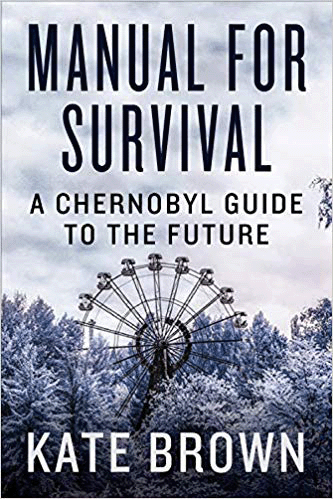 But in her book, Manual For Survival: A Chernobyl Guide To The Future, she claims: “International scientists suppressed evidence of a cancer epidemic among children.”
Cancer Research UK acknowledged rates of the disease were rising but said this war largely down to people were living longer coupled with increased consumption of red and processed meats, increasing obesity in the west, and a culture of sunbathing and sunbeds were largely to blame.
One in two people are now likely to develop the disease rather than the previous estimates of one in three.
Ms Brown believes the increase in cancer may be linked to Chernobyl while governments and nuclear industry chiefs have dodged responsibility.
She said: “Minimising both the number of deaths so far and the on-going health consequences of the Chernobyl disaster provided cover for nuclear powers to dodge lawsuits and uncomfortable investigations in the 1990s.”
She criticises a lot of senior figures, both past and present, for not admitting that nuclear radiation is really poisonous and therefore not providing adequate protection or support for people who may still be affected.
Her book details how the threshold for the amount of radiation legally allowed in produce exported for consumption in the US is surprisingly high and could be dangerous.
It also describes what the nuclear plant workers and local residents saw and experienced when the explosion tore through the power station.
It reveals how workers clearing the devastated site were advised by Soviet doctors to drink vodka throughout the day because they claimed it would stimulate the liver and cleanse the body of radiation.
Ms Brown conducted her research over four years and relied on 27 archives of information from Europe, the US and the former Soviet Union.
She reckons the actual death told could be as high as 150,000 for Ukraine alone over the past three decades.
She concludes by calling for the impact of nuclear radiation on human health and the facts and figures surrounding to Chernobyl to be reassessed.
New Hampshire citizens’ group to monitor radiation emanating from the Seabrook Power plant.
Group looks to monitor Seabrook power plant radiation, Seacoastonline.com By
The health and environmental effects of the Chernobyl nuclear accident horror
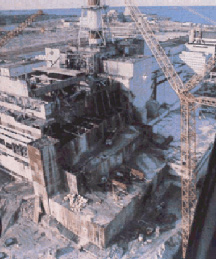 It’s one of the hottest TV shows in the world but what is the real story of Chernobyl and is it actually safe to visit the site now? https://www.news.com.au/entertainment/tv/the-real-story-of-the-chernobyl-nuclear-disaster/news-story/c3a2487f9392eb79717ae2f6b8c1a8cc
31 May 19, “…. The five-part Sky and HBO co-production, which is based on real-life events around the world’s worst nuclear disaster, has gripped the UK and is also now available in Australia via One Demand on Fox Showcase.
The horrifying events of April 26, 1986 when the Chernobyl nuclear power station went into meltdown have been brought to life in the new drama, and the show is now the highest rated program on IMDb.
Here’s a rundown of what we know about the real life events.
WHAT WAS THE CHERNOBYL NUCLEAR DISASTER?
An alarm bellowed out at the nuclear plant on April 26, 1986, as workers looked on in horror at the control panels signalling a major meltdown in the number four reactor.
The safety switches had been switched off in the early hours to test the turbine but the reactor overheated and generated a blast the equivalent of 500 nuclear bombs.
The reactor’s roof was blown off and a plume of radioactive material was blasted into the atmosphere.
As air was sucked into the shattered reactor, it ignited flammable carbon monoxide gas causing a fire which burned for nine days.
The catastrophe released at least 100 times more radiation than the atom bombs dropped on Nagasaki and Hiroshima.
Soviet authorities waited 24 hours before evacuating the nearby town of Pripyat — giving the 50,000 residents just three hours to leave their homes.
After the accident traces of radioactive deposits were found in Belarus where poisonous rain damaged plants and caused animal mutations.
But the devastating impact was also felt in Scandinavia, Switzerland, Greece, Italy, France and the UK.
An 18-mile radius known as the “Exclusion Zone” was set up around the reactor following the disaster.
HOW MANY PEOPLE DIED IN CHERNOBYL?
At least 31 people died in the accident — including two who were killed at the scene and more who passed away a few months later from Acute Radiation Syndrome.
The actual death toll is hard to predict as mortality rates have been hidden by propaganda and reports were lost when the Soviet Union broke up.
In 2005, the World Health Organisation revealed a total of 4000 people could eventually die of radiation exposure.
About 4000 cases of thyroid cancer have been seen since the disaster — mainly in people who were children or teenagers at the time.
DID THE CHERNOBYL RADIATION CAUSE ANIMAL MUTATIONS?
Farmers noticed an increase in genetic abnormalities in farm animals immediately after the disaster.
This spiked again in 1990 when around 400 deformed animals were born — possibly as a result of radiation released from the sarcophagus intended to isolate the nuclear core.
Some animals were born with extra limbs, abnormal colouring and a smaller size.
Animals that remained in the exclusion zone became radioactive — including as many as 400 wolves, which is the highest density wolf population on the entire planet.
The Eurasian lynx — once believed to have disappeared from Europe — thrived in Chernobyl as there were no humans to run them out.
Birds were also affected by radiation, with barn swallows having deformed beaks, albinism and even smaller brains.
The radioactive animals all live in the “Red Forest”, which got its name after the trees turned crimson in the fallout.
IS IT SAFE TO GO THERE NOW?
The site and Pripyat has been safe for tourists to visit since 2010.
There are around 160 villages in the Exclusion Zone but the basement of the hospital in Pripyat remains one of the more chilling stories.
The firemen were taken to the hospital for treatment and their clothes, which had been stripped off were discarded.
Later radiation readings at the site reached 7000 millisieverts — the risk of haemorrhage starts at 1000 while death begins at 4000.
The ghost town also includes a school that features in the video game Call of Duty, an abandoned Ferris wheel and homes frantically deserted when evacuation began.
Tourists have to be screened before they enter the Exclusion Zone and are told not to touch anything within the cordon.
Holiday companies offer packages that give an official tour of the Exclusion Zone.
Chernobyl’s “liquidators” suffered acute, and long-term health effects
|
How Did Radiation Affect the ‘Liquidators’ of the Chernobyl Nuclear Meltdown? https://www.livescience.com/65563-chernobyl-radiation-effects-body.html These liquidators, who worked between 1987 and 1990, were exposed to high levels of radiation, on average around 120 millisievert (mSv), according to the World Health Organization. That’s over a thousand times more powerful than a typical chest X-ray, which delivers 0.1 mSv of radiation. And some of the very first responders were exposed to levels astronomically higher than that. So, what happens to the human body when exposed to such high levels of radiation? [5 Weird Things You Didn’t Know About Chernobyl] It’s like walking into a giant, powerful X-ray machine shooting radiation everywhere, said Dr. Lewis Nelson, chairman of emergency medicine at Rutgers New Jersey Medical School. Except, in this case, most of the radiation consisted of an even more damaging type of radiation than X-rays, called gamma-rays. This radiation, as it passes through the body, is ionizing. This means that it removes electrons from atoms in the body’s molecules, breaking chemical bonds and damaging tissues. Very high levels of ionizing radiation cause “radiation sickness.” At Chernobyl, 134 liquidators quickly developed radiation sickness, and 28 of them died from it. These people were exposed to radiation levels as high as 8,000 to 16,000 mSv, or the equivalent of 80,000 to 160,000 chest X-rays, according to the World Health Organization. Radiation sickness mostly manifests in the gastrointestinal tract and the bone marrow, Nelson said. Those areas have rapidly dividing cells, which means that instead of being tightly coiled and a little more protected, the DNA is unraveled so that it can be copied. That makes it more susceptible to the radiation (this is also why radiation therapy works to target cancer cells, which also rapidly divide). Within a couple of hours of the exposure, people with radiation sickness develop symptoms such as diarrhea and vomiting, Nelson said. When cells cannot properly divide, the mucosa or tissue lining of the GI tract also break downs, releasing cells and the bacteria that live in the gut (including in the stool) into the bloodstream. This would make even a healthy person sick, Nelson said. But because the radiation is also stopping the bone marrow from producing infection-fighting white blood cells, the body can’t fight those infections. People who have radiation sickness therefore have a weakened immune systemand frequently die of blood poisoning, or sepsis, within a couple of days, he said. High levels of radiation can also cause burns and blisters on the skin, which show up minutes to a few hours after the exposure and look just like a sunburn, Nelson said. While the GI-tract symptoms and burns happen almost immediately to a couple of hours after exposure to the radiation, the bone marrow survives for a couple of days. This means there is a latency period, when the person might even seem to improve, before showing symptoms of sepsis. The people who survived radiation sickness from Chernobyl took years to recover, and many of them developed cataracts because the radiation damaged the eye lenses, according to the World Health Organization. Lower exposuresBut much of the health focus around Chernobyl survivors has focused on the long-term consequences of the radiation exposure in these areas. The main consequence, for them, is an elevated risk of cancer. “But remember, the cancer risk is something you see 10 years down the road, so you have to live for 10 more years in order to see [that],” Nelson said. So the cancer risk is generally more of a concern for those who survived Chernobyl but were exposed to lower levels of radiation. The data on this risk is murky, with very approximate numbers, but it is estimated that 270,000 people in the Ukraine, Russia and Belarus who wouldn’t have otherwise developed cancers did develop these illnesses. This mainly manifested as thyroid cancer, directly caused by radioactive particles of iodine-131 released by the explosion. The thyroid needs iodine in order to produce hormones that regulate our metabolism. But if it doesn’t have enough of the healthy, nonradioactive iodine found in many foods, it absorbs the radioactive iodine, and this can eventually lead to thyroid cancer. This is why in the HBO series “Chernobyl,” people take iodine pills; filling those stores of iodine in the thyroid prevents it from absorbing the radioactive iodine. These radioactive particles, which also include others such as cesium-137 enter the body through contact with the skin or through the mouth and nose. In Chernobyl, these particles were thrown into the air, carried by winds and later fell back down in surrounding areas, contaminated crops and water, and the people who ate them. |
|
Misleading and dangerous – the downplaying of Chernobyl’s radiation risks
|
Downplaying the danger of Chernobyl https://www.theguardian.com/environment/2019/may/26/downplaying-the-danger-of-chernobyl
A travel article on a wildlife trip to the Chernobyl disaster zone failed to highlight the continuing radiation threat to people, animals and plants, write David Lowry and Ian Fairlie
Tom Allan’s report of his holiday inside the Chernobyl exclusion zone (Nuclear reaction, Travel, 25 May) was both misleading and dangerous in its assertions. He gives the impression that the radiation dangers are minimal: “less radiation risk than on a single transatlantic flight”, according to his ornithologist Belarusian guide, Valery Yurko. The problem around Chernobyl is not average radiation exposure but the millions of highly radioactive hotspots of radioactive particles spewed from inside the destroyed Chernobyl reactor core. The entire exclusion zone area has suffered from serious forest fires in the 33 years since the catastrophe, re-suspending these hot particles into the atmosphere and spreading them around.
Mr Allan also inaccurately asserts “so far, the effect of radiation on the animal populations has not been visible”. I suggest he consult the extensive academic research of Professor Tim Mousseau of the department of biological sciences at the University of South Carolina, and his international colleagues, where he will find extensively set out the crippling effect of the radioactive contamination on both flora and fauna. • Tom Allan is poorly informed about the risks of radiation. The external radiation he received may be low, but what about the radioactivity he inhaled? Internal radiation is far more serious than external radiation, as his lungs are likely still being irradiated from the radioisotopes he breathed in during his short visit. |
|
Comparing the radioactive pollution from Fukushima and Chernobyl nuclear accidents
|
Chernobyl vs. Fukushima: Which Nuclear Meltdown Was the Bigger Disaster? Live Science By | May 24, 2019 The new HBO series “Chernobyl” dramatizes the accident and horrific aftermath of a nuclear meltdown that rocked the Ukraine in 1986. Twenty-five years later, another nuclear catastrophe would unfold in Japan, after the magnitude 9.0 Tohoku earthquake and subsequent tsunami triggered a disastrous system failure at Fukushima Daiichi Nuclear Power Plant.Both of these accidents released radiation; their impacts were far-reaching and long-lasting. But how do the circumstances of Chernobyl and Fukushima compare to each other, and which event caused more damage? [5 Weird Things You Didn’t Know About Chernobyl] Only one reactor exploded at Chernobyl, while three reactors experienced meltdowns at Fukushima. Yet the accident at Chernobyl was far more dangerous, as damage to the reactor core unspooled very rapidly and violently, said Edwin Lyman, a senior scientist and acting director for the Union of Concerned Scientists Nuclear Safety Project. “As a result, more fission products were released from the single Chernobyl core,” Lyman told Live Science. “At Fukushima the cores overheated and melted but did not experience violent dispersal, so a much smaller amount of plutonium was released.” In both accidents, radioactive iodine-131 posed the most immediate threat, but with a half-life of eight days, meaning half of the radioactive material decayed within that time, its effects soon dissipated. In both meltdowns, the long-term hazards arose primarily from strontium-90 and cesium-137, radioactive isotopes with half-lives of 30 years. And Chernobyl released far more cesium-137 than Fukushima did, according to Lyman. “About 25 petabecquerels (PBq) of cesium-137 was released to the environment from the three damaged Fukushima reactors, compared to an estimate of 85 PBq for Chernobyl,” he said (PBq is a unit for measuring radioactivity that shows the decay of nuclei per second). What’s more, Chernobyl’s raging inferno created a towering plume of radioactivity that dispersed more widely than the radioactivity released by Fukushima, Lyman added. Sickness, cancer and deathAt Chernobyl, two plant workers were killed by the initial explosion and 29 more workers died from radiation poisoning over the next three months, Time reported in 2018. Many of those who died had knowingly exposed themselves to deadly radiation as they worked to secure the plant and prevent further leaks. Government officials relocated an estimated 200,000 people from the region, according to the International Atomic Energy Agency. In the years that followed, cancers in children skyrocketed in the Ukraine, up by more than 90%, according to Time. A report issued by United Nations agencies in 2005 approximated that 4,000 people could eventually die of radiation exposure from Chernobyl. Greenpeace International estimated, in 2006, that the number of fatalities in the Ukraine, Russia and Belarus could be as high as 93,000 people, with 270,000 people in those countries developing cancers who otherwise would not have done so…….. The extent of Fukushima’s environmental impact is still unknown, though there is already some evidence that genetic mutations are on the rise in butterflies from the Fukushima area, producing deformations in their wings, legs and eyes. [See Photos of Fukushima’s Deformed Butterflies] ……. radiation levels around Chernobyl can vary widely. Aerial drone surveys revealed in May that radiation in Ukraine’s Red Forest was concentrated in previously unknown “hotspots,” which scientists outlined in the region’s most accurate radiation maps to date. The Fukushima nuclear power plant is still open and active (though the reactors that exploded remain closed); nonetheless, ongoing concerns about safety linger. The Tokyo Electric Power Company (TEPCO) recently announced that it would not hire foreign workers coming to Japan under newly relaxed immigration rules……. https://www.livescience.com/65554-chernobyl-vs-fukushima.html |
|
|
Illness and death legacy of employment in America’s nuclear weapons business
As US modernizes its nuclear weapons, NCR looks at the legacy of one Cold War-era plant, National Catholic Reporter, May 20, 2019 by Claire Schaeffer-Duffy
1 This Month
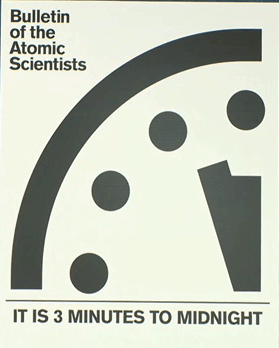
Watch the 2026 Doomsday Clock unveiling live here on January 27 at 10 a.m. EST
To see nuclear-related stories in greater depth and intensity – go to https://nuclearinformation.wordpress.com/
29 Jan. Thursday 7-8 p.m. Webinar – World’s Largest Nuclear Station in Port Hope, ON?


31st January – Challenging the War Machine – a DECLASSIFIED UK SUMMIT


Website of the Week
Now until to February 10, 2026 Radioactive waste storage in France: the debate is finally open! How to participate?
-
Archives
- January 2026 (271)
- December 2025 (358)
- November 2025 (359)
- October 2025 (376)
- September 2025 (258)
- August 2025 (319)
- July 2025 (230)
- June 2025 (348)
- May 2025 (261)
- April 2025 (305)
- March 2025 (319)
- February 2025 (234)
-
Categories
- 1
- 1 NUCLEAR ISSUES
- business and costs
- climate change
- culture and arts
- ENERGY
- environment
- health
- history
- indigenous issues
- Legal
- marketing of nuclear
- media
- opposition to nuclear
- PERSONAL STORIES
- politics
- politics international
- Religion and ethics
- safety
- secrets,lies and civil liberties
- spinbuster
- technology
- Uranium
- wastes
- weapons and war
- Women
- 2 WORLD
- ACTION
- AFRICA
- Atrocities
- AUSTRALIA
- Christina's notes
- Christina's themes
- culture and arts
- Events
- Fuk 2022
- Fuk 2023
- Fukushima 2017
- Fukushima 2018
- fukushima 2019
- Fukushima 2020
- Fukushima 2021
- general
- global warming
- Humour (God we need it)
- Nuclear
- RARE EARTHS
- Reference
- resources – print
- Resources -audiovicual
- Weekly Newsletter
- World
- World Nuclear
- YouTube
-
RSS
Entries RSS
Comments RSS
 nuclear-news