Pacific Islanders, victims of nuclear radiation from bomb tests, are more susceptible to coronavirus
|
“…………The Marshall Islands is one of three countries under the Compacts of Free Association (COFA), which allows citizens of these countries to live and work in the US in exchange for the US military’s exclusive use of and access to these nation’s lands, airspace, and waters. COFA was also supposed to give these communities access to federal benefits, including Medicaid. But in 1996, Medicaid was stripped from COFA communities in what has been called an “oversight.” In the face of an international pandemic, this “oversight” is made all the more severe. Even before the pandemic, studies are showing that in COFA communities, higher death rates are associated with the loss of Medicaid after 1996. Today, data shows that Pacific Islanders in the US, including the Marshallese, are contracting COVID-19 at rates two to three times higher than other Americans. On the importance of addressing this issue in the stimulus now, David Anitok, Project Coordinator at COFA Alliance National Network of WA (CANN-WA) said, “Timing is highly crucial and far too many people are dying that could’ve been prevented had everyone had health equity access and resources.” There is also a simple solution for this oversight: bills have been introduced in Congress to restore Medicaid to COFA communities – HR 4821 and S.2218. Already, nearly 300 organizations across the country have supported this effort. In light of the pandemic, there is no time to wait. Congress should include the provisions to reinstate Medicaid for COFA Residents in a future stimulus package. I am constantly inspired by the advocates in these communities. Even before the pandemic, they stared death in the face every day. Those who have survived are fighters, working tirelessly for the care they deserve, battling illness after illness, yet miraculously maintaining their compassion, community, and resilience. They attend too many funerals; they wonder if their government is simply waiting for them all to die. Now facing a pandemic, there is no more time to wait. It’s time for Congress to act. https://allthingsnuclear.org/guest-commentary/covid-19-nuclear-weapons |
|
|

Workers at Connecticut’s nuclear power plant worried about coronavirus precautions
Nuclear plant workers cite lack of precautions around virus, myrecordjournal. 4 May 20, HARTFORD, Conn. (AP) — Workers at Connecticut’s only nuclear power plant worry that managers are not taking enough precautions against the coronavirus after 750 temporary employees were brought in to help refuel one of the two active reactors.
Ten employees at the Millstone Power Station in Waterford have tested positive for the virus, and the arrival of the temporary workers alarms some of the permanent employees, The Day newspaper reported Sunday.
“Speaking specifically for the guard force, there’s a lot of frustration, there’s a lot of concern, and I would say there’s anger,” said Millstone security officer Jim Foley.
Foley, vice president of the local chapter of the United Government Security Officers of America, said security personnel have had to fight for personal protective equipment and for partitions at access points to separate staff from security.
Foley also has filed a complaint with the Occupational Safety and Health Administration saying Millstone staff are using ineffective cleaning materials and citing a lack of cleaning and sanitizing. Cleaning activity was not scheduled during three weekends in April, he said.
Officials at Millstone, owned by Dominion Energy, have not heard internal criticism about the plant’s virus precautions, Millstone spokesman Kenneth Holt said……..
Millstone recently increased cleaning staff on the weekends, Holt said, and there is regular disinfecting at the plant. …….
The deaths of nearly 2,500 Connecticut residents have been linked to COVID-19, the disease caused by the virus. More than 29,000 state residents have tested positive. As of Sunday, hospitalizations had declined for 11 consecutive days, to over 1,480……. https://www.myrecordjournal.com/News/State/Nuclear-plant-workers-cite-lack-of-precautions-around-virus.html
Scientists Warn Worse Pandemics Are on the Way if We Don’t Protect Nature
 Scientists Warn Worse Pandemics Are on the Way if We Don’t Protect Nature https://www.ecowatch.com/pandemics-environmental-destruction-2645854694.html?rebelltitem=4#rebelltitem4 Jordan Davidson
Apr. 27, 2020 A group of biodiversity experts warned that future pandemics are on the horizon if mankind does not stop its rapid destruction of nature.
Writing an article published Monday by The Intergovernmental Science-Policy Platform on Biodiversity and Ecosystem Services (IPBES), the authors put the responsibility for COVID-19 squarely on our shoulders.
“There is a single species that is responsible for the COVID-19 pandemic – us. As with the climate and biodiversity crises, recent pandemics are a direct consequence of human activity – particularly our global financial and economic systems, based on a limited paradigm that prizes economic growth at any cost. We have a small window of opportunity, in overcoming the challenges of the current crisis, to avoid sowing the seeds of future ones,” the authors wrote on IPBES.
The authors of the report include the three co-chairs of the comprehensive 2019 IPBES Global Assessment Report on Biodiversity and Ecosystem Services, which found that one million species of plants and animals are at risk of extinction within decades. The fourth author, Peter Daszak, is the president of EcoHealth Alliance and is tasked with spearheading the IPBES’ next global assessment, as The Guardian reported.
The authors argue that government stimulus plans need to include sustainable and nature-positive initiatives. “It may be politically expedient at this time to relax environmental standards and to prop up industries such as intensive agriculture, long-distance transportation such as the airlines, and fossil-fuel-dependent energy sectors, but doing so without requiring urgent and fundamental change, essentially subsidizes the emergence of future pandemics,” the authors wrote.
They also fault wanton greed for allowing microbes that lead to novel diseases to jump from animals to humans.
“Rampant deforestation, uncontrolled expansion of agriculture, intensive farming, mining and infrastructure development, as well as the exploitation of wild species have created a ‘perfect storm’ for the spillover of diseases from wildlife to people,” they wrote in their article.
They warn that 1.7 million unidentified viruses known to infect people are estimated to exist in mammals and water birds. Any one of these may be more disruptive and lethal than COVID-19.
With that in mind, the authors suggest three facets that should be considered for COVID-19-related stimulus plans. Countries should strengthen environmental regulations; adopt a ‘One Health’ approach to decision-making that recognizes complex interconnections among the health of people, animals, plants, and our shared environment; and prop up healthcare systems in the most vulnerable countries where resources are strained and underfunded. “This is not simple altruism – it is vital investment in the interests of all to prevent future global outbreaks,” the scientists argue in their IPBES article.
“The programs we’re talking about will cost tens of billions of dollars a year,” Daszak told The Guardian. “But if you get one pandemic, even just one a century, that costs trillions, so you still come out with an incredibly good return on investment.
“Business as usual will not work. Business as usual right now for pandemics is waiting for them to emerge and hoping for a vaccine. That’s not a good strategy. We need to deal with the underlying drivers.”
Their assessment has been supported recently by others in the scientific community. A study published earlier this month blamed human impact on wildlife for the current outbreak, as The Guardian reported.
The authors of the new article end their piece on an optimistic note about nature’s resiliency. “We can build back better and emerge from the current crisis stronger and more resilient than ever – but to do so means choosing policies and actions that protect nature – so that nature can help to protect us,” they wrote.
The COVID-19 crisis is a warning for the future
|
As Tasmania prepares to enter the recovery phase of the COVID-19 pandemic, calls are growing for the crisis to be seen as a warning for the future. The pandemic has had widespread health and economic ramifications across Tasmania. Thirteen people have died, thousands have been quarantined and more than 20,000 people have lost their jobs. While we don’t know exactly what animal species the virus originated from, scientists widely consider bats the likely source. Dr Scott Carver is a senior lecturer at the University of Tasmania who specialises in the ecology and epidemiology of infectious diseases. He said human impacts on the environment can create new contacts with animals and increase risk of pathogens transferring between animals and humans.
“Pathogen spillover between species … happens quite often,” Mr Carver said. “It is just that most pathogens don’t cause really significant health outcomes. Some of them, however, do. “The chance of any one spillover event resulting in an epidemic is low, but if you increase the opportunity for that to happen, through increasing new contacts, then the probability increases.” He said implementing policies to limit the risk of potential future pandemics would benefit both public health and biodiversity. “With a growing human population size and growing human impacts on the environment it is not surprising that you get more of these events happening,” Dr Carver said. “It is incumbent upon us to really take a serious look at the way we treat the environment and think about policies that can limit these sorts of things.” UTAS’s Dr Olivia Hasler believes legislating a law of ecocide could be one way to approach establishing these policies. “Ecocide is an attempt to criminalise human activities that destroy and diminish the well-being and health of ecosystems and species within an ecosystem,” she said. She said the COVID-19 pandemic had highlighted how connected we were as a society, and she hoped that would not be forgotten in the recovery effort. “A law against ecocide would provide accountability to those that are in positions of power to make decisions about the use of our resources and shared land,” Dr Hasler said…… https://www.examiner.com.au/story/6743091/human-impacts-on-the-environment-could-be-increasing-the-risk-of-pandemics/?cs=95 |
|

The pandemic poses a danger that is unique to the nuclear industry

The Hidden Nuclear Risk of the Pandemic The coronavirus crisis highlights the resilience problem of civilian nuclear power plants. https://thebulwark.com/the-hidden-nuclear-risk-of-the-pandemic/ by VICTOR GILINSKY AND HENRY SOKOLSKI APRIL 27, 2020
The coronavirus crisis has revealed a significant Achilles’ heel in civilian nuclear power: The plants can’t operate if their relatively few highly skilled operators get sick or become contagious and have to be quarantined, a situation that, according to news reports, some plants are getting close to. That puts a dent in nuclear-industry assertions that its plants provide a level of protection against natural events far beyond that of most other electricity suppliers.
In recent weeks, several vital institutions—police forces, food-processing plants, the U.S. Postal Service, not to mention health care providers—have reportedly been strained as personnel have become sick with COVID-19. As the pandemic spreads, it could create a problem for the smooth functioning of nuclear plants, as well. Just operating in safe shutdown state could be challenging. The details differ from plant to plant and are spelled out in technical specifications that are part of each plant’s federal license, but generally it takes a supervisor and several operators to man the control room and some number of maintenance staff. Altogether, counting all shifts, there may be a couple of dozen operators per plant. That doesn’t sound like much, but these are highly skilled personnel who are licensed to operate an individual plant. You can’t just pull in operators from elsewhere. If the licensed operators are unavailable because of disease or medical concerns, you are out of luck.
The Nuclear Energy Institute also argues that by contributing reliable power to military installations, nuclear energy “supports the nation’s ability to defend itself.” Yet here we have a type of emergency—involving a possible lack of operating staff—in which the nuclear plants could become a serious liability rather than an asset.
Nuclear plants are not without their advantages. But they also come with serious disadvantages, one of which—the safety imperative for constant, highly trained staffing no matter what—has become evident during the current pandemic. They are an inflexible source of energy that carries an enormous overhead in terms of safety and security, when what we need in our energy system for dealing with inevitable emergencies is not rigidity, but resilience.
UK ignored warnings about pandemic danger, cut health funding, spent up big on nuclear weapons
 Pride: why the UK spent billions on nuclear bombs but ignored Pride: why the UK spent billions on nuclear bombs but ignored  pandemic threat https://www.opendemocracy.net/en/opendemocracyuk/pride-why-uk-spent-billions-nuclear-bombs-ignored-pandemic-threat/ pandemic threat https://www.opendemocracy.net/en/opendemocracyuk/pride-why-uk-spent-billions-nuclear-bombs-ignored-pandemic-threat/
A viral outbreak was judged more likely than a nuclear attack – so why was Trident ring-fenced while NHS funding was cut? Richard Norton-Taylor 30 April 2020 We now know that the government was warned last year that a viral pandemic posed the greatest potential threat to the country. In a confidential briefing from the Cabinet Office, which was leaked last week, ministers were told that tens of thousands lives could be at risk if an outbreak occurred. Among the recommendations were stockpiling PPE (personal protective equipment) and establishing plans for a contact tracing system.
It was not the first time that warnings fell on deaf ears. In 2014, the Ministry of Defence advised that “alertness to changing trends” was vital to mitigating the likelihood of a pandemic. Senior civilian and military officials promptly shoved the report into a draw where it was left to gather dust.
To make matters worse, the austerity programme carried out over the last decade, has led to significant cuts to government projects and public services, including the NHS, that would ready us for a pandemic. There has, however, been one notable exception to the cuts – the country’s nuclear weapons arsenal. Tens of billions continue to be spent on weapons that are of no use against the types of attacks judged a possible threat to the UK in the government’s National Risk Register. The latest register, drawn up in 2017, refers only to the need to protect nuclear power stations and the possibility of chemical, biological and nuclear material attacks by terrorists. But it adds that terrorists’ use of conventional weapons is “far more likely”. Successive governments have described Britain’s nuclear arsenal as an “ultimate insurance” against an attack, or blackmail, by a foreign power. If that is the case, then why did the government not increase its healthcare spending as insurance against what it knew was a far greater threat – an infectious pandemic. Defenders of Britain’s nuclear weapons argue that they are needed for political reasons, to preserve Britain’s status as world power. But arguments about whether nuclear weapons would ever be considered a realistic or effective threat against a potential aggressor are dodged. Continue reading |
Coronavirus a big threat to Russia’s secret nuclear cities, as virus incidence rises

Concern as coronavirus threatens Russia’s closed ‘nuclear cities’ https://www.theguardian.com/world/2020/apr/28/concern-as-coronavirus-threatens-russias-closed-nuclear-cities
Rosatom nuclear chief warns of ‘particularly alarming situation’ in three areas as country reports biggest daily rise in cases, Reuters in Moscow 29 Apr 2020
Alexei Likhachev, Rosatom chief, said the pandemic ‘creates a direct threat’ to Russia’s nuclear cities.
The head of Russia’s state-run nuclear corporation has expressed concern about the spread of the new coronavirus to three “nuclear cities”, including one that houses a top-secret research institute that helped develop the Soviet atomic bomb.
The cities are closely linked to Russia’s nuclear industry, which is managed by the Rosatom corporation. Several are closed to foreigners and Russians require special clearance to enter them as facilities located there are closely guarded secrets.
Rosatom chief Alexei Likhachev said special deliveries of ventilators and personal protection equipment (PPE) were being sent to the closed town of Sarov, east of Moscow, and other towns where dozens of cases of the virus have been registered.
“This [pandemic] creates a direct threat to our nuclear towns. The situation in Sarov, Elektrostal [and] Desnogorsk is today particularly alarming,” he said in an online speech to Russia’s nuclear industry workers.
“The situation in Sarov is exacerbated by an outbreak of the illness in the nearby Diveyevo monastery,” he said, without elaborating further.
Likhachev made his remarks on a day when Russia reported its biggest daily rise in new coronavirus cases. Russia now ranks eighth worldwide with 93,558 confirmed cases, though its death toll of 867 is still far below that of many other countries.
Moscow, which accounts for more than half of Russia’s cases, and many other regions have imposed stay-at-home orders to curb the spread of the virus.
Sarov, which was so secret that it did not appear on maps until the breakup of the Soviet Union in 1991, remains an important part of Russia’s nuclear military complex, defence experts say.
It is home to a research institute that gained prominence last year when five of its scientists died in a mysterious accident at a military testing site in the far north.
Rosatom said the incident had occurred during a rocket engine test on a sea platform. Some US experts said they suspected it had been a botched test of a new missile vaunted by the president, Vladimir Putin.
Last week, Rosatom said seven people at Sarov’s All-Russian Scientific Research Institute of Experimental Physics had been diagnosed with coronavirus, bringing the total number of cases in the city – which has a population of about 95,000 – to 23.
It said the outbreak in Sarov had begun when a retired couple returned to the city from a Russian holiday resort and that more than 100 people had since been isolated to stop it spreading further.
The pandemic is showing us how our trashed world can heal
 Now We Know How Quickly Our Trashed Planet Can Heal
Clean air, wandering goats. The pandemic is teaching us that all is not yet lost. By Margaret Renkl “………. Now a pandemic has turned us all into window gazers. We have been given an unexpected space for wondering. In cities the world over, songbirds seem louder now that they aren’t competing with the sounds of traffic.
I think the birds are enjoying this,” wrote a New York City bookseller in response to an online order I’d placed for a new field guide to songbirds. “In NYC we can hear them better than ever.”
But it’s not just that our ears are tuned, in the new silence, to the sounds of birds that have always shared our world. Coyotes now wander the sidewalks of San Francisco and the streets of Chicago; Great Orme Kashmiri goats forage in the town of Llandudno, Wales; a groundhog snarfs pizza right outside a window in Philadelphia; a mountain lion jaywalks in San Mateo; wild boars root in the medians of Barcelona; a red fox saunters across a driveway in Nashville.
This pandemic has overlapped with the annual spring songbird migration, so it’s possible that people are seeing birds that truly weren’t there before we all went into lockdown. But in general it’s not true that the wild animals we’re seeing from our windows have become more plentiful in our absence. They are simply making themselves more visible to us now that we have become less visible to them.
The pandemic is teaching us that all is not yet lost.
None of these changes will last — the human race cannot stay cooped up indoors forever — but while we have both the time to observe and the window perch to watch from, we can use this cultural moment to rethink our relationship to wildness. We can ponder what it truly means to share the planet. We can resolve to change our lives.…..
And so our first task when we emerge from this isolation will be to remember. To sear into our memories that pure pageantry of wildness, of life in its most insistent persisting. And then to try in every possible way to save it. https://www.nytimes.com/2020/04/27/opinion/coronavirus-shutdown-environment.html
Time to support humanitarian initiatives for North Korea
|
The Looming Crises in North Korea: Coronavirus, Starvation and a Nuclear Test ,https://nationalinterest.org/blog/korea-watch/looming-crises-north-korea-coronavirus-starvation-and-nuclear-test-149301 29 Apr 20, “We will know soon enough what is going on with Kim Jong-un. However, for now, one thing is very clear. North Korea is on the precipice of crisis—from wide-spread illness and starvation or from a nuclear provocation that escalates into a disastrous miscalculation. We can choose to ignore past lessons when perhaps millions died before in North Korea, but I cannot.”
by Philip W. Yun In the midst of a world engulfed in pandemic, economic meltdown and distracting speculation over Kim Jong-un’s health, we are in danger of missing two new crises to come: (1) an overwhelming cycle of disease and famine in North Korea; as well as (2) a seventh North Korean nuclear weapons test. Both possibilities ominously signal what we don’t need more of — major instability in Northeast Asia which risks miscalculation and possibly war. As a former State Department official, I bore witness through cables and media reports to the North’s 1990’s famine, and during official trips to Pyongyang, I saw the heavy toll of mass starvation on the faces of Pyongyang’s residents. Reportedly millions died. As a second-generation Korean-American, I promised myself then that I would not let another similar tragedy unfold without sounding the alarm.
Pyongyang has proudly declared that it has no COVID-19 cases. Few believe this is true. Even with comprehensive social distancing and draconian quarantine measures, we know that viruses respect no borders. So even taking the regime’s assertions at face value, it is only a matter of time before the disease mounts its own kind of invasion.
In the case of COVID-19, North Korea’s citizenry is particularly susceptible to a devastating outbreak. Decades of malnutrition have left the population’s health and immunity compromised. North Korea’s persistently high rates of respiratory diseases like tuberculosis show the country is not capable of dealing with these types of sicknesses at any scale. Where international sanctions are stringent and the economy sputtering, domestic shortages are chronic — the country will have few personal protective equipment (PPE), ventilators and other medical basics. Rather than request international assistance, its mistaken priority to keep the country under control will likely delay an effective response until it is too late.
To make matters worse, North Korea may soon be facing more food shortages. The challenge is daunting even in normal times. But during a pandemic, who will plant, harvest and process badly needed grains if all are sheltering or ill?
When faced with a crushing combination of large-scale malnutrition and COVID-19, the regime will do what it always does when it doesn’t have proper tools — it will triage. North Korea will devote precious resources to its privileged and not to everyday North Koreans, leaving them to simply die either from disease or lack of food. Regardless, the loss in human life could be shocking and threatening to the regime’s very existence. Adding to this morass is the high likelihood that North Korea will test another nuclear device. Here’s why: First, Kim Jong-un was embarrassed by last year’s summit in Hanoi because the North’s leaders had high expectations for concrete gains (like sanctions relief); yet nothing came. Relations with the U.S. are dead. Kim’s highly publicized remarks in December 2019 have arguably rejected diplomacy while simultaneously bracing the country for greater hardship and possible provocations. With a population under pressure, Kim will do what many political leaders do when stressed, internally rally his country by touting an outside threat. Second, the North’s leaders are skilled at making the country’s weakness an asset, usually by resorting to nuclear extortion to draw international benefits. We can expect more of this. More troubling, however, is North Korea’s tendency to double down and show “strength” during unusual internal turmoil – usually in the form of a deliberate warning to adversaries to back off and leave the country alone. If Kim Jong-un is ailing or dead, then this incentive becomes even greater for those in charge and a nuclear test more certain. Third, there is a technical imperative. To produce a truly operational nuclear device, North Korea must test again. Undoubtedly, its military is aggressively lobbying for another test because it sees a nuclear weapon as the best guarantee against invasion and attack. Finally, there is perhaps a no better time to conduct a test than this year. Governments around the globe are mired in and distracted by a pandemic and the prospect of world-wide depression. Ever opportunistic, the North could very well calculate the international political costs of a nuclear test as minimal. So what do we do?Having contained COVID-19, South Korea has the means and know-how to help the North; its President Moon Jae-in, the will. The U.S. needs to set aside differences with the South over security costs and fully support upcoming peace and humanitarian initiatives that are sure to come. The U.S. must then work with the WHO and others, like Japan, Russia, and China, to put together a comprehensive approach that will augment South Korean efforts. While a decision to conduct a nuclear weapons test or some other provocation is solely up to North Korea, there is a small chance, and one worth taking, that American willingness to help the North during a time of dire need may create an opening to somehow persuade the North to forego a test. Lastly and perhaps most importantly, the U.S. must lead. We can’t do everything, nor should we, but our role in the world, I believe, remains essential.
|
|
Coronavirus spreads to Russia’s ‘secret’ nuclear cities
|
Now, coronavirus spreads to Russia’s ‘secret’ nuclear cities,
WION New Delhi, Delhi, India Apr 29, 2020, The coronavirus has rattled Russia. The number of cases in the country is nearing the 100,000 milestone, the country’s oil prices have collapsed and its economy is set to contract by 4 to 6 per cent.
In the latest, the coronavirus has begun spreading to Russia’s nuclear cities. The secret cities are at high risk and they stand exposed. ……
Also lying exposed are Russia’s secret cities. The Wuhan virus has sneaked its way past their fences and now Sarov, Elektrostal and Desnogorsk are infected. The situation is so bad that a top Russian executive was forced to mention these cities during his address. “The situation in Sarov, Elektrostal, Desnogorsk is today particularly alarming. In Sarov, the situation is being compounded by the outbreak in the nearest Diveyevo convent,” Rosatom chief, Alexei Likhachev, said. Sarov has at least 23 coronavirus cases. The numbers for Elektrostal and Desnogorsk are not clear. Also unknown are the number of hospitals in these cities and their pandemic preparedness. Not surprising, given everything around these cities is blurry. Sarov, Elektostal, and Desnogorsk are among Russia’s many secret cities.
They are highly restricted, so much so that they weren’t shown on the map until the breakup of the Soviet Union in the 1990s. These cities were excluded from train and bus routes. They were known only by their postal codes. Sarov, for example, was Arzamas-16. No one knew who lived there. The lives of its residents were as secretive as those of KGB agents. For years, the Russian government rewarded the residents of its secret cities with numerous perks – private apartments, well-paying jobs and good healthcare. These cities are closely linked to Russia’s nuclear industry. They are managed by Russia’s state atomic energy corporation – Rosatom.
Sarov became a closed city after World War-II. Once known for its monastery, the city was quickly turned into a rocket-making hub. It’s monastery buildings were converted into rocket factories. Today, Sarov is home to one of Russia’s top research institutes. The city is fenced, patrolled by the military and no one can enter without a pass. Last year, five scientists from the research institute died in a mysterious accident. No one knew what had happened. Russia said there was an accident during a rocket engine test.
The United States claimed it was a missile test gone wrong. Today, these secret cities are becoming coronavirus hotspots. Russia says it is sending emergency ventilators and medical aids to its nuclear cities but truth be told – we may never know what’s really going on there. https://www.wionews.com/world/now-coronavirus-spreads-to-russias-secret-nuclear-cities-295663
|
|
Do-it-yourself radiation monitoring
By Dahyun Kang, April 28, 2020 Watching the HBO drama Chernobyl about the nuclear disaster that occurred in April 1986 gave me a whole new perspective on how destructive radioactive particles can be. One scene depicted local men and women fearfully looking toward the nuclear site, a dim red glow against the night sky. Highly radioactive cesium-137-contaminated dust fell like snow on children running in the streets. Plant workers and firefighters died gruesomely after exposure to acute radiation doses unleashed by the debris that exploded from the nuclear reactor. No one knew what to do because Soviet bureaucrats delayed accident announcements and evacuation orders.
The lack of information about radiation levels meant that people were exposed to radiation for a longer duration than if they had received timely warnings. The Chernobyl drama not only helped me realize the disastrous consequences and hazards of radiation, but also inspired me to create a radiation estimator that could provide estimations of environmental radiation levels in places where there are no stationed detectors.
A focus on Fukushima. To develop my estimator, I focused on the Fukushima region in Japan. I chose this area because of the nuclear disaster there in March 2011, when three nuclear power plant cores melted down and released radionuclides into the atmosphere. The Japanese government chose this region to hold a couple of events that are part of the 2020 Tokyo Summer Olympics and Paralympics, branded as the “Reconstruction Olympics.”
The environmental group Greenpeace has raised concerns about whether people attending these Olympic events—which have now been postponed until 2021—could be exposed to lingering radiation. In a report published last month, Greenpeace claimed measurements taken by a survey team detected radioactive hotspots at the Fukushima Azuma Baseball Stadium near Fukushima City, in the area around the city’s central station, and at the J-Village sports complex where the Olympic torch relay will start. According to Greenpeace, the highest measurement at J-Village on October 26, 2019, was 71 microsieverts per hour close to the ground, a reading more than 1,750 times higher than pre-2011 background levels. The forested mountains covering roughly 70 percent of the Fukushima prefecture cannot be decontaminated and therefore pose a recontamination risk to areas when heavy rainfall or typhoons mobilize radionuclides, which Greenpeace says happened during two intense typhoons in 2019.
Japan’s Shinzo Abe administration plans to host the Olympics baseball and softball games at the Azuma stadium, approximately 80 kilometers from the Fukushima Daiichi nuclear power plant site where the nuclear accident occurred. J-Village, where the torch relay will begin, is located about 20 kilometers south of Fukushima Daiichi.
How I built my radiation estimator. The nonprofit organization Safecast, which collects radiation readings taken by volunteers and makes them publicly available at no charge, provides data for a number of locations worldwide—particularly in Japan, where the monitoring network began as a response to the Fukushima disaster. Using the Safecast website, I collected data from the Fukushima prefecture. With the help of mathematical software called Mathematica, I then developed a mathematical equation that takes the Safecast Fukushima data and provides estimates of radiation values at any other location in Fukushima. With the help of a relative who works as a coding programmer, I also created a Radiation Estimation website that uses the mathematical equation to estimate radiation values, in microsieverts per hour, for any latitude and longitude entered by a user.
For example, if the user enters the latitude and longitude of the Azuma stadium, the equation gives an estimate of 0.103 microsieverts per hour. According to the International Commission on Radiological Protection, anything less than 0.23 microsieverts per hour is considered a safe dose, based on the recommended public dose limit of 1 millisievert per year (1 millisievert is equivalent to 1,000 microsieverts).
Future efforts. Currently, my radiation estimator inevitably contains some degree of uncertainty due to limited available data from the Fukushima prefecture, which covers about 13,700 square kilometers. The estimates would be more precise and could be applied beyond Fukushima if there were more disclosed data available to reference.
What about the radiation levels in my own city and others in the United States? Unfortunately, I was unable to find enough open radiation data available to make a good estimate. The US Environmental Protection Agency runs a nationwide environmental radiation monitoring system, RadNet, which has 140 radiation air monitors spread across 50 states, mostly in the heart of big cities. Although these monitors run 24/7, collecting near-real-time measurements of gamma radiation, the number and locations of the monitors are inadequate to cover all of the United States.
There are 96 US nuclear power reactors in operation. Who can assure the American public that no nuclear catastrophe on the scale of Chernobyl or Fukushima will occur in the United States? It is natural for the public to be worried and to insist that the US government install more radiation monitors near reactors and the surrounding populated areas to protect the public. Information collected by the monitors should also be disclosed to the public.
Once sufficient environmental radiation data are available, my radiation estimator would be applicable in my own city and others in America as well. I hope to raise awareness of environmental radiation and offer people information about what kind of environment they are living in. Since my radiation estimator is only a first step in that direction, I hope that someone with more expertise can build upon my idea to create a more precise tool that provides information about environmental radiation anywhere on the globe.
USA Government prioritises nuclear industry over its duty to public health
As Pandemic Rages, Federal Nuclear Regulators Put Keeping Reactors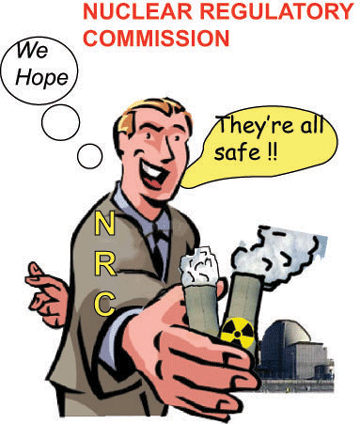 Running Ahead of Public Health and Safety https://www.ewg.org/energy/23141/pandemic-rages-federal-nuclear-regulators-put-keeping-reactors-running-ahead-public-27 Apr 20,
The federal government’s toothless nuclear “watchdog” has historically shown more concern for keeping dangerous aging reactors running than for Americans’ safety from a nuclear accident. So how is the Nuclear Regulatory Commission, or NRC, responding to the coronavirus pandemic?
-
-
- Letting nuclear power plants cut back their workforces to facilitate social distancing – but letting them make up for the reduced numbers by requiring the remaining control room operators and other key employees to work back-to-back 84-hour weeks, heightening the danger of worker exhaustion that could contribute to a reactor accident.Telling the agency’s on-site safety inspectors – two or more resident inspectors at each plant – to work from home, and allowing plants to defer required inspections of piping systems critical to cooling the reactors.
- Keeping reactor refueling crews of up to 1,500 technicians traveling from plant to plant, working in crowded conditions and staying in nearby communities, increasing the likelihood of crew members spreading the virus
The U.S. has 58 nuclear power plants housing 96 nuclear reactors in 29 states. Each plant employs 500 to 1,000 workers. Every 18 to 24 months, plants are powered down for four to six weeks for refueling, done in the spring or fall, when electric demand is low. According to the Nuclear Energy Institute, or NEI, the lobbying arm of the nuclear industry, refueling is scheduled at 56 plants this year.
On March 20, the NEI wrote the NRC to request that refueling crews have “unfettered access to travel across state lines” and unrestricted access to local hotels and food services, and to be prioritized for personal protective equipment. The NRC responded by allowing a reduction in the required number of plant personnel, and allowing an increased work week for remaining employees of 12-hour days for up to 14 days straight.
That worries Beyond Nuclear, a nonprofit that advocates “for an energy future that is sustainable, benign and democratic.”“Nuclear plant operators on extended 12-hour shifts, who can now be assigned to work two consecutive 84-hour weeks, will suffer excessive fatigue,” Beyond Nuclear’s director of plant oversight, Paul Gunter, said in a news release. “This not only compromises their immune systems, but makes catastrophic mistakes more likely.” The release cited the infamous Three Mile Island nuclear accident, in 1979, which it said was attributed to “mechanical failure worsened by operator fatigue and error.”
One week after the Nuclear Institute’s letter, the NRC directed resident inspectors to work from home, “only coming on site for risk-significant in-plant operations.” The agency has also allowed utilities operating the plants to request postponement of inspections and maintenance. “There are some ancillary activities during an outage that can be deferred,” an NRC spokesperson told Bloomberg.Among the “ancillary” activities that can be deferred is inspection of piping critical to cooling the reactors. Beyond Nuclear says three plants, in Illinois, Florida and Texas, have requested 18-month deferments of inspections of steam generator tubes that are subject to extreme heat, radiation and vibration. Failure of the piping, says the International Atomic Energy Agency, could lead to “core damage or large release events” of radiation.At least four nuclear plants – Fermi 2, near Detroit, Susquehanna, near Berwick, Pa., Limerick, near Pottstown, Pa., and Vogtle, near Waynesboro, Ga. – have seen cases of COVID-19
The Pottstown Mercury reports that local officials asked Exelon, the owner of Limerick, to postpone refueling because they found the company’s plans to address the pandemic inadequate. Regardless, the company went ahead with refueling and didn’t begin social distancing until workers told the press they were “terrified” that they’re working in a “breeding ground” for COVID-19.Nearly 30 Limerick workers have tested positive for the virus, according to The Philadelphia Inquirer. But Vogtle has by far the biggest outbreak, with 143 workers testing positive. It’s unknown how many nuclear plant workers nationwide have tested positive, because the NRC has not reported cases.“The key question,” Edwin Lyman, director of nuclear power safety for the Union of Concerned Scientists, told Utility Dive, “is how much additional risk will the NRC allow nuclear plants to accept in order to keep them running during the crisis?”Good question
-





 nuclear-news