Covid-19 pandemic – ‘fire drill’ for effects of climate crisis

|
Covid-19 pandemic is ‘fire drill’ for effects of climate crisis, says UN official, Tue 16 Jun 2020 “The overall problem is that we are not sustainable in the ways we are living and producing on the planet today,” said Lise Kingo, the executive director of the UN Global Compact, under which businesses sign up to principles of environmental protection and social justice. “The only way forward is to create a world that leaves no one behind.”She said there were “very, very clear connections” between the Covid-19 and climate crises, and the Black Lives Matter protests around the world, which she said had helped to reveal deep-seated inequalities and “endemic and structural racism”.
“We have seen illustrated to everyone that social inequality issues are part of the sustainable development agenda,” Kingo said. ….. The UN secretary general, António Guterres, said building a fairer society would be essential to the world’s health, as well as to saving the planet from climate breakdown and ecological destruction. “Today, the fabric of society and the wellbeing of people hinge on our ability to build a fair globalisation,” he told the two-day UN Global Compact virtual conference of business leaders, which started on Monday……. https://www.theguardian.com/environment/2020/jun/15/covid-19-pandemic-is-fire-drill-for-effects-of-climate-crisis-says-un-official
|
|
Radioactive cloud over Europe in 2017 came from a civilian nuclear reactor

|
Radioactive cloud over Europe had civilian background https://www.eurekalert.org/pub_releases/2020-06/uom-rco061220.phpIsotope measurements on air filters: researchers investigated undeclared nuclear release / Study in “Nature Communications” 14 June 20
UNIVERSITY OF MÜNSTER A mysterious cloud containing radioactive ruthenium-106, which moved across Europe in autumn 2017, is still bothering Europe’s radiation protection entities. Although the activity concentrations were innocuous, they reached up to 100 times the levels of what had been detected over Europe in the aftermath of the Fukushima accident. Since no government has assumed responsibility so far, a military background could not be ruled out. Researchers at the Leibniz University Hannover and the University of Münster (both Germany) now found out that the cloud did not originate from military sources – but rather from civilian nuclear activities. Hence, the release of ruthenium from a reprocessing plant for nuclear fuels is the most conclusive scenario for explaining the incident in autumn 2017. The study has been published in the journal Nature Communications.
Background: It is impossible to make a clear distinction between civilian and military sources solely based on measurements of radioactive isotopes of ruthenium. For the first time, researchers from the Institute of Radioecology and Radiation Protection at Leibniz University of Hannover and the Institute of Planetology at Münster University succeeded in quantifying stable ruthenium isotopes in air filters that were released with the radioactive ruthenium. Within the scope of the study, the team left conventional scientific paths: “We usually measure ruthenium isotopes to study the formation history of Earth”, says Prof. Thorsten Kleine from the University of Münster, adding that the methods originally developed to address research questions in planetology were instrumental in solving this mystery. The fact that the airborne ruthenium stemming from nuclear activities occurred in minuscule amounts and were diluted with natural stable ruthenium presented a significant challenge. Through the clean chemical separation of ruthenium fractions from air filters and subsequent high-precision measurements via mass spectrometry, the researchers determined the ratio of stable ruthenium from the nuclear source. The ruthenium isotopic ratios found in the filter are consistent with the signature of a civilian source, in particular the signature of spent nuclear fuel from a nuclear power plant. A military background (such as the production of weapons-grade plutonium) can be ruled out. Furthermore, high-precision measurements enabled the researchers to draw further conclusions. “The isotope signature discovered in the air filter exhibits no similarities with nuclear fuels of conventional Western pressurised or boiling water reactors. Instead, it is consistent with the isotope signature of a specific type of Russian pressurised water reactors – the VVER series. Worldwide, approximately 20 reactors of this type of VVER are currently operational”, specifies Professor Georg Steinhauser from Leibniz University Hannover. Original publication: T. Hopp et al. (2020): Non-natural ruthenium isotope ratios of the undeclared 2017 atmospheric release consistent with civilian nuclear activities. Nature Communications; DOI: 10.1038/s41467-020-16316-3 |
|
Russian city Severodvinsk, (near site of nuclear accident) sealed off due to Covid-19
 Coronavirus seals off city near secret Russian nuclear accident site, https://thebarentsobserver.com/en/2020/06/coronavirus-seals-city-near-secret-russian-nuclear-accident-site The Moscow Times 05, 2020, Authorities have blocked access to Severodvinsk, the north Russian city located near the site of last year’s mysterious nuclear testing accident as the coronavirus outbreak there intensified.The governor of the Arkhangelsk region signed an order to close public access to Severodvinsk this Saturday, the city’s press service said Thursday. Severodvinsk is near the Nyonoksa testing site where an August 2019 explosion during a rocket engine test killed five Russian nuclear workers and led to a radiation spike.
Severodvinsk will set up checkpoints Friday and restrict entry and exit starting midnight Saturday to everyone except workers and people attending funerals, going to country houses or transiting through the city.
“The measure remains in effect until special orders,” the city’s press service said in a statement.
Around 700 people have been infected with Covid-19 at two of the city’s major shipyards since April, an unnamed shipbuilding industry source told the Vedomosti business daily. The Sevmash and Zvezdochka shipyards reportedly saw more than 200 new cases in the past week alone.
The outbreak has prompted federal health officials last week to order enterprises in Severodvinsk to limit their activities.
The Arkhangelsk region has confirmed 2,496 coronavirus infections since the start of the outbreak. Severodvinsk accounts for roughly half of the region’s overall cases.
Last August, a missile exploded during what is believed to have been a recovery operation. The secrecy surrounding the accident has led outside observers to speculate that the explosion involved the Burevestnik nuclear-powered intercontinental cruise missile, dubbed the SSC-X-9 Skyfall by NATO.
President Vladimir Putin later said the accident occurred during testing of what he called promising new weapons systems.
High rate of cancers among Mururoa nuclear veterans’ families
|
Research confirms high rate of cancers among Mururoa nuclear veterans’ families https://www.stuff.co.nz/national/121726358/research-confirms-high-rate-of-cancers-among-mururoa-nuclear-veterans-families 5 June 20, A navy veteran who saw his own finger bones in the flash of a nuclear blast says families should be compensated for suffering health problems linked to the military service of their relatives.And he now has evidence to prove the link.
Gavin Smith, 69, served in the navy in 1973 when Prime Minister Norman Kirk sent two frigates and 500 men on a sea-borne protest to nuclear testing at a French Polynesian atoll. It was at Mururoa that he and his colleagues were exposed to harmful radiation while observing two nuclear explosions by the French on board HMNZS Canterbury. Smith, also president of the Mururoa Veterans Group, was one of 83 sailors and 65 children included in a University of Otago study, which was published in the New Zealand Medical Journal in May. The research proves they have a higher risk of transferring genetic illnesses. It shows 30 per cent of veterans suffer a cocktail of cancers, including prostate, non-Hodgkin lymphoma, leukaemia and skin conditions. Thirty-one per cent also suffer joint problems. Forty per cent of veterans’ children reported fertility problems, including endometriosis, miscarriages and polycystic ovarian syndrome. Some had taken more than 12 months to conceive children, while others chose not to have kids because of their fathers’ exposure to radiation. Smith said the next step was to create a registry for veterans and their families. He had contacted Minister of Defence Ron Mark about the study and hoped to gain funding for further genetic studies. This would detect heritable change, where scientists could look at specific changes in genetic code. Smith said the cost of veterans’ health problems were covered by Veterans Affairs, however the plight of their descendents were not. “We’re pleased to have the cold facts, because we’ve been fighting for this for 40 years,” he said. “It proves what we’ve been saying all along – that there is a problem and it needs addressing. “We now know [the rate of cancer] is higher among veterans and their descendents than the average rate, but further genetic studies will confirm the link.” The university’s director of veterans’ health research David McBride conducted the study, alongside a team of trainee doctors. McBride said only 21 veterans in the study were receiving Government support. “Ionising radiation can cause changes in the chromosomes carrying the genetic code, but we know neither if these changes result in disease nor whether they can be passed on by fathers to offspring.” McBride said more genetic testing was required to show the way genes express themselves through decoding. This would involve establishing a registry of veterans and their families, and storing tissue samples for analysis. |
|
Now with the pandemic, it is a free-for-all for the nuclear operators
COVID Infects World Nuclear Plants, May 27, 2020, by Alex Smith, Radio Ecoshock, “……….During this pandemic, the nuclear industry is another disaster not just waiting to happen, but already dancing with it. Some reactors have been shut down due to the pandemic. But most atomic companies demanded to stay open.
They call themselves essential services, despite a glut of electricity priced well below what the nuclear industry can match. In many countries, taxpayers are paying billions for mal-investments in nuclear power. In America, the private operators and their investors demanded the federal government top up user bills in order to compete with electricity from cheap wind and natural gas. They want safety regulations cut back, inspections and rules developed after major nuclear accidents to be relaxed.
In America, the Trump Administration is ready to help. Three of the 5 commissioners of the Nuclear Regulatory Commission were nominated by President Trump. Along with other environmental protection rules, the Trump Administration has been dropping safety requirements at nuclear plants. Now with the pandemic, it is a free-for-all for the nuclear operators – as they struggle to avoid painful bankruptcies across the nation.
In just one small example, the former on-site nuclear plant inspectors, found in all nuclear power plants by law, are now making their “inspections” over the phone. There is fear of massive absenteeism of nuclear employees as the pandemic infects workers and their families or contacts. In Georgia, 120 nuclear plant workers had to quarantine. American companies admit they have plans to keep emergency staff, thousands of them, at the reactors in a 24/7 lock down, sleeping on cots. But they won’t say if that is already happening or where. During this pandemic, a nuclear reactor in the United States is sunk down in ground flooded in Michigan. You probably did not hear about that. We will ask big questions about nuclear safety during the pandemic with our guest Grant Smith, Senior Energy Policy Advisor with EWG, the Environmental Working Group.
But it is not just America. The international scene is just as scary. Many companies said they had pandemic plans, but few did, or no plan on this scale. A few reactors in the UK and France were closed down because they could not be operated safely during a pandemic. Almost all the rest stay on, full power, despite workers getting infected, and essential supply chains in doubt. The Russian state atomic company Rosatom brags “Nuclear Is Not Afraid of COVID-19”. Construction on the first nuclear power plant in impoverished Bangladesh is continuing, they say, even though a few hundred Russian nuclear construction experts were called home during the pandemic. I guess it is up to the Bangladeshis to build it completely safely. Rosatom reports construction of new reactors in Egypt and Turkey continues through the pandemic.
Russian nuclear operators have been infected with this virus. Probably every country with a reactor or nuclear weapon has these infections and risks, without reporting it. What could go wrong? I summarize carefully worded reports that explain so much. A nuclear accident during a pandemic would be a dire twist in history. Maybe with a bit of sunlight and public voice, we can avoid that?
The industry reports terrorists threatened to attack nuclear facilities during this plague. Experts point to spikes in attempts to hack nuclear control systems, even while some reactor employees work from home computers. I hope they are not using Windows 10 with botched and hackable updates.. In all countries, from Finland to Canada to Australia, the problems or policies meant to cope with nuclear-sized risks during this pandemic are shrouded in secrecy.
A watchdog group reports major decisions approved by the U.S. Nuclear Regulatory Commission require, by law, public consultation and information. The pandemic has excused all that, the brakes are off, the deregulators are not regulating. The NRC claims it rules the operation of nuclear plants, but not worker health. The NRC has not provided a public plan for nuclear plants during COVID-19. Other national governments are distracted. They are already politically and financially enmeshed in the nuclear game. That leaves safety up to nuclear plant owners and investors, the unseen wealthy and their CEOs, the ones already facing oblivion as dangerous aging reactors shut down one after another, and wind power blows them away.
I’m Alex Smith. This is Radio Ecoshock. Before I cover the convergence of a pandemic, climate change, and grave nuclear risks in many countries, let’s start out with our guest in America. …… https://www.ecoshock.org/2020/05/covid-infects-world-nuclear-plants.html
RUSSIAN NUCLEAR INDUSTRY STRUGGLES WITH PANDEMIC, also threatened by climate change
|
COVID Infects World Nuclear Plants, May 27, 2020, by Alex Smith, Radio Ecoshock, “……….RUSSIAN NUCLEAR INDUSTRY STRUGGLES WITH PANDEMICNow it the time to talk about the awful virus out of control in Russia, the last bastion of nuclear ambition with an infamous track record. I have to report it, because it seems no one from there feels safe to talk about it. One environment group reported safety questions about secret nuclear cities – after a government minister mentioned it. They declined an interview. I contacted reporters usually willing to do radio, including two from the English language Moscow Times, but got no reply. Radio silence as they say. These are dangerous times in Moscow, as ambulances line up outside hospitals, mortuaries go into overdrive, and the Putin government, like many governments, covers up early mistakes.
o I patch together what little we can find out. The Russian nuclear story, as I said in the beginning, spreads out to governments all over the world, from the Middle East to North Korea. Really their nuclear technology is not much more dangerous than in Japan or America. It is all dangerous when built and run by flawed humans. Every nuclear country has a secret history of near-misses and hidden atomic poisons. Britain, Canada, France, you name it. There is a long list of atomic leaks, break-downs, hair-raising risks all over the world. Like the Trump Administration, the Putin government downplayed the threat of COVID-19 for precious months after it broke out in China. For a while in February, it looked like the pandemic would barely graze Russia. It was business-as-usual. Then the first wave arrived. Now Russia has the third most serious infection in the world, with way over 300,000 cases confirmed, and who knows how many really. The government is reporting low death rates, under 4,000 mortalities. As in China, these numbers are not credible. The real number of deaths has to be many times that. In late May, the Moscow Times ran an article explaining why the Russian government did not count 60% of suspected Covid-19 deaths. Only cases where autopsies showed the disease were counted. But who has time or staff to do thousands of autopsies during a wave of the pandemic? The Moscow health department attributed the obvious spike in deaths to things like “heart failure, stage four malignant diseases, leukemia … and other incurable deadly diseases”. In many ways, Russia is still a secret state. Certainly it has secret atomic cities. These are closed cities. You needed special permits to go there even before the pandemic, in fact, since the 1950’s. Nuclear bombs, missiles, and torpedoes are made there. Factories make reactors that can float in the sea, hide in the ground, or blast out into space. During Soviet times, these cities also specialized in chemical and biological weapons. Some say they still do, though the Russians publicly denounced those weapons. So if was surprising when “The head of Russia’s state nuclear corporation has expressed concerns about the spread of the novel coronavirus to three of its so-called “nuclear cities.” At the beginning of May, Charles Digges from the Russian environment group Bellona wrote about it, after the public announcement by Rosatom chief Alexei Likhachev. Likhachev said: “The situation in Sarov, Elektrostal, Desnogorsk is today particularly alarming.” People in the West do not understand why it is alarming that anything was admitted at all. When he said it, Russia was just the seventh most infected country. Less than a month later, their cases have doubled, and Russia is number two worst. The archipelago of nuclear labs and businesses controlled by Russia’s Rosatom employ around 250,000 people. The company admits they have stashed some workers permanently on nuclear sites, but like the U.S. industry, won’t say how many or where. This is what you do when you have an emergency. During the pandemic, they need to try to isolate enough workers to keep nuclear reactors operating and cool, to keep vast lakes and mountains of nuclear waste cool and secure, literally, to keep the lights on. The record shows safety at many Russian nuclear complexes has been poor at the best of times. There is a long and painful history not just of nuclear accidents – those are legendary – but of atomic neglect. Barrels of highly radioactive materials were just buried all over, or sunk at sea. Nobody is totally sure where all of it went. The Soviet Union left the world a legacy of abandoned hot spots no-go zones. Putin inherited that, and doubled down on Russian nuclear ambitions. The Russians will sell, and have sold, nuclear technology to anyone. Iran? Sure. North Korea, well that transfer of Russian nuclear technology may or may not have been authorized. Now they are building a nuclear reactor in Bangladesh. But why not? Canada gave India nuclear tech that led to their atomic bomb, and trained the Pakistani father of the bomb. Canadian engineers watched as prison slave labor built a Candu nuclear plant in Romania. The Romanians couldn’t really pay, so Canada agreed to take it out in coal and jam. It’s a dirty corrupt business no matter who does it. The on-again off-again felon Mike Flynn was busy trying to selling nuclear reactors to dictators in the Middle East. China wants to make money selling reactors. Nobody makes money selling reactors. Nuclear power is the biggest money pit in the history of money pits. And the cost never ends. Deconstruction usually falls on future taxpayers. The dangerous radioactive waste needs to be secured and guarded for tens of thousands of years. It’s never over. Thank goodness nuclear weapons are no longer a threat. Except both Russia and the United States have announced new supersonic atomic delivery missiles in just the last couple of years. Trump is pushing to build new nuclear weapons – the best anybody has ever seen! Britain is always embarking on a new nuclear plan that sinks into hundreds of billions of wasted pounds. Don’t get me started on nuclear waste dump schemes that never work or mini-reactors to save the climate. But the Russians have to be champions of nuclear secrecy. I don’t know of any other whole cities entirely closed off, so secret they did not even appear on maps. Now they say that despite official worries, everything nuclear is under control in Russia. The Rosatom chief reported 47 employees infected with COVID-19. 23 of them are in the secret city of Sarov, he said, in late April. How many are there now? MORE NUCLEAR WORRIES IN RUSSIA AS COVID-19 RUNS RAMPANTEleven hundred miles East of Moscow, the Russian nuclear power plant at Beloyarsk was the first to keep it’s staff on site. Nobody goes home. That was reported in Russian-only by the state news agency Interfax. At least one staff member was sick for days with a high fever. That was in April. The old reactors from the 1960’s are temporarily shut down, but now they run two large fast-neutron reactors there. The Russian group Bellona reports “270 workers isolated at the Rostov nuclear plant took to social media to complain they were being treated like ’cattle’.” That is in Southwest corner of Russia, along the Don River. The workers reported lack of protection against the virus and terrible working conditions. Rosatom says those concerns have since been addressed. URANIUM MINING SHUT DOWN AROUND THE WORLDRosatom also reports the large Russian uranium mining industry has been shut down due to coronavirus concerns. Many mines of all kinds have been closed around the world. We will start to feel the shortages some time in the fall, even though demand has fallen off. The Russians are also concerned about their electric utilities, because as they say “Falling incomes of both retail and corporate consumers might result in a tidal wave of unpaid electricity bills.” The American and European electric utilities fear that too. Uranium mining has been closed down for the pandemic pretty well everywhere from Canada to Kazakhstan to Namibia. Nuclear reprocessing plants are also closed. There is currently a glut of nuclear fuel, but I suppose if the pandemic is not solved in a year or so, nuclear power plants could run low on fuel. Perhaps experts can advise us on that. On April 14, a Russia language news outlet reported three employees of Kursk Nuclear Power Plant were infected by COVID-19. That is in the city of Kurchatov, in the direction of the border with Ukraine. You need a special permit to go there too. How many are infected there now? The Russian nuclear industry, both weapons and power, is not immune to this novel virus. So far they have not been overwhelmed by it. Not that we know of. Now that the pandemic is full blown and still growing in Russia, there is practically nothing coming out about the nuclear danger there. I suppose we will find out 30 years from now when the archives are released. Or maybe any day now, when radioactivity monitors in Sweden or Washington State go off. Of course, that could be coming from Japan, China, Canada, the U.S., or any of the dozens of nuclear operations run by humans with no immunity to a new disease, and economies shaking down. THERE IS ANOTHER HOT SPOT – SIBERIABefore we leave Russia, let me tell you about another hot spot there: Siberia. In last week’s Radio Ecoshock program, two top scientists told us about the coming heat as we load up the atmosphere with carbon. Dr. Radley Horton from Columbia was part of a team that discovered heat beyond human endurance is already popping up in various countries. It’s not that hot in Siberia. I’m sure the locals are enjoying the early summer warmth, although they must be nervous. Forest fires, and they have massive planet-changing forest fires, are already burning in Siberia, when it should be time for the snow to melt. For European and Canadian listeners, that’s 31 degrees C in Siberia, instead of -12 C, over a massive, massive area. Will we see a repeat of the 2010 heat wave over Russia, that killed tens of thousands of people and closed down the country’s wheat export trade? How much carbon will be released this year from forest fires in the far north? It has begun. ‘…… https://www.ecoshock.org/2020/05/covid-infects-world-nuclear-plants.html |
|
PANDEMIC STRIKES NUCLEAR WORKERS IN AMERICA
|
COVID Infects World Nuclear Plants, May 27, 2020, by Alex Smith, Radio Ecoshock,”………..PANDEMIC STRIKES NUCLEAR WORKERS IN AMERICA – GRANT SMITHAmerican nuclear plant workers are being overworked, some crowded in conditions ripe for spread of the Coronavirus. By late April, multiple reactors reported employees infected with COVID-19. The Trump version of the Nuclear Regulatory Commission reacted to the crisis by dropping key safety rules and inspections. Grant Smith is Senior Energy Policy Advisor for EWG, the Environmental Working Group, headquartered in Washington D.C…….
With offices and factories closed down, there is a glut of electricity in the United States. Reactors have shut down during other emergencies. These old units down should at least power down during this pandemic, when workers are showing up sick with a dangerous communicable disease. The industry claims they are under a sustained cyber-attack during the pandemic. Some of their computer systems use decades old technology that cannot be accessed from the Internet, so I suppose that is a safety feature. But what happens when hundreds or thousands of workers are asked to work from home computers? We are also concerned about communities near reactors. Workers are going back to their families and communities. The industry admits they have backup plans to keep workers on site 24/7 – providing them with cots and pre-packaged food. Now that America has over a million and a half cases, over 100,000 confirmed COVID-19 deaths, has that emergency plan been implemented anywhere? The nuclear industry has announced they will not say what plants have staff quarantined inside. There are American-designed nuclear reactors all over the world. Four General Electric Mark I reactors blew up at Fukushima Japan following the tsunami in 2011. But now most Americans were flown home during the pandemic. This disease raise worries about other U.S.-type reactors in other countries. If America experiences a second or third wave of disease, worse than this first one, and this pandemic drags on for months or even a couple of years, can the nuclear power industry hold out? Can they just keep training replacements for their sick and dying workers? I know the American public doesn’t really want to hear about anything nuclear. It’s complex and scary to think about. We feel there is nothing we can do about it. The nuclear industry is happy with that, content to run reactors in the shadows, or even in secret. We aren’t handling the pandemic well, we are failing to stop horrible climate change. Can we revive a movement to shut nuclear down and using safe green energy instead?….. https://www.ecoshock.org/2020/05/covid-infects-world-nuclear-plants.html |
|
Coronavirus pandemic hampers Japan’s nuclear regulators’ probe into Fukushima disaster

 Nuclear regulators’ Fukushima crisis probe hit by coronavirus, https://mainichi.jp/english/articles/20200530/p2g/00m/0na/054000c May 30, 2020 (Mainichi Japan) TOKYO (Kyodo) — A probe by nuclear regulators into the causes of the March 2011 Fukushima crisis has been hampered by the coronavirus pandemic, with the dispatch of staff from Tokyo postponed for fear of spreading infection among the some 4,000 on-site decommissioning workers.
The Nuclear Regulation Authority had resumed its investigation last October, deeming radiation levels in some areas of the crippled Fukushima Daiichi nuclear plant had lowered sufficiently enough, nearly a decade since the disaster.
NRA officials had repeatedly traveled to the site from Tokyo and succeeded last December in filming scattered debris and a damaged ceiling on the third floor of the No. 3 reactor building, where a hydrogen explosion occurred during the crisis triggered by the quake-tsunami disaster.
In late March, the watchdog set seven priorities in conducting the probe for the time being, including checking the radiation levels on the fourth floor of the No. 3 reactor building, and radiation contamination levels at the No. 2 reactor facility.
The NRA originally intended to send its staff to the plant every one or two weeks in April and May, but the plan came to a halt following the government’s declaration of a state of emergency over the coronavirus on April 7 for Tokyo and six other prefectures, which was expanded nationwide on April 16.
“It would be impermissible should the virus be brought from Tokyo in any case” to the Fukushima complex, NRA Chairman Toyoshi Fuketa said.
The nuclear watchdog was compelled to cancel the planned dispatch of its staff for the probe because any coronavirus infection among the employees at the plant could stop their decommissioning work.
The state of emergency declaration was lifted on Monday for the entire nation, but the NRA fears it may take even more time before staff can enter the site again.
Further delays in the resumption of the probe could affect the NRA’s goal of compiling a report by the end of the year.
“We can’t do it during the summer period,” a senior NRA official said, as it will be impossible to carry out an investigation under the summer heat wearing heavy radiation protection gear.
The NRA is looking to restart sending the staff from the fall, according to sources close to the matter.
Nuclear emissions cause cancer
Irvine Community News 30th May 2020, While we agonize over the COVID-19 pandemic, perhaps it is also appropriate to consider another medical enigma which kills far more. Cancer is the number one killer in California. This year, cancer deaths are expected to
exceed 60,000 in California and 600,000 nationwide.
Radioactive discharges from nuclear power plants are viewed by many as a contributing factor. Over 100 million Americans live within 50 miles of a nuclear power plant. Our
very own San Onofre has been regularly releasing low-level radiation into
the ocean and atmosphere for more than a half-century.
Although it is listed as “low-level,” the destructive biological effects of radiation
are cumulative. According to the Nuclear Regulatory Commission, even small
doses of ionizing radiation increase risks to humans.
Air ejectors blast dozens of radionuclides into the prevailing winds which generally blow over
the populated cities of Orange County. Giant pipes that are 18 feet in
diameter discharge liquid releases into the ocean, up to a million gallons
per minute. Radionuclides are mixed with sea water in discharges that can
go on for more than a day. The theory is simple: The solution to pollution
is dilution.
Do these emissions increase cancer risk? The shocking answer
is that no one knows for sure, mainly because of lack of research. The
public would like to know more but nuclear industry wants to know less. The
Nuclear Regulatory Commission likes to cite a heavily flawed study from 30
years ago which failed to find an answer. It studied only where people
died, not where they lived or worked. It also failed to study cancer in
children, the most vulnerable group.
More recently, scientific studies in Europe have reported an increase in cancer risks, especially in children.
Research is needed into health effects of 4G and 5G radiation
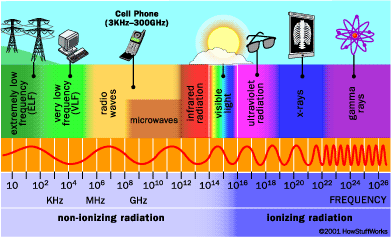
Professor Kromhout: ‘Research into future exposure to 4G and 5G radiation is warranted’ https://innovationorigins.com/professor-kromhout-research-into-future-exposure-to-4g-and-5g-radiation-is-warranted/ This week and next week, Innovation Origins is looking at the growing influence of wireless communication within today’s society and in particular at data transmission via electromagnetic with ever-higher frequencies, such as 5G.
Research is needed to map out exactly what the exposure to electromagnetic fields is as soon as the new frequencies come into effect for communicating data wirelessly with 5G. In the interim, 4G will coexist with 5G. This means that levels of electromagnetic fields might experience an overall increase. So says Professor Hans Kromhout, who is chair of the Exposure Assessment and Occupational Hygiene group at the University of Utrecht in the Netherlands. Kromhout is also chair of the Committee Electromagnetic Fields (EMF) Health Council of the Netherlands. This committee is investigating the possible health risks associated with 5G at the request of the Dutch House of Representatives. The advisory report is due by the end of July, as stipulated by the Health Council of the Netherlands.
“The level of expected exposure to radiofrequency fields can be easily mapped out. The people who devised the technology for 5G are very smart physicists. They should be able to do this.”
Resistance to 5G
Several individuals and groups in The Netherlands are actively opposing the introduction of 5G because they are convinced that radiofrequency waves are harmful. Some claim that there is a conspiracy to harm the population. Over the past few months, it has frequently been reported in the news that activists had set fire to telecom companies’ masts. Some of these new 5G antennas will have to be placed on the same masts that are currently used for 4G.
Another group has filed a preliminary injunction against the government which is to auction off the new frequencies starting this summer.
Several documents circulate among activists, such as a pamphlet written by Martin Pallan, an American emeritus professor of biochemistry at the University of Washington. The pamphlet claims that electromagnetic fields used for 5G can lead to, among other things, damage to DNA, increased risk of infertility, cancer, ADHD, and Alzheimer’s disease.
No scientific evidence linked to cancer
According to Kromhout, there isn’t any substantiated evidence-based scientific research that proves that such diseases are caused by the use of mobile phones and exposure to radiofrequency fields from transmission masts. Kromhout himself participated in research into the effect that mobile phone usage might have on the onset of headaches, tinnitus (a hearing disorder whereby you constantly hear peeping sounds in your ear when in reality there’s no sound), hearing impairment and insomnia. This study did not show a connection between the radiofrequency fields and the health complaints that were studied. Although it did show a connection with the (excessive) use of a mobile phone.
Kromhout also took part in a study into the effect of electromagnetic fields on people who consider themselves to be ‘electrohypersensitive.’ This experimental double-blind study showed that the test subjects were unable to perceive whether or not they were exposed to electromagnetic fields. This made the claim that their complaints were related to these fields far more improbable.
Research into the effect of static magnetic fields from MRI scanners on nurses and workers in the production of MRI scanners showed that after prolonged exposure, they are more likely to suffer from dizziness, abnormal bleeding in the uterus, and an increased risk of developing high blood pressure. “The levels of radiation to which these people are exposed are significantly higher than those of people using a mobile phone,” Kromhout adds. “You cannot use those tests to determine any potential effects of 4G or 5G on health.”
Absence of test procedures for determining health effects stemming from 5G
In spite of this, Kromhout thinks it is appropriate to carry out research into any eventual effects. “When a company introduces a new medicine, it has to go through all kinds of test procedures to be certain that they are safe to public health. This hasn’t taken place at all here.”
It is difficult to establish with 100% certainty that there is no damage to health without scientific research because you just don’t know exactly what the influence of 4G and 5G is. “But I don’t think it’s likely that the damage could be more severe as a result of the use of these higher frequencies. Electromagnetic fields with lower frequencies are able to penetrate deeper into your head. These seem to me to be more dangerous than high frequencies like 5G. Research should, therefore, focus more on the skin. Skin is what is most likely to come into contact with electromagnetic fields at higher frequencies.”
The fact that there will be more transmission masts as a result of 5G does not necessarily lead to more exposure, Kromhout believes that as the increasingly higher frequencies that will come into use have a shorter range than existing lower frequencies. “Exposure to radiation in the times of 1G and 2G was many times higher than it is now.”
Yet as 5G will become active alongside 4G, and in light of the fact that there will be a greater number of applications, the total amount of exposure to radiation is still likely to increase for today’s user.
Read other IO articles about 5G via this link.
Nuclear deregulation threatens workers at Pennsylvania plants and nationwide
|
Nuclear deregulation threatens workers at Pennsylvania plants and nationwide https://www.inquirer.com/opinion/commentary/nuclear-plants-coronavirus-regulatory-commission-pennsylvania-20200526.html May 26, 2020 ,Paul Gunter and Linda Pentz Gunter, For the Inquirer Workers at nuclear power plants, just like everywhere else, are falling ill with the highly contagious Covid-19. Pennsylvania’s Susquehanna and Limerick power plants are among those that have so far identified infections among their staff, with incidences soaring at some plants.
One might hope that, at a time of such crisis, the nuclear power industry and its regulator would take every possible step to ensure the health and safety of nuclear workers and their families, as well as the surrounding communities where they live. Unfortunately, the opposite is happening. Instead, the U.S. Nuclear Regulatory Commission (NRC) is relaxing nuclear power plant safety inspections and maintenance while allowing essential staff, including control room operators, security forces and fire brigades, to work longer and exhausting shifts. The extended permitted hours — up to 86-hour work weeks for two weeks straight — are justified, the NRC says, due to absenteeism, workers in quarantine, and Centers for Disease Control (CDC) guidelines for the Covid-19 pandemic, which recommend social distancing, necessitating fewer staff on site. Yet at the same time, the NRC is allowing nuclear power plants to proceed with refueling operations, which can bring in as many as 1,800 workers from across the country. While the nuclear industry was among those in the energy sector demanding priority testing for Covid-19, it is not clear whether testing for the coronavirus was conducted on workers before they arrived at the plants, given the scale of the outbreaks. More recent positive cases have been discovered through testing, with some tests conducted by workers’ personal physicians. The Limerick nuclear power plant in Pennsylvania, which has now completed refueling, saw a level of overcrowding during refueling that alarmed workers. They described sitting “elbow to elbow” in canteens and computer labs, terrified that the coronavirus would rapidly spread among them. One told the Pottsdown Mercury he was “in a constant state of paranoia.” Such a “wildfire” spread of Infection became a reality at the Fermi 2 reactor in Michigan, which was forced to halt refueling. Close to 200 workers tested positive for Covid-19 at the Vogtle nuclear power plant in Georgia, where work has not been stopped, although the workforce has been cut back. Asking workers to put in exhausting shifts not only weakens their immune systems, making them more susceptible to the coronavirus, but could also lead to fatigue-driven errors. Investigators found that sleep deprivation played a part in the March 1979 nuclear accident at the Three Mile Island reactor near Harrisburg. Compounding these risks is the request by reactor operators to postpone inspections of critical safety components, such as steam generators and reactor emergency core cooling systems, for an additional 18 months. The NRC is now allowing for these delays. But skipping over essential safety checks could come at a high price. Steam generators are critical to power operations and reactor safety. The reactors’ harsh operational environment places extreme stresses on the heat transfer component, causing tube degradation from vibration, heat, radiation, corrosion, and cracking that must be guarded against through routine inspection and maintenance. Arguing for a reduction in nuclear power plant staff to avoid unnecessary contact might sound reasonable if it were not contradicted by the overcrowding brought on by the influx of large refueling crews. This suggests that the shared priority of the nuclear industry and its captured regulator is production, putting financial interests ahead of the wellbeing and safety of workers and surrounding communities. Mandatory testing of refueling crews and maintenance crews could prioritize both production and safety agendas. Overextending exhausted workers could be also avoided by allowing reactors closed for refueling to delay restart and remain shuttered, especially given that electricity demand has fallen with most of the country in lockdown. Instead, those stay-at-home workers could supplement the crews at operating plants, ensuring worker safety and site security and reducing the likelihood of an accident due to exhaustion or human error. The prospect of a serious nuclear power accident under the current pandemic conditions would set up an impossible choice for entire communities surrounding the affected reactor, already sheltering in place from the viral threat: whether to evacuate with potentially tens of thousands of others, or stay, instead risking radiation exposure. The disastrous flooding last week in Michigan, necessitating mass evacuations, has now given us a preview of this conundrum, without the added danger of radiation exposure. Japan faced such a confluence of crises in March 2011, when the country was struck with an earthquake and tsunami, followed by widespread radiation contamination from the Fukushima nuclear meltdowns. This resulted in rescue attempts of some survivors of the tsunami and earthquake being abandoned due to the high levels of radioactivity in areas too contaminated for first responders to enter. Now is not a time to increase the likelihood of a serious nuclear accident here at home. Instead, the NRC should be taking this opportunity to fulfill its stated mandate of “protecting the people and environment,” rather than bowing to the craven financial interests of the nuclear power industry.
Paul Gunter is Director of the Reactor Oversight Project at Beyond Nuclear, a national non-profit anti-nuclear watchdog organization based in Takoma Park, Maryland. Linda Pentz Gunter is Beyond Nuclear’s international specialist and edits and writes for its online magazine, Beyond Nuclear International. |
|
During pandemic, U.S. military runs the largest maritime war games in the world
COVID-19: US Military Pursues War Games Amid Contagion, Consortium News, May 26, 2020 A robust schedule of military maneuvers and exercises is either underway or planned for Europe and the Pacific this year, with more in store for 2021, Ann Wright reports. During the pandemic the U.S. military is running the largest maritime military maneuvers in the world, with Rim of the Pacific (RIMPAC) coming to the waters off Hawaii Aug. 17-31, bringing 26 nations, 25,000 military personnel, up to 50 ships and submarines and hundreds of aircraft.Hawaii hasstringent measures to combat the spread of Covid-19, with a mandatory 14-day quarantine for all persons arriving in the state; returning residents as well as visitors. This quarantine is required until at least June 30, 2020.
The U.S. Army is also pursuing a 6,000-person war game in Poland, June 5-19, with a Polish airborne operation and a U.S.-Polish division-size river crossing.
If these weren’t too many military operations during an epidemic in which personnel on 40 U.S. Navy ships have come down with the hyper-contagious virus and during which military personnel and their families have been told not to travel, plans are also underway for a U.S. Army division-sized exercise in the Indo-Pacific region in less than a year. Known as Defender 2021, the U.S. Army has requested $364 million to conduct the war exercises throughout Asian and Pacific countries.
The pivot to the Pacific, begun under the Obama administration, and maintained by the Trump administration, is reflected in a U.S. National Defense Strategy (NDS) that sees the world as “a great power competition rather than counterterrorism and has formulated its strategy to confront China as a long-term, strategic competitor.”
Earlier in May, the U.S. Navy sent at least seven submarines, including all four Guam-based attack submarines, several Hawaii-based ships and the San Diego-based USS Alexandria to the western Pacific in what the Pacific Fleet Submarine Force announced as simultaneous “contingency response operations” for all of its forward-deployed subs. This was all in support of the Pentagon’s “free and open Indo-Pacific ” policy — aimed at countering China’s expansionism in the South China Sea — and as a show of force to counter ideas that the capabilities of U.S. Navy forces have been reduced by Covid-19…….
In May, 2020, the Australian government announced that a delayed six-month rotation of 2,500 U.S. Marines to a military base in Australia’s northern city of Darwin will go ahead based on strict adherence to Covid-19 measures including a 14-day quarantine. The Marines had been scheduled to arrive in April but their arrival was postponed in March because of the pandemic.
The remote Northern Territory, which had recorded just 30 Covid-19 cases, closed its borders to international and interstate visitors in March, and any arrivals must now undergo mandatory quarantine for 14 days. U.S. Marine deployments to Australia began in 2012 with 250 personnel and have grown to 2,500. The Joint U.S. Defense facility Pine Gap— the U.S. Department of Defense, Five Eyes and CIA surveillance facility that pinpoints airstrikes around the world and targets nuclear weapons, among other military and intelligence tasks — was also adapting its policy and procedures to comply with Australian government COVID restrictions.
As the U.S. military expands its presence in Asia and the Pacific, one place it will NOT be returning to is Wuhan, China. In October 2019, the Pentagon sent 17 teams with more than 280 athletes and other staff members to the Military World Games in Wuhan. Over 100 nations sent a total of 10,000 military personnel to the games in Wuhan last October.
The presence of a large U.S. military contingent in Wuhan just months before the outbreak of the Covid-19 in Wuhan in December 2019, fueled a theory by some Chinese officials that the U.S. military was somehow involved in the outbreak, which now has been used by the Trump administration and its allies in Congress and the media that the Chinese deliberately used the virus to infect the world and adding justification for the U.S. military build-up in the Pacific region.
Ann Wright served 29 years in the U.S. Army/Army Reserves and retired as a colonel. She was a U.S. diplomat for 16 years and served in U.S. Embassies in Nicaragua, Grenada, Somalia, Uzbekistan, Kyrgyzstan, Micronesia, Afghanistan and Mongolia. She resigned from the U.S. government in March 2003 in opposition to President George W. Bush’s war on Iraq. She is co-author of “Dissent: Voices of Conscience.” https://consortiumnews.com/2020/05/26/covid-19-military-pursues-war-exercises-amid-contagion/
The danger to children of low level nuclear radiation has been underestimated

|
How dangerous is low-level radiation to children? https://climatenewsnetwork.net/how-dangerous-is-low-level-radiation-to-children/#.Xsn914VYtCg.twitter May 22nd, 2020, by Paul Brown
A rethink on the risks of low-level radiation would imperil the nuclear industry’s future − perhaps why there’s never been one. The threat that low-level radiation poses to human life, particularly to unborn children, and its link with childhood leukaemia, demands an urgent scientific reassessment. This is the conclusion of a carefully-detailed report produced for the charity Children With Cancer UK by the Low-Level Radiation Campaign. It is compiled from evidence contained in dozens of scientific reports from numerous countries over many decades, which show that tiny doses of radiation, some of it inhaled, can have devastating effects on the human body, particularly by causing cancer and birth defects. The original reports were completed for a range of academic institutions, governments and medical organisations, and their results were compared by the newest report’s authors, Richard Bramhall and Pete Wilkinson. They believe they have provided overwhelming evidence for a basic rethink on so-called “safe” radiation doses. They write: “The fundamental conclusion of this report is that when the evidence is rationally assessed it appears that the health impacts, especially in the more radio-sensitive young, have been consistently and routinely underestimated.” Ceaseless controversy The pair concede this is not the first time such a call has been made, but it has never been acted upon. Now they say it must be. What constitutes safety for nuclear workers and for civilians living near nuclear power stations, or affected by fall-out from accidents like the ones at Sellafield in Cumbria in north-west England in 1957, Chernobyl in 1986 and Fukushima in 2011, has always been highly controversial. Bramhall and Wilkinson detail how the debate began in earnest in the 1980s, when a cluster of childhood leukaemia cases, ten times higher than would be expected, was identified around Sellafield. Government inquiries followed but reached no settled conclusion, and low-level radiation safety has been a scientific battleground ever since. The official agencies appointed by governments are still using dose estimates based on calculations made in 1943, when Western governments were trying to develop an atomic bomb.
The new report highlights that this was when very little was known about how tiny doses of ingested radiation could affect the body − and when DNA was yet to be discovered. Despite the fact that international standards are based on these scientifically ancient, out-of-date assumptions, they have not been revised. If they were, the results could be catastrophic for the nuclear industry and for the manufacturers of nuclear weapons. The report makes clear that if the worst estimates of the damage that low-level radiation causes to children proved anywhere close to correct, then no-one would want to live anywhere near a nuclear power station. Most would be appalled if they knew even small numbers of children living within 50 kilometres of a station would contract leukaemia from being so close. It acknowledges that the stakes are high. If the authors’ findings are accepted, then it will be the end of public tolerance of nuclear power. Revolution needed Despite this long-lived institutional pushback from governments and the industry, the report says what is needed is a scientific revolution in the way that low-level radiation is considered. It compares the situation with the treatment of asbestos. It was in the 1890s that the first evidence of disease related to asbestos exposure was laid before the UK Parliament. But it was not until 1972, when the causal link between the always fatal lung cancer, mesothelioma, and human fatality rates was established beyond reasonable doubt, that the use of asbestos was banned. This delay is why on average 2,700 people still die annually in the UK: they were at some point exposed to and inhalers of asbestos. Another example, which the report does not quote but is perhaps as relevant today, is air pollution. It has taken decades for the scientific community to realise that in many cities it is the tiniest particles of air pollution, invisible to the naked eye, that are taken deepest into the lungs and that cause the most damage, killing thousands of people a year. So far governments across the world have not yet outlawed the vehicles and industrial processes that are wiping out their own citizens in vast numbers. Anxiety not irrational The report cites many studies, with perhaps the most telling those that compare the actual numbers of cancers and malformations in babies which occurred in the aftermath of the Chernobyl accident with the numbers to have been expected if the currently accepted and out-of-date risk calculations had been used. Despite the difficulties of getting information from reluctant governments close to Chernobyl, the report says: “The discrepancy between the number of congenital malformations in babies expected after Chernobyl and the number actually observed was between 15,000 and 50,000.” The authors say their object “is to dispel the repeated assertion that public anxiety about the health impact of radioactivity in the environment is irrational.” Both Wilkinson and Bramhall have considerable experience of dealing with governments, both inside official bodies as members, and as external lobbyists. They detail how they believe the concerns of both ordinary people and scientists have been swept aside in order to preserve the status quo. Clearly, in sponsoring the report, Children with Cancer UK agrees. − Climate News Network |
|
Michigan flooding: a warning on potential triple disaster – climate, pandemic, and nuclear radiation

Michigan authorities were forced to face a “no-win compromise” between protecting the public from exposure to Covid-19 while at the same time moving people out of harm’s way after heavy rains caused failures at the Edenville and Sanford dams, leading to devastating floods.
The Dow plant insists there have been no chemical or radiological releases, but the situation will be evaluated once floodwaters recede. Fortunately, no full-scale commercial nuclear power plant was in the path of the Michigan floods.
Operating nuclear power stations are required by federal and state laws to maintain radiological emergency preparedness to protect populations within a ten-mile radius from the release of radioactivity following a serious nuclear accident. These measures include mass evacuations.
However, many communities around the nation’s 95 commercial reactors are presently sheltering-in-place at home as a protective action during the Covid-19 pandemic.
The Michigan flooding has forced the relocation of thousands of citizens from their stay-at-home lockdown into the social distancing challenges of mass shelters. Evacuating tens of thousands from a likely more far-reaching radioactive cloud to mass shelters, as is presently planned during a nuclear emergency, raises difficult if not impossible choices under pandemic conditions.
In fact, a Memorandum of Understanding (MOU) (Sect.03.02 p.2) between the U.S. Nuclear Regulatory Commission (NRC) and the Federal Emergency Management Agency (FEMA) already obligates the federal government to re-exam radiological emergency plans around nuclear facilities specifically in response to a pandemic, and to identify any shortcomings, deficiencies and enhancements that might be needed under such conditions.
But to date, neither agency has taken the initiative to do so. In fact, the NRC actions are focused on relaxing safety measures required by operating licenses, resulting in extended work hours for reactor operators and security guards, and deferred safety inspections and repairs for as much as another 18 months. This makes an accident more likely.
Given what we are now seeing in Michigan, the NRC and FEMA should lose no time in reviewing their MOU and the viability of their radiological emergency plans, and take action to make any necessary enhancements or shut these nuclear facilities down.
Beyond Nuclear has identified two such actions under the MOU as vital to public health:
- The NRC and FEMA must conduct a “Disaster Initiated Report”, as mandated by the MOU, on the adequacy of offsite radiological emergency response plans during the pandemic, and;
- Federal and state response plans need to be bolstered by the immediate pre-distribution of potassium iodide (KI) tablets by direct delivery to every resident within the ten-mile radius of U.S. nuclear power stations, now, before any accident occurs. This is in accordance with disaster medicine expert recommendations including from the American Thyroid Association (ATA).
- KI, if taken promptly in advance or shortly after exposure to radioactive iodine, is recognized by the US Food and Drug administration as a safe, inexpensive and effective prophylactic prevention for thyroid cancer and other developmental disorders caused by exposure to highly mobile iodine-131. Radioactive iodine is a gas released early in a serious nuclear accident.
- KI is particularly important for the protection of infants, young children and pregnant women and should be readily on hand, according to the ATA and the American Academy of Pediatrics.
The ATA further recommends stockpiling KI tablets in schools, hospitals, police and fire stations from 10 miles out to 50 miles from every nuclear power plant. These institutions could then serve to pre-distribute KI free through the mail upon request to every home and business within 50 miles of an operating nuclear plant.
KI is commonly used to iodize table salt in concentrations. When taken in tablet form, it saturates the thyroid with stable iodine and blocks the absorption of radioactive iodine into the thyroid gland.
- KI only protects the thyroid. It does not protect other parts of the body, or prevent damage from other radioactive isotopes released during a nuclear power plant accident, such as cesium-137 or krypton or xenon gases. Ideally, it is used to provide protection to the thyroid — because iodine-131 can be the large and early radioactive exposure first to arrive — while people are still evacuating out of the oncoming radioactive fallout pathway.
KI is a critical adjunct to evacuation, but it should not replace evacuation from a nuclear accident, even during a viral pandemic. If faced with an immediate threat to life, perhaps even a triple threat such as an extreme flood, a nuclear accident and Covid-19 exposure, evacuation must be the immediate decision.
However, at least having KI tablets on hand provides for a reasonable protection from the radioactive iodine, a fundamental human right while seeking to shelter farther away from a nuclear accident.
The prospect of a nuclear disaster prompting a mass evacuation during a viral pandemic reinforces the need for an energy policy focused on safe, clean and affordable renewable energy. It’s time to remove the added and unnecessary danger presented by the 95 nuclear reactors still operating in the US today and transition to a rapid phaseout before a nuclear emergency during a pandemic becomes a nightmarish reality.
U.S. Unprepared for Nuclear Accident During Pandemic
U.S. Unprepared for Nuclear Accident During Pandemic Common Dreams, 22 May 20
Michigan floods expose impossible challenges of mass evacuation during Covid-19
Emergency preparedness must include direct delivery of potassium iodide to all residents around nuclear plants
TAKOMA PARK, MD – Two dam failures and catastrophic flooding in central Michigan, which also prompted a low-level emergency notification (NRC event #54719) at a nearby nuclear research reactor in Midland, have exposed the almost impossible challenge of evacuating people to safety during simultaneous catastrophic events.
The sudden need to evacuate large numbers of people from severe flooding — also threatening to compromise a Dow chemical facility that uses a research reactor — during a time of national lockdown due to the Covid-19 pandemic, raises “serious questions and concerns about the emergency response readiness and the viability of evacuation that might simultaneously include a radiological accident,” said Paul Gunter, director of the Reactor Oversight Project at Beyond Nuclear, a national anti-nuclear advocacy organization.
Michigan authorities were forced to face a “no-win compromise” between protecting the public from exposure to Covid-19 while at the same time moving people out of harm’s way, after heavy rains caused failures at the Edenville and Sanford dams, leading to devastating floods. The Dow plant insists there have been no chemical or radiological releases, but the situation will be evaluated once floodwaters recede. Fortunately, no full-scale commercial nuclear power plant was in the path of the Michigan floods.
Operating nuclear power stations are required by federal and state laws to maintain radiological emergency preparedness to protect populations within a ten-mile radius from the release of radioactivity following a serious nuclear accident. These measures include mass evacuations.
However, many communities around the nation’s 95 commercial reactors are presently sheltering-in-place at home as a protective action during the Covid-19 pandemic.
“The Michigan flooding has forced the relocation of thousands of citizens from their stay-at-home shelters into the social distancing challenges of mass shelters,” Gunter said. “Evacuating tens of thousands from a radioactive cloud to mass shelters, as is presently planned during a nuclear emergency, raises difficult if not impossible choices under pandemic conditions.”
In fact, a Memorandum of Understanding (MOU), Sect.03.02, p.2, between the U.S. Nuclear Regulatory Commission (NRC) and the Federal Emergency Management Agency (FEMA) already obligates the federal government to re-exam radiological emergency plans around nuclear facilities specifically in response to a pandemic, and to identify any shortcomings, deficiencies and enhancements that might be needed under such conditions.
But to date, neither agency has publicly taken the initiative to do so. In fact, the NRC actions are focused on relaxing safety measures required by operating licenses, resulting in extended work hours for reactor operators and security guards, and deferred safety inspections and repairs for as much as another 18 months. This makes an accident more likely.
“Given what we see in Michigan, the NRC and FEMA should lose no time in reviewing the viability of their radiological emergency plans, and publicly take action to make any necessary enhancements or shut these nuclear facilities down,” Gunter said.
Beyond Nuclear has identified two such actions under the MOU as vital to public health:
- NRC and FEMA must conduct a “Disaster Initiated Report”, as mandated by the MOU, on the adequacy of offsite radiological emergency response plans during the pandemic, and;
- Federal and state response plans need to be bolstered by the immediate pre-distribution of potassium iodide (KI) tablets by direct delivery to every resident within the ten-mile radius of U.S. nuclear power stations, now, before any accident occurs. This is in accordance with disaster medicine expert recommendations including from the American Thyroid Association (ATA)……..“The prospect of a nuclear disaster prompting a mass evacuation during a viral pandemic reinforces the need for an energy policy focused on safe, clean and affordable renewable energy,” said Gunter. “It’s time to remove the added and unnecessary danger presented by the 95 nuclear reactors still operating in the US today, and transition to a rapid phaseout before a nuclear emergency during a pandemic becomes a nightmarish reality.” https://www.commondreams.org/newswire/2020/05/22/us-unprepared-nuclear-accident-during-pandemic
1 This Month

of the week – Shut Down Drone Warfare!


Tell the Ukrainian Government to Drop Prosecution of Peace Activist Yurii Sheliazhenko

Petition to revoke the licensing of the Near Surface Nuclear Disposal Facility (NSDF) at Chalk River. https://www.ourcommons.ca/petitions/en/Petition/Details?Petition=e-7247
To see nuclear-related stories in greater depth and intensity – go to https://nuclearinformation.wordpress.com
-
Archives
- April 2026 (114)
- March 2026 (251)
- February 2026 (268)
- January 2026 (308)
- December 2025 (358)
- November 2025 (359)
- October 2025 (376)
- September 2025 (257)
- August 2025 (319)
- July 2025 (230)
- June 2025 (348)
- May 2025 (261)
-
Categories
- 1
- 1 NUCLEAR ISSUES
- business and costs
- climate change
- culture and arts
- ENERGY
- environment
- health
- history
- indigenous issues
- Legal
- marketing of nuclear
- media
- opposition to nuclear
- PERSONAL STORIES
- politics
- politics international
- Religion and ethics
- safety
- secrets,lies and civil liberties
- spinbuster
- technology
- Uranium
- wastes
- weapons and war
- Women
- 2 WORLD
- ACTION
- AFRICA
- Atrocities
- AUSTRALIA
- Christina's notes
- Christina's themes
- culture and arts
- Events
- Fuk 2022
- Fuk 2023
- Fukushima 2017
- Fukushima 2018
- fukushima 2019
- Fukushima 2020
- Fukushima 2021
- general
- global warming
- Humour (God we need it)
- Nuclear
- RARE EARTHS
- Reference
- resources – print
- Resources -audiovicual
- Weekly Newsletter
- World
- World Nuclear
- YouTube
-
RSS
Entries RSS
Comments RSS
 nuclear-news