Thyroid cancer at ages 0 and 2 at the time of the nuclear accident-Health survey in Fukushima Prefecture January 2021
Thyroid cancer at ages 0 and 2 at the time of the nuclear accident-Health survey in Fukushima  Prefecture Posted by: ourplanet Posted on: Thu, 01/14/2021 –00:46 http://ourplanet-tv.org/?q=node/2537 (Japanese only)
(Translated from Google) The “Prefectural Health Survey” Review Committee was held in Fukushima City on the 15th to discuss the health survey of Fukushima citizens following the accident at the Fukushima Daiichi Nuclear Power Plant. For the first time, it was discovered that two infants, a 0-year-old girl and a 2-year-old girl at the time of the accident, were diagnosed with thyroid cancer.
Material https://www.pref.fukushima.lg.jp/site/portal/kenkocyosa-kentoiinkai-40.html

This time, the result of the fourth round of thyroid examination until June last year was newly announced. The number of children diagnosed with suspected thyroid cancer by fine needle cytology increased by 6 from the previous time to 27, and the number of children who underwent thyroidectomy increased by 3 from the previous time to 16 children. Up to now, 252 patients have been diagnosed with thyroid cancer or suspected thyroid cancer from prior examination, of which 203 have undergone thyroid surgery. 202 people, excluding one, were confirmed to have thyroid cancer.
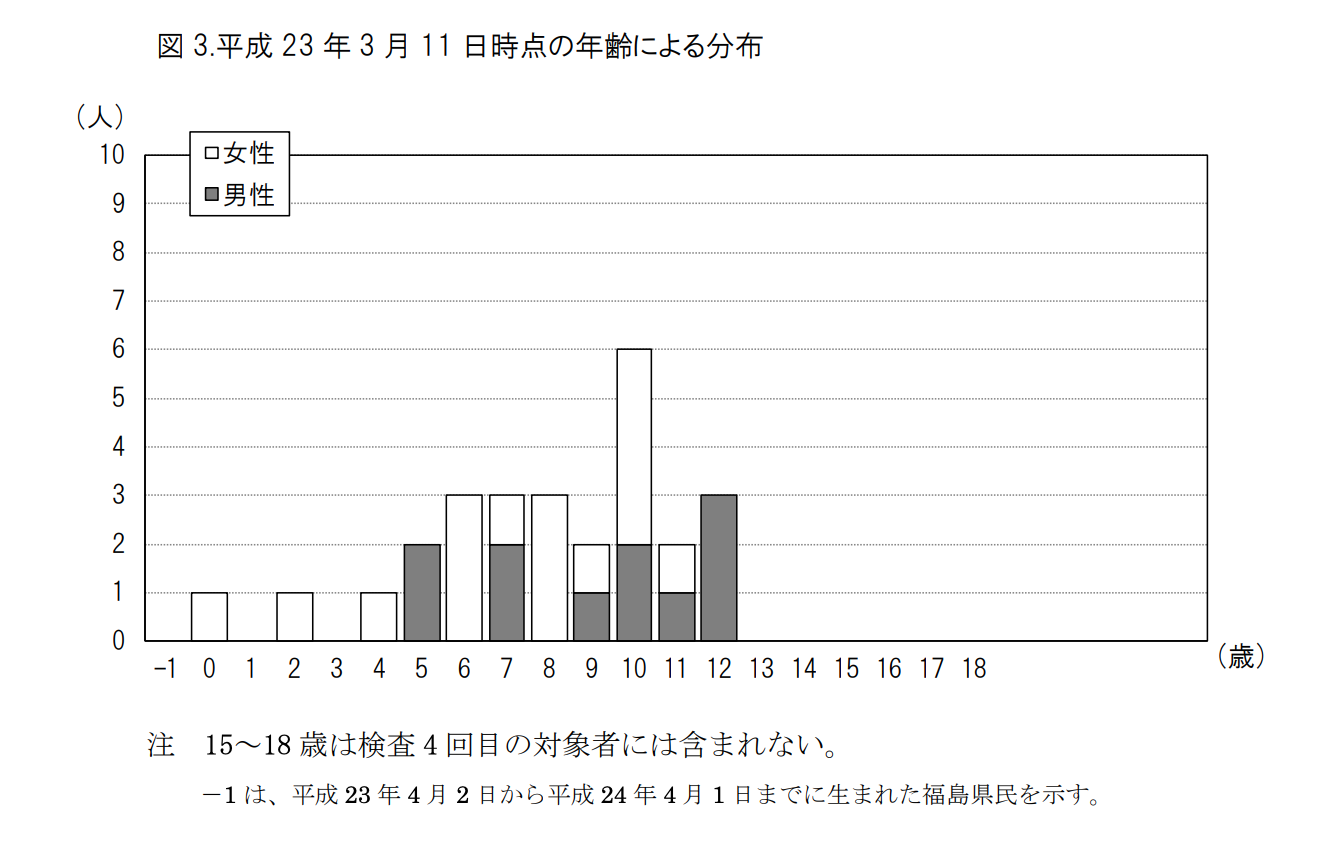
In the fourth round of examination, it was found for the first time that a girl who was 0 years old and a girl who was 2 years old at the time of the accident were diagnosed with thyroid cancer. Since the age of the examination is not the actual age but the grade, the ages at the time of the examination are 9 years old (3rd grade of elementary school) and 11 years old (5th grade of elementary school), respectively. According to the previous test results of 27 patients, 5 patients had “A1 judgement” without nodules or tumors, and 16 people had “A2 judgement” with nodules of 5 mm or less or cysts of 2 cm or less, 5 mm or more. 5 people had a “B-judgement” with nodules or cysts of 2 cm or more, and 1 had not been examined. He had the smallest tumor size of 6.1 mm and the largest tumor was 29.4 mm.
What stands out in the results of the fourth round of examination is the high dose of radiation for people diagnosed with thyroid cancer. Of the 27 patients diagnosed as suspected of being malignant by fine needle cytology, 11 patients (40.7%) who submitted the basic survey questionnaire had an exposure dose of less than 1 mSv in 2 patients (18.1%) 4 months after the accident. The number of children exposed to 2mSv or more was the highest, with 4 (36.3%) from 1mSv to 2mSv and 5 (45.5%) from 2mSv to 5mSv. In particular, the two boys who were five years old at the time of the accident were both over 2mSv.
According to the results of the basic survey of all Fukushima residents, 62.2% are less than 1mSv, 31.6% are from 1mSv to 2mSv, and 5.5% are from 2mSv to 3mSv. Very different.

To review the mass examination at school At this review committee, a major shift was made to reviewing simultaneous examinations at schools. The test, which has found more than 200 people with thyroid cancer, raises the theory of “overdiagnosis” among experts who deny the effects of radiation exposure, saying that they are finding thyroid cancer that they do not have to find. There is a growing opinion that the mass examination at school should be reviewed.
Based on these opinions, the review committee decided to conduct an interview survey at schools in the prefecture on August 31st last time. This time, there was a report on the results of a survey conducted by the prefecture at 26 elementary and junior high schools and high schools in the prefecture.
At many schools, thyroid examinations were performed during class hours, criticized by Shoichiro Tsugane, a member of the National Cancer Center, saying, “You can’t take this without a strong will.” “The benefits of the test are not except that you can be reassured when you get negative. The discovery of thyroid cancer has little benefit in avoiding death or poor quality of life, especially when you are diagnosed with thyroid cancer. “I think it will be a huge disadvantage for those who do,” he said. “Thyroid examination in a group of asymptomatic healthy people is not desirable. I asked him to stop the mass examination at school. ..
In addition, Professor Toshiya Inaba of Hiroshima University also cut out at the school examination that “they are left behind” and said, “Parents are not worried. The school rents the venue. The prefectural medical college has an inspection. I understand each position well, but in the end, it is the people who are left unattended. ” He emphasized that the prefectures and medical colleges that are the subjects of the survey should explain more to children and students the significance of the test and the fact that it can be rejected.

In response, Professor Satoshi Tomita of Fukushima University argued head-on. He criticized that “many Fukushima residents have anxiety about their health” and that members of the Prefectural Health Investigation Committee, especially members outside Fukushima Prefecture, are calling for the cancellation or reduction of examinations. He said that thyroid examination is a way to relieve the anxiety of Fukushima residents, “the anxiety of Fukushima residents, especially those with children, is left behind.” “It is dangerous to go in the direction of reduction easily.” “Thinking” was pointed out.
Ikuko Abe, chairman of the Fukushima Clinical Psychologists Association, who also lives in Fukushima Prefecture and has a close relationship with schools, agrees with this, saying, “I agree with Professor Tomita’s opinion.” “Given the anxiety about radiation that Fukushima residents have, thyroid examinations are very reassuring,” she said. “Reducing or eliminating the examinations still takes the opposite position. I want you to do it. “
What caught my eye in the discussion was the presence of Katsushi Tahara, director of the Ministry of the Environment’s Health and Welfare Department. The members of the review committee from the Ministry of the Environment have not said much, but have played a role in important aspects of policy change. This time too, Mr. Tahara considers the fact that the school is cooperating with the implementation of the examination, such as encouraging households whose delivery to Fukushima Medical University is delayed to submit again when the deadline has passed. About 30% of the children undergoing medical examinations at school were asked intensively about this point, such as confirming that the school side took over the collection of consent forms.
To conduct hearings with the person to be inspected Following a survey of the school, the prefecture proposed to have a place to hear directly from the children and students who had been inspected. Questions were raised about the representativeness of the interviewees, and there was an opinion requesting a quantitative survey such as a questionnaire, but the prefecture’s proposal was approved because the survey took too long.
Regarding this “interview survey,” there was a harsh debate over the neutrality of the content, such as the opinion that a pilot study was unavoidable and that the voices of patients diagnosed with thyroid cancer should also be heard. With the strong push back of the constellation chairman, it was decided that the selection of the target audience and the holding method would be left to the chairperson and the prefecture. The results will be reported at the next meeting.
In response to the further shift to reviewing mass screening at school in this “interview,” Chiba parent and child of the “thyroid cancer support group Hydrangea Association” that supports families with thyroid cancer said, “Accident Among the 0-year-old and 2-year-old children at that time, a child with thyroid cancer appeared and my chest hurts. Thyroid cancer also has recurrence and metastasis, and early detection and early treatment are beneficial for the child. Given that the cancer was found in a school test, there can be no argument to eliminate the school test. ” The group has made offers to the prefecture three times in the past and opposes the reduction of inspections.
183 workers at Waste Isolation Pilot Plant infected with COVID-19
|
183 workers at Waste Isolation Pilot Plant infected with COVID-19, Adrian Hedden
Carlsbad Current-Argus, 8 Jan 21,
Six more cases of COVID-19 were reported at the Waste Isolation Pilot Plant last week, bringing the facility’s total caseload to 183 as coronavirus continued to spread in New Mexico.All six of the cases reported at the nuclear waste facility near Carlsbad were from employees of Nuclear Waste Partnership (NWP), the primary operations contractor at WIPP. The employees were last at the site between Dec. 3 and 18, and the positive results were reported between Dec. 22 and 28……. https://www.currentargus.com/story/news/local/2021/01/05/183-workers-waste-isolation-pilot-plant-infected-covid-19/4125844001/ |
|
|
Canada shows how nuclear reactors are not needed for production of technetium-99m
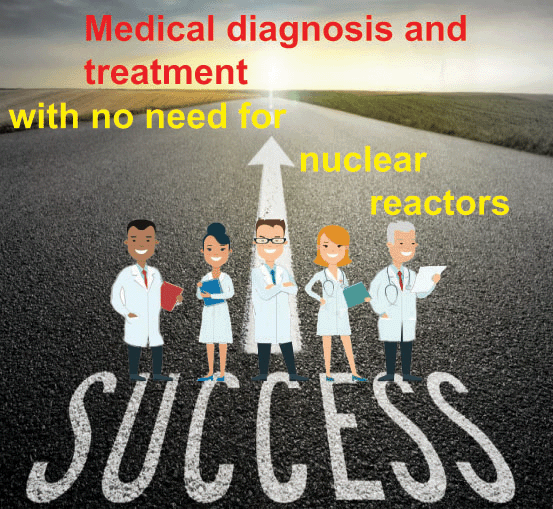
these cyclotrons can be used to reliably create technetium-99m regionally and without the need for reactor-based materials.
Cyclotron-produced technetium-99m approved by Health Canada, TRIUMF,
Now, a new cyclotron-based approach to producing this critical diagnostic tool has received Health Canada approval, greenlighting the made-in-Canada technology for national implementation and opening the door to a greener, more reliable way to make technetium-99m.
The approval represents a critical milestone for the TRIUMF-led Cyclomed99 consortium, which spearheaded the innovative research effort. The consortium, including partners BC Cancer, the University of British Columbia (UBC), the Lawson Health Research Institute, and the Centre for Probe Development and Commercialization, is the first in the world to obtain full regulatory approval for cyclotron-based production.
It also a turning point for the consortium‘s licensee ARTMS Inc., the TRIUMF spin-off company bringing this technology to market. ARTMS’ technology makes technetium-99m production possible on many of the world’s most common medical cyclotrons, enabling regional production of this critical isotope within local communities.
“Medical isotopes help so many people every day. It’s critical to have a stable, multi-faceted supply chain to avoid unexpected disruptions to their availability,” said Paul Schaffer, Associate Laboratory Director, Life Sciences at TRIUMF and Associate Professor at UBC’s Faculty of Medicine. “The approval of cyclotron-produced technetium-99m by Health Canada is an important milestone for this Canadian innovation that will ultimately deliver direct benefit for Canadian patients.”
While the Health Canada approval brings new promise for patients and researchers, it also highlights an important chapter in Canadian innovation, one which saw a focused national research effort produce an effective solution to a global problem.
The path towards cyclotron-produced technetium-99m ……
In 2009, following unplanned disruptions at NRU (which historically provided up to half of the world’s technetium-99m via molybdenum-99 generators), the Government of Canada initiated the Non-reactor-based Isotope Supply Contribution Program (NISP) which challenged researchers to find a new way to produce critical medical isotopes—in particular, technetium-99m.
Led by Schaffer and TRIUMF‘s Dr. Tom Ruth, scientists and engineers from TRIUMF joined partners at BC Cancer, the Centre for Probe Development Commercialization (CPDC), the Lawson Health Research Institute, and the University of British Columbia to launch a national collaboration to answer the NISP call: the ‘CycloMed99‘ consortium.‘
A new way to produce technetium-99m
The consortium’s proposal detailed a new and innovative technology to enable the production of technetium-99m using medical cyclotrons. These compact particle accelerators already operate in regional healthcare centres worldwide, producing isotopes by bombarding a target material with a proton beam and extracting the desired species. The process is safe and precise, employing stable targets and producing little to no long-lived radioactive waste. And, with the right target and extraction systems, these cyclotrons can be used to reliably create technetium-99m regionally and without the need for reactor-based materials.
“Cyclotron centres across Canada can produce these isotopes locally and on-demand, and we have shown the path that can be used to achieve regulatory approval,” said Francois Bénard, senior executive director of research at BC Cancer, professor of radiology and associate dean of research at UBC’s faculty of medicine. “The same approach can be followed at other sites in Canada and internationally. This has been a shared vision of many researchers across the country, and we have to recognize the many collaborators who worked for years to make this announcement possible.”
This bright future will first take shape at TRIUMF‘s Institute for Advanced Medical Isotopes (IAMI), where a state-of-the-art TR-24 medical cyclotron will offer production capacity for the Lower Mainland‘s technetium-99 needs. In addition, IAMI will serve as a hub for radiopharmaceutical research, providing access to leading-edge facilities and expertise in accelerator technology and isotope science. The Institute will further catalyze the Vancouver region’s diverse nuclear medicine sector by convening researchers, students, academic collaborators, not-for-profits, government, and industry partners.
“With support from the Canadian government and our partners, we have developed an effective solution to the medical isotope crisis, one that will improve health outcomes and reaffirm Canada’s role as a global leader in isotope production and research. … …https://www.triumf.ca/headlines/cyclotron-produced-technetium-99m-approved-health-canada?fbclid=IwAR1d-vA4gmCfoY1HWJqwPBs_KkmGHMfwxGKVK41bnPNeD2I7Yr-vHkaVf4o
Mary Olson pays tribute to Rosalie Bertell, the great explainer of radiation impacts on health.
My Six Mentors, by Mary Olson, Gender and Radiation Impact Project, 1 January 20121
 “……………. Rosalie Bertell, PhD
It was Rosalie who most let me know that I am able to contribute original work towards the day that People, to decide not to split atoms any more. Human beings began splitting atoms in Chicago, in 1942. Rosalie, a PhD in mathematics and member of the Order of Gray Nuns, knew more than anyone else I have worked with, that all of it—every last nuclear license, and radioactive emission, all the waste and all the bombs and all the money congress gives to nuclear activities are choices. People made, and continue to make these decisions…and we can change our mind.
Rosalie studied radiation impacts and was committed to service on behalf of future generations. She won the Right Livelihood award for her work with communities impacted by nuclear industry. Often called the “alternative Peace Prize” – she was one of the first women to be honored. As a laureate, she was encouraged to find and mentor students. Rosalie hoped that I, and my coworker Diane D’Arrigo would go to graduate school and she could be our mentor. We decided since we were already in our 50’s to simply study with her, informally. We traveled, 5 or 6 times to the Mother House where she resided and she generously met with us in the last two years of her life. She was always small in stature, but at that point her back was bent and she barely came up to my chest, but still had the intensity of a wolverine!
It was Rosalie Bertell who helped me tackle one of the biggest challenges I have faced. After a public talk on radioactive waste policy that I gave during this time, a woman asked me if radiation was more harmful to women, to her, compared to a man. Even though I had studied and known many of the top independent radiation researchers, including Bertell, I had never heard that biological sex could be a factor for harm—other than in reproduction (pregnancy)—but that is more about the embryo and fetus than the woman. I told her that I was sorry, I did not know and would get back to her. In fact, I forgot.
Two years later, when nuclear reactors exploded in Japan at a site called Fukushima Daiichi, I remembered that question and knew it urgently needed an answer. I was unaware that Dr Arjun Makhijani and a team had written on sex differences in radiation harm in 2006 (see www.ieer.org ) and also did not turn that up as I searched for any information on differences between males and females. My findings, five years later are an independent confirmation of the IEER work.
Since I found nothing on a basic google dive, I called Rosalie, who was at that point nearing the end of her life, to ask if she had studied biological sex. She had not, and the one report she pointed me to was out of print. It was my second call, a week later, that prompted her to tell me that I would have to look at the data myself.
I had no idea that the National Academy of Science (NAS) had published tables with 60 years of data on cancers and cancer deaths among the survivors of Hiroshima and Nagasaki. Rosalie told me to find out for myself. I was shocked. I had stopped any formal study of math in the 6th grade…she was a mathematician—I asked her to do it, and she reminded me that she was dying. I protested again. It was her next words that pushed me. Rosalie said, “The data is divided by males and females so you can look at this question—and if there is a difference, it will be a simple pattern. It is good you do not have more math because if there is a difference, you will find it and not make it more complicated than it is.” She said to get a few pencils, a sharpener, an eraser and lots of paper, and go to it. I did.
The result was my first paper on the topic, “Atomic Radiation is More Harmful to Women,” (October 2011) published to the web in time for Rosalie to congratulate me. Three years later the paper was the basis for my invitation to speak at the global Vienna Conference on the Humanitarian Consequences of Nuclear Weapons. Three years later as the new Treaty on the Prohibition of Nuclear Weapons was in the work, I founded the Gender and Radiation Impact Project. Rosalie is the one who put rocket fuel in my determination to help. If the world decides to base radiation protection on Refence Little Girl—make every regulation in terms of protecting females who are infants—five years old, future generations have a chance. Rosalie is the one who modeled for me that it is possible to reach for the best possible outcome, and, indeed, we have an obligation to do so………..…… https://www.genderandradiation.org/blog/2020/12/31/my-six-mentors
How the USA and Soviet Union planned to use nuclear radiation as a weapon.
 This was initially seen as a great idea – you could kill all the people while leaving the omfrastructure intact for your own use.
For decades, the thought of radiological weapons has conjured terrifying images of cities covered in “death dust.” Classified as a weapon of mass destruction — alongside chemical, biological, and nuclear weapons — it has remained a point of mystery as to why these devastatingly indiscriminate weapons were not pursued in earnest by more state and non-state actors alike.
What did early radiological weapons (RW) programs look like? How and why did they arise, and what accounts for their ultimate demise? Aside from a handful of known cases, why have RW programs not proliferated with the same alacrity as other weapons programs?
Thanks to the rigorous and rich historical work of Samuel Meyer, Sarah Bidgood, and William Potter of the Middlebury Institute of International Studies at Monterey, we now have more answers. Focusing on the United States and Soviet Union in the 1940s and 1950s, the authors, in a recent study published in the journal International Security, trace the unique origins of these RW programs, as well as explain why they were subsequently abandoned. Their study, “Death Dust: The Little-Known Story of U.S. and Soviet Pursuit of Radiological Weapons,” reveals a fascinating web of causes, including organizational and bureaucratic politics, international competition, economic and technological constraints, and even the powerful initiatives of well-placed individuals.
While the authors’ work examines the past, it speaks directly to the present and future trajectory of RW programs. If you are interested in military innovation, the history of weapons of mass destruction, the sociology of technology, and science fiction (yes, science fiction!), the exchange featured below is for you.
Samuel Meyer, Sarah Bidgood, and William C. Potter: We define a radiological weapon as one intended to disperse radioactive material in the absence of a nuclear detonation. ……..
……….. May 1941 — the first reference to RW appeared in a U.S. government document: the Report of the Uranium Committee. The report identified three possible military aspects of atomic fission, the first of which was “production of violently radioactive materials … carried by airplanes to be scattered as bombs over enemy territory.” (The other two possible applications noted in the report were “a power source on submarines and other ships” and “violently explosive bombs.”) ………
Technological advances were among the major drivers of RW programs in both the U.S. and the Soviet Union, and RW were initially pursued in tandem with nuclear weapons and chemical weapons (CW) programs. The anticipated promise of RW as a weapons innovation, however, never materialized in either country due to a combination of factors, including technical difficulties in the production and maintenance of the weapons, diminution in the perceived military utility of RW relative to both CW and nuclear weapons, and low threat perceptions about adversary RW capabilities. ……..
the parallelism in many respects between the rise and demise of the U.S. and Soviet RW programs; and (5) the serious but ultimately unsuccessful effort by the United States and the Soviet Union to secure a draft convention at the Conference on Disarmament prohibiting radiological weapons.
MK: Are radiological weapons a thing of the past or do they remain an attractive option for some countries and non-state actors today?
The authors: We are encouraged that no country has either used RW in war or has incorporated them into a national military arsenal. We are concerned, however, that the Russian Federation, despite its own unsuccessful history with RW, has shown renewed interest in advanced nuclear weapons that seek to maximize radioactive contamination. We also worry that some countries may conclude that RW serve their perceived national interests, especially in the absence of international legal restraints. It therefore is important, we believe, to revive U.S.-Russian cooperation to ban radiological weapons and strengthen the norm against their use.
Morgan L. Kaplan is the Executive Editor of International Security and Series Editor of the Belfer Center Studies in International Security book series at the Belfer Center for Science and International Affairs at the Harvard Kennedy School. https://thereader.mitpress.mit.edu/death-dust-the-little-known-story-of-radiological-weapons/
No acknowledgment, no compensation, for a British nuclear test hero
Nuclear veteran who died alone is buried with honour by pals days after he was refused medal
A Cold War hero, who believed he was rendered infertile by radiation experiments, got the send-off he deserved, Mirror UK By Susie Boniface, 27 DEC 2020
Ken Miller’s death went almost unnoticed, but his funeral was conducted with the pomp and ceremony due a war hero, Ken had died alone and childless, aged 82, after taking part in three radiation experiments which he believed left him infertile. He had hoped for at least a medal to acknowledge his service. But just days before he died the government refused, saying men like him had faced no risks.
But after the Mirror publicised his story, his fellow veterans pulled out all the stops to honour him at a humanist ceremony on Christmas Eve.
Ken’s coffin, draped in the flag of the British Nuclear Test Veterans Association, was carried into the crematorium by six ex-military pallbearers to the theme tune from A Bridge Too Far, a film that exemplifies the courage of servicemen and the madness of their generals.
The chapel at Morriston Crematorium in Swansea had expected no mourners, and planned a brief ceremony attended only by local officials.
Instead, the seats were as packed as they could be under pandemic rules for social distancing after Ken’s fellow veterans rallied to give him a proper send-off.
The service heard Billie Holiday’s version of Blue Moon, which was released in 1952, the year of Britain’s first nuclear test. And as the Gerry & The Pacemakers classic You’ll Never Walk Alone was played, the standard of the Soldiers, Sailors and Airmen’s Families Association was dipped over Ken’s coffin.
Then a veteran played a poignant Last Post on the bugle and, after a two minutes’ silence, the Reveille………
Ken was one of 22,000 men, many on National Service, who were ordered to take part in Britain’s Cold War bomb tests. Fewer than 1,500 are still alive, and one of them dies, on average, every week.
Born in Oxford, Ken ran away to join the navy and was a junior rating on HMS Warrior when he was ordered to watch three atomic explosions as part of Operation Grapple, at Malden Island in the South Pacific, in 1957.
The biggest, at 720 kilotons, was 35 times more powerful than the blast which levelled the Japanese city of Nagasaki at the end of the Second World War. It was still ruled a failure by scientists, who went on to detonate much larger H-bombs the following year.
Fellow nuke vet David Taunt, 78, of Swindon, began talking to Ken on the phone during the first lockdown as a BNTVA project to help its members.
He said: “He was one of the guys who stood on the deck with his back to it and then turned round and watched the mushroom cloud rise. He said the ship they were on sailed a lot closer to the blast zone than they should have done. And of course, like all the sailors, he used distilled seawater to drink and wash in.”………
on their regular talks, he discussed memories of the nuclear tests with David, who never met him in person and was unable to attend the funeral in Wales because of travel restrictions.
David said: “I was at Operation Dominic in 1961, when the Americans used British troops to help test close to 30 nuclear bombs at Christmas Island………
David was able to get compensation from the US government due to his cancer, because that nation agrees that service at their tests was the most likely cause. But the UK still refuses payouts or any other recognition, and fights every bid for a small war pension.
He said: “Ken would have been quite happy with a medal. It would be confirmation something happened. He appreciated what the BNTVA and the Mirror were doing for us.”
The medal decision is to be reviewed in the New Year, and 10 Tory MPs, including former ministers and influential backbenchers, have written to Boris Johnson demanding he personally intervene. https://www.mirror.co.uk/news/uk-news/nuclear-veteran-who-died-alone-23226173
A scary reality, Trump still has the nuclear codes
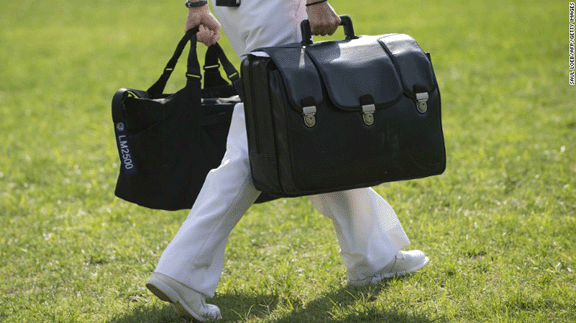
Former Reagan aide: Trump still has the nuclear codes. And that’s genuinely  scary. https://www.nj.com/opinion/2020/12/former-reagan-aide-trump-still-has-the-nuclear-codes-and-thats-genuinely-scary-opinion.html By Star-Ledger Guest Columnist By Mark Weinberg, 24 Dec 20
Almost anything Donald Trump does in his last weeks as president can be undone by Joe Biden. Executive Orders can be reversed, regulations can be changed, unnecessary commissions can be disbanded, and (some) political appointees can be removed from their positions. Unfortunately, a few will remain after Trump leaves because of how terms are structured, but their ability and probably their willingness to cause mischief will be severely limited when their man is out of the White House. At least one hopes so.
That’s the good news.
The bad news is that until noon on January 20th Trump will have access to the codes necessary to authorize a nuclear war. That is genuinely scary.
The size, scale and influence of the United States’ economy notwithstanding, what makes the president of the United States the most powerful person in the world is control of our nuclear weapons.
Our two most threatening adversaries, Russia and China, both have significant nuclear arsenals. Vladimir Putin and Xi Jinping are aware that Trump is a wounded and weakened president and will be so until he leaves office next month. Whether they sense that translates into an opening for them to outright attack us — or at least threaten to — is an open question. No doubt they are watching closely for opportunities to enhance their world domination campaigns at our expense, which means we must be super-vigilant. Nuclear war is no joke. It is as serious as it gets. What animated Ronald Reagan most in his efforts to engage the Soviet Union to reduce both country’s nuclear stockpiles was that each nation had the ability to destroy each other. Reagan called this the “MAD” – Mutually Assured Destruction – policy, which he rightly thought was unacceptably dangerous and worked hard to eliminate. He famously said: “a nuclear war cannot be won and must never be fought.” Contrary to opponents’ depictions, Reagan was not a trigger-happy warmonger. Indeed, he was the opposite. A World War II veteran, he knew well of, and worried about, the indescribably deadly potential of nuclear weapons and took very seriously his duties as president in either responding to — or initiating — a nuclear strike.
As with all modern-day presidents, elaborate steps were taken to make certain Reagan always had access to the nuclear codes wherever he was. There was never a time during Reagan’s presidency when his stability or suitability to have the nuclear codes was in question.
So what to do until he is replaced by a more stable, sensible, and sane president?
Tempting and legitimate as it may be, invoking the 25th Amendment to declare Trump “unable to discharge the powers and duties of his office” is not a realistic possibility at this point. For reasons they will have to explain later, most members of Trump’s Cabinet, including Vice President Michael Pence, are either unable or unwilling to recognize Trump’s instability and unsuitability for office and fear that doing anything to upset him could be professional suicide.
USA government resists paying compensation to nuclear workers made ill by ionising radiation
the labor department ignored overwhelming evidence that her husband became sick from working at SRS
the system has become hard to navigate, with the government often fighting tooth-and-nail against the workers they were supposed to help
More than 2,200 workers had spent five years or more going through the exhaustive claims process, according to McClatchy’s 2015 “Irradiated’’ series. Some workers who filed for benefits died while awaiting decisions from the government, McClatchy found.
 Death and despair. How the feds refused to help a nuclear worker’s family in SC, The State,
 BY SAMMY FRETWELL, December18, 2020 Every time Jerry Bolen came home from a construction job at the local nuclear weapons complex, he took off his dusty coveralls before stepping into the house he shared with his wife and children.
It was a precaution against tracking hazardous, radioactive materials into the family’s home in rural Barnwell County, says his widow, recalling how she would gingerly place the contaminated garment into the washing machine.
But while the effort protected the couple’s three kids, Jerry Bolen suffered. The long days he spent working at the Savannah River Site, exposed to chemicals and radiation, eventually killed him, his widow says.
Now, an exasperated Carolyn Bolen has sued the U.S. Department of Labor following a 13-year battle with the government over whether the family should receive compensation for the cancer that took Jerry Bolen’s life in 2006.
Her story is a familiar one. Many people who worked at SRS have complained for years that a federal compensation program for sick workers and their families is a bureaucratic morass that takes too long to maneuver and often doesn’t provide the benefits they were promised.
In Carolyn Bolen’s case, however, she was turned down so many times for benefits through the federal program that she exhausted all her appeals, prompting the federal lawsuit, she and her lawyers say.
The Nov. 20 suit against the labor department is among a handful of cases in South Carolina by ex-SRS workers and their families who were denied benefits in recent years through the federal compensation program, said Bolen’s lawyers, who specialize in helping sick workers.
Bolen’s attorneys said the labor department ignored overwhelming evidence that her husband became sick from working at SRS. They are seeking $275,000, the maximum she can get under the program. Other suits are expected as more workers or their loved ones are turned down by the government, said attorneys Warren Johnson and Josh Fester.
The federal government launched the compensation program two decades ago after conceding that employment at nuclear weapons sites likely made some of the workers ill. It was designed to help former employees who got sick working in U.S. nuclear sites during the Cold War.
To receive compensation, workers or their families must show that radiation on the site was as likely as not to have caused cancer or a handful of other ailments. Or, in some cases, they must show that people worked on the site during times when records of exposure are difficult to find.
The nuclear compensation program provides benefits to sick workers, but in some cases, covers their families after the person has passed away, such as with Bolen.
Unfortunately, the system has become hard to navigate, with the government often fighting tooth-and-nail against the workers they were supposed to help, Johnson said. Taking legal action to force federal compensation shouldn’t be necessary, said Johnson and Fester, whose law practice has represented sick SRS workers for years.
“This was supposed to be a way to make up for, or show our gratitude to these patriotic workers,’’ Johnson said of the compensation program. “They gave their health for our sake for the Cold War. We can at least offset the burden, by giving financial security, knowing they aren’t leaving a burden on their wives and children.’’………..
In 2015, the labor department told The State and the McClatchy Co. the program had approved more than 40 percent of the claims made by nuclear workers and their families, far more than the 25 percent the government anticipated when the program launched in 2001. The labor department said Friday the approval rate nationally is now more than 50 percent.
Even so, many claims don’t get approved and the wait for answers can be time-consuming. More than 2,200 workers had spent five years or more going through the exhaustive claims process, according to McClatchy’s 2015 “Irradiated’’ series. Some workers who filed for benefits died while awaiting decisions from the government, McClatchy found.
Earlier this month, a federal panel considered a proposal, advocated by Johnson, that could make it easier for thousands of workers and their families to receive benefits. But the board put off a decision until next year…………
he never complained about the long hours or said much about hazardous conditions at the site. That was important to the federal government because, during the Cold War, much of the work on the Savannah River Site needed to be kept confidential, family members say.
Tim Bolen, his son, said he never knew his father worked at SRS until just a few weeks before his death. But Carolyn Bolen did.
She remembers the days her husband came home with his coveralls coated in “white stuff’’ that she says came from the Savannah River Site. Bolen never knew what the material was, but she was always wary of the potential danger. And her husband occasionally offered clues that the white material came from SRS, she said……….
The site, a 310-square-mile complex, contains an array of nuclear production areas with some of the most toxic substances in the world.
Among them is a tank farm, which houses nuclear waste deadly enough to rapidly kill a person directly exposed to it. Carolyn Bolen’s lawsuit says her husband worked for a while in the tank farm area and another section where radioactive material is used.
The Savannah River Site, located near the Georgia border outside Aiken, was part of the national effort to produce atomic weapons between World War II and the early 1990s. Nationally, the effort employed some 600,000 people, according to the U.S. Government Accountability Office……
After working periodically at SRS through the years, Jerry Bolen began to feel an uncomfortable sensation in the late 1990s that he couldn’t shake.
Something was wrong with his bladder. During trips to the bathroom, bloody urine flowed into the toilet and a sharp sting caused him to gasp. The pain was so bad, at times, that Carolyn Bolen could hear her husband’s cries throughout the house.
“He just screamed for mercy,’’ she said.
The discomfort sent him to a doctor, where the family learned the man who had faithfully kept a roof over their heads and food on the table was gravely ill. He had bladder and prostate cancer…….
In August 2006, Jerry “Little Mac’’ Bolen died at the age of 60, leaving his wife and family wondering how the once robust man could slip from their world. It didn’t seem right that a man so young and energetic had become so sick, family members say. …….
MISSING RECORDS
Jerry Bolen’s time at SRS, and his devotion to his family, haven’t impressed federal officials who have considered whether his family is eligible for benefits through the labor department’s sick worker compensation program. They’re skeptical an award to his widow is warranted, saying they need more evidence.
An obstacle some workers face is gaining access to records that could show there is at least a 50 percent chance radiation caused cancer they developed after working at the Savannah River Site, a complex developed in the early 1950s.
Many records either can’t be located, are inaccurate or don’t exist, meaning workers can’t prove how many days they worked on site, or the amount of radioactive material they might have been exposed to.
That’s a particular concern for subcontractors like Bolen, who did not work directly for the government or for the major contractors hired by the U.S. Department of Energy to run the site. Subcontractors often were local construction companies brought in to do specific jobs.
Johnson and Fester said records of subcontractors often are harder to find than those for energy department workers.
In Bolen’s case, the labor department turned down the family’s claim for benefits because “the submitted documentation does not establish covered SRS employment for the employee,’’ according to the federal lawsuit Carolyn Bolen filed. In declining comment on the Bolen case, a Department of Labor spokeswoman said Friday that claims can be turned down for a variety of reasons…..
Bolen’s lawsuit, however, said the labor department simply dismissed credible evidence that would prove the case. Jerry Bolen, for instance, worked with acquaintances or for his brothers’ construction businesses in the late 1960s, 1970s and 1980s, according to five affidavits filed in Carolyn Bolen’s federal lawsuit last month.
Those affidavits, provided by family and friends who worked with Jerry Bolen, were combined with SRS identification badges issued in his name, and records of radiation doses the family ran across in his belongings. Some material was unearthed and provided to the government after the labor department had initially denied requests for compensation.
Despite the evidence, the Department of Labor ruled against the Bolen family’s request for reconsideration this past summer. Her case had been turned down at least three times before 2020.
“The department simply ignored additional evidence that Mr. Bolen was present at the site before 1968 and after Jan. 24, 1969,’’ the lawsuit said. “Mrs. Bolen’s request for reconsideration further asserts the department misapplied the law in determining covered employment by holding Mrs. Bolen to an impossible burden of proof.’’
While the Bolens have been turned down repeatedly in seeking compensation, Johnson and Fester are hoping the lawsuit will succeed. Fester said one of the five other cases the firm has filed resulted in a verdict that would have required payment to a sick worker. But the worker died before benefits were dispersed.
In the meantime, Fester and Johnson are pushing the federal government to approve a proposal that could open up benefits to thousands of people who worked at the Savannah River Site.
Under federal law, the government can acknowledge that it is too difficult to find records during certain years that would prove a person’s case for compensation for radiation-related cancer. As a result, the government can declare periods of years free of the need to provide records showing that a person likely got cancer from working at SRS.
The government already has done that for the time from 1953 to fall 1972. Some ex-workers at SRS, who were employed there for at least 250 days between these times, are eligible for benefits without producing extensive documentation about exposure to radioactive materials.
Now, a federal advisory board is considering whether to extend that to cover up to 1990 for some types of workers at SRS. It’s clear that Jerry Bolen worked well above 250 days between 1972 and 1990 at the site, so it’s possible his family could gain compensation if the time period is expanded to 1990, Johnson and Fester said.
A decision, under consideration for years, could be rendered as early as February if the federal advisory board recommends expanding the period. Such a decision ultimately would be made by the U.S. Department of Health and Human Services, the labor department said Friday.
Carolyn Bolen said a favorable decision — and her lawsuit — would mean a lot to many people who need help after they or their loved ones got sick at SRS.
“There are a lot of poor people in this world, and they don’t have the money like the president or the people in the White House,’’ she said. “I ain’t just talking about myself. There are people with needs.’’
This story has been updated with information provided Friday Dec. 18, 2020 by the U.S. Department of Labor. https://www.thestate.com/news/local/environment/article247828620.html
34 years later, food crops near Chernobyl still contain ionising radiation
 Unsafe levels of radiation found in Chernobyl crops, By Harry Baker – Staff Writer https://www.livescience.com/chernobyl-radioactive-isotopes-crops.html– 19 December 20, The effects of the explosive 1986 disaster can still be seen in nearby crops.
Crops grown near the Chernobyl nuclear site in Ukraine are still contaminated with radiation from the explosive 1986 disaster.
In a new study, researchers found that wheat, rye, oats and barley grown in this area contained two radioactive isotopes — strontium 90 and cesium 137 — that were above safe consumption limits. Radioactive isotopes are elements that have increased masses and release excess energy as a result.
“Our findings point to ongoing contamination and human exposure, compounded by lack of official routine monitoring,” study author David Santillo, an environmental forensic scientist at Greenpeace Research Laboratories at the University of Exeter, said in a statement, referring to the fact that the government suspended its radioactive goods monitoring program in 2013.
Santillo and his colleagues, in collaboration with researchers from the Ukrainian Institute of Agricultural Radiology, analyzed 116 grain samples, collected between 2011 and 2019, from the Ivankiv district of Ukraine — about 31 miles (50 kilometers) south of the nuclear plant.
This area is outside of Chernobyl’s “exclusion zone,” which is a 30 mile (48 km) radius around the plant that was evacuated in 1986 and has remained unoccupied. They found radioactive isotopes, predominantly strontium 90, were above safe consumption level in 48% of samples. They also found that wood samples collected from the same region between 2015 and 2019, had strontium 90 levels above the safe limit for firewood.
The researchers believe that the lingering radiation in the wood, in particular, may be the reason for the continued contamination of crops, almost 35 years after the disaster. When analyzing the wood ash from domestic wood-burning ovens, they found strontium 90 levels that were 25 times higher than the safe limit. Locals use this ash, as well as ash from the local thermal power plant (TPP), to fertilize their crops, which continues to cycle the radiation through their soil.
However, computer simulations suggest that it could be possible to grow crops in the region at “safe” levels if this process of repeated contamination ceased. The researchers are now calling for the Ukrainian government to reinstate its monitoring program and create a system for properly disposing of radioactive ash.
“Contamination of grain and wood grown in the Ivankiv district remains of major concern and deserves further urgent investigation,” study author Valery Kashparov, director of the Ukrainian Institute of Agricultural Radiology, said in the statement. “Similarly, further research is urgently needed to assess the effects of the Ivankiv TPP on the environment and local residents, which still remain mostly unknown.”
The findings were published on Dec. 17 in the journal Environment International.
Originally published on Live Science.
The cover-up of workers’ illnesss in radioactively polluted clean-up of Kingston coal ash spill
A Legacy of Contamination, How the Kingston coal ash spill unearthed a nuclear nightmare, Grist By Austyn Gaffney on Dec 15, 2020 This story was published in partnership with the Daily Yonder.
………………………………….The apparent mixing of fossil fuel and nuclear waste streams underscores the long relationship between the  Kingston and Oak Ridge facilities………… .
 ……….In 2017, a former chemist named Dan Nichols stumbled upon a news story that revealed the existence of the additional health problems TVA feared. High levels of uranium had been measured in the urine of a former cleanup worker named Craig Wilkinson. Like Thacker, Wilkinson had worked the night shift. After dredges piped the coal ash back onshore, Wilkinson used heavy equipment to scoop, flip, and dry the wet ash along the Ball Field.
Although Wilkinson worked at the Kingston site for less than a year, he quickly developed health issues, including chronic sinus infections and breathing problems that eventually led to a double-lung transplant. Frustrated by his sudden decline in health, Wilkinson shelled out over $1,000 for a toxicology test because he wanted to know what occupational hazards might be lingering in his body.
After reading Wilkinson’s story, Nichols sat stunned. Though he was not associated with the spill, he’d been unable to shake his obsession with the Kingston disaster. Nichols had worked as a Memphis-based field chemist for a wastewater technology company, and he was used to studying lab reports on industrial water supplies and samples. For years he’d been trying to solve a mystery that no one else seemed to be aware of: why Kingston regulators deleted and then altered a state-sanctioned report showing extremely high levels of radiation at the cleanup site.
Roughly a month after the spill, Nichols read a Duke University press release stating that ash samples collected at Kingston by a team led by Vengosh, the geochemist, showed radium levels well above those typically found in coal ash. Nichols knew that the state environmental regulator, the Tennessee Department for Environment and Conservation, or TDEC, was also testing soil and ash samples at the site. After seeing Vengosh’s high radium readings, he wondered if TDEC’s report would also show high levels of either radium or uranium. (Radium is a decay element of uranium.) Later that spring, Nichols visited TDEC’s website and discovered the test results.
“I opened it up and went to uranium, and it was just off the charts,” Nichols recalled. In a 2020 affidavit, Nichols reported that these levels were “extremely high so as to be alarming.” At least 27 soil and ash samples were collected from at least 20 different sites surrounding Kingston beginning January 6, 2009. The levels ranged from 84 parts per million (ppm) to 2,000 ppm. The average level was over 500 ppm, as much as 50 times the typical uranium content found in coal ash.
The next morning, when Nichols slumped back into his computer chair and refreshed TDEC’s website, he saw that the report had been changed. The high uranium readings had plummeted. Now the average uranium levels in the ash were 2.88 ppm, a tenth of the typical uranium content found in coal ash and illogically, below levels naturally occurring in soil. Luckily, Nichols had downloaded the unaltered report the night before.
A month later, Nichols sent the two lab reports to one of the attorneys representing Tennessee residents affected by the spill in a lawsuit they’d brought against TVA. According to Nichols, the lawyers weren’t interested. Nevertheless, Nichols was determined to find more proof of the unusually high levels of on-site radiation. In between cutting hay and spraying weeds on his family farm, he spent years poring over information online about TVA, coal ash, and uranium before he stumbled across Wilkinson’s story.
Back in 2014, Wilkinson’s urine tested for unusually high levels of both mercury and uranium. The mercury is more easily explained: The most common cause of mercury contamination, according to the EPA, is coal-fired power plant emissions, which account for 44 percent of all man-made mercury pollution. The 2008 spill released 29 times the mercury reported at the Kingston site for the entire decade before it, and TVA documents show high levels of additional legacy mercury were present in the Clinch River and could have migrated into the Emory. Today, Wilkinson has symptoms attributable to methylmercury poisoning including blurry vision, fatigue, a hearing impairment, memory loss, and loss of coordination that caused him to fall out of the machines he operated until retiring on disability in 2015.
But most shocking to Nichols was the high level of uranium in Wilkinson’s body — it was 10 times the U.S. average, and identical to the median levels that one study found in workers exposed to the substance. Prolonged occupational exposure to uranium is strongly linked to chronic kidney disease, which Wilkinson suffers from. Because Wilkinson’s toxicology results were taken four years after he left Kingston, they likely show lower uranium levels than what he and other cleanup workers initially had.
Wilkinson’s results left no doubt in Nichols’ mind that the original uranium readings he’d saved were significant. A reporter for the Knoxville News-Sentinel, Jamie Satterfield, contacted him after the report he saved showed up in court proceedings. Satterfield published a story about the altered uranium readings in May of this year.
In response to her story, TDEC told the News-Sentinel that its updated uranium readings, which plummeted by 98 percent, were due to a change in the sampling method used for the tests. (Satterfield also reported that radium levels had been lowered between the initial TDEC report Nichols downloaded and the updated one; the department attributed this to a “data entry error.”) In an email response to Grist and the Daily Yonder, a TDEC spokesperson elaborated that the sampling lab, which was neither staffed nor supervised by TDEC, “discovered there were interferences in the analysis of soil and ash samples for uranium” and subsequently changed the method of analysis from one EPA-approved protocol to another. The new results were then published without public notice of the alteration.
“Changing lab reports is a very serious thing,” Nichols said. “But I can assure you data entry errors don’t cause a man to test for unusually high levels of uranium. That’s [TDEC’s] big problem.”
Unbeknownst to Nichols, Russell Johnson, the district attorney with jurisdiction over Roane County, where Kingston is located, had informed TDEC’s commissioner in 2017 that he was beginning a criminal probe into the Kingston cleanup. “I am deeply concerned with the apparent intentional conduct of the cleanup contractors and their supervisors, actions that took place in Roane County, conduct that may indeed have caused serious bodily injury or possibly even death to a number of people,” Johnson wrote in a letter to TDEC.
In concert with the Tennessee Bureau of Investigation, Johnson began investigating whether TVA or its contractors “suppressed information” as part of the coverup alleged in the 2013 worker lawsuit against Jacobs. They now have Nichols’ evidence as well. But despite this ongoing investigation, it’s unclear if workers will ever learn for certain whether or not they were exposed to dangerous substances besides the coal ash itself. (Bob Edwards, an assistant district attorney working under Johnson, told Grist and the Daily Yonder that the district attorney’s office could not comment on a pending investigation.)………………….https://grist.org/justice/tva-kingston-coal-ash-spill-nuclear/
Microwave Radiation ‘Most Plausible’ Cause Of Diplomats’ Ailments
Microwave Radiation ‘Most Plausible’ Cause Of Diplomats’ Ailments, Report Says, NPR
|
December 6, 2020
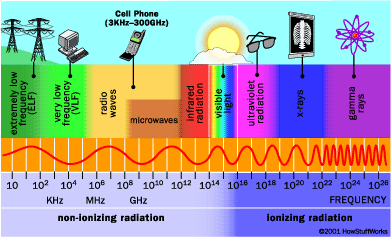
Heard on Morning Edition Microwave radiation is the “most plausible” cause of migraines, dizziness, memory loss and other ailments that dozens of U.S. diplomats have complained of while serving in Cuba and China, a new report says.
Since 2016, the so-called Havana syndrome has afflicted more than 40 U.S. diplomats at the U.S. Embassy in the Cuban capital and at least a dozen more at the U.S. Consulate in Guangzhou, China. At the request of the State Department, the National Academies of Sciences, Engineering, and Medicine investigated and produced a 64-page report. “The committee [of experts] felt that many of the distinctive and acute signs, symptoms, and observations reported by the Department of State employees are consistent with the effects of directed, pulsed, radiofrequency energy,” the report said. Radiofrequency energy includes radio waves and microwaves. “What we can say is that something real and significant clinically happened to these people,” Dr. David Relman, a Stanford University professor who led the study, said in an interview with NPR. “At least some, if not many, of the signs and symptoms that were reported in these patients can be explained by this particular form of microwave radiation,” he added. The report noted that individual cases varied but that many diplomats described a common pattern: The sudden onset of a perceived loud sound, a sensation of intense pressure or vibration in the head, and pain in the ear or more diffusely in the head. Most individuals reported that the sound or these other sensations seemed to originate from a particular direction and were perceived only when the individual was in a specific physical location. Some also reported sudden onset of tinnitus, hearing loss, dizziness, unsteady gait, and visual disturbances.” Some of the diplomats have complained that the State Department has been slow or reluctant to provide sufficient support. A number of them have retired, saying their ailments were so debilitating they could no longer work. ………https://www.npr.org/2020/12/06/943531538/microwave-radiation-most-plausible-cause-of-diplomats-ailments-report-says |
Slowly moving lawsuit on the health impacts of a national nuclear laboratory
BNL lawsuit and the impacts of national nuclear laboratory
Brookhaven National Laboratory “continues to show almost no regard for its neighbors…Is this any way for a government-funded agency to treat its neighbors?” Nation of Change, By Karl Grossman, November 20, 2020
BNL after negotiations agreed to settlements of approximately $600,000 for the first two groups of plaintiffs, each with about 18 persons. However, last month a settlement was not agreed to involving the final group of 18 plaintiffs, and New York State Supreme Court Justice Joseph Farneti ordered that a trial be scheduled.
It accuses BNL of “failure to observe accepted relevant industry standards in the use, storage and disposal of hazardous and toxic substances” and says BNL itself had been “improperly located” by the U.S. Atomic Energy Commission “on top of an underground aquifer which supplies drinking water to a large number of persons.”
Lead attorneys are A. Craig Purcell of Smithtown, Long Island who is a former president of the Suffolk County Bar Association, and Richard J. Lippes, whose Buffalo, New York law firm successfully represented residents of the Love Canal neighborhood near Niagara Falls, severely polluted by the Hooker Chemical Co.
The lawsuit’s title is Osarczuk, et. al, vs. Associated Universities. Barbara Osarczuk had lived in North Shirley, just outside the BNL boundaries, for 28 years and attributed her thyroid and breast cancer to BNL.
A book on radioactive pollution from BNL causing health impacts to residents of Shirley was published in 2008. Welcome to Shirley: A Memoir from an Atomic Town was authored by Kelly McMasters of Hofstra University, who grew up in Shirley. The book was the basis of the 2012 TV documentary Atomic States of America.
As Professor McMasters has related in an interview: “I do believe there was a watershed moment in 1960, after the first radioactive leaks occurred, that the federal government or the scientists themselves should have realized that Shirley was the fastest growing town in the county, with a population that doubled within ten years, and that the middle of one of the largest sole-source drinking water aquifers in the country was not the best place for a nuclear laboratory.” http://www.smithmag.net/memoirville/2008/05/11/interview-kelly-mcmasters-welcome-to-shirley-a-memoir-from-an-atomic-town/
Purcell declares that the lawsuit, “now, nearly 25 years later…has still not been resolved despite Judge Farneti’s urging that the interests of justice would be better served by a fair and final resolution.” BNL and its lawyers “continue to nickel and dime their neighbors to this very day.” He charges that BNL “continues to show almost no regard for its neighbors…Is this any way for a government-funded agency to treat its neighbors?” https://www.nationofchange.org/2020/11/20/bnl-lawsuit-and-the-impacts-of-national-nuclear-laboratory/?fbclid=IwAR0Q0RKD6eJuJL4jNn19c-afztaMbdVNA2btXEzW16z0My0KtQW6TiWPKJY
The human impact of ”Trinity” and a thousand other nuuclear bomb tests on American soil

|
75 Years Later, Victims of Nuclear Bomb Tests on U.S. Soil Still Seek Justice, https://truthout.org/articles/75-years-later-victims-of-nuclear-bomb-tests-on-u-s-soil-still-seek-justice/, BY Satya Vatti, Globetrotter / Independent Media Institute, November 15, 2020 They thought the world was coming to an end,” Genoveva Peralta Purcella explains.
On July 16, 1945, the first-ever nuclear bomb was tested in New Mexico, in the Southwestern United States. The detonation was code-named “Trinity.” It is the day that would seal the fate of many Americans living in the surrounding areas for generations to come. Seventy miles from what became known as ground zero—the Trinity test site—Genoveva’s family lived on a ranch just outside the village of Capitan in New Mexico. Genoveva was born the year after the blast. Now 74 years old, she solemnly recalls how her family remembers the day that would change their lives forever. Genoveva’s sisters had come to visit their father and pregnant mother at the ranch. At precisely 5:30 a.m., as dawn broke, the sky suddenly went pitch dark. Having no other point of reference, they mistook the abnormally loud roaring and rumbling in the sky for thunder. The entire house began to shake. Fear-stricken, the family huddled together in a corner. When the sky cleared, her father stepped outside the house and found himself being showered with a white powder. The powder was everywhere and covered everything around them. Nothing escaped it, not the cows the family had raised, or the vegetables in the garden, or the rainwater they stored in the absence of running water. Like other families who went through this experience, Genoveva’s family also dusted off the powder and consumed their vegetables and the stored water. The blast produced so much energy that it incinerated everything it touched and formed a fireball that rose to more than 12 kilometers into the atmosphere. The fireball created ash that snowed over the communities surrounding the blast site. The people did not know it then, but this ash that covered thousands of square miles was the radioactive fallout from the explosion. Dread gripped the communities in Tularosa Basin who either witnessed or experienced the phenomenon they could not make sense of. Meanwhile, the immediate reaction of the staff of the Manhattan Project, which created the bomb, was of “surprise, joy, and relief.” Paul Pino, Genoveva’s cousin, who was born nine years after the Trinity blast, says that his family, which lived 33 miles from the blast site, was one of many who were unaware of what had transpired on that day. In the days and months leading up to the blast, U.S. government officials did not notify anyone who lived in the region about the imminent nuclear bomb test. Nobody in the Tularosa Basin was evacuated to safety. In the aftermath of the nuclear test, officials began to cement a false narrative into the consciousness of the nation; the region was remote and uninhabited. Tens of thousands of people, in fact, lived in the Tularosa Basin in 1945. For a long time, the people of the basin believed that the blast was an ammunition explosion. “We were lied to by the government,” said Pino. It takes 24,000 years for half of the radioactive plutonium used in the Trinity bomb to decay. The people of the region have inhaled and ingested radioactive particles for 75 years because of environmental contamination. Those in power refuse to accept responsibility and take any corrective action. To this day, there have been no cleanup efforts. Radiation exposure has caused high rates of aggressive cancers, thyroid disease, infant mortality, and other health abnormalities in generations of families in the Tularosa Basin region. The scale of the health impact cannot be determined accurately as long-term epidemiological studies have only been undertaken recently. The findings of the latest research studies by the National Cancer Institute were published in September 2020 in the journal Health Physics. “There were 10 of us; now only one is surviving,” Genoveva says, speaking of herself. She has lost everyone in her family to cancer. In a country without universal health care, debt from medical expenses has brought economic ruin to the communities near the Trinity site. “All the pain and suffering we have had to endure, and not a speck of help from the government,” Pino says. “Meanwhile, it has spent trillions on thousands of nuclear weapons.” Genoveva’s story is not an exceptional one. It is the story of tens of thousands of families in the United States. More than 1,000 nuclear bomb tests have been conducted in the U.S. between 1945 and 1992. A total of 100 above-ground tests were conducted at the Nevada test site from 1951 to 1962. The winds carried radioactive fallout for thousands of kilometers. Hundreds of millions of people living in the U.S. have been exposed to varying levels of radiation over the years, unknown to them. New Mexico was downwind of the Nevada test site, and the people living there continued to be exposed to radioactivity for decades after the initial exposure during the Trinity nuclear test. People from the impacted communities founded the Tularosa Basin Downwinders Consortium in 2005 to fight for justice for the survivors and their descendants. Tina Cordova, one of the group’s cofounders, was shocked to find out that a few of the impacted states neighboring New Mexico were receiving financial compensation under the Radiation Exposure Compensation Act since 1990. The communities in New Mexico, however, were left out of the act. When asked why, Cordova responds with, “It is the billion-dollar question. I think we are being left out because we are mainly Mexican Hispanics, Natives, and Latinos. We are minorities and we are poor.” Cordova herself is the fourth generation in her family to have cancer. She has joined with others like her to educate and organize the affected communities, to fight to establish the truth. “In their [the government’s] rush to bomb Japan, we were sacrificed in the process. We were enlisted in the service of our country, unknowing, unwilling, and remain uncompensated.” |
|
Dismantling of Trawsfynydd nuclear power plant held back due to coronavirus outbreak
 Covid outbreak at former Trawsfynydd nuclear power plant, BBC 11 Nov 20, Covid outbreak at former Trawsfynydd nuclear power plant, BBC 11 Nov 20,
Work has been scaled back on the site of former nuclear power station following an outbreak of Covid. Magnox said a “small number” of employees tested positive at the Trawsfynydd site in Gwynedd, where they are working to remove nuclear reactors and towers. Those affected and others found through track and trace are self-isolating. It said some key work will continue on site but other staff can work from home. ………. T https://www.bbc.com/news/uk-wales-54904337rawsfynydd was shut down in 1991 after operating for a quarter of a century.
The twin reactors will become the first in the UK to be fully decommissioned. Over 20 years the remaining reactor buildings will be demolished, while a new low-level radioactive waste store is built on the site to hold the material. https://www.bbc.com/news/uk-wales-54904337 |
|
1 This Month
6 June – WEBINAR- Get Inspired by Protests Against Military Bases!


Cuba Is Not a Failed State – It Is a Besieged State
PETITION: “Global Appeal to Endorse Palestinian Right of Return of Refugees”


of the week– Nuclear Reactor Information Task Force
To see nuclear-related stories in greater depth and intensity – go to https://nuclearinformation.wordpress.com
-
Archives
- June 2026 (34)
- May 2026 (306)
- April 2026 (356)
- March 2026 (251)
- February 2026 (268)
- January 2026 (308)
- December 2025 (358)
- November 2025 (359)
- October 2025 (376)
- September 2025 (257)
- August 2025 (319)
- July 2025 (230)
-
Categories
- 1
- 1 NUCLEAR ISSUES
- business and costs
- climate change
- culture and arts
- ENERGY
- environment
- health
- history
- indigenous issues
- Legal
- marketing of nuclear
- media
- opposition to nuclear
- PERSONAL STORIES
- politics
- politics international
- Religion and ethics
- safety
- secrets,lies and civil liberties
- spinbuster
- technology
- Uranium
- wastes
- weapons and war
- Women
- 2 WORLD
- ACTION
- AFRICA
- Atrocities
- AUSTRALIA
- Christina's notes
- Christina's themes
- culture and arts
- Events
- Fuk 2022
- Fuk 2023
- Fukushima 2017
- Fukushima 2018
- fukushima 2019
- Fukushima 2020
- Fukushima 2021
- general
- global warming
- Humour (God we need it)
- Nuclear
- RARE EARTHS
- Reference
- resources – print
- Resources -audiovicual
- Weekly Newsletter
- World
- World Nuclear
- YouTube
-
RSS
Entries RSS
Comments RSS
 nuclear-news