The real death count for Hiroshima and Nagasaki was at least 210,000 – and more later.
The real death count for Hiroshima and nagasaki was 210,000 It was not 15,000 for Hiroshima and 74,000 for Nagasaki. That does not reflect birth defects, or other health effects we now know, are part of nuclear bomb fallout
The Atomic Bombings of Hiroshima and Nagasaki: A Summary of the Human Consequences, 1945-2018, and Lessons for Homo sapiens to End the Nuclear Weapon Age
Masao Tomonaga Pages 491-517 | Received 01 Sep 2019, Accepted 02 Oct 2019, Accepted author version posted online: 13 Nov 2019, Published online: 02 Dec 2019
ABSTRACT
Seventy-four years have passed since the atomic bombings of Hiroshima and Nagasaki. Approximately 210,000 victims died, and another 210,000 people survived. The damage to their health has continued, consisting of three phases of late effects: the appearance of leukemia, the first malignant disease, in 1949; an intermediate phase entailing the development of many types of cancer; and a final phase of lifelong cancers for hibakusha who experienced the bombing as a child, as well as a second wave of leukemia for elderly hibakusha and psychological damage such as depression and post-traumatic stress disorder. Thus, the human consequences of the atomic bombings have not ceased; many people are still dying of radiation-induced malignant diseases. Therefore, it is too early to finalize the total death toll. Hibakusha have faced a never-ending struggle to regenerate their lives and families under the fear of disease. As the only group of Homo sapiens experiencing real nuclear attacks, hibakusha have continued to engage in a lifelong movement to eliminate nuclear weapons. Political leaders, especially of nuclear-weapon states, must learn the wisdom of the hibakusha to save Homo sapiens from possible global extinction by nuclear war.
Introduction
The first nuclear weapon was detonated in New Mexico on 16 July 1945. That test explosion was soon followed by the wartime use of two atomic bombs on Hiroshima and Nagasaki on August 6 and 9, respectively. This opened the nuclear weapon age in the history of humanity. In the long history of wars and weapons, Homo sapiens had finally gained an ultimate weapon of mass destruction capable of obliterating itself……………………………….
Immediate Death and Early Lethal Consequences of the Bombings
Death-rate
Under the two gigantic mushroom clouds, approximately 280,000 citizens in Hiroshima and 240,000 in Nagasaki were suddenly thrown into chaos and agony. A total of approximately 140,000 in Hiroshima (Hiroshima 1971) and 73,000 in Nagasaki (Nagasaki, 1977) died instantaneously or within five months due to the combined effects of three components of physical energy generated by nuclear fissions: blast wind (pressure), radiant heat, and ionizing radiation. A total of more than 210,000 remaining victims, 140,000 in Hiroshima and 74,000 in Nagasaki, survived the first five months of death and agony and became hibakusha (Figure 1 on original).
A curve of death rates calculated in the aftermath by the surviving medical staff and students of Nagasaki Medical College showed almost 100% in residents living within a 500-meter radius of ground zero; 90% within 1,000 meters; 50% within1,500 meters; and 10% within 2,000 meters, making a clear concentric figure (Figure 2) (Shirabe 2006). Later the death-rate curve of Hiroshima was compared with Nagasaki’s, revealing that two curves were very similar, as if two scientific experiments were conducted. Among areas within 1,000 meters, the Nagasaki Medical School Hospital was exceptional – The death rate in the facility was as low as 43%. This is obviously because of the shielding effect of the thickest concrete walls of the hospital buildings.
Figure 2. [on original] Death rates by distance from ground zero in the first three months in areas of Nagasaki city.
The residents of both cities were mostly noncombatant civilians, including many women and children. Military combatants were only a minority. There were fewer adult males than females, and most of the males worked at military arsenals. Many young men went to war in the later stages of World War II. Young students were employed by military arsenals located close to ground zero; that increased the number of victims.
Citizens were suddenly thrown into firestorms at home, factories, and schools; on open roads or on ground; in automobiles and trams; and in city offices, hospitals, pharmacies, fire stations, and almost all city structures.
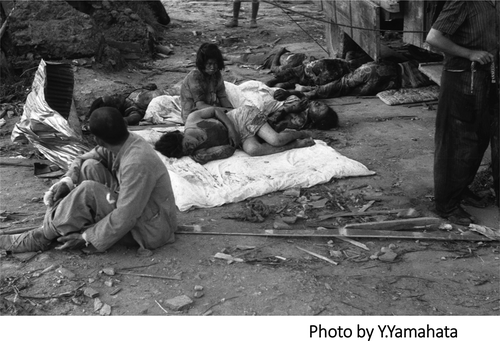
Many survivors spent the night on the road or the ground (Figure 3). Subsequently, many severely injured victims were forced to remain where they survived the first strike without being provided any meaningful medical treatment. Most of them died there.
Figure 3. The second morning after Nagasaki bombing.
……………………………….. In areas within 1 kilometer of ground zero, human bodies without any shielding, namely in open air on the roads and ground, were instantaneously squeezed by the blast wind (pressure) against walls, causing multiple fractures of skeletons and ruptures of the abdominal cavity causing escape of colons. Many people in open roads and grounds were carbonized by the direct effect of heat rays within 1.0 km from ground zero (Figure 7, Photo A). Many residential areas full of Japanese houses were crushed by the wind and burned out in which many victims were also burned to white bones (Figure 7, Photo B). The skin of people on open roads or grounds within 0.5–1.5 km were deeply flash-burned due to heavy heat rays. The skins were soon peeled off because of necrosis in the deep skin layer (For an example of a boy whose back was entirely burned, see Figure 8). With large areas of skin peeling off, people suffered severe pain and bleeding.
Figure 7. Body effects by heat rays and fire burn (1).
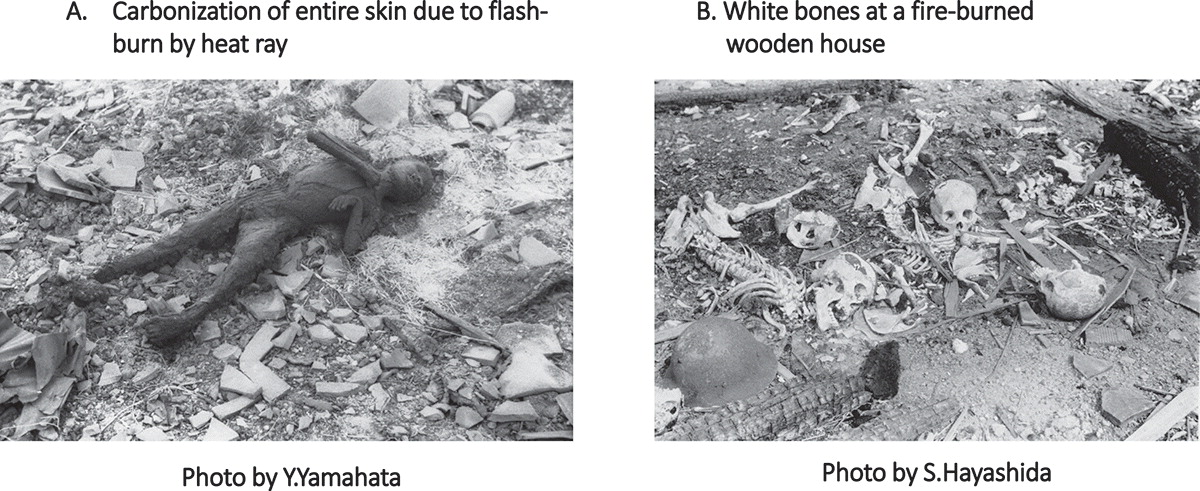
Figure 7. Body effects by heat rays and fire burn (1).
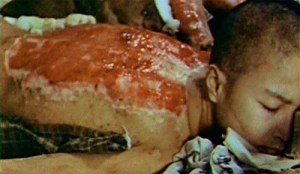
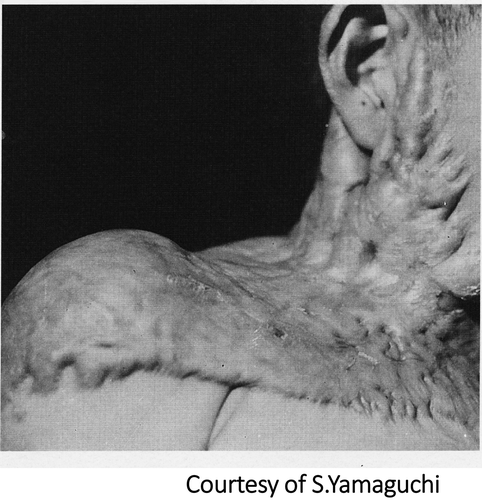
In three months after the bombing, these deep skin flash burns began to heal. However, with tissue being regenerated, keloid was quite often formed as shown in Figure 9. It was charcterized by marked thickening of the wounds, sometimes resembling cancerous proliferation of the skin.
Figure 9. Keloid formation after a severe flash burn by heat rays.
Thus many residential areas full of Japanese wooden houses were crushed and burned. The firestorms that continued over to next day finally flattened city areas within a 4 km radius. According to the saddest memory of some survivors, the blast wind tore off the heads of babies who were being carried on their mothers’ backs in the traditional Japanese way. Most of the mothers also died soon.
At the same time, the victims were irradiated by 100 grays (Gy)1 or more of combined gamma and neutron rays generated by nuclear fissions (Figure 6). Thus it could be possible to say that they were killed in three ways at once.
The people within 1 km of ground zero who finally survived were mostly those who were working inside a concrete building with thick walls or in a basement. Some other survivors were inside private air-raid shelters or military arsenals set in large shelters. Heat rays were effectively blocked by the walls, and radiation and blast were partially shielded before victims were exposed, thus allowing them to survive. But there were only a few hundred of these people. Many of those who survived at various proximal points were severely injured by debris and pieces of glass from damaged houses, heated and irradiated simultaneously. Many of them died within the first three months.
Struggle for Survival
Medical rescue teams perished and hospitals were all destroyed on the first day of the bombing. It therefore was impossible to find any meaningful medical aid. The situation was much severer in Hiroshima where over 90% of medical staffs, doctors, nurses, and pharmacists were dead. The Nagasaki Medical College Hospital, the largest and strongest concrete buildings in Nagasaki City, located 600 meters from ground zero, did provide fairly good shielding effects; the death rate was a relatively as low as 43%. Subsequently 900 lives in total – approximately half of the total number of professors, doctors, nurses and medical students were lost in the entire college facility including the hospital. Most of those who survived were severely injured by the blast wind and heat ray. The hospital had completely ceased to function. Within a few days, medical staffs and medical students who had survived opened first-aid stations around the margin of flattened areas.
n the late afternoon on the first day, several rescue trucks arrived carrying medical teams consisting of military doctors and nurses from Omura Navy Hospital, located 45 km north of Nagasaki City. They brought back approximately 700 severely injured victims, most of them severely burned, to the hospital and started treatment for burns and injuries consisting of bone fractures, cuts from pieces of glass, and embedding of debris and pieces of glass fragments deep in the skin. This number was very small compared to the total number of victims who suffered severe injuries, estimated to be approximately 30,000 in Nagasaki. A few hundred victims out of 700 were able to survive, thanks to intensive care at Omura Navy Hospital. They were indeed lucky people.
Several small rescue teams started their clinical activities within a few days. Some surgical operations were performed for those who had severe fractures due to the blast wind. There was no good treatment for severe skin burn, especially those cases with wide areas of skin burn. There were no stocks of drugs such as antibiotics and frozen blood plasma. Only oil and ointment were used. Even drip infusions of water and electrolytes such as salts and glucose (sugar) were not available in such small ambulatory facilities.
As a result of this lack of care, many survivors who were alive on the first and second days began to die due to severe bleeding from injuries such as severe fractures, dislocations, abdominal ruptures, thoracic punctures, and scalp and brain damage and also from dehydration and lack of adequate food supplies.
Initial Difficulty in Recognizing Radiation Effects
In the early days after the atomic bombings, many doctors had difficulty in identifying the symptoms of radiation-related ailments. There was no information about the nature of this new type of bomb. They did not even know that the bombs were nuclear and that radiation was dangerous to human beings. …………………………………………………………………………………….
Late Effects of Atomic Bombings: 1948–2018
About 270,000 victims of Hiroshima and Nagasaki finally recovered their health. They had to start their new daily life with a serious shortage of food and other necessities. After spending three years of recovery with relatively good health, hibakusha encountered the first malignant disease: leukemia. It is classified as the earliest occurring malignant disease due to atomic-bomb radiation because it was clearly distinguished from the disorders caused by ARS. Therefore, leukemia was the first malignant disease derived from cells injured by initial radiation exposure; the cells then transformed to malignant leukemia cells. This earliest delayed, or “late”, effect was followed by many kinds of cancer of various organs. Thus, the late effect spans an extremely long period.
First Malignant Disease Observed as the Earliest Late Effect of Atomic Bombings
Leukemias
In 1949, doctors in Hiroshima and Nagasaki began to recognize a gradual increase in the number of hibakusha patients, including children, suffering from leukemia. The excess annual rate of leukemia continued to rise until 1955 and then continued at an elevated level for more than 10 years (Figure 12) (Gunz and Henderson 1974). Acute and chronic types of leukemia both were observed.
These leukemias were later analyzed in detail when the first dosimetry system (DS65) became available. A clear radiation-dose dependency was revealed as a curve that elevated exponentially (called quadratic) from 100 millisieverts (mSv) at around 2.0 km from ground zero to more than 4 Gy at around 1.0 km (Figure 13 on original). Dose is thus inversely proportional to the square of the distance. Total leukemia incidence was four to five times higher than the control group of Nagasaki citizens not exposed to the bombing (Preston et al. 1996).
……………………………. People who were children under the age of 10 at the time of the bombings are now in their seventies. Some of them suffer from MDS. The increase in MDS among childhood survivors indicates that the massive irradiation of the whole body injured blood cells in bone marrow, and that these cells have survived more than 70 years in the bodies of hibakusha, and finally resulted in leukemia-inducing gene abnormality. MDS patients occasionally develop acute leukemia 3–5 years after the first diagnosis, and mostly die. Therefore, it can be said that atomic bomb is still killing some hibakusha even after more than a half century……………………..
Intermediate to Life-long Delayed Effects of Exposure to Atomic-bomb Radiation
Cancers
Around 1960, the incidence of solid cancers began to rise gradually. The elevated cancer incidence lasted for a long time (Ozasa 2016). It peaked around the year 2000 and remained at that level until now. The types of cancer that appeared include lung, breast, thyroid, stomach, colon, liver, skin, and bladder. ……………………………………….
In-utero Radiation Exposure
Microcephaly
In both Hiroshima and Nagasaki, many pregnant women were exposed to various doses of radiation. Miscarriages and malformation of newborn babies were frequently observed, but there were no good statistics showing radiation-dose effect. Some mothers who were in the early prenatal period at the time of the bombing sometimes bore babies who had a small head. The babies later became mentally disabled. There were 62 such babies recorded among 1,470 (Otake and Schull 1998). The larger the dose to the mother’s uterus was, the higher the incidence of microcephalic babies, suggesting high-dose radiation interrupted brain development. This is the most obvious phenomenon observed among fetuses exposed to radiation in utero.
Cancers
In-utero exposed babies were later found to have an increased risk of cancer development during their early adulthood. The follow-up study is now ongoing (Izumi et al. 2003)……………………………………………………………..
Summary of Hibakusha Life, 1945–2018
Can Homo Sapiens Gain the Ethical Wisdom to End the Nuclear Weapon Age and Survive?
The consequences of the atomic bombings linger on. First generation hibakusha population will cease to exist probably around 2045. If genetic transmission of radiation-related diseases to the second generation of hibakusha would be proved in the future, atomic bombs will continue to affect those descendants forever. The year 2045 will mark the 100th annniversary of the Hiroshima and Nagasaki nuclear bombings and of the nuclear weapon age. If we human beings fail to eradicate nuclear weapons before the first century ends, what should we do? This is the question that all hibakusha have posed in their 70-year struggle for survival all the time after bombings.
Summary of Hibakusha Life, 1945–2018
Can Homo Sapiens Gain the Ethical Wisdom to End the Nuclear Weapon Age and Survive?
The consequences of the atomic bombings linger on. First generation hibakusha population will cease to exist probably around 2045. If genetic transmission of radiation-related diseases to the second generation of hibakusha would be proved in the future, atomic bombs will continue to affect those descendants forever. The year 2045 will mark the 100th annniversary of the Hiroshima and Nagasaki nuclear bombings and of the nuclear weapon age. If we human beings fail to eradicate nuclear weapons before the first century ends, what should we do? This is the question that all hibakusha have posed in their 70-year struggle for survival all the time after bombings…………………………………………………………………………..more https://www.tandfonline.com/doi/full/10.1080/25751654.2019.1681226
“Shell” companies purchase radioactive materials, prompting push for nuclear licensing reform

Defense News, By Bryant Harris, 10 Aug 22,
WASHINGTON – Late last year, government employees forged a copy of a license to buy hazardous, radioactive material. They created shell companies, then placed orders, generated invoices and paid two U.S.-based vendors.
The scheme worked. The employees successfully had the material shipped, complete with radioactive stickers on the side, then confirmed delivery.
But the workers were actually investigators from the Government Accountability Office, the congressional watchdog, and they were testing the Nuclear Regulatory Commission’s ability to regulate the sale and procurement of dangerous materials.
The act, and a subsequent report from the GAO, alarmed Rep. Ritchie Torres, D-N.Y., who is now calling on the Nuclear Regulatory Commission to overhaul its licensing system as a way to avoid a national security disaster.
“Anyone could open a shell company with a fraudulent license to obtain dangerous amounts of radioactive material that could be weaponized into a dirty bomb,” Torres told Defense News in an interview on Wednesday. “Disperse radioactive material in a city as densely populated as New York, and it could cause catastrophic damage.”
The commission classifies radioactive material into five categories of risk. Only categories one and two currently are subject to its independent license verification system – a loophole that Torres and the GAO fear that an individual or group could exploit to wreak havoc by building a dirty bomb that combines combines conventional explosives with category three radioactive materials.
Torres, who sits on the House Homeland Security Committee, is pressing the NRC to immediately expand its independent license verification system to include category three quantities of radioactive materials. He formally made the licensing overhaul request in a letter seen by Defense News on Wednesday. This request is in line with the GAO’s recommendations in what Torres called an “alarming report.”………………………
more https://www.defensenews.com/congress/2022/08/10/shell-companies-purchase-radioactive-materials-prompting-push-for-nuclear-licensing-reform/
Hisashi Ouchi Suffered an 83-day Death By Radiation Poisoning

https://science.howstuffworks.com/hisashi-ouchi.htm By: Patrick J. Kiger | Aug 8, 2022
On the morning of Sept. 30, 1999, at a nuclear fuel-processing plant in Tokaimura, Japan, 35-year-old Hisashi Ouchi and two other workers were purifying uranium oxide to make fuel rods for a research reactor.
As this account published a few months later in The Washington Post details, Ouchi was standing at a tank, holding a funnel, while a co-worker named Masato Shinohara poured a mixture of intermediate-enriched uranium oxide into it from a bucket.
Suddenly, they were startled by a flash of blue light, the first sign that something terrible was about to happen.
The workers, who had no previous experience in handling uranium with that level of enrichment, inadvertently had put too much of it in the tank, as this 2000 article in Bulletin of the Atomic Scientists details. As a result, they inadvertently triggered what’s known in the nuclear industry as a criticality accident — a release of radiation from an uncontrolled nuclear chain reaction.
Ouchi, who was closest to the nuclear reaction, received what probably was one of the biggest exposures to radiation in the history of nuclear accidents. He was about to suffer a horrifying fate that would become a cautionary lesson of the perils of the Atomic Age.
“The most obvious lesson is that when you’re working with [fissile] materials, criticality limits are there for a reason,” explains Edwin Lyman, a physicist and director of nuclear power safety for the Union of Concerned Scientists, and co-author, with his colleague Steven Dolley, of the article in Bulletin of the Atomic Scientists.
If safeguards aren’t carefully taught and followed, there’s potential for “a devastating type of accident,” Lyman says.
It wasn’t the first time it had happened. A 2000 U.S. Nuclear Regulatory Commission report noted that before Tokaimura, 21 previous criticality accidents had occurred between 1953 and 1997.
The two workers quickly left the room, according to The Post’s account. But even so, the damage already had been done. Ouchi, who was closest to the reaction, had received a massive dose of radiation. There have been various estimates of the exact amount, but a 2010 presentation by Masashi Kanamori of the Japan Atomic Energy Agency put the amount at 16 to 25 gray equivalents (GyEq), while Shinohara, who was about 18 inches (46 centimeters) away, received a lesser but still extremely harmful dose of about 6 to 9 GyEq and a third man, who was further away, was exposed to less radiation.
Internet articles frequently describe Ouchi as ‘the most radioactive man in history,’ or words to that effect, but nuclear expert Lyman stops a bit short of that assessment.
“The estimated doses for Ouchi were among the highest known, though I’m not sure if it’s the highest,” explains Lyman. “These typically occur in these kinds of criticality accidents.”
What Does a High Dose of Radiation Do To the Body?
The radiation dose in a criticality accident can be even worse than in a catastrophic accident at a nuclear power plant, such as the 1986 reactor explosion at Chernobyl in Ukraine, then a part of the Soviet Union, where the radiation was dispersed. (Even so, 28 people eventually died from radiation exposure.)
“These criticality accidents present the potential for delivery of a large amount of radiation in a short period of time, though a burst of neutrons and gamma rays,” Lyman says. “That one burst, if you’re close enough, you can sustain more than a lethal dose of radiation in seconds. So that’s the scary thing about it.”
High doses of radiation damage the body, rendering it unable to make new cells, so that the bone marrow, for example, stops making the red blood cells that carry oxygen and the white blood cells that fight infection, according to Lyman. “Your fate is predetermined, even though there will be a delay,” he says, “if you have a high enough dose of ionizing radiation that will kill cells, to the extent that your organs will not function.”
According to an October 1999 account in medical journal BMJ, the irradiated workers were taken to the National Institute of Radiological Sciences in Chiba, just east of Tokyo. There, it was determined that their lymphatic blood count had dropped to almost zero. Their symptoms included nausea, dehydration and diarrhea. Three days later, they were transferred to University of Tokyo Hospital, where doctors tried various measures in a desperate effort to save their lives.
Ouchi’s Condition Continued to Deteriorate
When Ouchi, a handsome, powerfully built, former high school rugby player who had a wife and young son, arrived at the hospital, he didn’t yet look like a victim of intense radiation exposure, according to “A Slow Death: 83 Days of Radiation Sickness,” a 2002 book by a team of journalists from Japan’s NHK-TV, later translated into English by Maho Harada. His face was slightly red and swollen and his eyes were bloodshot, but he didn’t have any blisters or burns, though he complained of pain in his ears and hand. The doctor who examined him even thought that it might be possible to save his life.
But within a day, Ouchi’s condition got worse. He began to require oxygen, and his abdomen swelled, according to the book. Things continued downhill after he arrived at the University of Tokyo hospital. Six days after the accident, a specialist who looked at images of the chromosomes in Ouchi’s bone marrow cells saw only scattered black dots, indicating that they were broken into pieces. Ouchi’s body wouldn’t be able to generate new cells. A week after the accident, Ouchi received a peripheral blood stem cell transplant, with his sister volunteering as a donor.
Nevertheless, Ouchi’s condition continued to deteriorate, according to the book. He began to complain of thirst, and when medical tape was removed from his chest, his skin started coming off with it. He began developing blisters. Tests showed that the radiation had killed the chromosomes that normally would enable his skin to regenerate, so that his epidermis, the outer layer that protected his body, gradually vanished. The pain became intense. He began experiencing breathing problems as well. Two weeks after the accident, he was no longer able to eat, and had to be fed intravenously. Two months into his ordeal, his heart stopped, though doctors were able to revive him.
On Dec. 21, at 11:21 p.m., Ouchi’s body finally gave out. According to Lyman’s and Dolley’s article, he died of multiple organ failure. Japan’s Prime Minister at the time, Keizo Obuchi, issued a statement expressing his condolences to the worker’s family and promised to improve nuclear safety measures, according to Japan Times.
Shinohara, Ouchi’s co-worker, died in April 2000 of multiple organ failure as well, according to The Guardian.
The Japanese government’s investigation concluded that the accident’s main causes included inadequate regulatory oversight, lack of an appropriate safety culture, and inadequate worker training and qualification, according to this April 2000 report by the U.S. Nuclear Regulatory Commission. Six officials from the company that operated the plant were charged with professional negligence and violating nuclear safety laws. In 2003, a court gave them suspended prison terms, and the company and at least one of the officials also were assessed fines, according to the Sydney Morning Herald.
Bad luck for the river environment – nuclear reactors allowed to release hotter water.
Heat wave: the State grants environmental exemptions to maintain the
activity of five nuclear power plants. These derogations will allow the
power stations to discharge warmer water than usual, which could have
negative effects on the environment.
The nuclear power plants of Blayais, Saint-Alban-Saint-Maurice, Golfech, Bugey and Tricastin will benefit until September 11 from environmental exemptions concerning the temperatures of
water discharge because of the high temperatures. With a downside: possible
negative effects on the environment.
France Info 6th Aug 2022
UN to Host Over 190 World Leaders & Delegates — Despite Threats from a Deadly New Covid-19 Variant

By Thalif Deen /UNITED NATIONS, Jul 22 2022 (IPS) – The United Nations is planning to host a high-level “in-person” General Assembly session, September 20-26, with over 190 world leaders and delegates listed to speak, including heads of state, heads of government, high-ranking ministers and senior officials.
The world body is apparently on a risky path, with hundreds of delegates due in New York for the opening of the 77th session—and, most worryingly, at a time when a new Covid-19 variant BA.5 is sweeping across the United States, including New York.
In a letter addressed to the President of the General Assembly, E. Courtenay Rattray Chef de Cabinet, says “while there is strong support for the return to a pre-pandemic General Debate, as reflected by the level of inscriptions by Member States in the provisional list of speakers– and an improvement in the environment as compared to the last two years– we also recognize that we are not free from the Coronavirus and its impact.”
“As such, there is a need to be prudent in our facilitation of the General Debate and High-level Week.”
Under a business-as-usual scenario, occupancy at UN Headquarters will increase significantly this September, particularly in meeting rooms and in the General Assembly and Conference buildings.
“With a view to mitigating this impact, our planning assumptions reflect an emphasis on basic protective measures and a decrease in the number of attendees, as much as reasonably possible”, the letter said.’
On July 21, White House Press Secretary Karine Jean-Pierre formally announced that US President Joe Biden, who is scheduled to address the General Assembly on September 20, tested positive for COVID-19.
“He is fully vaccinated and twice boosted and experiencing very mild symptoms. He has begun taking Paxlovid. Consistent with CDC guidelines, he will isolate at the White House and will continue to carry out all of his duties fully during that time,” she added.
In a July 20 report, Cable News Network (CNN) said “in the United States, BA.5 has become the dominant strain and is driving a significant spike in cases — more than 120,000 a day, according to the Centers for Disease Control and Prevention (CDC), though experts say that number may be more like 1 million, given the underreporting of home test results.
Europe, meanwhile, has seen a tripling of new Covid-19 infections over the past six weeks, with nearly 3 million reported last week, accounting for almost half of all new cases worldwide. Hospital admissions in Europe over the same period have doubled.
“The end of the last remaining restrictions on international travel and return of large gatherings, like music festivals, are among the factors helping the virus to spread, experts say. And the number of cases may actually be higher than data shows because countries have significantly pared back testing and surveillance, making it difficult to judge the true extent of the current surge’, said CNN.
Last week, the World Health Organization (WHO) warned that the spike in infections was a harbinger of an even worse situation to come, calling on countries to urgently reintroduce mitigation strategies before it was too late.
“It’s now abundantly clear we’re in a similar situation to last summer — only this time the ongoing Covid-19 wave is being propelled by sub-lineages of the Omicron variant, notably BA.2 and BA.5, with each dominant sub-lineage of Omicron showing clear transmission advantages over the previously circulating viruses,” WHO’s regional director for Europe, Hans Kluge, said in a statement.
Though intensive care admissions remain relatively low, as infection rates rise among older populations, deaths are mounting — almost 3,000 people a week are dying from Covid in Europe.
But in order to protect delegates and staff alike, UN Secretary-General Antonio Guterres, having considered the recommendations of the UN’s Occupational Safety and Health (OSH) Committee, has decided on the following guidelines:
- * As a condition of entry to the compound, all persons will be required to attest that they have not had symptoms of, or been diagnosed with, COVID-19 in the last 5 days.
- ** Masks are to be worn by all attendees at all times when indoors, except when directly addressing a meeting or consuming food/beverages
- ** Apart from a limited number of high-level side events, for which preparations are well under way, side events are to be conducted virtually or off-site.
- ** United Nations departments and offices will not be hosting or co-hosting in-person side events or luncheons during the high-level week.
- ** Bilateral booths will be available with seating for 2 principals and 6 advisers (3 per side).
- ** Permanent Missions are encouraged to manage COVID-19 cases and determine any subsequent action regarding case exposures among their own attendees and guests, including notification to other delegations or to the President of the General Assembly.
- ** United Nations staff who are not required to be on-site to support the proceedings will be mandated to work remotely for the full week………………………….more https://www.ipsnews.net/2022/07/un-host-190-world-leaders-delegates-despite-threats-deadly-new-covid-19-variant/?utm_source=rss&utm_medium=rss&utm_campaign=un-host-190-world-leaders-delegates-despite-threats-deadly-new-covid-19-variant
British soldiers used as radiation guinea pigs in nuclear bomb tests in Australia
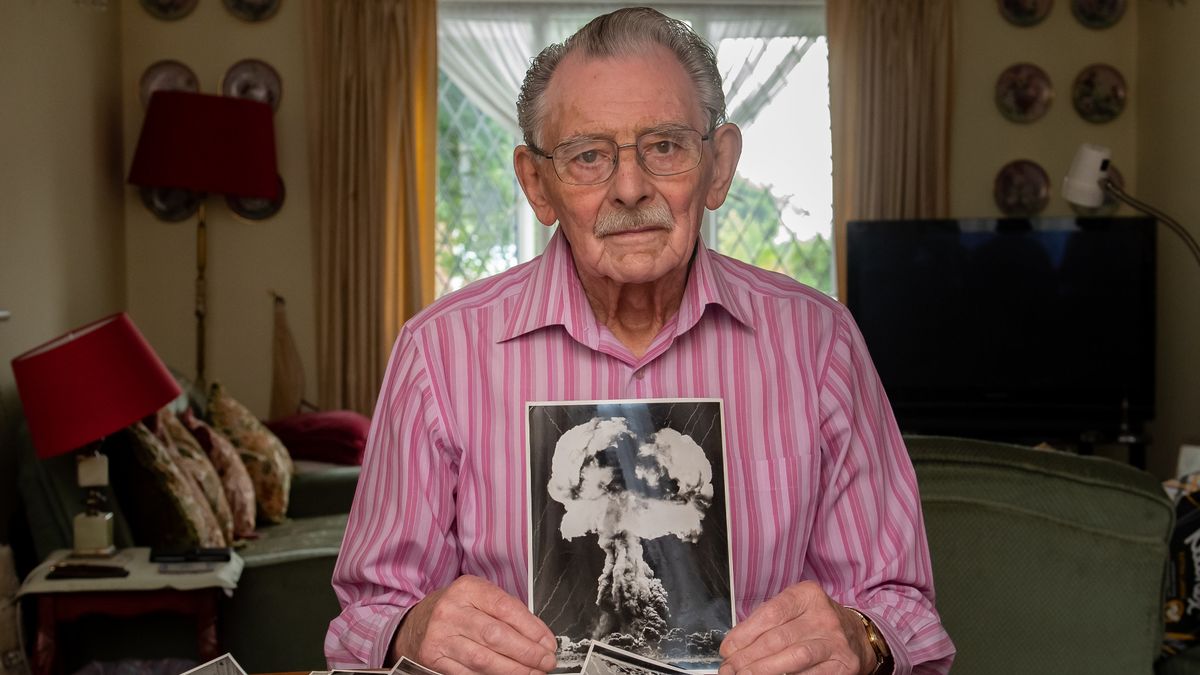
British veterans ‘ordered to march through smoking craters’ in nuclear bomb tests, Brian Tomlinson claims the state dumped him and his comrades, many of whom died from cancer after being used in a shocking human experiment,
https://www.mirror.co.uk/news/uk-news/british-veterans-ordered-march-through-27563987 Susie Boniface, Reporter, 24 Jul 2022,
A veteran of nuclear bomb tests has told how British servicemen were ordered to march through a smoking crater to find how radioactive it was.
Brian Tomlinson said he also had to dig out scientific instruments buried in the contaminated soil and revealed he was left with bleeding ulcers on his palms for two decades.
But he claims the state dumped him and his comrades, many of whom died from cancer in the years after they were used in a shocking human experiment in the Australian outback.
And Brian supports the Mirror’s campaign for a medal for heroes of the nuclear tests in the 50s.
“That place is still radioactive, it’s in the soil for a hell of a long time, so what chance does a human being have?” he said.
“A medal would get us a little bit of recognition for those who took part. It says you’re someone who’s been noticed and not discarded, which is how we’ve felt for so long.”
Last month, Boris Johnson became the first PM to meet veterans, and promised action before October’s 70th anniversary of the first test. His resignation threw it into doubt and campaigners are seeking reassurances from Rishi Sunak or Liz Truss that they will do the same.
Brian, now 85, was a sapper sent to Maralinga, South Australia, in 1957 to take part in Operation Antler, a series of three atomic bomb tests designed to help build the more powerful H-bomb.
His troop of Royal Engineers were blended with Australian soldiers, and 40 of them lived for a year inside the blast zone in canvas tents.
The main base, where scientists, top brass, and most troops stayed, was called Maralinga Village. Brian’s unit was 14 miles deeper into the testing grounds, at Roadside Camp. From there, it was just 9 miles to Ground Zero.
Brian, a 20-year-old corporal at the time, said: “Nobody told us what it was all about, or checked us for radiation, but every morning we went into the forward area.
We had pneumatic drills, and had to blast down through the soil. There was about 12 inches of earth, red dust, and below that was rock.”
For each of 3 blasts, the crew had to bury dozens of large steel containers 8ft square. Each had instruments inside to measure the explosion, with pipes protruding above ground level. Those closest to the bombs were sandbagged and concreted to protect them from the shockwave.
A few hours after each bomb, Brian and his crew – wearing only shorts, socks, boots and a hat – had to drive back in, remove the sandbags and concrete, and extract the instruments.
Scientists who went with them wore radiation suits and badges, but Brian said for the first two blasts he had neither.
He added: “After the third bomb, we were given little rubber boots, and a white overall, and a dose badge. We were told to walk through the crater. The mushroom cloud was still overhead. The wind had started to push it away. It was only a few hours after, not very long.”
The first two bombs, codenamed Tadje and Biak, were one kiloton and 6kts respectively.
But the third, Taranaki, was 25kts, as powerful as the weapon which destroyed Nagasaki in 1945.
Brian, of Yate, near Bristol, said: “As you approached the bomb site it was quite amazing, because it was like a bowling green. Everything was green and smooth. It was only when you were on it you realised the heat from the bomb had crystallised the earth underneath it. It was a crust of molten sand, like glass.
“The crater left there was huge. They told us to walk into that, down into the crater, and up the other side, and then check our meters to see how high the dose was.”
Brian said: “When it reached a certain point they told us to come out. It didn’t take long for it to reach that point. We weren’t told at the time what the dose was supposed to be. But it was just as bad as going through the centre of the bomb as soon as it had gone off.”
The first two bombs were detonated on top of 100ft-high towers built by the sappers, but desert sand was sucked into the fireball and fell to the ground as toxic fallout. The third bomb was tethered to barrage balloons 980ft up, supposedly minimising the risk.
But the size of the bomb, and perhaps the fact the same site was used for previous weapons tests, meant there was still fallout.
After they left the crater, Brian was taken to a decontamination area. The men’s clothes were stripped off and taken away, and the men were put through showers.
“We spent 5 or 6 minutes scrubbing away, then put ourselves in this meter, it was like standing on a weighing machine, and you push your hands through these bars to be tested. If a bell rang, you were still radioactive and had to go back in and scrub under your nails, everywhere, in your hair. I had to do it 3 times. They didn’t give us any more information.”
Documented safety measures at Maralinga included wire fences through which sand could easily be blown, and one wooden post barrier that Brian’s unit passed through each morning.
Brian was not checked for radiation while excavating amid the fallout, nor given long-term medical follow-ups. Six years later, he was medically discharged with a duodenal ulcer.
Radiation is known to cause problems with the lining of the gut, and earlier this year a government study reported nuclear test veterans were 20 per cent more likely than other servicemen to die from stomach cancer.
Brian said: “It wasn’t until later I started having skin problems. It would cover me from head to toes, rashes on my back, chest, legs, thighs. They used to come out on the palms of my hands.
“I’d get a little itchy blister in the centre of my palm, it would break and then spread over the fingers. I used to wear white cotton gloves to ease the pain and itching.
“The skin would go hard, then crack and bleed, and it would start all over again. I had that for 20 years, and no doctor could work out what it was.”
Today, cancer patients are warned radiotherapy using beta radiation can lead to radiodermatitis, which causes rashes, skin peeling, and ulceration. It is caused by the decay of isotopes, including plutonium and cobalt-60, both of which were in the Antler bombs.
Brian said: “I would have a constant itch, all over, and had to take cold showers just to stop the itching and have something of a normal life. I got depressed, to the point where I didn’t want to go and see the doctors because they just have me the same old medication and it never did me any good. Then one day, after 20 years, it just stopped, as suddenly as it came.”
Two decades after his discharge, Brian also had an operation to finally cure his ulcer. It involved cutting the vagus nerve, which controls digestion as well as carrying sensory information from the skin’s surface.
“I told all my consultants what was done to me out there in Maralinga, and asked if it was due to fallout. They all denied it,” said Brian. “Nobody’s ever done anything for us nuclear test veterans except withhold information from us.”
Campaigners have asked the Prime Minister for a medal and a service of national recognition at Westminster Abbey to mark the Plutonium Jubilee in 3 months’ time.
A spokesman for the MoD said it was grateful to veterans, and claimed they were well-monitored and protected. He added: “The Prime Minister met with veterans recently, and asked ministers to explore how their dedication can be recognised. We remain committed to considering any new evidence”
************************************************************************
For 40 years, the Mirror has campaigned for justice for the brave men who took part in Britain’s nuclear weapons tests.
The Ministry of Defence has fought back every step of the way.
We have told countless heartbreaking stories of grieving mums, children with deformities, men aged before their time and widows struggling to hold their families together, all while campaigning for recognition.
Two years ago we launched an appeal for a medal for the 1,500 survivors.
For the first time we were able to prove some were unwittingly used in experiments.
Our appeal was backed by then-Defence Secretary Gavin Williamson but his review foundered after he lost his job.
It had only six meetings in two years. They never asked to meet veterans. They never questioned the evidence.
Instead they asked for information from the MoD, which has a track record of denying what its own paperwork later proves.
And as our medal campaign gathered steam, civil servants simultaneously withdrew public documents from the National Archives.
Would anyone working in Whitehall today stay there, if 3 megatons of plutonium exploded south of the river?
The test veterans and their families will never stop fighting. The Mirror will never cease to demand they are heard.
Prime Minister, listen to them. Overturn this disgraceful decision.
Greenpeace experts find Chornobyl under Russian occupation – radiation levels much higher than the IAEA estimated

Russian military occupation at Chornobyl commits crime against the
environment and global science understanding of radiation risks.
This was stated by the Greenpeace experts during the press conference in the Ukraine
Crisis Media Center on July 20. The Greenpeace investigation team has found
radiation levels in areas where Russian military operations occurred that
classifies it as nuclear waste to be at least three times higher than the
estimation by the International Atomic Energy Agency (IAEA).
In April 2022, the IAEA provided very limited data with assurances that radiation levels
were ‘normal” and not a major environmental or public safety issue.
Ukraine Crisis 20th July 2022
Greenpeace radiation investigation at Chornobyl to assess accuracy of IAEA data.

During the Russian occupation of the Chornobyl region, Greenpeace experts warned that this could lead to increased radioactive contamination.
But the IAEA gave an “all-clear” at the end of April. The nuclear agency has a mandate to promote nuclear power.
Greenpeace Germany will present the results of the Chornobyl radiation research, in English, at a press conference in Kyiv on July 20 at 9:00 am CEST (ZOOM Link: https://t1p.de/dzbks).
Greenpeace https://www.miragenews.com/greenpeace-radiation-investigation-at-chornobyl-820855/ 18 July 22,
Chornobyl, Ukraine – Near the ruins of the Chornobyl nuclear power plant, an international team of radiation experts led by Greenpeace Germany is examining abandoned Russian positions for radioactive contamination. Trenches and dugouts were built by Russian soldiers during their occupation of the Chornobyl site in March. About 600 soldiers were deployed there. The research project is being conducted with the approval of the Ukrainian government and in cooperation with scientists from the State Agency of Ukraine on the Exclusion Zone Management (SAUEZM).
For the first time since the beginning of the Russian invasion, independent measurements will be taken and the April 28 statement of the International Atomic Energy Agency (IAEA) will be assessed. According to the IAEA, while there was increased radiation the levels did not pose a great danger to the environment or people. The IAEA’s deputy director is Mikhail Chudakov, a long-time employee of the Russian nuclear company Rosatom.[1]
Shaun Burnie, a nuclear expert from Greenpeace Germany, on site in Chornobyl, said:
“We want to know what really happened on the ground. The IAEA’s information so far is insufficient. The Ukrainian authorities are enabling the Greenpeace Germany research team to gather independent information about radiation safety in the region. This includes investigating the radioactive contamination that deposited in the Exclusion Zone when the Chornobyl reactor exploded in 1986. Between seven and nine tonnes of nuclear fuel were pulverized and ejected into the atmosphere in the 1986 explosion.”
During the Russian occupation of the Chornobyl region, Greenpeace experts warned that this could lead to increased radioactive contamination. But the IAEA gave an “all-clear” at the end of April. The nuclear agency has a mandate to promote nuclear power.[2]
“While the European Commission actively supports nuclear power by including it in its taxonomy. It’s more important than ever to investigate the environmental impact of Chornobyl, the world’s worst nuclear disaster,” said Burnie.
Greenpeace Germany will present the results of the Chornobyl radiation research, in English, at a press conference in Kyiv on July 20 at 9:00 am CEST (ZOOM Link: https://t1p.de/dzbks).
Public Release. This material from the originating organization/author(s) may be of a point-in-time nature, edited for clarity, style and length. The views and opinions expressed are those of the author(s).View in full here.
The lingering horror of thorium radioactive poisoning in West Chicago

On the one hand, the story of West Chicago and thorium is one of triumph: a small town overcomes the odds and makes a big corporation clean up its radioactive waste. On the other hand, thorium still haunts some residents, especially those living with illness or deaths in the family that they suspect are related.
Are West Chicago’s Radiation Worries Over?, BELT Magazine, By Liuan Huska, 13 July 22,
Sandra Arzola was relaxing in her West Chicago home one weekend in 1995, when she heard a knock at the door. Recently married, she shared the gray duplex with her husband, mom and sister, and family members were constantly coming and going. But when Sandra answered the door that day, what she learned would change how she looked at her home and suburban community forever.
At the door was a woman representing Envirocon, an environmental cleanup company. There was thorium on the family’s property, the woman said, and if it was OK with them, workers were coming to remove it. It was the first time Sandra had heard of thorium “It took me by left field,” she said. “But [the representative] made it sound like everything was going to be fine.”
Unknowingly, the Arzolas had bought their way into what the Chicago Tribune in 1979 called “the radioactive capital of the Midwest.” Not long after they purchased the property, the U.S. Environmental Protection Agency designated it a Superfund site because of the hazardous waste in their yard.
The source of the danger was the old factory one block to the north of the Arzola home, which Jesse Arzola frequently went past while walking their dogs. From 1932 to 1973, the factory was the largest producer of rare earth and radioactive thorium compounds in the world. It started out producing lamps and later supplied thorium for the federal government’s atomic bomb development. But perhaps the factory’s most lasting legacy, at least in West Chicago, is the harmful radioactive waste that was dumped in ponds, piled at the factory and buried around homes and sidewalks across town.
Residents raised health concerns as early as the 1940s about the toxic material, but these were regularly dismissed by the factory, last owned by the Kerr-McGee Chemical Corporation. Comprehensive environmental protection rules weren’t put in place until the early 1970s, leaving the factory largely free to dispose of its nuclear waste for decades.
It has taken just as long for the company and government to clean up the radioactive waste. As of 2015, the radioactive sites under federal jurisdiction near the factory have been cleaned to EPA standards. There are no remaining health risks from the land, according to government officials.
But below the factory, the groundwater is still polluted with a range of toxins – particularly uranium – that exceed protection standards. The Illinois Emergency Management Agency, which has jurisdiction over the site, expects remediation to begin this fall. ……………………..
Prolonged or high levels of radiation exposure can damage genetic material in cells and cause cancer and other diseases later on, especially for children, who are more sensitive to radiation. Only two public health studies, published in the early 1990s, have been conducted in West Chicago. Both found elevated cancer rates in the 60185 zip code, which includes the neighborhood around the factory……………………………
The challenges facing West Chicago residents today began ninety years ago, when Charles R. Lindsay moved his lamp factory from Chicago to what was then an undeveloped little town with multiple rail connections. The factory, now officially known as the Rare Earths Facility, took monazite ore and used powerful acids to extract minerals to make gas lanterns, which burned thorium nitrate to emit an incandescent glow. During World War II, it also supplied thorium to the federal government to develop the atomic bombs that were later dropped on Nagasaki and Hiroshima, Japan.
During its four decades of operation, the Rare Earths Facility processed up to one hundred and forty-one thousand tons of monazite. The liquid waste from the extraction process was dumped into unlined ponds around the factory, seeping into the surrounding water table. Solid waste, a black, sand-like material known as thorium tailings, piled up on site. Old-timers share stories of sneaking into the factory grounds and playing on “Mount Thorium.” When the pile got too big, the waste was trucked down the road to a new pile in Reed Keppler Park.
Facing mounting piles of toxic waste, Lindsay came up with another solution: offer the waste to residents for landscaping. From the 1930s through the 1950s, radioactive thorium tailings were distributed across town, mixed with concrete to pour foundations, mixed with topsoil for gardens and spilled along roadways. The company continued to do this as the risks of radiation exposure became widely known starting in the late 1940s through its effects on Japanese atomic bomb survivors.
Soon after the factory moved to West Chicago, people started complaining. In 1941, nearby residents sued Lindsay Light for releasing airborne hydrofluoric acid that killed trees and shrubs nearby.
The federal government did not begin regulating nuclear materials until 1954. Starting in 1957 the company received repeated citations for safety violations, including failing to fence off radioactive storage areas, exposing workers to radiation levels above standards and improper waste disposal.
As the environmental movement gained steam through the 1960s, growing public pressure pushed Congress to create the Environmental Protection Agency and pass the Clean Air Act of 1970 and Clean Water Act of 1972. That resulted in sweeping new regulations – and obligations to the American public – for companies like Kerr-McGee, which had gotten used to operating with limited oversight…………………………….
The EPA denied the company’s request for an operating permit and the factory shuttered in 1973. It was cheaper to cease operations than follow the new rules. By 1980, Kerr-McGee had started the process of closing down the West Chicago facility for good. Pressure from residents and the city pushed the company to begin cleanup on 119 contaminated residential properties.
Still, Kerr-McGee had another plan that worried residents: to permanently store thirteen million cubic feet of radioactive waste at the factory site in a four-story, twenty-seven-acre, clay-covered cell. Concerned residents formed an organization, the Thorium Action Group, to fight the company’s proposal. This spawned more than a decade of legal battles between residents, the city of West Chicago, and state of Illinois — who wanted the thorium out of town — and the company and the federal Nuclear Regulatory Commission, who insisted the waste could safely be stored in this densely populated neighborhood of West Chicago…………………
Moving the thorium waste out of town would take over two decades to complete. In the meantime, there was still the problem of radioactive tailings embedded around the neighborhood…………………….
The Arzolas’ experience is far from rare. Realtors in West Chicago have operated with a “don’t ask, don’t tell” policy, said longtime realtor and former West Chicago resident Dan Czuba. Unlike for radon or lead, realtors never received directives from the state or any licensing board to disclose other harmful thorium byproducts. People have had to do their own homework and decide whether or not a home was a risk. “To this day,” Czuba said, “I still don’t know that there was an official statement of, ‘Thorium will hurt you.’”…………………………………..
Throughout the decades, various groups have tried to get the word out about thorium. The Thorium Action Group was active through the early 2000s. Once the EPA got involved and Kerr-McGee agreed to move the waste out, the group dissipated………
The lack of easily accessible information surrounding the contamination and cleanups has left some residents with the nagging worry that there may be other hidden pockets of radiation around town……….
One house to the west and across the railroad from the Arzolas, Erika Bartlett grew up playing along the tracks and under her yard’s sprawling old oak trees. When she was diagnosed with leukemia in 2012, at age thirty-four, a friend asked if there was anything she could have been exposed to.
“Wait a minute, I actually was,” Bartlett told her friend. She thought back to her high school years, when the oak trees, swingset and above-ground pool at her house were removed during the radiation remediation. Bartlett realized she had spent her childhood, starting from age four, in a neighborhood embedded with nuclear waste. She wondered how many others living near the factory had similar health problems. That started her on a yearslong personal investigation into the town’s thorium legacy.
Between 2012 and 2016, as Bartlett was undergoing cancer treatment, she knocked on doors in the neighborhoods around the factory, an area covering about one square mile. She found over 200 cases of cancers and other illnesses that could stem from radiation exposure, including birth defects, Hashimoto’s and aplastic anemia, the illness that killed the pioneering radioactivity researcher Marie Curie in 1934.
“When I first started, I didn’t think I’d find anything,” Bartlett said. “But block after block, it seemed like a bigger deal than I thought.”
The EPA estimated that, before the waste was removed, radiation levels in some residential neighborhoods in West Chicago increased lifetime cancer risks up to seventy times what is acceptable……
The only official health studies into the impacts on people living near the factory were conducted over three decades ago, by the Illinois Department of Public Health. Among residents in the 60185 zip code, studies in 1990 and 1991 found elevated rates of cancer, including melanomas and lung, colorectal and breast cancers. By grouping exposed and unexposed people together, however, researchers said more differences may have been masked……………………………………….
On the one hand, the story of West Chicago and thorium is one of triumph: a small town overcomes the odds and makes a big corporation clean up its radioactive waste. On the other hand, thorium still haunts some residents, especially those living with illness or deaths in the family that they suspect are related………………… https://beltmag.com/are-west-chicagos-radiation-worries-over/
The prohibition of nuclear weapons: a public health priority
The Lancet. July 16, 2022, DOI:https://doi.org/10.1016/S0140-6736(22)01203-X
The ongoing conflict in Ukraine confirms how wars and armed conflicts are a serious threat to public health and environmental integrity. The crisis has made clear that nuclear war is closer than ever.
As people working in the biomedical field, we are urged to stress that any reasoning about just causes of war loses any hypothetical meaning when compared with the destructive potential of modern nuclear technology. The very concept of defence is not applicable to nuclear weapons, which, by their very nature, clearly violate all of the principles enshrined in international humanitarian law and the protocols of the Geneva Conventions.
Nuclear weapons cause immediate damage by death and injury that far exceeds the capacity for health care even in well organised settings. Global health-care infrastructure is not, and cannot, be prepared for the humanitarian catastrophe that would result from the use of these weapons.
The long-term damage to the health of the population and the environment could easily be beyond the resilience, not only of individual countries or territories, but of the entire world. As long as these weapons of mass destruction exist, humanity’s survival is under threat.
The Treaty on the Prohibition of Nuclear Weapons entered into force on Jan 22, 2021, and the first meeting of state parties took place in June, 2022. In an open letter to the Italian Government, the Italian Association of Epidemiology urged the Italian government to attend the meeting, with the ultimate goal of signing and ratifying the treaty as soon as possible.
As the Italian historian of medicine, Giorgio Cosmacini, opportunely pointed out in reference to the two world wars: “The fact that no one—or very few—among the protagonists of medicine…has posed the problem of the prevention of one of the deadliest pandemics in the history of human societies should make us reflect on the actual coherence of a medical science that, while professing to be at the service of life, refuses to take sides and declares itself neutral………………… https://www.thelancet.com/journals/lancet/article/PIIS0140-6736(22)01203-X/fulltext
Lost in space: Astronauts struggle to regain bone density
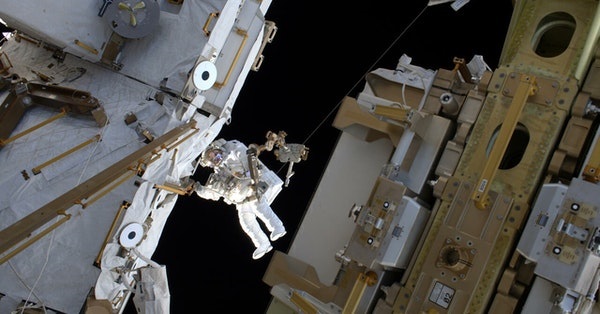
France 24 30/06/2022 Paris (AFP) – Astronauts lose decades’ worth of bone mass in space that many do not recover even after a year back on Earth, researchers said Thursday, warning that it could be a “big concern” for future missions to Mars.
Previous research has shown astronauts lose between one to two percent of bone density for every month spent in space, as the lack of gravity takes the pressure off their legs when it comes to standing and walking.
To find out how astronauts recover once their feet are back on the ground, a new study scanned the wrists and ankles of 17 astronauts before, during and after a stay on the International Space Station.
The bone density lost by astronauts was equivalent to how much they would shed in several decades if they were back on Earth, said study co-author Steven Boyd of Canada’s University of Calgary and director of the McCaig Institute for Bone and Joint Health.
The researchers found that the shinbone density of nine of the astronauts had not fully recovered after a year on Earth — and were still lacking around a decade’s worth of bone mass.
The astronauts who went on the longest missions, which ranged from four to seven months on the ISS, were the slowest to recover.
“The longer you spend in space, the more bone you lose,” Boyd told AFP.
Boyd said it is a “big concern” for planned for future missions to Mars, which could see astronauts spend years in space……………………..
Guillemette Gauquelin-Koch, the head of medicine research at France’s CNES space agency, said that the weightlessness experienced in space is “most drastic physical inactivity there is”.
“Even with two hours of sport a day, it is like you are bedridden for the other 22 hours,” said the doctor, who was not part of the study.
“It will not be easy for the crew to set foot on Martian soil when they arrive — it’s very disabling.”…………………………………. https://www.france24.com/en/live-news/20220630-lost-in-space-astronauts-struggle-to-regain-bone-density—
What I Know About Human Life as a Nuclear Downwinder

A government that knowingly harms its own citizens must be held accountable. Our lives are worth more than civilization-ending weapons. https://www.commondreams.org/views/2022/06/17/what-i-know-about-human-life-nuclear-downwinder MARY DICKSON, June 17, 2022
With Russia’s invasion of Ukraine in February, we unbelievably find ourselves on the brink of a new Cold War, ironically as casualties of the last Cold War are running out of time to seek the compensation and justice they deserve.
President Biden recently signed into law a stopgap bill to extend for another two years the Radiation Exposure Compensation Act, which pays partial restitution to select victims of atmospheric nuclear testing on American soil. While a welcome first step, it fails to address thousands more Americans who have been excluded from compensation despite the devastating harms they have suffered from radiation exposure. Time is running out as many are literally dying as they wait for justice.
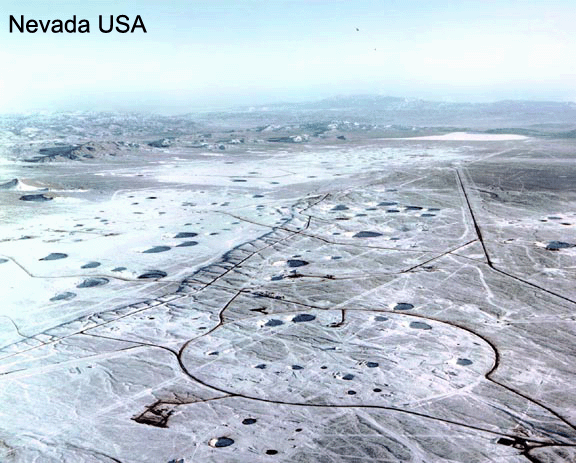
I am a casualty of the Cold War, a survivor of nuclear weapons testing. Growing up in Salt Lake City, Utah during the Cold War I was repeatedly exposed to dangerous levels of radioactive fallout from hundreds of detonations at the Nevada Test Site just 65 miles west of Las Vegas.
Our government detonated 100 bombs above ground in Nevada between 1951 and 1962 and 828 more bombs underground through 1992, many of which broke through the earth’s surface and spewed radioactive fallout into the atmosphere as well. The jet stream carried fallout far beyond the test site where it made its way into the environment and the bodies of unsuspecting Americans, while a government we trusted repeatedly assured us “there is no danger.”
In the spring before my 30th birthday, I was diagnosed with thyroid cancer. Children, especially those under the age of five at the time of radiation exposure, as I was, were most at risk.
I have been sliced, radiated and scooped out. I have buried and mourned the dead, comforted and advocated for the living, and worried with each pain, ache and lump that I am getting sick again. I survived thyroid cancer as well as subsequent health complications that left me unable to have children. My sister and others I grew up with were not so fortunate. They lost their lives to various cancers and other radiation-related illnesses. Before she died, my sister and I counted 54 people in a five-block area of our childhood neighborhood who developed cancer, autoimmune disorders, and other diseases that ravaged them and their families.
The government’s ambitious program of nuclear testing had tragic consequences for countless unsuspecting, patriotic Americans living downwind. “We are veterans of the Cold War, only we never enlisted and no one will fold a flag over our coffins,” a late friend of mine was fond of saying.
The U.S. government finally acknowledged its responsibility in 1990 when it passed the bipartisan Radiation Exposure Compensation Act (RECA), which paid partial restitution to some fallout victims in select rural counties of Utah, Arizona and Nevada. The bill never went far enough. We now know that the harm wreaked by fallout extends far beyond these counties. We also know that people are still getting sick. The suffering has not ended.
As part of a coalition of impacted community groups working with allied advocates nationwide, we have worked hard for the speedy expansion and extension of RECA through the Radiation Exposure Compensation Act Amendments of 2021. This bipartisan bill would add downwinders from all of Utah, Nevada, Arizona, Idaho, Montana, Colorado, New Mexico and Guam, as well as uranium miners who worked in the industry beyond 1971. It also would increase compensation from $50,000 to $150,00 for all claimants and extend the program for 19 years.
The House bill currently has 68 co-sponsors, the Senate bill 18, Republicans and Democrats from across the country. What we now need are their colleagues in both parties to join them.
As we reach out to Senators and Representatives asking them to support the bills, we are sometimes confronted with questions about cost. What, I ask in return, is a human life worth? Over the last 32 years, RECA has paid out $2.5 billion to 39,000 Americans. To put that into perspective, each year this country spends $50 billion just to maintain our nuclear arsenal. Are our lives not worth 0.5% of the cost of weapons that harmed us?
What is paramount is rectifying the mistakes of the past. As Rep. Diane Titus of Nevada said, “These people are Cold Warriors and we do not leave our warriors on the field.”
A government that knowingly harms its own citizens must be held accountable. Our lives are worth more than civilization-ending weapons. It’s a simple matter of priorities and justice.
Putting People First in Low-Dose Radiation Research

Putting People First in Low-Dose Radiation Research, Bemnet Alemayehu Natural Resources Defense Council. 7 June 22.It is urgent and feasible to improve our understanding of low-dose and low-dose-rate ionizing radiation health effects according to a new report released by the National Academies of Sciences, Engineering, and Medicine (NAS). At the request of the U.S. Congress, the NAS formed a committee of experts to conduct the study, sponsored by the U.S. Department of Energy. The report’s primary goal was to recommend a research program to increase the certainty of how exposure to low-dose and low-dose-rate radiation affects human health.
NRDC agrees that this is the right time to reconsider low-dose interdisciplinary radiation research in the United States and explore opportunities that advances in radiation health physics and information technology are providing. A large fraction of the U.S. population is exposed to low-dose, and low-dose-rate radiation and this number is increasing. Low-dose radiation research is most relevant to impacted communities due to disproportionate level of radiation exposure these communities have experienced compared to the general U.S. population due to activities carried out as part of the U.S. nuclear weapons program. Going forward, the study should give an opportunity for stakeholders and impacted communities to have deep and meaningful engagement at all stages of the research program by identifying priorities of research that concern them. The study should also prioritize trust building and make use of local community expertise.
How are we exposed to low-dose radiation?
People are exposed to ionizing radiation from a variety of sources. Most of this exposure comes from background radiation sources and from medical procedures.
Ionizing radiation is radiation that carries with it enough energy to remove an electron from an atom. This process can initiate a chain of events leading to health problems. When considering the health effects of radiation, understanding the amount of radiation dose absorbed by a person or an organ is critical.
Low-dose and low-dose-rate (low-dose accumulated over several years) are defined to mean a dose below 100 milligray and 5 milligray per hour, respectively. Gray is a unit used to measure the amount of radiation absorbed by an object or person, reflecting the amount of energy that radioactive sources deposit in materials through which they pass. Low-dose radiation exposure includes exposure to natural radiation, medical applications, and occupational exposures. According to the NAS report, low doses of radiation delivered over long periods do not cause prompt tissue or organ damage but may cause cellular damage that increases an individual’s long-term risk of cancer and hereditary disorders in a stochastic (or probabilistic) fashion.
The NAS report identified the following seven low-dose and low-dose-rate radiation exposure sources to be relevant for the study:
- exposure from natural radiation sources
- exposure to patients from medical applications
- occupational exposures
- exposure of workers that results from nuclear power routine operations and accidents
- exposure from nuclear or radiological incidents
- exposures from the nuclear weapons program, and
- exposure from nuclear waste.
Key recommendations from the report
Research agenda
Ionizing radiation occurs in a wide range of settings and the number of exposed individuals is increasing. However, the relationship between exposure to radiation and cancer risk at the very low doses is not well established. Currently, there is also no dedicated low-dose and low-dose-rate radiation research program or coordinated research strategy in the United States.
The report recommended research programs that leverage advances in modern science to obtain direct information on low-dose and low-dose-rate radiation health effects. These are:
- advances in epidemiological study design and analysis
- advances in radiobiological research
- advances in biotechnology and research infrastructure
For the research to achieve its goals, integration and interaction between these research programs is critical.
Program funding
The report found that a significant investment over a sustained period spanning several decades is necessary to accomplish the research goals. The report estimated that $100 million annually is needed during the first 10 to 15 years with periodic assessments. The report cautioned that inadequate funding for the program would lead to the possible inadequate protection of patients, workers, and members of the public from the adverse effects of radiation.
Leadership for low-dose research in the United States
The report proposed joint Department of Energy and National Institute of Health leadership for low-dose radiation research that involves division of tasks based on capabilities. The report also recommended that the Department of Energy take strong and transparent steps to mitigate the issues of distrust toward research that it manages.
Engagement with impacted communities
Success of the low-dose radiation program would depend not only on its scientific integrity but also on its ability to meaningfully engage and communicate with the stakeholders, which includes impacted communities.
Impacted communities, according to the report, include indigenous communities; atomic veterans; nuclear workers; uranium miners, transporters, and their families; and individuals or communities impacted by radioactive contamination or nuclear fallout due to nuclear weapons testing, offsite radiation releases from nuclear weapons production sites, and nuclear waste cleanup activities.
Impacted communities have strongly objected to the Department of Energy’s management of the low-dose radiation program due to the Department’s responsibility for management and cleanup of nuclear sites conflicting with its role as a manager of studies on low-dose and low-dose-rate radiation health effects.
For the success of the low-dose radiation program, the program needs to:
- develop a transparent process for stakeholder identification, engagement, and communication
- include members of the impacted communities in the independent advisory committee so that they may participate in various aspects of research planning and implementation, and
- set up additional advisory subcommittees with substantial stakeholder participation to advise on specific projects that involve human populations exposed to low-dose radiation.
UK Nuclear test veterans demand recognition at first meeting with Prime Minister
Boris Johnson was told about debilitating health issues suffered by servicemen and their descendants as a result of radiation exposure. Sophie Wingate 8 June 22
People affected by Britain’s atomic experiments have asked for formal recognition for nuclear test veterans in their first ever official meeting with a prime minister.
A group including a nuclear bomb test veteran, a widow and four descendants told Boris Johnson about their experiences of the tests and,,,,,,,,,,,, (Registered readers only_ https://www.independent.co.uk/news/uk/boris-johnson-people-joe-biden-christmas-island-rebecca-longbailey-b2096722.html
1 This Month
6 June – WEBINAR- Get Inspired by Protests Against Military Bases!


Cuba Is Not a Failed State – It Is a Besieged State
PETITION: “Global Appeal to Endorse Palestinian Right of Return of Refugees”


of the week– Nuclear Reactor Information Task Force
To see nuclear-related stories in greater depth and intensity – go to https://nuclearinformation.wordpress.com
-
Archives
- June 2026 (34)
- May 2026 (306)
- April 2026 (356)
- March 2026 (251)
- February 2026 (268)
- January 2026 (308)
- December 2025 (358)
- November 2025 (359)
- October 2025 (376)
- September 2025 (257)
- August 2025 (319)
- July 2025 (230)
-
Categories
- 1
- 1 NUCLEAR ISSUES
- business and costs
- climate change
- culture and arts
- ENERGY
- environment
- health
- history
- indigenous issues
- Legal
- marketing of nuclear
- media
- opposition to nuclear
- PERSONAL STORIES
- politics
- politics international
- Religion and ethics
- safety
- secrets,lies and civil liberties
- spinbuster
- technology
- Uranium
- wastes
- weapons and war
- Women
- 2 WORLD
- ACTION
- AFRICA
- Atrocities
- AUSTRALIA
- Christina's notes
- Christina's themes
- culture and arts
- Events
- Fuk 2022
- Fuk 2023
- Fukushima 2017
- Fukushima 2018
- fukushima 2019
- Fukushima 2020
- Fukushima 2021
- general
- global warming
- Humour (God we need it)
- Nuclear
- RARE EARTHS
- Reference
- resources – print
- Resources -audiovicual
- Weekly Newsletter
- World
- World Nuclear
- YouTube
-
RSS
Entries RSS
Comments RSS
 nuclear-news