Japanese Red Cross Society radiation limits for emergency workesr
Red Cross radiation limit for relief workers too low, say critics Asahi Shimbun, By YURI OIWA June 13, 2013 The Japanese Red Cross Society has established a guideline for medical workers that sets an accumulated radiation dose limit of 1 millisievert for relief activities, although experts have said the ceiling is too low to allow workers to provide ample assistance to disaster victims.
“Radiation doses above 1 millisievert have no health effects,” said Yasushi Asari, a professor of emergency medical care at Hirosaki University. “There is no need for medical workers to use that threshold.”
Masahito Yamazawa, director-general of the Red Cross nuclear disaster preparedness task force, said during in-house discussions there were arguments for and against the 1-millisievert threshold. But the Red Cross determined that a 1-millisievert limit would still allow its workers to engage in relief activities in zones with high radiation levels because each relief mission usually lasts only up to a week, Yamazawa said.
One millisievert is the legal annual dose limit for members of the public during normal times.
Yamazawa added that allowances were also made for the fact that its medical relief squads include clerical workers.
“We have created the guideline out of a positive desire to help victims during a nuclear disaster,” Yamazawa said. “We will use it as a platform for further improvements if the need arises.”
Japanese Red Cross relief units fulfilled a total of 900 missions in communities ravaged by the 2011 Great East Japan Earthquake. However, initially they were unprepared for a nuclear disaster, and that created a vacuum of relief squads in Fukushima Prefecture during the early stages of the crisis at the Fukushima No. 1 nuclear power plant.
Red Cross officials said they learned from that experience and decided to create the new guideline for nuclear disaster relief activities.
The guideline says relief squad members should carry dosimeters and iodine tablets at all times, and retreat to safety whenever they are in danger of being exposed to more than 1 millisievert in accumulated radiation. It also says relief workers should keep clear of zones that are off-limits to residents……
Patterns of Fukushima radiation in Northern hemisphere
 Study: Fukushima fuel burn-up spread over entire northern hemisphere’s middle latitudes — First time measured in southern hemisphere http://enenews.com/study-fukushima-fuel-burn-up-dispersed-over-entire-northern-hemispheres-middle-latitudes-first-time-also-measured-in-southern-hemisphere
Title: An overview of Fukushima radionuclides measured in the northern hemisphere
Source: Science of The Total Environment
Author: P. Thakura, S. Ballard, R. Nelson
Date: August 1, 2013
Abstract
The Great East Japan Earthquake and tsunami on March 11, 2011 resulted in the tragic accident at the Fukushima Nuclear Power Plant (NPP) and subsequently uncontrolled release of radioactive contaminants into the atmosphere. This review article attempts to compile and interpret data collected by various national and international monitoring networks in response to the Fukushima releases across the northern hemisphere. The majority of the releases occurred during the period March 12–22 with a maximum release phase from March 14–17, 2011. The radioactivity released was dominated by volatile fission products including isotopes of the noble gases (xenon and krypton), iodine, cesium, and tellurium. The radioactive gases and particles released in the accident were dispersed over the middle latitudes of the entire northern hemisphere and for the first time also measured in the southern Hemisphere. Isotopes of iodine and cesium were detected in air, water, milk and food samples collected across the entire northern hemisphere. Elevated levels of fission products were detected from March to May 2011 at many locations over the northern hemisphere.
This article focuses on the most prevalent cesium and iodine isotopes, but other secondary isotopes are also discussed. Spatial and temporal patterns and differences are contrasted. The activity ratios of 131I/137Cs and 134Cs/137Cs measured at several locations are evaluated to gain an insight into the fuel burn-up, the inventory of radionuclides in the reactor and the isotopic signature of the accident. It is important to note that all of the radiation levels detected outside of Japan have been very low and are well below any level of public and environmental hazard. Full study available here
Concern over radiation risks in CT scans for children
 more research is urgently needed to determine when CT in pediatrics can lead to improved health outcomes and whether other imaging methods (or no imaging) could be as effective. For now, it is important for both the referring physician and the radiologist to consider whether the risks of CT exceed the diagnostic value it provides over other tests, based on current evidence,”
Study Examines Cancer Risk from Pediatric Radiation Exposure from CT Scans http://www.sciencedaily.com/releases/2013/06/130610192536.htm June 10, 2013 — According to a study of seven U.S. healthcare systems, the use of computed tomography (CT) scans of the head, abdomen/pelvis, chest or spine, in children younger than age 14 more than doubled from 1996 to 2005, and this associated radiation is projected to potentially increase the risk of radiation-induced cancer in these children in the future, according to a study published Online First byJAMA Pediatrics. The use of CT in pediatrics has increased over the last two decades. The ionizing radiation doses delivered by the tests are higher than convention radiography and are in ranges that have been linked to an increased risk of cancer. Children are more sensitive to radiation-induced carcinogenesis and have many years of life left for cancer to develop, the authors write in the study background.
“The increased use of CT in pediatrics, combined with the wide variability in radiation doses, has resulted in many children receiving a high-dose examination,” the study notes.
Diana L. Miglioretti, Ph.D., of the Group Health Research Institute and University of California, Davis, and colleagues quantified trends in the use of CT in pediatrics plus the associated radiation exposure and estimated potential cancer risk using data from seven U.S. health care systems. Continue reading
Why is World Health Organisation not releasing Iraq birth defects report?
 What’s delaying the WHO report on Iraqi birth defects http://www.aljazeera.com/indepth/opinion/2013/06/201365101540408281.html A 2012 World
  Health Organization study on congenital birth defects in Iraq has still not been released to the public. 06 Jun 2013 Mozhgan Savabieasfahani Dr Mozhgan Savabieasfahani, a native of Iran, is an environmental toxicologist based in Michigan. She is the author of over two dozen peer reviewed articles and the book, Pollution and Reproductive Damage (DVM 2009).

Iraq is poisoned. Thirty-five million Iraqis wake up every morning to a living nightmare of childhood cancers, adult cancers and birth defects. Familial cancers, cluster cancers and multiple cancers in the same individual have become frequent in Iraq.
Sterility, repeated miscarriages, stillbirths and severe birth defects – some never described in any medical books – are all around, in increasing numbers. Trapped in this hellish nightmare, millions of Iraqis struggle to survive, and they and they call for help.
At long last, public pressure and media attention to this public health catastrophe prompted a joint study by the World Health Organization (WHO) and the Iraqi Ministry of Health to determine the prevalence of birth defects in Iraq. This study began in May-June 2012 and was completed in early October 2012. Continue reading
Higherdeath rate for those living near Browns Ferry Nuclear Plant
The full report may be downloaded at www.matrr.org or www.bredl.org

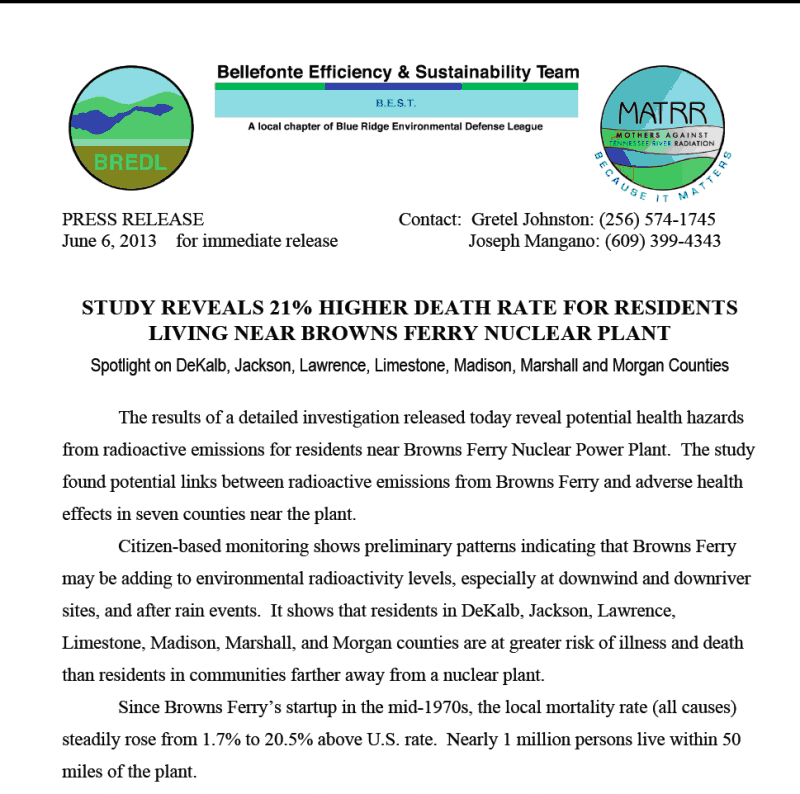
Major findings of the report• Continue reading
Radiation and the ethics of sending astronauts to Mars
 One thing is certain: there can be no more romantic idealism. No amount of wishful thinking, or crowdsourcing, or press releasing can circumvent this problem. Space radiation is dangerous, potentially deadly. Manned missions to Mars with current technology will carry significant exposure risks.
At what price ethically do we want the Red Planet?
Space radiation results should spark manned Mars mission debate, Guardian UK, Stuart Clark 5 June 13Nasa data shows radiation doses would be so high on a manned Mars mission that we must now debate the ethics of deep space exploration – or wait decades to develop safer technology
It is time for idealism about missions to Mars to end. Going there with current technology would carry a significant risk of harmful radiation exposure. Continue reading
Thyroid cancer in Fukushima children – nothing to worry about?
 Life and Death Choices: Radiation, Children, and Japan’s Future, Truth Out, By David McNeill, The Asia-Pacific Journal: Japan Focus, 4 June 13 “…….Many parents point to a recent finding that over 40 per cent of nearly 95,000 children checked by Dr Suzuki’s team had thyroid ultrasound “abnormalities”. About 35 per cent had nodules or cysts on their thyroids.
The cysts and nodules are not cancers but they point to an inevitable spike in future health problems, says Mr Fujimoto – a view contested by the government. “I have absolutely no faith in what the Fukushima government is saying,” he retorts. “They want people to go back and live there so they clearly want to keep a lid on the impact of the disaster.”
Parents accuse government scientists of making their minds up before the survey began – Professor Suzuki’s team said last July that their aim was “to calm the anxiety of the population.”
Iwata Wataru, who heads a non-profit group that measures radiation, believes that’s an abuse of science. “A scientific study is normally designed to detect an effect and lead the investigator to accept or reject a stated hypothesis,” he said. “In this case, they have a strong prior belief that there is no physical effect of exposure.” Iwata wants more independent testing.
In the absence of a consensus on the likely impact of the Fukushima accident, the debate has hardened into two sides: people like Fujimoto an Iwata who say the authorities are playing down or even covering up the disaster, and the increasingly vocal official view that their worries are overblown. Those who stray too far from the official line risk being accused of fear-mongering.
That criticism misses the point, says Mochizuki Iori, author of the blog Fukushima Diary. “I was exposed in the first week,” he writes. “It’s irreversible. Not so many people can share this feeling in the world. I check my thyroid, lymph and symptoms of other things that I don’t even want to mention.”
Doctors say children’s thyroids, which help regulate the body’s metabolism, are especially sensitive to radioactive iodine. The gland is very active during childhood development. A study published last year in the International Journal of Cancer found elevated risks of thyroid cancer in childhood survivors of Hiroshima and Nagasaki, 50 years after they were exposed to radiation. The study found over a third of 191 thyroid cancers in adults who were children at the time of the bombing were probably due to exposure. <link>
Whatever the scientists say, Mr. Fujimoto insists he won’t be persuaded by government reassurances that it is safe to return to Fukushima. “There is so much information not getting out at the moment. It will be too late for my children when it is eventually released.”
http://truth-out.org/news/item/16768-life-and-death-choices-radiation-children-and-japans-future
EPA Dramatically Weakens Radiation Protection
 Fukushima Radiation Risk Media Deception, Lynda Lovon 3 June 13 ………“The U.S. Environmental Protection Agency (EPA) is publishing in the Federal Register today controversial new Protective Action Guides (PAGs) for responding to radioactive releases. EPA says it solicits public comment but is nonetheless making the PAGs immediately effective.
Fukushima children and thyroid abnormalities: predictions of thyroid cancers
“Rates of thyroid problems in children near Fukushima nuclear plant are high” — Expert: Parents have reason to worry — Gov’t accused of cover-up http://enenews.com/rates-of-thyroid-problems-in-children-near-fukushima-nuclear-plant-are-high-expert-parents-have-reason-to-worry-govt-accused-of-cover-up
Source: The Independent
Author: David McNeill
Date: June 1, 2013
h/t Anonymous tip Rates of thyroid problems in children near the nuclear plant are high
[…] Last December, the eldest of the two was diagnosed with adenoidal cysts, the prelude to a type of cancer that often strikes the salivary glands. “I was told by the doctor that it’s very rare,” [Yoji Fujimoto] says. […]
“I’m convinced this is because of the Fukushima accident.” […]
[Steve Wing, an epidemiologist at the University of North Carolina] says that parents like Mr Fujimoto do have reason to worry. “We know that doses to populations are both unquantified by the official agencies, that evidence suggests relatively high doses, and that children and women are more vulnerable to radiation. So the questions and deep concerns for the people in Fukushima will continue for the rest of their lives.” […]
“I expect a growth in the numbers of thyroid cancers in Japan from next year,” [Dr Alexey Yablokov, a Russian biologist] said. […]
Parents accuse government scientists of making their minds up before the [thyroid] survey began – Professor Suzuki’s team said last July that their aim was “to calm the anxiety of the population”.
Yoji Fujimoto
“I have absolutely no faith in what the Fukushima government is saying”
“They want people to go back and live there so they clearly want to keep a lid on the impact of the disaster”
“There is so much information not getting out at the moment — It will be too late for my children when it is eventually released”
See also: UN: “Fukushima nuclear disaster poses no IMMEDIATE health risks” — Unknown if increase in thyroid cancer is due to radioactivity
Good news: ionising radiation type scanners removed from airports across USA
 Full-body scanners at airports replaced with less-revealing, low radiation machines http://abclocal.go.com/wls/story?section=news/local&id=9125985 June 03, 2013 — Airports across the U.S. have removed the full-body scanners that used x-rays to create what looks like nude images of passengers.
The remaining 250 machines were removed about two weeks before the June 1st deadline set by Congress.Some critics said they were too revealing, while others expressed health concerns over radiation exposure.
Passengers still have to undergo full-body scans. However, the scanners now use radio waves that produce a less-detailed image.
Harm from radiation, among families of nuclear workers
 Some Atomic Energy Workers Passed Effects of Radiation and Chemical Exposure to their Spouses and Children Huntington News, June 3, 2013 – BY TONY E. RUTHERFORD, NEWS EDITOR “……“Big Jim” took a job working around radioactive elements in 1954 at the Portsmouth Gaseous Diffusion Plant (PGDP) in Piketon, Ohio. Workers told his daughter how they kept their lunches warm by laying them on uranium yellow cakes and poked fun of individuals who put around their clothing before painting. They wore radiation exposure badges, but by “doing his job” Jim later developed four cancers.
“My dad talked about the A plant, but he never told us what it was,” Joan Fearing (Big Jim’s daughter) said. “Mom washed his work clothes.” She passed away from a rare form of cancer too. “When my mother was dying, she still did not tell us what it was.”
The Cold War ended the arms race. Nuclear weapons were replaced with atoms for peace at electrical power plants. However, the atomic legacy appears passed to the 21st Century. Continue reading
Compensation for Fukushima evacuees’ radiation anxiety
 Fukushima Evacuees To Get Radiation Uncertainty Compensation http://www.rttnews.com/2128844/fukushima-evacuees-to-get-radiation-uncertainty-compensation.aspx?type=gn&utm_source=google&utm_campaign=sitemap 6/3/2013 A government-backed arbitration body in Japan directed the operator of the tsunami-wrecked Fukushima nuclear power plant to pay compensation to former residents of a district for radiation exposure and future healthuncertainties.
As per a directive issued by the Nuclear Damage Claim Dispute Resolution Center, the Tokyo Electric Power Company (TEPCO) has to pay about $10,000 each to pregnant women and those aged below 18 years. The other residents of Nagadoro district would get $5,000 each, Japanese media reported on Sunday.
Nagadoro is near the Fukushima plant where radiation levels remain high and it is the only district that the government declared uninhabitable for a long period.
An evacuation order for the area was issued more than a month after the nuclear accident on March 11, 2011. The arbitrators accepted the residents’ claim of fear and anxiety as they had lived without any protection against high radiation doses because of their delayed evacuation. The residents had already received compensation for having to evacuate, but the amount did not cover health anxieties. Lawyers representing the residents said it was for the first time that compensation for health anxietywas granted.
The massive tsunami severely damaged four reactors at the Fukushima plant north of Tokyo, knocking out its cooling systems and triggering meltdowns and radiation leaks. Tens of thousands of people fled their homes in the worst atomic disaster since the 1986 Chernobyl nuclear accident.
Huge radiation health danger for astronauts going to Mars
Curiosity flew to Mars in a spacecraft that had shielding similar to what astronauts would have on the new crew vehicle being developed by NASA. The detector picked up an average of 1.8 millisieverts of radiation per day. A human being on the surface of the Earth receives only about 3 millisieverts of radiation in an entire year.
“The radiation environment in deep space is several hundred times more intense than it is on Earth, and that’s even inside a shielded spacecraft,”
“The radiation exposure on a trip to Mars would — barring a super-huge solar event — not be lethal. The concerns are mostly about cancer induction (a so-called ‘late effect’) and damage to the central nervous system,”
Space radiation would make Mars mission hazardous WP, By Joel Achenbach, May 30 Of all the hazards facing a human mission to Mars — something NASA and countless space buffs would love to see at some point — one of the hardest to solve is the radiation that saturates interplanetary space. New data, gathered by NASA’s Curiosity rover as it traveled to Mars, have confirmed that interplanetary space is a hostile medium and suggest that engineers need to find a way to speed up space travel significantly if they hope to reduce radiation exposure……
The effects of interplanetary radiation on the human body are not well understood. Until now, scientists had limited information about how much radiation penetrates a spacecraft during an interplanetary journey. But the Curiosity rover, which bristles with instruments, carried along a Radiation Assessment Detector, and it measured the incoming radiation during its 253-day trip to Mars, which began in November 2011. Continue reading
Two head CT scans double one’s risk of cancer from radiation
the risk of having soft-tissue sarcoma will be doubled under an exposure equal to radiation from two CT head scans.
Low levels of medical radiation can cause cancer, HKU study warns http://www.scmp.com/news/hong-kong/article/1250953/low-levels-medical-radiation-can-cause-cancer-hku-study-warns Even low levels emitted by X-rays and CT scans can cause cancer, and people who often get whole-body checks are at risk, HKU study says, 01 June, 2013 Emily Tsang emily.tsang@scmp.com Worries have been raised about the overuse of radiation in medicine after a study shows that even low levels of radiation – such as those emitted by X-rays and CT scans – can cause cancer.
The risk of soft-tissue sarcoma is doubled if a person receives an amount of radiation equivalent to two CT head scans, University of Hong Kong researchers say. This means that people who join a growing
trend of getting frequent whole-body checks including X-rays and scans are putting themselves at risk, the researchers say, adding that authorities should also reconsider the risks of nuclear power.
“The study has highlighted that even low to moderate levels of exposure are enough to cause genetic mutation,” study leader Dino Samartzis said. Continue reading
More radiation exposure when contrast medium is used with CT scans
Radiation dose increased for every organ scanned at CT, particularly in the most vascularized tissues, wrote researchers from the University of Messina in Italy. Average doses rose by one-fifth for the liver, one-third for the spleen and pancreas, and almost three-fourths for the kidneys.
“The results are in agreement with our previous data, confirming an increase in organ radiation dose in contrast-enhanced CT compared with unenhanced CT,” wrote Dr. Ernesto Amato and colleagues (AJR, June 2013, Vol. 200:6, pp. 1288-1293)……
Investigators have also found an increase in the frequency of cellular abnormalities in patients who underwent contrast-enhanced radiographic examinations. But the actual increase in dose for any given scan — which depends on iodine uptake; the shape, volume, and position of the organ; and the emitted x-ray energy spectrum — remains unknown, the authors wrote…….
Confirming dose increases
The results were in line with the group’s previous phantom study, and they confirmed significant radiation dose increases in contrast-enhanced CT versus unenhanced CT, Amato and colleagues wrote. The data showed average dose increases of 19% for the liver, 71% for the kidneys, 33% for the spleen and pancreas, and 41% for the thyroid.
“The kidneys showed the maximum among the average dose [increases] (71%, resulting from an attenuation increment of 139 HU),” the authors wrote.”High renal enhancement is, in fact, due to both their high vascularization because they receive 20% to 25% of the cardiac output and the passage of iodine within the renal tubules. In particular, the level of contrast medium within renal tubules can be up to 50 to 100 times higher than that in the blood because of the mechanisms of tubular concentration and secretion.”
Thyroid tissue showed the second highest dose increase (41%) after contrast injection, based on an HU increase of 87%. Also, the dose increases in the thyroid depended on tissue density on unenhanced CT, the group noted. Denser thyroids showed a lower increase in attenuation and, consequently, lower increases in dose.
Because the liver and spleen are richly vascularized, Hounsfield units increased with contrast by 49 HU and 71 HU, respectively, and average dose increased by 19% and 33%……. http://www.auntminnie.com/index.aspx?sec=ser&sub=def&pag=dis&ItemID=103565
1 This Month

petition to oppose the rapid increase of space-military industry threatening Jeju Island and the region.
[Petition by April 19th (KST)] Stop the joint military-Hanwha Systems-Jeju Provincial Government Sea Launch!

Chernobyl: The Lost Tapes – A good documentary on Chernobyl on SBS available On Demand for the next 3 weeks– https://www.sbs.com.au/ondemand/tv-program/chernobyl-the-lost-tapes/2352741955560

of the week–London Campaign for Nuclear Disarmament


Tell the Ukrainian Government to Drop Prosecution of Peace Activist Yurii Sheliazhenko
To see nuclear-related stories in greater depth and intensity – go to https://nuclearinformation.wordpress.com
-
Archives
- April 2026 (194)
- March 2026 (251)
- February 2026 (268)
- January 2026 (308)
- December 2025 (358)
- November 2025 (359)
- October 2025 (376)
- September 2025 (257)
- August 2025 (319)
- July 2025 (230)
- June 2025 (348)
- May 2025 (261)
-
Categories
- 1
- 1 NUCLEAR ISSUES
- business and costs
- climate change
- culture and arts
- ENERGY
- environment
- health
- history
- indigenous issues
- Legal
- marketing of nuclear
- media
- opposition to nuclear
- PERSONAL STORIES
- politics
- politics international
- Religion and ethics
- safety
- secrets,lies and civil liberties
- spinbuster
- technology
- Uranium
- wastes
- weapons and war
- Women
- 2 WORLD
- ACTION
- AFRICA
- Atrocities
- AUSTRALIA
- Christina's notes
- Christina's themes
- culture and arts
- Events
- Fuk 2022
- Fuk 2023
- Fukushima 2017
- Fukushima 2018
- fukushima 2019
- Fukushima 2020
- Fukushima 2021
- general
- global warming
- Humour (God we need it)
- Nuclear
- RARE EARTHS
- Reference
- resources – print
- Resources -audiovicual
- Weekly Newsletter
- World
- World Nuclear
- YouTube
-
RSS
Entries RSS
Comments RSS
 nuclear-news