10 million data points: Safecast volunteers map Fukushima radiation
 Volunteers See Fukushima Radiation on the Move http://www.technologyreview.com/view/517416/volunteers-see-fukushima-radiation-on-the-move/ Aviva Hope Rutkin, 23 July 13
Crowd-sourced data provides a high-res view of radiation levels in Japan.The radiation-mapping project launched shortly after the Fukushima Daiichi nuclear disaster recently surpassed more than ten million data points, all gathered by a network of local volunteers. The maps show, among other things, that radiation levels are dropping more quickly than should be expected via half-life decay alone. Project director Sean Bonner says this may be a sign that radioactive contamination is on the move. “This could mean that organic material (such as leaves on tree, brush) might have been contaminated and fallen off and washed away over the last two years, lowering the overall background of an area,” he said in an email.
The project, Safecast, was founded one week after the disaster to share information about radiation levels around Japan. Although the Japanese government provides its own statistics on this issue, its data is sometimes unreliable and can be restricted from public access. Safecast sends volunteers cheap Geiger counters, called geigies, to measure local levels of radioactivity. Volunteers can either purchase a unit for anywhere from $200 to $1000 or build their own using a $450 kit. This data is then mapped and made publicly available through the Safecast website.
Over more than two years of data collection, Safecast has produced the highest resolution picture to date of Japan’s radiation levels. The project’s maps confirm that the majority of the country’s radiation levels remain near background, with no appreciable change in radioactive activity. In areas that do have significant radiation, the maps show how levels can fluctuate simply when one crosses the street in a given neighborhood—uncovering small, previously unrecognized hotspots, though the organization maintains that these hotspots are not cause for concern.
Safecast plans to continue collecting data to use in a larger analysis of how these levels change in different cities over the coming years. They hope to uncover more about where the radiation is spreading, and how a given area’s climate, topography, and soil affect the way surface radioactivity decays.
According to TEPCO, 2000 Fukushima workers at higher risk of thyroid cancer

 Workers at Japan’s Fukushima nuclear plant see raised cancer risk http://www.thehindubusinessline.com/news/international/workers-at-japans-fukushima-nuclear-plant-see-raised-cancer-risk/article4931822.ece TOKYO, JULY 19: Japan’s Tokyo Electric Power Company said on Friday that 1,973 employees who were at the nuclear power plant damaged after a 2011 tsunami are facing a higher risk of thyroid cancer.
Workers at the Fukushima Daiichi Nuclear Power Station have estimated thyroid radiation doses exceeding 100 millisieverts, the widely accepted level for an increase in the risk of cancer, the company said.
They are to undergo annual ultrasonic thyroid examinations, it said.
Health tests were given to 19,592 workers — 3,290 Tokyo Electric employees and 16,302 employees of its affiliated companies.
They were involved in the struggle to bring the plant under control after the world’s worst nuclear crisis since the 1986 Chernobyl disaster.
The Fukushima plant suffered meltdowns at three of its six reactors after the earthquake and tsunami two years ago.
No official body is measuring ionising radiation in the atmosphere
Fukushima 2013: “Remaining Radioactive Mass”, “Dangerous Leaking Radioactive Water”, All Four Reactors are “Getting Worse” By William Boardman Global Research, July 11,  2013 “……...It’s Not a Cover-up If Governments Gather No Useful Information, Is It?
Apparently there is no comprehensive, Fukushima-related radiation testing being carried on by the U.S. Canadian, or other governments whose people are directly affected. Nor is there any international body publicly performing this work.
The Global Monitoring Division of the Earth System Research Laboratory of the National Oceanic & Atmospheric Administration (NOAA) of the U.S. Dept. of Commerce monitors global levels of “carbon dioxide, carbon monoxide, methane, nitrous oxide, surface and stratospheric ozone, halogenated compounds including CFC replacements, hydrocarbons, sulfur gases, aerosols, and solar and infrared radiation.”
Worldwide nuclear weapons programs and nuclear power generation add ionizing radiation to the atmosphere continuously. NOAA’s website offers five different safety programs related to ionizing radiation. But if NOAA (or any other government entity) is measuring ionizing radiation in the atmosphere, that information is not easily found…..”.http://www.globalresearch.ca/fukushima-2013-remaining-radioactive-mass-dangerous-leaking-radioactive-water-all-four-reactors-are-getting-worse/5342466
World Health Organisation predicted cancers from Fukushima radiation, called for long term monitoring
Fukushima 2013: “Remaining Radioactive Mass”, “Dangerous Leaking Radioactive Water”, All Four Reactors are “Getting Worse” By William Boardman Global Research, July 11, 2013 “………Radiation Dose So Far Not Harmful, U.N. says – But It’s Not Over Yet
In February the World Health Organization (WHO) of the U.N. released an almost 200-page assessment of the health risks from the Fukushima disaster, “the first-ever analysis of global health effects due to radiation exposure” from Fukushima. In a press release issued in Geneva, WHO concluded that: “for the general population inside and outside of Japan, the predicted risks are low and no observable increases in cancer rates above baseline rates are anticipated.”
Using preliminary dose estimation data to make its predictions, the WHO report also found “that the estimated risk for specific cancers in certain subsets of the population in Fukushima Prefecture has increased and, as such, it calls for long term continued monitoring and health screening for those people.”
The release quotes Dr Angelika Tritscher, Acting Director for WHO’s Food Safety and Zoonosis Department, saying that: “In addition to strengthening medical support and services, continued environmental monitoring, in particular of food and water supplies, backed by the enforcement of existing regulations, is required to reduce potential radiation exposure in the future.”
And the WHO report “notes that the psychosocial impact of Fukushima] may have a consequence on health and well-being. These should not be ignored as part of the overall response.”…..http://www.globalresearch.ca/fukushima-2013-remaining-radioactive-mass-dangerous-leaking-radioactive-water-all-four-reactors-are-getting-worse/5342466
New Zealand’s and other countries’ veterans, victims of Mururoa nuclear tests
In April 2006, the Herald reported Dr Rowland saying a small but statistically significant level of genetic damage had been found.
“Taking all confounding factors [like smoking, alcohol and medical x-rays] into account, we are left with only one other interpretation of what it is about this group that’s different to the control group: they went to Operation Grapple.”
His work on chromosome damage – the first step in the formation of cancer – gave hope of compensation to thousands of men from Britain, Australia, Fiji and New Zealand.
The research was commissioned by Nuclear Test Veterans’ Association chairman Roy Sefton, who sought Government acknowledgment that men were harmed in their teens and had no choice on whether they went to Mururoa.
Tony Cox, who was on HMNZS Otago and heads the Rimpac veterans’ rights organisations, said an attempt was being made to convert Dr Rowland’s findings to apply to the Mururoa veterans.
“Just because the Government did not accept the Rowland study does not mean that it can’t come up for a review.”
Mr Cox said he had cancer of a type that was contracted only through exposure to ionised radiation…
Mururoa – our darker legacy New Zealand Herald By Wayne Thompson Jul 19, 2013 A band of men who “drove the taxis” – the naval frigates carrying the official New Zealand protesters against French nuclear testing in the air of the Pacific Ocean – will be in a sombre and angry mood at their 40th anniversary reunion in Tauranga tomorrow.
“Our feeling in 1973 was there was one protester, Government minister Fraser Colman,” said one of the former crew members of HMNZS Canterbury, Wayne O’Donnell.
“We were there just to keep the ship going and do what we were employed to do.
“By the time the blast was observed we were glad to head home.
“We did not expect any major radiation fallout, which has been proven wrong.” Continue reading
Ionising radiation causes cancer. electromagnetic might, too
The World Health Organisation’s International Agency for Research on Cancer has classified radiofrequency electromagnetic fields as “possibly carcinogenic to humans”.
Parents urged to limit children’s use of mobiles, cordless phone under new health warningshttp://www.adelaidenow.com.au/technology/parents-urged-to-limit-childrens-use-of-mobiles-cordless-phone-under-new-health-warnings/story-fn7bfu22-1226589473040 Natasha Bita, National Social Editor March 03, 2013 PARENTS should limit kids’ use of mobile and cordless phones, Australia’s radiation watchdog recommends in new health advice.
The Federal Government’s Australian Radiation Protection and Nuclear Safety Agency (ARPANSA) also suggests that baby monitors be kept a metre away from cots, to minimise any electromagnetic emissions.
“Due to the lack of scientific evidence on mobile and cordless phone use by children, ARPANSA recommends that parents encourage their children to limit their exposure,” the agency states in its first “fact sheet” for consumers to reduce exposure from wireless devices including mobile phones.Doctors yesterday agreed with the regulator’s advice, in light of children’s fixation with tablets and smartphones. Continue reading
Electromagnetic radiation could be hazardous, too, as well as ionising radiation
Instant Expert: Electromagnetic radiation Green Lifestyle, By Caitlin Howlett,16 July Breaking down the buzz of a shock-worthy pollution.
What is electromagnetic radiation?
Electromagnetic radiation (EMR), sometimes called electrosmog or electromagnetic pollution, is emitted by all electrical and wireless technologies. Radiofrequency EMR is invisible but it’s everywhere – it is naturally produced by all matter in the Universe, with high levels produced by the Sun, and low levels by your body. However over the past 100 years or so, radio, television, power-lines, computers and, more recently, telecommunications (in particular mobile phones), have changed the way humans, plants and animals are exposed to EMR.
What do we know about it?
Naturally occurring levels of EMR probably have little or no effect on humans, but the proliferation of appliances in the 21st century has raised questions about setting safe levels of exposure. Unnaturally high levels of EMR – as used by microwave ovens or radio transmitters – have been suggested to cause cancers, miscarriages, genetic damage and other health problems, but there is no firm scientific evidence…….
Does it affect all living things?
Birds and bees use the Earth’s natural magnetic field for navigation, but magnetic interference from power lines and mobile phone technology may alter their ability to do this. Studies suggest wildlife is affected by radiofrequency (which is emitted by all wireless technology, from WiFi and cordless phones to phone masts) and there have been calls to ban the installation of phone masts in protected natural areas and where endangered species are present…..
Some statistical links were found between high phone use and brain tumours, and in May IARC classified mobile phone radiation as possibly carcinogenic.
How can I avoid it?
“To avoid electromagnetic radiation in the home it’s important to use wired connections wherever you can and avoid wireless connections,” says Lyn McLean, author of The Force: Living safely in a world
of electromagnetic pollution.
While she advises avoiding “long-term exposure while you’re sleeping”, Dr Lindsay Martin of the Australian Radiation Protection and Nuclear Safety Agency says sensible precautions should be weighed against advantages of technology that could provide security and health benefits.
McLean says there are safer alternatives to using a phone as an alarm clock, such as battery-operated or electric devices, and she suggests using non-bluetooth hands-free on a mobile, and texting instead…….
Dr. Lindsay Martin, Australian Radiation Protection and Nuclear Safety Agency
“While there is little evidence of widespread health effects or environmental impact from EMR, there is enough circumstantial evidence to justify precaution in regard to prolonged exposure to magnetic fields from electrical infrastructure such as power lines and children’s use of mobile phones.” http://www.greenlifestylemag.com.au/2947/instant-expert-electromagnetic-radiation
FUKISHIMA: RADIOACTIVITY in SEAWATER

Issue 1: The number of radio-nuclides entering the marine environment of the east coast of Japan.
Issue 2: The nature of the radio-nuclides derived from reactor and cooling pond outputs
It’s my conclusion that the official monitoring regime being carried out by TEPCO and other Japanese agencies is inadequate to the task of identifying the potential radiobiological threats to the public.
An OPEN BRIEFING, Tim Deere-Jones: Marine Radioactivity Consultant, timdj@talktalk.netJuly 2013
I’m a UK based Marine Radioactivity Consultant, Researcher and Campaigner whose been researching the subject since the 1980’s and working (on a freelance, independent basis) as a consultant to NGO’s, Green Groups, Citizens Campaign Groups and UK Local Authorities since the 1980’s.
My field work experience and desk review research have been focussed on the behaviour and fate of man made radioactivity in UK and European marine, coastal and estuarine environments and the pathways by which doses of marine radioactivity may be delivered to maritime, coastal zone and island populations.
In the context of the ongoing contamination of the marine environment following the multiple meltdowns and loss of coolant from the Fukushima site I note the ongoing near-site monitoring of the marine environment (sea water) and of some marine environmental media (principally fish, with some marine algae).
However I am deeply concerned to note that a number of highly relevant issues and phenomena relating to the behaviour and fate of the Fukushima sea discharged radioactivity and its potential for delivering doses to human populations remain un-recorded, under researched and/or completely ignored.
Thus it is evident that the true impacts of the radioactive contamination of the Japanese east coast are not being documented or acted upon.
The short, informal briefing, set out in the following pages, identifies and comments on some of those issues and introduces the outcome of a number of UK observations and studies (principally carried out in one of the planets most radioactive sea areas: the Irish Sea and it’s adjacent waters) in order to provide some supporting background information in support of my concerns relating to the Fukushima case.
N.B. Input of the search term “Tim Deere-Jones: Marine Radioactivity” to most of the popular search engines will upload links to a number of fully referenced, scientific and technical reports and studies, on the behaviour, fate and doses potential of marine discharged radioactive wastes in UK and European waters, that I have authored for a number of clients. Continue reading
Cancer risk to children increased with CT scans
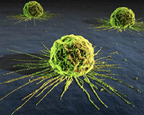 They found, after some statistical adjustment, that the group of children exposed to CT scans were 24 percent more likely to develop any cancer during the study time period and that their risk bumped up (about 16 percent or so) with each additional scan. The peril was greater for children exposed at younger ages and was linked to many different types of malignancies — including cancers of the brain, skin, blood and gut
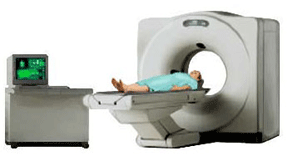 Dr. Dustin Ballard: Examining the trade-offs with CT scans marinij.com By Dr. Dustin BallardIJ correspondent 07/15/2013 IN MEDICINE, like in life, there are almost always trade-offs. Most treatments, even unassuming ones like oxygen, have side effects. And most medical tests hold the potential of unintended consequences.
Consider the recent evidence about the long-term effects of CAT Scan (CT) radiation in children. But, before we get there — please don’t flip out — CTs can be valuable tools, so please don’t decide that you will boycott them entirely. That said, it’s undeniable that there’s been an explosion in the use of CTs, and that this is a concerning trend. Mounting evidence shows that CT exposure in childhood results in a small but real increased risk of cancer later in life. Continue reading
American Medical Association wants action on radiation in seafoods

 American Medical Assn. Urges Testing Seafood For Radiation http://www.simplyinfo.org/?p=10663 July 11th, 2013 The American Medical Association has passed a resolution calling for the US to continue to monitor and publicly report radiation contamination in seafood. The original resolution included the language that cited Fukushima as a main reason for the concern and focused on the Pacific ocean. The final resolution broadened it to include all seafood.
The resolution was approved before the recent announcement that Fukushima Daiichi has been continually leaking contamination into the Pacific for the last 2+ years.
The resolution is a good step for public health. The current policy of the FDA does no ongoing seafood testing for radiation. That done soon after the Fukushima disaster was vague, using frozen fish of unknown catch date and fish with an unknown catch location within Japan. The FDA and USDA so far have not publicly released any seafood testing for products hauled places other than Japan. The current US contamination level before the government will intervene is 1200 bq/kg far higher than other countries including Japan.
New guidelines allow far greater radiation exposure to the public
 For Future Reactor Meltdowns, EPA Means “Extra Pollution Allowed” by JOHN LaFORGE Cutting Corners, Cutting Costs, Creating Cancer
As the nuclear power industry struggles against collapse from skyrocketing costs, bankrupting repair bills and investor flight (four operating reactors were permanently closed this year, more than in any previous 12 month period), the government seems to have capitulated to political pressure to weaken radiation exposure standards and save nuclear utilities billions.
On April 15, the EPA issued new Protective Action Guides (PAGs) for dealing with large scale radiation releases — like the catastrophic triple reactor meltdowns at Fukushima, Japan that spread cesium and radio-iodine worldwide. The new PAGs are like a government bailout, saving reactor owners the gargantuan costs of comprehensive cleanup. And eerily, the new PAGs seem to presume the inevitability of radiation disasters that the industry — with its fleet of 100 rickety 40-year-old units — can’t currently afford to withstand.
According to Daniel Hirsch, President of Committee to Bridge the Gap, the latest PAGs took effect in April but can be amended — and EPA is taking comments. Hirsch says that the National Council on Radiation Protection’s plans for implementing the new PAGs “would allow the public to be exposed to extraordinarily higher levels of radiation than previously permitted” during reactor accident emergencies.
The new PAGs also allow extremely high contamination of food, he says. “In essence,” Hirsch reports, the PAGs say “nuclear power accidents could be so widespread and produce such immense radiation levels that the government would abandon cleanup obligations” forcing people to absorb and live with far more cancers.
To cut costs, industry has long pushed for weakening radiation exposure rules. In 2002, Roger Clarke president of the International Commission on Radiological Protection (ICRP) warned in the Bulletin of the Atomic Scientists, “Some people think that too much money is being spent to achieve low levels of residual contamination.” The ICRP recommends exposure standards to governments for nuclear industry workers and the public…….http://www.counterpunch.org/2013/07/09/for-future-reactor-meltdowns-epa-means-extra-pollution-allowed/
Rising radioactivity in Fukushima’s leaking water
- 11,000 becquerels per liter – TEPCO’s measurement of Cesium-134 on July 9.
- 18,000 becquerels per liter — TEPCO’s measurement of Cesium-137 on July 8.
- 22,000 becquerels per liter – TEPCO’s measurement of Cesium-137 on July 9.
Fukushima Radiation Leaks Rise Sharply By William Boardman, Reader Supported News 11 July 13 “………Here’s another perspective on the same situation:
- 10 becquerels per liter – The officially “safe” level for radioactivity in drinking water, as set by the NRA.
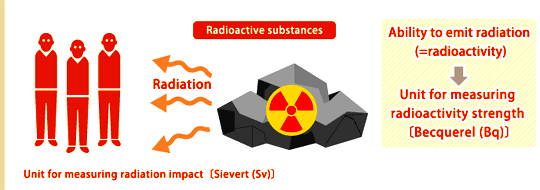
A becquerel is a standard scientific measure of radioactivity, similar in some ways to a rad or a rem or a roentgen or a sievert or a curie, but not equivalent to any of them. But you don’t have to understand the nuances of nuclear physics to get a reasonable idea of what’s going on in Fukushima. Just keep the measure of that safe drinking water in mind, that liter of water, less than a quart, with 10 becquerels of radioactivity.
- 60 becquerels per liter – For nuclear power plants, the safety limit for drinking water is 60 becquerels, as set by the NRA, with less concern for nuclear plant workers than ordinary civilians.
- 60-90 becquerels per liter – For waste water at nuclear power plants, the NRA sets a maximum standard of 90 becquerels per liter for Cesium-137 and 60 becquerels per liter of Cesium-134.
At some of Fukushima’s monitoring wells, radiation levels were in fractions of a becquerel on July 8 and 9. At the well (or wells) that are proving problematical, TEPCO has provided no baseline readings. Continue reading
Permissible radiation doses established by polluters
 For Future Reactor Meltdowns, EPA Means “Extra Pollution Allowed”, Counter Punch, Cutting Corners, Cutting Costs, Creating Cancer, by JOHN LaFORGE, 11 July 13,
“……….There is no exposure to ionizing radiation that’s safe. Even the smallest exposures have cellular-level effects that can lead to immune dysfunction, birth defects, cancer and other diseases. The National Academy of Sciences’ 7th book-length on the biological effects of ionizing radiation, BEIR-VII, declared that any exposure, regardless of how small, may cause the induction of cancer. BEIR-VII also explicitly refuted and repudiated the pop culture “hormesus” theory, promoted by industry boosters, that a little radiation is good for us and acts like a vaccination.
Today, the nuclear industry — military, industrial and medical — is required to keep radiation exposures only “as low as reasonably achievable.” This tragicomic standard is neither a medical nor scientific concept. It’s not based on health physics or biology. It’s merely the formal admission that radiation producers cannot keep worker or public exposures to a level that is safe — that is zero.
Exposure limits have been established at the convenience of the military and industrial producers of radioactive pollution, not by medical doctors of health physicists. The late Dr. Rosalie Bertell made clear 36 years ago in Robert Del Tredici’s book At Work In the Fields of the Bomb, “The people with the highest vested interest are the ones that are making the nuclear bombs. And it turns out they have complete control over setting the permissible [radiation exposure] levels.” Since then, little has changed in the regulatory world (although scientists have found that far more damage is caused by low dose radiation than was earlier thought possible): the ICRP’s 1990 recommendations to reduce worker and public exposures by three-fifths has yet to be adopted by the United States.
We can thank industrial and political roadblocks for that, yet in spite of them the government’s permissible dose (lazy reporters often write “safe” dose) of radiation has dramatically decreased over the years — as we’ve come to better understand the toxic, carcinogenic and mutagenic properties of low-level exposures. In the 1920s the permissible dose was 75 rem (radiation equivalent man) per year for nuclear industry workers. In 1936, the limit was reduced to 50 rem per year; then 20-25 in 1948; 15 in 1954; and down to 5 rem per year in 1958. The general public is officially allowed to be exposed to one-tenth the workers’ dose, or 0.5 rem per year. The ICRP’s 1990 suggestion was to cut this to 2 and 0.2 respectively.
With cancer rates at pandemic proportions, adding higher radiation exposures to the effects of 80,000 chemicals that contaminate our air, water and food only makes our chance of avoiding the dread disease slimmer. Rather than permitting increased doses of dangerous and sometimes deadly radiation, especially following reactor disasters, the government should be acting to prevent them — like Germany, Italy and Japan — by preparing the phase-out of the country’s accident-prone nukes.
John LaForge is a co-director of Nukewatch, a nuclear watchdog and environmental justice group in Wisconsin.
Health and environmental destruction in Africa, by foreign uranium companies
Health hazards posed by uranium mining IPP MEDIA 5th July 2013“……..History has it that uranium mining companies had never solved problems associated with extraction of uranium and also never employed good practice of settling uranium radioactive waste seriously after the mining activity is complete.
Of course, these foreign companies have their eyes fixed on maximising profits against corresponding safe infrastructure investment. Some of the companies run away from implementing this social cooperative responsibility to the poor ignorant communities.
This happens in countries where local atomic energy commissions are non-existent, or if present are under- equipped with the necessary human and material resources for effective supervision, monitoring and control of 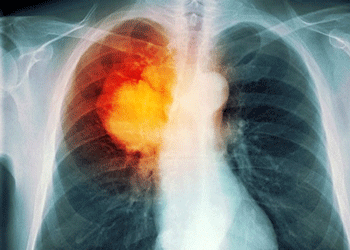 the foreign mining companies for radiation protection to the miners and the environment.
The whole population in the area surrounding the mines is endangered with the diseases mentioned above, lung cancer being the most serious for miners due to inhalation of radon gas in the pits and in the dusty atmosphere of the processing mills.
Uranium radioactive waste stored close to the mines can leach into ground water and contaminate drinking water. Other possibilities of radioactivity reaching humans and environment are a result of deficient radioactive waste management practices by the mining companies, Continue reading
Toxicity of ionising radiation from uranium mining
 Health hazards posed by uranium mining IPP MEDIA 5th July 2013 All Uranium mined end up as either nuclear weapons or highly radioactive waste from nuclear reactors. Uranium is a naturally occurring radioactive toxic element, found in the ground worldwide, including Tanzania, soon to be mined! Countries with active uranium mining are Australia, Canada, Central Africa Republic, France Namibia, Niger, South Africa and the US. The normal decay of uranium in the soil results in the production of decay radioactive products.In the process of mining uranium we liberate from the ground these natural radioactive substances like radium and radon, which are among the most harmful materials known in science.
Uranium emits ionising nuclear radiation like x-rays. Ionising radiation is energetic enough to break chemical bonds, thereby possessing the ability to damage or destroy living cells. Hence the need to keep away from nuclear radiation x-rays, uranium and its radioactive waste. Ultrasound, radio, sound and light are non-ionising nuclear radiations and are harmless
As long as the mineral remains outside the body, uranium poses little health hazards. However, if uranium is inhaled or ingested, its radioactivity and toxicity pose increased risks of lung cancer as well as cancer of bones, stomach, soft tissue and blood. It may also cause damage to internal organs notably kidneys alongside affecting the reproductive system, leading to birth defects in future generations.
Imaging swallowing or inhaling small radiation exposing x-ray machines with jammed exposure switches could result in serious health effects in the form of cancer. Similar incidence of diseases is observed in Atomic bomb survivors, refer bombing of Hiroshima and Nagasaki in Japan 1942 at end of World War II.
All the decay radioactive products of uranium remain in the crushed rock when uranium is separated from the ore. The rock left over’s waste contains 85 per cent radioactivity of the ore as well as heavy metals and toxic dissolving chemicals, which have dangerous health hazards.
Uranium mining is responsible for introducing into the human environment a tremendous large range of radioactive materials which are all very harmful to biological organisms – human beings included.
1 This Month

petition to oppose the rapid increase of space-military industry threatening Jeju Island and the region.
[Petition by April 19th (KST)] Stop the joint military-Hanwha Systems-Jeju Provincial Government Sea Launch!
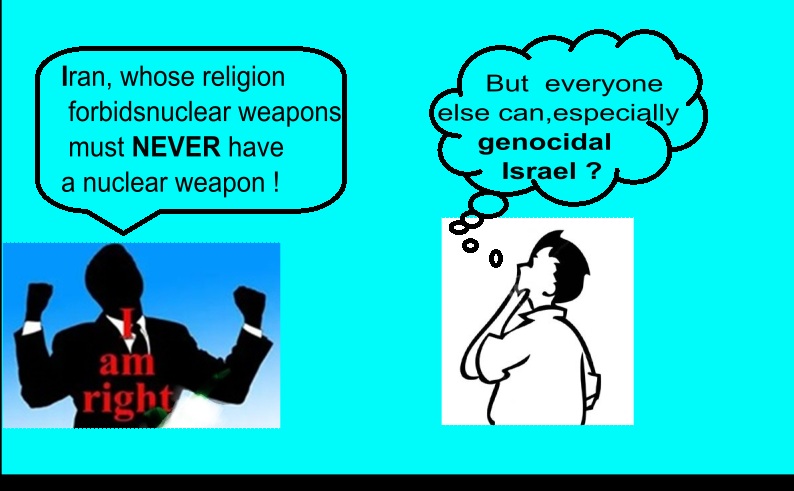
Chernobyl: The Lost Tapes – A good documentary on Chernobyl on SBS available On Demand for the next 3 weeks– https://www.sbs.com.au/ondemand/tv-program/chernobyl-the-lost-tapes/2352741955560

of the week–London Campaign for Nuclear Disarmament

Tell the Ukrainian Government to Drop Prosecution of Peace Activist Yurii Sheliazhenko
To see nuclear-related stories in greater depth and intensity – go to https://nuclearinformation.wordpress.com
-
Archives
- April 2026 (194)
- March 2026 (251)
- February 2026 (268)
- January 2026 (308)
- December 2025 (358)
- November 2025 (359)
- October 2025 (376)
- September 2025 (257)
- August 2025 (319)
- July 2025 (230)
- June 2025 (348)
- May 2025 (261)
-
Categories
- 1
- 1 NUCLEAR ISSUES
- business and costs
- climate change
- culture and arts
- ENERGY
- environment
- health
- history
- indigenous issues
- Legal
- marketing of nuclear
- media
- opposition to nuclear
- PERSONAL STORIES
- politics
- politics international
- Religion and ethics
- safety
- secrets,lies and civil liberties
- spinbuster
- technology
- Uranium
- wastes
- weapons and war
- Women
- 2 WORLD
- ACTION
- AFRICA
- Atrocities
- AUSTRALIA
- Christina's notes
- Christina's themes
- culture and arts
- Events
- Fuk 2022
- Fuk 2023
- Fukushima 2017
- Fukushima 2018
- fukushima 2019
- Fukushima 2020
- Fukushima 2021
- general
- global warming
- Humour (God we need it)
- Nuclear
- RARE EARTHS
- Reference
- resources – print
- Resources -audiovicual
- Weekly Newsletter
- World
- World Nuclear
- YouTube
-
RSS
Entries RSS
Comments RSS
 nuclear-news