A Faustian bargain, uranium mining’s radioactive pollution of groundwater
 A Decades-Old Deal With Uranium Miners Is Causing Trouble For The EPA Abrahm Lustgarten, ProPublica | Dec. 26, 2012, GILLETTE, Wyo. — On a lonely stretch at the edge of the Great Plains, rolling grassland presses up against a crowning escarpment called the Pumpkin Buttes. The land appears bountiful, but it is stingy, straining to produce enough sustenance for the herds of cattle and sheep on its arid prairies.
“It’s a tough way to make a living,” said John Christensen, whose family has worked this private expanse, called Christensen Ranch,  for more than a century.
Christensen has made ends meet by allowing prospectors to tap into minerals and oil and gas beneath his bucolic hills. But from the start, it has been a Faustian bargain.
As dry as this land may be, underground, vast reservoirs hold billions of gallons of water suitable for drinking, according to the U.S. Environmental Protection Agency. Yet every day injection wells pump more than 200,000 gallons of toxic and radioactive waste from uranium mining into Christensen’s aquifers. Continue reading
Drinking water threatened as EPA allows uranium miners to inject radioactive wastes into groundwater
 Environmental groups say the EPA should not be letting mining companies write their own rules.
Similar disputes are erupting across the country.
“This is a health issue as much as a water supply issue,”
 A Decades-Old Deal With Uranium Miners Is Causing Trouble For The EPA Abrahm Lustgarten, ProPublica | Dec. 26, 2012, GILLETTE, Wyo.“…….The problems and pressures the EPA is facing at Christensen Ranch are not unique.
With uranium mining booming, the agency has received a mounting number of requests for aquifer exemptions in recent years. So far, EPA records show, the agency has issued at least 40 exemptions for uranium mines across the country and is considering several more. Two mines are expanding operations near Christensen Ranch.
In several cases, the EPA has struggled to balance imposing water protections with accommodating the industry’s needs.
In South Dakota, where Powertech Uranium is seeking permits for a new mine in the Black Hills, state regulations bar the deep injection wells typically used to dispose of mining waste. The EPA is weighing whether to allow Powertech to use what’s called a Class 5 well u2014 a virtually unregulated and unmonitored shallow dumping system normally used for non-toxic waste u2014 instead….. Continue reading
Doubts on uranium market’s future add to environment fears in Virginia
Charles Ebinger, the director of the energy security initiative at the Brookings Institution, a research center in Washington. thinks, though, that the United States is moving away from nuclear energy as cheap natural gas and flat electricity demand make nuclear power less competitive. That makes it tougher to argue in favor of the mine, said Ebinger, who’s a supporter of nuclear energy
Proposed Coles Hill uranium mine: Buried treasure or hidden threat? By Sean Cockerham and John Murawski | McClatchy Newspapers
CHATHAM, Va. 23 Dec 12, — “….. pitting neighbor against neighbor and North Carolinians against Virginians. North Carolina is only about 20 miles from the proposed uranium mine and residents, public officials and lawmakers there worry that a catastrophic release of radioactive waste could poison Kerr Lake, the drinking water source for more than 118,000 North Carolinians, as well as contaminate the fishing- and recreation-rich Roanoke River as far east as Pamlico Sound.
“My concern is the catastrophic impact it could have on North Carolina’s water, and it could be major,” said state Rep. Mitch Gillespie, a McDowell County Republican. “This is brand new for North Carolina.” Continue reading
South Carolina’s radiation pollution increasing, but no action taken
Rising radiation at SC nuclear dump prompts cleanup talk but no action The State, 16 Dec 12, By SAMMY FRETWELL – sfretwell@thestate.com COLUMBIA, SC — Radioactive pollution is getting worse on parts of South Carolina’s nuclear-waste dump near Barnwell, but state regulators say cleaning up the contaminated groundwater isn’t in their plan.
Tritium continues to exceed federal safe drinking-water standards in and around the 41-year-old burial ground that has come to symbolize South Carolina’s historic willingness to accept the nation’s garbage. In some spots tritium levels are higher today than they were fiveyears ago…….
Read more here:
http://www.thestate.com/2012/12/16/2557919/rising-radiation-at-sc-nuclear.html#.UM9tJuR9JLs#storylink=cpy
Wind and solar energy have the advantage, as water becomes scarcer
 Water scarcity could drive push towards wind and solar REneweconomy By Giles Parkinson 14 November 2012 In 2010, more water – 583 billion cubic metres – than is discharged each year by the mighty Ganges River in India was used to meet the world’s growing energy needs.
It’s an interesting statistic, but why should that matter? Well, if the world continues on its merry way, power capacity – particularly with water-hungry energy technologies such as coal and nuclear – and water-dependent extractive techniques such as coal, shale gas and tar sands, are going to grow quickly, and, according to the International Energy Agency, the world’s demand for water will grow at twice the pace, putting pressure on increasingly scarce water resources. Continue reading
Fukushima radioactive water could fill 50 Olympic sized swimming pools
To deal with the excess tainted water, the utility has channeled it to more than 300 huge storage tanks placed around the plant.
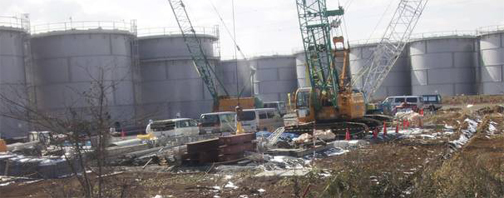
 Fukushima Nuclear Disaster: Plant’s Contaminated Water Storage Running Out Of Space HUFFINGTON POST, By MARI YAMAGUCHI 10/25/12 TOKYO — Japan’s crippled nuclear power plant is struggling to find space to store tens of thousands of tons of highly contaminated water used to cool the broken reactors, the manager of the water treatment team said.
About 200,000 tons of radioactive water – enough to fill more than 50 Olympic-sized swimming pools – are being stored in hundreds of gigantic tanks built around the Fukushima Dai-ichi plant. Operator Tokyo Electric Power Co. has already chopped down trees to make room for more tanks and predicts the volume of water will more than triple within three years. Continue reading
Water use by nuclear power plants – another climate change problem
 Millstone shutdown is a sign of broader power problem caused by climate change, CT Mirror, September 24, 2012, By Jan Ellen Spiegel ….. Water consumption – some view raising the plant’s operating temperature as a Band-Aid for the real problem — the amount of water the nation’s 19,000 power generating units, including 104 nuclear ones, use. They consume 100 billion gallons a day — three times what cascades over Niagara Falls in the same time frame.
“U.S. power plants are at risk from not enough water due to situations like drought, too much water because of sea level rise and flooding, or water that is simply too warm,” said Steve Fleischli, acting director of the Natural Resources Defense Council‘s water and climate program. “From our perspective, what power plants can do to protect the grid is not rely so much on water.”
Most of the cooling water is returned to its source and then re-used, according to the U.S. Geological Survey, which documents fresh- and saltwater use every five years. Since 1965 most water withdrawals have gone for thermo-electric power generation. In 2005 (2010 data is not available yet), that figure was 40 percent nationally.
But in Connecticut it’s 82 percent. Among freshwater withdrawals, 24 percent goes to power plants. Of the saltwater withdrawals here, 99 percent goes to power plants.
At Millstone, Unit 2 uses 450,000 gallons of water per minute, and Unit 3 uses twice that amount. Coal plants like that in Bridgeport, which also takes its water from Long Island Sound, withdraw nearly the same amount of water as nuclear plants per megawatt hour. Gas and oil plants — similar in their water needs — require less than nuclear and coal. Conventional plants, however, generally can use warmer water than nuclear plants because without radiation concerns, their safety systems are less critical…… http://www.ctmirror.org/story/17512/millstone-shutdown-sign-broader-water-power-conflicts-climate-change
Nuclear power and its threat to fresh water supplies
According to a 2011 report from the Union of Concerned Scientists, water withdrawals vary widely from one type of power plant to another: “On average in 2008, plants in the US nuclear fleet withdrew nearly eight times more freshwater than natural gas plants per unit of electricity generated, and 11 percent more than coal plants.
When water efficiency is factored into the equation, alternative energy sources, like wind turbines and solar cells, compare more favorably to coal, gas, and nuclear power.
Treading water, BULLETIN OF THE ATOMIC SCIENTISTS, BY DAWN STOVER | 22 AUGUST 2012 In 1954, Lewis Strauss, then chairman of the Atomic Energy Commission, gave a speech in which he famously predicted that “our children will enjoy in their homes electrical energy too cheap to meter.” Whether he was talking about fission reactors or a secret fusion project is unclear, but he was wrong in either case. What did turn out to be too cheap to meter, however, was water.
Unless you have a private well or spring on your property, you probably don’t enjoy free water in your home. But it’s a different story if you’re running a power plant or drilling for oil: The biggest water consumers pay the least for every gallon, and most power plants pay almost nothing at all. Perhaps that’s why so little research and funding is devoted to saving water — far less than is spent on energy efficiency.
This year’s drought, however, is a painful reminder that water is not an unlimited resource. According to the National Climate Data Center, moderate to exceptional drought currentlycovers 64 percent of the contiguous United States. A new study in the journal Nature Climate Change predicts that severe and widespread droughts will continue during the coming decades……
A June 2012 report from the watershed-protection group River Network found that, for every gallon of water used in an average American household, five times as much water is used to provide that same home with electricity.
It takes water to make energy. Coal, gas, and nuclear power plants generate electricity using steam-driven turbine generators. They withdraw surface water from rivers, lakes, or other bodies and use it to cool the steam. Thermoelectric power production has been the largest category of water use in the United States since 1965, and it is currently the fastest-growing user of freshwater. Continue reading
COLD water is a critical factor for nuclear reactors
Extreme Heat, Drought Show Vulnerability of Nuclear Power Plants
By Robert Krier, InsideClimate News, 15 Aug 12,”……Why the Water Matters Drought and heat affect the water needed to cool nuclear plants in three main ways.
Most plants are built along lakes or rivers because of the ready supply of water to cool the plant. But if water levels drop below the plants’ intake pipes, they can’t suck in the water. In some cases, the pipes can be lowered, but that is often expensive and also risks pulling in sediment that could damage the plant.
Lake or river water can also be unusable if it’s too warm to cool the plant. Other times, the warm water can be used, but the plants operate far more efficiently with cooler water. The third problem that crops up in heat waves is with the outflow from the plant. If the water body is already warm because of low levels or hot days, the outflow could raise the downstream temperature above accepted levels. That has happened repeatedly in the U.S. and in Europe. If a plant isn’t shut down in those situations, the hot discharge can cause algae blooms, reduce dissolved oxygen in the water and threaten aquatic life.
“From our perspective, this has been a problem for years, and it’s only getting worse,” said Wendy Wilson, director of rivers, energy and climate for the River Network, which aims to protect the nation’s freshwater resources. “It gets worse every time we have a drought like this.
“We have terrible thermal pollution problems in this country, and the result is dead and dying rivers. Nobody’s managing the system. We’re all just praying for rain.”…. http://insideclimatenews.org/news/20120815/nuclear-power-plants-energy-nrc-drought-weather-heat-water?utm_source=feedburner&utm_medium=feed&utm_campaign=Feed:%20solveclimate/blog%20(InsideClimate%20News)
Mystery still shrouds uranium tailings storage
It is presently unknown what type of containment system —if any — would offer any degree of protection to groundwater or for how long at Coles Hill.
Mystery still shrouds uranium tailings storage, Star Tribune, Karen B. Maute August 1, 2012 Virginia Uranium Inc.’ website states: “Much of the tailings will be mixed with a cement-like substance and put back into the mine shafts and drifts, and the rest will be stored in heavily-monitored and regulated below-grade storage facilities.” Continue reading
Cancer and birth deformities toll, due to uranium radiation in Punjab groundwater
The effect of all this can be seen in the growing number of patients in the Malwa belt with cancer and other diseases and children being born with abnormalities. In fact, a train that connects Bathinda with Bikaner in neighbouring Rajasthan is known as the ‘Cancer Express’ as it ferries a large number of cancer patients from Punjab to Bikaner for treatment at a cancer hospital.
Groundwater contaminated, Punjab battles uranium curse Times of IndiaI Jul 13, 2012, CHANDIGARH, The high incidence of cancer and other diseases in Punjab’s Malwa belt has been highlighted over the last decade. Now, union Rural Development Minister Jairam Ramesh has confirmed the presence of uranium and other heavy metals in groundwater in the state, particularly the Malwa region, and serious efforts are afoot to control the damage. Continue reading
North Carolina’s water faces danger from Virginia uranium mining

 Virginia uranium mining ‘would be a huge mistake’ for NC HENDERSON, N.C.WRAL News : Beau Minnick, 27 June 12, — As Virginia considers lifting a 30-year-old ban on uranium mining, some North Carolina residents have been crossing the border to share their concerns about the possible environmental effects on this state.
Lifting the ban, which has been in place since 1982, would allow a Chatham, Va., company to tap into the nation’s largest undeveloped resource of uranium. The question is how that could impact Kerr Lake and surrounding bodies of water, which straddle both states. Continue reading
Uranium mining threatens water supply
even a small spill could affect the water supply for growing populations in North Carolina, and that radioactive mill waste would have to be monitored forever.
Water worries continue to flow around uranium controversy Go Dan River, 21 March 12, Residents and leaders downstream of a proposed uranium site in Pittsylvania County say they bear risks from the project, but have nothing to gain. Continue reading
The damaging impact of Indian Point Nuclear Plant on river fish
NRC Finds New Environmental Data on Indian Point, Scarsdale, by Jessica Glenza BUCHANAN, N.Y. 15 March 12, – New environmental impact data of Indian Point Nuclear Power Plants’ effect on Hudson River aquatic organisms prompted the Nuclear Regulatory Commission to begin a supplemental environmental impact statement. The supplement is in addition to the impact statement already required for the two reactors’ license renewal proceedings.
The NRC cited three reasons for the supplemental statement; new data provided by Entergy regarding how many fish are killed or trapped against cooling water intakes, the thermal plume created by warm water ejected from the plant into the Hudson River and new developments with regard to endangered species.
“It’s not that uncommon for us to do a supplemental environmental impact statement, these reviews can take years,” said Neil Sheehan, spokesperson for the NRC about reviews for license renewal. “The listing of the Atlantic sturgeon is obviously a very new piece of information.”
In January, the National Marine Fisheries listed Hudson River Atlantic sturgeon populations as endangered. Data provided by Entergy refers to “impingement” and “entrainment” of fish in the once-through cooling water intakes. “Impingment” refers to the trapping of fish against intake screens, “entrainment” refers to smaller fish that go through the intake’s traveling screens and are killed in the plants’ cooling systems, which use up to 2.5 billion gallons of river water per day….. http://www.thedailyscarsdale.com/news/nrc-finds-new-environmental-data-indian-point
Climate change leading to overuse of groundwater
UN scientists warn of increased groundwater demands due to climate change, Eureka Alert, Philip Riley, SAN FRANCISCO, March 1, 2012 –– Climate change has been studied extensively, but a new body of research guided by a San Francisco State University hydrologist looks beneath the surface of the phenomenon and finds that climate change will put particular strain on one of our most important natural resources: groundwater.
SF State Assistant Professor of Geosciences Jason Gurdak says that as precipitation becomes less frequent due to climate change, lake and reservoir levels will drop and people will increasingly turn to groundwater for agricultural, industrial, and drinking water needs. The resource accounts for nearly half of all drinking water worldwide, but recharges at a much slower rate than aboveground water sources and in many cases is nonrenewable.
“It is clear that groundwater will play a critical role in society’s adaption to climate change,” said Gurdak, who co-led a United Nations-sponsored group of scientists who are now urging policymakers to increase regulations and conservation measures on nonrenewable groundwater.
The scientists recently released a book of their research, titled “Climate Change Effects on Groundwater Resources,” that is the result of a global groundwater initiative by the United Nations Educational, Scientific, and Cultural Organization (UNESCO). They will soon make their case to international policymakers at the March 12-17 World Water Forum in Marseille, France.
The high-profile forum will allow the scientists for the first time to put the comprehensive groundwater findings before decision makers who have the power to enact regulatory changes. Gurdak will recommend closely monitoring or limiting groundwater pumping as well as renewing cooperation from communities to consume less water.
“In many ways, California is leading the way in developing solutions,” he said. “Artificial recharge, managed storage and recovery projects and low impact development around the state will become more important for many local water systems to bank excess water in aquifers.”
The World Water Forum will be held from March 12 to 17 in Marseille, France. ”Climate Change Effects on Groundwater Resources: A Global Synthesis of Findings and Recommendations,” was published in December 2011 by CRC Press. Selections from the book can be read here:  http://userwww.sfsu.edu/~jgurdak/Publications/Treidel_etal_2011_ClimateChange-Groundwater_tableofcontents.pdf http://www.eurekalert.org/pub_releases/2012-03/sfsu-usw030512.php
1 This Month

of the week – Shut Down Drone Warfare!


Tell the Ukrainian Government to Drop Prosecution of Peace Activist Yurii Sheliazhenko

Petition to revoke the licensing of the Near Surface Nuclear Disposal Facility (NSDF) at Chalk River. https://www.ourcommons.ca/petitions/en/Petition/Details?Petition=e-7247
To see nuclear-related stories in greater depth and intensity – go to https://nuclearinformation.wordpress.com
-
Archives
- April 2026 (91)
- March 2026 (251)
- February 2026 (268)
- January 2026 (308)
- December 2025 (358)
- November 2025 (359)
- October 2025 (376)
- September 2025 (257)
- August 2025 (319)
- July 2025 (230)
- June 2025 (348)
- May 2025 (261)
-
Categories
- 1
- 1 NUCLEAR ISSUES
- business and costs
- climate change
- culture and arts
- ENERGY
- environment
- health
- history
- indigenous issues
- Legal
- marketing of nuclear
- media
- opposition to nuclear
- PERSONAL STORIES
- politics
- politics international
- Religion and ethics
- safety
- secrets,lies and civil liberties
- spinbuster
- technology
- Uranium
- wastes
- weapons and war
- Women
- 2 WORLD
- ACTION
- AFRICA
- Atrocities
- AUSTRALIA
- Christina's notes
- Christina's themes
- culture and arts
- Events
- Fuk 2022
- Fuk 2023
- Fukushima 2017
- Fukushima 2018
- fukushima 2019
- Fukushima 2020
- Fukushima 2021
- general
- global warming
- Humour (God we need it)
- Nuclear
- RARE EARTHS
- Reference
- resources – print
- Resources -audiovicual
- Weekly Newsletter
- World
- World Nuclear
- YouTube
-
RSS
Entries RSS
Comments RSS
 nuclear-news