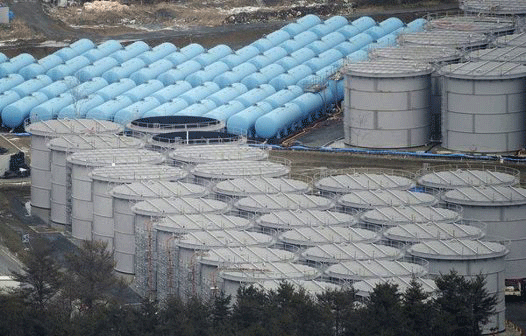
Huge and growing area of tanks storing Fukushima’s radioactive water

 Radioactive Leaks in Japan Prompt Call for Overseas Help, Bloomberg, By Yuji Okada, Jacob Adelman & Peter Langan – Aug 21, 2013
“……..Toxic Sludge. Tepco was storing 330,000 tons of radioactive water as of Aug. 13 in tanks covering an area equal to 37 football fields, according to the company. The utility is clearing forest to make room for more tanks as it adds to the stored water at a rate of 400 tons a day after pumping it out from under the plant’s reactors, which melted down as a result of the March 2011 earthquake and tsunami.
The water is treated to remove some of the cesium particles before it is stored, which has left 480 filters clogged with the radioactive material at the site. Each weigh 15 tons and are warehoused in what the utility calls temporary storage, though it will take hundreds of years for the radiation to decay. Other radioactive contaminants remain in the water even after treatment. That includes strontium, which has been linked to bone cancers.
Besides radiated water, the site north of Tokyo has more than 73,000 cubic meters of contaminated concrete, 58,000 cubic meters of irradiated trees and undergrowth, and 157,710 gallons of toxic sludge, according to the utility.
’Biggest Concern’
Japan’s nuclear watchdog has ratcheted up alarm over the potential for more leaks of highly radioactive water from the hundreds of storage tanks at the Fukushima atomic plant.
The possibility of leaks from other tanks “is the biggest concern,” said Nuclear Regulation Authority Chairman Shunichi Tanaka at a press conference yesterday. “This will need to be handled carefully on the assumption that one incident could bring another.”
Late last night, Tepco said water leaking from the storage tank probably ran into the ocean, citing high radiation readings in a drainage ditch.
As much as 20 trillion becquerels of cesium and 10 trillion becquerels of strontium leaked into the ocean since May 2011, Tepco spokeswoman Mayumi Yoshida said today. The total amount of cesium and strontium is equivalent to about 100 times the annual limit on radiation from the plant to the ocean under normal conditions, according to calculations based on Tepco data……….
Leaking Tanks
Japan’s government has ordered an investigation into the safety of hundreds of other tanks storing contaminated water in Fukushima, the site of the world’s worst civilian nuclear disaster since the Chernobyl reactor exploded in 1986.
There are 226 tanks of similar bolted design to the leaking unit with the same 1,000-ton capacity at the site, said Tatsuya Shinkawa, director of the nuclear accident response office in the government’s Agency for Natural Resources and Energy, which called for the probe…… http://www.bloomberg.com/news/2013-08-21/tepco-shares-plunge-on-report-of-serious-radiated-water-leak.html
After 2 years, Fukushima groundwater cesium levels now 8 times higher!
 Cesium levels in Fukushima water 8 times higher than after disaster Asahi Shimbun By SHUNSUKE KIMURA/ Staff Writer 16 Aug 13 Tokyo Electric Power Co. has reported finding radioactive cesium levels in underground water at the crippled Fukushima No. 1 nuclear power plant that is eight times greater than what it recorded right after the accident.
TEPCO, which operates the facility, said Aug. 15 that it detected 11,600 becquerels of radioactive cesium per liter of contaminated water in a tunnel near the No. 1 reactor building on the side facing the ocean.
That compares with 1,490 becquerels per liter it recorded at the site shortly after the accident in March 2011.
TEPCO said it believes the readings have soared due to rainwater containing cesium flowing into the tunnel. But the amount detected is roughly one-100,000th of that found in radioactive water in a tunnel near the No. 2 reactor building……http://ajw.asahi.com/article/0311disaster/fukushima/AJ201308160041
Regular radioactive releases into water, air are “normal” says nuclear industry
Radiological releases are an inevitable part of the nuclear power industry
“Dilution is not the solution to radioactive pollution,” “It rather guarantees a chronic exposure over years and decades to tritium, a known cause of cancer, birth defects and genetic damage, to all those who drink Lake Michigan water.”
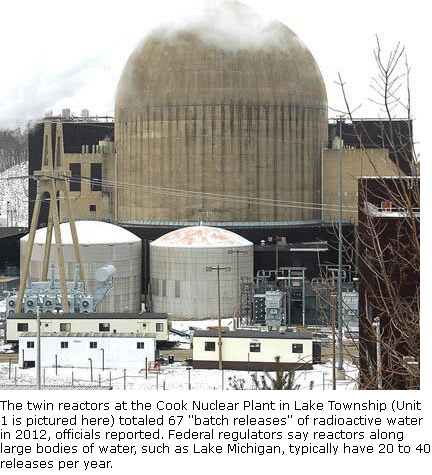 Release of nuclear plant ‘effluents’ into lake described as part of normal cycle Opinions differ on safety of practice Harbor Country News By Andrew Lersten July 17, 2013 COVERT — The May 5 release of about 80 gallons of slightly radioactive water from the Palisades nuclear power plant into Lake Michigan was unusual because it wasn’t planned.
But the incident brought into focus what many Southwest Michigan residents likely didn’t realize: The region’s two nuclear power plants (Palisades and the Donald C. Cook Plant in Lake Township) routinely discharge radioactive material into the air and into Lake Michigan.
In the nuclear industry, it’s called effluents. The federal Nuclear Regulatory Commission allows such releases, as long as they are closely monitored and do not exceed federal radiation release standards set in place by the NRC.
“Plants need to discharge small amounts of radioactive materials to operate,” said Jack Geissner, branch chief for the regional NRC office. Continue reading
The unsolved problem of radioactive water leaks
If nuclear energy is so safe, why is the industry incapable of dealing with the relative simple plumbing issue of water leaks?
Secondly, if the NPP by-products are so safe, why does every government in the world go to such strenuous efforts to contain them even while assuring their populaces that there’s no risk?
 Fukushima isn’t the only nuclear plant leaking radioactive water Christian Scence Monitor, 12 Aug 13 Fukushima Daiichi Nuclear Power Plant continues to leak contaminated water into the Pacific Ocean, but it’s not the only nuclear plant suffering from radioactive water issues. Taiwan’s First Nuclear Power Plant and the Plutonium Finishing Plant in Hanford, Wash., join Fukushima in grappling with leaking waste water.
Unfortunately, that reliance can also prove to be a liability. By John C.K. Daly, August 13, 2013
Water is an essential ingredient for the operation of most nuclear power plants, from providing the liquid that is flashed to steam to drive turbines to providing coolant for storage of spent fuel. In most NPPs, water is drawn from nearby rivers or from the ocean…… Continue reading
Heat pollution of Connecticut River from Vermont Yankee Nuclear Power Plant
 NRC to probe Entergy’s nuclear plant finances Rutland Herald, By Susan Smallheer Staff Writer | August 11,2013 HINSDALE, N.H. ”……….Saturday’s protest was designed to bring public attention to the fact that Vermont Yankee daily dumps 200 million gallons of “hot” water into the Connecticut River to save money by not running its cooling towers.
Dr. Andrew Larkin, a retired internist from Northampton, Mass., said the Connecticut River was 10 degrees warmer near the plant’s discharge than other spots in the river he tested.
“The heated water coming from the reactor confused us, but still we persisted,” Schakman said, adding that only one in 10 shad get past all the dams on the Connecticut River, “only to be cooked by the reactor.” “We have lost so many, now we are down to a few, but still we persist,” he said.
This is the second year that the SAGE Alliance, a coalition of antinuclear groups, has organized the flotilla to focus public attention on the water discharge. About two dozen kayaks and canoes took to the water, with an equal number of people on shore to protest the daily discharge of warm water. Some people wrote messages to Entergy on cedar shingles and set them floating on the river.
“No nuclear accidents. All it takes is one,” wrote Elo-Mai Noormets of Westminster, Vt.
“Peace and health to this river,” wrote Leslie Sullivan Sachs of Brattleboro, Vt. http://rutlandherald.com/article/20130811/THISJUSTIN/708119973
VIDEO: Strontium 90 at high levels in Fukushima’s uncontrolled water leak
 the unfortunate thing about strontium especially is that it bioaccumulates in algae, it bioaccumulates in fish. It targets the bone, because it’s like calcium.
the government is trying to shore up its decision to support restarting nuclear reactors by showing some kind of commitment to preventing this disaster from
getting too much worse………
 VIDEO: Fukushima Reinforces Worst Fears for Japanese Who Are Anti-Nuclear Power
http://www.pbs.org/newshour/bb/world/july-dec13/japan2_08-08.html
How are the Japanese people reacting to the news of the continuing contamination leak and what does it mean for Japan’s energy policy? Jeffrey Brown talks with Arjun Makhijani of the Institute for Energy
and Environmental Research and Kenji Kushida of Stanford University
about what the government may do to stop the flow.
“……..ARJUN MAKHIJANI, Institute for Energy and Environmental Research: So there are a couple of different problems. One of the problems is what they have found in the groundwater and what actually
is there.
So, so far, we have been concerned about an element called cesium, cesium 137 and 134, which is radioactive. But now they have found strontium-90, which is much more dangerous, at levels that are 30
times more than cesium. So to give you an idea of the level of contamination, if somebody drank that water for a year, they would almost certainly get cancer. So it’s very contaminated.
So that’s one problem. The other is the defenses to hold back this water from the sea seem to be overcome. So now the contaminated waters, 70,000, 80,000 gallons is flowing into the sea every day.
JEFFREY BROWN: And do we know how far out to sea this contaminated water is going and what happens to it when it goes into the sea? Continue reading
Water discharge permit may lead to closure of Indian Point Nuclear Power Plant
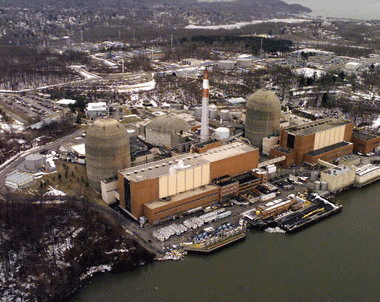 Indian Point may close if Entergy loses water-use permit Company proposes new screen-filtering system, LOHUD.com Aug. 6, 2013 The future of the Indian Point nuclear power plant may rest on the bottom of the Hudson River. That is where plant owner Entergy Nuclear wants to install a new technology
 to filter the water needed to cool the plant’s reactors. The technology is Entergy’s attempt to get a water-use permit from the state, without which it could no longer operate Indian Point.
The environmental group Riverkeeper said Entergy isn’t likely to get the state permission it needs to build anything on the river bottom — an assessment with which the utility company disagrees……..The DEC in 2010 ruled the plant’s daily use of 2.5 billion gallons of river water harmed fish populations and the river’s ecosystem. It denied Entergy the water-use permits. Without them, Entergy can’t renew the plant’s licenses for another 20 years, said Neil Sheehan, a Nuclear Regulatory Commission spokesman. The licenses expire this year and in 2015.
“A final decision by the NRC in favor of the (renewal) application is contingent upon, among other things, successful resolution of the water discharge permit issue at the state level,” Sheehan said.
Entergy has balked at building closed-cycle towers, contending they are too expensive and too massive. Entergy has estimated the towers would cost about $1 billion, approximately 10 times as much as the wire screen technology. http://www.lohud.com/article/20130806/NEWS/308060066
Japan’s desperate battle to contain Fukushima’s radioactive water
Japan Nuclear Plant’s Battle to Contain Radioactive Water Tepco Builds Sunken Barrier to Ring-Fence Site, but Water May Have Already Overtopped Wall WSJ, 6 Aug 13, by MARI IWATA and PHRED DVORAK
To stem the advance of radioactive water to the sea, the operator of the stricken Fukushima Daiichi nuclear power plant has tried plugs, walls, pumps and chemicals that harden the ground into a solid barrier.
But as Tokyo Electric Power Co. 9501.TO +3.26% prepares this week to start work on a new set of measures that would ring off and cap the area where the most highly contaminated water has been found, some experts and regulators are saying that the battle to completely contain radioactivity to the site of one of the world’s worst nuclear accidents may be a losing one.
In the most recent example of Tepco’s Sisyphean struggle, the company said late last week that rising levels of contaminated groundwater may have already overtopped a sunken barrier that the utility started only a month ago, and wasn’t even expecting to complete until late this week. Tepco’s water-control measures, such as pumping out contaminated water and putting it in storage, are “merely a temporary solution,” said Shunichi Tanaka, chairman of Japan’s Nuclear Regulation Authority, at a news conference last week. Eventually, “it will be necessary to discharge water” that’s still contaminated into the sea, he said…..
Controlling contaminated water has been a struggle at Fukushima Daiichi ever since the March 2011 earthquake and tsunami knocked out the power at the plant and sent its three active reactors spiraling out of control. Some 400 metric tons of water a day is still being used to cool the melted fuel cores—though much of that water is now recycled. More troubling is another 400 tons a day of groundwater that flows down from hills and mountains into the compound, and toward the sea.
For the past two years, Tepco has been trying to keep the contamination contained by pumping accumulated water out of the highly radioactive reactor buildings, and storing it in tanks on the plant grounds. But the company’s efforts went into overdrive a few months ago, when it found that groundwater sampled near the crippled reactors was showing spiking levels of radioactive elements. It was unclear why. What’s more, Tepco said that the water was likely leaking into the sea.
The continuing problems at the reactor site, including the company’s lack of transparency over the radioactive leaks, have drawn criticism from Japanese regulators….http://online.wsj.com/article/SB10001424127887323420604578651713545887032.html
Japan’s emergency experimental methods to stem flow of radioactive water
Japan Nuclear Plant’s Battle to Contain Radioactive Water Tepco Builds Sunken Barrier to Ring-Fence Site, but Water May Have Already Overtopped Wall WSJ, 6 Aug 13, by MARI IWATA and PHRED DVORAK “…………As an emergency measure, Tepco last month started to inject the ground near the coast with chemicals that hardened it into an underground barrier. But since then, groundwater levels in the area have risen faster, as they hit the barrier. Recently, Tepco has found that the groundwater has risen to around a meter below the surface—already above the level of the underground barrier, which starts 1.8 meters down.Now, Tepco is planning to pump out some of the water that’s built up behind the barrier, and store it as well. It’s preparing to extend the underground hardened-earth barrier in a ring around the most heavily contaminated section of coastline, in hopes of heading groundwater off before it can flood in. Tepco is also proposing to cap that ringed section with gravel and asphalt, so nothing gets out. The operator is hoping to get an initial ring of hardened ground done by October.
The company has some other more experimental ideas on the table as well. One involves surrounding the contaminated reactor buildings with a shield of frozen soil.
But there’s a risk to changing the flow of groundwater in the ways that Tepco is considering, said Tatsuya Shinkawa, nuclear accident response director of the Ministry of Economy, Trade and Industry, at a news conference last month. The water could pool dangerously underground, softening the earth and potentially toppling the reactor buildings, he said. Tepco should also try things like using robots to fix cracks in the reactor buildings where the water is likely seeping through.
Freezing soil has its own problems, said Kunio Watanabe, a geology professor at Saitama University. The technology, which is used in civil engineering to dig tunnels, may be able to cut down the amount of groundwater entering the contaminated site, but it is expensive. “You’ll need hundreds of millions of yen to build a system,” Mr. Watanabe said. “You’ll also need a large amount of electricity to maintain the ice walls.”….. http://online.wsj.com/article/SB10001424127887323420604578651713545887032.html
300,000 tons of radioactive water at Fukushima, and still growing
As of May 7, the Japan Times reported that TEPCO had installed 290 huge storage talks at Fukushima to hold more than 78 million gallons (290,000 tons) of radioactive water, with another 25 million gallons still uncollected. Fukushima is generating an estimated 100,000-plus gallons (400 tons) of radioactive water every day
TEPCO estimates that groundwater is entering the complex at a rate of at least 54,000 gallons per day.
Fukushima 2013: “Remaining Radioactive Mass”, “Dangerous Leaking Radioactive Water”, All Four Reactors are “Getting Worse” By William Boardman Global Research, July 11, 2013 The first thing to know about the danger from the radioactive mass remaining on site in the three reactors that melted down at Fukushima is that nobody knows how much radioactive material there is, nobody knows how much uranium and plutonium it contains, and nobody knows how to make it safe — so no one knows how great the continuing danger is.
In order to prevent nuclear material from being diverted to use in weapons, the International Atomic Energy Agency of the U.N. requires each country to report regularly on the volume of nuclear materials in its nuclear power plants. At Fukushima, this is currently impossible with the cores of the three reactors that melted down.
Diversion of this material to weapons use is not a problem at the moment, since the level of radioactivity is high enough to kill anyone who comes close to it, which is why it hasn’t been moved. On the other hand, it is necessary to move it in order to measure it, and even if it was movable now, the technology to measure it does not yet exist. Continue reading
Cesium 137 leaking from Swiss nuclear plant, into lake
 ‘Radioactivity found in Swiss lake’ near nuclear plant : http://www.foxnews.com/world/2013/07/14/radioactivity-found-in-swiss-lake-near-nuclear-plant/#ixzz2Z9ZJtrGX July 14, 2013GENEVA (AFP) – Scientists have discovered a radioactive substance in sediment under a Swiss lake used for drinking water and situated near a nuclear plant, the Le Matin Dimanche weekly reported Sunday.
While scientists cited in the report stressed there was no danger to human health, the discovery raises concerns about safety practices and a lack of transparency at the Muehleberg nuclear plant in northwestern Switzerland.
The plant is believed to have caused a spike in cesium 137 found in the sediment of Lake Biel and dating back to 2000 through the discharge of contaminated waste water into the Aar river that feeds into the lake, about 20 kilometres (12 miles) downstream, the weekly reported.
Geologists from Geneva University happened upon the spike while working on an unrelated research project in 2010, and chemists in the northern canton of Basel recently verified the findings, it said.
The Muehleberg plant is permitted to discharge water with very low levels of radioactivity subject to strict controls several times a year, according to Le Matin Dimanche.
Politicians and environmentalists however expressed outrage Sunday that the plant and nuclear inspectors had provided no information about the higher levels of cesium 137 released more than a decade ago into a lake that provides 68 percent of the drinking water to the nearby town of Biel.
“No one ever told me that there were abnormally high concentrations in the lake,” Hans Stoekli, who served as Biel mayor from 1990 to 2010, told the paper, insisting that in light of the use of the lake for drinking water “the plant should have alerted us even in the case of minimal risk.”
Environmental group Greenpeace voiced dismay at the news, urging the public prosecutor in the canton of Bern, where Biel and the Muehleberg plant are located, to investigate.
The group, which has long called for the plant’s closure, also questioned in a statement how the Swiss Federal Nuclear Safety Inspectorate could have either missed the higher radioactive levels or decided not to inform decision makers or the public about them.
The Muehleberg plant, which came online in 1972, is 17 kilometres (11 miles) west of the Swiss capital Bern.
In the wake of the 2011 Fukushima disaster in Japan, the Swiss parliament approved a phase-out for the country’s five atomic power plants by 2034.
Radioactive cesium levels 90% higher in Fukushima groundwater
 Fukushima Groundwater Shows Record Radiation Levels HUFFINGTON POST, Reuters 07/09/2013 “……SITUATION WORSENS Tokyo Electric Power Co, the operator of the Fukushima station, hit by the March 2011 earthquake and tsunami, said that an observation well between the damaged reactor No. 2 and the sea showed levels of radioactive caesium-134 were 90 times higher on Monday than they had been the previous Friday.
Tokyo Electric, also known as Tepco, said it detected caesium-134 at 9,000 becquerels per litre, 150 times above Japan’s safety standard. A becquerel is a measure of the release of radioactive energy. The reading for caesium-137, with a half life of 30 years, was some 85 times higher than it had been three days earlier.
The latest findings, 25 metres from the sea, come a month after Tepco detected radioactive caesium in groundwater flowing into its wrecked plant far from the sea on elevated ground. The level of caesium found in June was much lower than the amount announced on Tuesday.
The spike, combined with recent discoveries of high levels of radioactive elements like tritium and strontium, suggest that contaminated water is spreading toward the sea side of the plant from the reactors sitting on higher ground…..
Gathering storm of protest against endangering Great Lakes by radioactive waste
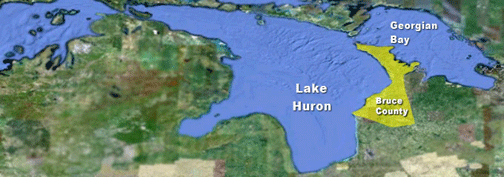 The Canadian nuclear industry, like its counterparts in nuclearized countries around the world, was born promoting the myth that nuclear energy is safe, green and too cheap to meter
why would anyone consider dumping radioactive poisons that will remain deathly dangerous for hundreds of thousands of years next to such an integral part of the our Great Lakes ecosystem?
Stop the Great Lakes Nuclear Waste Dump Eco Watch, Michael Leonardi July 3, 2013“……….More than 500 citizens from across North America gathered at the Southampton, Ontario, flagpole on High Street by the lake. They gathered to voice their opposition to nuke dumps on these beautiful shores and to the continued production of this dangerous and deadly waste. They walked several kilometers through the town and along the beach to heighten awareness and bring attention to this diabolical plan, orchestrated largely in secret by local and national authorities and a deceitful industry, to bury low level, intermediate and high level nuclear waste underground and less than a mile away from this important fresh water source. They gathered to push back against a corrupt political leadership from the local level to the upper levels of dirty energy frontman Stephen Harper’s disastrous national government. They marched to say no to an industry that has been lying and deceiving the public about the dangers of nuclear energy and radiation exposure for decades. They walked to promote real renewable wind and solar energy alternatives.
Surely the question that comes to many is why on Earth would anyone in their right mind consider the shores of Lake Huron for the first permanent nuclear dump in North America? Lake Huron sits to the north of Lakes St. Clair, Erie and Ontario and the water of this lake flows southward and eastward, eventually connecting to the Atlantic Ocean through the St. Lawrence Seaway. The Great Lakes account for 21 percent of the world’s fresh water resources, Continue reading
Uranium mining’s threat to Grand Canyon water
Are We Really Okay With a Uranium Mine Next Door to the Grand Canyon? This move would definitely not fall under the good neighbor policy Take Part, July 3, 2013 Lawrence Karol “……Located just six miles south of Grand Canyon National Park is the site of Canyon Mine, a proposed uranium mine that could negatively impact the area’s cultural values, wildlife, and waters. The Sierra Club has stated that, “Originally approved in 1986, the Canyon Mine has long been the subject of protests by the Havasupai Tribe and others objecting to potential uranium mining impacts on regional groundwater, springs, creeks, and cultural values associated with Red Butte, a Traditional Cultural Property.”
The Obama administration has taken steps to protect one million acres around Grand Canyon from new uranium mining, but Canyon Mine has been permitted to move forward as an existing claim even though the last environmental review of the project is over two decades old.
“Mining has a history of taking precedence over other important issues due in part to the outdated Mining Law of 1872 and the significant political influence of large multinational mining corporations,” says Brune.
“The reviews for Canyon Mine are more than 27 years old, older than a number of the volunteers working on this issue,” he adds. “The mine’s permit was issued with no consideration of significant new information, including the designation of the Red Butte Traditional Cultural Property and the reintroduction of the endangered California condor.”
“Scientific studies published since 1986 demonstrate more strongly the connection between the water in this area and the seeps, springs, and creeks in Grand Canyon. If this mine pollutes the groundwater, it pollutes Grand Canyon,” says Brune………http://www.takepart.com/article/2013/07/03/uranium-mine-next-door-grand-canyon
Water-guzzling nuclear power is not viable for Jordan

Professor Steve Thomas, a nuclear policy expert from the University of Greenwich in London, also questions the argument that renewables aren’t a realistic option for Jordan.
“Although the government have been saying that they aren’t viable, what really isn’t viable is their nuclear plans,” he told DW.
Jordanians protest plans to go nuclear. DW 14 June 13, As Jordan works on plans to build its first nuclear plant, protestors are still criticizing the country’s decision to go nuclear in the first place. They say it wastes water and ignores the nation’s renewables potential.
Safa Al Jayoussi, an activist with Greenpeace in Jordan, becomes concerned when she starts to explain why Jordan won’t be able to cope with the country’s impending turn towards nuclear power. She says Jordan is one of the five driest countries in the world and that the new power plans are just going to put the nation under even more pressure.
“Nuclear power plants require large quantities of cooling water, usually from a large river or a large lake,” she told DW. “But, in Jordan, we don’t really have any sources of water.” Continue reading
1 This Month

of the week – Shut Down Drone Warfare!


Tell the Ukrainian Government to Drop Prosecution of Peace Activist Yurii Sheliazhenko

Petition to revoke the licensing of the Near Surface Nuclear Disposal Facility (NSDF) at Chalk River. https://www.ourcommons.ca/petitions/en/Petition/Details?Petition=e-7247
To see nuclear-related stories in greater depth and intensity – go to https://nuclearinformation.wordpress.com
-
Archives
- April 2026 (91)
- March 2026 (251)
- February 2026 (268)
- January 2026 (308)
- December 2025 (358)
- November 2025 (359)
- October 2025 (376)
- September 2025 (257)
- August 2025 (319)
- July 2025 (230)
- June 2025 (348)
- May 2025 (261)
-
Categories
- 1
- 1 NUCLEAR ISSUES
- business and costs
- climate change
- culture and arts
- ENERGY
- environment
- health
- history
- indigenous issues
- Legal
- marketing of nuclear
- media
- opposition to nuclear
- PERSONAL STORIES
- politics
- politics international
- Religion and ethics
- safety
- secrets,lies and civil liberties
- spinbuster
- technology
- Uranium
- wastes
- weapons and war
- Women
- 2 WORLD
- ACTION
- AFRICA
- Atrocities
- AUSTRALIA
- Christina's notes
- Christina's themes
- culture and arts
- Events
- Fuk 2022
- Fuk 2023
- Fukushima 2017
- Fukushima 2018
- fukushima 2019
- Fukushima 2020
- Fukushima 2021
- general
- global warming
- Humour (God we need it)
- Nuclear
- RARE EARTHS
- Reference
- resources – print
- Resources -audiovicual
- Weekly Newsletter
- World
- World Nuclear
- YouTube
-
RSS
Entries RSS
Comments RSS
 nuclear-news