India must oppose dumping of radioactive waste into the Pacific, but IAEA and Indian govt downplay the dangers
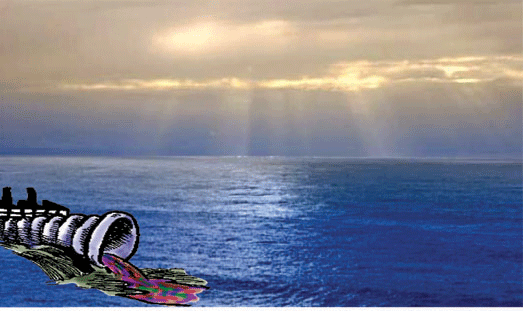 Silence on Fukushima Disaster Exposes our Approach to Nuclear Safety and Why India must Oppose Dumping of Radioactive Water Into the Pacific, BYSONALI HURIA, JANUARY 17, 2021 Next year, the operator of the tsunami-hit Fukushima nuclear plant would start releasing radioactive water into the Pacific Ocean. A number of nations are up in arms against it, but Indian authorities are not rising to the occasion to protect its most vulnerable against the impending disaster.
SONALI HURIA explains what is at stake for people and the environment.
THE new year has begun on a grim note with a toxic gas leak at the Rourkela Steel Plant in Odisha on 6 January, which claimed the lives of four contractual workers. This is the latest in a disconcerting string of industrial accidents in India over the last few years, which have remained peripheral to the mainstream media narrative.
It appears that India has learned precious little from the Bhopal gas disaster, which has ebbed from public memory even as the accident site remains contaminated and survivors continue to await an elusive justice.
Against this backdrop, as we approach the tenth anniversary of the Fukushima nuclear disaster, it may be pertinent to think of what a nuclear accident might mean for the country’s already shoddy industrial safety record and systemic inadequacies, especially as the Fukushima disaster now poses a formidable new challenge to which India’s response, so far, has been active denial and muted silence.
“Fukushima” has become synonymous with the devastating and ongoing nuclear accident that occurred off the eastern Pacific coast of Japan in 2011.
Japan’s nuclear regulator, the Nuclear Regulation Authority (NRA) reportedly stated as recently as in December 2020 that the reactor buildings of the Fukushima Daiichi nuclear power plant continue to record “lethal” levels of radiation, thus posing a “serious challenge” to decommissioning efforts.
DISPOSING CONTAMINATED WATER
Among the many vexing problems precipitated by the accident is the disposal of the contaminated water from the beleaguered nuclear plant.
The acerbic debate within Japan on the disposal of this radioactive water came to a head recently when the Japanese government made it clear that beginning 2022, the operator of the Fukushima plant, the Tokyo Electric Power Company (TEPCO), would start releasing radioactive water from the wrecked plant into the Pacific Ocean—a task envisaged to be accomplished over the next several years as part of larger decommissioning efforts.
Since the devastating earthquake and tsunami off the Pacific coast of Tōhoku triggered a meltdown at the three units of the nuclear plant in March 2011, cleanup efforts have required, among other things, the pumping of tens of thousands of tons of water to cool the smouldering reactor fuel cores.
However, this has led to a steady on-site accumulation of heavily contaminated water—as of 2020, TEPCO has nearly 1.23 million metric tons (and counting) of highly radioactive wastewater on its hands that has been stored in nearly 1,044 tanks…………
LOOMING DANGERS
Greenpeace International has warned that carbon-14, which TEPCO affirmed is present in the contaminated tank-water for the first time in August 2020, has the “potential to damage human DNA”.
Tokyo’s decision has understandably ruffled feathers globally.
The Republic of Korea, China, and Chile, state parties to the London Convention on the Prevention of Marine Pollution by Dumping of Wastes and Other Matter, have repeatedly called for international deliberation and resolution of the problem, even as South Korea, which has banned all seafood imports from the region since the accident, has formally called upon the International Atomic Energy Agency (IAEA) to dissuade Japan. While the North Korean state media described the proposed discharge as a “criminal act”, a coalition of environmental and citizens’ groups from Taiwan petitioned the Japanese government in November 2020, expressing their objections.
The IAEA has confined itself to assisting the Japanese government rather than question or evaluates the proposed water disposal plan. It has demonstrated yet again that it is not the international nuclear watchdog many believe it to be.
UN Special Rapporteurs on hazardous wastes, right to food, rights to assembly and association, and the rights of indigenous people have also urged Japan not to use the present pandemic as a “sleight of hand” to release the radioactive water without any credible consultation within and outside Japan regarding a decision that will have a long-lasting impact on the environment and human health.
DANGERS FOR INDIA
The stakes for India cannot be overstated either.
In an unanticipated moment of candidness, nuclear health scientists from within the Indian establishment—the Defence Research Development Organisation (DRDO) and the All India Institute of Medical Sciences (AIIMS)—have warned that the release of the Fukushima wastewater containing “radioactive isotopes such as cesium, tritium, cobalt and carbon-12” will prove disastrous for human and aquatic health across the world’s coastal belts by crippling fishing economies and causing a “spectrum of diseases, including cancer”……..
the Indian government, in particular, its nuclear establishment, has consistently downplayed the risks associated with nuclear energy to public and environmental health, even labelling public concerns surrounding radiation “myths”, and whose first reactions to the Fukushima nuclear accident were of impudent denial.
… EAS Sarma, former Union Power Secretary to the Government of India, has exhorted the Department of Atomic Energy (DAE) to apprise the Prime Minister’s Office of the “far-reaching implications” of the proposed release of the radioactive Fukushima water, and for India to take a firm stand at the IAEA against this unilateral decision of the Japanese government.
TEPCO has reportedly already been draining hundreds of tonnes of contaminated water into the Pacific Ocean. Noting with dismay the abject silence of the DAE and India’s Environment Ministry in this regard, Sarma identifies the lack of a robust nuclear regulatory body or mechanism in India as responsible for this lack lustre approach to an issue of great import for the health of the people of the country and the larger marine ecology of the region.
Domestically, it is time to pause and think whether India is equipped to handle an accident of the scale of Fukushima—a nuclear Bhopal?
Sarma’s letter to the Cabinet Secretary also underscores the need for the government to recognise the magnitude of the devastation wrought by nuclear accidents, the inability of TEPCO to handle the disaster even a decade since its occurrence, and thus to pause its own plans “to import reactors on a large scale and enlarge nuclear power generation capacity”.
…..…DOWNPLAYING THE DANGERS
In effect, therefore, the IAEA has demonstrated yet again that it is not the international nuclear watchdog many believe it to be. In her fascinating new account of the Chernobyl nuclear accident, Manual for Survival, the environmental historian, Kate Brown, explores the IAEA’s complicity in downplaying the accident and denying radiation impacts in exposed Chernobyl children and even asserting that “radiation anxiety” stems from “irrational fears”, as nuclear technocrats across the globe are prone to doing.
In the tenth year of the ongoing Fukushima accident, therefore, it is imperative that a dialogue be initiated on the need for an effective international nuclear monitoring regime that isn’t also tasked with the responsibility of promoting nuclear energy.
Domestically, it is time to pause and think whether India is equipped to handle an accident of the scale of Fukushima—a nuclear Bhopal?
At the very least, it is time India’s government demonstrates that it is willing and able to deploy its purportedly surging international stature and influence under Prime Minister Narendra Modi to protect the country’s environment and the health of its vulnerable communities against the Fukushima water release, which appears a near certainty now. https://www.theleaflet.in/silence-on-fukushima-disaster-exposes-our-approach-to-nuclear-safety-and-why-india-must-oppose-dumping-of-radioactive-water-into-the-pacific/#
From tears to joy — Beyond Nuclear International

First Native American nominated to US cabinet position
From tears to joy — Beyond Nuclear International
……………..“A new scintilla of hope has bloomed among us in part because Haaland, like millions of Indigenous peoples, strongly believes in and practices the Seven Generation rule,” wrote Moya-Smith. “The rule says that all significant decisions must be made with the next seven generations in mind, and includes preserving and protecting the water, the earth and the two leggeds and the four leggeds for people you will never meet — at least in this life.”
……. Haaland has been in the forefront of the fight to get restoration and compensation for Native uranium miners and their families. Getting the mines cleaned up will also likely be high on her priority list at Interior.
……Last year, Haaland was also recognized by the Nuclear Free Future Award, receiving the award in the Special Recognition category.
Scientists must tell the truth on our consumerist, ecology-killing Ponzi culture

Scientists must not sugarcoat the overwhelming challenges ahead. Instead, they should tell it like it is. Anything else is at best misleading, and at worst potentially lethal for the human enterprise.
Worried about Earth’s future? Well, the outlook is worse than even scientists can grasp , The Conversation, Corey J. A. Bradshaw, Matthew Flinders Professor of Global Ecology and Models Theme Leader for the ARC Centre of Excellence for Australian Biodiversity and Heritage, Flinders University. Daniel T. Blumstein, Professor in the Department of Ecology and Evolutionary Biology and the Institute of the Environment and Sustainability, University of California, Los Angeles, Paul Ehrlich, President, Center for Conservation Biology, Bing Professor of Population Studies, January 13, 2021
Anyone with even a passing interest in the global environment knows all is not well. But just how bad is the situation? Our new paper shows the outlook for life on Earth is more dire than is generally understood.
The research published today reviews more than 150 studies to produce a stark summary of the state of the natural world. We outline the likely future trends in biodiversity decline, mass extinction, climate disruption and planetary toxification. We clarify the gravity of the human predicament and provide a timely snapshot of the crises that must be addressed now.
The problems, all tied to human consumption and population growth, will almost certainly worsen over coming decades. The damage will be felt for centuries and threatens the survival of all species, including our own………
academics tend to specialise in one discipline, which means they’re in many cases unfamiliar with the complex system in which planetary-scale problems — and their potential solutions — exist.
What’s more, positive change can be impeded by governments rejecting or ignoring scientific advice, and ignorance of human behaviour by both technical experts and policymakers.
More broadly, the human optimism bias – thinking bad things are more likely to befall others than yourself – means many people underestimate the environmental crisis.
Numbers don’t lie
A bad situation only getting worse
The human population has reached 7.8 billion – double what it was in 1970 – and is set to reach about 10 billion by 2050. More people equals more food insecurity, soil degradation, plastic pollution and biodiversity loss.
Essentially, humans have created an ecological Ponzi scheme. Consumption, as a percentage of Earth’s capacity to regenerate itself, has grown from 73% in 1960 to more than 170% today.
High-consuming countries like Australia, Canada and the US use multiple units of fossil-fuel energy to produce one energy unit of food. Energy consumption will therefore increase in the near future, especially as the global middle class grows.
The danger of political impotence
Our paper found global policymaking falls far short of addressing these existential threats. Securing Earth’s future requires prudent, long-term decisions. However this is impeded by short-term interests, and an economic system that concentrates wealth among a few individuals.
Right-wing populist leaders with anti-environment agendas are on the rise, and in many countries, environmental protest groups have been labelled “terrorists”. Environmentalism has become weaponised as a political ideology, rather than properly viewed as a universal mode of self-preservation.
Changing course
Fundamental change is required to avoid this ghastly future. Specifically, we and many others suggest:
- abolishing the goal of perpetual economic growth………..
Don’t look away………
Scientists must not sugarcoat the overwhelming challenges ahead. Instead, they should tell it like it is. Anything else is at best misleading, and at worst potentially lethal for the human enterprise. https://theconversation.com/worried-about-earths-future-well-the-outlook-is-worse-than-even-scientists-can-grasp-153091
An act of love — Beyond Nuclear International

Courts threaten freedom of Russian nature protector
An act of love — Beyond Nuclear International
Lyubov Kudryashova loves nature. Now she may be jailed for defending it
By Jack Cohen-Joppa
In Russian, her name means love. And it’s true. Lyubov Kudryashova loves the broad valley of Russia’s Tobol River, where it meanders out of Kazakhstan into the Kurgan Oblast. Her grandfather is buried there, she was born there, and she’s raised three sons there. As far as she knows, her ancestors have always lived there.
There, below the southern Urals, frigid continental winters give way to spring floods that inundate a landscape of oxbow lakes, wetlands, forests and fields. The waters sustain a large aquifer that Russia recognizes as a strategic reserve of fresh water.
“We, native people of the land, are against a barbaric attitude towards nature,” she says. “But our voices are too low.”
Which is why the passion of this campaigning environmentalist and entrepreneur has been met with fabricated charges of encouraging terrorism via the internet. She’s now on trial in a military court in Yekaterinburg, six hours away from her small town.
But Lyubov Kudryashova will not be spurned. “My ecological activity is going to continue. Well, I guess till the day the unjust court could takes away my freedom.”
In 2017, the government awarded an operating license for borehole leeching of uranium to Dalur, a uranium mining subsidiary of the Russian state nuclear agency Rosatom. The license to tap the Dobrovolnoye deposit around the village of Zverinogolovskoye condemned the very farmland Kudryashova’s father managed when she would accompany him as a child.
Dalur has two other leaky in-situ uranium projects in the Kurgan.
Many Tobol Valley residents feared environmental disaster when they learned that hundreds of exploratory wells would be drilled through the aquifer into the mineral deposit lying beneath it, without any public environmental review. Borehole leeching would eventually involve drilling thousands of wells and the injection of a million tons of sulfuric acid over 20-30 years, then withdrawing the dissolved minerals and chemically extracting the uranium.
Several times, activists tried to start a referendum and demand an independent environmental review, but met only refusals from the local officials.
Last fall, environmentalists surveyed some of Dalur’s other boreholes in Kurgan and documented much higher radiation levels than permitted. Despite the concerns, construction began on an in-situ leaching pilot plant and the huge clay-lined “mud pits” needed to receive the massive volume of toxic, acidified sludge produced in the process.
Beginning in 2017, Kudryashova was involved in the legal case against the Russian Federation over its refusal to conduct an environmental impact assessment before awarding the license to develop the mine.
That year, she also co-founded the Public Monitoring Fund for the Environmental Condition and the Population Welfare with the regional branch of the Communist Party of the Russian Federation. One month later, a judge of the Kurgan Regional Court issued an order giving the Russian Federal Security Service (FSB) authority to wiretap her telephone.
The Fund publishes information on the environmental impact of Dalur’s mining activity. Kudryashova writes, “Shortly after the completion of the case in the Supreme Court of the Russian Federation and the registration of the environmental fund, a hidden judgment of another court was rendered that allowed the FSB to begin wiretapping my phone and, I believe, begin to look for fictitious crimes in order to stop my work.
“I guess money is more important than the radioactive contamination of land,” she observed.
So it was that on January 29, 2019, armed men led by an FSB captain broke into her family’s home and spent the day searching it. That summer the FSB got a local court to involuntarily commit Kudryashova to the Kurgan District Psychiatric Hospital for most of the month of July. She was kept from speaking with family or others outside without permission of the agency.
Then in March 2020, the FSB charged Kudryashova with 12 counts of “public justification of terrorism using the Internet” based on a specious forensic analysis of posts on the social network VKontakte, which, according to Kudryashova, never belonged to her page. The actual source of those posts remains unknown because the protocol and the DVD-R capturing those posts show evidence of fabrication and forgery. And at the most recent session of her trial in late December, a CD-R the defense had presented to the court for evidence was found to have been erased by an FSB operative.
Prosecutors say she advocated for violent overthrow of the constitutional order by re-posting memes with such seditious phrases as, “The fate of Russia is determined by each of us, what you personally or I do, then Russia will. A correct position can only be revolutionary” and “If the nation is convinced that the ruling power in the state is directed not at the development of its cultural, economic and other needs, but, on the contrary, at trampling them, then it is not only the right, but also the duty of the nation to overthrow that power and establish one corresponding to the national interests of the people.”
Kudryashova writes, “Nonviolent ecological activism, in the understanding of the rulers of my country, is a crime. That’s why prisons are full of people who wanted to protect nature, but those who harmed it are free… Ecological crimes against present and future generations are not subject to the judgement of a military court.
“I’m 55 years old and my life is not as important as the preservation of nature. My duty and responsibility are to make a small contribution in a great cause — to stop violence against nature and people. The price of atomic energy is the life of future generations.”
Her trial is in the Central District Military Court of Yekaterinburg, where the next hearing is scheduled for 28-29 January, 2021. Agora International Human Rights Group and the Memorial civil rights society in Russia have provided an attorney and other support for Kudryashova.
Letters in support of Lyubov Kudryashova and seeking dismissal of the charges against her should be addressed to the chair of the court collegium examining the case, Judge Sergei Gladkih, st. Bazhova 85, Yekaterinburg, Russia 62005, or by email to opo.covs.svd@sudrf.ru. Refer to Case №: 2-42/2020, Lyubov Kudryashova.
Jack Cohen-Joppa is the co-editor of The Nuclear Resister, the co-founder of the eponymous organization and co-winner with Felice Cohen-Joppa of the 2020 Nuclear Free Future Award in the category of Education.
Seven beautiful Italian regions furious at sites recommended for nuclear trash
We’ll fight it’: Uproar over nuclear dump plan in scenic Tuscany, https://www.theage.com.au/world/europe/we-ll-fight-it-uproar-over-nuclear-dump-plan-in-scenic-tuscany-20210108-p56skh.htmly Nick Squires, January 8, 2021 Some: Italian regional leaders are fighting against plans to dump nuclear waste in some of the most picturesque areas of the country.
Some of the 67 potential sites earmarked to become a national contaminated waste facility include the rolling valleys of Tuscany and the countryside around the southern ancient town of Matera, famed for its cavernous homes.
The governors of the seven affected regions, including Piedmont, Puglia, Basilicata, Sardinia and Sicily, have accused the national government and SOGIN, Italy’s nuclear decommissioning agency, of failing to consult them. Italy closed down its nuclear power plants after a referendum in 1987 – held in the wake of the 1986 Chernobyl disaster.
The new deposit site would store waste from those power plants as well as radioactive material that is still produced by industry, hospitals and research centres.
Manolo Garosi, the mayor of Pienza, a Tuscan hill town, said he was incredulous about the prospect of a nuclear dump being located in his region.
“How can they be considering a region like ours, which has World Heritage recognition? It is totally unacceptable. This is an area of natural beauty,” he told Corriere della Sera newspaper. “I can’t imagine what tourists would say when they come here looking for beauty and discover instead radioactive waste dumps.”
Domenico Bennardi, the mayor of Matera, said locating the dump near the town would be a “slap in the face”, particularly as it was a European City of Culture in 2019. It was also used as a location for the forthcoming Bond film No Time To Die. “We’ll fight it at every level,” he said.
More than 20 of the potential dump sites are in the northern part of Lazio, famed for its Etruscan heritage, small villages and farmland. One of the sites is near the village of Gallese, where William Urquhart, a British businessman, helps run a country estate that his family has managed for more than a century.
“Of course, no one wants buried nuclear waste where they live, but it needs to be an open, transparent process. Instead, it has come as a bombshell that will frighten a lot of people.”
The publication of the map of potential sites is the first stage in a long process that could last years.
“Now that people have seen the list, they can participate in the process and express their views,” said Deputy Environment Minister Roberto Morassut.
The government said the nuclear deposit site could bring benefits to a region – there would be 4000 jobs during the four-year construction phase and up to 1000 jobs when it is operational. The 370-acre facility would cost about €900 million ($1.4 billion).
Hinkley Point C mud dredging – radioactive mud could be dumped off Somerset instead of south Wales.
Energy is considering two sites in the Bristol Channel.
over concerns the mud was contaminated by nuclear waste. But a private disposal site off Portishead, on the England side of the channel, is also under consideration. A public outcry over the original mud dumping led to protests and petitions attracting hundreds of thousands of signatures online, a full Senedd debate and an acknowledgment by both the developers
and Natural Resources Wales that better communication with the public was needed over the plans.https://www.bbc.co.uk/news/uk-wales-55577848
The Mayak nuclear reprocessing plant: Rosatom’s dirty face- and the courageous opposition

 problems, protests, reprisals” Produced by RSEU’s program “Against nuclear and radioaсtive threats”
In the city of Krasnoyarsk, Rosatom plans to build a national repository for high–level radioactive waste. A site has been selected on the banks of Siberia’s largest river, the Yenisei, only 40 km from the city. Environmental activists consider this project, if implemented,to be a crime against future generations and violates numerous Russian laws. Activists are also concerned that waste from Ukraine,Hungary, Bulgaria (and in the future from Belarus, Turkey, Bangladesh, and other countries) could be transported there as well. (47)
34 years later, food crops near Chernobyl still contain ionising radiation
 Unsafe levels of radiation found in Chernobyl crops, By Harry Baker – Staff Writer https://www.livescience.com/chernobyl-radioactive-isotopes-crops.html– 19 December 20, The effects of the explosive 1986 disaster can still be seen in nearby crops.
Crops grown near the Chernobyl nuclear site in Ukraine are still contaminated with radiation from the explosive 1986 disaster.
In a new study, researchers found that wheat, rye, oats and barley grown in this area contained two radioactive isotopes — strontium 90 and cesium 137 — that were above safe consumption limits. Radioactive isotopes are elements that have increased masses and release excess energy as a result.
“Our findings point to ongoing contamination and human exposure, compounded by lack of official routine monitoring,” study author David Santillo, an environmental forensic scientist at Greenpeace Research Laboratories at the University of Exeter, said in a statement, referring to the fact that the government suspended its radioactive goods monitoring program in 2013.
Santillo and his colleagues, in collaboration with researchers from the Ukrainian Institute of Agricultural Radiology, analyzed 116 grain samples, collected between 2011 and 2019, from the Ivankiv district of Ukraine — about 31 miles (50 kilometers) south of the nuclear plant.
This area is outside of Chernobyl’s “exclusion zone,” which is a 30 mile (48 km) radius around the plant that was evacuated in 1986 and has remained unoccupied. They found radioactive isotopes, predominantly strontium 90, were above safe consumption level in 48% of samples. They also found that wood samples collected from the same region between 2015 and 2019, had strontium 90 levels above the safe limit for firewood.
The researchers believe that the lingering radiation in the wood, in particular, may be the reason for the continued contamination of crops, almost 35 years after the disaster. When analyzing the wood ash from domestic wood-burning ovens, they found strontium 90 levels that were 25 times higher than the safe limit. Locals use this ash, as well as ash from the local thermal power plant (TPP), to fertilize their crops, which continues to cycle the radiation through their soil.
However, computer simulations suggest that it could be possible to grow crops in the region at “safe” levels if this process of repeated contamination ceased. The researchers are now calling for the Ukrainian government to reinstate its monitoring program and create a system for properly disposing of radioactive ash.
“Contamination of grain and wood grown in the Ivankiv district remains of major concern and deserves further urgent investigation,” study author Valery Kashparov, director of the Ukrainian Institute of Agricultural Radiology, said in the statement. “Similarly, further research is urgently needed to assess the effects of the Ivankiv TPP on the environment and local residents, which still remain mostly unknown.”
The findings were published on Dec. 17 in the journal Environment International.
Originally published on Live Science.
UK’s beautiful Lake District – no “final solution” for the nuclear waste problem.
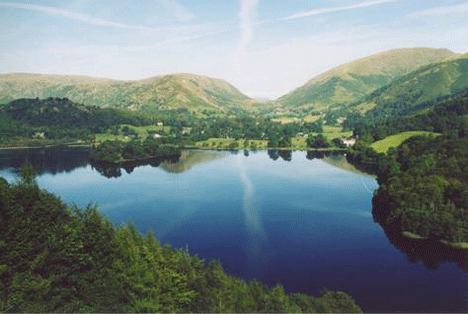 Radiation Free Lakeland 28th Nov 2020, Millom Rock and Deer Parks, This is a lovely description of a walk in an amazingly beautiful area.unbelievable it could be seriously considered as a nuclear waste dump. This quarry and surrounding area is being seriously considered by Radioactive Waste Management (a government quango) for the “disposal” of heat generating nuclear wastes.
In order to justify new nuclear build such as that at Hinkley Point, there needs to be a “final solution” for the
nuclear waste. This is no solution it is an excuse. A very dangerous excuse.
https://mariannewildart.wordpress.com/2020/11/28/millom-rock-deer-parks/
Comprehensive research now shows that irradiated areas near Chernobyl have fewest mammals
Scientific American (accessed) 26th Nov 2020, More than 30 years after the Chernobyl nuclear plant’s meltdown, an 18-mile
radius around the site remains almost entirely devoid of human
activity—creating a haven for wildlife. But scientists disagree over
lingering radiation’s effects on animal populations in this region, called
the Exclusion Zone.
A new analysis, based on estimating the actual doses
animals receive in various parts of the zone, supports the hypothesis that
areas with the most radiation have the fewest mammals. “The effects we
saw are consistent with conventional wisdom about radiation,” says
University of South Carolina biologist Timothy Mousseau, co-author of the
new study in Scientific Reports. “What’s surprising is that it took this
long to start looking at this in a rigorous, comprehensive way.”
https://www.scientificamerican.com/article/chernobyl-exclusion-zone-radiation-doses-reanalyzed/
Precious Suffolk Coast bird habitat to be destroyed by Sizewell C nuclear ptoject
 Bird Guides 22nd Nov 2020, Despite the UK Government this week announcing “greater protections for England’s iconic landscapes”, concerns are increasing over plans for a new twin nuclear reactor at Sizewell, on the Suffolk coast, with The Wildlife Trusts expressing deep worry. The Sizewell C project would cut through the Suffolk Coast and Heaths Area of Outstanding Natural Beauty and its associated important wildlife designations.
ahead. Christine Luxton, Chief Executive of Suffolk Wildlife Trust, commented: “Sizewell C would destroy a vast swathe of the Suffolk coastline in one of the most beautiful natural parts of the UK.
https://www.birdguides.com/news/the-wildlife-trusts-raise-concerns-over-sizewell-c/
Sizewell C nuclear plant ‘not value for money’, and would sabotage the govt’s pledge for nature
|
New Civil Engineer 18th Nov 2020, Plans for proposed Sizewell C nuclear power station on the Suffolk coast,
which is currently waiting for planning approval, would “sabotage” the |
|
Destruction of wildlife habitat, Coronation Wood to be felled, for Sizewell C nuclear project
(TASC), and the invaluable financial and moral support from many concerned
citizens, TASC are devastated to learn that the Courts have refused its
application to make a final appeal to overturn the decision to allow the
destruction of Coronation Wood.
case to court, said “Due to the crass decision-making of East Suffolk
Council, EDF have now been given the green light to carry out their
Sizewell B relocation plans which include taking their chain-saws to and
destroying the whole of Coronation Wood.
allow the felling of the wood. Sizewell C may never get permission and a
100 year old wood cannot be replaced. Due to its removal there will be a
major loss of visual screening of the nuclear industrial complex causing
increased noise and light pollution, totally ignoring the site’s status
as an Area of Outstanding Natural Beauty.
setts, bird and bat habitats blows EDF’s environmental credentials out of
the water. There are alternatives but EDF and the council chose not to
pursue them. EDF is not concerned in any way, shape or form for the well
being of the ecology of the area, nor that of locals who are deeply upset
by their plans”
https://tasizewellc.org.uk/latest-on-coronation-wood-judicial-revue/
 |
ReplyForward
|
The Irish sea – plagued by dumped munitions and radioactive trash
Belfast Telegraph 13th Nov 2020, A report highlighting the dangers of underwater explosions and radioactive
waste has cast doubt on the viability of any Irish Sea bridge. The UK and Ireland Nuclear Free Local Authorities (NFLA) study focused on Beaufort’s Dyke, one of the deepest sections of water in Europe and a training sitefor nuclear submarines. Munitions from both world wars and radioactive waste, when it was permitted in Europe, are known to have been dumped in the stretch of sea.
Guardians of UK’s precious habitat in Suffolk are fearful of government decision on Sizewell nuclear plan.
East Anglian Daily Times 12th Nov 2020, Guardians of one of Britain’s most precious habitats are waiting to see
how Prime Minister Boris Johnson’s 10-point plan for the environment will
affect their Suffolk site.
https://www.eadt.co.uk/news/rspb-minsmere-sizewell-c-damage-1-6926669
1 This Month
19 February – VIRTUAL EVENT-Decision Time: AI and Our Nuclear Arsenal
12:45 p.m. Central / 1:45 p.m. Eastern
To see nuclear-related stories in greater depth and intensity – go to https://nuclearinformation.wordpress.com
-
Archives
- February 2026 (161)
- January 2026 (308)
- December 2025 (358)
- November 2025 (359)
- October 2025 (376)
- September 2025 (258)
- August 2025 (319)
- July 2025 (230)
- June 2025 (348)
- May 2025 (261)
- April 2025 (305)
- March 2025 (319)
-
Categories
- 1
- 1 NUCLEAR ISSUES
- business and costs
- climate change
- culture and arts
- ENERGY
- environment
- health
- history
- indigenous issues
- Legal
- marketing of nuclear
- media
- opposition to nuclear
- PERSONAL STORIES
- politics
- politics international
- Religion and ethics
- safety
- secrets,lies and civil liberties
- spinbuster
- technology
- Uranium
- wastes
- weapons and war
- Women
- 2 WORLD
- ACTION
- AFRICA
- Atrocities
- AUSTRALIA
- Christina's notes
- Christina's themes
- culture and arts
- Events
- Fuk 2022
- Fuk 2023
- Fukushima 2017
- Fukushima 2018
- fukushima 2019
- Fukushima 2020
- Fukushima 2021
- general
- global warming
- Humour (God we need it)
- Nuclear
- RARE EARTHS
- Reference
- resources – print
- Resources -audiovicual
- Weekly Newsletter
- World
- World Nuclear
- YouTube
-
RSS
Entries RSS
Comments RSS
 nuclear-news