“You can forget about the protection of area of outstanding natural beauty because if Sizewell C nuclear goes ahead nowhere is safe”

Sizewell C: Bill Turnbull says nuclear plant will cause ‘devastation’ Presenter Bill Turnbull has told a Planning Inspectorate hearing the Sizewell C nuclear power station would cause “awful devastation”. BBC , 21 May 21,
The former BBC Breakfast anchor was speaking on the last day of a four-day public hearing into the proposed plant on the Suffolk coast.
He said he was speaking on behalf of “those who have no voice – the rare and abundant wildlife around Sizewell”.
Turnbull, who is now a presenter on Classic FM, spoke in the final session of the hearing, saying it was “in sorrow, because [Sizewell C] will be awful devastation”.
He said he lived about two and a half miles away from the proposed power plant, where “the wildlife is extraordinary”.
He expressed concern over the impact on local birds including nightingales, cuckoos and owls and called the proposed link road to the plant a “highway of destruction”.
Turnbull questioned building the plant next to RSPB Minsmere, asking the Planning Inspectorate “has the world gone that mad?”.
The 65 year old asked if the power plant was approved, “what message would it send?”
“You can forget about the protection of area of outstanding natural beauty because if Sizewell C goes ahead nowhere is safe,” he said.
The Planning Inspectorate also heard from actress Diana Quick, who said she had “became convinced nuclear was a dubious option” for energy generation.
Quick, who received a Bafta nomination for her role in Brideshead Revisited, said she was “very concerned about the pollution, from many sources, such as light, dust, and traffic fumes”.
She also said her home village, Theberton, had been flooded “with mud and water” and this could increase with the building of the power plant.
William Kendall, a farmer, food and drink entrepreneur and chairman of soft drinks manufacturer Cawston Press, also spoke at the hearing.
He said as a “lifelong environmentalist” he used to support Sizewell C, but subsequently saw “several neighbours and friends upset” by the plans.
Mr Kendall, who is also president of Suffolk Wildlife Trust, said he now believed there was an “overwhelming case against” the plant.
He said it would “leave our local tourism industry millions of pounds worse off”.
Mr Kendall said he had also spoken to politicians who were against Sizewell C, saying: “If you turn down this application no tears will be shed here or in Whitehall.”………..
A decision on the power plant is not expected until later this year. https://www.bbc.com/news/uk-england-suffolk-57202548
Sizewell nuclear project will harm Suffolk’s tourism industry
East Anglian Daily Times 20th May 2021, The construction of large-scale energy projects on the coast is of
“significant concern” to Suffolk’s tourism industry, a Planning
Inspectorate hearing on Sizewell C has heard. EDF Energy’s proposals to
build a £20billion nuclear power station are being discussed in a four-day
public hearing.
Katherine Mackie, chairman of the Aldeburgh Society, told
the hearing on Thursday a study had revealed that more than four million
tourists visit the area every year, bringing in more than £160million to
the economy. That number rose to £228m for the wider Suffolk Coast and
Heaths area of outstanding natural beauty (AONB) in 2019 with around 5,000
jobs supported, she added.
Mrs Mackie said the figures would be
“significantly impacted due to the loss of defined AONB characteristics”.
She also cited research by the Suffolk Coast Destination Management
Organisation, which found that construction of the Sizewell C project – as
well as ScottishPower’s proposed windfarm off the Suffolk coast – could
reduce visitor numbers by 17%.
https://www.eadt.co.uk/news/sizewell-c-edf-planning-inspectorate-public-hearing-7988408
UK’s radioactive pollution at Dalgety Bay to be cleaned up after 31 years
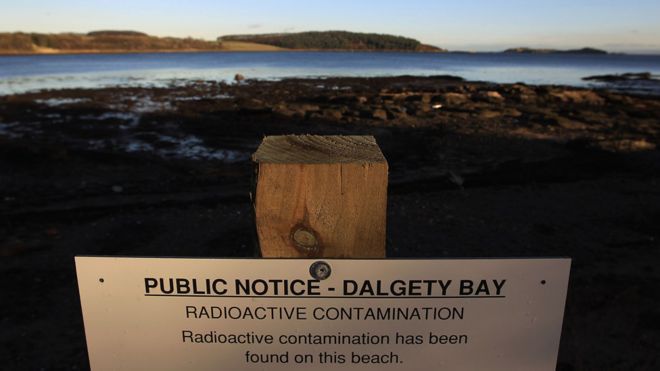
Radioactive pollution at Dalgety Bay to be cleaned up after 31 years,The Ferrret, Rob Edwards, May 14, 2021, The clean-up of radioactive pollution by the Ministry of Defence (MoD) at Dalgety Bay in Fife is to start — 31 years after it was first discovered.
The Scottish Environment Protection Agency (Sepa) has announced that work to decontaminate a stretch of foreshore on the north of the Firth of Forth near a popular sailing club will begin on 17 May. It is expected to be finished in 2022.
Sepa promised that the clean-up would provide a “permanent and positive resolution” to the decades-old pollution. It was “an important milestone for Dalgety Bay”, the agency said.
Campaigners have welcomed the news, but said that it was “utterly disgraceful” that it had taken so long to deal with the contamination. Locals and visitors had been put at risk for “many unnecessary years”, they argued
The £10m clean-up has long been the subject of fierce arguments and delays. Local politicians have repeatedly accused the MoD of refusing to take responsibility, and dragging its heels.
The contamination comes from second world war planes, and was accidentally detected during monitoring in 1990. Luminous, radioactive radium was used to make plane dials glow in the dark so they could be read at night.
After the war the planes were incinerated and dumped as landfill, on which part of the town of Dalgety Bay was built in the 1960s. Since 1990 more than 3,000 radioactive particles have been found on the beach and in local gardens.
Hundreds of particles, many of them potentially hazardous, keep being washed ashore from a headland being eroded by the sea. To protect public health, access to contaminated areas was restricted in 2011, and fishing was banne…………
According to Friends of the Earth Scotland, the area had been “blighted” by radioactive pollution that was “dangerous” to people and wildlife. “It is great news that a clean up is about to get underway but it is utterly disgraceful that it has taken more than thirty years to begin properly dealing with the problems,” said the environmental group’s director, Dr Richard Dixon.
“MoD denial and foot dragging has left locals and visitors at risk for many unnecessary years. A big part of the problem has been the MoD’s fear that if they admit they have to pay to clean up Dalgety Bay they’ll be on the hook for massive bills for similar work that needs to done throughout the UK.”……….
According to Friends of the Earth Scotland, the area had been “blighted” by radioactive pollution that was “dangerous” to people and wildlife. “It is great news that a clean up is about to get underway but it is utterly disgraceful that it has taken more than thirty years to begin properly dealing with the problems,” said the environmental group’s director, Dr Richard Dixon……..
The 50-strong group of Nuclear Free Local Authorities has been working with Fife Council to help get the Dalgety Bay foreshore decontaminated…………https://theferret.scot/radioactive-pollution-dalgety-bay-cleaned-up/
Endangered sea turtles sucked into nuclear power plant pipes
FPL doesn’t prevent endangered sea turtles from being sucked into nuclear power plant pipe, TC Palm, Max Chesnes, Treasure Coast Newspapers, 12 May 21, After 15 years of trying, Florida Power & Light Co. still has not found a way to keep endangered sea turtles from being sucked into its nuclear power plant’s intake pipes.
A TCPalm investigation in 2016 showed how a solution had been mired in bureaucratic red tape for 10 years. Since then, FPL has tested a proposed grate-like device, but found it could harm turtles, spokesperson Peter Robbins told TCPalm Wednesday.
FPL is still discussing the issue at the St. Lucie Nuclear Plant with the Nuclear Regulatory Commission and National Marine Fisheries Service, Robbins said.
Last year, 339 turtles were swept into the pipes at the South Hutchinson Island plant on ………
TCPalm investigation: 16,000 sea turtles sucked up since 1976
How does marine life get sucked into the intake pipes?
Ocean water used to cool the plant’s nuclear-fueled generators is slurped into three “intake structures” positioned underwater about a quarter-mile offshore.
Saltwater enters these pipes, runs under the beach at about 1 foot per second and dumps into a nearly mile-long intake canal, according to FPL. Marine life can be swept through the pipes and into the canal, from which they need to be removed………….. https://www.tcpalm.com/story/news/local/indian-river-lagoon/2021/05/12/fpl-st-lucie-nuclear-power-plant-still-sucking-endangered-sea-turtles-sawfish-into-intake-pipes/5037097001/
Radioactive water release – Fukushima nuclear disaster continues to haunt the world

Radioactive water: Japan’s Fukushima nuclear disaster haunts the world a decade later, Geo News, 7 May 21, ”…. In a recent development, Japan decided to dump radioactive water stored at the disaster-hit Fukushima Daiichi nuclear power plant into the Pacific Ocean.
Scores of Pakistani fishermen recently protested this decision of Japan outside the Gawadar Press Club……….
Radioactive water could contaminate fish exports from Pacific ocean
Geo News got in touch with renowned Pakistani physicist Dr AH Nayyar to talk about Japan’s decision.
Dr Nayyar recalled the 1986 Chernobyl nuclear disaster while discussing the Fukushima disaster.
“They could not stop Chernobyl and radioactive clouds once they hovered over Europe from Soviet Union. Radioactivity found its way inside human skin and the world paid the price,” he said, adding that as far as Fukushima is concerned, it will be a first experiment of its own kind.
Dr Nayyar pointed out releasing radioactive water into the ocean could mean that if radioactive elements sit in marine life, it will soar chances of it infiltrating into humans via catchments and exports. “When radioactive particles decay, they cause cancer in the human body,” he said.
“People were skeptical in buying fresh milk and powder imported from Europe post 1986 Chernobyl disaster. It could be the same with fish coming from the Pacific ocean. They will have to be carefully examined if they carry radioactive particles. However, waters from the Pacific Ocean will not intrude into the Arabian Sea,” Dr Nayyar concluded……….
Currently, it is stored in gigantic water tanks, but the plant’s operator, Tepco, appraised that these tanks are expected to fill up by 2022.
The water is contaminated as it comes in contact with fuel before leaking into damaged basements and tunnels, where it mixes with groundwater that flows through the site from hills above. The combination results in excess contaminated water that is pumped out and treated before being stored in huge tanks crowding the site.
About 1.3 million tonnes of radioactive water – or enough to fill 500 Olympic-sized swimming pools – are currently stored in these tanks, In 2018, Tepco admitted it had not filtered all dangerous materials out of the water, despite saying for years they had been removed, according to a Reuters report.
Unacceptable and irresponsible, say China, South Korea to Japan
In a statement, China’s foreign ministry called the move “extremely irresponsible” and said it reserved the right to take further action.
South Korea’s government said the plan was “totally unacceptable” and that it would lodge a formal complaint with Japan.
Voices are rising within Japan as well. Greenpeace Japan said it “strongly condemned” the decision.
“The Japanese government has once again failed the people of Fukushima,” Kazue Suzuki, a climate change and energy campaigner at Greenpeace Japan, said in a statement. “The government has taken the wholly unjustified decision to deliberately contaminate the Pacific Ocean with radioactive wastes. Rather than using the best available technology to minimize radiation hazards by storing and processing the water over the longer term, they have opted for the cheapest option.” https://www.geo.tv/latest/349126-radioactive-water-japans-fukushima-nuclear-disaster-haunts-the-world-a-decade-later
The toll on marine life of radioactive water poured into the Pacific Ocean.
Beyond Nuclear 2nd May 2021, Tepco and the Japanese government are once more preparing to “dispose” of 1.25 million tonnes — translating to hundred of millions of gallons — of radioactive water accumulating at the Fukushima Daiichi nuclear power plant site by pouring it into the Pacific Ocean. I say “accumulating” because this water, needed to constantly cool the stricken reactors that exploded and melted down during and after March 11, 2011 — and that also runs down neighboring hillsides and across the site, picking up radioactive contamination — will continue to accumulate.
This is not a one-stop-toss. Citizens groups and fishing unions have been up in arms about this ever since it was first mooted. The actual dumping of the water always seems to be about two years away, and is always threatened as
the only “solution,” which it is not. It is almost certainly the cheapest solution, but not the only choice.
Even if we never ate the fish that comes out of the Pacific; and even if the fish and higher marine mammal predators never ate each other; contaminating sea life with radioactive toxins is wrong. We made it. Why dump it on creatures who had nothing whatever to do with its production and never needed to turn on a light?
This is not the only instance of total disregard for marine life when it comes to nuclear power. Just by using what is known as the “once-through” cooling intake system at coastal nuclear power plants, the toll on sea life is immense.
Billions of fish, fingerlings and spawn are drawn into the plant with the cooling water (the water rate can be as high as a million gallons a minute) and duly pulverized. Their “remains” are discharged at the other end as sediment. No fishing license required. New nuclear power plants promise to be even bigger marine predators.
Fission folly
Millions of fish to be destroyed by UK’s new nuclear stations, but Centre for Environment, Fisheries and Aquaculture Science (Cefas) is in the pay of nuclear firm EDF.
| Climate News Network 4th May 2021, The high fatality rate which the cooling systems of two British nuclear power stations may impose on marine life is worrying environmentalists, who describe the heavy fish toll they expect as “staggering”. The twostations, Hinkley Point C, under construction on England’s west coast, and Sizewell C, planned for the eastern side of the country, will, they say, kill more than 200 million fish a year and destroy millions more sea creatures. But the stations’ builders say their critics are exaggerating drastically. Objectors to the fish kill had hoped that the UK government agency tasked with conserving fish stocks in the seas around Britain, the Centre for Environment, Fisheries and Aquaculture Science (Cefas), would be on their side. They have been disappointed to learn that Cefas is a paid adviser to the French nuclear company EDF, which is building the stations, and would raise no objections to the company’s method of cooling them with seawater. https://climatenewsnetwork.net/uk-nuclear-plants-will-exact-heavy-fish-toll/ |
Nuclear weapons have triggered a new geological era

NUCLEAR WEAPONS IN THE ANTHROPOCENE
Nuclear weapons have triggered a new geological era, but what does that really mean ? Inkstick Media: Peter Waring, 3 May 21, There were a few possible contenders when a working group established by the International Commission on Stratigraphy began searching for a “golden spike” — a geological inflection point marking the end of one era and the beginning of another. ………
from a geological perspective, no marker better captures humanity’s impact on the physical environment than the fallout from decades of atmospheric nuclear testing.

In 2019, the Working Group voted overwhelmingly to recommend establishing a new era — the Anthropocene — to record the beginning of the period where humans have drastically altered the planet. The proposed start day was July 16, 1945, the day of the Trinity Test.

The beginning of the nuclear age marks a new stratigraphic boundary in Earth’s history. The “bomb spike,” as it came to be known, represents the level of carbon 14 and plutonium 239 in the atmosphere, both of which peaked in the mid-1960s at the height of the Cold War. And though levels have subsequently reduced — as states limited and finally halted atmospheric testing — evidence of the spike is now a matter of geological record. In other words, it will exist for as long as the Earth does. But what does this really mean for our security and our environment?
RACING TOWARD CATASTROPHE
Humanity and the environment are now “mutually transformative — and potentially mutually destructive,” a fact which forces us to confront the possibility that the era of climate stability, known as the Holocene, has ended and that our own collective and individual actions are to blame. Apart from its prominent geological signature, the “bomb spike” is also emblematic of the so-called Great Acceleration, the exponential growth in various metrics of human activity since the mid-twentieth century, which include: population, technology, economic development, industrial output, energy consumption, carbon emissions, and international tourism. These measures have been thrust ever upwards by the spread of extractive capitalism, endless technological innovation, and an underlying assumption that somehow the realm of human activity exists outside and separate from nature. Today, we are not witnessing the failure of this world view. Rather, we are witnessing the consequences of its success.
Nuclear arsenals are regularly justified as a bulwark against threats to the postwar, liberal international order. But it is precisely this global system that has served as the launching pad for the Great Acceleration. And as such, it is difficult to separate our conceptions of wealth, progress, and liberty — the very things nuclear weapons are meant to secure — from the causes of human-induced climate change. We have been led to believe that this skyward trajectory is a good thing, that all of our problems will disappear if only there were more progress, more technology, more freedom. But like Icarus, have we flown too close to the sun?
OUR WORST ENEMY
The Manhattan Project, which developed the first atomic weapons, has been described as a “full stop on modernity” — or in other words, the natural terminus of a worldview that separated humankind from our environment. It is the belief that we can do whatever we want to nature and that the Earth exists to support humanity. The Manhattan Project, which developed the first atomic weapons, has been described as a “full stop on modernity” — or in other words, the natural terminus of a worldview that separated humankind from our environment. It is the belief that we can do whatever we want to nature and that the Earth exists to support humanity.
Modernity in this sense is not merely technology or our institutions but rather a mode of thought premised on a belief in human supremacy. Nuclear weapons are the apotheosis of modernity. We can take whatever we want from the Earth and we can destroy it too. Here is the intersection some nuclear threat experts have been looking for, between the environmental movement and the nuclear movement. Between a cause with seemingly endless cultural cachet and one that appears like a mid-century relic.
The nuclear weapons industry is undoubtedly the source of much environmental damage: There are uranium mines, plutonium production facilities, and former test sites. But the true impact exists on a different register altogether. It is more than just the material effects, more even than the devastating ecological impact of a nuclear blast.
Atomic weapons are the most extreme example of our world-possessing pretensions. Their existence and central role in our security apparatus is representative of a mode of thought that portrays humanity as the chief protagonist in the story of Earth. The Anthropocene is the point at which the plot changes.
It is also clear that on a planet increasingly defined by human activity the old dichotomies of friend and foe — of good and evil — are no longer relevant. But constructing enemies is at the core of nuclear thinking as only the most extreme adversaries can justify the most extreme weapons. During the Cold War this was a relatively simple task, albeit one pursued with a kind of cartoonish zeal by politicians on both sides. And while there is a worrisome element of deja vu about the rising discord between Russia and NATO, talk of a new Cold War seems oddly out of place in a world of pandemics and catastrophic climate change. Yet it remains an inescapable feature of the Atomic Age that enemies must be suitably evil and suitably different from us. They must “hate freedom” and they must reject the so-called “rules-based” global order. More significantly, the enemies themselves are largely inconsequential: When they crumble or retreat into the background, we create new ones. As long as the weapons exist there will be myths to justify them. Arundhati Roy perhaps said it best:
“Nuclear weapons pervade our thinking. Control our behavior. Administer our societies. Inform our dreams. They bury themselves like meat hooks deep in the base of our brains. They are purveyors of madness.”
The Anthropocene forces us to grapple with this madness and to reconsider our need for enemies. It demands that we confront unsettling truths and come to terms with the prospect that the greatest threat to our security and way of life is our way of life.
ADJUSTING OUR POLITICS
The long half-life of the Atomic Age is as much the product of outdated thinking as it is bureaucratic inertia or military strategy. The scholarship surrounding nuclear weapons is held back — stuck — by a kind of thinking that belongs to a different epoch. International Relations (IR) and its dominant paradigms of realism and liberalism have lost whatever explanatory power they once had. They are no longer fit for purpose as either an academic discipline or a collection of governing institutions. They have become a trap of our own making. In fact, IR fails even to acknowledge the threat posed by the Anthropocene or the consequences of inaction. The global apparatus constructed to manage twentieth-century challenges, such as genocide, nuclear conflict, and world wars has proved disastrously ill-suited to our new era.
This has been particularly true with regards to the supposed preeminence of the nation-state, which serves as the very basis of world governance. But it is precisely this belief — the privileging of the national above the international, of the human above the planetary — that has drawn attention away from the devastation occurring all around us.
Viewed from the perspective of deep geological time, the pantomime of global politics and state rivalry has been little more than a distraction. What good are states if their future consists of flooded cities, devastated ecosystems, and uninhabitable wastelands? And can states defend the interests of future generations, both human and non-human?
If indeed the domain of the human and the natural are now indistinguishable, then it follows that our notions of international security and geopolitics must change. What is needed is not more realism or liberalism or business-as-usual diplomacy but rather an altogether new way of organizing the world — a theory of IR based on the belief that the Earth itself matters. ……. https://inkstickmedia.com/nuclear-weapons-in-the-anthropocene/
How Chernobyl’s radioactive dust blanketed Europe in 1986

Radiation high over Europe after Chernobyl disaster – archive, 1986
3 May 1986: Mainland Europe experiences higher than normal radiation, with Poland, East Germany and Sweden bearing the brunt of contamination Michael SimmonsFrom the Guardian archive Mon 3 May 2021 By dusk last night, every country in mainland Europe had experienced higher than normal radiation as a result of the Chernobyl disaster. Only the Iberian peninsula was still clear, as governments in East and West, having recovered from the initial panic, started to count the medium-term costs.
Changes in wind direction from the epicentre at Kiev created fresh uncertainties throughout the day. The consensus among meteorologists was that the south-east wind which had done its worst earlier in the week in parts of Poland and Scandinavia was now veering towards due east, affecting Greece, Yugoslavia, and south-west Germany.
France reported “a minor increase” in atmospheric radioactivity, while Holland reported yesterday that, for the first time since the disaster, radiation levels were markedly higher than normal. In that country, government plans to air details of a proposed shift to nuclear power in the 1990s were shelved indefinitely.
The brunt of the contamination continued to be borne by the countries closest to the disaster area – notably Poland and East Germany – as well as Sweden, which has been seeking to take remedial measures since the beginning of the week.
The Swedish authorities ordered farmers to keep their cattle indoors – possibly for some weeks – and said people should not drink rainwater or eat wild vegetables or mushrooms. One fear in Stockholm is that the wind could veer back towards Sweden early next week……..
The brunt of the contamination continued to be borne by the countries closest to the disaster area – notably Poland and East Germany – as well as Sweden, which has been seeking to take remedial measures since the beginning of the week.
The Swedish authorities ordered farmers to keep their cattle indoors – possibly for some weeks – and said people should not drink rainwater or eat wild vegetables or mushrooms. One fear in Stockholm is that the wind could veer back towards Sweden early next week…….
Italy yesterday prohibited the sale of salad greens and barred a variety of imports from northern Europe. The Health Minister, Mr Costante Degan signed an order that forbade vendors from selling fresh leafy vegetables. https://www.theguardian.com/environment/2021/may/03/radiation-high-over-europe-after-chernobyl-disaster-1986
Paul Beckwith on the failure of universities to address real world problems
1 May 21, I have often wondered how humanity, in our present day and age, can be facing total and utter catastrophe from abrupt climate system change, and still have the vast multitudes of citizens, governments, and nations not even want to recognize the grave dangers that we face. These are not long term risks, in fact we face the imminent complete loss of Arctic Sea Ice, enormous outbursts of methane gas, mass extinctions of our plants and animals, and global food shortages leading to deadly widespread famine within a decade. How is this possible? How can society be so stupid? Why am I cursed to recognize the imminent and complete collapse of our society?
Having been within the university system and academia for many years, I have been constantly puzzled as to why there is no sense of societal danger and risk of near term collapse. The Ivory Towers of Academia have been completely oblivious to the existential crisis, and has done absolutely nothing to educate the public to these risks. The university is essentially a knowledge-factory to push forward the boundaries of knowledge in a vast array of independently siloed fields, while it has completely lacked the wisdom to recognize let alone address the real world problems that are right in front of our face. As a result, with zero wisdom from our esteemed institutes of learning, our society is teetering on the brink of complete and utter collapse from abrupt climate system change. The best paper that I have read on this failure of our university system to address real world and imminent global problems was published two weeks ago and is called “How Universities Have Betrayed Reason and Humanity – And What’s to Be Done About It” by Nicolas Maxwell.
Malaysia needs to speak out on releasing nuclear waste into the sea
Malaysia needs to speak out on releasing nuclear waste into the sea https://www.theedgemarkets.com/article/malaysia-needs-speak-out-releasing-nuclear-waste-seaBernama/Bernama
May 02, 2021 KUALA LUMPUR : Malaysia needs to play its role as a member of the United Nations Environment Programme (UNEP) by speaking out on the long-term effect of releasing treated water from nuclear power plants into the ocean.
Co-founder of Project Ocean Hope, Mogesh Sababathy said actions need to be taken to ensure environmental sustainability, especially for marine life, is not threatened.
“Even though the nuclear waste will be diluted in water, its radioactive concentration should also be considered. And even when diluted, toxic is still toxic and it can still affect everyone.
“Hence, Malaysia needs to play its role and speak out on this issue at an international level, as this involves people’s security and health, as well as marine life in the region,” he told Bernama.
The Japanese government has recently approved a plan to release more than one million tonnes of treated water from the ruined Fukushima nuclear plant into the sea.
The plan also has the support of the International Atomic Energy Agency (IAEA), which says the release is comparable to the disposal of waste water from other nuclear plants globally.
Mogesh argued that this method will affect the world’s food chain security. “Nuclear radioactive is capable of affecting marine life and killing organisms, thus threatening the economic source of those who rely on it.
“It’s undeniable that Malaysia is far removed from Fukushima but we still share the same ocean. It is not impossible for the waste to drift to our country,” he said.
He hopes the relevant international bodies will study and develop safer alternative to dispose radioactive nuclear waste without harming the environment.
South Korean fishermen protest against the dumping of Fukushima wastewater into the Pacific Ocean
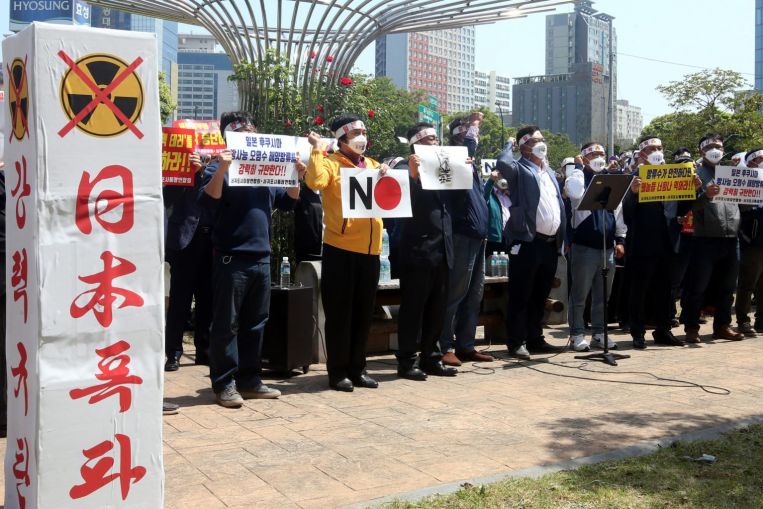
S.Korean fishermen hold boat protests against Japan nuclear plans, Reuters 30 Apr 21, Hundreds of South Korean fishermen across the country held protests on Friday calling on Japan to reverse its decision to release contaminated water from its crippled Fukushima nuclear plant into the sea.
About 800 fishermen participated in rallies at ports in nine cities, according to South Korea’s National Federation of Fisheries Cooperatives.
At one port, at Gungpyeong on the west coast, fishermen held anti-Japan banners and chanted slogans such as “Withdraw Japan’s decision” and “Condemn irresponsible nuclear attack”. Twenty fishing boats with banners denouncing Japan’s decision sailed near the port.
“My father bequeathed this sea to me and I’m going to pass it on to my son, who is also fishing,” said Park Re-seung, chief of Yongdu-ri fishing village, who has worked in the fishing industry for 38 years. “Why is Japan doing this? How could they do such a bad thing against the sea? Don’t they eat fish?”…….
“For us, this issue is about making our living,” Park added. “If the customers continue to see the news of the water release, they wouldn’t be even buying fishes that we caught here.” https://www.reuters.com/business/environment/skorean-fishermen-hold-boat-protests-against-japan-nuclear-plans-2021-04-30/
High level of radioactivity near France’s uranium processing factory
France Info 29th April 2021, Residents of the largest uranium processing site in France, in Narbonne
(Aude), are worried: samples taken near the plant and analyzed in the laboratory show a high level of uranium. The site manager, however, says there is no danger to residents.
The most important uranium processing site in France is located three kilometers from Narbonne (Aude). Concerned local residents regularly check the level of radioactivity in the vicinity of the plant.
At the barrier that limits access to the site, the meter is racing and exceeds four times the natural level of radioactivity. The Orano Malvési plant is the entry point for nuclear power in France. Uranium arrives from all over the world in the form of yellow powder and must be purified and transformed into nuclear fuel. In 60 years, already more than 300,000 m3 of radioactive waste have been produced and are contained in basins, in the form of sludge.
Sizewell C nuclear plant could kill 500m fish
Sizewell C nuclear plant could kill 500m fish, campaigners say
Environmental groups claim planned Suffolk power station will devastate marine life and key bird habitat, Guardian,
Karen McVeigh 27 Apr 21,
More than 500 million fish, including protected species, could be sucked into the cooling system of a proposed £20bn nuclear power plant in Suffolk if construction goes ahead, environmental campaigners say.
A local campaign group, Together Against Sizewell C (Tasc), claims the subsequent deaths of millions of fish is “inhumane and unacceptable” and flies in the face of the government’s green agenda. Also opposing the development, the bird conservation group RSPB expressed concern over predicted levels of fish loss on the marine birds that feed on them…….
environmental campaign groups, including Greenpeace, argue that nuclear reactors are unnecessary and expensive, compared with a combination of renewable energy and battery storage technology. The RSPB and the local community group Stop Sizewell C said the reactor poses a risk to the natural habitats along the Suffolk coast and the adjacent Minsmere nature reserve.
Planning documents published by EDF have revealed that almost 8 million fish were “impinged” – or sucked into the cooling system – by the existing plant Sizewell B each year between 2009 and 2013. Extrapolating from these figures, Tasc has estimated that 28 million fish could be impinged in the cooling system of both plants each year, which is 560 million over the two decades the plants are expected to operate, between 2035 and 2055. The proposed plant is larger than Sizewell B and will take in 2.5 times the amount of seawater, Tasc said.
Pete Wilkinson, the chair of Tasc and a co-founder of Greenpeace UK, said the estimates were “staggering”. Such wildlife loss was the “tip of the iceberg”, he said, as it did not take into account fish fry, eggs, crustacea and other aquatic life.
“Tens of millions of fish, crustaceans and other marine biota will be sacrificed for the purposes of cooling a plant which is not needed to keep the lights on, which will do nothing to reduce global carbon emissions, which will be paid for from the pockets of all UK taxpayers and bill-paying customers, leaving future generations with a lasting legacy of an impoverished environment,” he said.
Wilkinson said he expected Cefas (The Centre for Environment, Fisheries and Aquaculture Science) to condemn the impact on fish at the inquiry stage of the Sizewell C planning process.
“Cefas’s stated aim is ‘to help keep our seas, oceans and rivers healthy and productive, and our seafood safe and sustainable … ’ Instead, it seems that Cefas appears quite at ease presiding over the deaths of millions of fish and clearly feels the huge number of fish deaths is acceptable in that the overall health of fish stocks will not be compromised.”
Adam Rowlands, the RSPB’s Suffolk area manager, said: “It is our position that the project should not go ahead. The potential impacts on the environment are too great. Fish impingement is one of our concerns. These fish provide a valuable food supply to rare birds nesting and breeding in the area.”
Protected species breeding in the area include little and common terns and in the winter there are a number of internationally important red-throated divers. “They won’t feed on dead fish,” Rowlands said…….
If the plant goes ahead, it will be built on part of Sizewell marshes, a site of special scientific interest. It will also be adjacent to the southern boundary of the RSPB-owned Minsmere nature reserve, a Ramsar (internationally important wetland) site and special protection area. Minsmere is one of only five sites in Britain to receive the Council of Europe European Diploma for protected areas award, whose renewal depends on Sizewell C not causing any damage………
The Sizewell C planning process began in May 2020 and an examination is now under way by the Planning Inspectorate. This stage of the process is expected to take about six months, during which local people and organisations can make representations. https://www.theguardian.com/environment/2021/apr/28/sizewell-c-nuclear-plant-could-kill-500m-fish-campaigners-claim
Not to be forgotten – the 1957 nuclear explosion in Mayak centre, Russia, that continues to poison the region.

Reporterre 26th April 2021, While the Chernobyl nuclear disaster occurred thirty-five years ago,
another explosion, which occurred in Russia in 1957 in the Mayak military
nuclear center, continues to poison the region. A look back at this
disaster kept secret for more than twenty years.
https://reporterre.net/Trente-ans-avant-Tchernobyl-la-catastrophe-nucleaire-de-Kychtym
1 This Month



26 September – International Day for the Total Elimination of Nuclear Weapons


PLEASE OPPOSE HR 8255 AND S.3639 – bills would accelerate satellite deployment, with no environmental review or safeguards – https://ncstd5li.quorum.us/campaign/169331/
To see nuclear-related stories in greater depth and intensity – go to https://nuclearinformation.wordpress.com
-
Archives
- September 2026 (233)
- August 2026 (330)
- July 2026 (355)
- June 2026 (287)
- May 2026 (306)
- April 2026 (356)
- March 2026 (251)
- February 2026 (267)
- January 2026 (308)
- December 2025 (358)
- November 2025 (359)
- October 2025 (375)
-
Categories
- 1
- 1 NUCLEAR ISSUES
- business and costs
- climate change
- culture and arts
- ENERGY
- environment
- health
- history
- indigenous issues
- Legal
- marketing of nuclear
- media
- opposition to nuclear
- PERSONAL STORIES
- politics
- politics international
- Religion and ethics
- safety
- secrets,lies and civil liberties
- spinbuster
- technology
- Uranium
- wastes
- weapons and war
- Women
- 2 WORLD
- ACTION
- AFRICA
- Atrocities
- AUSTRALIA
- Christina's notes
- Christina's themes
- culture and arts
- Events
- Fuk 2022
- Fuk 2023
- Fukushima 2017
- Fukushima 2018
- fukushima 2019
- Fukushima 2020
- Fukushima 2021
- general
- global warming
- Humour (God we need it)
- Nuclear
- RARE EARTHS
- Reference
- resources – print
- Resources -audiovicual
- Weekly Newsletter
- World
- World Nuclear
- YouTube
-
RSS
Entries RSS
Comments RSS
 nuclear-news