Black pigmentation in Chernobyl’s Eastern Tree Frogs
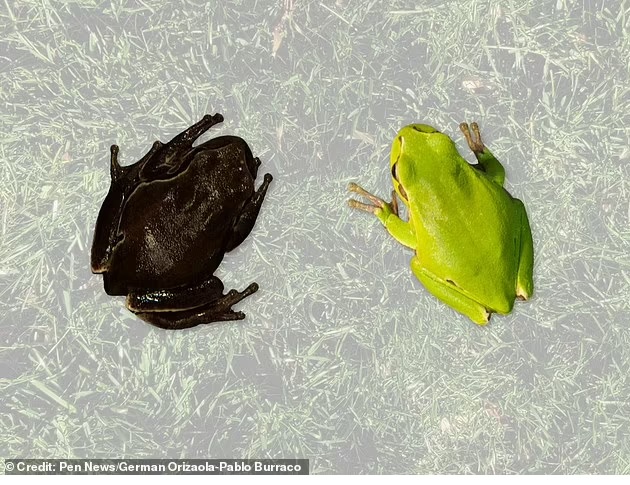
Chernobyl is spawning MUTANT frogs: Bizarre black amphibians are spotted near the nuclear plant – 36 years after its catastrophic meltdown
- Eastern tree frogs are meant to have bright green skin
- But scientists working near Chernobyl have found many with black skin
- They think the dark skin may have helped them to survive the exclusion zone
https://www.dailymail.co.uk/sciencetech/article-11290735/Chernobyl-spawning-MUTANT-frogs-Bizarre-black-amphibians-spotted-near-nuclear-plant.html By SHIVALI BEST FOR MAILONLINE and MICHAEL HAVIS, 7 October 2022
Mutant black frogs are spawning near the Chernobyl power plant, 36 years after its catastrophic meltdown unleashed one of the worst nuclear disasters in history.
Eastern tree frogs are meant to have bright green skin but scientists working near Chernobyl have found many with darker or black pigmentation.
In 1986, the site in northern Ukraine – then under Soviet rule – witnessed the largest release of radioactive material into the environment in human history.
Now scientists think the mutated frogs’ darker skin may have helped them survive in the exclusion zone, which today restricts access to 1,0000 sq miles around ground zero.
Germán Orizaola, a researcher at Spain’s University of Oviedo, who co-authored the new study, said: ‘We become aware of these frogs the very first night we worked in Chernobyl.
‘We were looking for this species near the damaged power plant and we detected many frogs that were just black.
‘We know that melanin is responsible for dark or black colouration in many organisms, including frogs.
‘At the same time, we know that melanin protects from the damage caused by different types of radiation, from UV to ionizing radiation – the kind at Chernobyl.’
For their study, Dr Orizaola and his co-author, Pablo Burraco, collected more than 200 male frogs from 12 different breeding ponds with different levels of radiation.
They found that frogs within the exclusion zone were much darker than those from outside it.
And though there was no correlation between the darkest frogs and the most irradiated places today, there was a correlation with the worst-affected places from the time of the accident.
In other words, the darker frogs had stood a better chance of survival when disaster struck in 1986, making them more numerous today.
Dr Orizaola said: ‘With this species it’s possible to find, under normal circumstances, a small percentage of frogs with unusual colouration.
Macron’s nuclear dream means attacking environmental law, and is no help to the climate
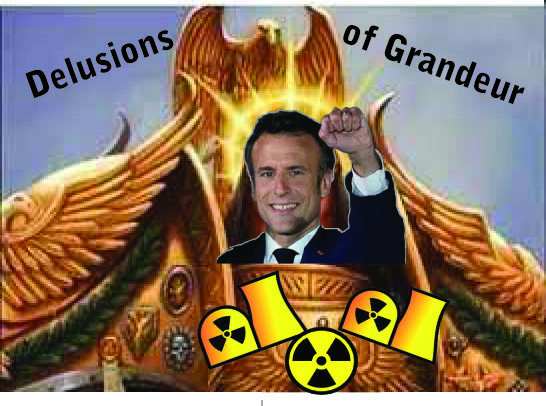
Attacking environmental law to accelerate the construction of new nuclear reactors: Macron’s assumed project.
On September 22, on the occasion of the inauguration of the St Nazaire maritime wind farm, and once again anticipating the public debate supposed to be held on the EPR projects in Penly, Emmanuel Macron reaffirmed his project of a “deployment of a forced-march nuclear strategy” (sic!). On this occasion, he announced an acceleration of the procedures supposed to make it possible to start the first reactors even earlier than planned.
Barely a week later, the dedicated bill reached the National Council for Ecological Transition, summoned to make a decision within an extremely short time. This forced passage and the assumed deconstruction of environmental law presented in this text are quite simply shameful.
But trampling on the law and democracy will not make the problems of a sector undermined by a lack of skills, and of a technology that is too slow and too cumbersome to respond to the climate emergency, disappear with a magic wand.
Sortir du Nucleaire 28th Sept 2022
https://www.sortirdunucleaire.org/Attaquer-le-droit-de-l-environnement-pour
Here comes the catastrophocene…

If humans have become a geological force reshaping the Earth in the Anthropocene, then we need to become a geological force to undo the damage we have caused, and correct the threats we are still causing.
Pearls and Irritations, By Julian Cribb Oct 3, 2022, https://johnmenadue.com/here-comes-the-catastrophocene/
The good news is that the Anthropocene is almost over. It will have been the shortest geological epoch in all of Earth history.
The bad news is that the Catastrophocene is just beginning.
This is a period marked by the interaction of ten catastrophic risks which many scientists are now warning could precipitate the end of human civilisation – and potentially bring about the departure of our species from an uninhabitable Earth.
The Holocene, the climatically stable period which enabled humans to develop agriculture and cities, is now over. It lasted about 11,650 years, from the last Ice Age to the latter C20th. And now it is gone and we are into a wholly different world, named in 2000 by Dutch Nobel laureate Paul Crutzen ‘the Anthropocene’ – the epoch in which humans became a truly geological force, reshaping and altering the entire planet, its atmosphere, oceans, the land, and life itself. On present indications, the Anthropocene will last only a century or two.
The evidence is all about us that we’re into something altogether grimmer. Each day, almost, brings fresh reports of colossal unintended consequences of human activity around the planet – vast floods, tens of thousands of fires raging, dust storms sweeping topsoil off our farms, heatwaves, dried-up rivers and lakes, melting glaciers, unimaginable losses of birds, animals, insects and other life, dwindling forests and fish, poisoned water, oceans, food and air, declining oxygen levels, hunger and starvation, the dissemination of new diseases, the mass migration of 350 million people a year, the advent of powerful new technologies whose effects are unknown and uncontrolled, and the insidious worldwide seep of malicious lies about it all.
The evidence is all about us that we’re into something altogether grimmer. Each day, almost, brings fresh reports of colossal unintended consequences of human activity around the planet – vast floods, tens of thousands of fires raging, dust storms sweeping topsoil off our farms, heatwaves, dried-up rivers and lakes, melting glaciers, unimaginable losses of birds, animals, insects and other life, dwindling forests and fish, poisoned water, oceans, food and air, declining oxygen levels, hunger and starvation, the dissemination of new diseases, the mass migration of 350 million people a year, the advent of powerful new technologies whose effects are unknown and uncontrolled, and the insidious worldwide seep of malicious lies about it all.
These phenomena are the physical manifestations of what the Council for the Human Future has termed the ‘existential emergency’ now confronting humanity – a crisis which many scientists and individual citizens now recognise as real, but which most governments, corporates and politicians seem loath to accept the evidence that is before their very eyes.
This crisis is comprised of ten catastrophic risks, not just the one or two most commonly reported in the media. All these risks interact with one another, meaning they cannot be tackled separately or solved one by one. Collectively, they are driven by human overpopulation, overconsumption and over pollution. The risks are:
Extinction and eco-collapse: currently proceeding 1000-10,000 times faster than normal, eliminating the ecosystems that humans and wildlife need to survive. Mainly caused by agriculture and land development.
Overheating: a climate approaching out-of-control as nine huge ‘feedbacks’ from the Earth system itself make it even faster, hotter and more turbulent than man-made factors (like fossil fuels and land clearing) alone.
Global poisoning: five times larger and ten times more deadly even that climate, human chemical emissions are the largest and most underestimated threat to planetary health and survival.
Nuclear holocaust: with 70 nations still committed to nuclear arms and conflict, scientists currently rate the threat at ‘100 seconds to midnight’, the worst level since Hiroshima.
Resource scarcity: a world water crisis is already a reality for half the population. Loss of topsoil, forests, fish stocks and scarcity of other key resources threaten to unleash fresh conflicts.
Pandemics: there have been seven pandemics since 2000, with a new one striking every 2-3 years. With some 90 wild animal diseases already crossed into humans, more are on the way.
Overpopulation: due to hit 8 billion in November and 10 billion by 2060, human numbers are estimated by some researchers to now be 4 times what the Earth can carry in the long run. Not a threat in itself, population pressure drives all the other threats and must be brough under control.
Famine and hunger: already rising due to loss of soil, water and a stable climate. World food chains increasingly vulnerable to disruption from shortages, conflict and big events, putting megacities at risk.
Ultratechnologies: uncontrolled development and release of powerful new technologies without thought for the consequences will unlock fresh threats for humanity, just as fossil fuels and chemistry already have.
Misinformation: the world is drowning in lies, half-truths and disinformation, mainly spread by the fossil fuels lobby, certain media, politicians and other malicious actors. These are disabling government, breeding mistrust of science and making the task of saving civilisation ever harder.
It is the interaction of these ten mega-threats which now constitutes the new age – The Catastrophocene. This will be a period in which most human lives will be consumed in attempting merely to survive and find workable collective solutions to these threats, to repair our damaged planet and salvage all that is good and decent of our civilisation.
Take heart, solutions do exist. I detail the main ones in a forthcoming book, both global answers and what individuals can do to save themselves. However, as the Council for the Human Future has noted: no government on Earth yet has a policy for human survival. They simply do not grasp the magnitude or the reality of what is unfolding. Or they don’t care. Nor do the giant corporations who now rule the world economically.
If humans have become a geological force reshaping the Earth in the Anthropocene, then we need to become a geological force to undo the damage we have caused, and correct the threats we are still causing. Part of that consists in reducing both our numbers and our material demands to what the planet can safely bear in the long term. If we do not undertake this task, then nature will surely do it for us. Doing nothing, or doing too little too late, will destroy us.
In other words, controlling the catastrophic risks we now face will save countless lives, help avoid total collapse or even extinction, restore the Earth and preserve what is best about the human endeavour.
It is the greatest, noblest and most urgent cause in all our million year journey.
‘People’s Plan for Nature’ – a response to UK government’s attack on environmental protection laws
Three of the UK’s biggest conservation charities have joined with
celebrities to launch a new People’s Plan for Nature, in response to the
Government’s “open season” on policy protection for nature, which
could seed hundreds of environmental laws eased.
The National Trust, the RSPB, and WWF have joined forces with celebrity champions Maisie Williams
and Cel Spellman to launch the People’s Plan for Nature, a national
rallying cry for the public to have its say on how to respond to the
ecological crisis. The plan calls on Prime Minister Liz Truss and new
Environment Secretary Ranil Jayawardena to take rapid action on what the
charities describe as “open season” on existing environmental
legislation, with the recent mini-budget and rumours that Defra will U-turn
on its manifesto sparking concerns amongst green groups.
Edie 30th Sept 2022
UK Government to speed through nuclear development by making a bonfire of existing environmental regulations.

Whilst the media may have focused on the Chancellor’s contentious plan
to make the rich richer by cutting tax for higher earners, anti-nuclear
campaign groups, including and the Nuclear Free Local Authorities, are
concerned that buried within the finer print of the HM Treasury Growth
Plan, which was published alongside Kwasi Kwarteng’s speech in
Parliament, is a clear plot to streamline planning regulations and stifle
public objections to civil nuclear projects.
Treasury mandarins have identified Hinkley Point C and Sizewell C, numbered 115 and 116
respectively, as amongst the large infrastructure projects earmarked to be
fast-tracked by the end of next year by creating a bonfire of existing
regulations covering protection of the natural environment and the rights
and opportunity of the public and other stakeholders to object.
According to departmental officials new legislation will be brought forward to
‘address barriers by reducing unnecessary burdens to speed-up the
delivery of much-needed infrastructure’.
NFLA 27th Sept 2022
Pilgrim power plant owner Holtec still considering dumping nuclear waste into Cape Cod Bay
Holtec International has 1.1 million gallons of radioactive wastewater to get rid of.
Boston.com By Susannah Sudborough, September 28, 2022 ,
The company working to decommission the Pilgrim Nuclear Power Plant in Plymouth is still considering dumping radioactive waste into Cape Cod Bay despite pushback from activists, lawmakers, and the EPA.
Holtec International has 1.1 million gallons of leftover wastewater from the plant, which closed in 2019, that it needs to get rid of.
NBC 10 Boston reported Tuesday that a representative from Holtec gave an update on the company’s plans at a town hall meeting Monday evening.
“When you do liquid discharges, it is diluted with seawater to non-detectable levels pretty quickly once it’s released, and doing it in small batches is actually the safest manner,” Holtec spokesman Patrick O’Brien told the news station.
But activists from Save Our Bay, a coalition of conservation groups, local leaders, and citizens who oppose the proposed dumping, say Holtec wants to dump the nuclear waste in Cape Cod Bay simply because it’s cheaper.
While O’Brien denied to NBC 10 Boston that dumping is the cheaper option, the group, which protested in Plymouth before the meeting Monday, says the waste will make the bay’s and local waters unsafe.
“The contaminated water will inevitably flow into Plymouth, Duxbury, and Kingston Bays. The bays are semi-enclosed, and circulation currents tend to keep the water in them. It [does] not quickly flush out and disperse in the ocean, but is likely to end up in the sediments at the bottoms of the bays or beaches,” the group wrote on its website.
Additionally, Save Our Bay says, the nuclear waste could contaminate the fish, oysters, clams, and mussels that support the local aquaculture industry, making a major local product dangerous.
The loss of the local fishing and potentially tourism, due to contaminated waters would devastate the local economy, the group says.
Save Our Bays is not alone in opposing the proposed dumping. In January 2022, Sen. Elizabeth Warren, Sen. Ed Markey, Rep. Bill Keating, and Rep. Seth Moulton sent a letter to Holtec stating their opposition.
Additionally, in July, the EPA wrote to the company saying it doesn’t think the company is allowed to dump the waste according to its permit.
According to The Boston Globe, Nuclear Regulatory Commission rules say Holtec can dump the water as long as its radioactivity is not above specified limits……………………….
A decision could come early next year, NBC 10 Boston reported. https://www.boston.com/news/local-news/2022/09/28/pilgrim-power-plant-owner-considering-dumping-nuclear-waste-into-cape-cod-bay-holtec-international-plymouth/—
Save the fish: Nuclear Free Local Authorities call for acoustic deterrent at Sizewell C
https://www.nuclearpolicy.info/news/save-the-fish-nuclear-free-local-authorities-call-for-acoustic-deterrent-at-sizewell-c/ 28 Sept 22, The Nuclear Free Local Authorities have written to the Environment Agency calling for the developers of a new nuclear power plant at Sizewell C to be required to install an acoustic fish deterrent to save local fish stocks from destruction should the plant become operational.
The Environment Secretary George Eustace has recently decided that EDF Energy should be required to install a similar device at Hinkley Point C, a new nuclear plant currently being built on the Somerset coast, and as Sizewell C would be built to the same design the NFLA can see no reason why the same condition should not be applied to the Suffolk plant.
Councillor David Blackburn, Chair of the NFLA Steering Committee, has just written to the Environment Agency responding to a consultation over the permits that will be issued to EDF by the Environment Agency now that a Development Consent Order has been granted by a government minister.
Commenting he said: “We are still a very long way from Sizewell C becoming operational and it is far from a done deal. Most of the finance is not in place, there remains doubts about the safety and reliability of the proposed EDR reactor, EDF appears to be having cold feet given its financial position and poor operational performance at home, and local activists are looking to challenge the decision to go-ahead in the courts.
“I hope that the decision to grant approval can be successfully challenged in the courts or that EDF’s many troubles elsewhere may still kibosh the plan, but if somehow, despite the odds, this insane plan goes ahead it is important that we ensure that high standards are encapsulated in the conditions attached to the operation of Sizewell C to protect the natural environment and the people who live in adjoining communities – at least as far as is possible when your neighbour is a huge nuclear power plant.”
Although the NFLA submission to Environment Agency covers many points but two particular concerns are plans for long-term salination and the welfare of marine life.
Councillor Blackburn further explained: “We are grateful to Sizewell C for their advice on our response to this consultation; we completely share their concerns about the adverse impact of this plant on the lives of local people and the local environment. Our two key points in our response are that should EDF Energy look to desalination as a long-term solution to the lack of potable water that an extensive public consultation should take place prior to a decision on approval and that an acoustic fish deterrent should be installed at Sizewell C.
“The Environment Secretary has creditably recently upheld his inspector’s decision to require EDF Energy to install an Acoustic Fish Deterrent at Hinkley Point C. The EPR reactors proposed for Sizewell C will be the same as those proposed for Hinkley Point C. Both sites will be heavily reliant upon sucking in vast amounts of seawater to cool the plant, the impact on local sea life is likely to be similarly destructive. Accordingly, the NFLA believes that an acoustic fish deterrent, which projects sound waves to deter fish entering the plant, should be installed at Sizewell C as a condition of any permit issued by the Environment Agency giving the go ahead.”
Continuing campaign to stop the dumping of Hinkley nuclear power station mud off Cardiff coast
Campaigners attempting to stop mud from the construction of Hinkley Point
Nuclear Power Station, Somerset, being dumped into Welsh waters, have
announced they are working with leading environmental lawyers Leigh Day to
block the proposals. In February EDF Energy applied to National Resources
Wales for a licence to dump 800,0000 tonnes of mud dredged as part of
building work for the new plant that is being built on the site of the
disused Hinkley Point A facility.
Two years ago, EDF were given permission
to dump 300,000 tonnes of mud from the site off the Cardiff coast, despite
protests and following a Senedd debate. A petition against the latest
proposals received over 10,000 signatures and has triggered a debate in the
Senedd tomorrow. Earlier this month EDF Energy confirmed it will carry out
an Environmental Impact Assessment as part of its licence application. This
agreement reverses NRW and Welsh Government’s previous position that an
EIA was not needed for the dumping they permitted in 2018 just 2.1 miles
off the South Wales coast and 2.5 miles from Cardiff. Leigh Day has now
written to Natural Resources Wales (NRW) requesting full disclosure of
documents on the Environmental Impact Assessment (EIA)-screening
application from EDF and the agreement with NRW that “environmental
impact assessment is required”.
EDF are also facing a public inquiry over
a controversial fish management system that is being installed at the site
of the new facility. The Environment Agency granted a licence to EDF in
2013 that permitted sea water to be used for the nuclear power station’s
cooling system but required the deployment of a fish deterrent system on
the site to protect marine life in the estuary. Initially the operator
proposed the use of an acoustic deterrent system to reduce the number of
fish being killed by the cooling system but in 2017 abandoned the plans
without suggesting any alternative.
Currently the plant’s proposed Fish
Recovery and Return System will consist of a 5mm mesh barrier set up in the
water intake tunnel to stop large fish from being sucked in while another
channel will divert fish, dead or alive, back out to sea. Last year the
Sunday Times reported that marine and conservation groups estimated that
this system will kill 250,000 fish a day and called for it to be altered or
scrapped. EDF said the FRR will kills an estimated 650,00 fish a year.
Source: Nation Cymru 20th Oct 2020
https://nation.cymru/news/senedd-roundup-leading-environmental-lawyers-join-battle-to-block-mud-dump/
Hinkley Mud still needs more testing for radiation
Richard Bramhall, Secretary of the Level Radiation Campaign. Tomorrow the
Senedd will debate a petition calling for an Environmental Impact
Assessment (EIA) to be undertaken ahead of any further dredged material
from Hinkley Point being disposed of at the Cardiff Grounds disposal site.
This is taking centre stage as Electricité de France (EDF) seeks a licence
to dredge huge amounts of mud from the Severn Estuary and dump it on a
shallow sandbank less than two miles from Cardiff.
The Environment (Wales) Act 2016 requires decision-makers to take great care and to consult widely
when there are uncertainties. We argue that there are large uncertainties
about how many uranium oxide fragments are in the mud, and about where they
would go if dumped on Cardiff Grounds, how much genetic damage they would
do to the population of Wales and whether the people who must make the
licensing decisions understand the relevant science.
Source: Nation Cymru 20th Oct 2020
Link:
https://nation.cymru/opinion/why-were-calling-for-more-testing-before-more-mud-from-hinkley-point-is-dumped-near-cardiff/
Sizewell C: Planning shake-up – getting rid of environmental assessment ‘runs roughshod over objectors’.
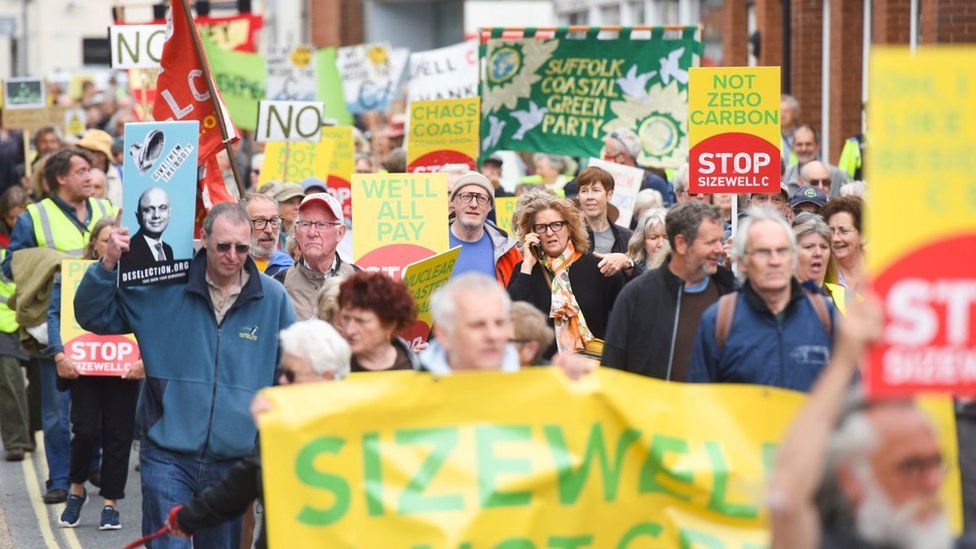
A government shake-up of planning which could bring forward the building of Sizewell C is “deeply dismaying”, campaigners said.
BBC News 24 Sept 22,
New legislation aims to cut planning rules and get rid of environmental assessments to speed up construction.
The nuclear power station in Suffolk is among projects to be “accelerated as fast as possible”, the Treasury said.
Stop Sizewell C said the plan “rode roughshod over the ability to fight damaging projects”.
The scheme, currently estimated to cost £20bn, was given government approval in July, against the advice of the Planning Inspectorate.
The new plant would be built by French-owned EDF next to the existing Sizewell B, which is still generating electricity, and Sizewell A, which has been decommissioned.
Fellow campaigners Together Against Sizewell C (TASC) has instigated a judicial review process over the planning approval, claiming it was illegal.
Chancellor of the Exchequer, Kwasi Kwarteng, who gave Sizewell the go-ahead when he was business secretary, made the latest announcement as part of his Autumn statement.
New legislation would be brought forward to “address barriers by reducing unnecessary burdens to speed-up the delivery of much-needed infrastructure”, the Treasury said………………………….. more https://www.bbc.com/news/uk-england-suffolk-6301233.
At U.N., Micronesia denounces Japan plan to release Fukushima water into Pacific
UNITED NATIONS, Sept 22 (Reuters) – The president of the Pacific island state of Micronesia denounced at the United Nations on Thursday Japan’s decision to discharge what he called nuclear-contaminated water from the Fukushima Daiichi Nuclear Power Station into the Pacific Ocean………………… (subscribers only) more https://www.reuters.com/world/asia-pacific/un-micronesia-denounces-japan-plan-release-fukushima-water-into-pacific-2022-09-22/
s
Permit problems for Sizewell C nuclear project? Cooling system could kill millions of fish.
Permit problems for Sizewell C predicted after report confirms cooling
mechanisms can kill millions of fish. The Sizewell C nuclear reactor may
face obstacles in receiving an environmental permit after a report revealed
that the cooling mechanism at a similar development could kill millions of
fish.
ENDS 12th Sept 2022
Environment Agency rejects EDF’s appeal against requirement to protect millions of fish from Hinkley C’s huge cooling system

A report threatens to undermine the government’s Sizewell C plan after it sided with opponents who claim a plughole to cool a similar nuclear reactor could kill millions of fish. Boris Johnson promised £700 million for the Sizewell C power station in Suffolk in a speech last week, saying he was “absolutely confident” the project would “get over the line”.
A day later an inspector threw out an appeal by EDF, the French energy company, against the installation of a fish deterrent device relating to Hinkley Point C in Somerset, which EDF is building. Environmentalists claim that without the device, millions of fish could be killed after being sucked into the large cooling system for the new reactor. EDF now has to install the technology or be at risk of paying compensation, which experts say could run into hundreds of millions of pounds.
Campaigners claim the saga is directly relevant to the proposed Sizewell C plant, which is also being developed by EDF and uses the same technology. The Blue Marine Foundation was one of six groups that opposed the plans from EDF. Priyal Bunwaree, the foundation’s lawyer, said: “EDF decided to build the largest engineering project in Europe in the middle of a marine protected area in the Severn estuary and then claimed it would have no adverse effect on the species within it. This was a colossal blunder and they were poorly advised. “The company must now find a technical solution to stop killing so many fish or pay compensation which we estimate could run into hundreds of millions.”
Bunwaree added that similar legal issues could be an obstacle to opening Sizewell C. “The sad
thing about Sizewell is that there has been no proper assessment of damage to the marine environment, so it is likely the same legal issue will arise there,” she said. The Hinkley C cooling system, described as a giant plughole under the sea, will suck in 130,000 litres of water per second. The twin inlet tunnels, stretching two miles out into the Severn estuary, are so big that a double-decker bus could drive through them.
Conservation groups say it will kill up to 250,000 fish a day and must be altered or scrapped. EDF appealed against the Environment Agency’s requirement that it fit an “acoustic fish deterrent” to the cooling system. It argued that it was dangerous for divers to install the fish deterrent device in
the fast waters of the Bristol Channel. An inquiry into the appeal was held last year. The inspector and George Eustice, the environment secretary who endorsed his conclusions, said that before the Hinkley plant can open EDF must fit the technology to it. Experts say it will stop the deaths of an estimated 182 million fish, which will be killed in the Bristol Channel every year for the 60 years the plant is in operation. The inspector’s report said the measures are required by law to protect cod, herring, bass and whiting and migratory species such as Atlantic salmon, allis shad and twaite shad. The report concluded that the magnitude of predicted fish deaths was more likely than EDF’s contention that there would be “no adverse effect” on species or the Bristol Channel. Some experts say the
Sizewell plant would kill 804 million fish a year.
Times 5th Sept 2022
WHAT HAPPENED AT CAMP LEJEUNE
I grew up drinking and bathing in the toxic waters around a military base in North Carolina. Thirty years later, I went back to investigate.
BY LORI LOU FRESHWATER, AUG 21, 2018
In the autumn of 1980, a contractor showed up to grade a parking lot. He had no idea he was about to start digging up the radioactive bodies of dead beagles. But the forked bucket on his bulldozer started pulling up more than soil, and it turned out he was digging in a pit of strontium-90 and dog carcasses that had been buried in an ash-gray tomb: a nest of dead dogs and laboratory waste labeled “Radioactive Poison.”
The new parking lot was on the site of the former Naval Research Laboratory dump and its associated incinerator in Camp Lejeune, North Carolina—and it was just one of many areas contaminated by an assortment of hazardous waste and chemicals on the base.
About half a mile away from the dump, soon to be known as Site 19, my friends and I were living in our neighborhood, called Paradise Point. We spent our time putting other girls’ bras into freezers at slumber parties, playing the Telephone Game, riding our bikes all over the place: to the golf course to steal a cart, to swim at the pool, to play soccer on Saturdays.
During the same autumn the dead beagles were found, I was sitting in front of a fake backdrop of rusty colored leaves, a slight 11-year-old girl with spaces between my teeth and freckles spritzed across my nose and cheeks, to take my school photo.
Under normal circumstances, this entirely unremarkable fifth-grade photo, in a plaid shirt and fragile gold necklace, would have likely ended up where most school photos do, in an old album or a drawer or simply lost to time. Instead, the photo would become a marker in the medical history of my family and my community, a reminder of the crime that was being committed on the day the photo was taken—and also for decades before, and for years after.
The place was Camp Lejeune, a United States Marine Corps base wrapped around the New River in Onslow County that served as an amphibious training base where Marines learned to be “the world’s best war fighters,” picking up skills that would allow them (for example) to make surprise landings on the shores of far away countries. From the 1950s until at least 1985, the drinking water was contaminated with toxic chemicals at levels 240 to 3400 times higher than what is permitted by safety standards.
There may never be a true accounting of the suffering caused at Lejeune. As with many other hometown environmental disasters, the Marines and family members poisoned on this military base were not born here, nor did they settle here to make a permanent life and raise their children. Instead, they were often here just for a short time, literally stationed at Lejeune for weeks, months, or, at most, a few years. From the 1950s through at least 1985, an undetermined number of of residents, including infants, children, and civilian workers and personnel, were exposed to trichloroethylene (TCE), tetrachloroethylene (PCE), vinyl chloride, and other contaminants in the drinking water at the Camp Lejeune. These exposures likely increased their risk of cancers, including renal cancer, multiple myeloma, leukemias, and more. It also likely increased their risk of adverse birth outcomes, along with other negative health effects. Now the sick and the dying are all over the world, and an untold number will never be notified about what happened. Instead, we are left to rely on scientific models and data trickling out of public-health agencies and the slow process of adding one story at a time, person-by-person, to the cold data representing an environmental and public-health disaster.
In 1989, the Environmental Protection Agency placed 236 square miles of North Carolina’s coastal soil and water on the list of toxic areas known as Superfund sites. The agency cited “contaminated groundwater, sediment, soil and surface water resulting from base operations and waste handling practices” as reasons for including it on the National Priorities List.
Camp Lejeune remains a sprawling Superfund site, and it is also the place where my mom and I spent years drinking a terrible mix of chemicals from our faucet. In the book A Trust Betrayed: The Untold Story of Camp Lejeune, author Mike Magner gives special attention to my mother’s story: “A woman with the ironic name of Mary Freshwater may have had the most ghastly experiences at Camp Lejeune.”
Of course, I share her ironic name, which can still seem like more of a curse. Nearly my entire childhood was consumed by tragedy. The chemical contamination can be linked to the deaths of my two baby brothers, Rusty and Charlie, and to my mom’s own difficult final years, when she was dying from two types of acute leukemia. My mother also suffered from mental illness, which was intensified—understandably—by our family’s brutal losses. Sometimes it seems that, behind me, there is nothing but inescapable grief. …………………..more https://psmag.com/.amp/environment/what-happened-at-camp-lejeune
As Japan builds nuclear dumping facilities, Pacific groups say ‘stop’
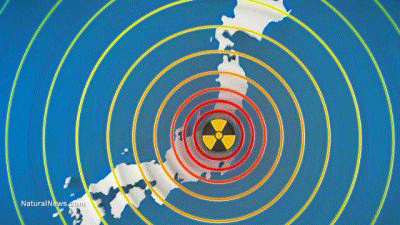
https://www.reuters.com/world/iran-seeks-stronger-us-guarantees-revival-2015-nuclear-deal-2022-08-31/ Pacific civil society groups are calling on Japan to halt its plans to dump radioactive nuclear wastewater into the Pacific Ocean.
Earlier this month the Japanese government started building facilities needed for the discharge of treated, but still radioactive, wastewater from the defunct Fukushima nuclear power plant.
In a joint statement, civil society groups, non-governmental organisations and activists described the Fumio Kishida Government’s plans as a fundamental breach of Pacific peoples’ right to a clean, healthy and sustainable environment.
Joey Tau from the pan-Pacific movement Youngsolwara Pacific said this breaches Pacific peoples’ rights to live in a clean environment.
Tau told Pacific Waves the Pacific Ocean is already endangered and Japan’s plan will have devastating impacts.
“We have a nuclear testing legacy in the Pacific. That continues to impact our people, our islands and our way of life, and it impacts the health of our people.
“Having this plan by Japan poses greater risks to the ocean which is already in a declining state.
“The health of our ocean has declined due to human endured stresses and having this could aggravate the current state of our region.
“And also, there are possible threats on the lives of our people as we clearly understand in this part of the world, the ocean is dear to us, it sustains us,” Tau said.
Tau said both the opposition in Vanuatu and the president of the Federated States of Micronesia have expressed serious concerns at Japan’s plans, and the Pacific Islands Secretariat this year has appointed an international expert panel to advise the Forum Secretary-General and national leaders.
The Northern Marianas’ House of Representatives has also condemned Japan’s plan to dump the nuclear waste.
Tau said the plans should not proceed without the Pacific people being able to voice their concerns and being better advised.
1 This Month
19 February – VIRTUAL EVENT-Decision Time: AI and Our Nuclear Arsenal
12:45 p.m. Central / 1:45 p.m. Eastern
To see nuclear-related stories in greater depth and intensity – go to https://nuclearinformation.wordpress.com
-
Archives
- February 2026 (141)
- January 2026 (308)
- December 2025 (358)
- November 2025 (359)
- October 2025 (376)
- September 2025 (258)
- August 2025 (319)
- July 2025 (230)
- June 2025 (348)
- May 2025 (261)
- April 2025 (305)
- March 2025 (319)
-
Categories
- 1
- 1 NUCLEAR ISSUES
- business and costs
- climate change
- culture and arts
- ENERGY
- environment
- health
- history
- indigenous issues
- Legal
- marketing of nuclear
- media
- opposition to nuclear
- PERSONAL STORIES
- politics
- politics international
- Religion and ethics
- safety
- secrets,lies and civil liberties
- spinbuster
- technology
- Uranium
- wastes
- weapons and war
- Women
- 2 WORLD
- ACTION
- AFRICA
- Atrocities
- AUSTRALIA
- Christina's notes
- Christina's themes
- culture and arts
- Events
- Fuk 2022
- Fuk 2023
- Fukushima 2017
- Fukushima 2018
- fukushima 2019
- Fukushima 2020
- Fukushima 2021
- general
- global warming
- Humour (God we need it)
- Nuclear
- RARE EARTHS
- Reference
- resources – print
- Resources -audiovicual
- Weekly Newsletter
- World
- World Nuclear
- YouTube
-
RSS
Entries RSS
Comments RSS
 nuclear-news