Pacific islanders are not convinced that the release of Fukushima wastewater is safe
“………………………………………..Selling the water release plan to the Pacific
Nuclear experts from South Korea, which has been hostile to the planned discharge, have this week been given an unprecedented six-day personalised tour of the Fukushima plant.
The prime minister of the Cook Islands and chair of the Pacific Islands Forum, Mark Brown, said there had been an increase in “more intense dialogue” with Japan, and he was presently happy with the level of transparency………………..
Dozens rally against water release
However, a series of public relations disasters by TEPCO have fuelled public distrust in the plan.
There have been numerous cases where TEPCO failed to reveal that tainted water had leaked into the sea.
Local media also exposed that most water storage tanks did contain water still contaminated with dangerous radioactive elements, such as the cancer-causing strontium-90, despite TECPO’s assurances this was not the case.
TEPCO now says about a third of the tanks are ready for release, and water not up to standards will be reprocessed until it is.
“They don’t provide true information,” said Gen Hirai, a protester who gathered outside the company’s headquarters in May.
“It’s a company that blocks information to citizens.”
What do surrounding countries think of the plan?
Earlier in May, the Solomon Islands reportedly rebuked an offer from Japan to step up maritime cooperation, citing the planned Fukushima discharge.
“Japan keeps emphasising the significance of maritime security, they still decided to dump the radioactive wastewater into the ocean,” the Solomon Star reported from a government source.
Whereas Papua New Guinea (PNG) is reportedly softening its stance to accept Japan’s position.
But PNG Prime Minister James Marape couldn’t be drawn on whether the country would support Japan’s plan, saying it was “another conversation.”………….. https://www.abc.net.au/news/2023-05-26/treated-fukushima-water-to-flow-into-pacific-oaten/102380592
Public health expert says Fukushima waste water release a retrograde step
ABCNewsAustralia 30 May 23 Operators of the Fukushima Daiichi Nuclear Power Plant, which was destroyed by a massive tsunami followed by nuclear meltdowns in March 2011, are set to release treated wastewater into the ocean in coming months.
Public health expert Tilman Ruff says the danger with dumping the contaminated water is that it could settle on the sea floor or concentrate up the food chain.
South Korean experts to continue analysis of Fukushima water discharge
Japan Times 26 May 23
A South Korean delegation of experts will continue, from home, with its analysis of Japan’s plan to discharge treated radioactive water into the sea from the disaster-hit Fukushima nuclear power plant, the group said Thursday after inspecting it.
The delegation of 21 experts from agencies and affiliated organizations of the South Korean government with expertise in radiation and nuclear reactors, among other fields, held a meeting with Japanese officials to summarize their observations following the two-day inspection, telling the Japanese side they still needed to confirm several things before releasing their conclusion on the plan’s safety.
They requested additional materials, such as protocols for a power outage and a long-term management plan for an advanced liquid processing system (ALPS) capable of removing radionuclides other than tritium in water……….. (Subscribers only) more https://www.japantimes.co.jp/news/2023/05/26/national/south-korea-fukushima-analysis/
Nuclear & Toxic Chemicals
The nuclear industry faces a significant challenge with the proposed ban on
per- and polyfluoroalkyl substances (PFAS). PFAS are a large class of
thousands of synthetic chemicals that are used throughout society. They are
commonly used in textiles, sealants, gaskets, lubricants, and many other
applications.
Their persistence in the environment and potential adverse
health effects have raised concerns. On 13 January 2023, a dossier was
submitted to the European Chemicals Agency (ECHA) by Denmark, Germany, the
Netherlands, Norway, and Sweden, aiming to reduce PFAS emissions into the
environment. Authorities estimate that without action, approximately 4.4
million tonnes of PFAS could enter the environment over the next three
decades.
With the potential restrictions proposed encompassing a wide range
of PFAS compounds, the nuclear sector must identify their uses and
collaborate to address this critical matter.
Nuclear Europe 25th May 2023
1
South Korean nuclear experts to tour Fukushima plant amid water concerns
Japan Times, BY ERIC JOHNSTON. STAFF WRITER. May 22, 2023
A team of South Korean experts arrived in Japan on Sunday for an unprecedented six-day visit that will include a trip on Tuesday to the crippled Fukushima No. 1 nuclear power plant, where the government is planning to release treated water into the ocean as part of a decadeslong decommissioning process.
Concerned about the aftereffects of the March 2011 nuclear disaster, South Korea continues to uphold a ban on seafood and marine imports from the area around the Fukushima No. 1 plant, despite Japanese government insistence the food is safe.
Nuclear Safety and Security Commission Chairperson Yoo Guk-hee is heading a 21-member team of government experts, who on Monday met with nuclear officials from plant operator Tokyo Electric Power Company Holdings (Tepco) and various government agencies that oversee Japan’s nuclear power industry. They will tour the plant on Tuesday and Wednesday, paying particular attention to Japan’s plans to discharge treated water, currently being stored at Fukushima No. 1, into the ocean……………. https://www.japantimes.co.jp/news/2023/05/22/national/south-korean-experts-fukushima-tour/
Ocean release of Fukushima nuclear wastewater endangers Pacific Islanders’ welfare
CGTN News 21 May 23,
As Japan continues to carry out its intentions to dump more than one million metric tonnes of diluted nuclear wastewater into the Pacific Ocean, Pacific Islanders’ safety and subsistence living are in jeopardy…………………………………………
“Our Pacific people did not have the opportunity to ask decades ago when our region and our ocean was identified as a nuclear test field,” Henry Puna, secretary general of the inter-governmental organization Pacific Islands Forum said, urging Japan to hold off on any such release until the people of the Pacific Island countries are certain about the implications of such discharge on the environment and on human health………………………………………
Meanwhile, a recent poll shows that more than 90 percent of Japanese believe that the discharge of nuclear wastewater into the sea will bring “negative word-of-mouth” to Japan’s fishing industry and aquatic products, and over 60 percent think that the Japanese government and TEPCO have not given enough explanation.
As said by Puna, the decision for any ocean release is not and should not only be a domestic matter for Japan but a global and transnational issue that should give rise to the need to examine the issue in the context of obligations under international law.
Japan does not own the Pacific Ocean either. If Tokyo persists in its risky, poisonous nuclear wastewater discharge plan, it will leave another indelible mark of sin on its history as a result of its irresponsible behavior. https://news.cgtn.com/news/2023-05-21/Fukushima-nuclear-wastewater-dump-endangers-Pacific-Islanders-welfare-1jYQQWdReIU/index.html
Nuclear Free Local Authorities condemn UK Environment Agency’s failure to protect fish in Hinkley Point C’s nuclear project
NFLAs condemn ‘craven climbdown’ by Environment Agency over Acoustic
Fish Deterrent. In response to an ongoing consultation, the UK / Ireland
Nuclear Free Local Authorities has condemned the Environment Agency for
cravenly climbing down when faced with EDF Energy’s demand that it be
excused from providing an Acoustic Fish Deterrent at the new Hinkley Point
C nuclear power project, and has urged them not to waive this requirement.
The Environment Agency’s latest recommendation represents a complete
volte-face on its previous position on the permit requirements, which was
taken after an in-depth examination by an inspection team and by
verification by the Secretary of State. NFLA England Forum Chair,
Councillor David Blackburn said: “The consequences of the Environment
Agency granting this concession will be catastrophic for the local fish
population and marine environment.
NFLA 18th May 2023
Fukushima fishermen speak out against nuclear-contaminated wastewater dumping plan
Global Times, Xu Keyue and Xing Xiaojing in Iwaki May 17, 2023
Located at the confluence of cold and warm currents, the coastal area of Fukushima Prefecture, Japan, has a rich variety of sea life and a long history of local fishing.
In the 12 years since the accident at the Fukushima Daiichi Nuclear Power Plant, the fishing industry in the area has started to recover thanks to the efforts of local fishermen and other groups.
However, the Japanese government and the Tokyo Electric Power Company (TEPCO) have gone back on their promises and arbitrarily decided to release nuclear-contaminated wastewater into the sea, in a big blow to the Fukushima fishing industry and the prefecture’s revitalization.
As the scheduled plan to dump the nuclear-contaminated wastewater from Daiichi plant approaches, Global Times reporters went to Fukushima. In this second installment of this field investigation, the Global Times reveals the helpless fishermen who are speaking out.
Silenced Fukushima fishermen
Fishermen in Fukushima were banned from fishing after the March 11 earthquake and tsunami in 2011, which caused leaks at the Fukushima Daiichi Nuclear Power Plant. In 2015, the Japanese government, TEPCO, the Fukushima Prefectural Federation of Fisheries Cooperative Associations, and the National Federation of Fisheries Cooperative Associations of Japan signed an agreement, stating nothing would be done “about the nuclear-contaminated water from Fukushima without the understanding and consent of the relevant people.” However, in April 2021, the Japanese government blatantly broke its promise and announced that it had decided to dump the nuclear-contaminated wastewater from the Daiichi plant into the sea in two years, which has sparked strong dissatisfaction from fishery associations and the wider public.
As the most direct stakeholders, the voices of Fukushima fishermen are indispensable in the opposition to the disposal of nuclear-contaminated wastewater. However, when contacting them before the trip to Fukushima, Global Times reporters were surprised to find that the local fishermen were not allowed to speak.
Global Times reporters contacted industry groups such as the Fukushima Prefectural Federation of Fisheries Cooperative Associations and Fukushima Prefecture’s Soma Futaba Fisheries Cooperative Association for help in reaching fishermen in their areas, but were told that “individual fishermen are not allowed to give interviews.” Toshimitsu Konno, president of the Soma Futaba Fisheries Cooperative Association, told the Global Times that fishermen have different views and need to unify their opinions to form a single position on behalf of the association before negotiating with the Japanese government and TEPCO.
The voices of fishermen are at the heart of a series of field investigations into the issue of nuclear-contaminated wastewater at Fukushima. Global Times reporters tried other ways to contact the fishermen for interviews, but were either rejected or ignored.
It is understood that Japan’s trade associations are highly hierarchical and an extremely closed society. If members are excluded for offending the trade associations, it is equivalent to losing their jobs. When asked for an interview, one fisherman said, “we have to fish here for generations.”
The voices of fishermen are at the heart of a series of field investigations into the issue of nuclear-contaminated wastewater at Fukushima. Global Times reporters tried other ways to contact the fishermen for interviews, but were either rejected or ignored.
It is understood that Japan’s trade associations are highly hierarchical and an extremely closed society. If members are excluded for offending the trade associations, it is equivalent to losing their jobs. When asked for an interview, one fisherman said, “we have to fish here for generations.”
However, Haruo Ono, a fisherman from the town of Shinchi in Fukushima, said he was willing to be interviewed. He had something to say about the dumping of nuclear-contaminated wastewater.
The town is the northernmost part of Fukushima’s coastline, where rivers run eastward into the Pacific Ocean. Since Iwaki city where the Global Times reporters stayed is in the southernmost part of Fukushima Prefecture, to interview Ono, they set out early and drove north through towns of Hirono, Tomioka, Futaba and Namie, near the Daiichi and Daini nuclear power plants, and through Minamisoma and Soma cities, for more than 100 kilometers before arriving at Shinchi……………..
After the accident, fishermen were unable to fish normally for a long time and have not fully recovered until now. For years, Ono has been pressing for answers from the Japanese government and TEPCO…………………………………
the 71-year-old walked briskly, holding forth without waiting for a reporter’s question.
“When will Fumio Kishida, the Japanese prime minister, come and listen to our voices? When can he come to know the real situation in Fukushima?” asked Ono, speaking quickly in the Fukushima dialect.
“Does the government think that by issuing leaflets telling people that the nuclear-contaminated wastewater is OK, it can be released into the sea? Is that really safe? The sea is not a dustbin! In Japan, where people are fined for throwing rubbish into the sea, how can the wastewater containing radioactive materials be discharged into the sea? It is really strange that the Japanese government and TEPCO chose the easiest and cheapest way to throw out the wastewater when there were other options,” Ono said with a puzzled face………………………………………………………………………………………………….
Global Times reporters also visited seafood shelves in local supermarkets and found many imported products from areas such as the US, Chile and Russia, but those from Fukushima were nowhere to be found……………………………………………………….
“There is no change in the Fukushima fisheries association’s clear stance against the discharge plan,” Sawada said, stressing that he will continue to express his opposition to the plan to the Japanese government and TEPCO in collaboration with the national fishery association and other organizations.
………………………… World’s responsibility to protect the sea
Why would the association prohibit individual fishermen from speaking out when it also opposes the dumping plan? What is the “unified position” of the association, and how did the negotiations with the Japanese government go?……………………………………..more https://www.globaltimes.cn/page/202305/1290843.shtml
Fukushima greets summer with dread as nuclear-contaminated wastewater dumping approaches
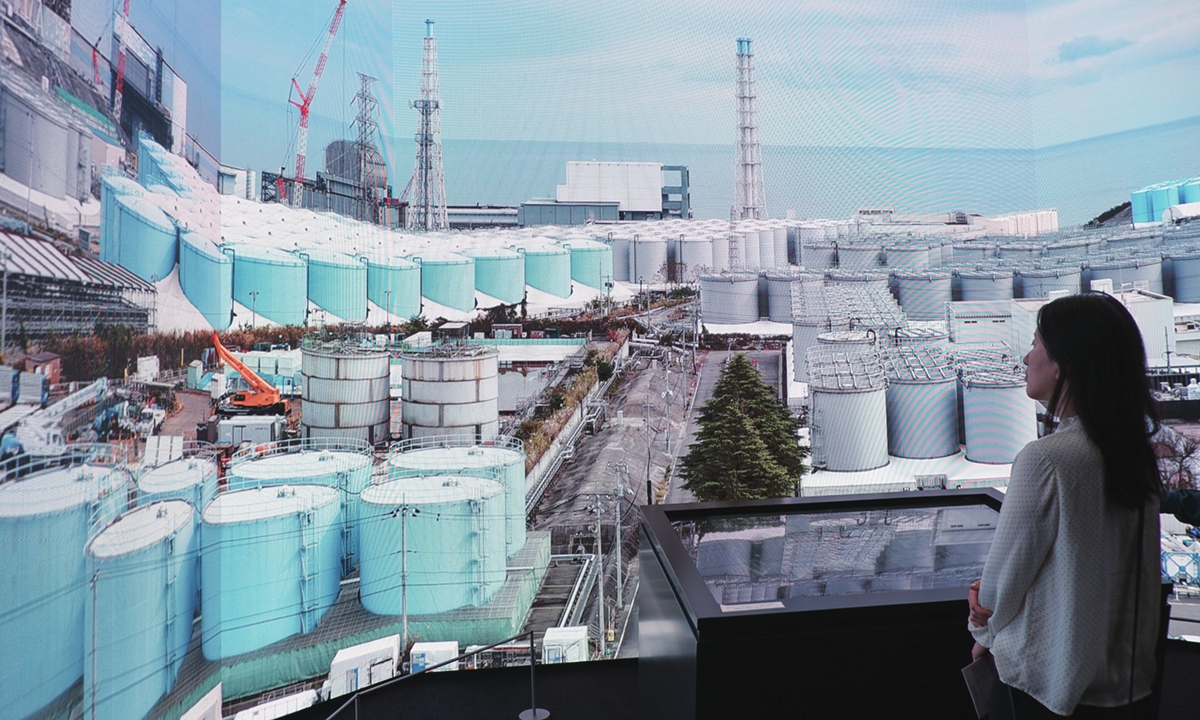
Global Times, By Xu Keyue and Xing Xiaojing in Iwaki, May 15, 2023
The Fukushima Prefecture in northeastern Japan is known as “the island of happiness,” which embodies people’s longing for a better life. Summer began in Fukushima in early May when locals normally look forward to intimate contact with the sea.
However, despite strong opposition at home and abroad, the Japanese government and the Tokyo Electric Power Company (TEPCO) are set to go ahead with the plan to dump the nuclear-contaminated wastewater from the Fukushima Daiichi Nuclear Power Plant into the sea this summer.
As summer approaches, the Global Times reporters went to the Fukushima Prefecture. In this first installment of this field investigation, the Global Times reveals the palpable sense of fear and unease hanging over Fukushima, paired with intense opposition from locals who chanted “Never allow arbitrary dumping into the sea!”………………………………………………………………………………………………………
About 54 kilometers away from the Fukushima Daiichi Nuclear Power Plant, the city looks subdued with few passersby along the streets. The excavation of an underwater tunnel for the project to drain the nuclear-contaminated wastewater from the Fukushima Daiichi Nuclear Power Plant was completed in April, and TEPCO announced that it is expected to complete the construction of the tunnel by the end of June. Measuring 1,031 meters long and 1 kilometer away from the coast, the tunnel will allow radioactive wastewater to be dumped into the sea.
…………………………………………………….. Chiyo Oda, co-chairperson of an environmental NGO and city assembly “Stop polluting the oceans!” was one of them.
“Summer is coming. What’s going to happen? Fukushima greets summer with fear!” said Oda, who expressed strong concern about the dumping of nuclear-contaminated wastewater at a conference themed “Don’t Nuke the Pacific” on May 7. “The Japanese government has reached an agreement with the fishing community that nothing will be done without [the fishing community and other stakeholders’] understanding.” Nevertheless, the Japanese government is apparently breaking its promise and is preparing to dump the water which is likely to start this summer.
When the Global Times reporters met Oda, the 68-year-old woman had just returned to Iwaki from Fukushima city, the capital of Fukushima Prefecture. Early that day, with Kazuyoshi Sato, another co-representative of the city assembly, Oda had driven for two hours to the Fukushima prefectural office to hold a press conference to announce that a mass rally called “May 16 Tokyo Action” will be held in Tokyo on May 16 to urge the Japanese government and TEPCO to stop dumping the nuclear-contaminated wastewater.
Oda told the Global Times that the campaign will last all day on May 16, when anti-sea pollution campaigners from all over Japan are meant to gather in Tokyo. As planned, they will gather in front of the TEPCO headquarters at 10:30 am, and then head to the House of Representatives with lawmakers to hold the rally. The rally and petition to the Japanese government and parliament will be followed by a speech at the Hibiya Open Air Concert Hall in the evening. It will then be followed by a massive demonstration in Ginza, Tokyo, which is expected to be attended by more than 1,000 people.
“The sea of my hometown, the Sea of Japan, and the seas of the world must not be polluted,” said Oda.
Oda noted that the Japanese government, TEPCO, the Fukushima Prefectural Federation of Fisheries Cooperative Associations, and the National Federation of Fisheries Cooperative Associations of Japan signed an agreement in 2015, stating it would not “do anything about the nuclear-contaminated water from Fukushima without the understanding and consent of the relevant people,” but now the Japanese government and TEPCO insist on dumping the water despite opposition from all parties, including fishermen. …………………………………………………………………………………………………………………………………………………………………..
“Look! This is the sea we want to protect!” Ikarashi told the Global Times that he and his family have fond memories of living by the sea, eating the catch from the same sea, surfing, and frolicking with their children. The people of Fukushima live just like them, having enjoyed the bounty of the sea for generations. If the nuclear-contaminated wastewater is dumped into the sea, future generations will no longer be able to enjoy the beautiful nature.
Ruiko Muto, who lives in Tamura, Fukushima, is the head of the association for the victims of the Fukushima nuclear accident. After the accident, she worked hard to hold the former management of TEPCO accountable as a member of the legal team for the Fukushima nuclear accident and the criminal prosecution team.
Muto told the Global Times in an email that “ALPS-treated water” used by the Japanese government and TEPCO contains many other radioactive substances besides tritium, making it “not safe at all.” Under such circumstances, attempts to release the radioactive wastewater from Fukushima into the sea must not be allowed.
Muto said that as summer approaches, her group will join forces with other civic groups and continue to express opposition through protests and rallies.
Dumping not only way
In an on-the-spot interview, Global Times reporters noted the intense concern over whether “ALPS-treated water,” as the Japanese government and TEPCO refer to it, is safe, and whether there is an alternative to dealing with the wastewater.
Hideyuki Ban, a Japanese nuclear expert and co-director of the Tokyo-based Citizens’ Nuclear Information Center (CNIC), told the Global Times that “the nuclear-contaminated wastewater contains 64 radionuclides, including tritium, some of which are very long-lived and cannot necessarily be diluted. [The compounds] can accumulate in the ocean and attach to fish and shellfish, and some of them can enter the body of marine organisms, causing human beings to be exposed to nuclear radiation after consumption. Even if [the wastewater] is treated and released into the sea, it is not safe.”
“There is no precedent in the world for dumping such wastewater containing 64 radionuclides into the sea,” he said.
“The capacity of ALPS to remove radionuclides and the amount of the nuclear-contaminated wastewater to be discharged are not fully understood, let alone gaining the understanding and consent of stakeholders. Under such circumstances, it is not allowed to arbitrarily discharge the wastewater,” he said.
Ban noted that there are other ways to dispose of the wastewater. For example, there is the option of “mortar solidification,” where the nuclear-contaminated wastewater is mixed, solidified, and stored in mortar as in cement production. What the Japanese government has done is based on a political decision, not one based on scientific research, Ban criticized……………………………………………………………………….
The problem, however, is that even if the nuclear-contaminated wastewater is disposed of, key issues such as whether nuclear fuel debris can be removed from the Daiichi plant remain unresolved. The government plans to decommission the reactor in the next 30 to 40 years, but it has yet to give a clear explanation of how long it will take to complete the project and in what condition the facility will have to be in order to qualify as successfully decommissioned, according to Muto.
Surrounded by the sea, Japan gives thanks to the gracious sea as a prosperous maritime nation, on “Sea Day” held annually on the third Monday of July, which is one of the statutory holidays in the country.. Born by the sea, the locals reached by the Global Times could not help but express their deep concern and fear that if the sea is polluted, it will be difficult to enjoy the sea’s succor in the future. https://www.globaltimes.cn/page/202305/1290745.shtml
 |
What to Know About Fukushima’s Exclusion Zone and Nuclear Mutations
The Fukushima exclusion zone is the result of a nuclear disaster in 2011. Keep reading to learn more about nuclear mutations and the earthquake that started it all.
BY RAYNA SKIVER. MAY 8 2023, https://www.greenmatters.com/clean-energy/fukushima-exclusion-zone
Back in 2011, a coastal city in Japan was hit by a powerful earthquake and tsunami. When this disaster struck Fukushima, reactors at a nuclear power plant overheated melted, causing radioactive materials to be released into the environment.
Soon after the catastrophe, the Fukushima exclusion zone was created.
After the disaster, the area surrounding the power plant was closed off due to the dangers of radiation— this site is called an exclusion zone. Today, a few places are still closed even after all of these years.
Some people might think that Fukushima is completely unsafe to visit, but that’s actually not the case. In fact, it’s possible to tour the area and learn more about the disaster. Real Fukushima is one of the many organizations that are working to change the public’s perception — they want people to see the city as hopeful, not dark.
The Fukushima disaster resulted in nuclear mutations.
Another result of the 2011 catastrophe was nuclear mutations. According to NBC News, researchers found mutations in butterflies near the Daiichi power plant. This observation was a sign of potential changes to the local ecosystem.
Nearby forests were also affected by the nuclear disaster. Studies showed that leaves had high concentrations of radiation and that there were “growth mutations of fir trees,” according to Greenpeace. The organization voiced concern about the potential consequences that the disaster might have on plants and animals.
The Fukushima nuclear disaster had terrible consequences for the surrounding communities and the environment. According to BBC, the earthquake and the tsunami that followed killed over 18,000 people, with many still missing. Over 150,000 had to evacuate the area as well, due to radiation leaks.
After the event, many countries began correcting design flaws — such as having the generators in the basement — and conducting stress tests in order to minimize future risks. On the other hand, Japan decided to phase out nuclear energy altogether.
The country’s citizens were uncomfortable with their dependence on atomic energy after the disaster, understandably so. Most nuclear power plants in Japan have been idle since 2011. Before the incident, nuclear energy accounted for about a third of the country’s power, but in 2020, the number significantly decreased to less than 5 percent, according to The Guardian.
But now, the country is reconsidering its reliance on nuclear power. Japan is looking for a secure energy supply — the war in Ukraine and rising energy costs have made the feat difficult. Not only might this be an unpopular move with the country’s citizens, but it’s also a loss for the environment.
Nuclear energy produces radioactive waste. This waste can end up harming both humans and the environment, according to the Energy Information Association. Nuclear power plants are also water hungry — they require a lot of water for cooling, Greenpeace explained.
With all of the risks involved, it might be best to turn away from nuclear energy and toward renewable energy.
Why did Russians dig trenches in radioactive Chernobyl woods?

Even Ukrainians who stayed after the nuclear disaster tried to warn their
enemies. On February 24, 2022, the first day of the invasion of Ukraine,
the Russians crossed into the area from Belarus. They stayed for five
weeks, camping out for part of that time in some of the most contaminated
land around the site of the worst nuclear accident in history.
They dug defensive positions in the Red Forest, within a six-mile radius of reactor
No 4, where they lived, ate and slept for a fortnight. Nobody can
understand why.
“Don’t try to find logic,” said Oksana Pyshna, 30, a
tour guide turned employee of the state ministry responsible for the
exclusion zone, who showed us around. “It’s stupid.” The place is
called the Red Forest because that’s the colour the trees went after the
disaster as the cloud of poison spread through Ukraine, Belarus, Russia, on
to the Baltics and Scandinavia.
In 1986 and the years after, teams of men
dug up the topsoil and buried it: under the surface it is far more
poisonous. Carving trenches there was a terrible idea, said Pyshna.
“It’s the most dangerous territory in the special zone, because under
the ground we have nuclear waste.”
Perhaps the Russians felt safer there
because they knew the Ukrainians wouldn’t shell the area around the
nuclear plant. Perhaps the beauty of the woods blinded them to the danger.
Catfish throng the reactor’s cooling channel, deer shy through the silver
birches when visitors pass. There are, apparently, bears in the forests;
wolves too, wild ponies. In the autumn, the trees hang heavy with the most
perfect apples, green and pink.
But their pips can hold radioactive
isotopes: caesium-137 or strontium-90. Some Russian soldiers stationed in
the forest got radiation sickness, diplomats have confirmed. Kicking up the
dust or walking on the moss can contaminate you. Digging is much worse. The
few dozen locals – average age, 86 – who remained here after the
disaster have become unspeakably blasé about the risks of nuclear
radiation. Even they were shocked.
Times 29th April 2023
https://www.thetimes.co.uk/article/ukraine-chernobyl-nuclear-putin-russia-invasion-rgjzskfvq
Hinkley fish deterrent farce makes mockery of Environment Agency and Minister

In a humiliating climbdown, the Environment Agency now recommend that EDF Energy be excused from installing an acoustic fish deterrent at Hinkley Point C nuclear power plant, and they have had the cheek to ask for the public’s endorsement of the Agency’s inexplicable volte face in a further consultation.
The UK/Ireland Nuclear Free Local Authorities for one will not be giving it.
NFLA England Forum Chair Councillor David Blackburn said: “After a late hour supper of humble lamprey pie, senior executives at the Environment Agency appear to have shown themselves to have less spine than jellyfish. The requirement to install a deterrent was first made after representations from the public and campaign groups, including the NFLA; a detailed analysis of the impact of the plant on fish stocks and pain-staking deliberations; and the personal intercession of the Secretary of State George Eustice to ensure that it became part of the permitting conditions.
“This new recommendation makes a mockery of the Environment Agency inspection team and the Secretary of State who previously had the courage to stand up to nuclear interests. It also represents a massive slap in the face with a wet kipper for public consultation, because what is the point responding again and again to consultations and presenting to inquiries demonstrating conclusively the validity of your case when senior civil servants simply cave into any clamour from EDF Energy?”
Nonetheless, the NFLA, in a last-ditch effort, will be joining local campaigners by responding robustly to oppose this proposal – for the sake of the fish.
Councillor Blackburn added: “It looks like someone at EDF Energy is following the adage of Robert the Bruce ‘to try, try, try again’ as clearly the company remains determined to pressurise the Environment Agency to recuse it from installing an acoustic fish deterrent at Hinkley Point C to save time and money, for this is a project well behind schedule and massively over budget. French shareholders will be happy, but the fish will not.
“The Severn Estuary is one of the most important fish habitats in the UK, and the fear is that millions of fish will die every day once this plant finally becomes operational as they are sucked to their deaths along with the cooling water.
“We would urge members of the public, elected members and local groups opposed to this plan to respond to the Environment Agency consultation before 25 May 2023. This is your last chance to save the fish!”
Details of the latest Environment Agency consultation can be found at:
https://www.gov.uk/government/consultations/hinkley-point-c-water-discharge-activity-permit-variation
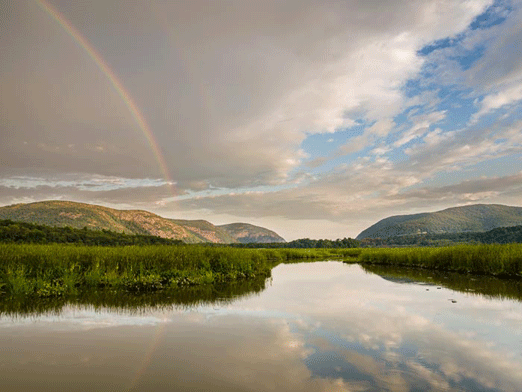
Plans to release nuclear wastewater into Hudson River delayed following outcry
Spectrum News, By John Camera Hudson Valley, Apr. 28, 2023
Manna Jo Greene, an Ulster County legislator and environmental director for Hudson River Sloop Clearwater, does not want to see the proposed release of nuclear wastewater from Indian Point into the Hudson River to go forward.
She says standards that deem the proposed discharge safe are outdated.
“And we’re also looking into whether or not this could impact communities that take their drinking water from the Hudson,” Greene said.
……………………………… For now, the release of about 300,000 gallons of nuclear wastewater has been slated for September, giving more time to determine the best path forward.
The next meeting from the Indian Point Decommissioning Oversight Board will take place June 15. https://spectrumlocalnews.com/nys/hudson-valley/news/2023/04/28/release-of-nuclear-wastewater-into-hudson-pushed-to-fall
Remembering Chornobyl — Beyond Nuclear
In 2018, host Libbe HaLevy recorded a special edition of Nuclear Hotseat, focused on the aftermath of the April 26, 1986 Chornobyl nuclear disaster. This week, the episode is being replayed. Sadly, none of this information goes out of date. The program featured: Bonnie Kouneva, a 15-year-old living in Communist Bulgaria when the Chornobyl disaster began,…
Remembering Chornobyl — Beyond Nuclear
In 2018, host Libbe HaLevy recorded a special edition of Nuclear Hotseat, focused on the aftermath of the April 26, 1986 Chornobyl nuclear disaster. This week, the episode is being replayed. Sadly, none of this information goes out of date. The program featured:
- Bonnie Kouneva, a 15-year-old living in Communist Bulgaria when the Chornobyl disaster began, but no one knew about it because the Soviet Union said nothing to its people. On May 1, May Day, only five days after it began, Bulgarian citizens were “encouraged” by the Soviet hierarchy to attend all-day celebrations of the communist state – outdoors, in the rain – at the exact time the worst of Chornobyl’s radiation was directly overhead. Here, she paints the picture of the impact of that radiation rainout and lets us know the result of this devastating experience on her life.
- Dr. Timothy Mousseau, an evolutionary biologist and faculty member of the Department of Biological Sciences at the University of South Carolina. Since 1999, Professor Mousseau and his collaborators have explored the ecological, genetic and evolutionary consequences of low-dose radiation in populations of plants, animals and people inhabiting the Chornobyl region of Ukraine and Belarus.
- The late Dr. Janette Sherman edited the the English translation of the groundbreaking work, Chernobyl: Consequences of the Catastrophe for People and the Environment by Alexei Yablokov, Vassily B. Nesterenko, and Alexey V. Nesterenko. Dr. Sherman and I spoke about this book for NH #97 on April 23, 2013. She passed away on November 20, 2019.
- Dr. Alexei Yablokov was environmental advisor to Russian President Boris Yeltsin and the Gorbachev administration, as well as a co-founder of Greenpeace, Russia. His book, Chernobyl: Consequences of the Catastrophe for People and the Environment, compiled and translated into English more than 5,000 separate scientific reports on Chornobylthat completely contradict the World Health Organization’s report, which undermined the seriousness of the accident. Dr. Yablakov died in January, 2017.
Click on the title to receive a free pdf of the entire book.
Marine deaths prompt calls for investigation and halt into any new nuclear dump tests.

Marine Deaths of harbour porpoise, dolphin, pilot whale, seals
and other protected species following last August’s seismic blasting
looking at the geology of the Irish Sea for a deep sub-sea nuclear dump
have prompted calls for a halt and an investigation.
A legal challenge has been threatened by campaigners against further seismic blasting in the search areas which include the Irish Sea and Allerdale’s Solway Firth area.
The Copeland seismic blasting went ahead for 20 days from the 1st August
2022 despite a petiton of over 50,000 signatures. The testing of the
Copeland Irish Sea area centred off Sellafield was contracted by Nuclear
Waste Services in their quest to find a place to dispose of high level
nuclear wastes in a Geological Disposal Facility.
Environmental Lawyers
Leigh Day acting for Lakes Against Nuclear Dump, a Radiation Free Lakeland
campaign have now written to the Environment Secretary Thérèse Coffey and
to the Marine Management Organisation. The letter includes an Appendix of
“Events” beginning with strandings of protected species including dead
seals and harbour porpoise at Drigg on the 8th August and includes deaths
of dolphin, pilot whale and jellyfish (food for protected turtle species).
Radiation Free Lakeland 25th April 2023
1 This Month



Shut down the radiation-damaged Heysham nuclear reactors now
To see nuclear-related stories in greater depth and intensity – go to https://nuclearinformation.wordpress.com

Say No to NASA’s Reckless Nuclear Reactor on the Moon
Say No to NASA’s Reckless Nuclear Reactor on the Moon
-
Archives
- October 2026 (256)
- September 2026 (339)
- August 2026 (330)
- July 2026 (355)
- June 2026 (287)
- May 2026 (306)
- April 2026 (356)
- March 2026 (251)
- February 2026 (267)
- January 2026 (308)
- December 2025 (358)
- November 2025 (359)
-
Categories
- 1
- 1 NUCLEAR ISSUES
- business and costs
- climate change
- culture and arts
- ENERGY
- environment
- health
- history
- indigenous issues
- Legal
- marketing of nuclear
- media
- opposition to nuclear
- PERSONAL STORIES
- politics
- politics international
- Religion and ethics
- safety
- secrets,lies and civil liberties
- spinbuster
- technology
- Uranium
- wastes
- weapons and war
- Women
- 2 WORLD
- ACTION
- AFRICA
- Atrocities
- AUSTRALIA
- Christina's notes
- Christina's themes
- culture and arts
- Events
- Fuk 2022
- Fuk 2023
- Fukushima 2017
- Fukushima 2018
- fukushima 2019
- Fukushima 2020
- Fukushima 2021
- general
- global warming
- Humour (God we need it)
- Nuclear
- RARE EARTHS
- Reference
- resources – print
- Resources -audiovicual
- Weekly Newsletter
- World
- World Nuclear
- YouTube
-
RSS
Entries RSS
Comments RSS

