SpaceX’s Starlink satellites are leaking electromagnetic radiation that’s ‘photobombing’ our attempts to study the cosmos
Live Science , By Harry Baker 2 Jul 23
New research finds that SpaceX’s Starlink satellites are leaking radiation that could interfere with radio astronomy.
But in the new study, published July 3 in the journal Astronomy & Astrophysics, researchers have shown that Starlink satellites also emit unintended and previously unrecognized radio signals that are separate from the signals they send to and receive from our planet. Some of these signals overlap with those detected by the dishes of radio telescopes — which represents a new problem in this scientific field………………………………………………
SpaceX likely isn’t the only culprit; the researchers expect to detect similar emissions from many other satellites in low Earth orbit (LEO). The problem also could worsen as the number of private satellites in LEO continues to increase dramatically. For example, there were only 2,000 Starlink satellites in LEO when the data was collected, but there are now more than 4,000.
“Our simulations show that the larger the constellation, the more important this effect becomes as the radiation from all satellites adds up,” study co-author Gyula Józsa, an astronomer at the Max Planck Institute for Radio Astronomy in Germany, said in the statement. “This makes us not only worried about the existing constellations, but even more about the planned ones.”…………………
Emitting radio signals is not the only way that satellites can interfere with astronomy. The shiny spacecraft can also reflect light back toward the planet’s surface, which can leave white streaks across time-lapse images. In December 2022, the International Astronomical Union warned that the world’s largest communication satellite, known as BlueWalker 3, is creating interference that could “severely hamper progress in our understanding of the cosmos.” https://www.livescience.com/space/space-exploration/spacexs-starlink-satellites-are-leaking-radiation-thats-photobombing-our-attempts-to-study-the-cosmos
How much water do French nuclear plants use?

Figures showing that the cooling of reactors could capture 30% of water resources have been removed from the site of the Ministry of Environment.
Le Monde ,By Perrine Mouterde, March 26, 2023,
How much do nuclear power plants contribute to total water consumption in France? This simple question no longer seems to have a clear answer. At the root of the confusion lies the Ministry of Environmental Transition’s removal of a background paper on the resourcing and use of water in France on around March 10. According to this fact sheet from the statistical service, power plant cooling represented the second most water-consuming activity in the country (31%), behind agriculture (45%) and ahead of drinking water (21%) and industrial use (4%). The annual volume of water consumed in mainland France, over the period 2008-2018, was estimated at 5.3 billion cubic meters.
In the midst of the review of the parliamentary bill to accelerate the construction of new reactors, the figure of 31% was being used by opponents of atomic energy to demonstrate that this energy source was not adapted to climate change. “Once and for all, let’s say it, simply and firmly: at this rate, there will soon not be enough water in our rivers to cool the nuclear power plants!,” stated Marine Tondelier – the national secretary of Europe Ecologie-Les Verts (EELV, Greens) – on March 7, based on this data.
Three days later, the Ministry of Environmental Transition………….(subscribers only)
Nuclear bomb plutonium fallout marks dawn of new epoch in which humanity dominates planet

The AWG has chosen the plutonium isotopes from H-bomb tests as the key marker for the Anthropocene,
Canadian lake chosen to represent start of Anthropocene, Damian Carrington Environment editor, @dpcarringtonWed 12 Jul 2023 https://www.theguardian.com/environment/2023/jul/11/nuclear-bomb-fallout-site-chosen-to-define-start-of-anthropocene
The site to represent the start of the Anthropocene epoch on Earth has been selected by scientists. It will mark the end of 11,700 years of a stable global environment in which the whole of human civilisation developed and the start of a new age, dominated by human activities.
The site is a sinkhole lake in Canada. It hosts annual sediments showing clear spikes due to the colossal impact of humanity on the planet from 1950 onwards, from plutonium from hydrogen bomb tests to the particles from fossil fuel burning that have showered the globe.
If the site is approved by the scientists who oversee the geological timescale, the official declaration of the Anthropocene as a new geological epoch will come in August 2024.
Experts said the decision has social and political importance, as well as great scientific value, as it would testify to the “scale and severity of the planetary transformation processes unleashed by industrialised humanity”.
The climate crisis is the most prominent impact of the Anthropocene, but huge losses of wildlife, the spread of invasive species, and the widespread pollution of the planet with plastics and nitrates are also key features.
The Anthropocene Working Group was set up in 2009 and in 2016 concluded that the human-caused changes to Earth were so great that a new geological time unit was justified. The AWG then assessed in detail a dozen sites across the world as candidates for what geologists call a “golden spike”, ie the place where the abrupt and global changes marking the start of the new age is best recorded in geological strata.
Candidate sites included tropical corals in the US and Australia, a mountainous peat bog in Poland, the Antarctic ice sheet and even the human debris accumulated under the city of Vienna. However, after several rounds of voting by the AWG, Crawford Lake, near Toronto, was selected.
“There is compelling evidence globally of a massive shift, a tipping point, in the Earth’s system,” said Prof Francine McCarthy, a geologist at Brock University, Canada, and AWG member. “Crawford Lake is so special because it allows us to see at annual resolution the changes in Earth history.
The lake, formed in a limestone sinkhole, is 24 metres deep but only 2.4 hectares in area. That tall shape means the bottom waters and surface waters do not mix, which would confuse the record laid down in the sediments. “The bottom of the lake is completely isolated from the rest of the planet, except for what gently sinks to the bottom and accumulates in sediment,” McCarthy said.
The AWG has chosen the plutonium isotopes from H-bomb tests as the key marker for the Anthropocene, as they were spread globally from 1952 but declined rapidly after the Nuclear Test Ban Treaty in the mid-1960s, creating a spike in sediments.
“The presence of plutonium gives us a stark indicator of when humanity became such a dominant force that it could leave a unique global ‘fingerprint’ on our planet,” said Prof Andrew Cundy, an environmental radiochemist at the University of Southampton, and AWG member.
There are other important markers in the lake sediments, including spherical carbon particles produced by the burning of fossil fuels in power plants and nitrates from the mass application of chemical fertilisers. “We have a dramatic increase in the concentration in our core at exactly the same depth that we see the rapid rise in plutonium,” said McCarthy.
The 1950s saw the start of the “great acceleration”, the unprecedented increase in industrial, transport and economic activity that occurred after the second world war and continues today. “It is the great acceleration that we decided to use as a major tipping point in Earth history. But it is the increase in plutonium 239 fallout specifically that we chose as the marker,” said McCarthy.
Prof Jürgen Renn, director of the Max Planck Institute for the History of Science, in Berlin, Germany, said: “The Anthropocene concept has now received a firm anchoring in a very precise stratigraphic definition, [giving] a reference point for scientific discussions.
“It also creates a bridge between the natural sciences and the humanities, because it’s about the humans,” Renn said. “We are looking at something that is shaping our fate as humanity, so it’s very important to have a common reference point.”
Official ratification of the Crawford Lake site and the Anthropocene epoch requires passing three more votes of geological authorities, the subcommission on Quaternary Stratigraphy, the International Commission on Stratigraphy and finally the International Union of Geological Sciences.
The decision may be a difficult one for geologists, who are used to dealing with time periods spanning millions of years and using rocks with fossils as markers. The AWG will present a dossier of evidence hoping to convince the voting bodies that the Anthropocene does represent a planetary change that requires a new geological time period.
Dr Alexander Farnsworth, at the University of Bristol, said plutonium is a radioactive element and decays over time, so might not persist over geological timescales of millions. He also questioned whether an Anthropocene epoch is needed, saying: “We are but a ripple in the river of gene flow through time.”
Prof Colin Waters, AWG chair from the University of Leicester, said: “The Anthropocene that starts in the 1950s represents a very rapid change that we have caused to the planet. There’s hope in that respect. The combined impacts of humanity can be changed rapidly for good and for bad. It’s not inevitable that we have to slide into continuing environmental poverty
Nuclear bomb fallout marks dawn of new epoch in which humanity dominates planet
Safe or septic – Japan’s nuclear wastewater dumping
RNZ, From The Detail, Tom Kitchin, co-host of The Detail @inkitchnz tom.kitchin@rnz.co.nz 11 July 23
There are diplomatic headaches and heated scientific debates after Japan revealed plans to dump the wastewater it’s been using to cool the Fukushima nuclear power plant – in the Pacific.
…………………………… Sea and ground water has been used to cool the damaged reactors, and now there’s about 1.3 million tonnes of that sitting in tanks while the Japanese government and plant operator Tokyo Electric Power Company (TEPCO) figure out what to do with it.
They want to release the wastewater into the ocean – diluting all the cancer-causing nuclear fission products out of it – such as caesium, which can build up in muscles, strontium-90 which can build up in bones and iodine-129 which can build up in the thyroid.
…………………………………………. journalist Nic Maclellan, a Melbourne-based correspondent with Islands Business Magazine, tells The Detail.
“The Pacific Islands Forum has been especially critical, and appointed an independent scientific panel to investigate safety issues around the proposed dumping,” he says.
“The panel has raised a series of issues around the quality of the sampling, the cost of the sampling, the cost of the programme over decades, the maintenance of safety sampling and the fact that they really don’t know whether Japan can maintain the quality that will stop other radioactive isotopes being released into the ocean.”
There are also questions over whether the wastewater dump is a breach of the Treaty of Rarotonga, signed in 1985, which created a South Pacific nuclear-free zone.
It was largely about nuclear weapons, but article seven talks about preventing nuclear waste dumping.
“Japan has been acting as if these safety concerns are not serious and it’s taken a lot of pressure for Japan to be dragged kicking and screaming into addressing questions, many of which are still unresolved,” Maclellan says.
AUKUS is also a factor now – a security pact between Australia, the United Kingdom and United States. The main news out of that is the US and UK will help Australia get nuclear-powered submarines.
“The nuclear submarines are a breach of the spirit of the Rarotonga treaty. There’s going to be interesting debates about a technical definition of whether this is… a breach of the letter as well as the spirit,” Maclellan says. https://www.rnz.co.nz/programmes/the-detail/story/2018897817/safe-or-septic-japan-s-nuclear-wastewater-dumping
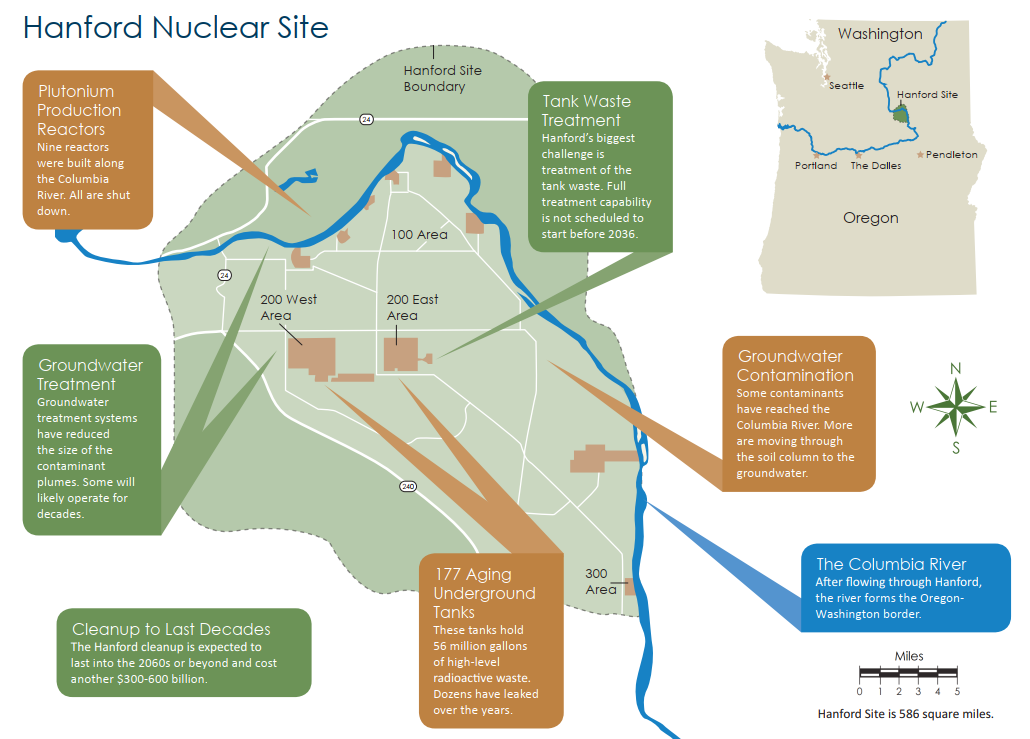
Historic Hanford contamination is worse than expected.
Energy Info 7th July 2023
In late June, the U.S. Department of Energy reported that radioactive contamination beneath a building at the Hanford Nuclear Site is worse than originally thought.
The Hanford 324 Building is located on the south end of Hanford – in what’s known as the 300 Area – just 1,000 feet from the Columbia River. The US DOE has known about one spill under the building for over a decade, and has been working on a plan for cleanup of the area while also making progress in other areas of Hanford since production turned to cleanup at the site in the 1980s.
The agency knew the contamination in the soil was serious, but sampling this spring found unexpected contamination deeper in the soil and outside the previously known spill area. So what does that mean? Oregon Department of Energy Assistant Director for Nuclear Safety and Emergency Preparedness Maxwell Woods and Hanford Hydrogeologist Tom Sicilia weigh in………………………………………………….. more https://energyinfo.oregon.gov/blog/2023/7/7/historic-hanford-contamination-is-worse-than-expected-oregon-experts-weigh-in
UN report on Japan’s Fukushima water plans fails to placate opponents

“The concern is not over external exposure,” Burnie said. “It is internal exposure to organically bound tritium that is the problem – when it gets inside fish, seafood, and then humans. When tritium gets inside cells, it can do damage.
“Tepco and the Japanese government are making a conscious decision to increase marine pollution with radioactivity, and they have no idea where that will lead.”
While South Korea offers official support, China and other voices in region continue to express concerns over discharge from nuclear plant
Justin McCurry in Tokyo, 7 July 23 https://www.theguardian.com/environment/2023/jul/07/un-report-on-japans-fukushima-water-plans-fails-to-placate-opponents
The publication this week of the UN nuclear watchdog’s positive assessment of Japanese plans to pump more than 1m tonnes of water from the wrecked Fukushima Daiichi nuclear power plant into the ocean has failed to placate opponents.
China is fiercely opposed to the plans, despite a report by the International Atomic Energy Agency (IAEA) backing the scheme, while the support of the government of South Korea has failed to quell widespread public opposition to the idea in the country.
The government in Seoul said on Friday that it “respected the IAEA’s review of plans by Japan and the plant’s operator, Tokyo Electric Power (Tepco), to pump water from the plant into the Pacific over the next 30 to 40 years”.
The discharge would have “negligible consequences” for South Korea, it said in an attempt to win over a deeply sceptical public. The country’s ban on food and seafood products from the Fukushima region will remain in place, however.
But South Korea, whose conservative president, Yoon Suk Yeol, is attempting to mend diplomatic fences with Japan over the countries’ wartime legacy, is a lone voice of support in the region.
On the same day, China announced a ban on food imports from 10 of Japan’s prefectures over “safety concerns”, and said it would conduct stringent radiation tests on food from the rest of the country.
“The Japanese side still has many problems in the legitimacy of sea discharge, the reliability of purification equipment and the perfection of monitoring programmes,” Chinese customs said.
Japan’s top government spokesperson, Hirokazu Matsuno, responded to criticism of the plan by saying that Fukushima Daiichi would pump far less tritium into the ocean than Chinese and South Korean nuclear facilities.
Japan’s standard for the release of tritium, at below 22tn becquerels a year, is far stricter than that of its neighbours, Matsuno said.
According to Japan’s trade and industry ministry, the Yangjiang nuclear plant in China discharged about 112tn becquerels of tritium in 2021, while the Kori power station in South Korea released about 49tn becquerels.
That is unlikely to placate opponents in Fukushima, where fishing communities have warned the water discharge will undo more than a decade of work to repair the damage the meltdown inflicted on the reputation of the region’s seafood, which is subject to one of the world’s strictest radiation testing regimes.
“We here in Fukushima have done absolutely nothing wrong, so why do they have to mess up our ocean?” said Haruo Ono, a fisher in Shinchimachi, 34 miles north of Fukushima Daiichi. “The ocean doesn’t belong to only us humans – and it isn’t a rubbish tip.
“It’s been 12 years [since the meltdown] and fish prices are rising, so we were finally hoping to really get down to business. Now they’re talking about releasing the water and we’re going to have to go back to square one again. It’s unbearable.”
Fisheries cooperatives in three prefectures were due to submit a petition with 33,000 signatures on Friday expressing their opposition to the water discharge.
While their government has given Japan breathing room, many South Koreans remain sceptical of Tokyo’s safety assurances. Some are panic-buying salt amid contamination fears, while a Gallup poll conducted in June found 78% of South Koreans were either “very worried” or “somewhat worried” about potential harm to the marine environment.
“It’s much more difficult to make sales now, as customers are asking more questions as they worry a lot,” said Jin Wol-sun, a stallholder at Seoul’s Noryangjin market, where market officials carried out random radiation tests on seafood in an attempt to reassure shoppers.
Rafael Grossi, the head of the IAEA, conceded there had been a lack of unanimity among the IAEA scientists, who come from 11 countries, including China, involved in the safety review. One or two “may have expressed concerns” over the plan, he said in an interview with Reuters. “I heard that being said … but again, what we have published is scientifically impeccable.”
China’s state-run Global Times newspaper on Thursday said Liu Senlin, a Chinese expert in the IAEA’s technical working group, was disappointed with the “hasty” report and had said the input from experts was limited and only used for reference.
Other experts openly voiced concerns about the impact the discharge could have on marine and human life, and accused Tepco and the IAEA of cutting corners.
“We have repeatedly pointed out to Tepco and IAEA substantive concerns we have with Japan’s approach and flaws in their methodology,” said Ferenc Dalnoki-Veress, an adjunct professor at Middlebury Institute of International Studies at Monterey in the US.
Dalnoki-Veress, a member of a panel of scientists that advised the Pacific Islands Forum, cited Tepco’s controlled tritium-exposure experiments on fish, which he said included only three species that were being fed on commercial fish pellets rather than exposed smaller fish, which would normally be their food source.
“We have repeatedly offered to help advise on how to conduct these experiments, but each time Tepco rejected them,” he said. “We take as proof that they are not truly interested in collecting relevant data that may demonstrate and confirm concerns regarding their present plans.”
The “dumping” of treated water into the ocean, he said, would cause potentially irreversible damage to the local fishing industry.
“When we think about the effect of radiation we can’t just think about the effect on the environment, we have to consider the effect on cultures, societies and peoples who suffer psychological effects, a sense of fear, and reputational damage. Trust has been broken, and it will be difficult to repair.”
Shaun Burnie, a senior nuclear specialist with Greenpeace who regularly visits Fukushima, said claims that tritium posed no risk to human health were “scientifically bankrupt”.
“The concern is not over external exposure,” Burnie said. “It is internal exposure to organically bound tritium that is the problem – when it gets inside fish, seafood, and then humans. When tritium gets inside cells, it can do damage.
“Tepco and the Japanese government are making a conscious decision to increase marine pollution with radioactivity, and they have no idea where that will lead.”
Russian K-278 sub sank 30 years ago but continues to leak radiation
By Boyko Nikolov On Jul 7, 2023 https://bulgarianmilitary.com/2023/07/07/russian-k-278-sub-sank-30-years-ago-but-continues-to-leak-radiation/
Imagine a Russian nuclear submarine, resting at the bottom of the Arctic sea for over 30 years, still leaking radiation. It may sound like a plot from a sci-fi movie, but according to Norwegian researchers, this is indeed reality.
For several years, a joint team of Russian and Norwegian scientists has been investigating this phenomenon. They found that the water around the K-278 Komsomolets submarine is 100,000 times more radioactive than uncontaminated water. The results of their research revealed in 2019, raise alarming questions about the potential short and long-term effects of radioactive water surrounding the vessel beneath the Barents Sea.
An essay in The Drive from 2019 suggests that the submarine may now be actively leaking radiation. This could be from its reactor or a pair of nuclear-armed torpedoes, both having remained submerged in the Barents Sea for over three decades.
The researchers collected samples from 5,500 feet below the sea surface, around 100 miles southwest of Norway’s Bear Island. This incident, and its potential long-term effects, highlight the importance of managing and disposing of radioactive material responsibly. This is even more crucial given the current geopolitical tensions between the US and Russia.
The submarine, known as Soviet Project 685, is believed to be leaking radiation either from its reactor or from its nuclear-armed torpedoes. This leakage is likely due to the submarine’s prolonged stay at the bottom of the Barents Sea.
The contaminated water was collected by the Egir 600, a Norwegian-designed remotely operated submersible. The research was carried out by Norway’s Institute of Marine Research and Norway’s University of Bergen.
One of the samples showed a significantly elevated radiation level. While the findings were preliminary, researchers stressed the need for continued monitoring of the sunken submarine. The ongoing analysis likely examines the extent of potential contamination and its possible impact on wildlife, ships, and coastal regions. The currents, water flow, and concentrations of radioactive material were probably scrutinized to minimize damage and contamination.
In conclusion, a plan was likely set in motion to mitigate the leakage of radioactive materials. Perhaps the nuclear-armed torpedoes were safely removed, or the contaminated materials were disposed of in a manner that would prevent any further leakage.
Japan claims that China and South Korea both pour radioactive waste-water , worse than Japan’s, into the oceans

Japan said Thursday that China and South Korea have both discharged liquid
waste containing high levels of tritium, a radioactive material, countering
Beijing’s criticism of Tokyo’s plan to release treated water from the
Fukushima nuclear power plant. Chief Cabinet Secretary Hirokazu Matsuno
also said Japan will explain to China “based on scientific perspectives”
the planned water discharge into the sea from the nuclear complex, crippled
by a devastating earthquake and ensuing tsunami in March 2011. Japan’s
standard for the release of tritium, at below 22 trillion becquerels per
year, is far stricter than that of other nations including its neighbors
China and South Korea, Matsuno, the top government spokesman, said at a
regular press conference.
In 2021, the Yangjiang nuclear plant in China
discharged around 112 trillion becquerels of tritium, while the Kori power
station in South Korea released about 49 trillion becquerels of the
radioactive material, Japan’s industry ministry said.
Japan Today 6th July 2023
Japanese regulator greenlights discharge of nuclear waste from Fukushima plant.

(Rafael Grossi – the consummate hypocrite)
Grossi, however, stressed that the report does not signify support for Japan’s decision to discharge the nuclear-contaminated water into the ocean.
‘IAEA’s conclusion largely limited, incomplete, fails to respond to international community’s concerns,’ says China
AA, Necva Taştan |07.07.2023, ISTANBUL
Japan’s nuclear regulator Friday approved the release of treated radioactive water from the crippled Fukushima nuclear power plant, thus allowing the country to begin discharge of the waste into the sea this summer.
The plant’s operator, Tokyo Electric Power Company Holdings Inc., received certification from the Nuclear Regulation Authority of Japan after the International Atomic Energy Agency (IAEA) approved Japan’s water discharge plan through a comprehensive assessment, Tokyo-based Kyodo News reported.
Neighboring China has fiercely opposed the plan and on Friday imposed a ban on the import of seafood from Japan’s 10 regions.
However, the IAEA its two-year-long safety review report concluded the discharge of nuclear waste will have a “negligible” impact on people and the environment.
However, Beijing disagrees.
The report was submitted to Japanese Prime Minister Fumio Kishida early this week by IAEA chief Rafael Grossi.
“The IAEA conclusion is largely limited and incomplete and failed to respond to the international community’s concerns over Japan’s plan to dump nuclear-contaminated wastewater into the ocean,” said Wang Wenbin, a spokesman for China’s Foreign Ministry, Beijing-based Global Times reported.
Grossi, however, stressed that the report does not signify support for Japan’s decision to discharge the nuclear-contaminated water into the ocean.
Wang said Grossi’s remarks that “one or two experts” of the IAEA team had concerns over the agency’s report on Japan’s nuclear waste, “once again prove the report was hastily released and failed to fully reflect views from experts who participated in the review.”……….
“China urges Japan not to take the report as the greenlight,” but suspend the dumping plan and dispose of the nuclear-contaminated wastewater in a responsible way, Wang added.
Grossi is now traveling to South Korea, New Zealand, and Cook Islands, which is the current chair of the Pacific Islands Forum, to “address concerns, hear views, clarify IAEA role” on Japan’s nuclear waste, the IAEA chief said on Twitter.
Japan’s water discharge plan, announced in April 2021, faced significant criticism from China, South Korea, North Korea, Taiwan, and international organizations, including the UN.
The US supported the proposal, following years of discussions on dealing with over 1 million tons of water stored at the Fukushima nuclear complex since the 2011 disaster.
Despite the pressure, Japan last month initiated the injection of seawater into a drainage tunnel at the damaged Fukushima Daiichi Nuclear Power Plant, marking the initial stage of releasing treated radioactive wastewater into the ocean. https://www.aa.com.tr/en/asia-pacific/japanese-regulator-greenlights-discharge-of-nuclear-waste-from-fukushima-plant/2939518
IAEA chief Rafael Grossi says he’s satisfied with Japan’s plans to release Fukushima wastewater
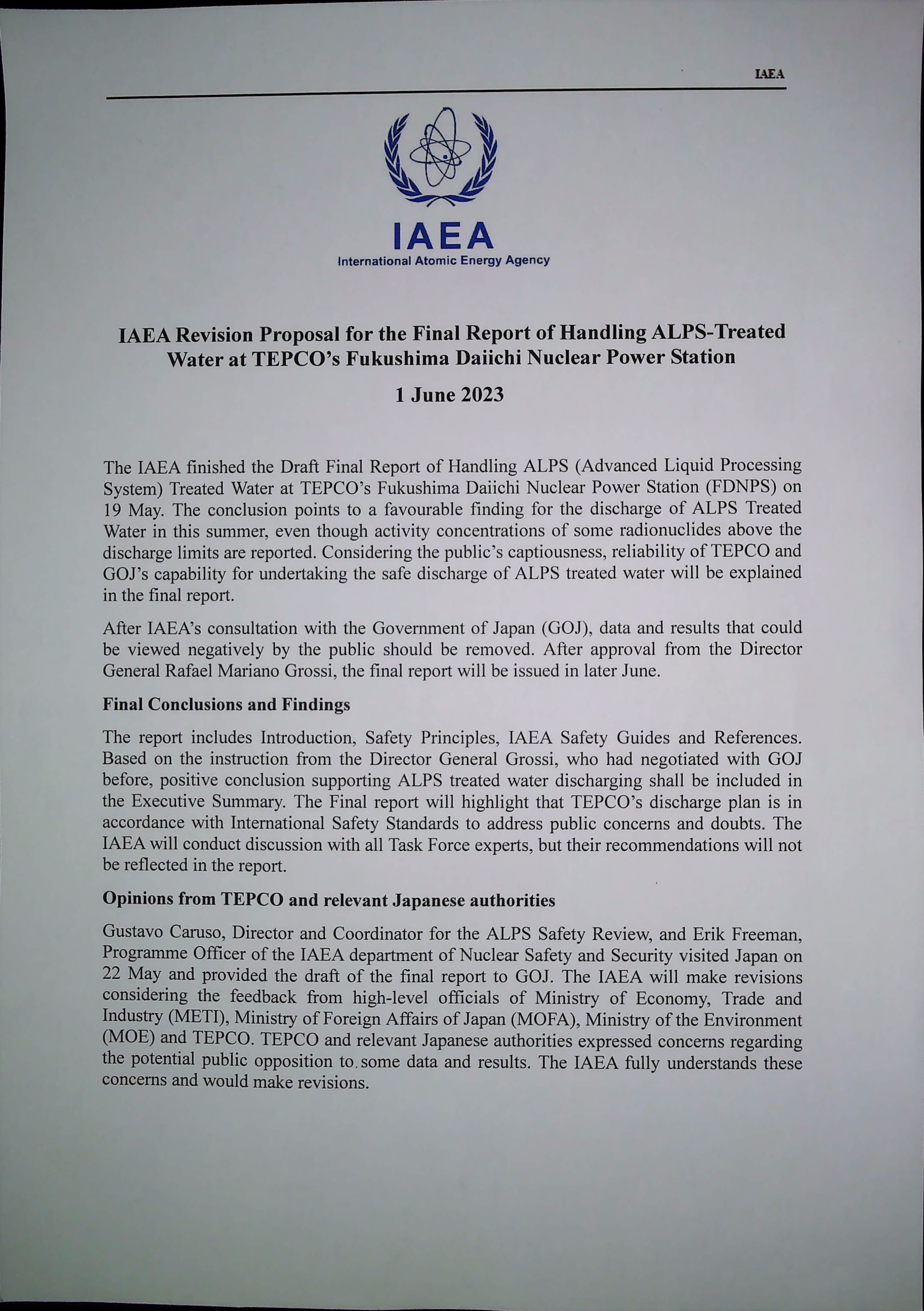
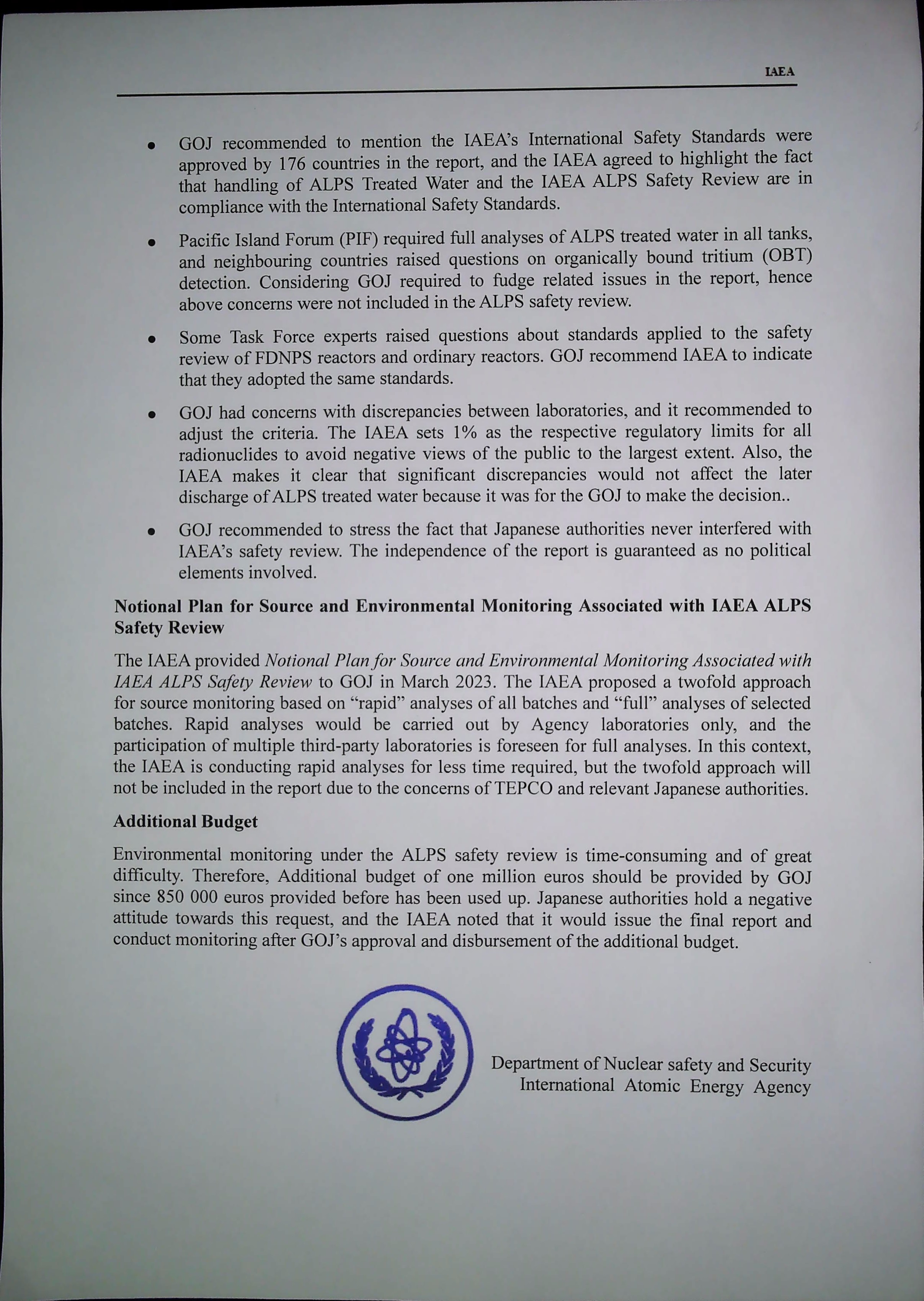
[Ed note. In this IAEA’s internal document the IAEA is seen coaching TEPCO about what to tell and what not tell to the public regarding the « treated » water to be soon discharged into the Pacific Ocean.
One thing that can be drawn from that document’s content is that the IAEA and TEPCO have no intention to be fully transparent about the radioactive contamination of the said « treated water », only the one to cushion insidiously the real facts to the public eyes.]
BY MARI YAMAGUCHI, July 5, 2023
FUTABA, Japan (AP) — The head of the U.N. atomic agency toured Japan’s tsunami-wrecked Fukushima nuclear power plant on Wednesday and said he is satisfied with still-contentious plans to release treated radioactive wastewater into the Pacific Ocean…………………………………

The wastewater release still faces opposition in and outside Japan.
Earlier Wednesday, Grossi met with local mayors and fishing association leaders and stressed that the IAEA will be present throughout the water discharge, which is expected to last decades, to ensure safety and address residents’ concerns. He said he inaugurated a permanent IAEA office at the plant, showing its long-term commitment.
The water discharge is not “some strange plan that has been devised only to be applied here, and sold to you,” Grossi said at the meeting in Iwaki, about 40 kilometers (25 miles) south of the plant. He said the method is certified by the IAEA and is followed around the world…………………….
Local fishing organizations have rejected the plan because they worry their reputation will be damaged even if their catch isn’t contaminated. It is also opposed by groups in South Korea, China and some Pacific Island nations due to safety concerns and political reasons.
Fukushima’s fisheries association adopted a resolution on June 30 reaffirming its rejection of the plan.
The fishery association chief, Tetsu Nozaki, urged government officials at Wednesday’s meeting “to remember that the treated water plan was pushed forward despite our opposition.”
Grossi is expected to also visit South Korea, New Zealand and the Cook Islands to ease concerns there. He said his intention is to explain what the IAEA, not Japan, is doing to ensure there is no problem.
In an effort to address concerns about fish and the marine environment, Grossi and Tomoaki Kobayakawa, president of the plant operator, Tokyo Electric Power Company Holdings, signed an agreement on a joint project to determine whether they are impacted by tritium, the only radionuclide officials say cannot be removed from the wastewater by treatment.
In South Korea, officials said in a briefing Wednesday that it’s highly unlikely that the released water will have dangerous levels of contamination. They said South Korea plans to tightly screen seafood imported from Japan and that there is no immediate plan to lift the country’s import ban on seafood from the Fukushima region.
Park Ku-yeon, first vice minister of South Korea’s Office for Government Policy Coordination, said Seoul plans to comment on the IAEA findings when it issues the results of the country’s own investigation into the potential effects of the water release, which he said will come soon.
China doubled down on its objections to the release in a statement late Tuesday, saying the IAEA report failed to reflect all views and accusing Japan of treating the Pacific Ocean as a sewer.
“We once again urge the Japanese side to stop its ocean discharge plan, and earnestly dispose of the nuclear-contaminated water in a science-based, safe and transparent manner. If Japan insists on going ahead with the plan, it will have to bear all the consequences arising from this,” the Chinese Foreign Ministry said.
Grossi said Wednesday he is aware of the Chinese position and takes any concern seriously. “China is a very important partner of the IAEA and we are in close contact,” he said…………………. https://apnews.com/article/japan-fukushima-radioactive-water-a4dcc4457c95f15ac7636fde4aca1df3
—
Fukushima: Anxiety and anger over Japan’s nuclear waste water plan

By Tessa Wong, Asia Digital Reporter, BBC News, 6 July 23
A controversial plan by Japan to release treated waste water from the Fukushima nuclear plant has sparked anxiety and anger at home and abroad.
Since the 2011 tsunami which severely damaged the plant, more than a million tonnes of treated waste water has accumulated there. Japan now wants to start discharging it into the Pacific Ocean.
The UN nuclear watchdog the International Atomic Energy Agency (IAEA), has published a report endorsing Japan’s plan.
But since it was announced two years ago, the plan has been deeply controversial in Japan with local communities expressing concerns about contamination.
Fishing and seafood industry groups in Japan and the wider region have also voiced concerns about their livelihoods, as they fear consumers will avoid buying seafood.
And Tokyo’s neighbours are not happy either. China has been the most vocal, accusing Japan of treating the ocean as its “private sewer”. On Tuesday it criticised the IAEA report, saying its conclusions were “one-sided”.
So what is Japan’s plan and how exactly has it churned the waters?
What does Japan plan to do with the nuclear waste?
Since the disaster, power plant company Tepco has been pumping in water to cool down the Fukushima nuclear reactors’ fuel rods. This means every day the plant produces contaminated water, which is stored in massive tanks.
More than 1,000 tanks have been filled, and Japan says this is not a sustainable long-term solution. It wants to gradually release this water into the Pacific Ocean over the next 30 years, insisting it is safe to be discharged.
Releasing treated waste water into the ocean is a routine practice for nuclear plants – but given that this is the by-product of an accident, this is no ordinary nuclear waste.
Tepco filters the Fukushima water through its Advanced Liquid Processing System (ALPS), which reduces most radioactive substances to acceptable safety standards, apart from tritium and carbon-14……………………………………….
What do critics say?
UN-appointed human rights experts have opposed the plan, as have environmental activists. Greenpeace has released reports casting doubt on Tepco’s treatment process, alleging it does not go far enough in removing radioactive substances.
Critics say Japan should, for the time being, keep the treated water in the tanks. They argue this buys time to develop new processing technologies, and allow any remaining radioactivity to naturally reduce.
UN-appointed human rights experts have opposed the plan, as have environmental activists. Greenpeace has released reports casting doubt on Tepco’s treatment process, alleging it does not go far enough in removing radioactive substances.
Critics say Japan should, for the time being, keep the treated water in the tanks. They argue this buys time to develop new processing technologies, and allow any remaining radioactivity to naturally reduce.
There are also some scientists who are uncomfortable with the plan. They say it requires more studies on how it would affect the ocean bed and marine life.
“We’ve seen an inadequate radiological, ecological impact assessment that makes us very concerned that Japan would not only be unable to detect what’s getting into the water, sediment and organisms, but if it does, there is no recourse to remove it… there’s no way to get the genie back in the bottle,” marine biologist Robert Richmond, a professor with the University of Hawaii, told the BBC’s Newsday programme.
Tatsujiro Suzuki, a nuclear engineering professor from Nagasaki University’s Research Center for Nuclear Weapons Abolition, told the BBC the plan would “not necessarily lead to serious pollution or readily harm the public – if everything goes well”.
But given that Tepco failed to prevent the 2011 disaster, he remains concerned about a potential accidental release of contaminated water, he said.
What have Japan’s neighbours said?
China has demanded that Japan reaches an agreement with regional countries and international institutions before it releases the water.
Beijing has also accused Tokyo of violating “international moral and legal obligations”, and warned that if it proceeded with the plan, “it must bear all consequences”.
The two countries currently have a prickly relationship, with Japan’s recent military build-up and China’s provocative moves around Taiwan raising tensions.
Tokyo has engaged in talks with its neighbours, and hosted a South Korean team of experts on a tour of the Fukushima plant in May. But it is not certain how far it would commit to getting neighbouring countries’ approval before it goes ahead with the plan.
In contrast to China, Seoul – which has been keen to build ties with Japan – has soft-pedalled its concerns and on Tuesday it said it “respects” the IAEA’s findings.
But this approach has angered the South Korean public, 80% of whom are worried about the water release according to a recent poll.
“The government enforces a strong no-littering policy at sea… But now the government is not saying a word (to Japan) about the wastewater flowing into the ocean,” Park Hee-jun, a South Korean fisherman told BBC Korean.
“Some of the officials say we should remain quiet if we don’t want to make consumers even more anxious. I think that’s nonsense.”
Thousands have attended protests in Seoul calling for government action, as some shoppers fearing food supply disruptions have stockpiled salt and other necessities.
In response, South Korea’s parliament passed a resolution last week opposing the water release plan – though it is unclear what impact this would have on Japan’s decision. Officials are also launching “intense inspections” of seafood, and are sticking to an existing ban of Japanese seafood imports from regions around the Fukushima plant.
To assuage the public’s fears, prime minister Han Duck-soo said he would be willing to drink the Fukushima water to show it is safe, while one official said last week that only a small fraction of the discharge would end up in Korean waters.
Elsewhere in the region, several island nations have also expressed concerns with the Pacific Islands Forum regional group calling the plan another “major nuclear contamination disaster”.
How has Japan responded?
Japanese authorities and Tepco have sought to convince critics by explaining the science behind the treatment process, and they would continue to do so with “a high level of transparency”, promised prime minister Fumio Kishida on Tuesday.
In materials published on its foreign affairs ministry website, Japan also pointed out that other nuclear plants in the region – particularly those in China – discharge water with much higher levels of tritium. The BBC was able to verify some of these figures with publicly available data from Chinese nuclear plants.
But the biggest vindication may lie with the IAEA report, released by the agency’s chief Rafael Grossi while visiting Japan…………………………
On Tuesday, Mr Grossi said the plan would have a “negligible radiological impact on people and the environment”.
With the world’s nuclear watchdog giving its stamp of approval, Japan could start discharging the Fukushima water as early as August, according to some reports – setting the stage for an intensified showdown with its critics.
Additional reporting by Yuna Kim and Chika Nakayama. https://www.bbc.com/news/world-asia-66106162
Fukushima: China calls for suspension of Japanese plan to release radioactive water into sea.

Guardian, 4 July 23
Comments come as IAEA boss visits Japan to deliver results of safety report on planned discharge of nuclear-contaminated water
China has called for the suspension of a Japanese plan to begin releasing radioactive water from the tsunami-wrecked Fukushima nuclear plant into the sea, ahead of a UN report that is expected to give its approval to the scheme.
Beijing denounced the plan as “extremely irresponsible” when it was announced in 2021 and reiterated its opposition on Tuesday, as International Atomic Energy Agency (IAEA) chief, Rafael Grossi, begins a four-day visit in which he is set to deliver the results of the body’s safety review.
Through its embassy in Japan, China said the IAEA’s report cannot be a “pass” for the water release and called for it to be suspended.
Last week a spokesperson for the country’s foreign ministry said Beijing urged Japan to “take seriously both international and domestic concerns, stop forcibly proceeding with its ocean discharge plan” and “subject itself to rigorous international oversight”.
……… Local Japanese fishing communities have also objected to the plan, saying it will destroy more than a decade of work rebuilding their industry, with consumers likely to shun their catch and send prices plummeting.
Japan has not specified a date for the water release, which would take place over 30 to 40 years pending the IAEA’s final review and official approval from the national nuclear regulatory body for Tokyo Electric Power (Tepco). The regulatory body’s final word could come as early as this week………………… https://www.theguardian.com/world/2023/jul/04/fukushima-china-calls-for-suspension-of-japanese-plan-to-release-radioactive-water-into-sea
—
International community cannot tolerate Japan’s nuclear-contaminated water dumping.
By Global Times, Jul 03, 2023 , https://www.globaltimes.cn/page/202307/1293596.shtml
Japan is making final preparations for dumping nuclear-contaminated wastewater into the sea. According to local media reports, Japan’s nuclear regulator finished inspecting a newly completed system to release radioactive water from the Fukushima Daiichi nuclear plant into the sea, presenting a posture that everything is ready. Rafael Mariano Grossi, director General of the International Atomic Energy Agency (IAEA), will visit Japan from Tuesday to Friday, and the IAEA’s final assessment report on Japan’s dumping plan will soon be released. Will Grossi’s attitude, or the IAEA’s final assessment, change Japan’s decision to dump wastewater into the sea? It seems unlikely.
In fact, the Japanese side officially approved the dumping plan as early as July 22 last year. Since then, it has been working intensively on implementing the plan. At the same time, it has been spending a lot of effort on public relations, never taking seriously of the strong concerns at home and abroad, and failing to conduct adequate and well-intentioned consultations with stakeholders. And the IAEA is being targeted by the Japanese side as a priority in networking. Although the organization cannot give Japan a “license” and a “talisman” for dumping nuclear-contaminated water into the sea, the Japanese side may make an issue of how the IAEA writes its assessment report and draws its conclusions.
We still urge the IAEA to uphold the principles of objectivity, professionalism and impartiality, develop an assessment report that can stand the test of science and history, and not endorse the Japanese side’s dumping plan. Tokyo’s calculation is to force the international community to accept that what’s done is done. Japan hopes that after resisting the pressure for some time, perhaps the international community’s attention will turn to other areas, and the opposition to dumping nuclear-contaminated wastewater into the sea will weaken. We cannot let such a scheme succeed.
Now we need to be particularly vigilant that some governments and the Japanese side have reached a political deal over the issue of the wastewater dumping plan, which is a colluded betrayal of the public interest of mankind and marine ecology. Washington was the first to give Tokyo the green light for geopolitical reasons and then persuaded its other allies. The South Korean government has also started to release ambiguous messages frequently despite strong opposition from the public. To dispel the public’s doubts, some lawmakers from the South Korean ruling party even went to the seafood market in groups to drink seawater from the breeding pond, and “even the fish in the pond found it ridiculous.” Some European governments have also relaxed their attitude over the issue.
There have been concerns, objections, and questions about the discharge of nuclear-contaminated wastewater into the sea from ASEAN countries, Pacific Island countries, and others including Japan. Although the US and Japanese governments have tried to marginalize such voices, they have never disappeared. China’s position as a major power is clear and has remained unchanged. The discharge of nuclear-contaminated wastewater into the sea is a matter of common interest for the international community, not a private matter for Japan. So China urges the Japanese side to stop pushing forward with the dumping plan, effectively dispose of the nuclear-contaminated water in a scientific, safe and transparent manner, and accept strict international supervision. This is a voice from a scientific and all-human perspective, which is justified and couldn’t be alone.
In order to promote the safety of seafood from Fukushima, the Japanese government once attempted to use Fukushima’s seafood in the meals of primary and secondary schools in the prefecture. However, all schools in Fukushima prefecture rejected this proposal. According to reports, content of Cs-137 in fish recently caught in the harbor of the Fukushima Daiichi Nuclear Power Plant is 180 times that of the standard maximum stipulated in Japan’s food safety law, which is extremely alarming.
In this situation, claiming that the contaminated wastewater is safe is nothing but a lie. As officials from Pacific island countries have said, if the so-called “treated water” meets the standards and can be discharged, why doesn’t Japan use this contaminated wastewater in its own country, especially in its agricultural sector?
Japan does have other more appropriate choices. The Japanese government has considered five different treatment options, but it ultimately chose the cheapest and easiest one, which is to discharge the contaminated wastewater into the ocean. From a technical standpoint, this is the solution with the lowest economic cost to Japan, but it releases the highest amount of radioactive substances into the global environment. Japan is unwilling to spend money on safely treating the contaminated wastewater but is willing to invest in public relations. According to recent reports from South Korean media, Japanese officials made political donations worth over EUR 1 million to the staff of the IAEA Secretariat and there has been no response to this matter so far.
According to a German marine scientific research institute, with the world’s strongest currents along the coast of Fukushima, radioactive materials could spread to most of the Pacific Ocean within 57 days from the date of discharge. However, Japan has failed to provide a comprehensive and systematic monitoring plan for the disposal of nuclear-contaminated wastewater into the sea. The current monitoring scope is small, with few sampling points and low frequency, making it difficult to timely detect abnormal situations such as discharging pollutants in levels that exceed the stipulated standards. In short, Japan’s forceful disposal of nuclear-contaminated water into the sea is illegal and violates a series of international legal obligations, constituting a crime against all of humanity. China and the international community’s forces of justice stand together against such behavior and will never compromise or tolerate it.
US navy accused of cover-up over radioactive shipyard waste

The US navy is covering up dangerous levels of radioactive waste on a
40-acre former shipyard parcel in San Francisco’s waterside Hunters Point
neighborhood, public health advocates charge.
The land is slated to be
turned over to the city as early as next year, and could be used for
residential redevelopment. The accusations stem from 2021 navy testing that
found 23 samples from the property showed high levels of strontium-90, a
radioactive isotope that replaces calcium in bones and causes cancer.
The Environmental Protection Agency raised alarm over the levels, but the navy
in 2022 said its testing was inaccurate and produced a new set of data that
showed levels of strontium-90 lower than zero, which was dismissed by
environmental health experts as impossible.
Guardian 25th June 2023
https://www.theguardian.com/us-news/2023/jun/25/us-navy-accused-radiocative-shipyard-waste
Is Fukushima wastewater release safe? What the science says
Radiation in the water will be diluted to almost-background levels, but some researchers are not sure this will be sufficient to mitigate the risks.
Bianca Nogrady Nature, 22 June 23
Despite concerns from several nations and international groups, Japan is pressing ahead with plans to release water contaminated by the 2011 meltdown of the Fukushima Daiichi nuclear power plant into the Pacific Ocean. Starting sometime this year and continuing for the next 30 years, Japan will slowly release treated water stored in tanks at the site into the ocean through a pipeline extending one kilometre from the coast. But just how safe is the water to the marine environment and humans across the Pacific region?
How is the water contaminated?
The power station exploded after a devastating earthquake and subsequent tsunami crippled the coastal plant, overheating the reactor cores. Since then, more than 1.3 million cubic metres of seawater have been sprayed onto the damaged cores to keep them from overheating, contaminating the water with 64 radioactive elements, known as radionuclides. Of greatest concern are those that could pose a threat to human health: carbon-14, iodine-131, caesium-137, strontium-90, cobalt-60 and hydrogen-3, also known as tritium.
Some of these radionuclides have a relatively short half-life and would already have decayed in the 12 years since the disaster. But others take longer to decay; carbon-14, for example, has a half-life of more than 5,000 years.
How are they treating the water?
The contaminated water has been collected, treated to reduce the radioactive content and stored in more than 1,000 stainless steel tanks at the site. …………………………
Will radioactivity concentrate in fish?
Nations such as South Korea have expressed concern that the treated water could have unexplored impacts on the ocean environment, and a delegation from the country visited the Fukushima site in May. Last year, the US National Association of Marine Laboratories in Herndon, Virginia, also voiced its opposition to the planned release, saying that there was “a lack of adequate and accurate scientific data supporting Japan’s assertion of safety”. The Philippine government has also called for Japan to reconsider releasing the water into the Pacific.
“Have the people promoting this going forward — ALPS treatment of the water and then release into the ocean — demonstrated to our satisfaction that it will be safe for ocean health and human health?” asks Robert Richmond, marine biologist at the University of Hawaii at Manoa. “The answer is ‘no’.”
Richmond is one of five scientists on a panel advising the Pacific Islands Forum, an intergovernmental organization made up of 18 Pacific nations including Australia, Fiji, Papua New Guinea and French Polynesia. The panel was convened to advise on whether the release of the treated water from Fukushima was safe both for the ocean and for those who depend on it. Richmond says they have reviewed all the data provided by TEPCO and the Japanese government, and visited the Fukushima site, but there are still some unanswered questions about tritium and carbon-14………………………………….
TEPCO says fishing is not routinely conducted in an area within 3 kilometres of where the pipeline will discharge the water. But Richmond is concerned the tritium could concentrate in the food web as larger organisms eat smaller contaminated ones. “The concept of dilution as the solution to pollution has demonstrably been shown to be false,” Richmond says. “The very chemistry of dilution is undercut by the biology of the ocean.”
Shigeyoshi Otosaka, an oceanographer and marine chemist at the Atmospheric and Ocean Research Institute of the University of Tokyo says that the organically bound form of tritium could accumulate in fish and marine organisms. He says international research is investigating the potential for such bioaccumulation of the radionuclides in marine life, and what has already happened in the waters around Fukushima after the accidental release of contaminated water during the tsunami. “I think it is important to evaluate the long-term environmental impact of these radionuclides,” Otosaka says………………………………. https://www.nature.com/articles/d41586-
1 This Month
To see nuclear-related stories in greater depth and intensity – go to https://nuclearinformation.wordpress.com
-
Archives
- February 2026 (127)
- January 2026 (308)
- December 2025 (358)
- November 2025 (359)
- October 2025 (376)
- September 2025 (258)
- August 2025 (319)
- July 2025 (230)
- June 2025 (348)
- May 2025 (261)
- April 2025 (305)
- March 2025 (319)
-
Categories
- 1
- 1 NUCLEAR ISSUES
- business and costs
- climate change
- culture and arts
- ENERGY
- environment
- health
- history
- indigenous issues
- Legal
- marketing of nuclear
- media
- opposition to nuclear
- PERSONAL STORIES
- politics
- politics international
- Religion and ethics
- safety
- secrets,lies and civil liberties
- spinbuster
- technology
- Uranium
- wastes
- weapons and war
- Women
- 2 WORLD
- ACTION
- AFRICA
- Atrocities
- AUSTRALIA
- Christina's notes
- Christina's themes
- culture and arts
- Events
- Fuk 2022
- Fuk 2023
- Fukushima 2017
- Fukushima 2018
- fukushima 2019
- Fukushima 2020
- Fukushima 2021
- general
- global warming
- Humour (God we need it)
- Nuclear
- RARE EARTHS
- Reference
- resources – print
- Resources -audiovicual
- Weekly Newsletter
- World
- World Nuclear
- YouTube
-
RSS
Entries RSS
Comments RSS
 nuclear-news