China urges long-term supervision over Japan’s radioactive water discharge
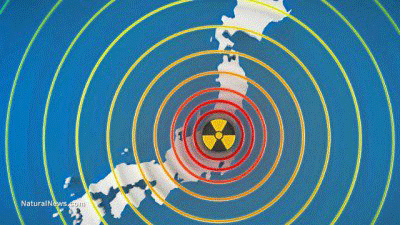
08-Jun-2024. CGTN https://news.cgtn.com/news/2024-06-08/China-urges-strict-supervision-over-Japan-radioactive-water-discharge-1ugaDo6lH8I/p.html
A Chinese envoy on Friday called for strict, independent and effective long-term international supervision over Japan’s discharge of nuclear-contaminated wastewater from the crippled Fukushima Daiichi Nuclear Power Plant into the ocean.
Japan has recently carried out its sixth round of the Fukushima wastewater release. The Chinese envoy stated that the discharge continues to raise deep concerns among the international community, especially among Japan’s neighboring countries.
Li Song, China’s permanent representative to the International Atomic Energy Agency (IAEA), expressed doubts about the long-term reliability of Japan’s wastewater purification equipment, the effectiveness of the current monitoring arrangements, the weak supervision from the Japanese government, and the chaotic management of the Tokyo Electric Power Company, the Fukushima plant’s operator, during a meeting of the agency’s board of governors.
Li stressed the importance and urgency of establishing a long-term international supervision mechanism for nuclear-contaminated wastewater discharge as an addition to the regulation of the Japanese government and monitoring by Japanese nuclear power regulators, rather than replacing them.
He emphasized that only through such an arrangement can Japan dispel the concerns and panic of the people of China and other stakeholder countries. Such an arrangement is also conducive to further strengthening the authority and function of the IAEA in the field of international nuclear security and serves the fundamental interests of Japan and the Japanese people, Li added.
The Chinese envoy also stated that China and Japan have agreed to find an appropriate solution to the issue of the Fukushima wastewater discharge through consultation and negotiation. China hopes that Japan will show sincerity, seriously address the legitimate concerns from home and abroad, earnestly fulfill its responsibilities and obligations, and join hands with China, the IAEA, and the international community to work out more effective supervision measures to ensure that the Fukushima wastewater release will not cause long-term harm to the marine environment and humankind.
Russia nuclear-powered submarine to visit Cuba amid rising tensions with US
Guardian, 7 June 24
Russian sub – joined by three other naval vessels – will not be carrying nuclear weapons, authorities in Havana said as they announced the visit
A Russian nuclear-powered submarine – which will not be carrying nuclear weapons – will visit Havana next week, Cuba’s communist authorities have announced, amid rising tensions with the US over the war in Ukraine.
The nuclear submarine Kazan and three other Russian naval vessels, including the missile frigate Admiral Gorshkov, an oil tanker and a salvage tug, will dock in the Cuban capital from 12-17 June, Cuba’s ministry of the revolutionary armed forces said in a statement.
“None of the vessels is carrying nuclear weapons, so their stopover in our country does not represent a threat to the region,” the ministry said.
The announcement came a day after US officials said that Washington had been tracking Russian warships and aircraft that were expected to arrive in the Caribbean for a military exercise. They said the exercise would be part of a broader Russian response to US support for Ukraine.
The US officials said that the Russian military presence was notable but not concerning. However, it comes as Russian President Vladimir Putin has suggested that Moscow could take “asymmetrical steps” elsewhere in the world in response to President Joe Biden’s decision to allow Ukraine to use US-provided weapons to strike inside Russia to protect Kharkiv, Ukraine’s second-largest city………………………………… more https://www.theguardian.com/world/article/2024/jun/07/russia-nuclear-powered-submarine-kazan-to-visit-cuba
38 Years After Chernobyl Disaster, 12% of Belarus’s Territory Is Still Contaminated
Belarus is not communicating anything about Chernobyl to other countries.
May 26, 2024 by Global Voices, By Daria Dergacheva, https://goodmenproject.com/featured-content/38-years-after-chernobyl-disaster-12-of-belaruss-territory-is-still-contaminated/
On April 26, 1986, a catastrophic accident occurred at the Chernobyl Nuclear Power Plant. A planned shutdown of the reactor, lasting 20 seconds, seemed like a routine check of electrical equipment. However, a few seconds later, a chemical explosion released about 520 types of dangerous radionuclides into the atmosphere. Thirty-eight years later, Belarusian officials say 12 percent of the country’s territory is still contaminated.
The Chernobyl Nuclear Power Plant was located near the city of Pripyat in northern Ukraine, then part of the Ukrainian SSR, close to the border with the Byelorussian SSR. Pripyat has been abandoned since the year of the accident, and an exclusion zone was created with a radius of 30 km around the plant. Over 100,000 people were evacuated from the zone
To the north of the Ukrainian part of the Exclusion Zone is the Polesie State Radiation-Ecological Reserve, which belongs to the territory of the Republic of Belarus. There are 96 abandoned settlements in the area, where more than 22,000 residents lived before the accident and evacuation in 1986.
According to Belarus state media, in the end of April 2024, the first deputy head of the State Atomic Inspectorate in Belarus Leonid Dedul said during a press-conference:
As a result of explosions and fires, about 200 types of radionuclides with half-lives ranging from a few hours to hundreds of thousands of years were released into the atmosphere, with Belarus taking the main blow. For example, if we consider the radionuclide cesium-137, 35 percent of the total amount that fell down landed in our country. This radionuclide accounts for about 90 percent of the radiation dose load on the population. Since the post-accident period, the area of contaminated territory in Belarus by cesium-137 has decreased by almost half and now amounts to about 25.5 thousand square kilometers, or 12 percent of the country’s total area.
Today, more than 2,000 populated areas are located in radioactive contamination zones, with approximately 930,000 people (185,000 of whom are children) living in them.
Although the state media reports on the success of Belarusian state-sponsored Chernobyl program that deals with economic, social and environmental consequences of the disaster, those outside the country are skeptical about it.
Alyaksandr Lukashenka, who has been the leader of Belarus for 30 years now, said that the program worked so well that it has “beaten Chernobyl in the face.”
However, Belarusian historian Alexander Fridman thinks that Lukashenka’s regime, through propaganda, is manipulating public memory and opinion around the tragedy. Economic goals, he says, and the ability to use contaminated territories for them, were the driver of Lukashenka’s Chernobyl program. In his opinion piece for DW, he says the people were overlooked, and research that showed grave consequences of using the land even after years have passed was repressed.
One of the researchers was Yury Bandazhevsky, former director of the Medical Institute in Gomel, a scientist working on the consequences of the Chernobyl disaster. He was sentenced to eight years imprisonment in Belarus in 2001. According to many human rights groups Dr. Bandazhevsky was a prisoner of conscience. His arrest came soon after he published reports critical of the official research being conducted into the Chernobyl incident.
He was released on parole in 2005, and is now working in Ukraine. Bandazhevsky said in one of his interviews to the DW 30 years after the disaster:
I believe that even three decades after the Chernobyl disaster, the situation hasn’t changed enough to allow for safe living and agricultural activities in these territories. Yes, the radiation levels of cesium-137 and strontium-90, which have a half-life of about 30 years, have indeed decreased. However, cesium’s half-life product is barium, which hardly exits cells.
Radionuclides have migrated into the soil, entering biological chains into plants, animals, and humans, affecting the cells of vital organs. This is ignored by those [officials] who speak of safe living in areas affected by the nuclear power plant accident.
We began to study the changes occurring in the human body under the influence of radioactive elements in the fifth year after the explosion. At that time, we recorded serious pathologies of internal organs — brain, heart, and endocrine system — that could be assessed as a result of direct radiotoxic exposure. But [Belarusian] officials didn’t want to connect cause and effect. Meanwhile, in the Vetka district of Belarus, many of the children we observed in 1993–1995 have died.
We must consider that victims can also include those who live far from the Chernobyl area but consume products from there. In Belarus, after the Chernobyl accident, some “smart” individuals came up with the idea to mix “clean” products with “dirty” ones. In the Gomel region, contaminated lands were initially secretly, then openly, used to produce agricultural products, with livestock being fed grain from there. Products from the region continue to be distributed throughout the republic. Now, the situation has reached the point where these territories are reclassified as “clean,” saving on social payments.
In October 2023, as the media reported, an NGO, Children of Chernobyl, which had helped thousands of kids from contaminated areas to visit European countries in order to receive health and psychological support, was shut down by a Belarusian court as part of ongoing crack down on Belarusian civil society. In addition, for over two years since the Russian full-scale invasion of Ukraine started (supported by Lukashenka), Belarus is not communicating any research or other issues about Chernobyl to other countries, apart from rare meetings of IAEA, Belarusian state media reports. Thus, it is impossible to conduct an independent evaluation of what is going on in contaminated areas of Belarus. It is safe to suggest that, until Lukashenka’s regime fails, the public within and outside the country will not know the real cost of the 1986 Chernobyl disaster for Belarus.
Japan starts 6th discharge of Fukushima nuclear-contaminated wastewater

CGTN, 17-May-2024
Japan on Friday started the sixth round of release of nuclear-contaminated wastewater from the crippled Fukushima Daiichi Nuclear Power Plant into the Pacific Ocean.
Despite opposition among local fishermen, residents as well as backlash from the international community, Tokyo Electric Power Company (TEPCO), the plant’s operator, started releasing the radioactive wastewater in the morning, the second round in fiscal 2024.
The same as the previous rounds, about 7,800 tonnes of wastewater are being discharged from about a kilometer off the coast of Fukushima Prefecture via an underwater tunnel until June 4.
According to the TEPCO, the concentrations of all radioactive substances other than tritium in the water stored in the tank scheduled for release were below the national release standards, while the concentration of tritium that cannot be removed will be diluted with seawater.
The Chinese Embassy in Japan expressed firm opposition to this unilateral move of ocean discharge. While safety and reliability have yet to be ensured, Japan’s dumping of nuclear-contaminated water has repeatedly raised risks to neighboring countries and marine ecology, a spokesperson for the embassy said.
The spokesperson called on the Japanese side to attach great importance to the concerns at home and abroad and to fully cooperate in setting up an independent international monitoring arrangement that remains effective in the long haul and has the substantive participation of stakeholders.
………………………….. In fiscal 2024, the TEPCO plans to discharge a total of 54,600 tonnes of contaminated water in seven rounds, which contains approximately 14 trillion becquerels of tritium. https://news.cgtn.com/news/2024-05-17/news-1tFIzr3u9Da/p.html
Hinkley Point C: New public inquiry planned over environmental impact
New saltmarshes could be created to mitigate the power station
Somerset Live, By Daniel Mumby, Local Democracy Reporter, 8 May 24
The environmental impact of Somerset’s new nuclear power station will be the subject of a new planning inquiry which could be held in the next 18 months. Around 11,000 people are currently working at the Hinkley Point C construction site near Stogursey, with this number expected to rise to 12,000 in the coming months.
EDF Energy secured planning consent for the power station back in 2013, with construction beginning three years later – a consent which include a number of measures to offset the environmental impact of the new facility. The company is seeking to make a number of changes to the agreed measures, which will require the approval of the Planning Inspectorate – resulting in a new public inquiry where residents can have their say.
The new inquiry was confirmed in a recent report by Councillor Ros Wyke, Somerset Council‘s portfolio holder for economic development, planning and assets. She said: “EDF Energy is proposing to make some material (and non-material) changes to the development consent order (DCO) for the Hinkley Point C project.
“As a DCO, any material changes will need to be authorised by the relevant secretary of state. EDF Energy expect to submit proposals to the secretary of state in the spring of 2025.
“This is likely to result in a public examination, which would begin by the autumn of 2025.” DCOs are detailed planning consents which are issued by central government for major infrastructure projects, such as the dualling of the A303 between Podimore and Sparkford.
EDF is proposing to make the following changes to the current DCO:
- Removing the need to install an acoustic fish deterrent in the Bristol Channel
- Providing ecological mitigation to counter the potential loss of fish stocks from this deterrent – taking the form of new saltmarshes near the River Parrett
- Changing the agreed interim spent fuel store from a wet store to a larger dry
store…………………………………………………………………………………………………..
Councillor Leigh Redman, who is standing for Labour in the new Bridgwater constituency, said that he had serious concerns about the saltmarshes proposal, including how effective it would be given the other environmental factors at play. Mr Redman (who represents the Bridgwater North and Central division on the council) said: “The Bristol Channel and Severn estuary are hugely important habitats for species including salmon and eel.
“According to the government’s Centre for Environment, Fisheries and Aquaculture Science, between 18 and 46 tonnes of fish could be lost a year if the acoustic fish deterrent plan is abandoned. Saltmarshes are vulnerable to erosion caused by factors, such as stormy conditions, wave action, and human activities, particularly in this area of the tidal River Parrett.
“This erosion can lead to habitat loss and a decrease in the protective function of the marsh against flooding and coastal erosion. I really do feel that we must listen to local people that know their area.
I feel that this particular element of the mitigation needs much more thought before any decision can be made, particularly in this area of the Parrett.” Councillor Claire Sully – who is standing for the Liberal Democrats in the same constituency – has been fighting against the new saltmarshes as part of the Save Pawlett Hams campaign.
The action group held a ‘Run the Hams’ event on Sunday (May 5) to raise awareness of the issues, following a ‘Rock the Hams’ concerns held at Pawlett Pavillion at the end of April. Ms Sully – who represents the Mendip South division on the council – claimed that the new nature reserve would cost up to £50m to deliver, arguing the acoustic fish deterrent was “essential” to preventing damage to the Severn estuary.
………..Pawlett Hams is well known in aquatic beetle circles and the EDF proposals would certainly lead to a serious diminishing of freshwater aquatic biodiversity for little seeming biodiversity gain, and a huge loss of fish from the Severn estuary.
“Other wildlife that could be lost include great crested newts, water voles in the ditches, and hares.” The Planning Inspectorate will confirm the precise dates of the public inquiry once EDF has formally submitted its plans to alter the DCO for the power station.
Hinkley Point C is currently expected to be operational by 2031, following EDF’s announcement in January 2023 that it would not meet its then-target date of 2027.
https://www.somersetlive.co.uk/news/somerset-news/hinkley-point-c-new-public-9268906
—
Climate change: World’s oceans suffer from record-breaking year of heat

Fuelled by climate change, the world’s oceans have broken temperature
records every single day over the past year, a BBC analysis finds. Nearly
50 days have smashed existing highs for the time of year by the largest
margin in the satellite era. Planet-warming gasses are mostly to blame, but
the natural weather event El Niño has also helped warm the seas. The
super-heated oceans have hit marine life hard and driven a new wave of
coral bleaching. The analysis is based on data from the EU’s Copernicus
Climate Service. Copernicus also confirmed that last month was the warmest
April on record in terms of air temperatures, extending that sequence of
month-specific records to 11 in a row.
BBC 8th May 2024
The undersea nuclear graveyard now more costly than HS2
Behind the much delayed plan to store the radioactive waste generated over decades
A vast subsea nuclear graveyard planned to hold Britain’s burgeoning piles of radioactive waste is set to become the biggest, longest-lasting and most expensive infrastructure project ever undertaken in the UK… ……………………………..(Subscribers only) https://www.telegraph.co.uk/business/2024/05/05/66bn-nuclear-graveyard-became-expensive-challenge/
Barrels Of Radioactive Waste Turn Up Off The Coast Of California

by Trisha Leigh, 27 Apr 24, https://twistedsifter.com/2024/04/barrels-of-radioactive-waste-turn-up-off-the-coast-of-california/
Mysterious radioactive waste showing up anywhere would be cause for concern, but today it’s barrels full of it off the coast of Los Angeles.
There is a notorious “graveyard” of discarded barrels off the coast of Los Angeles. They’re half-sucked into the seafloor and now scientists believe they contain not only toxic chemicals, but low-level radioactive waste as well.
For a long time, people assumed the barrels contained a dangerous pesticide called DDT, but this new study, published in Environmental Science & Technology, suggests they contain radioactive isotopes tritium and carbon-14.
These chemicals were once used in hospitals, labs, and industrial operations in the area.
David Valentine, lead researcher at UC Santa Barbara, says this might not be the worst thing they could have learned.
“This is a classic situation of bad versus worse. It’s bad we have potential low-level radioactive waste just sitting there on the seafloor. It’s worse that we have DDT compounds spread across a wide area of the seafloor at concerning concentrations.”
To be clear, they’re both bad, even if one compound might be a little bit worse.
The barrels were first discovered in 2020, and scientists have been working since to analyze the surrounding sediment and water to understand what could be inside of them.
They also went through hundreds of pages of old records to find evidence for who might have been dumping waste in the area.
One of them, California Salvage, could have been dumping radioactive waste.
They had received a permit for disposing of the stuff, but the US Atomic Energy Commission claims this permit was never activated.
There’s pretty much no accountability and no way to retroactively apply any now, either. Researchers say it’s more than possible that the radioactive material was dumped within 150 miles of shore.
The Atomic Energy Commission has a map that shows that, between 1946 and 1970, more than 56,000 barrels of radioactive waste was dumped on the US end of the Pacific Ocean.
Marine radiochemist Ken Buesseler, who was not involved in the study, says these are grim findings.
“The problem with the oceans as a dumping solution is once it’s there, you can’t go back and get it. These 56,000 barrels, for example, we’re never going to get them back.”
As always, it seems today’s scientists are hamstrung by the actions of the past.
And all of the ways we have to correct them aren’t working fast enough to keep up
Chernobyl – the Cloud Lingers On
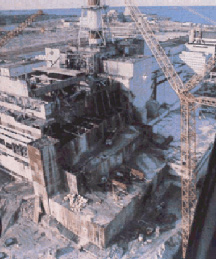
CHERNOBYL – THE FACTS
- The total radioactively released from Chernobyl was 20 times that of the combined releases of the Hiroshima and Nagasaki atomic bombs.
- At least 9 million people have been directly affected by the accident
- Over 160,000 square kilometres of land were contaminated with 42,000 squarekilometres rendered unusable.
- At least 400,000 people were forced to leave their homes in Russia, Ukraine and Belarus.
- Analysis concluded that the former Soviet Union would have been better off financially if it had never begun building nuclear reactors.
- It is estimated that the total cost of compensation paid to UK farmers is over £12 million.
- The Chernobyl disaster has caused a massive increase in thyroid cancers in the three most affected countries of Belarus, Russia and Ukraine.
- The sarcophagus built to contain the damaged reactor was supposed to last 30 years but some 300 yards of cracks and holes are already evident.
- In Ukraine, two million children live in contaminated areas with 900,000 still living in high-risk zones.
- The stricken reactor will remain radioactive for about 10,000 years.
BY MARIANNEWILDART, https://mariannewildart.wordpress.com/2024/04/26/chernobyl-the-cloud-lingers-on/
38th Anniversary of Chernobyl
Today is the 38th Anniversary of the ongoing Chernobyl nuclear disaster. A huge steel and concrete sarcophagus covers the site of the meltdown. Under its dome, called the New Safe Confinement, lie 200 tons of lava-like nuclear fuel, 30 tons of highly contaminated dust and 16 tons of uranium and plutonium that continue to release high levels of radiation. There is a rather odd link with the Russian state nuclear body Rosatom and Cumbria. Until recently Rosatom shared the same PR company as West Cumbria Mining – New Century Media. The coal mine plans have an uncanny resemblance to the Chernobyl sarcophagus
The damage from Chernobyl is ongoing, snowballing down through the generations with tenacious charities such as Chernobyl Children’s Project (UK) and Chernobyl Childern International doing their utmost to support those whose lives continue to be damaged.
Here we re-publish “The Cloud Lingers On”
a hard hitting article from 1996…in non other than Cumbria Life.
The lifestyle magazine, Cumbria Life, is not where you would expect to find a hard- hitting article on Chernobyl and the nuclear industry. But that is exactly what was published in this Cumbrian coffee table magazine in 1996. ….
(the article is in the public domain but not online – any mistakes in transcript are mine)
Ten years ago a cloud washed over the Cumbrian fells, coating the grass, trees, heather, bracken and rocks with a film of radiation. It came from Chernobyl, a ruptured nuclear reactor in the Ukraine, several thousand miles away. Early, confident predictions that the heavy Cumbrian rain, that brought down the radioactive Caesium in the first place would now wash it from the uplands, were quietly buried. No amount of rain was every going to wash away the poison from Chernobyl. Award winning environmental writer Alan Air reports.
At the height of the Cold War, the superpowers hid behind the perverted logic of the military defence acronym MAD – Mutually Assured Destruction – to shore up a global arms industry worth billions of pounds. We pointed our nuclear warheads at them. They pointed their nuclear warheads at us. Would they dare unleash their missiles? Would we dare unleash our missiles? All that awful tension.
Cumbria at first glance a global backwater of lakes, dry stone walls and back packing ramblers, seemed remote from the world stage but it played a part in the divide between West and East; Sellafield’s nuclear complex, the Broughton Moor arms depot, Anthorn’s submarine tracking station and even the Chapelcross nuclear plant just across the Solway Firth were all key components in the UK’s military and nuclear defence strategy.
Britain’s post-war civil atomic power programme was inextricably interwoven with its nuclear defence objectives; no British Government Minister wanted to enter the nuclear conference chamber naked.
Thankfully, Eastern Bloc missiles never did scream over Saddleback or the back o’ Skiddaw but in the spring of 1986, before the Soviet Union started to implode, Cumbrians felt the heat of Cold War politics on its back when an experiment at the Lenin nuclear plant at Chernobyl, in the Ukraine went wrong and Number 4 reactor exploded and threw up over Europe.
Spiralling weather patterns spread the atomic debris to dozens of countries in different time zones, heavy rain brought the radiation down on our county’s mountain tops and the alarms went berserk at Sellafield evoking a home-grown nuclear nightmare, the Windscale fire of ’57 that contaminated large parts of Cumbria and northern England. Chernobyl was nothing if not ironic.
Ten years later and Chernobyl – the noun is now instantly synonymous with the world’s worst nuclear disaster – is now in the hands of a ‘democratic’ Ukraine, but the perilous state of the infamous Number 4 reactor continues to cause concern among the international community. The cracking concrete sarcophagus, hastily erected around the molten core by nuclear workers a the stricken plant, many of whom later died from the radiation, is already crumbling and radioactive water is pouring from the site. Unless a new containment chamber is constructed, and much of the cash would have to come from a kitty topped up by the rich industrial nations of the West, then Chernobyl 2 – The Sequel, is not just a possibility but a probability, warns Janine Allis-Smith of the campaign group Cumbrians Opposed to a Radioactive Environment (CORE).
“Chernobyl proved that you can never, ever guard against human error, someone doing something stupid. Whatever nuclear experts say about the design of the Chernobyl reactor it was human error that triggered the explosion. It is bound to happen again,” she predicts.
In the weeks, months and years after Chernobyl, hundreds of Cumbrian hill farmers faced restrictions on the movement, and sale for meat, of radioactive-contaminated sheep. Initial Government estimates about the time it would take for dangerous radiation to leave the animals were constantly revised upwards as the main components of Chernobyl fallout, Caesium 137 and Caesium 134, persisted in dangerous amounts in the beasts’ tissues.
Early, confident predictions that the heavy Cumbrian rain that brought down the Caesium in the first place, would now wash it from the uplands were quietly buried.
It took scientists at the Merlewood Research Station at Grange over Sands in south Cumbria, to uncover some very down to earth truths about the persistence of cancer causing Caesium in the Cumbrian hills. The irony of the scientific explanation wasn’t lost on the county’s loose alliance of anti-nuclear and ‘green’ campaigners forever kicking up a stink about nuclear waste reprocessing at Sellafield.
It was all to do with recycling.
In the nutrient poor uplands of the Lake District, native grasses and heathers survive by carefully safeguarding what minerals are available. Elements – which in 1986 including Caesium – are taken up by the roots and then circulated to the succulent shoot tips during the growing season. However, they are not lost when the plant sheds its leaves in the Autumn. Instead they are sucked back into the woody, permanent tissues, to be stored for re-use in the Spring. By another quirk of nature, Caesium was readily absorbed by Cumbrian hill vegetation because of a lack of potassium in the upland soil.
Scientists discovered that plants in potassium deficient areas have a Caesium take up rate that is 12 times greater than those plants growing in potassium rich soil. Even more bizarrely, many of Cumbria’s hillside plants enjoy ‘symbiotic’ relationships with ‘mycorrhizal fungi’ – tiny plants that survive by assisting the host plant to take up minerals. In the case of Cumbrian heather, these fungi helped move Caesium from the roots to the shoot tips on which the sheep fed. Even the lack of clay in our upland soil, a material that binds Caesium and hinders root absorption meant that vegetation could easily access this radioactive ion.
No amount of rain was ever going to wash away the poison from Chernobyl.
Sheep feeding on hillside vegetation took in Caesium with every mouthful. For Ennerdale sheep farmer, John Hinde, who has a 1,500 strong flock at Low Moor End, the Chernobyl fallout meant nine stressful years of working within Government restrictions and monitoring. He has survived but recalls: “For a time it looked as if there wasn’t going to be any sheep left on the fells.”
Ten years on and only a dozen or so farms in Cumbria are regulated by movement restrictions compared to nearly 400 in Wales. That would appear to be good news for our farmers, and the mutton-eating consumer. Janine Allis-Smith of CORE isn’t so sure that radiation levels on the fells have declined quite so dramatically as the Government would have us believe, and she suggests that the de-restrictions are rooted in political pragmatism.
“It is interesting that the only area where this massive de-restriction has taken place is the Lake District. It is obviously important that Cumbrian and the whole tourist area is seen to be okay. I think a lot of Cumbrian farmers had their eyes opened when it was discovered that only 50% of the radiation on the hills came from Chernobyl. Some of the stuff was there long before May 1986” she says.
Indeed, scientists confirmed that radioactive contamination of the fells was not confined to Chernobyl but that much of it came from global nuclear bomb testing, the Windscale Fire of 1957 and routine discharges from Windscale, now Sellafield, in the 1960s and 1970s. Allis-Smith cites an aerial survey revealed the Ravenglass Estuary was contaminated by radioactive discharges from Sellafield long before Chernobyl dumped on us.
“If radiation was like confetti, the whole bloody Lake District would be like a wedding cake.” She suggests.
Cumbrian hill farmer’s daughter Jill Perry is equally suspicious of recent de-restrictions in the Lake District,
“The hill farm where I was born and brought up was one of those where milk had to be destroyed after the 1957 Windscale fire and one which, 29 years later, was placed under Chernobyl restrictions and has recently been exempted>” she explains.
“I think most farmers originally thought the Chernobyl testing was just a formality and were surprised and dismayed when they were placed under restriction, and equally wonder why restrictions have been lifted more quickly than those in Wales, where the number of restricted farms seems to fall much more slowly.”
Mrs Perry who now acts as the spokesman for West Cumbrian Friends of the Earth group, sees no point in differentiating between Windscale ’57 and Chernobyl ’86.
“What these two incidents show most graphically is that whether a nuclear accident happens locally or in another country, the radiation recognises no international borders and that we cannot afford to take lightly the risks brought about by human error in a high tech industry.”
The greatest irony of Chernobyl may yet lie ahead. British Nuclear Fuels, the company that now runs Sellafield in West Cumbria (and which has polluted areas of the UK coastline with its radioactive discharges) is now spreading tentacles around the globe. Selling its decontamination services to a tainted world. No-one can rule out experts from Sellafield, the plant that spawned the world’s first ‘civil’ nuclear disaster in 1957 and whose alarms bells rung out loud and clear when the Chernobyl could went over, will not, in the future, ret-trace the path of the Chernobyl radiation plume and venture into the plant’s exclusion zone.
Bridget Woodman, an anti nuclear campaigner with Greenpeace believes that Chernobyl taught Cumbrians about the universal nature of the nuclear power threat.
“When the Chernobyl explosion first appeared on the news bulletins, most Cumbrians probably never envisaged that it would impact directly on them. Yet within a few days, people were watching the skies apprehensively. Cumbrians may have become blasé about Sellafield on their own doorstep but Chernobyl proved that a nuclear disaster can affect them even if its happening thousands of miles away. There is no guarantee of safety. Chernobyl proved there is no escape.
“And while many of the restrictions on sheep movements in Cumbria have now been lifted, we should remember that there is no safe dose of radiation. No-one knows what the legacy of Chernobyl fallout will be on existing and future generations of Cumbrians.
RED GROUSEThe Red Grouse has escaped media attention but its almost exclusive diet of succulent heather shoots means that many birds will have concentrated Caesium in their bodies post Chernobyl. Work prior to the Chernobyl disaster established that the heather family, Ericaceae, could accumulate high concentrations of Caesium. Since then, surveys in the Lake District have revealed that one species of heather, calluna vulgaris, accumulates the highest Caesium burden.
CHERNOBYL – THE FACTS
- The total radioactively released from Chernobyl was 20 times that of the combined releases of the Hiroshima and Nagasaki atomic bombs.
- At least 9 million people have been directly affected by the accident
- Over 160,000 square kilometres of land were contaminated with 42,000 squarekilometres rendered unusable.
- At least 400,000 people were forced to leave their homes in Russia, Ukraine and Belarus.
Analysis concluded that the former Soviet Union would have been better off financially if it had never begun building nuclear reactors.- It is estimated that the total cost of compensation paid to UK farmers is over £12 million.
- The Chernobyl disaster has caused a massive increase in thyroid cancers in the three most affected countries of Belarus, Russia and Ukraine.
- The sarcophagus built to contain the damaged reactor was supposed to last 30 years but some 300 yards of cracks and holes are already evident.
- In Ukraine, two million children live in contaminated areas with 900,000 still living in high-risk zones.
- The stricken reactor will remain radioactive for about 10,000 years. ENDS
Indian Nuclear Sites Impact South Tibetan Plateau Radioactivity
Chinese Academy of Sciences, 24 Apr 24 https://www.miragenews.com/indian-nuclear-sites-impact-south-tibetan-1222069/
A recent study published in Environmental Science & Technology Letter has shed light on the long-range transboundary transport of radioactive iodine-129 (129I) from the Indian nuclear fuel reprocessing plants (NFRPs) to the Southern Tibetan Plateau (STP).
This study, conducted by researchers from the Institute of Earth Environment of the Chinese Academy of Sciences (CAS), provides a new understanding of the transport of airborne radioactive pollutants from low to high altitudes, and may have implications for environmental protection on the Tibetan Plateau.
The Tibetan Plateau, known as the “Third Pole of the Earth” and the “Roof of the World,” is a remote, isolated, and presumably pristine region. Previous studies of radioactive contamination have focused primarily on the northern TP, leaving little knowledge of the STP. Primarily originating from human nuclear activities, iodine-129, with its properties of high volatility and radiation risk of short-lived radioiodine, serves as a key radionuclide for nuclear environmental safety monitoring.
In this study, the researchers have meticulously investigated the spatial variation of 129I in the bioindicators, moss and lichen, from the STP.
They found that 129I in the STP was significantly higher than the pre-nuclear levels and those in Chinese inland cities, but two-four orders of magnitude lower than those in the vicinity of the Indian and European NFRPs.
Analysis of the 129I discharge history in conjunction with the wind field indicates that the Indian NFRPs are the primary sources of 129I in the STP. The prevailing ISM plays a crucial role in the transport of 129I from the lowland to the high-altitude STP. The transport process is further enhanced by the summertime overlying heat pump, but is weakened by topographic blocking, forest adsorption, and cold trapping.
The spatial distribution of 129I and 127I in lichens distributed on Mt. Galongla shows that the Yarlung Zangbo Grand Canyon serves as a key transport channel.
“It is much beyond our expectation that Indian NFRPs have such a significant impact on the Tibetan Plateau. Since there are many nuclear facilities in operation and under construction in India, the radiation risk is just there. So we still need more data to find out the extent and scope of such impacts,” said Dr. ZHANG Luyuan, corresponding author of this study.
This work was supported by the second comprehensive scientific expedition to the Qinghai-Tibetan Plateau, CAS and the National Natural Science Foundation of China.
Japan starts 5th ocean discharge of Fukushima nuclear-tainted wastewater despite opposition

(Xinhua) Web editor: Zhang Kaiwei, Liang Jun, April 19, 2024
TOKYO, April 19 (Xinhua) — Japan on Friday started the fifth-round of release of nuclear-contaminated wastewater from the crippled Fukushima Daiichi Nuclear Power Plant into the Pacific Ocean.
Despite opposition among local fishermen, residents as well as backlash from the international community, Tokyo Electric Power Company (TEPCO), the plant’s operator, started discharging the radioactive wastewater in the morning, the first round in fiscal 2024.
Similar to the previous four rounds, about 7,800 tons of the wastewater, which still contains tritium, a radioactive substance, will be discharged until May 7.
TEPCO analyzed the water stored in the tank scheduled for release, and found that the concentrations of all radioactive substances other than tritium were below the national release standards, while the concentration of tritium that cannot be removed will be diluted with seawater, Japanese newspaper Asahi Shimbun reported.
TEPCO will measure the concentration of radioactive substances such as tritium in the surrounding waters every day during the period to investigate the effects of the release, it added.
The Fukushima nuclear-contaminated water release began in August 2023, and a total of about 31,200 tons of the water was released in four rounds in fiscal 2023, which ended in March.
In fiscal 2024, TEPCO plans to discharge a total of 54,600 tons of contaminated water in seven rounds, which contains approximately 14 trillion becquerels of tritium.
Coral bleaching: Fourth global mass stress episode underway – US scientists
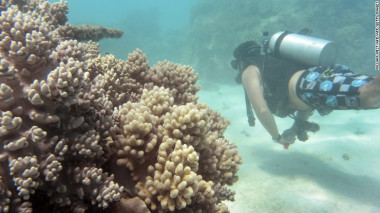
Coral around the world is turning white and even dying as recent record
ocean heat takes a devastating toll. It has triggered the fourth global
mass coral bleaching event, according to the US National Oceanic and
Atmospheric Administration (NOAA).
Bleaching happens when coral gets
stressed and turns white because the water it lives in is too hot. Coral
sustains ocean life, fishing, and creates trillions of dollars of revenue
annually.
Ocean heat records have been falling for months but this is the
first global evidence of how this episode is affecting sea life. The US
National Oceanic and Atmospheric Administration (NOAA) confirmed the mass
stress in all oceans (the Atlantic, Pacific and Indian Ocean) after weeks
of receiving reports from scientists globally. The bleached coral can look
beautiful in pictures but scientists that dive to examine the reefs say
that up close the coral is clearly ill and decaying.
BBC 15th April 2024
New Hinkley nuclear power plant expected to kill 46 tonnes of fish a year.

EDF building £50m nature reserve near Hinkley Point to compensate for loss of life
Jonathan Leake, 16 April 2024
A nature reserve is to be flooded by the developer of the Hinkley Point C nuclear plant at a cost of £50m to compensate for the death of fish in its cooling pipes…
An 840 acre swathe of land along the Parrett
estuary in Somerset will be transformed into salt marsh as a habitat for
marine life to replace fish sucked in by the new power station’s cooling
ducts. The area affected – part of the Somerset levels, where Saxon king
Alfred the Great is said to have hidden from the Vikings – includes
farmers’ fields used for grazing, as well as a nature reserve.
EDF, the French company building Hinkley Point, will create a new nature reserve
nearby to replace the land being lost. The overall changes are expected to
cost it £50m. The massive water intakes used to suck water from the
Bristol Channel to cool Hinkley Point C’s reactors are expected to kill
up to 46 tonnes of fish a year when the plant opens in 2031.
EDF also explored installing an acoustic fish deterrent, effectively a loud noise to
ward away animals, but concluded this would cause more harm than it
prevented. Chris Fayers, the company’s head of environment at Hinkley,
said: “An acoustic fish deterrent would use 280 speakers to make noise
louder than a jumbo jet 24-hours a day for 60 years with unknown impacts on
other species like porpoises, seals, whales. “It offers a very
small potential benefit to protected fish species and would also risk the
safety of divers in the fast-flowing tides of the Bristol Channel. New
natural habitat is a better solution.”
EDF said it was working with
Natural England, the Environment Agency, and other conservation
bodies to develop the new natural habitats. It plans to take out
compulsory purchase orders to acquire the land and then destroy its
protective dykes so that saltwater can flood in, according to planning
documents.
Dozens of farmers around Pawlett Hams, north of Bridgwater in
Somerset, have been told their grazing land is likely to become salt marsh.
One said: “It’s an existential threat to farmers’ livelihoods.” EDF
has told local people: “We are proposing to create 340 hectares of salt
marsh habitat. Will Barnard, chair of the Pawlett Parish Council, who also
works as an environmental land manager on some of the affected land, said
no-one was happy with the scheme.
Telegraph 16th April 2024
Environmental impacts of underground nuclear weapons testing

While underground nuclear tests were chosen to limit atmospheric radioactive fallout, each test still caused dynamic and complex responses within crustal formations. Mechanical effects of underground nuclear tests span from the prompt post-detonation responses to the enduring impacts resulting in radionuclide release, dispersion, and migration through the geosphere. Every test of nuclear weapons adds to a global burden of released radioactivity (Ewing 1999).
Bulletin, By Sulgiye Park, Rodney C. Ewing, March 7, 2024
Since Trinity—the first atomic bomb test on the morning of July 16, 1945, near Alamogordo, New Mexico—the nuclear-armed states have conducted 2,056 nuclear tests (Kimball 2023). The United States led the way with 1,030 nuclear tests, or almost half of the total, between 1945 and 1992. Second is the former Soviet Union, with 715 tests between 1949 and 1990, and then France, with 210 tests between 1960 and 1996. Globally, nuclear tests culminated in a cumulative yield of over 500 megatons, which is equivalent to 500 million tons of TNT (Pravalie 2014). This surpasses by over 30,000 times the yield of the first atomic bomb dropped on Hiroshima on August 6, 1945.
Atmospheric nuclear tests prevailed until the early 1960s, with bombs tested by various means: aircraft drops, rocket launches, suspension from balloons, and detonation atop towers above ground. Between 1945 and 1963, the Soviet Union conducted 219 atmospheric tests, followed by the United States (215), the United Kingdom (21), and France (3) (Kimball 2023).
In the early days of the nuclear age, little was known about the impacts of radioactive “fallout —the residual and activated radioactive material that falls to the ground after a nuclear explosion. The impacts became clearer in the 1950s, when the Kodak chemical company detected radioactive contamination on their film, which was linked to radiation resulting from the atmospheric nuclear tests (Sato et al. 2022). American scientists, like Barry Commoner, also discovered the presence of strontium 90 in children’s teeth originating from nuclear fallout thousands of kilometers from the original test site (Commoner 1959; Commoner 1958; Reiss 1961). These discoveries alerted scientists and the public to the consequences of radioactive fallout from underwater and atmospheric nuclear tests, particularly tests of powerful thermonuclear weapons that had single event yields of one megaton or greater.
Public concerns for the effects of radioactive contamination led to the Limited (or Partial) Test Ban Treaty, signed on August 5, 1963. The treaty restricted nuclear tests from air, space, and underwater (Atomic Heritage Foundation 2016; Loeb 1991; Rubinson 2011). And while the treaty was imperfect with only three signatories at the beginning (the United States, the United Kingdom, and the Soviet Union), the ban succeeded in significantly curbing atmospheric release of radioactive isotopes.
After the entry into force of the partial test ban, almost 1,500 underground nuclear tests were conducted globally. Of the 1,030 US nuclear tests, nearly 80 percent, or 815 tests (See Table 1 on original ), were conducted underground, primarily at the Nevada Test Site.[1] As for other nuclear powers, the Soviet Union conducted 496 underground tests, mostly in the Semipalatinsk region of Kazakhstan, France conducted 160 underground tests, the United Kingdom conducted 24, and China 22. These underground nuclear tests were in a variety of geologic formations (e.g., basalt, alluvium, rhyolite, sandstone, shale) to depths up to 2,400 meters.
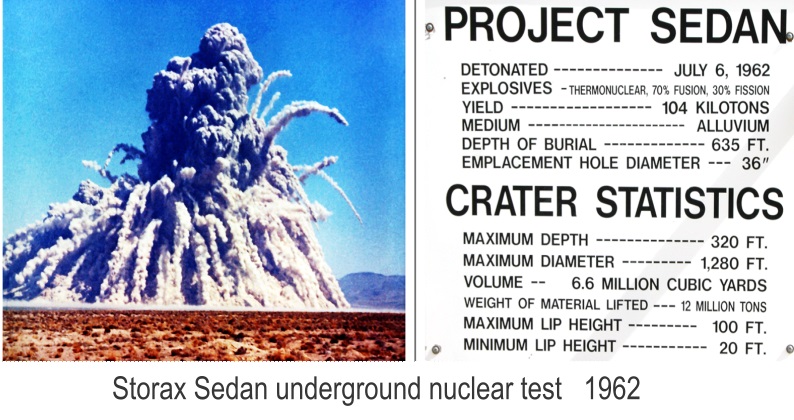
In 1996, after some international efforts to curb nuclear testing and promote disarmament, the Comprehensive Test Ban Treaty (CTBT) was negotiated, which prohibited all nuclear explosions (General Assembly 1996). Since the negotiation of the CTBT, India and Pakistan conducted three and two underground nuclear tests, respectively, in 1998. And today, North Korea stands as the only country to have tested nuclear weapons in the 21st century.
While underground nuclear tests were chosen to limit atmospheric radioactive fallout, each test still caused dynamic and complex responses within crustal formations. Mechanical effects of underground nuclear tests span from the prompt post-detonation responses to the enduring impacts resulting in radionuclide release, dispersion, and migration through the geosphere. Every test of nuclear weapons adds to a global burden of released radioactivity (Ewing 1999)…………………………………………………………………………
………………………………………………………………….. Containment failures and nuclear accidents
Underground nuclear tests are designed to limit radioactive fallout and surface effects. However, containment methods are not foolproof, and radioisotopes, which are elements with neutrons in excess making them unstable and radioactive, can leak into the surrounding environment and atmosphere, posing potential risks to ecosystems and human health.
Instances of radiation leaks were not uncommon…………………………………..
Unintended radioactive releases from underground nuclear tests occurred through venting or seeps, where fission products and radioactive materials were uncontrollably released, driven by pressure from shockwave-induced steam or gas. In rare cases, more serious nuclear accidents occurred due to incomplete geological assessments of the surrounding medium in preparation for the test. A notable example of accidental release is the Baneberry underground nuclear test on December 18, 1970, which, according to the federal government, resulted in an “unexpected and unrecognized abnormally high water content in the medium surrounding the detonation point” ……………………………………………………………………………………………
Mechanical and radiation effects of underground nuclear tests
Three main factors affect the mechanical responses of underground nuclear tests: the yield, the device placement (i.e., depth of burial, chamber geometry, and size), and the emplacement medium (i.e., rock type, water content, mineral compositions, physical properties, and tectonic structure). These factors influence the physical response of the surrounding geological formations and the extent of ground displacement, which, in turn, determine the radiation effects by influencing the timing and fate of the radioactive gas release.
Every kiloton of explosive yield produces approximately 60 grams (3 × 10¹² fission product atoms) of radionuclides (Smith 1995; Glasstone and Dolan 1977). Between 1962 and 1992, underground nuclear tests had a total explosive yield of approximately 90 megatons (Pravalie 2014), producing nearly 5.4 metric tons of radionuclides. ……………………………………………….
……………………………..The partitioning of radionuclides between the melt glass and rubble significantly impacts the subsequent transfer of radioactivity to groundwater.
…………………………Temperatures produced by large explosions can change the permeability, porosity, and water storage capacity by creating new fractures, cavities, and chimneys……………………. The explosion also affects the porosity of the surrounding rock. For example, a fully contained explosion of 12.5-kiloton yield in Degelen Mountain at the former Soviet Union’s Semipalatinsk test site resulted in up to a six-fold increase in porosity within the crush zone surrounding the cavity (Adushkin and Spivak 2015). Increased permeability and porosity of the surrounding rock can lead to more radionuclides being released, as more groundwater can pass through the geologic formation.
Hydrogeology and release of radioactivity
The main way contaminants can be moved from underground test areas to the more accessible environment is through groundwater flow. …………………………………………..
Given their long half-lives (Table 2 on original ), the ability of plutonium isotopes to migrate over time raises concerns about the long-term impacts and challenges in managing radioactive contamination.
In all these cases, colloid-facilitated transport allowed for the migration of radioactive particles through groundwater flow over an extended period—long after the nuclear tests or discharge occurred (Novikov et al. 2006). ………………………
The risks associated with the environmental contamination from underground nuclear tests have often been considered low due to the slow movement of the groundwater and the long distance that separates it from publicly accessible groundwater supplies. But these studies demonstrate that apart from prompt effect of radioactive gas releases from instantaneous changes in geologic formations, long-term effects persist due to the evolving properties of the surrounding rocks long after the tests. Long-lived radionuclides can be remarkably mobile in the geosphere. Such findings underscore the necessity for sustained long-term monitoring efforts at and around nuclear test sites to evaluate the delayed impacts of underground nuclear testing on the environment and public health.
Enduring legacy
Nearly three decades after the five nuclear-armed states under the CTBT stopped testing nuclear weapons both in the atmosphere and underground, the effects of past tests persist in various forms—including environmental contamination, radiation exposure, and socio-economic repercussions—which continue to impact populations at and near closed nuclear test sites (Blume 2022). The concerns are greater when the test sites are abandoned without adequate environmental remediation. This was the case with the Semipalatinsk test site in Kazakhstan that was left unattended after the fall of the Soviet Union in 1991, before a secret multi-million effort was made by the United States, Russia, and Kazakhstan to secure the site (Hecker 2013). The abandonment resulted in heavy contamination of soil, water, and vegetation, posing significant risks to the local populations (Kassenova 2009).
In 1990, the US Congress acknowledged the health risks from nuclear testing by establishing the Radiation Exposure Compensation Act (RECA), which provides compensation to those affected by radioactive fallout from nuclear tests and uranium mining. Still, there are limitations and gaps in coverage that leave many impacted individuals, including the “downwinders” from the Trinity test site without compensation for their radiation exposure (Blume, 2023). The Act is set to expire in July 2024, potentially depriving many individuals without essential assistance. Over the past 30 years, the RECA fund paid out approximately $2.5 billion to impacted populations (Congressional Research Service 2022). For comparison, the US federal government spends $60 billion per year to maintain its nuclear forces (Congressional Budget Office 2021).
As the effects of nuclear testing still linger, today’s generations are witnessing an increasing concern at the possibility of a new arms race and potential resumption of nuclear testing (Drozdenko 2023; Diaz-Maurin 2023). The concern is heightened by activities in China and North Korea and with Russia rescinding its ratification of the CTBT. Even though the United States maintains a moratorium on non-subcritical nuclear tests, its decision not to ratify the test ban treaty shows a lack of international leadership and commitment. As global tensions and uncertainties arise, it is critical to ensure global security and minimize the risks to humans and the environment by enforcing comprehensive treaties like the CTBT. Transparency at nuclear test sites should be promoted, including those conducting very-low-yield subcritical tests, and the enduring impacts of past nuclear tests should be assessed and addressed.
Endnotes………………………………………………………………more https://thebulletin.org/premium/2024-03/environmental-impacts-of-underground-nuclear-weapons-testing/?utm_source=Newsletter&utm_medium=Email&utm_campaign=MondayNewsletter04152024&utm_content=NuclearRisk_EnvironmentalImpactsNuclearTests_03072024
Not content with nuclear wastes to the seas, the nuclear lobby now wants floating nuclear power – (for the environment! they say).
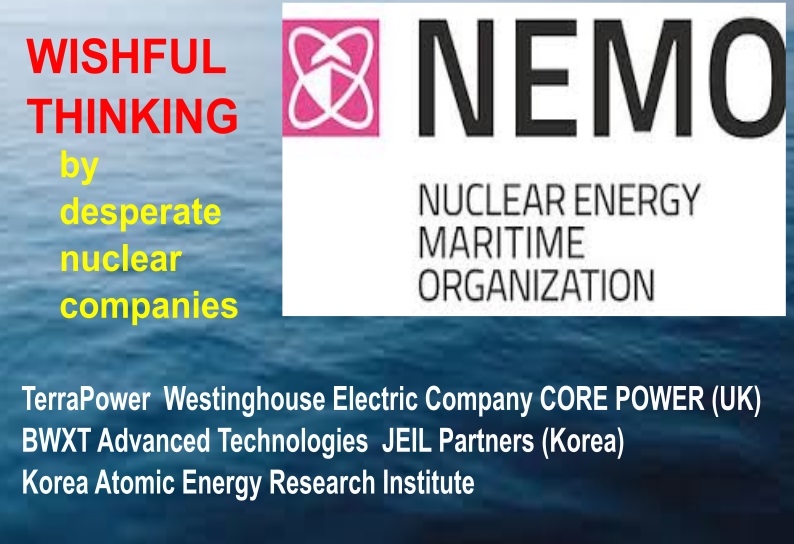
New association for maritime nuclear created
OFFSHORE ENERGY , April 3, 2024, by Naida Hakirevic Prevljak
A global group of companies with a common interest in developing nuclear energy solutions for the maritime sector have launched Nuclear Energy Maritime Organization (NEMO).
To be headquartered in London, NEMO will officially start activities in the second quarter of 2024.
By bringing together stakeholders with relevant expertise, NEMO aims to assist nuclear and maritime regulators in the development of appropriate standards and rules for the deployment, operation and decommissioning of floating nuclear power………………………………
Advanced nuclear technologies deployed at sea can reduce environmental impact, enhance social responsibility, and increase economic competitiveness. NEMO aims to provide a platform for its members to network and facilitate a functional connection between regulators to foster development and exchange best practices.
NEMO’s inaugural members are South Korean shipbuilder HD KSOE, the UK-based classification society Lloyd’s Register, American manufacturing and engineering company BWXT Advanced Technologies, American nuclear innovation company TerraPower, Japanese shipbuilder and ship repairer Onomichi Dockyard, American nuclear reactor designer and vendor Westinghouse Electric Company, Anglo-American maritime nuclear innovation company CORE POWER (UK), Fincantieri subsidiary VARD Group, French classification society Bureau Veritas, Italian classification society RINA, and Korean developer, consultant serving nuclear supply chain JEIL Partners.
……………………………………. The organization plans to hold regular events, workshops, webinars, and publications for its members and the wider public. The organization also intends to collaborate with other industry associations, government bodies, academic institutions, and civil society organizations to advance the cause of floating nuclear power.
In related news, Korean industry majors, led by shipping companies HMM and Sinokor, forged an alliance last year to develop nuclear-powered ships.
Under the agreement, the partners aim to develop and demonstrate how small modular nuclear reactors can be used to propel ships. The project will also investigate the development of relevant marine system interface and propulsion technology as well as the production of hydrogen using molten salt reactors (MSR). https://www.offshore-energy.biz/new-association-for-maritime-nuclear-created/
1 This Month



Shut down the radiation-damaged Heysham nuclear reactors now
To see nuclear-related stories in greater depth and intensity – go to https://nuclearinformation.wordpress.com

Say No to NASA’s Reckless Nuclear Reactor on the Moon
Say No to NASA’s Reckless Nuclear Reactor on the Moon
-
Archives
- October 2026 (255)
- September 2026 (339)
- August 2026 (330)
- July 2026 (355)
- June 2026 (287)
- May 2026 (306)
- April 2026 (356)
- March 2026 (251)
- February 2026 (267)
- January 2026 (308)
- December 2025 (358)
- November 2025 (359)
-
Categories
- 1
- 1 NUCLEAR ISSUES
- business and costs
- climate change
- culture and arts
- ENERGY
- environment
- health
- history
- indigenous issues
- Legal
- marketing of nuclear
- media
- opposition to nuclear
- PERSONAL STORIES
- politics
- politics international
- Religion and ethics
- safety
- secrets,lies and civil liberties
- spinbuster
- technology
- Uranium
- wastes
- weapons and war
- Women
- 2 WORLD
- ACTION
- AFRICA
- Atrocities
- AUSTRALIA
- Christina's notes
- Christina's themes
- culture and arts
- Events
- Fuk 2022
- Fuk 2023
- Fukushima 2017
- Fukushima 2018
- fukushima 2019
- Fukushima 2020
- Fukushima 2021
- general
- global warming
- Humour (God we need it)
- Nuclear
- RARE EARTHS
- Reference
- resources – print
- Resources -audiovicual
- Weekly Newsletter
- World
- World Nuclear
- YouTube
-
RSS
Entries RSS
Comments RSS

