Confusion in estimating Fukushima radiation
TEPCO estimate sees more radiation than NISA’s, The Yomiuri Shimbun, 24 May 12 Tokyo Electric Power Co. has estimated the total amount of radioactive substances discharged from its Fukushima No. 1 nuclear power plant measured 760,000 terabecquerels, 1.6 times the estimate released by the Economy, Trade and Industry Ministry’s Nuclear and Industrial Safety Agency in February. Continue reading
Uranium mining in Tanzania’s World Heritage Site?
The Selous cannot remain a World Heritage Site if the Tanzanian government gives the go-ahead for mining to start within the property,”
Unesco to decide on uranium mining at Selous next month 18 May 2012 By Lucas Liganga The Citizen Dar es Salaam. The Unesco World Heritage Committee (UWHC) will break the deadlock next month when it will decide whether or not to allow
mining of uranium in Selous Game Reserve, one of the largest remaining wilderness areas in Africa, harbouring the largest elephant population on the continent. Continue reading
Radioactive contamination at Scottish RAF base
Radiation probe launched at RAF Kinloss http://www.scotsman.com/news/scottish-news/top-stories/radiation-probe-launched-at-raf-kinloss-1-230528019 May 2012 RAF Kinloss in Moray is being investigated by the Ministry of Defence (MoD) to determine the extent of radioactive contamination at the base, it emerged last night. Continue reading
Increased radiation in Tokyo Bay
Radiation increasing in Tokyo Bay May 18, 2012 “If the contamination were to spread to fish, it is possible that radioactive isotopes could accumulate when bigger fish feed on smaller ones.” — Hideo Yamazaki
Radioactive contamination from Japan’s Fukushima nuclear disaster has risen sharply in Tokyo Bay over the past several months rather than decline, according to a new study.
Researcher Hideo Yamazaki from Osaka’s Kinki University found that contaminated sludge has accumulated due to runoff into the bay from rivers flowing from highly contaminated regions. This has caused radioactive cesium levels to rise by 1.5 to 13 times since August, Yamazaki says.
Radiation to be measured in monkeys in Fukushima forests
The group plans to target monkeys in southern Minami-Soma in the prefecture, an area that was inside the no-entry zone around the crippled nuclear plant until mid-April. Relatively high radiation levels have been recorded in the area.
“It’s difficult to accurately gauge how much radioactive cesium has
contaminated mountain forests because the substance is easily moved by
rainwater and by other natural conditions,”
 Wild monkeys to help gauge Fukushima radiation http://www.yomiuri.co.jp/dy/national/T120511004760.htm The Yomiuri Shimbun, 11 May 12, FUKUSHIMA–Wild Japanese monkeys wearing special collars fitted with dosimeters and Global Positioning System devices will be used to measure radiation levels in the mountain forests of Fukushima Prefecture in an experiment due to start this month.
A group of researchers at Fukushima University plans to start the experiment to determine the dispersal of radiation due to the crisis at the Fukushima No. 1 nuclear power plant and support decontamination work. Continue reading
Migrating birds from Japan to be tested for radiation
Kamchatka testing migrant birds for radiation Zee News, India, April 30, 2012, Petropavlovsk-Kamchatsky: Migrant birds arriving in Kamchatka from the side of Japan will be tested for radiation, the Kamchatka government said..
.. Up to 1,00,000 geese and about 1 million ducks come to Kamchatka in spring. Many of these birds might have nested on Japanese islands or flown over lands polluted with radiation in the Fukushima nuclear power plant accident in spring 2011, which makes the tests necessary.
The Kamchatka territory already tested migrant birds for radiation in 2011. No radioactive birds were found back then. http://zeenews.india.com/news/eco-news/kamchatka-testing-migrant-birds-for-radiation_772517.html
Canada avoids testing ocean salmon for radiation

 Canadians track Japanese tsunami debris, but won’t systematically test salmon for radiation http://www.straight.com/article-672746/vancouver/canadians-track-japanese-tsunami-debris-wont-systematically-test-salmon-radiation by Charlie Smith April 29, 2012 The Maritime Museum of B.C. has created a Facebook page devoted to collecting photos of debris from last year’s Japanese tsunami.
The majority of the material floating across the Pacific Ocean is not expected to arrive in B.C. until 2013 and 2014.
What I find interesting is that there still doesn’t appear to be a Facebook page concerning the potential effect of the Fukushima nuclear accident on the Canadian food supply.
Earlier this month, Straight reporter Carlito Pablo wrote an article noting that the Canadian Food Inspection Agency has no plans to systematically test next year’s wild salmon for radioactivity.
These fish travel through the same waters as the flotsam and jetsam coming from Japan, where a devastating nuclear accident crippled the Fukushima power plant.
It’s okay to keep records of the garbage—but as far as the Conservative government is concerned, it appears to be not okay to examine if any of it is ending up in our digestive tracts.
Salp invasion cuts nuclear power output
 Jellyfish-like creatures force California nuclear power plant to curtail operations By Steve Chawkins / Los Angeles Times, April 26, 2012 LOS ANGELES — Strange, jellyfish-like creatures swarming a coastal nuclear power plant: It might sound like the premise of a cult horror flick, but the invasion has prompted officials at the Diablo Canyon facility in San Luis Obispo, Calif., to curtail operations for at least a few days.
The plant’s operator, Pacific Gas & Electric, cut power generation from one of the plant’s two reactors to 25 percent of its capacity, spokesman Tom Cuddy said Wednesday. The other reactor was shut down this week for what PG&E described as routine refueling and
maintenance, a procedure that could take about a month.
Workers on Monday discovered an influx of the creatures, called salp, clogging screens that are used to keep marine life out of the sea water used as a coolant, Cuddy said. Often thronging many square miles of ocean in huge, gelatinous masses, salp are tubular, transparent organisms that can be roughly the size of a human thumb. No one knows how many are at the Avila Beach plant or how long they will remain…
.. Jellyfish swarmed Diablo Canyon in 2008, triggering a steep, sudden decrease in power generation. Over the years, they have been a problem at nuclear plants in the U.S., Japan, Israel andScotland. …. http://news.bostonherald.com/news/national/west/view/20120426jellyfish-like_creatures_force_california_nuclear_power_plant_to_curtail_operations/srvc=home&position=recent
Cesium 137 and the follies of Chernobyl and Fukushima
 The Fukushima Nuclear Disaster Is Far From Over HUFFINGTON POST, Robert Alvarez, Senior Scholar, Institute for Policy Studies, 22 April 12, “….It’s been 26 years, since the Chernobyl reactor exploded and caught fire releasing enormous amounts of radioactive debris — seriously contaminating areas over a thousand miles away. Chernobyl revealed the folly of not having an extra barrier of thick concrete and steel surrounding the reactor core that is required for modern plants, in the U.S., Japan and elsewhere. The Fukushima Dai-Ichi accident revealed the folly of operating several nuclear power plants in a high consequence earthquake zone while storing huge amounts of highly radioactive spent fuel in vulnerable pools, high above the ground.
What both accidents have in common is widespread environmental contamination from cesium-137. With a half-life of 30, years, Cs-137 gives off penetrating radiation, as it decays and can remain dangerous for hundreds of years. Once in the environment, it mimics potassium as it accumulates in the food chain. When it enters the human body, about 75 percent lodges in muscle tissue, with, perhaps, the most important muscle being the heart.http://www.huffingtonpost.com/robert-alvarez/the-fukushima-nuclear-dis_b_1444146.html
Uranium mining damages health of workers and environment
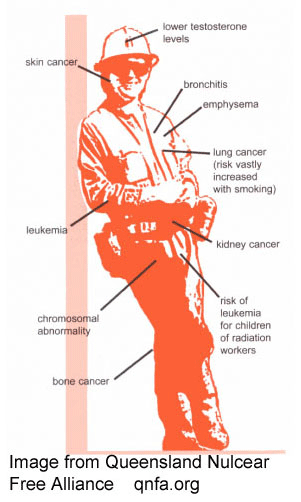 the World Health Organisation (WHO) acknowledges that Radon, which is a heavy gaseous radioactive chemical, is the second cause of lung cancer after smoking.
Uranium, even when purified, Chareyron said is radioactive and miners cannot really be protected from it.
 Concerns over uranium mining New Era, 12 Apr 2012 – by Irene Hoaës WINDHOEK – Renewed concern has been expressed regarding uranium mining activities along the coastal areas and its impact on the environment following tests undertaken by the Commission for Independent Research and Information about Radiation (CRIIRAD) and EARTHLIFE Namibia.
These mining activities have a direct bearing on people’s health as they reportedly cause cancer, especially to people that get exposed to them.
According to CRIIRAD, people that spend 30 minutes to 35 hours at a distance below 25 meters from the waste rock dump, would receive an external radiation dose above the trivial dose of 10 microsieverts per year.
One of the main concerns is uranium concentrates found in underground water sources and on sediments in areas where Rössing and the Langer Heinrich mines are found, especially along the Khan and Gawib rivers.
According to Bruno Chareyron, a Nuclear Physics Engineer and Director of the CRIIRAD Laboratory, the radioactive tailings (waste) of the mines are not covered and dust particles from the tailings are accumulating on bushes and slopes.
“When it rains, this dust is even washed off the waste rock dumps that are situated next to the river banks and therefore deposited into the river system,” the nuclear engineer said. Continue reading
In the world of birds, radiation is more damaging to females
the tertiary sex ratio (here defined as the proportion of males among adults) was skewed towards an excess of males across 48 different bird species. This finding is in accordance with lower adult survival rates in females compared to males previously reported for barn swallows in contaminated areas around Chernobyl …..
Female barn swallows suffer differentially from the mortality costs of radiation, with male adult survival being reduced by 24%, while female survival is reduced by 57% in contaminated areas compared to controls
Elevated Mortality among Birds in Chernobyl as Judged from Skewed Age and Sex Ratios PLoS One 13 April 12, “….Radiation has negative effects on survival of animals including humans, although the generality of this claim is poorly documented under low-dose field conditions.
Because females may suffer disproportionately from the effects of radiation on survival due to differences in sex roles during reproduction, radiation-induced mortality may result in
male-skewed adult sex ratios. Continue reading
The bitter history of Malaysia’s Bukit Merah rare earths project.
 Some of the surviving residents of Bukit Merah are still plagued with severe health problems. Until this very day, the Malaysian authorities refuse to acknowledge that the radioactive waste was responsible for the sudden escalation of health problems among the residents
Today, the government is the official custodian of this repository in Bukit Merah. This site in Bukit Merah is declared as a restricted and dangerous dump site for radioactive materials but a curtain of official silence has descended on it. Has the government not learnt from Bukit Merah?
The Lynas project is likely to be a replay of the ARE fiasco but on a much larger scale.
The benefits gained by Malaysia from the Lynas investment are very little relative to the risks involved. Whilst the profits of the project go to Lynas (untaxed) and the few Malaysian companies that are involved in the construction of and the provision of supplies to the Gebeng rare earth plant, the radioactive waste will remain in
Malaysian soil for hundreds of years.
 Lynas issue: Not learning from bitter experience —The Malaysian Insider, Richard Pendragon, April 12, 2012 “……..Bukit Merah The history of the rare earth industry in Malaysia is little known to most Malaysians. Most Malaysians in fact think that the Lynas project in Pahang is the first time Malaysia has been associated with this industry.
Few Malaysians actually know that there was a rare earth plant in Bukit Merah, Perak, which has been closed some 10 or more years ago, following a ruling by the High Court of Malaysia that the company involved was in negligence, and that the radioactive waste generated by the plant was dangerous and had to be removed and secured in a safe
place away from people for hundreds of years.
The evidence of the hazardous legacy of this rare earth plant is still present in our midst as a reminder to every one of the risks involved. Continue reading
Unacceptable risks of thorium
 Lynas issue: Not learning from bitter experience —The Malaysian Insider, Richard Pendragon, April 12, 2012 “…..Unacceptable risks of thorium “No monetary returns of whatever Foreign Direct Investment and its spinoffs can outweigh possible radiation and/or other health risks,
which can wreak harm on our citizens, perhaps for as long as the half-lives of some of the extremely toxic radionuclide waste products —which in some cases might be ‘forever’!”
Dr David KL Quek, President, Malaysian Medical Association (MMA), May 26, 2011 One of the most contentious issues with the Lynas Advanced Materials Plant is the thorium (Th) by-product. Exposure to Thorium can cause cancer posing serious risks to workers at the LAMP and surrounding communities. Studies have shown that inhaling thorium dust causes an increased risk of developing lung cancer, and cancer of the pancreas. Bone cancer risk is also increased because thorium may be stored in bone. Thorium has a half life of 14 billion years and is easily transported and spread through wind and water.
Lynas will be processing 10 times the amount of ore compared to the ARE. Despite Lynas’ public proclamation of “Zero Harm” commitment there is no foolproof containment measures for such toxic residue for workers onsite at the LAMP. It should be noted that the ores that Chinese miners were exposed to in Bayun Obo Rare-Earth and Iron Mine
contained 400 ppm of thorium. The rare earth oxide concentrates that will be arriving shortly at Kuantan port will have 1600 ppm of thorium. The US Public Health Service (1990) reports that the natural background level in soil is typically 6 ppm of thorium.
http://www.themalaysianinsider.com/sideviews/article/lynas-issue-not-learning-from-bitter-experience-richard-pendragon
Radioactive particles in ocean and atmosphere arriving at California
seaweed along California’s coastline is already measuring 500 times higher in radioactive iodine.
Fukushima Radiation Coming Soon to a Coastline Near You, Take Part, 9 April 12, “……. It turns out the Japanese are not the only ones worried about radiation exposure one year after the Fukushima Dai-ichi nuclear plants flooded and melted down. Californians are now number two on the list. Continue reading
Fukushima evacuees will be returning to a still contaminated zone
Decontamination needed even after residents return, The Yomiuri Shimbun, 10 April 12, If decontamination work does not continue for a certain period in areas highly contaminated by radioactive substances from the Fukushima No. 1 nuclear power plant, returning residents will be exposed to at least 100 millisieverts of accumulated radiation over 30 years, the Science Council of Japan said Monday. Continue reading
1 This Month
26 September – International Day for the Total Elimination of Nuclear Weapons





PLEASE OPPOSE HR 8255 AND S.3639 – bills would accelerate satellite deployment, with no environmental review or safeguards – https://ncstd5li.quorum.us/campaign/169331/
To see nuclear-related stories in greater depth and intensity – go to https://nuclearinformation.wordpress.com
-
Archives
- September 2026 (290)
- August 2026 (330)
- July 2026 (355)
- June 2026 (287)
- May 2026 (306)
- April 2026 (356)
- March 2026 (251)
- February 2026 (267)
- January 2026 (308)
- December 2025 (358)
- November 2025 (359)
- October 2025 (375)
-
Categories
- 1
- 1 NUCLEAR ISSUES
- business and costs
- climate change
- culture and arts
- ENERGY
- environment
- health
- history
- indigenous issues
- Legal
- marketing of nuclear
- media
- opposition to nuclear
- PERSONAL STORIES
- politics
- politics international
- Religion and ethics
- safety
- secrets,lies and civil liberties
- spinbuster
- technology
- Uranium
- wastes
- weapons and war
- Women
- 2 WORLD
- ACTION
- AFRICA
- Atrocities
- AUSTRALIA
- Christina's notes
- Christina's themes
- culture and arts
- Events
- Fuk 2022
- Fuk 2023
- Fukushima 2017
- Fukushima 2018
- fukushima 2019
- Fukushima 2020
- Fukushima 2021
- general
- global warming
- Humour (God we need it)
- Nuclear
- RARE EARTHS
- Reference
- resources – print
- Resources -audiovicual
- Weekly Newsletter
- World
- World Nuclear
- YouTube
-
RSS
Entries RSS
Comments RSS

