High radiation levels in Fukushima fish
Fukushima fish still hard to stomach http://www.radioaustralia.net.au/international/2012-06-25/fukushima-fish-still-hard-to-stomach/967258, 26 June 2012 Japanese fishermen are facing a struggle for their livelihoods.An ABC report shows that many fish caught in the oceans around Fukushima contain dangerous levels of radioactive material. Continue reading
Fukushima radiation added to human impact on oceans
 Fukushima radiation is showing up in tuna caught off the California coast. A new study published in The Proceedings of the National Academy of Sciences says that bluefin tuna caught off America’s West Coast are carrying radiation from the nuclear power plant in Fukushima badly damaged in a tsunami last year. Fortunately, the radiation is not at levels that would be harmful to humans…… Video bonus: It’s hard to find a better ambassador for the sea than Sylvia Earle, who’s been exploring the deep for more than 40 years. Here’s her TED talk from a few years ago, but it’s more relevant than ever
Roiling in the Deep, Smithsonian.com, 8 June 12“…… marine biologist Callum Roberts wrote in Newsweek, “With an ever-accelerating tide of human impact, the oceans have changed more in the last 30 years than in all of human history before……. Since today is World Oceans Day, here’s a rundown of 10 things we now know about the sea that we didn’t a year ago. Continue reading
Ionising radiation moves up in the marine food chain
 Radiation and Mercury in Fish: Should Americans be Concerned? One Green Planet June 5, 2012 by Joseph Keon: The May 29th issue of the Proceedings of the National Academy of Sciences reported that fish caught off the California coast in 2011 by researchers from Stony Brook University in New York were contaminated with radioactive waste from the crippled Fukushima nuclear power facility.
The radioactive isotopes cesium-137 and cesium-134 were found in blue fin tuna at levels ten times higher than in the years prior to the accident, roughly four months after the waste was released into the ocean. Seven months after the accident, Japan’s Fisheries Agency reported broad-spread radioactive contamination (up to 100 percent) in fish caught both in Japanese coastal waters and hundreds of miles away.
Problems with Radioactive Waste Predate Fukushima Even before Fukushima, fish have been shown to carry radioactive waste from the nuclear industry. Tests of salmon from six British supermarkets revealed contamination by the radioactive isotope technetium-99, which has also been found in lobster and shellfish, and has been traced to Britain’s Sellafield nuclear reprocessing plant, even though the fish were raised hundreds of miles away.
According to James Waczewski of Florida State University, author of Legal, Political, and Scientific Response to Ocean Dumping, the United States has dumped an estimated 112,000 containers of long-lived radioactive nuclear waste into the Pacific and Atlantic oceans at 30 different sites. A U.S. Senate ruling has since imposed a moratorium on this practice, but nuclear power plants continue to discharge radioactive waste-water into the world’s oceans daily.
No Fish from the Ocean Is Protected Because ionizing radiation from nuclear waste is a carcinogen,
radioactivity in fish is a disturbing reality. Yet even without the Fukushima disaster, the world’s fish supply has become a dubious source of nutrition…….
Although we seldom see the waste floating on the surface of the oceans, if we’re willing to test it, we find that sea life has become our proverbial “canary in the coal mine,” clearly revealing the hidden truth of all that has infiltrated the world’s oceans. Some bodies of water are vastly more polluted than others, but one toxin, mercury, permeates the world’s oceans to such a degree that no fish (and no one who eats fish) is protected.
Mercury in Fish Mercury is a toxic substance that can devastate the nervous system,
leading to lower intelligence and compromised fine motor skills. …..
http://www.onegreenplanet.org/animalsandnature/radiation-and-mercury-in-fish-should-americans-be-concerned/
Californian tuna found to have Fukushima radiation
Fukushima radiation fear in Californian tuna, Radio Australia 30 May 2012, Mark Doman Low levels of radiation have shown up in bluefin tuna off the US coast and experts believe it may have originated from a tsunami-damaged Japanese power plant. The discovery may lead to an international monitoring system for radioactive fish products. Continue reading
Increased radiation in Tokyo Bay
Radiation increasing in Tokyo Bay May 18, 2012 “If the contamination were to spread to fish, it is possible that radioactive isotopes could accumulate when bigger fish feed on smaller ones.” — Hideo Yamazaki
Radioactive contamination from Japan’s Fukushima nuclear disaster has risen sharply in Tokyo Bay over the past several months rather than decline, according to a new study.
Researcher Hideo Yamazaki from Osaka’s Kinki University found that contaminated sludge has accumulated due to runoff into the bay from rivers flowing from highly contaminated regions. This has caused radioactive cesium levels to rise by 1.5 to 13 times since August, Yamazaki says.
Canada avoids testing ocean salmon for radiation

 Canadians track Japanese tsunami debris, but won’t systematically test salmon for radiation http://www.straight.com/article-672746/vancouver/canadians-track-japanese-tsunami-debris-wont-systematically-test-salmon-radiation by Charlie Smith April 29, 2012 The Maritime Museum of B.C. has created a Facebook page devoted to collecting photos of debris from last year’s Japanese tsunami.
The majority of the material floating across the Pacific Ocean is not expected to arrive in B.C. until 2013 and 2014.
What I find interesting is that there still doesn’t appear to be a Facebook page concerning the potential effect of the Fukushima nuclear accident on the Canadian food supply.
Earlier this month, Straight reporter Carlito Pablo wrote an article noting that the Canadian Food Inspection Agency has no plans to systematically test next year’s wild salmon for radioactivity.
These fish travel through the same waters as the flotsam and jetsam coming from Japan, where a devastating nuclear accident crippled the Fukushima power plant.
It’s okay to keep records of the garbage—but as far as the Conservative government is concerned, it appears to be not okay to examine if any of it is ending up in our digestive tracts.
Salp invasion cuts nuclear power output
 Jellyfish-like creatures force California nuclear power plant to curtail operations By Steve Chawkins / Los Angeles Times, April 26, 2012 LOS ANGELES — Strange, jellyfish-like creatures swarming a coastal nuclear power plant: It might sound like the premise of a cult horror flick, but the invasion has prompted officials at the Diablo Canyon facility in San Luis Obispo, Calif., to curtail operations for at least a few days.
The plant’s operator, Pacific Gas & Electric, cut power generation from one of the plant’s two reactors to 25 percent of its capacity, spokesman Tom Cuddy said Wednesday. The other reactor was shut down this week for what PG&E described as routine refueling and
maintenance, a procedure that could take about a month.
Workers on Monday discovered an influx of the creatures, called salp, clogging screens that are used to keep marine life out of the sea water used as a coolant, Cuddy said. Often thronging many square miles of ocean in huge, gelatinous masses, salp are tubular, transparent organisms that can be roughly the size of a human thumb. No one knows how many are at the Avila Beach plant or how long they will remain…
.. Jellyfish swarmed Diablo Canyon in 2008, triggering a steep, sudden decrease in power generation. Over the years, they have been a problem at nuclear plants in the U.S., Japan, Israel andScotland. …. http://news.bostonherald.com/news/national/west/view/20120426jellyfish-like_creatures_force_california_nuclear_power_plant_to_curtail_operations/srvc=home&position=recent
Radiation in sea life 600 km beyond Fukushima
the marine radiation levels are comparable to those seen after past accidents, such as Chernobyl accident in 1986.
Radioactive material from Fukushima nuclear reactor tracked 600 km away, THe Economic Times, 3 April 12 WASHINGTON: Scientists have found radioactive material from the crippled Fukushima nuclear reactor in tiny sea creatures and ocean water some 600 km off the coast of Japan, revealing the extent of the release and the direction pollutants might take in a future environmental disaster. Continue reading
Radioactive isotopes in ocean plankton, from Fukushiam
follow-up studies will be necessary because the radioactive cesium is likely to have accumulated in fish that eat plankton, the team said
In the latest survey, the team also found cesium-134 — which has a two-year half-life — in plankton at the same levels as cesium-137, whose half-life is three decades.
Cesium found in plankton almost 375 miles from Fukushima nuclear plant, Boston Herald, By The Yomiuri Shimbun http://news.bostonherald.com/news/international/asia_pacific/view/20120318cesium found_in_plankton_almost_375_miles_from_fukushima_nuclear_plant/srvc=home&position=recent,March 18, 2012 – TOKYO — Radioactive cesium believed to have been released during the crisis at the Fukushima No. 1 nuclear power plant in Japan following last year’s major earthquake has been found in plankton about 600 kilometers (nearly 375 miles) east of the facility, according to a Japan-U.S. joint research team. Continue reading
Increasing risk to nuclear sites, of sea level rise and tsunamis
Nuclear sites, sea-level rise and tsunamis, guardian.co.uk, Dr Paul Dorfman Co-ordinator, Nuclear Consulting Group 11 March 2012 It seems clear that nuclear facilities will be vulnerable to the effects of global warming (Nuclear power sites face flood and erosion risks, 8 March). As the Institution of Mechanical Engineers stated in a 2009 report: “Nuclear sites, such as Sizewell, based on the coastline, may need considerable investment to protect them against rising sea levels, or even abandonment/relocation in the long term.”
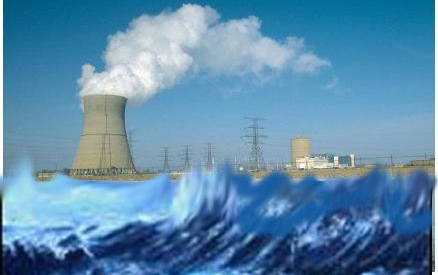
So, given that proposed new UK reactors, together with their radioactive waste stores including spent fuel, will be located on coasts – predicted sea-level rise, shoreline erosion, coastal storms, floods, tidal surges and the evolution of “nuclear islands” stand out as primary concerns. This means that adapting nuclear power to climate change will entail increased expense for construction, operation, waste storage and decommissioning, and the incurring of significant costs to the environment, public health and welfare.
 Robert Griffiths: Although the risk of floods to nuclear power stations must not be ignored, a much more dangerous threat is that of a tsunami. Oldbury, Berkeley and Hinkley Point are all in the area of England’s only known tsunami. This is reported to have occurred on 20 January in 1607. Plaques on local churches indicate the depth of the water may have been 7 to 8 metres, and it is said to have reached Glastonbury Tor, some 22km inland. Flood and erosion problems can be solved by building sea walls around the plants as we approach 2080. Why is no one worried about an unexpected tsunami on top of rising sea levels?
http://www.guardian.co.uk/environment/2012/mar/11/nuclear-sites-sea-rise-tsunamis?newsfeed=true
Rising radioactivity findings in Japanese fish
 Radiation Findings in Japanese Fish Imports Rising The Fish Site, 9 Mar, 12 SOUTH KOREA – South Korea is more frequently finding radioactive materials in fishery products from Japan but has no immediate plans to ban imports as their levels are far below the
maximum intake limits, the quarantine office said Thursday.
In the first two months of the year, the country has detected traces of radioactive materials, such as cesium, in 32 separate shipments of fisheries products from Japan, according to the Animal, Plant and Fisheries Quarantine and Inspection Agency. ….
http://www.thefishsite.com/fishnews/16655/radiation-findings-in-japanese-fish-imports-rising
73,000 square metres of concrete to cover Fukushima seabed radiation
 Tepco to cement Fukushima seabed to stem
  radiation Times Live, Sapa-AFP | 22 February, 2012 The operator of Japan’s tsunami-crippled nuclear plant is to cover a large swathe of seabed near the battered reactors with cement in a bid to halt the spread of radiation, the company said Wednesday.
A clay-cement compound will be laid over 73,000 square metres (785,000 square feet) of the floor of the Pacific in front of the Fukushima Daiichi plant on the nation’s northeast coast, said Tokyo Electric Power Co. (TEPCO).
The area is equivalent to around 10 football pitches. “This is meant to prevent further contamination of the ocean… as sample tests have shown a relatively high concentration of radioactive substances in the sea soil in the bay,” a company spokeswoman said….
Contaminated water from the plant leaked into the sea and radioactive particles concentrated on the seabed. Scientists fear ocean currents could pollute areas further afield.
The cover will be 60 centimetres (24 inches) thick, with 10 centimetres expected to be eaten away by seawater every 50 years, the TEPCO official said. http://www.timeslive.co.za/world/2012/02/22/tepco-to-cement-fukushima-seabed-to-stem-radiation
Continuing radioactive leakage to the ocean from Fukushima nuclear plant
“We’re not over the hump” yet in terms of radioactive contamination of the ocean because of continued leakage from the plant,
Radiation from tsunami disaster detected 400 miles off Japan’s coast, but levels below harmful Washinmgton Post, By Associated Press, February 21 SALT LAKE CITY — Radioactive contamination from the Fukushima power plant disaster has been detected as far as almost 400 miles off Japan in the Pacific Ocean, with water showing readings of up to 1,000 times more than prior levels, scientists reported Tuesday…. Continue reading
Nuclear fuel could be corroded by seawater
How sea water could corrode nuclear fuel, UC Davis, January 26, 2012, Japan used seawater to cool nuclear fuel at the stricken Fukushima-Daiichi nuclear plant after the tsunami in March 2011 — and that was probably the best action to take at the time, says ProfessorAlexandra Navrotsky of the University of California, Davis.
But Navrotsky and others have since discovered a new way in which seawater can corrode nuclear fuel, forming uranium compounds that could potentially travel long distances, either in solution or as very small particles. The research team published its work Jan. 23 in the
journal Proceedings of the National Academy of Sciences.
“This is a phenomenon that has not been considered before,” said Alexandra Navrotsky, distinguished professor of ceramic, earth and environmental materials chemistry. “We don’t know how much this will increase the rate of corrosion, but it is something that will have to
be considered in future.”….
In the new paper, the researchers show that in the presence of alkali metal ions such as sodium — for example, in seawater — these clusters are stable enough to persist in solution or as small particles even when the oxidizing agent is removed.
In other words, these clusters could form on the surface of a fuel rod exposed to seawater and then be transported away, surviving in the environment for months or years before reverting to more common forms of uranium, without peroxide, and settling to the bottom of the
ocean. There is no data yet on how fast these uranium peroxide clusters will break down in the environment, Navrotsky said… http://www.news.ucdavis.edu/search/news_detail.lasso?id=10131
Radioactive cesium in the ocean fish food chain
Some cesium was found in 16 of these 22 species in November, the last
full month for which data was available.
Cesium was especially prevalent in certain of the species:
– 73 per cent of mackerel tested
– 91 per cent of the halibut
– 92 per cent of the sardines
– 93 per cent of the tuna and eel
– 94 per cent of the cod and anchovies
– 100 per cent of the carp, sea-weed, shark and monkfish
 After Fukushima, fish tales, By Alex Roslin, The Montreal Gazette January 14, 2012 “…………evidence has emerged that the impacts of the disaster on the Pacific Ocean are worse than expected.
Since a tsunami and earthquake destroyed the Fukushima Daiichi Nuclear Power Plant last March, radioactive cesium has consistently been found in 60 to 80 per cent of Japanese fishing catches each month tested by Japan’s Fisheries Agency. Continue reading
1 This Month
To see nuclear-related stories in greater depth and intensity – go to https://nuclearinformation.wordpress.com/
12 February – Webinar The Big Push: New Nuclear Projects in Canada
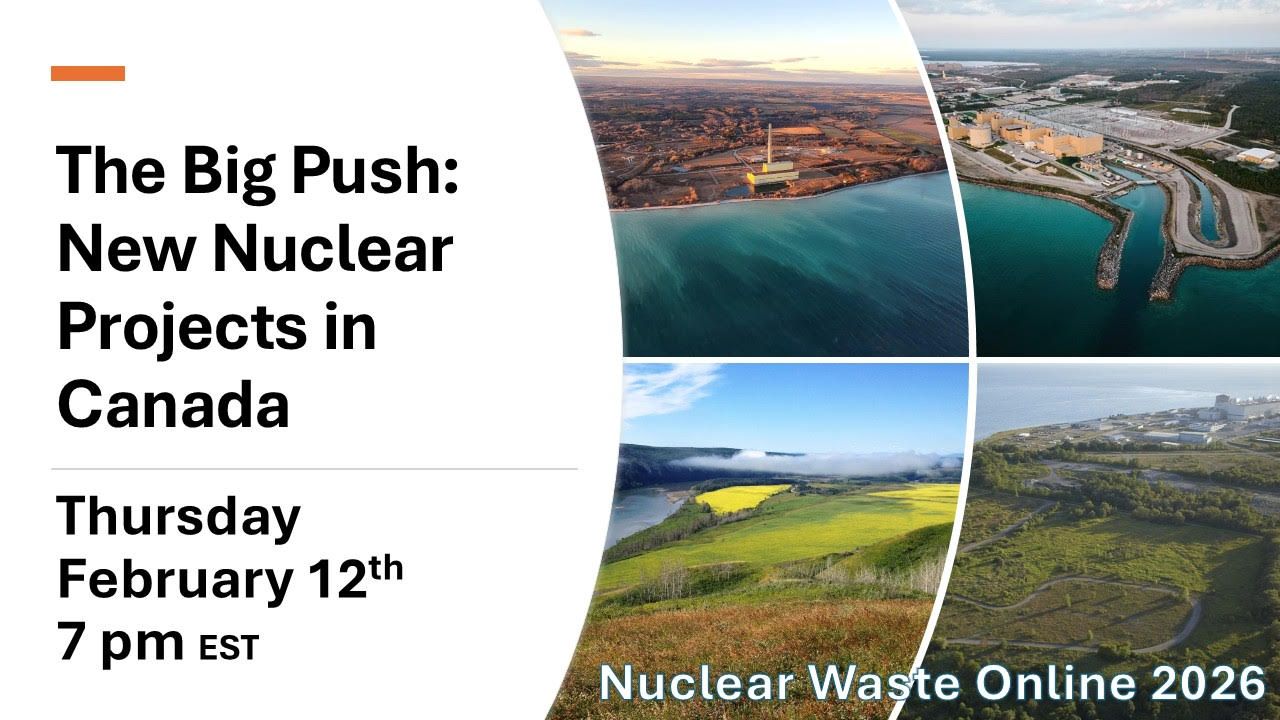
Thursday, February 12, 7 pm Eastern | 2nd of 4 sessions in the 2026 Nuclear Waste Online webinar series
Join a webinar on the push for new nuclear generation in Canada. Go to Northwatch.org to register or use the registration link https://us02web.zoom.us/webinar/register/WN_ZfWOf1GITqSRIZX8CB-A9w
-
Archives
- February 2026 (127)
- January 2026 (308)
- December 2025 (358)
- November 2025 (359)
- October 2025 (376)
- September 2025 (258)
- August 2025 (319)
- July 2025 (230)
- June 2025 (348)
- May 2025 (261)
- April 2025 (305)
- March 2025 (319)
-
Categories
- 1
- 1 NUCLEAR ISSUES
- business and costs
- climate change
- culture and arts
- ENERGY
- environment
- health
- history
- indigenous issues
- Legal
- marketing of nuclear
- media
- opposition to nuclear
- PERSONAL STORIES
- politics
- politics international
- Religion and ethics
- safety
- secrets,lies and civil liberties
- spinbuster
- technology
- Uranium
- wastes
- weapons and war
- Women
- 2 WORLD
- ACTION
- AFRICA
- Atrocities
- AUSTRALIA
- Christina's notes
- Christina's themes
- culture and arts
- Events
- Fuk 2022
- Fuk 2023
- Fukushima 2017
- Fukushima 2018
- fukushima 2019
- Fukushima 2020
- Fukushima 2021
- general
- global warming
- Humour (God we need it)
- Nuclear
- RARE EARTHS
- Reference
- resources – print
- Resources -audiovicual
- Weekly Newsletter
- World
- World Nuclear
- YouTube
-
RSS
Entries RSS
Comments RSS
 nuclear-news