International Research Team studies Fukushima contaminants in seafloor sediments
Examining the fate of Fukushima contaminants, Science Daily,
Fraction of buried, ocean sediment uncovered by typhoons, carried offshore by currents August 18, 2015, Woods Hole Oceanographic Institution
- Summary:
- An international research team reports results of a three-year study of sediment samples collected offshore from the Fukushima Daiichi Nuclear Power Plant. The research aids in understanding what happens to Fukushima contaminants after they are buried on the seafloor off coastal Japan. Scientists found that a small fraction of contaminated seafloor sediments off Fukushima are moved offshore by typhoons that resuspend radioactive particles in the water.
- An international research team reports results of a three-year study of sediment samples collected offshore from the Fukushima Daiichi Nuclear Power Plant in a new paper published August 18, 2015, in the American Chemical Society’s journal,Environmental Science and Technology.
The research aids in understanding what happens to Fukushima contaminants after they are buried on the seafloor off coastal Japan.
Led by Ken Buesseler, a senior scientist and marine chemist at the Woods Hole Oceanographic Institution (WHOI), the team found that a small fraction of contaminated seafloor sediments off Fukushima are moved offshore by typhoons that resuspend radioactive particles in the water, which then travel laterally with southeasterly currents into the Pacific Ocean.
“Cesium is one of the dominant radionuclides that was released in unprecedented amounts with contaminated water from Japan’s Fukushima Daiichi nuclear power plant following the March 11, 2011, earthquake and tsunami,” says Buesseler. “A little over 99 percent of it moved with the water offshore, but a very small fraction–less than one percent–ended up on the sea floor as buried sediment.”
“We’ve been looking at the fate of that buried sediment on the continental shelf and tracking how much of that contaminated sediment gets offshore through re-suspension from the ocean bottom,” he adds.
The research team, which included colleagues from the Japan Agency for Marine-Earth Science and Technology and the Japan Atomic Energy Agency, analyzed three years’ worth of data collected from time-series sediment traps……….
-
“The total transport is small, though it is readily detectable. One percent or less of the contaminated sediment that’s moving offshore every year means things aren’t going to change very fast,” Buesseler says. “What’s buried is going to stay buried for decades to come. And that’s what may be contributing to elevated levels of cesium in fish–particularly bottom-dwelling fish off Japan.”
While there were hundreds of different radionuclides released from the Fukushima Daiichi Nuclear Power Plant during the disaster, after the initial decay of contaminants with half lives (the time it takes for one half of a given amount of radionuclide to decay) less than days to weeks, much of the attention has remained focused on cesium-137 and-134– two of the more abundant contaminants. Cesium-134 has a half-life of a little over two years, and so any found in the ocean could come only from the reactors at Fukushima. Cesium-137 has a half-life of roughly 30 years and is also known to have entered the Pacific as a result of aboveground nuclear weapons tests in the 1950s and ’60s, providing a benchmark against which to measure any additional releases from the reactors.
In October, Buesseler and the research team will return to Japan to redeploy more sediment traps. The continued study will help estimate how long it takes to decrease the level of radiocesium in seafloor sediments near the Fukushima Daiichi Nuclear Power Plant.
Story Source:
The above post is reprinted from materials provided by Woods Hole Oceanographic Institution. Note: Materials may be edited for content and length. http://www.sciencedaily.com/releases/2015/08/150818112431.htm
Nuclear bomb testing has resulted in radioactive polonium in seafoods
Kiwis exposed to radiation in seafood – study http://www.3news.co.nz/nznews/kiwis-exposed-to-radiation-in-seafood—study-2015081507#axzz3ipQ2JViV Saturday 15 Aug 2015 New Zealanders who eat a lot of seafood may be exposing themselves to radiation and putting their health at risk, a study suggests.

Researchers found seafood such as mussels, paua and oysters contained concentrated levels of radiation.
Those at particular risk were sub-populations for whom fish consumption was culturally important and those relying of fishing and shellfish collection to feed their families, the study’s authors said in an article released on Friday.
“Seafood has importance to the New Zealand population as a source of nutrition consumed in considerable amounts by some sectors of the community,” they said.
“Chemical contaminants in seafood can therefore lead to significant health burdens to the population and it is an important public health function to identify the contaminants of concern and characterise their exposure.”
Researchers measured levels of radioactive caesium and polonium in 36 kinds of seafood.
Levels of caesium were of minimal dietary concern, but levels of polonium could “contribute significantly to the dietary does of ionising radiation for high seafood consumers, although the magnitude varies considerably depending on the composition of seafood species consumed,” the researchers said.
They found levels in New Zealand were the same as found in other countries, which suggested the radiation was a worldwide result of global nuclear testing rather than the 2011 Fukushima incident.
Radiation levels were higher in seafood than other foods, they said.
The study by Andrew Pearson, Sally Gaw, Nikolaus Hermanspahn and Chris Glover was published in the Journal of Environmental Radioactivity earlier this year.
SEAFOOD WITH HIGHER CONCENTRATED RADIATION LEVELS:
- Slapjack tuna
- greenshell mussels
- paua
- queen scallop
- rock lobster
- Bluff oyster
- littleneck clams
“Trillions of becquerels of radioactive material still flowing into sea” at Fukushima
 Officials: “Trillions of becquerels of radioactive material still flowing into sea” at Fukushima — Map shows nuclear waste coming up from bottom of ocean far offshore — Japan TV Journalist: “Contaminated seawater will circulate around globe… disaster like a huge cloth expanding everyday” (VIDEO) http://enenews.com/officials-trillions-becquerels-radioactive-material-flowing-sea-fukushima-map-shows-nuclear-waste-flowing-bottom-ocean-offshore-japan-tv-journalist-contaminated-seawater-will-circulate-around-gl?utm_source=feedburner&utm_medium=email&utm_campaign=Feed%3A+ENENews+%28Energy+News%29
Interview with NHK journalist Morley Robertson, by the Center for Remembering 3.11, published Jun 30, 2012 (emphasis added): I begin with the radiation leakage. Radiation leakage exerts a long term effect on the environment. It contaminates our food chain, the groundwaterand the ocean. And the contaminated seawater will circulate around the globe. We never know how much this will impact on the environment… We’ll never able to study such issues with empirical certainty… [Due to nuclear testing] we have already accumulated “hidden losses” of radiation damage… how much is the [Fukushima] cesium in relation to that?… I believe we should enjoy delicious food rather than worrying about the food. I enjoyed the town’s delicacy… I didn’t mind about how the beef was produced or where it came from. As long as it is tasty, it is no problem for me. With regard to radiation, I have become more optimistic. My hypothesis is that it’s no use worrying about radiation. For people in Fukushima, they have a lot to worry about their future, like damaged reputation… One reason why we have relied on nuclear plants is because we didn’t know about the facts… We need to face the facts… Rad-waste from the nuclear cycle is said to be unsolvable even after 2.5 million years.
Part II of Robertson’s Interview, published Jun 30, 2012: In 1974, then PM Tanaka declared, “Let ‘s go nuclear!”… we were issued credit cards to buy electric goods to consume the extra electricity… It is OK to say that everything was just a lie… and 3/11 happened. So we must study everything. It isno longer about what to do with Onagawa nuclear power plant, Miyagi or Tohoku. This is about what to do with Japan. This has been revealed by our vulnerability to the accident… So when we talk about “disaster“, it’s like a huge wrapping cloth expanding everyday.
- NHK: Morley is a journalist… working in the fields of television, radio, and lecture meetings… he studied at the University of Tokyo and Harvard University.
- Robertson’s Wikipedia entry (translated from Japanese by Microsoft): In 1968, because of father’s job moved to… Hiroshima [to work] on Atomic Bomb Casualty Commission [and] undertook study of atomic bomb patients.
TEPCO, updated Mar 10, 2015: Fukushima Daiichi Contaminated Water Issue FAQ — Q1Please explain the impact of the leaked radioactive materials on the sea. [Answer:] TEPCO announced that underground water including radioactive materials had leaked into the port… It has been implied that trillions of becquerels of radioactive materials are still flowing into the sea; however, the concentration of radioactive materials in the sea is at a level that meets the Guidelines for Drinking-water Quality, except for some areas…
TEPCO, Apr 28, 2015: Comprehensive risk review was implemented, considering all the possible risks that might have an impact outside the Fukushima Daiichi NPS site… Thepaths through which water could leak outside the site: …
- Sources of risk — Trenches… Pits… Tanks… Accumulated water inside reactor buildings… Contamination inside the port
- Leakage routes — Ground surface… Drainage channels… Underground (groundwater)
- Destination of the contaminated material… The Sea: Unit 1-4 water intake channel… Inside the port… Outside the port
Is Fukushima radiation affecting Arctic wildlife?
UNIVERSITY OF ALASKA SCIENTISTS: FUKUSHIMA RADIATION MAY BE MAKING ALASKA SEALS  SICK http://www.infowars.com/university-of-alaska-scientists-fukushima-radiation-may-be-making-alaska-seals-sick/ Washington’s Blog January 26, 2014
American sailors on the USS Reagan got really sick after having snowball fights with radioactive snow blowing off of the coasts of Fukushima. University of Alaska professors Doug Dasher, John Kelley, Gay Sheffield, and Raphaela Stimmelmayr theorize that radioactive snow might have also caused Alaska’s seals to become sick er plant resulting in a major nuclear accident that included a large release of airborne radionuclides into theenvironment.
Within five days of the accident atmospheric air masses carrying Fukushima radiation were transiting into the northern Bering and Chukchi seas. During summer 2011 it became evidentto coastal communities and wildlife management agencies that there was a novel disease outbreak occurring in several species of Arctic ice-associated seals. Gross symptoms associated with the disease included lethargy, no new hair growth, andskin lesions, with the majority of the outbreak reports occurring between the Nome and Barrow region. NOAA and USFWS declared an Alaska Northern Pinnipeds Usual Mortality Event (UME) in late winter of 2011.
The ongoing Alaska 2011 Northern Pinnipeds UME investigation continues to explore a mix of potential etiologies (infectious, endocrine, toxins, nutritious etc.), including radioactivity. Currently, the underlying etiology remains undetermined [i.e. scientists don’t yet know what caused the seals’ sickness, but they think it might have been Fukushima radiation]. We present results on gamma analysis (cesium 134 and 137) of muscle tissue from control and diseased seals, and discuss wildlife health implications from different possible routes of exposure to Fukushima fallout to ice seals. Continue reading
Unstoppable warming of oceans due to climate change
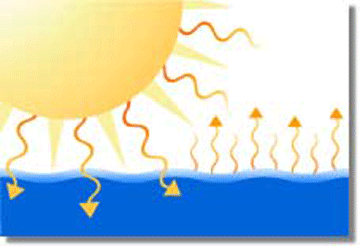 Warming of oceans due to climate change is unstoppable, say US scientistshttp://www.theguardian.com/environment/2015/jul/16/warming-of-oceans-due-to-climate-change-is-unstoppable-say-us-scientists Suzanne Goldenberg, 17 July 15 Globally 90% of the excess heat caused by the rise in greenhouse gas emissions is absorbed by the oceans.
Seas will continue to warm for centuries even if manmade greenhouse gas emissions were frozen at today’s levels, say US government scientists The warming of the oceans due to climate change is now unstoppable after record temperatures last year, bringing additional sea-level rise, and raising the risks of severe storms, US government climate scientists said on Thursday.
The annual State of the Climate in 2014 report, based on research from 413 scientists from 58 countries, found record warming on the surface and upper levels of the oceans, especially in the North Pacific, in line with earlier findings of2014 as the hottest year on record. Continue reading
White lungs on Fukushima’s dead dolphins indicates radiation poisoning
Each dolphins lungs were white, which is according to scientists, an indication of loss of blood to the organs – a symptom of radiation poisoning.
The translated article comes from EneNews:
Apr 11, 2015 (emphasis added):
Google Translate: Ibaraki Prefecture… for a large amount of dolphin which was launched on the shore… the National Science Museum… investigated… researchers rushed from national museums and university laboratory, about 30 people were the anatomy of the 17 animals in the field. [According to Yuko Tajima] who led the investigation.
“the lungs of most of the 17… was pure white ischemic state, visceral signs of overall clean and disease and infections were observed”… Lungs white state, that has never seen before.
Fukushima Diary, Apr 12, 2015: According to National Science Museum, most of the inspected 17 dolphins had their lungs in ischaemia state… The chief of the researching team stated “Most of the lungs looked entirely white”… internal organs were generally clean without any symptoms of disease or infection, but most of the lungs were in ischaemia state. She said “I have never seen such a state”.
Wikipedia: Ischemia is a vascular disease involving an interruption in the arterial blood supply to a tissue, organ, or extremity that, if untreated, can lead to tissue death.
Many reports have been published on the links between ischemia and radiation exposure:
“It has been shown that the ionizing radiation in small doses under certain conditions can be considered as one of starting mechanisms of… IHD [ischemic heart disease].” -Source
“Radiation risks on non-cancer effects has been revealed in the [Chernobyl] liquidators… Recently, the statistically significant dose risk of ischemic heart disease… was published.” -Source……….http://www.neonnettle.com/sphere/366-dead-dolphins-in-fukushima-stranding-found-with-white-radiated-lungs
Mysterious die-off of whales in the pacific: US scientists test for radiation
TV: US scientists testing for radiation in dead whales as mysterious die-off in Pacific continues — Now 14 carcasses reported, expert warns “death toll could still rise” — “Whales may have consumed something toxic… trying to find an explanation for this unusual event” (VIDEO) http://enenews.com/tv-scientists-testing-radiation-mysterious-whale-die-pacific-continues-14-carcasses-reported-expert-warns-death-toll-could-rise-whales-consumed-toxic-trying-find-explanation-unusual-event-video?utm_source=feedburner&utm_medium=email&utm_campaign=Feed%3A+ENENews+%28Energy+News%29
KTUU, Jul 10, 2015 (emphasis added): 5 more dead whales found in Alaska waters since June; total 14 dead; Researchers try to understand mysterious whale deaths… Kate Wynne, a Marine Mammal Specialist for the Alaska Sea Grant Marine Advisory Program, told Channel 2 News that since the June 18 announcement of the nine dead fin whales, four humpback whales and another fin whale have been found dead. According to Wynne, the five whales appeared to have been dead for the same amount of time as the previously discovered whales… After the first two whales were discovered… it triggered a response from numerous agencies… “The good news is that this has gotten a lot of us to talk toeach other, and be alert,” Wynne said… Wynne thinks the whales may have consumed something toxic… Tests on tissue from one of the whales have proven negative for domoic acid, a biotoxin, and results on two other tests, for Paralytic Shellfish Poisoning (PSP) and Cesium-137 radioactivity, are still pending.
Alaska Dispatch News, Jul 10, 2015: More whales found dead in southern Alaska waters – Scientists investigating the mysterious deaths of nine endangered fin whales… report that the death toll has increased… five additional whales — one fin whale and four humpbacks — have been reported… So far, the only sample taken from any of the dead animals… came back negative for domoic acid, a toxin that is produced by algae… Results from other tests are still pending… [Scientists] have been trying to find an explanation for the unusual event. Wynne said it’s possible the toll could still rise. “The number of now-rotten carcasses may continue to climbas more people travel around the area and submit reports of carcasses they see,” she said.
AP, Jul 11, 2015: More whale carcasses found in Gulf of Alaska… [Wynne] said it’s possible that more carcasses will be reported as people continue to travel around the area.
AP, Jul 11, 2015: Whale deaths in Gulf of Alaskapuzzle scientists – More dead whales have been found in the Gulf of Alaska following the sightings of nine fin whale carcasses… five additional dead whales [were reported] over the past several weeks, including four humpbacks and one fin whale… Wynne says it’s possible that more whale carcasses could be reported soon.
CBC, Jul 11, 2015: Reports of whale carcasses off Alaska raise whale death toll to 14; Scientists don’t know what’s been killing humpback and fin whales
Watch a report from ABC San Diego on NOAA scientists on the way to study whales in Alaska
Cesium 137 & Cesium 134 detected in seaweed on the West Coast of British Columbia

We have new clear precise lab results that seaweed on the West Coast of BC has both Cesium 137 and Cesium 134 radiation in it. PLEASE stop eating from the Pacific. Results are from a test sample sent in from my friend Jeff whose use of a Geiger Counter on seaweed showed distinctly elevated readings. He sent the samples to labs and these were the results.
The final result is in for the seaweed sample you sent us on June 16, 2015.
137Cs = 0.5 +/- 0.3 Bq/kg
134Cs = 0.3 +/- 0.3 Bq/kg
The 137Cs is above the limit of detection. The 134Cs is at the detection,limit which is generally considered a nondetect.
While the amount of radio cesium was low it held up after repeated analyses. Although the result is a low detect, it is nevertheless one of the few samples that shows any radioactive cesium in west coast seaweed samples. Time will tell if it is part of a trend.
Source: Mimi German from Radcast.org
Global silence on developing radiation crisis in the oceans
 Fukushima: The Extinction-Level Event That No One Is Talking About, Collectively Conscious, July 15 by Satyapriya Source: dougmichaeltruth.wordpress.com “……….Roughly 72% of the Earth is made up of water, and if you look at a global map, you can see that all of the world’s oceans are connected; it’s essentially one ocean. So what happens when two of the planet’s large bodies of water are rendered lifeless? Since roughly 90% of Earth’s life is contained in the oceans, and two-thirds of the planet is water, what happens when the oceans die? What happens when we can no longer fish the oceans for food? The answer is simple: When the planet’s oceans die, all life on Earth will follow, but who cares? There’s a game on tonight, or some stupid shitcom that insults the intelligence.
What level of cognitive dissonance is adhered to that causes people to look away from painful truths? How is it that people can convince themselves that everything is just fine when we are staring our very extinction in the face? How many actually give a shit? Far too few unfortunately. The fact that the world’s top scientists have no idea how to contain the radiation at Fukushima speaks volumes about what happens when a species develops technologically yet does not operate with wisdom. They destroy themselves.
Has humanity made its decision that it will simply bow down and allow the few, through psychopathy and corporate greed to drive the planet into its very extinction? Is it game over for life on planet Earth?

We are certainly headed in that direction, but why would I want to face this painful truth and find my center when Miley Cyrus is on TV sucking off a blow up doll in her latest piece of shit video?
The time for humanity to collectively wake up and come together is here and now! We can no longer put off the mess for future generations to mop up because at the rate we are going, the planet will be unable to support life and very may well become a dead rock resembling Mars. This is where we stand as a species. Does this sound paranoid? Maybe, but that does not negate the fact that it’s true! So as we bow our heads in quiet approval, our home is being destroyed and your children’s futures are being stolen right from under them. Sleep on, everything is OK, and raise your glass to the extinction of humanity! http://collectivelyconscious.net/articles/fukushima-the-extinction-level-event-that-no-one-is-talking-about/
Beautiful but deserted Pacific Runit Island with its hazardous radiation tomb
Deadly dome of gorgeous Pacific island leaking radioactive waste news.com.au , JULY 07, 2015 A PICTURESQUE coral atoll that lies northeast of Australia in the Pacific Ocean harbours a deadly secret.
A giant, concrete dome filled with radioactive waste looms above Runit Island, and it’s leaking. Locals call it “The Tomb”.
Runit (or Cactus) dome was used for Cold War nuclear testing by the US government for 10 years from 1948. There were 42 tests in total on Enewetak Atoll, including 22 explosions on platforms, barges and underwater in the space of just three months in 1958, just before a moratorium on atomic testing.
In the late 1970s, an estimated 73,000 cubic metres of contaminated topsoil was deposited in the Cactus nuclear test crater beneath the dome, according to a report commissioned by the US government.
It was only supposed to be a temporary measure — but the dome remains.
Scientists now fear that a major storm, typhoon or other natural disaster coulddamage the 46cm-thick concrete dome, releasing nuclear waste into the sea, The Guardian reports.
The US Department of Energy insists cracks in the dome are merely cosmetic, a result of drying and shrinking of the half-submerged dome, but there are plans for repairs. The 2013 report states that this is to satisfy local concerns, but adds that rainwater could infiltrate through the cracks, possibly affecting groundwater flow and “radionuclide migration into the marine environment”.

Inhabitants of Runit were resettled on nearby Enewetak Island in 1980. Even in the early days, concerns were raised over human exposure to radiation through locally grown food, with resettlers resorting to cans of spam, Columbia University’s Michael Gerrard wrote last year in The New York Times.
Runit remains uninhabited, home only to abandoned bunkers and cables, but locals still visit to fish and salvage scrap metal. It sounds dangerous, but impoverished Marshall Islanders say they have no choice.
And just because Runit is remote, doesn’t mean other countries are totally immune from its influence. A report published in the Environmental Science and Technology journal last year traced plutonium found in Guangdong province in the South China Sea back to the Marshall Islands…….. Continue reading
Deep in the ocean, the true scale of global warming is hidden
 Have the oceans been HIDING the true scale of global warming? http://sidharamp.blogspot.com.au/ Nasa warns heat hasn’t disappeared, it’s just been buried in the sea
- Scientists looked at a layer of the oceans between 300 and 1,000ft
- They found it has been accumulating more heat than first thought
- Study looked at direct ocean temperature data for more accurate results
- Previous attempts to explain the temperature trends have relied heavily on climate model results which are less able to deal with short-term data
HOW OCEANS CAN BURY HEAT
Buildup of radioactive materials in Pacific ocean food chain – salmon, tuna and other species
 Study: Fukushima radiation will cause long-term harm to Pacific salmon population — Efforts needed to protect species from possible extinction — Radiation monitoring is critical to avoid human health problems — “US inland areas also at risk of exposure” http://enenews.com/study-fukushima-will-result-marked-lasting-decrease-population-pacific-salmon-efforts-needed-protect-species-possible-extinction-continued-monitoring-will-be-critical-avoidance-health-problems-h?utm_source=feedburner&utm_medium=email&utm_campaign=Feed%3A+ENENews+%28Energy+News%29
Journal of Applied Mathematics — Modelling the Effects of Radioactive Effluent on Thunnus orientalis and Oncorhynchus gorbuscha, New Jersey City Univ. (Chen, Ding, Laracuenti, Lipat(Columbia Univ., NASA Goddard Institute for Space Studies)), 2013 (emphasis added):
- The contamination of the Pacific Ocean by the radioactive pollutants released from the Fukushima Daiichi Nuclear Power Plant has raised legitimate concerns over the viability of marine wildlife. We… explore the extent of the effects of the radioactive effluent on two marine species: the Pacific Bluefin Tuna and the Pacific Pink Salmon…
- Because of the brevity of the period of time during which radioactive material was discharged… [it’s] assumed to be instantaneous [note the study was released beforeTEPCO admitted the flow of radioactive material into the Pacific never ended]…
- This pollution was spread through the entire Pacific Ocean…
- A numerical solution… will simulate the effects of the Fukushima Daiichi nuclear disaster…This simulation has far-reaching implications for decisions related to the location of nuclear power plants as well as to fishing policy…
- According to data released by Tepco, the initial concentrations of radioactivity following the release of 11,500 metric tonnes of contaminated water into the Pacific Ocean… are 310,000 Bq/L of iodine-131, 230,000 Bq/L of caesium-134, and 230,000 Bq/L of caesium-137 [which] produces the initial radioactivity of the iodine-131: 3.57 trillion Bq… caesium-134: 2.65 trillion Bq… caesium-137: 2.65 trillion Bq [note that estimates by gov’t scientists are 10,000+ times higher]…
- Analysis of the results shows that the Pacific Bluefin Tuna will experience a steeper population decline in the short term compared to its expected population decline… after which the population will return to the expected population.
- Pacific Pink Salmon, on the other hand, will simply decline at a faster pace than the expected population decline… radioactive effluent will result in a marked and lasting decrease in population [see Fig. 5, 6]…
- Before the conclusions are subjected to social analysis, the model’s limitations must be considered… the model does not reflect the migratory nature of both fish species. This does not, however, entirely negate the validity of the simulation: over a sufficiently long period of time, the short-term movement of the fish throughout the Pacific Ocean becomes negligible… The results of the model… opt to consider the fish species’ population on average…
- The very high rate of decline of the Pacific Pink Salmon indicates that live specimens may contain relatively high levels of radioactivity. Continued monitoring of the Pacific Pink Salmon, as well as all marine species, for radioactivity will be critical to the avoidance of health problems for humans. Because the species migrates throughout freshwater rivers and tributaries of British Columbia, Alaska, and the Pacific Northwest of the United States, inland areas are also at risk of exposure to, at the very least, low-level radioactivity. Moreover, the rapid rate of decline of the Pacific Pink Salmon, in conjunction with rapidly deteriorating conditions, seems to necessitate drastic action. Work beyond sustainability is needed to protect the species from possible extinction…
- Because of the deleterious effects on the marine environment… it seems reasonable to suggest that any new nuclear power plants be constructed sufficiently far from coastal waterways so as to mitigate the absorption of any radioactive contaminants into the biosphere. This, however, would pose a risk to the environment near the nuclear power plant without the capacity of an ocean to diffuse the radioactivity…
- The authors are thankful to [National Science Foundation award] NSF HRD-0902132 (LSAMP) for the support to do this research.
Fish in Pacific NorthWest afflicted by deadly black fungus – could it be related to Fukushima ?
Mysterious deadly black fungus being found on fish in Pacific Northwest — Gov’t: There was some concern Fukushima radiation could be involved — Biologists investigating how this landbased mold is now appearing in ocean — Many reports of unusual rotting sores, growths, bumps, cancer (PHOTOS) http://enenews.com/mysterious-black-mold-being-found-fish-pacific-northwest-govt-concern-fukushima-radiation-could-be-involved-biologists-investigating-landbased-fungus-appearing-fish-many-reports-unusual-rotti?utm_source=feedburner&utm_medium=email&utm_campaign=Feed%3A+ENENews+%28Energy+News%29
Nome Nugget (pdf), Nov 27, 2014 (emphasis added): The Nome office of the Alaska Department of Fish and Game received several reports of tomcod with black lesions this year… ADF&G fishery biologists speculate that the lesions are a fungus… Specifically, black mold, commonly found in houses… What the pathology lab finds interesting is that this fungus is landbased and yet it is appearing on fish… Fish pathologists would like to receive as many samples as possible so that they may adequately research what exactly is infecting these fish, as well as its affect on humans. Until further notice, ADF&G recommends that fish with lesions should not be eaten due to possible human health concerns (CAPTION: DON’T EAT THIS— ADF&G biologists are investigating black lesions found on tomcods in the region. Until it is known what the lesions exactly are, the department recommends not to consume fish showing these symptoms)
Brendan Scanlon, fishery biologist for North Slope Dept. of Fish & Game (pdf), Mar 17, 2015: Just a quick word on this fungus that people are seeing more and more of. It’s probably what’s called saprolegnia. It’s a water mold… It’s in the water at all times… healthy fish will swim around and never get it, but if the fish is stressed nutritionally or its immune system has been compromised… that gives a pathway for the mold to attack… It will eventually kill the fish… We saw something similar last summer. We had a very big die-off on the Kobuk River… we had thousands of dead chum salmon… and they had had presence of the same mold on them.
North Slope Federal Subsistence Regional Advisory Council (pdf), Feb 20, 2014:
- Dr. Jayde Ferguson, Alaska Dept of Fish & Game: The first confirmed report was from fish caught on Oct. 12, 2013… There was some concern that radiation from the Japanese disaster could be involved, so the North Slope biologist measured ionizing radiation in fish with a geiger-mueller counter and found that there was no elevated levels there… There was no food in the GI track and there was no fat or very little fat internally… The external lesions… corresponded to saprolegnia… it can act as a pathogen particularly in stressed fish because their immune system is depressed… I wanted to touch on a totally unrelated fungal case that is of interest to our lab because there’s not a lot known about it and it’s distinctly different from the saprolegnia in that it’s very black and large… there’s not a lot out in the literature on this black fungus… There’s just not a lot known about transmission or anything else, so we’re wanting to get a better idea of what’s going on…
- Dr. Todd Sformo, Wildlife Biologist: I think the main concern was that if this mold is really present in the environment… it’s been reported a lot… why is the mold coming up being on fish at this point? So we have very few records in the north slope and Jayde mentioned the one… in the 1980s, so that was just one fish with that mold that we had recorded up until this point… why is it occurring now if it’s so prevalent in the environment?… We measured a number of the fish that were caught that had the mold and that did not have the mold and the size of the fish didn’t seem to matter at all…
- Ferguson: If we’re seeing it in juveniles that really does support some environmental issue… How many fish are affected?… It might not have an impact at the population level, but if there’s a large amount of fish that are affected, then that’s a different thing.
Alaska Native Tribal Health Consortium:
- 02-02-15 – Whitefish that had a bulged out eye ball [and] some type of growth around the cheekbone. Would like to know the cause of these observed abnormalities
- 12-10-14 – Whitefish… has a brownish moldy growth all over it’s body. We would like to know more about what is going on with our fish and why this is happening
- 10-24-14 – Trout appeared to have sores… rotting or decaying… [we] have never seen these sores before… We are still seeing a lot of fish with these kinds of conditions
- 06-12-14 – A codfish that was caught with a deep cut or sore on it was pulled in… We are not really sure what happened to this poor cod, but we think it is unusual
- 05-26-14 – Whitefish that had a growth… on its dorsal fin. Other fish were also caught with a similar condition… ADF&G: “This whitefish has… probably a neoplasm (cancer)”
- 02-17-14 – Fish… found with lesions on them… Other people also said they saw these bumps… elders who said they have seen fish with skin bumps like this once before… people are still worried because they are not sure what it is this time…. these bumps… were like puss. There are quite a few people who are worried…
Scientists investigate effects of Fukushima radiation on Pacific Ocean animals
 US university testing animals in Pacific for Fukushima radiation — Photos show bodies riddled with tumors, eyes bleeding, covered in lesions — Some are missing testicles, eyeballs — Skin disintegrating, peeling off, turning yellow — Mammals affected by diseases never seen in species (WARNING: Graphic Pics)http://enenews.com/university-testing-animals-pacific-fukushima-radiation-gruesome-photos-show-bodies-riddled-massive-tumors-cysts-bleeding-eyes-covered-lesions-missing-testicles-eyeballs-skin-disintegrating-pe?utm_source=feedburner&utm_medium=email&utm_campaign=Feed%3A+ENENews+%28Energy+News%29
Colorado St. Univ., Apr 13, 2015 (emphasis added): CSU partners with Fukushima University to study radiation effects… Many CSU faculty and researchers are contributing to radiation research in Japan… including Thomas Johnson… professor of health physics, who is testing trace radiation samples in seal populations in thenorthern Pacific Ocean, where radiation from the Fukushima disaster was released.
Alaska Marine Science Symposium presentation, Raphaela Stimmelmayr (Dept. of Wildlife Management, North Slope Borough) & Gay Sheffield (Univ.of Alaska – Fairbanks Marine Advisory Program), 2014:
Incidental Gross Necropsy Findings in Subsistence-Harvested Ice Seals and Walruses
• Reproductive system: adnexal cysts [uterus], uterine and penile melanosis [darkening of skin], cliteromegaly [enlarged clitoris], cryptorchism [testicle(s) absent from scrotum], retained placenta;
• Endocrine system: thyroid cysts, adrenal nodules;
• Musculoskeletal system: synovial cyst [fluid-filled sacs in spine due to degeneration];
• Integumentary system: panniculitis [inflammation of fatty tissue], epidermal molt, skin sloughing;
• Respiratory system: lung tumor, parasitic granulomas [inflammation that forms when immune system is unable to eliminate a substance];
• Digestive system: microdontia [teeth smaller than normal], chronic interstitial pancreatitis [inflammation of pancreas], hepatic cyst [liver], cholestatic jaundice [yellowing of skin caused by thickening of bile or problems in liver], geophagia [eating dirt], and primary diffuse peritoneal tumor [membrane lining abdomen];
• A variety of the observed disease conditions are reported for the first time in ice seals and/or walruses.
• The majority of observed conditions in our material is classified as benign and are mostly inconsequential to the health of the harvested animals.
Strange and extreme tissue damage in dead dolphins near Fukushima
Japan Scientist: “I’ve never seen this before” — White lungs found in dolphins that died during mass stranding near Fukushima — Interruption of blood supply leading to death of tissue — Disease has been linked to radiation exposurehttp://enenews.com/dead-dolphins-washed-fukushima-entirely-white-lungs-head-scientist-ive-never-before-interruption-blood-supply-leading-tissue-death-disease-linked-radiation-exposure-large-spike-after-chernoby?utm_source=feedburner&utm_medium=email&utm_campaign=Feed%3A+ENENews+%28Energy+News%29
Asahi Shimbun, Apr 11, 2015 (emphasis added):
- Google Translate: Ibaraki Prefecture… for a large amount of dolphin which was launched on the shore… the National Science Museum… investigated… researchers rushed from national museums and university laboratory, about 30 people were the anatomy of the 17 animals in the field. [According to Yuko Tajima] who led the investigation… “the lungs of most of the 17… was pure white ischemic state, visceral signs of overall clean and disease and infections were observed”… Lungs white state, that has never seen before.
- Systran: The National Science Museum… investigated circumstance and cause etc concerning the mass dolphin which is launched to the seashore of Ibaraki prefecture… the researchers ran from the museum and the university laboratory… approximately 30 people dissected 17… [Yuko Tajima] of the National Science Museum which directed investigation research worker [said] “the most lung 17 was state with true white, but as for the internal organs being clean”… The lung true white as for state, says… have not seen.
Fukushima Diary, Apr 12, 2015: According to National Science Museum, most of the inspected 17 dolphins had their lungs in ischaemia state… The chief of the researching team stated “Most of the lungs looked entirely white”… internal organs were generally clean without any symptoms of disease or infection, but most of the lungs were in ischaemia state. She said “I have never seen such a state”.
Wikipedia: Ischemia is a vascular disease involving an interruption in the arterial blood supply to a tissue, organ, or extremity that, if untreated, can lead to tissue death.
Many reports have been published on the links between ischemia and radiation exposure:
- “It has been shown that the ionizing radiation in small doses under certain conditions can be considered as one of starting mechanisms of… IHD [ischemic heart disease].” –Source
- “Radiation risks on non-cancer effects has been revealed in the [Chernobyl] liquidators… Recently, the statistically significant dose risk of ischemic heart disease… was published.” –Source
- “Incidence of and mortality from ischemic heart disease (IHD) have been studied in a cohort of 12210 workers [at] Mayak nuclear facility… there was statistically significant increasing trend in IHD incidence with total external gamma dose.” –Source
- “Numerous studies have been published concerning non cancer diseases in liquidators… Risk of ischemic heart disease… seems increased.” –Source
- “In 1990 the International Chernobyl Project has been carried out under the aegis of the IAEA… It is known that the international experts who had taken part in the International Chernobyl Project were aware of the report by the Minster of the Ministry of Health Care of Belarus delivered at an informal meeting arranged by the IAEA… The Belorussian Minister reported about… the worsening of the general health state of the affected population… “Among adults in 1988 there was a two- to fourfold increase, in comparison with preceding years, in the number of persons suffering from… ischemic heart diseases” –Source
- “In a study on a Russian cohort of 61,000 Chernobyl emergency workers… a statistically significant risk of ischemic heart disease was observed.” –Source
1 This Month

10 March A LIVE WEBINAR THE REAL EFFECTS OF NUCLEAR POWER
What the Industry Isn’t Telling Us
1:00 PM Mountain, 2 pm Central, 3 pm Eastern. Live on the Keepers of the Water Facebook page

18 March Webinar @ 1 PM EST: An Assessment of SMR Projects: The Case of Canada
register for the zoom:
https://us02web.zoom.us/webinar/register/WN_o8BIIOUvQ2ONJR1nta65DQ#/registration


of the week – STOP SMALL MODULAR REACTORS IN CANADA
To see nuclear-related stories in greater depth and intensity – go to https://nuclearinformation.wordpress.com
-
Archives
- March 2026 (9)
- February 2026 (268)
- January 2026 (308)
- December 2025 (358)
- November 2025 (359)
- October 2025 (376)
- September 2025 (258)
- August 2025 (319)
- July 2025 (230)
- June 2025 (348)
- May 2025 (261)
- April 2025 (305)
-
Categories
- 1
- 1 NUCLEAR ISSUES
- business and costs
- climate change
- culture and arts
- ENERGY
- environment
- health
- history
- indigenous issues
- Legal
- marketing of nuclear
- media
- opposition to nuclear
- PERSONAL STORIES
- politics
- politics international
- Religion and ethics
- safety
- secrets,lies and civil liberties
- spinbuster
- technology
- Uranium
- wastes
- weapons and war
- Women
- 2 WORLD
- ACTION
- AFRICA
- Atrocities
- AUSTRALIA
- Christina's notes
- Christina's themes
- culture and arts
- Events
- Fuk 2022
- Fuk 2023
- Fukushima 2017
- Fukushima 2018
- fukushima 2019
- Fukushima 2020
- Fukushima 2021
- general
- global warming
- Humour (God we need it)
- Nuclear
- RARE EARTHS
- Reference
- resources – print
- Resources -audiovicual
- Weekly Newsletter
- World
- World Nuclear
- YouTube
-
RSS
Entries RSS
Comments RSS
 nuclear-news