FOCUS: Respite for Japan as radioactive Fukushima water accumulation slows
https://english.kyodonews.net/news/2022/08/d10f63c6bde0-focus-respite-for-japan-as-radioactive-water-accumulation-slows-in-fukushima.html By Takaki Tominaga, KYODO NEWS – Aug 12, 2022 Tanks containing treated water at the crippled Fukushima nuclear power plant are likely to reach capacity around the fall of 2023, later than the initially predicted spring of next year, as the pace of the accumulation of radioactive water slowed in fiscal 2021
The slowdown, based on an estimate by operator Tokyo Electric Power Company Holdings Inc., gives some breathing space to Prime Minister Fumio Kishida’s government if any roadblocks are thrown up in the plan to discharge the treated water into the sea starting around spring next year.
China and South Korea as well as local fishing communities that fear reputational damage to their products remain concerned and have expressed opposition to the plan.
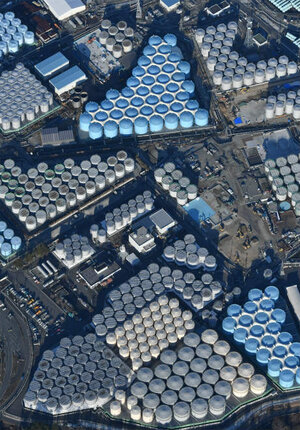
About 1.30 million tons of treated water has accumulated at the Fukushima Daiichi plant following the 2011 nuclear disaster, and it is inching closer to the capacity of 1.37 million tons.
The water became contaminated after being pumped in to cool melted reactor fuel at the plant and has been accumulating at the complex, also mixing with rainwater and groundwater.
According to the plan, the water — treated through an advanced liquid processing system, or ALPS, that removes radionuclides except for tritium — will be released 1-kilometer off the Pacific coast of the plant through an underwater pipe.
The International Atomic Energy Agency has been conducting safety reviews of the discharge plan and Director General Rafael Grossi says the U.N. nuclear watchdog will support Japan before, during and after the release of the water, based on science.
An IAEA task force, established last year, is made up of independent and highly regarded experts with diverse technical backgrounds from various countries including China and South Korea.
Japan’s new industry minister Yasutoshi Nishimura says the government and TEPCO will go ahead with the discharge plan around the spring of 2023 and stresses the two parties will strengthen communication with local residents and fishermen, as well as neighboring countries, to win their understanding.
Beijing and Seoul are among the 12 countries and regions that still have restrictions on food imports from Japan imposed in the wake of the massive earthquake and tsunami triggered nuclear meltdowns at the Fukushima plant in March 2011.
“We will improve our communication methods so we can convey information backed by scientific evidence to people both at home and abroad more effectively,” Nishimura said after taking up the current post in a Cabinet reshuffle Wednesday.
Kishida instructed Nishimura to focus on the planned discharge of ALPS-treated water that will be diluted with seawater to one-40th of the maximum concentration of tritium permitted under Japanese regulations, according to the chief of the Ministry of Economy, Trade and Industry.
The level is lower than the World Health Organization’s recommended maximum tritium limit for drinking water.
TEPCO will cap the total amount of tritium to be released into the sea as well.
Meanwhile, the Kishida government has decided to set up a 30 billion yen ($227 million) fund to support the fisheries industry and said it will buy seafood if demand dries up due to harmful rumors.
Fishing along the coast of Fukushima Prefecture, known for high-quality seafood, has been recovering from the reputational damage caused by the nuclear accident but the catch volume in 2021 was only about 5,000 tons, or about 20 percent of 2010 levels.
Construction of discharge facilities at the Fukushima plant started in August, while work to slow the infiltration of rain and groundwater was also conducted.
TEPCO said it was able to reduce the pace of accumulation of contaminated water by fixing the roof of a reactor building and cementing soil slopes around the facilities, among other measures, to prevent rainwater penetration.
The volume of radioactive water decreased some 20 tons a day from a year earlier to about 130 tons per day in fiscal 2021, according to the ministry.
The projected timeline to reach the tank capacity has been calculated based on the assumption that about 140 tons of contaminated water will be generated per day, according to METI.
However, storage tanks could still reach their capacity around the summer of next year if heavy precipitation or some unexpected events occur, the ministry said.
As part of preparations for the planned discharge, the Environment Ministry has started measuring tritium concentration at 30 locations on the surface of the sea and seabed around the Fukushima plant, four times a year.
Similarly, the Nuclear Regulation Authority has increased the number of locations it monitors tritium levels by eight to 20. The Fisheries Agency has started measuring tritium concentration in marine products caught along the Pacific coast stretching from Hokkaido to Chiba Prefecture.
Given that it is expected to take several decades to complete the release of treated water, NRA and METI officials urged TEPCO to further curb the generation of contaminated water at the plant.
“We want TEPCO to step up efforts so as to lower the volume of the daily generation of contaminated water to about 100 tons or lower by the end of 2025,” a METI official said.
China also discharges triated water from its nuclear power stations
 | Bob commented on Japan extremely selfish to insist on discharging nuclear wastewater into sea August 8, 2022 TOKYO, Aug. 10 (Xinhua) — Japan’s Tokyo Electric Power Company Holdings Inc. (TEPCO) has recently started …Neither you, nor China, whose official viewpoint this is, ever admits that China discharges tritiated water into the sea from its own nuclear plants and that the amount of this discharge exceeds that proposed for the ALPS treated tritiated water which has then been mixed with sea water before discharge (otherwise, the water will be so pure that its purity will poison sea life) on an annual basis. They also deliberately omit the fact that the annual discharge rate will be less than that of the Fukushima Daiichi Nuclear Power Station during its 40 year operational lifetime. A much better assessment is discussed in this other recently posted article here https://english.kyodonews.net/news/2022/08/d10f63c6bde0-focus-respite-for-japan-as-radioactive-water-accumulation-slows-in-fukushima.html |
Fukushima water dumping plan triggers fresh anger from South Korea
As water-dumping moves advance, S. Koreans seek firm regional stance, http://global.chinadaily.com.cn/a/202208/09/WS62f1be52a310fd2b29e7119d.html By YANG HAN in Hong Kong |2022-08-09
Japan’s plan to dump radioactive wastewater from the stricken Fukushima nuclear power plant will endanger the lives of people in the Asia-Pacific region, say experts who want to see stepped-up efforts against the ocean disposal from the countries most at risk.
South Koreans have been among those expressing their opposition to the plan, and voices have again been raised after Japan moved a step closer to implementing its planned discharge of the nuclear-contaminated water from next year, following the recent approval of the plan’s details by the nation’s nuclear regulator.
“The discharge of wastewater from Fukushima is an act of contaminating the Pacific Ocean as well as the sea area of South Korea,” said Ahn Jae-hun, energy and climate change director at the Korea Federation for Environment Movement, an advocacy group in Seoul.
“Many people in South Korea believe that Japan’s discharge of the Fukushima wastewater is a wrong policy that threatens the safety of both the sea and humans,” Ahn told China Daily.
Last month, Japan’s nuclear regulator approved the plan to discharge wastewater into the Pacific Ocean from the Fukushima Daiichi power plant, after it built up a huge amount of radiation-tainted water. The water has been collected and stored in tanks following efforts to cool down the reactors after an earthquake and tsunami struck Japan in 2011.
The dumping plan has drawn fierce opposition from government officials and civic groups in South Korea, one of the world’s major consumers of seafood.
On Aug 1, South Korea’s Minister of Oceans and Fisheries Cho Seunghwan said the government is considering whether to take the issue to the International Tribunal for the Law of the Sea, Yonhap News Agency reported. Cho said the government’s primary plan is to prevent Japan from releasing the contaminated water. “We do not accept the release plan”, he said.
Ahn said radioactive materials can generate long-term effects and it remains unclear how they will affect the marine ecosystem.
Though the South Korean government is considering taking the issue to the international tribunal, Ahn said it will be difficult to quantify the potential damage.
South Korea has said it will conduct a thorough analysis and revision of the impact of Japan’s plan, but the government has not received enough data from Japan to conduct such research, South Korea’s Hankyoreh newspaper reported in June.
After Japan’s nuclear regulator approved the Fukushima discharge plan, South Korean President Yoon Suk-yeol said Tokyo needs to transparently explain and gain consent from neighboring countries before releasing the contaminated water.
Potential impact
Shaun Burnie, a senior nuclear specialist with Greenpeace Germany, said the environmental group is concerned about the potential impact of the water’s release on the wider Asia-Pacific region.
The level of exposure depends on multiple variables including the concentration in seawater and how quickly it concentrates, disperses and dilutes, forms of life, and the type of radionuclide released and how that disperses or concentrates as it moves through the environment, Burnie said.
“The concentrations are of direct relevance to those who may consume them, including marine species like fish and, ultimately, humans,” Burnie told China Daily.
Noting that the Fukushima contaminated water issue comes under the United Nations Convention on the Law of the Sea as it is a form of pollution to international waters, Burnie said there are strong grounds for individual countries to file a legal challenge against Japan’s plan.
Ahn said joint expressions of opposition in the region could force the Japanese government to choose a safe method to deal with the wastewater instead of dumping it into the sea. China is also among the neighboring countries that have voiced opposition to the Fukushima discharge plan.
Damage to marine life from seismic testing, and from dumping of radioactive waste.

Concerns raised as the UK starts hunt for undersea nuclear waste disposal
sites. Animal welfare groups and campaigners blast ongoing surveys for
undersea nuclear waste dump. Officials have been warned about the potential
environmental impact of plans to dispose of radioactive nuclear waste
beneath the seabed off the north coast of England.
Yesterday, ELN reported
that the first marine geophysical surveys to determine suitable sites for
nuclear waste disposal started in the Irish sea near Cumbria. Nuclear Waste
Services (NWS), the developer of the Geological Disposal Facility (GDF)
said it is “committed to environmental protection at all times”.
Richard Outram, Secretary of the campaign group Nuclear Free Local
Authorities, told ELN: “The Nuclear Free Local Authorities are opposed to
both the seismic testing and its purpose. “Our concerns regarding the
testing regime itself is that it necessitates the prolonged and repeated
sound blasting of the seabed of the Irish Sea every few seconds for a
period of several weeks whilst the ship patrols a search area of some 250
square kilometres and that this activity will be both disruptive and
harmful to marine life, some of which has protected status, both in the
area and for many miles around it.”
Mr Outram added that he was not
convinced that any nuclear waste dump facility, however well engineered,
could provide a ‘forever guarantee’ against a potential leakage
scenario.
Cetacean Strandings Investigation Programme Manager Rob Deaville
from the Zoological Society of London said: “Many species of odontocetes
are sensitive to noise disturbance, given their primary sense is acoustic
in nature. “Generating impulsive noise, such as through seismic surveys,
can have a disturbance effect and may cause habitat avoidance and
potentially exclusion from an area. “Depending on how close animals are
to the source of impulsive noise, potential impacts can also include direct
physical effects ranging from temporary or permanent threshold shifts in
hearing to direct blast trauma and also the risk of decompression sickness
like conditions in some species that may ascend too rapidly to startle
responses.
“Finally, the area is a known habitat for many cetacean
species, ranging from coastal harbour porpoises to deeper diving Risso’s
dolphins. So, I would still have a concern about the seismic survey efforts
and our teams are very much on standby, in the event we receive increased
reports of live/dead strandings over this period.”
Energy Live News 3rd Aug 2022
https://www.energylivenews.com/2022/08/03/concerns-raised-as-the-uk-surveys-undersea-nuclear-waste-disposal-sites/
Undersea nuclear waste dump off Cumbria would imperil marine life, experts warn
UK looking for storage site for world’s biggest stockpile of untreated waste, including 100 tonnes of plutonium
Guardian, Mattha Busby, Fri 29 Jul 2022
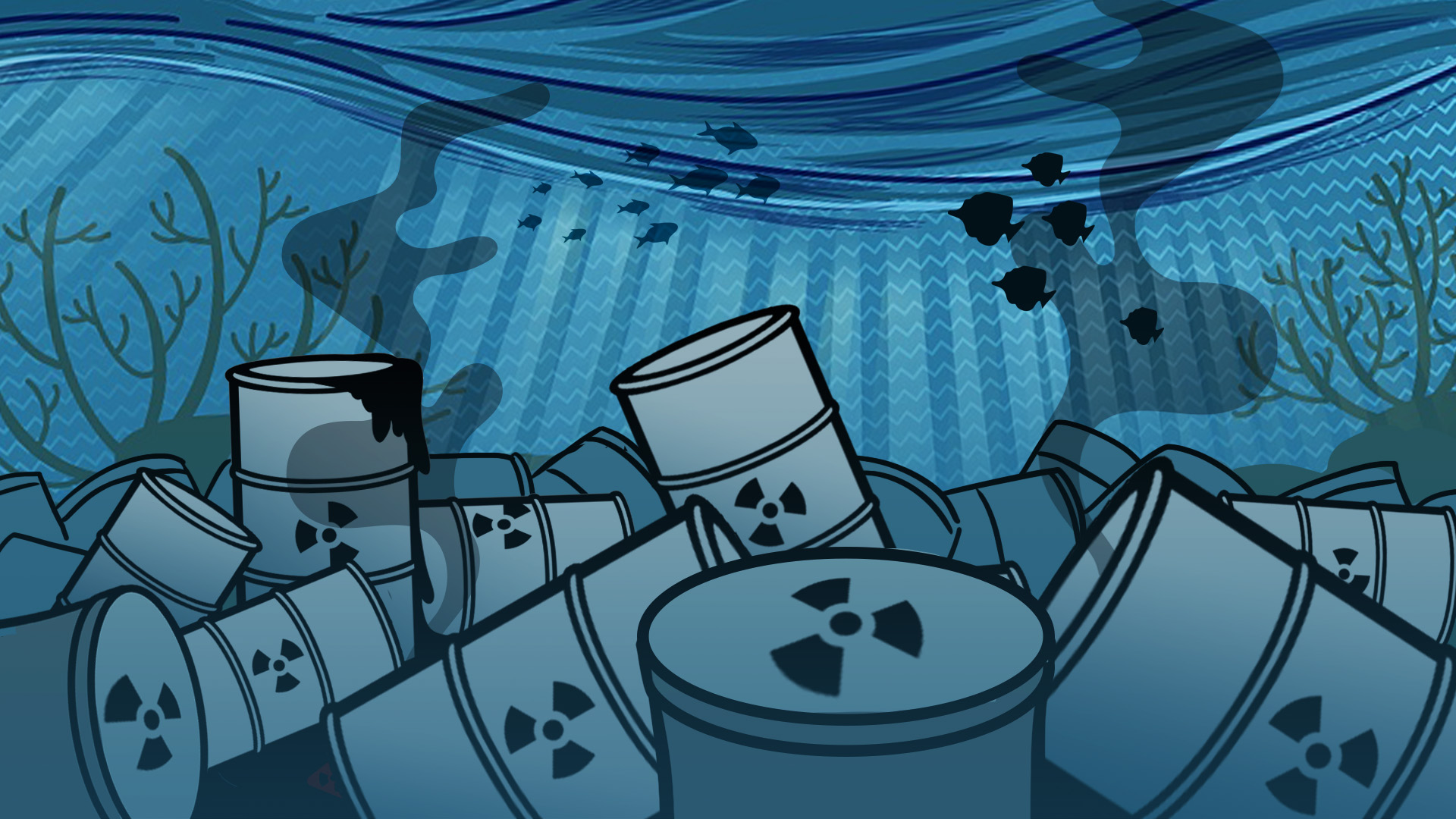
Plans to dispose of radioactive nuclear waste beneath the seabed off the north-west coast of England risk seriously harming marine life including mammals such as dolphins and whales, experts have warned.
Seismic surveys in the Irish Sea near Cumbria get under way on Saturday to explore whether the area is suitable for a proposed facility. The UK government is seeking a location for a deep underground repository to store the world’s largest stockpile of untreated nuclear waste.
Officials have said that a decades-long accumulation of materials including more than 100 tonnes of plutonium – which could create thousands of nuclear bombs – cannot sustainably be stored above ground for ever and they are therefore searching for a site to “keep it safe and secure over the hundreds of thousands of years it will take for the radioactivity to naturally decay”.
In 2019, radioactivity leaked into the soil beneath Sellafield, in Cumbria, which saw a serious leakage in the 1970s and was not built with decommissioning in mind. There are 20 surface facilities that store highly radioactive waste across the UK. About 750,000 cubic metres, equivalent to 70% of the volume of Wembley stadium, is earmarked for “geological disposal”.
But impacts related to noise exposure from seismic gun blasts have been linked to vastly reduced sightings of whales, whose primary sense is acoustic. There is also concern over storing nuclear waste underwater, with just a handful of such sites globally.
The Zoological Society of London’s cetacean strandings investigation programme manager, Rob Deaville, said that seismic blasts can cause habitat avoidance, risk excluding mammals from an area, and raise the risk of decompression sickness. “Potential impacts can also include direct physical effects ranging from temporary or permanent threshold shifts in hearing to direct blast trauma,” he told the Guardian.
There are also concerns that the blasts may drown out mating calls and even cause deaths, after more than 800 dolphins washed ashore in Peru in 2012 after seismic tests. On the Cumbria survey, Deaville added that the area is a known habitat for porpoises, dolphins and other species. “Our teams are very much on standby, in the event we receive increased reports of live/dead strandings over this period.”
In a letter to campaigners shared with the Guardian, an official from the Marine Management Organisation, a public body, acknowledged “the potential disturbance to certain cetacean species” but noted that the plans were largely exempt from regulations.
Critics also suggest it may be impossible to predict the consequences of storing heat-generating nuclear waste beneath the sea in perpetuity.
The chair of Nuclear Free Local Authorities (NFLA), David Blackburn, also leader of the Green party group at Leeds city council, told the Guardian: “The waste would be left in situ for millennia and, no matter how effective the barriers, some of the radioactivity will eventually reach the surface. The rate at which radioactivity would leak from a [geological disposal facility (GDF)] can be poorly predicted and is likely to remain so for an indefinite period.
“Rather than solving a problem for future generations, it could be leaving them a legacy of a nuclear waste dump gradually releasing radioactivity into the environment and cutting off their options for deciding how to deal with this waste.”
The NFLA prefers the idea of a “near surface, near site storage of waste” to allow for monitoring and management, and action in the event of a leakage. “Further scientific research may yield advancements that could mean that radioactive waste can be treated such as to make it less toxic in a shorter time period,” Blackburn added. “Chucking it in a hole in the ground or under the seabed precludes this possibility…………………………….. https://www.theguardian.com/environment/2022/jul/29/undersea-nuclear-waste-dump-off-cumbria-risks-harm-to-marine-life-experts-warn
High anxiety as Japan takes another step toward releasing wastewater from crippled Fukushima nuclear plant into sea.
China, South Korea, Taiwan, Hong Kong and Macau) still have import bans in place.
concern about whether the discharge of enormous amounts of wastewater could set a bad precedent for dealing with future nuclear accidents.
CBS News BY LUCY CRAFT, 25 July 22, Tokyo — The fishing industry around Japan’s Fukushima coast expressed disappointment and resignation over the weekend as long-expected plans to start releasing treated wastewater into the ocean from the crippled Fukushima Daiichi nuclear power plant moved one step closer to reality. The drastic measure has been adopted as the only practical way out of a dilemma that’s plagued the damaged plant for more than a decade……………………..
The unprecedented, controversial disposal operation is likely to take decades.
Since the massive 2011 earthquake and tsunami triggered meltdowns in three of the plant’s reactors, operator Tepco has struggled to manage the vast amount of contaminated water — a combination of reactor cooling water, rainwater and groundwater, all irradiated as it flows through the highly-radioactive melted reactor cores – accumulating at the facility.
As a stopgap, the grounds surrounding the damaged reactors have been converted into a giant tank farm, with more than 1,000 storage vessels holding 1,310,000 tons of wastewater.
Tepco has long warned that it will run out of storage space as soon as spring 2023, and that the structures are hampering the technologically challenging work of decommissioning the plant. The temporary storage solution is also highly vulnerable to any future natural disasters……………
Before construction of the undersea tunnel can even begin, however, Tepco’s proposal must win backing from the regional government in Fukushima Prefecture and the two affected towns of Okuma and Futaba. A Fukushima fish processing company representative told the Asahi newspaper, “to be honest, even if we oppose this, I don’t feel like we have any chance of overturning the decision.”
After years of painstaking efforts to convince the Japanese public and the rest of the world that their seafood is safe, the local fishing industry fears the ocean release will tarnish their brand anew. Tokyo has promised to buy catches if the industry suffers reputational damage.
Of the 55 countries and regions that imposed restrictions on imported Japanese food after the Fukushima Daiichi catastrophe — including the U.S. — five (China, South Korea, Taiwan, Hong Kong and Macau) still have import bans in place.
Regulators solicited public comment and said they had received more than 1,200 responses, including people voicing concern over whether the undersea tunnel would be earthquake-safe, and what was being done to protect workers.
Tokyo has said levels of tritium — the one isotope that can’t be filtered out — will be diluted to below 1/40th of the allowable level for discharge in Japan, and 1/7th the WHO ceiling for drinking water.
Still, some experts have called for greater transparency, fearing unintended consequences of the operation. There is also concern about whether the discharge of enormous amounts of wastewater could set a bad precedent for dealing with future nuclear accidents. https://www.cbsnews.com/news/japan-fukushima-daiichi-nuclear-plant-wastewater-release-into-sea-approved/
Guardians of the East Coast (Gotec) fight to stop nuclear waste dumping in the sea near holiday resorts UK

As Boris Johnson forged ahead with plans to triple Britain’s nuclear output in the shift away from a reliance on Russia and fossil fuels, he pledged to build a mini-nuclear reactor in almost every garden across the country.
The outgoing prime minister’s plan was typically bombastic, yet reflected the Government’s ambitious target to deliver up to a quarter of the country’s electricity from nuclear technologies by 2050.
What is less clear, however, is exactly where to put the hazardous waste produced from
reactors. Currently, Britain stores spent nuclear fuel at a number of nuclear sites including Sellafield, in Cumbria, and Sizewell B, in Suffolk.
But these on-land sites are not intended to be a permanent solution to the radioactive material building up as a by-product of Britain’s nuclear programme. The Government’s arms-length body Nuclear Waste Services (NWS) has been tasked with finding a permanent disposal site. Bruce Cairns, chief policy adviser at NWS, says: “We’re talking about a solution that should last hundreds of thousands of years. “What do you trust the most? Do you really want to leave this stuff at the surface, where it is vulnerable to
extreme weather events, climate change, sea level rise, terrorism, war or the breakdown in society?
“Everyone reaches the same conclusion. We just can’t give any guarantees that there will be people on the surface capable of looking after it over those timescales.” Countries worldwide with nuclear programmes are all trying to find ways to store the waste so that it will not endanger future civilisations, with policy makers discussing how to make it completely inaccessible to future populations likely to
speak different languages, hold different values and have access to new technologies. The best way forward, they have decided, is to store the waste in rocks deep underground.
But finding a local area happy to host the site has its challenges, and has come up against opposition. A number of locations in Cumbria are being vetted by the Government, with the communities near Sellafield considered more amenable because they are already better acquainted with nuclear technologies and aware of the economic benefits of the industry.
However, a new entrant has emerged on the east coast. A community group assessing plans for a GDF has been set up in Lincolnshire. The facility’s entrance would be located at a former gas terminal near the village of Theddlethorpe and the popular seaside town of Mablethorpe. Underground tunnels dug out of layers of deep rocks would lead to the underwater site around six miles from the coastline. NWS and other proponents of the site point out that granting a GDF in the area will unlock significant government funding for local projects.
Yet opponents fear it would wreck the local tourism industry. A group called the Guardians of the East Coast (Gotec) are fighting the plans through protests, petitions and coverage in local and national newspapers. Ken Smith, chairman of Gotec, says: “Mablethorpe is one of the east coast’s principle bucket-and-spade holiday resorts. “I imagine that having four square miles of nuclear waste just six miles off the coast is not exactly going to encourage people to send their children along to bathe in the sea.” Local Conservative MP Victoria Atkins has also expressed reservations and held meetings with site organisers.
Telegraph 23rd July 2022
Japan approves nuclear-contaminated water discharge plan, may turn Japanese people into ‘sick men of Asia,’ seafood consumption and export nosedive
By Zhang Hui and Xing Xiaojing Jul 22, 2022 , Japan’s nuclear regulator on Friday approved the discharge plan of Fukushima nuclear-contaminated water, with Chinese observers voicing concerns that the release of the contaminated water into the ocean may start earlier than the previous schedule of next spring and warning that Japan will bear the brunt of damage, with people’s lives under serious threat and seafood consumption and export nosediving.
………………… Although the Foreign Ministry statement said this does not mean that TEPCO can immediately start the discharge of the contaminated water into the sea as there are remaining processes, such as the Japanese regulator’s inspections to check and confirm the installation status of the discharge facilities, Chinese observers believed that Japan may accelerate its scheduled plan, making the release start earlier than April 2023.
Chang Yen-chiang, director of the Yellow Sea and Bohai Sea Research Institute of Dalian Maritime University, who has been closely following the Japanese government’s decision on discharging Fukushima wastewater, told the Global Times on Friday that the administrative process for releasing the contaminated water was done in a really fast manner, as it only took Japan five days from announcing completion of construction for undersea tunnel outlet to approving the plan.
The TEPCO has basically completed the construction of an undersea tunnel outlet to dump the nuclear-contaminated water, the Kyodo News agency reported on Sunday.
Japan’s latest move apparently aroused lots of concern and opposition from neighboring countries.
Chinese Foreign Ministry spokesperson Wang Wenbin said at Friday’s media briefing that it is extremely irresponsible for Japan to attempt to create a fait accompli, regardless of various parties’ concerns and China firmly opposes it.
China once again urges Japan to earnestly fulfill its due international obligations, dispose of the nuclear-contaminated water in a scientific, open, transparent and safe manner, and stop pushing through the ocean discharge plan, Wang said.
……………. Meanwhile, Japan’s seafood exports will be greatly hindered, which would hurt the economy and local fishery groups, observers said.
Many countries, including the US and UK, banned imports of food products manufactured in and around Fukushima Prefecture following the 2011 nuclear disaster, and some countries and regions have not lifted the ban even now.
Fishery groups in Japan have repeatedly said they were firmly opposed to the plan due to concerns over a negative impact on the industry. ……………..
China and other stakeholders could through the UN request an advisory opinion from the International Court of Justice, to prove the release is illegal, Chang said.
Yu also advised countries to conduct maritime environment investigation, which could be evidence in seeking compensation from Japan in cases of biological resources damages and other damage.
https://www.globaltimes.cn/page/202207/1271183.shtml
All at Sea: Energy Security Bill reveals UK government preference to dump waste offshore
https://www.nuclearpolicy.info/news/all-at-sea-energy-security-bill-reveals-government-preference-to-dump-waste-offshore/ 20 July 22, The Government has published a factsheet in support of the new Energy Security Bill which has confirmed the long-held suspicion of Britain’s Nuclear Free Local Authorities that the nuclear industry intends to dump its deadly legacy of radioactive waste out at sea.
Tucked away in this page-turner is a reference that could be missed on page seven revealing that with refence to the government stated ambition to Prepare for our nuclear future and clean up the past’, that ‘The Bill will also facilitate the safe, and cost-effective clean-up of the UK’s nuclear sites, ensuring the UK is a responsible nuclear state by clarifying that a geological disposal facility located deep below the seabed will be licensed.’[1]
That the intention is to dump the waste at a location out at sea has helpfully been made plain in the latest infomercial published by the Theddlethorpe GDF Community Partnership
20th July 2022
All at Sea: Energy Security Bill reveals government preference to dump waste offshore
The Government has published a factsheet in support of the new Energy Security Bill which has confirmed the long-held suspicion of Britain’s Nuclear Free Local Authorities that the nuclear industry intends to dump its deadly legacy of radioactive waste out at sea.
Tucked away in this page-turner is a reference that could be missed on page seven revealing that with refence to the government stated ambition to Prepare for our nuclear future and clean up the past’, that ‘The Bill will also facilitate the safe, and cost-effective clean-up of the UK’s nuclear sites, ensuring the UK is a responsible nuclear state by clarifying that a geological disposal facility located deep below the seabed will be licensed.’[1]
That the intention is to dump the waste at a location out at sea has helpfully been made plain in the latest infomercial published by the Theddlethorpe GDF Community Partnership

This latest plan to jeopardise the marine environment is par for the course for successive British Governments which, without a care for the ecology of British waters, have previously chosen to recklessly dump deadly munitions and poison gas into our oceans.
In November 2020, the NFLA published a horrifying report commissioned from marine pollution expert, Tim Deere-Jones, which revealed that evidence was mounting that around two million tons of unused wartime munitions were dumped in, or around, the Beaufort’s Dyke in the Irish Sea in the interwar and post-war years, up until at least the mid-1970’s.[2]
Alongside conventional explosives, this deadly legacy included at least 14,000 tons of phosgene gas and a cocktail of other nasties such as ‘canisters of chemical warfare agents including sarin, tabun, mustard gas, cyanide, … and the biological warfare agent anthrax’.
The New Scientist has reported instances of munitions washing up on Scottish beaches and the British Geological Survey confirmed that explosions generated by degrading munitions are a relatively frequent occurrence and that at least one of those explosions was observed to have generated an explosive force equivalent to approximately 5.5 tonnes of TNT.
The report also revealed that radioactive waste has previously been dumped into the Irish Sea, in the Beaufort’s Dyke, in the Firth of Tay and off the island of Arran, including radium-coated aircraft dials, laboratory waste, luminous paint and waste encased in concrete within metal drums.
Responding to the latest revelation, Councillor David Blackburn, Chair of the NFLA Steering Committee, said:
“Clearly then the Energy Security Bill demonstrates that once again the British Government’s plan is to dump its deadly legacy of high-level radioactive waste offshore whatever the long-term detriment to the marine environment and regardless of local and international opposition, and the Theddlethorpe Community Partnership diagram makes this intention writ large.
“The NFLA has far from convinced that however well engineered a nuclear waste dump, or Geological Disposal Facility as the nuclear industry likes to call it, is that the structure of such a facility will not become compromised over the 100,000 years it is required to hold waste whilst it remains radioactive. We fear that in future centuries we shall see radioactive waste poisoning our oceans and beaches.
“This is an especial issue of concern in West Cumbria, where three of the possible four current sites for the dump are under consideration; for here for generations Sellafield has been leaking its toxics into the Irish Sea.
“The NFLA will continue to oppose a GDF, especially one at sea. Our policy is to see radioactive waste properly monitored and managed in a near surface facility, rather than dumped out of sight, out of mind and forgotten about!”
For more information, please contact NFLA Secretary Richard Outram by email on richard.outram@manchester.gov.uk or mobile 07583097793
Millom and Haverigg being conned by nuclear industry over waste dump, claims former councillor.
A Millom resident, who recently resigned from her local council in disgust
at the shenanigans she witnessed, has claimed that the residents and
elected members of Millom and Haverigg and surrounding villages are
‘being conned’ with lies and false promises from Nuclear Waste Services
and some members of the local South Copeland GDF Community Partnership.
Only last month, Jan Bridget founded the Millom and District against the
Nuclear Dump campaign group as a voice for local people who are opposed to
the proposal to bring a nuclear waste dump to the South-West of Cumbria.
The waste dump or Geological Disposal Facility (as Nuclear Waste Services
prefers to call it) will be final resting place for the high-level
radioactive waste generated by Britain’s civil and military programmes
over the last seventy years.
One catalyst for local opposition has been
NWS’s plan to ‘sound blast’ the Irish Sea to determine if the geology
of the seabed could host the waste dump. Almost 50,000 individuals have
signed an online petition in opposition to the plan, whilst environmental
and conservation groups have registered their concerns that the health of
marine wildlife will be seriously compromised.
To date, the local and national authorities have been deaf to these objections. Over the last
month, the Millom and District group has become an effective local force
opposing plans for a dump. Nearly 400 local people have so far joined, and
members have been active with a protest by 19 local people outside an
NWS-organised community consultation event in Haverigg, and a door-to-door
delivery campaign completed with activists posting almost 5,000 leaflets
through letter boxes. As a member of Millom Town Council, Jan spoke up for
the objectors, but, from the hostile response she received from several
fellow Councillors involved with the Community Partnership, it soon became
clear that her lone voice was unwelcome in the council chamber, and the
atmosphere turned so toxic that Jan felt unable to stay.
NFLA 18th July 2022 https://www.nuclearpolicy.info/news/millom-and-haverigg-being-conned-by-nuclear-industry-over-waste-dump-claims-former-councillor/
Nuclear war would turn oceans upside down, crash food web
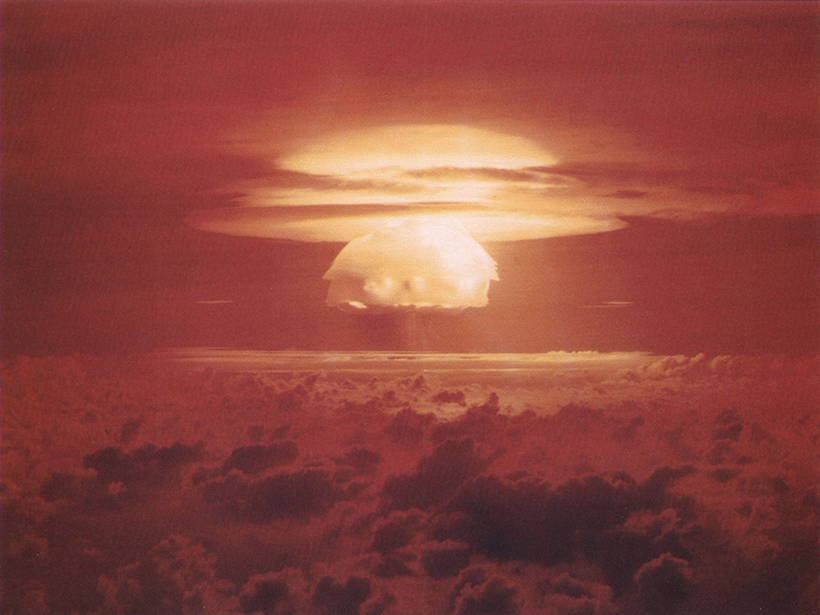
https://news.wisc.edu/nuclear-war-would-turn-oceans-upside-down-crash-food-web/ July 8, 2022 By Chris Barncard , Russia’s invasion of Ukraine has given the specter of nuclear war renewed weight as a global threat, and a new study of the environmental impact of a nuclear conflict describes dire consequences for the world’s oceans.
“If there were a nuclear war, these huge explosions and the firestorms they cause could throw so much soot — teragrams, or millions of tons — into the atmosphere, it would block out enough sunlight to cool the atmosphere significantly,” says Elizabeth Maroon, a professor of atmospheric and oceanic sciences at the University of Wisconsin–Madison.
In just one month after a nuclear exchange between Russia and the United States or India and Pakistan, average global temperatures would drop by 13 degrees Fahrenheit — a larger temperature change than in the last ice age — according to climate modeling by Maroon and collaborators from around the world. The research team, led by Louisiana State University professor of oceanography and coast sciences Cheryl Harrison, published their findings July 7 in the journal AGU Advances.
Even setting aside radioactive fallout, the consequences on land would be dire, including widespread crop failures. But in just a year, the planet’s interconnected oceans would enter a state unfamiliar to scientists like Maroon who study the way oceans have changed on much longer time scales. And, unlike effects on the atmosphere and on land, oceans would not fully recover within the 30-year time period covered by the researchers’ simulations of nuclear conflicts.
“Changes in the ocean take longer than in the atmosphere or on land, but our modeling shows that even in the first year after a nuclear war the ocean circulation would have started changing drastically,” says Maroon, an expert on the interplay between the Atlantic Ocean’s complex circulation patterns and Earth’s climate.
The Atlantic’s major circulation turn-around in the northern latitudes — in which warm surface water streaming north to Greenland, Iceland and Norway cools and sinks into middle depths to be drawn south again — comes unhinged.
“Within the first year or two, water in the North Atlantic sinks all the way to the bottom of the ocean, which we think has not happened even in the ice ages,” says Maroon. “In today’s ocean, only near Antarctica does water sink all the way to the seafloor.”
That unprecedented mixing and ocean circulation speed-up — which would last for about two decades — would move nutrients in the ocean vital for supporting the smallest and most numerous marine organisms, like plankton, into entirely unfamiliar conditions around the world.
It would also result in cooling so strong it would extend sea ice and render impassable major seaports that are now open year-round, and would likely cause significant damage to much of the ocean food web.
“It’s no secret that nuclear winter would be terrible,” Maroon says. “What this study shows are the lasting extent of effects we hadn’t really addressed before on ocean circulation and ecosystems and the very base of the food web.”
To read more about the study and its findings, visit: https://www.lsu.edu/mediacenter/news/2022/07/07docs_harrison_aguadvances.php
Marine Management Organisation Put “On Notice” Should they Rubber Stamp Possibly “Unlawful” Seismic Blasting Plan in Irish Sea — RADIATION FREE LAKELAND

The Marine Management Organisation are, any day, due to give their decision on Nuclear Waste Services seismic blasting plan for the Irish Sea. A report condemning Nuclear Waste Services plan for seismic blasting has been funded entirely by contributions from the public and written by renowned marine expert Tim Deere-Jones. The threat to the supposedly […]
Marine Management Organisation Put “On Notice” Should they Rubber Stamp Possibly “Unlawful” Seismic Blasting Plan in Irish Sea — RADIATION FREE LAKELAND
‘Lacking in scientific rigour’: Damning verdict of marine expert on UK’s Nuclear Waste Services seismic testing plan
Radiation Free Lakeland (RFL) and the Nuclear Free Local Authorities
(NFLA) have announced the publication of a report by a renowned marine
expert which is highly critical of Nuclear Waste Services’ (NWS) proposal
to carry out a seismic survey in the Irish Sea to further a plan for an
offshore nuclear waste dump.
The report, ‘The West of Copeland Acoustic
Airgun Survey Proposal: A critical analysis Review Briefing’, was
commissioned by Radiation Free Lakeland and supported wholly through
financial contributions made by members of the public concerned about the
harm that could be caused to marine life by seismic testing.
The report was written by Tim Deere-Jones, a highly-regarded marine radioactivity and
pollution researcher and consultant who has been working independently in
this field since 1983. The NWS, an operating division of the Nuclear
Decommissioning Authority, is responsible for finding a site for a
so-called Geological Disposal Facility, either below ground or beneath the
seabed.
This nuclear waste dump will be filled with the toxic radioactive
waste that is the legacy of Britain’s seven decades of the civil nuclear
power production; much of it will remain radioactive for many tens of
thousands of years.
Three search areas in Cumbria, falling within the local
authority areas of Allerdale and Copeland and offshore up to 22kms, are
under consideration. Seismic testing will enable NWS to determine if the
geology beneath the bed of the Irish Sea is suitable to host a repository
for the nuclear waste.
This involves firing blasts of sound from air guns
below the waves every 10 seconds for four weeks or longer. This sound
penetrates under the ocean floor to help scientists discover more about the
suitability of the geology to store nuclear waste. Seismic testing can
seriously impair the health of marine life, which in the Irish Sea includes
whales, dolphins, porpoises, and seals, but some scientific reports also
suggest that even tiny shellfish and plankton can be adversely impacted,
hazarding the whole marine ecosystem.
NWS have claimed an exemption from
the requirement to seek a Marine Licence from the MMO citing their survey
as furthering ‘scientific research’ and in so doing have prevented
public analysis of their proposals or commentary from academics and marine
welfare organisations.
NFLA 27th June 2022
The UK is searching the sea for a nuclear dump site with huge risks to marine life

”Protections clearly mean nothing when the nuclear waste industry wants to pave the way to a deep nuclear dump.”
By Charlie Jaay • euro news green, 22/06/2022
A new report delivers a damning verdict on the proposed seismic blasting in the Irish Sea.
The UK government’s Nuclear Waste Services (NWS) is set to carry out seismic surveys off the Cumbrian Coast between July and August this year.
They are looking for a place to dispose of the waste produced by Britain’s nuclear reactors.
The report, commissioned by Radiation Free Lakeland, calls for these plans to be postponed, claiming the impact assessment by NWS is “deeply inadequate” and “lacking in appropriate scientific and academic rigour”.
What is seismic blasting?
Seismic blasting is a process that allows scientists to find out more about the geography of the sea bed. Loud, repetitive blasts of sound are produced from an underwater airgun – like a powerful horn – and their echoes are measured to map the underwater rocks
The airgun will fire every 10 to 15 seconds, throughout the survey period of around one month.
The surveys, commissioned by NWS, will be looking into the possibility of locating a Geological Disposal Facility (GDF). Deep under the seabed, this facility will be used to dispose of the UK’s toxic legacy of high level nuclear waste – the highly radioactive byproducts of nuclear reactors.
Shearwater GeoServices, the company which last year saw the high court put an end to its work on South Africa’s ecologically sensitive Wild Coast, is carrying out the investigations.
According to a freedom of information request, a licence of exemption to carry out these surveys was given to NWS for ‘scientific research’. But Radiation Free Lakeland says the survey is not for ‘scientific research’ but a plan to dispose of nuclear waste.
“We commissioned an independent report because we need to counter the PR spin from the nuclear waste industry who are calling the seismic testing ‘non-invasive scientific research,’” says Marianne Birkby, Founder of the campaign group.
She argues that, rather than seismic blasting for scientific purposes, the plans facilitate a commercial venture for a “deep nuclear dump for heat generating nuclear waste.”
A limited company that wants to enable ever more nuclear waste from new nuclear builds, Radioactive Waste Management, is behind it, Birkby claims.
“Despite the marine protections this part of the Irish Sea has, it is an outrage that independent environmental impact assessments have not been carried out. Protections clearly mean nothing when the nuclear waste industry wants to pave the way to a deep nuclear dump.”
In response to the claims, NWS says “there is no requirement to undertake a public consultation for these surveys.”……
Seismic surveys can devastate marine life
Low frequency sounds generated by a single seismic airgun can extend over large distances, particularly in deeper waters.
They have been recorded at locations up to 4,000 kilometres from the source, and can blanket areas of up to 300,000 square kilometres with noise. Studies have shown that, because seismic surveys can disturb, injure or kill a wide variety of marine life, they can impact entire ecosystems.
Zooplankton are the base of the marine food chain and are extremely important to our ocean’s health. They are also very vulnerable to these loud noises, according to scientists.
Researchers have found that seismic surveys significantly increase the death rates of zooplankton in the 1.2 kilometre range they tested, killing all larval krill in the range.
Radiation Free Lakeland’s report says the surveys will take place when zooplankton populations are expected to be high. These creatures provide a food source for a wide variety of organisms including baleen whales, basking sharks and fish which, in turn, feed many other species.
Many other marine animals rely on sound for survival too. Seismic testing can interfere with basic functions such as communication, navigation, feeding and mating.
“Noise exposure can be a problem for a wide variety of Cetaceans-dolphins, porpoises and whales,” according to the Zoological Society of London’s Cetacean Strandings Investigation Programme.
“Noise related impacts have also been causally linked to many cetacean stranding and mass stranding events globally.”
The NWS investigation will focus on a survey area five to 20 kilometres off the Cumbrian coast in the north west of England in an area of approximately 250 square kilometres. The proposed GDF may extend over an area of 25 kilometres square, deep beneath the seabed.
This region is one of a number of designated Marine Conservation Zones in the Irish Sea. It has protected habitats and is home to a number of European protected species, such as sea turtles, minke whales, common and bottlenose dolphins, and harbour porpoises…………………
Marine habitats are already under huge pressure from pollution, irresponsible development and bottom trawling – as well as the consequences of climate change, she explains. Joan Edwards. Director of Policy at the Wildlife Trusts
We are concerned about the implications of seismic testing in the Irish Sea, which evidence shows can be devastating for marine life.”
The report claims many of the hugely important marine species found in the area have not been studied for their sensitivity to seismic surveys.
A ‘marked lack of transparency’ from Nuclear Waste Services
Marine radioactivity researcher and consultant Tim Deere-Jones is the author of Radiation Free Lakeland’s report. He says that NWS’s licence application for the seismic survey is characterised by “a marked lack of transparency.”
We are concerned about the implications of seismic testing in the Irish Sea, which evidence shows can be devastating for marine life.”
The report claims many of the hugely important marine species found in the area have not been studied for their sensitivity to seismic surveys.
A ‘marked lack of transparency’ from Nuclear Waste Services
Marine radioactivity researcher and consultant Tim Deere-Jones is the author of Radiation Free Lakeland’s report. He says that NWS’s licence application for the seismic survey is characterised by “a marked lack of transparency.”
The UK government, similar to many others, favours deep geological disposal to deal with the most radioactive waste – whether deep below ground or deep beneath the seabed.
However, there are still many concerns about this £53 billion (€62 billion) facility in the Irish Sea, which has not been tried or tested and provides no guarantees of safety. https://reliefweb.int/report/world/let-us-move-towards-world-without-nuclear-weapons
Extreme torture — Beyond Nuclear International

24/7 blasting for nuke waste dump will devastate marine life, Beyond Nuclear 19th June 2022
Extreme torture — Beyond Nuclear International magine being subjected to ear-shattering blasts every ten seconds, twentyfour hours a day for four straight weeks? By any metric, that would qualify
as the most appalling form of torture. But that is exactly what is about to
be inflicted on whales, dolphins, seals and other marine creatures in the
Irish Sea if a new wave of opposition cannot stop it. The Irish Sea is
already the most radioactive sea in the world, in large part a result of
decades of radioactive discharges from the Sellafield reprocessing facility
on the Cumbrian shoreline. Now, Nuclear Waste Services (NWS) has contracted
a company called Shearwater Geosciences to blast its undersea seismic
airguns off the Cumbria coast this summer, calling it “scientific
research”. https://beyondnuclearinternational.org/2022/06/19/extreme-torture/
1 This Month


Tell the Ukrainian Government to Drop Prosecution of Peace Activist Yurii Sheliazhenko

Petition to revoke the licensing of the Near Surface Nuclear Disposal Facility (NSDF) at Chalk River. https://www.ourcommons.ca/petitions/en/Petition/Details?Petition=e-7247


of the week – STOP SMALL MODULAR REACTORS IN CANADA
To see nuclear-related stories in greater depth and intensity – go to https://nuclearinformation.wordpress.com
-
Archives
- March 2026 (204)
- February 2026 (268)
- January 2026 (308)
- December 2025 (358)
- November 2025 (359)
- October 2025 (376)
- September 2025 (258)
- August 2025 (319)
- July 2025 (230)
- June 2025 (348)
- May 2025 (261)
- April 2025 (305)
-
Categories
- 1
- 1 NUCLEAR ISSUES
- business and costs
- climate change
- culture and arts
- ENERGY
- environment
- health
- history
- indigenous issues
- Legal
- marketing of nuclear
- media
- opposition to nuclear
- PERSONAL STORIES
- politics
- politics international
- Religion and ethics
- safety
- secrets,lies and civil liberties
- spinbuster
- technology
- Uranium
- wastes
- weapons and war
- Women
- 2 WORLD
- ACTION
- AFRICA
- Atrocities
- AUSTRALIA
- Christina's notes
- Christina's themes
- culture and arts
- Events
- Fuk 2022
- Fuk 2023
- Fukushima 2017
- Fukushima 2018
- fukushima 2019
- Fukushima 2020
- Fukushima 2021
- general
- global warming
- Humour (God we need it)
- Nuclear
- RARE EARTHS
- Reference
- resources – print
- Resources -audiovicual
- Weekly Newsletter
- World
- World Nuclear
- YouTube
-
RSS
Entries RSS
Comments RSS
 nuclear-news