How spin about wind farms can make you sick
 The results showed that the experience of symptoms and mood during exposure to audible windfarm sound and infrasound was influenced by the type of expectations provided before exposure periods.
The onus falls on the media to report on health fears about wind farms cautiously, particularly given strong evidence that it is the discussion itself that may be creating and perpetuating health complaints.
 Wind turbines don’t make you feel sick or healthy, but spin can http://theconversation.com/wind-turbines-dont-make-you-feel-sick-or-healthy-but-spin-can-20845 Fiona Crichton PhD candidate in psychological medicine at University of Auckland 29 Nov 13
Despite at least 19 reviews of the scientific evidence universally concluding that exposure to wind farm sound doesn’t trigger adverse health effects, people continue to report feeling unwell because they live near wind turbines.
We’ve known for some time that exposure to negative messages about wind farms makes people more likely to report feeling sick after exposure to turbines. And new research, published by my colleagues and I this week in the journal Health Psychology, shows positive messages about wind farms may have the opposite effect – improve perceptions of health.
Infrasound
Speculation in the media and on the internet often attributes the symptoms to sub-audible sound produced by operating wind farms (infrasound). But the reality is that infrasound (sound below 16 hertz) is consistently present in the environment and is caused by wind, ocean waves and traffic. Importantly, research demonstrates there is nothing unusual about the levels of infrasound produced by wind farms. Continue reading
Renewable energy agreement between India andBelgium
India, Belgium agree to promote renewable energy cooperation By PTI | 27 Nov, 2013, NEW DELHI: India and Belgium agreed to strengthen, promote and develop renewable energy cooperation besides exploring joint research opportunities in the sector. The decision was made during a bilateral meeting between New and Renewable Energy minister Farooq Abdullah and Princess Astrid of Belgium. Princess Astrid is currently on a visit to India as head of a large Belgian Economic Mission.
“After detailed discussions, the two sides agreed to start work on a MoU in the field of renewable energy between both the governments in order to strengthen, promote and develop renewable energy cooperation between the two countries on the basis of equality and mutual benefit,” it said.
Briefing the visiting delegation on the energy situation in India and rapid growth in this sector, Abdullah spoke about India’s plan of adding over 30GW of renewable energy in its energy mix in the next five years.
Offering all possible assistance to enhance cooperation in this sector, Abdullah also highlighted India’s conducive and investor friendly policy framework for promoting renewable energy in a big way. The minister also talked about the success of the wind programme as well as the significant cost reductions in solar energy through the Jawahar Lal Nehru National Solar Mission. http://economictimes.indiatimes.com/articleshow/26476932.cms?utm_source=contentofinterest&utm_medium=text&utm_campaign=cppst
Warren Buffett is going for Renewable Energy
 Here’s What Warren Buffett Thinks About Renewable Energy The Motley Fool By Jason Hall | November 27, 2013 |
“Rule No. 1: Never Lose Money. Rule No. 2: Never Forget Rule No. 1.”
–Warren Buffett
Warren Buffett is famous for both his legendary investing acumen, and his simple, straightforward investing advice. For years, alternative energy has been viewed as non-competitive with traditional energy production from coal and other fossil fuels, making them money-losers for most investors.
Buffett’s own Berkshire Hathaway (NYSE: BRK-B ) subsidiary MidAmerican Energy is heavily investing in alternative energy sources, including both wind and solar. And considering that MidAmerican produces more than $1.2 billion in annual “ammo” for Buffett’s “elephant gun,” the story on renewables is clearly changing.
Should investors follow t… (registered readers only) http://www.fool.com/investing/general/2013/11/27/when-it-comes-to-renewable-energy-buffetts-not-blo.aspx
Uzbekistan to get 100MW Solar Farm
100MW Solar Farm For Uzbekistan http://www.energymatters.com.au/index.php?main_page=news_article&article_id=4046 26 Nov 13 A USD $110 million loan from the Asian Development Bank will help fund Uzbekistan’s first large scale solar power plant.
Announced at the 6th meeting of the Asia Solar Energy Forum in Tashkent, ADB President Takehiko Nakao said the facility will be the largest of its type in Central Asia.
According to the U.S. Energy Information Administration (EIA), Uzbekistan currently relies heavily on fossil fuels for power generation. Natural gas represents approximately 85 percent of the electricity generation mix, petroleum products and coal approximately 8 and 2 percent respectively and hydroelectricity the remaining 5 percent.
Uzbekistan’s government is aiming to generate about 21% of all its energy needs from renewable sources, including solar, by 2031. “Uzbekistan has a large land mass, plenty of sunshine, and the highly skilled and educated human resources needed to become a major player in solar energy development in this region,” said Takehiko Nakao.
To be constructed in Samarkand, the solar farm will not only help green the nation’s energy mix; it will also help address the supply-demand gap.
Uzbekistan experiences 2,410 to 3,090 hours of sunshine annually, depending on the location. The country has rich reserves of natural gas, but ageing infrastructure and export demands means its citizens frequently endure power outages.
Counterpart financing of $200 million for the solar project will be sourced from Uzbekistan’s Fund for Reconstruction and Development and from Uzbekenergo, the state joint stock company.
The project is expected to take around 5 years to construct, with an estimated completion date of March 2019.
While solar looks set to make a substantial impact in the country, it would appear wind power is yet to gain a foothold. According to information from the International Renewable Energy Agency (IRENA), only 1MW of wind capacity was announced last year.
Renewable energy storage is going to change everything!
Energy storage fans are rejoicing all across the country on the heels of a new ruling by the Federal Energy Regulatory Commission (FERC), which opens the floodgates to connecting more solar arrays and wind farms to the power grid. FERC adopted the new ruling, Order 792, in order to bring its existing rules for small generators up to speed with new developments in the energy storage field.
As FERC explained when issuing Order 792:
…the Commission finds it necessary under section 206 of the Federal Power Act to revise the pro forma SGIP [Small Generator Interconnection Procedures] and pro forma SGIA [Small Generator Interconnection Agreement] to ensure that the rates, terms and conditions under which public utilities provide interconnection service to Small Generating Facilities remain just and reasonable and not unduly discriminatory.
Our friends over at the Energy Storage Association contributed to public comments on the rule during its proposal phase and they tipped us to the new ruling, so let’s see what they have to say about it.
Energy Storage Gets A Boost From FERC Order 792
In a nutshell, Rule 792 adds energy storage as a power source that is eligible to connect to the grid. It effectively puts energy storage in the same category as the existing Small Generator Interconnection Procedures and makes it eligible for the existing Fast Track process.
Darrel Hayslip, who chairs the ESA, was fast out of the box with a big thank-you to FERC:
We commend the FERC Commissioners for acknowledging that energy storage should be able to participate in the small generator interconnection process on our electric grid and that our rules and policies should evolve as well. These reforms are good news for storage project developers and further facilitate the deployment of storage on the power grid………
Barn Door Is Already Open
If you’re thinking that it will be a while before energy storage technology can get to the point where the industry can take advantage of the new FERC rules on a mass scale, guess again.
Energy storage for wind and solar is already well on its way to the mainstream………
The addition of utility scale storage facilities is expected to have a ripple effect on the renewable energy market in Hawaii, by contributing to grid flexibility.
Not for nothing, but Xtreme Power has some heavy hitters in its investment portfolio, including some that indicate the fossil fuel industry is continuing its slow (very slow) and lurching pivot to a more diversified approach to energy generation.
That would be BP Alternative Energy (yes, that BP) and Dominion Resources (yes, that Dominion). http://reneweconomy.com.au/2013/renewable-energy-barriers-fall-with-new-ferc-order-67494
French company installs world’s largest offshore wind turbine
Alstom Installs World’s Largest Offshore Wind Turbine by Energy Matters, 26 Nov 13, French energy company Alstom has successfully completed installing the world’s largest offshore wind turbine, the 6 MW Haliade 150, at the Belwind test site off the coast of Belgium.
Engineered to endure harsh North Sea conditions, the Haliade 150 is the biggest wind turbine ever erected at sea. With a rotor diameter of 150-metres and blades nearly 75-metres long, Alstom predicts each model will provide a 15 percent higher energy yield than other wind turbines – enabling a single unit to power up to 5000 households.
Touted as the new generation in offshore turbine technology, the Haliade 150’s nacelle (engine housing) looms 100-metres above sea level and is designed to operate with a minimum of upkeep. The turbine functions without a gearbox, instead relying on direct drive, and a magnetic alternator system transfers unwanted stresses from strong winds away to the tower, optimising efficiency……http://www.energymatters.com.au/index.php?main_page=news_article&article_id=4044
UK government turning its back on renewable energy industries
 David Cameron’s attack on green policies threatens £12bn renewable sector, say Greenpeace, Express, By: Owen Bennett – Political Reporter November 21, 2013 DAVID CAMERON has been accused of risking jobs and investment in the renewable energy sector after reports claimed he had told aides to “get rid of all this green c**p”. It was claimed the Prime Minister was making a major U-turn on environmental issues, and ordering aides to strip out green levies which push up energy bills.
Prior to the 2010 election, Mr Cameron had urged Britain to “vote blue, go green” as he promised to lead the “greenest government ever.”
Downing Street deny the Prime Minister is turning his back on environmentalism, but Greenpeace said the comments show Mr Cameron is trying to claw back support with green sceptics in his party.
Greenpeace’s deputy political director Joss Garman said: “If David Cameron thinks the road to electoral victory will be found in attacking the very policies that he once passionately advocated then he is sorely mistaken.
“The British electorate are a sophisticated bunch who will see through his chameleon tendencies and conclude this attack is not an act of leadership but one of cowardice as he panders to the extreme wing of his own party and tries to claw back support from Ukip.
“The real crime is that every time David Cameron reaches for the dog whistle playbook he undermines thousands of jobs in the green energy sector and threatens future investment. Now that really is crap.” Continue reading
At UN Climate Summit – the call for 100% renewable energy strategies
100% renewables ‘key to CO2 fight http://renews.biz/54420/call-for-100-renewables-targets/ re News, 19 Nov 13, The Global 100% Renewable Energy Coalition has called on governments to commit to 100% renewable energy targets and strategies.
A joint statement at the UN climate summit today asserted that “communicating and proving the urgency and feasibility of 100% renewable energy is key to breaking the climate deadlock”.
Members of the coalition including the World Wind Energy Association, World Bioenergy Association and the Fraunhofer ISE Institute also criticised “the ongoing stagnancy of the climate negotiations and their struggle to agree upon and implement measures that effectively combat the crisis”.
World Wind Energy Association secretary general Stefan Gsänger said: “The growing global movement shows that making the transition to 100% renewable energy is primarily a political, not technical, challenge. The necessary technologies and knowledge already exist.”
In Germany, 74 regions and municipalities have already reached 100% renewable energy. Entire nations like Denmark, Iceland, Scotland, Costa Rica, Maldives Islands, Cook Islands, Tuvalu, and Tokelau “have set and already partly achieved this ambitious target”, the group said.
“Climate change debates have become all too often associated with failing political negotiations and inadequate actions. There is an urgent need to change this,” added World Bioenergy Association president Heinz Kopetz.
10MW-sized battery parks – a revolution in solar energy storage
The battery storage system that could close down coal power REneweconomy, By Giles Parkinson on 19 November 2013 (Editors note: This is part of a series of interviews and stories that will run over the next few weeks looking at Germany’s Energiewende, and the transition of Germany’s energy grid to one dominated by renewable energy. You can find them all in our Insight section).
You don’t have to go far inside the headquarters of German battery storage company Younicos, or even their website for that matter, to find out what they are about. “Let the fossils rest in peace,” the logo suggests. Another sign at their technology centre east of Berlin proclaims: “You are now leaving the CO2 producing sector of the world.”
This sign is designed to mimic those which adorned the checkpoints that separated the various sectors of east and west Berlin before the wall was torn down. Younicos believe they have a technology that is equally disruptive, and can break down one of the last barriers to 100 per cent renewable energy: the need to run fossil fuel generation to control the “frequency” of the grid, and the other system services such as voltage control.
The company, based in Berlin Adlershof, on the eastern outskirts of the capital, is developing 10MW-sized battery parks, using battery systems that it says can stabilise the grid faster, cheaper and with greater precision that conventional generation. Continue reading
Britain’s successful Community Funded Solar Power
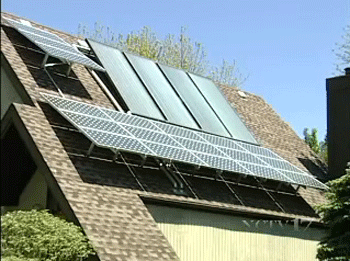 Community Funded Solar Powering Ahead In The UK http://www.energymatters.com.au/index.php?main_page=news_article&article_id=4029 19 Nov 13 The UK’s Brighton Energy Coop (BEC) has raised more than £200,000 in just 3 weeks for a 200kW rooftop solar panel system project – the largest in the city.
Like other solar co-ops, members of the community chip in for the installation of solar array. Revenue is generated through feed in tariffs and sale of the power generated to the “solar landlords”, the businesses where the systems are installed.
BEC offers cash payments to building owners of up to £10,000 to host solar panels, plus discounted electricity for 20 years.
Brighton Energy Co-operative intends to pay investors interest of 5% average per annum, commencing a year after installation ends. Investments may also qualify for 30% tax relief under the UK’s Enterprise Investment Scheme (EIS). Shares cost just £1 each and the minimum buy-in is £400.
“By taking the power into our own hands, BEC is showing that the roll out of renewable energy – such an obvious way of transforming our energy supply – can be done with the power of community support,” says the BEC’s Will Cottrell.
Last year, the BEC raised £240,000 for solar PV projects in Brighton and Portslade. At Shoreham Port, systems were installed on five buildings at the Hove Enterprise Centre. A 35kW system was also installed on City Coast Church in Portslade and a 10kw PV system on St George’s Church in Kemptown.
There are now more than 50 similar solar co-ops in the UK.
Gridline from Wyoming to Idaho a leap ahead for wind energy
 Obama’s Renewable Energy Initiative Changing US Landscape http://www.ibtimes.com/obamas-renewable-energy-initiative-changing-us-landscape-1474130 By David Kashi November 18 2013 The Department of Interior has approved the first major U.S. energy transmission project that will integrate existing renewable sources of electricity spanning the western U.S.
The 900-mile Gateway West Transmission Line project, proposed by Idaho Power and Rocky Mountain Power, will stretch from southern Wyoming to southern Idaho and will carry 1,500 gigawatts of energy, mostly generated by wind farms. A gigawatt of energy is 1,000 megawatts, and one megawatt can sustain about 1,000 homes for one hour.
The project is part of Obama’s 2009 initiative to revamp the U.S. transmission infrastructure through an interagency initiative called the Rapid Response Team for Transmission.
“Gateway West is a high-priority project of the president’s power infrastructure initiative – a commonsense approach that is speeding job creation in the near term while spurring the economy and increasing the nation’s competitiveness in the long term,” Sally Jewell, head of the Department of Interior, announced last week. “The line will strengthen the Western grid, bringing a diversified portfolio of renewable and conventional energy to meet the region’s projected growth in electricity demand.” Gateway West is one of seven pilot projects that will span the U.S. It’s estimated that at peak construction the seven projects will create around 1,200 jobs.
The development of the project went through a rigorous environmental impact and public comment period, results from which included the route for the transmission lines being crafted to use existing transmission corridors to avoid harming sensitive landscapes.
“Transmission is a vital component of our nation’s energy portfolio, and these seven lines, when completed, will serve as important links across our country to increase our power grid’s capacity and reliability,” Ken Salazar, former secretary of the Department of Interior, said in October. “This is the kind of critical infrastructure we should be working together to advance in order to create jobs and move our nation toward energy independence.”
 |
Click here to Reply or Forward
|
Google invests $1 billion, in its plan for 100% renewable energy
 Google wants to run on 100% renewable energy Here are 3 reasons the company may want clean and sustainable power sources.MSN Money, By The Week 16 Nov 13.This week, Google (GOOG -0.16%) announced in a blog post a new $80 million investment in solar energy in California and Arizona, bringing its total investments in renewable energy since 2010 to over $1 billion.
It’s just the latest step in an ongoing project by Google to keep at the forefront of the green energy industry. Continue reading
Record production of renewable energy in Denmark and Germany
 Renewable Energy Generation Hits All Time Highs in Denmark and Germany Permaculture Magazine | Friday, 15th November 2013 Denmark’s and Germany’s wind and solar electricity generation is peaking, covering much of their countries’ need, setting the trend for renewable energy systems that do not cost the Earth. In the last month, solar and wind energy has been reaching record breaking figures in some countries in Europe.
 On November 4th this year, Denmark’s wind turbines covered 122% of the countries demand for electricity.
“This is the highest registered figure so far,” says Preben Maegaard, director of the Nordic Folkcenter for Renewable Energy.
 A month before on October 3rd, Germany’s renewable energy peaked at 59.1% with a combination of solar and wind. Across the entire day, 36% of total electricity generation was achieved, with solar contributing 11% at 20.5 gigawatts at its peak.
“It was around midday on October 3, which just happened to be Germany’s annual Reunification Day holiday, when the sun was at its fullest and the significant peak was reached. Over the entire day, 36.4% of total electricity generation was achieved with solar and wind power; solar panels contributed 11.2% on their own. At its peak, solar accounted for 20.5 gigawatts.
“Although the electrical grid withstood the large amount of renewable energy flowing to it, you’ll be pleased to know that electricity prices also dived. A drop in demand from big, conventional power plants led the electricity price index at 2:00pm to 2.75 cents per kilowatt hour. The index covers Germany, Austria, France, and Switzerland.
“So there you have it. A country as large and industrialized as Germany can and did operate successfully, albeit on a national holiday, using a large percentage of renewable energy. And this is only the beginning,” comments Jim Winstead.
These surges not only showed that renewable energy can supply energy needs, but neither power grids broke down under the surge…..http://www.permaculture.co.uk/news/1511134008/renewable-energy-generation-hits-all-time-highs-denmark-and-germany
South Africa’s speedy connection – solar energy to the grid

 South African solar plant connects to the grid three months ahead of schedule, Renewable Energy Magazine, Robin Whitlock Friday, 15 November 2013 The 75MW Kalkbult solar plant will generate 135 million kilowatt hours per year and displace 115,000 tons of greenhouse gas emissions A solar plant built by Scatech Solar in cooperation with local partners has become the first utility-scale renewable energy facility to supply electricity to South African public utility Eskom after connecting to the country’s electricity grid three months ahead of schedule.
The 75MW Kalkbult solar PV plant near Petrusville in the Northern Cape, was officially opened on Tuesday 12thNovember. It will generate 135 million kilowatt hours per year, equivalent to the annual electricity consumption of 33,000 households. The plant covers 105 hectares of a working sheep farm and consists of 312,000 solar panels linked to inverters, transformers and a high-voltage sub-station. More than 600 people were employed during its construction, many from the local community…….
The plant is among 47 solar, wind and mini-hydro projects awarded 20-year electricity generation contracts under the South African government’s Renewable Energy Independent Power Producer Procurement Programme (REIPPPP), introduced three years ago by the Department of Energy. Total investment in the programme is estimated at R74 billion which will climb above R100 billion following the government’s acceptance of 17 new bids. The aim of the programme is to help the country combat climate change by reducing its current near-total dependence on coal-based electricity and accompanying high level of greenhouse gas emissions. The Kalbult plant is intended to displace annual greenhouse gas emissions of 115,000 tons.
The project will also add momentum to the country’s Green Economy Accord signed three years ago with the aim of creating 300,000 new jobs in renewable energy generation, energy efficiency, biofuel production, manufacturing in support of green projects and natural resource conservation and rehabilitation. http://www.renewableenergymagazine.com/article/south-african-solar-plant-connects-to-the-20131115
Solar energy for Ghana
Renewables get big boost as 50MW solar plant to be built Ghana Web 15 Nov 13 Ghana’s energy stock will receive 50 megawatts (MW) of solar power by 2015 as Scatec Solar, a Norwegian energy company, plans to build Africa’s second-largest solar power plant through its local partner Scatec Solar Ghana.
The project will cost about €70million and will be sited in the northern part of the country. “We are in discussion with ECG, the main off-taker, and we hope to progress with those discussions. So far everything is going well. We have had engagement with the Energy Commission and the Public Utilities Regulatory Commission (PURC), and we think that with all the efforts from these various institutions Scatec Solar will come onstream as planned,” Fred Nuerte Nuer, Director of Scatec Solar Ghana, said.
When completed, the project will become the first large utilities-scale solar power plant in West Africa and the second-largest in Africa, after the company unveiled a 75MW solar plant in South Africa early this week……
1 This Month
29 Jan. Thursday 7-8 p.m. Webinar – World’s Largest Nuclear Station in Port Hope, ON?
To see nuclear-related stories in greater depth and intensity – go to https://nuclearinformation.wordpress.com/



31st January – Challenging the War Machine – a DECLASSIFIED UK SUMMIT


Website of the Week
Now until to February 10, 2026 Radioactive waste storage in France: the debate is finally open! How to participate?
-
Archives
- January 2026 (288)
- December 2025 (358)
- November 2025 (359)
- October 2025 (376)
- September 2025 (258)
- August 2025 (319)
- July 2025 (230)
- June 2025 (348)
- May 2025 (261)
- April 2025 (305)
- March 2025 (319)
- February 2025 (234)
-
Categories
- 1
- 1 NUCLEAR ISSUES
- business and costs
- climate change
- culture and arts
- ENERGY
- environment
- health
- history
- indigenous issues
- Legal
- marketing of nuclear
- media
- opposition to nuclear
- PERSONAL STORIES
- politics
- politics international
- Religion and ethics
- safety
- secrets,lies and civil liberties
- spinbuster
- technology
- Uranium
- wastes
- weapons and war
- Women
- 2 WORLD
- ACTION
- AFRICA
- Atrocities
- AUSTRALIA
- Christina's notes
- Christina's themes
- culture and arts
- Events
- Fuk 2022
- Fuk 2023
- Fukushima 2017
- Fukushima 2018
- fukushima 2019
- Fukushima 2020
- Fukushima 2021
- general
- global warming
- Humour (God we need it)
- Nuclear
- RARE EARTHS
- Reference
- resources – print
- Resources -audiovicual
- Weekly Newsletter
- World
- World Nuclear
- YouTube
-
RSS
Entries RSS
Comments RSS
 nuclear-news