‘photoswitches,’ – a coming breakthrough in solar energy?
Scientists Discover How to Generate Solar Power in the Dark Meet ‘photoswitches,’ a breakthrough set of materials that act as their own batteries, absorbing energy and releasing it on demand. THE ATLANTIC, TODD WOODYAPR 15 2014, The next big thing in solar energy could be microscopic.
Scientists at MIT and Harvard University have devised a way to store solar energy in molecules that can then be tapped to heat homes, water or used for cooking.
The best part: The molecules can store the heat forever and be endlessly re-used while emitting absolutely no greenhouse gases. Scientists remain a way’s off in building this perpetual heat machine but they have succeeded in the laboratory at demonstrating the viability of the phenomenon called photoswitching……….
“One design we have for such an application is purely gravity driven – the material flows from one tank to another. The flow rate is restricted so that it’s exposed to the sun long enough that it gets fully charged. Then, when it’s time to cook dinner, after the sun is down, the flow direction is reversed, again driven by gravity, and the opposite side of the setup is used as the cooking surface.”
“As the material flows back to the first tank, it passes by an immobilized catalyst which triggers the energy-releasing process, heating the cooking surface up,” he adds.
Other versions of such device could be used to heat buildings.
Kucharski said the MIT and Harvard team is now investigating other photoswitching molecules and substrates, “with the aim of designing a system that absorbs more of the sun’s energy and also can be more practically scaled up.” http://www.theatlantic.com/technology/archive/2014/04/scientists-discover-how-to-generate-solar-power-in-the-dark/360679/
Vast majority of French people prefer renewable energy, would not invest in nuclear power
 France moving away from Nuclear power http://www.enn.com/energy/article/47327 27 April 14 France may be the world’s most nuclear energy dependent country, but times are changing as the country looks to increase the amount of wind—sourced electricity in its power mix.
When French President François Hollande took the reins of power in 2012 he pledged to reduce the country’s nuclear dependency from 75% to 50% by 2025. Today, France has a goal of reaching 19 GW of wind energy by 2020, up from its current level of 8.2 GW, according to the European Wind Energy Association’s (EWEA) latest statistics. This will significantly raise the percentage of wind powered electricity in the country from the 3% wind covers today. And, according to a very recent survey, the French people are firmly behind the transition.
Some 64% of French people see wind energy as a solution, among others, in the context of the energy transition, says a CSA survey published in March 2014. Moreover, 80% of the 1010 respondents consider it necessary to invest in wind without waiting for the traditional power plants to reach the end of their lifecycle.
65% of those surveyed said that they would invest in renewable energy (wind and solar/photovoltaic) today if they had to personally invest in one energy source, while 15% chose nuclear, 7% chose gas and 1% chose coal. Meanwhile, 69% of French people would choose wind energy if they had to choose one energy type to be constructed in their region. 75% chose solar, 21% chose nuclear, 16% chose gas and 4% chose gas.
The results show that the French are aware that an energy transition must take place, they are confident enough in renewables to invest if they could, and they know that the time to act is now.
Decentralised wind and solar power – democratising the energy system
Communicating The Renewable Energy Revolution, Clean Technica, Zachary Shahan 27 April 14, The clean tech movement is about a shift toward a more peaceful world, a world in which there is more respect for others and in which our ways of living leave a smaller environmental footprint. Clean energy is not just about cleaning our air, preserving our water supplies and helping to protect our climate; it is also about democratizing the energy sector……
Solar Power and Wind Power
Solar power has been a dream for ages. In 1931, Thomas Edison wrote, “I’d put my money on the sun and solar energy. What a source of power! I hope we don’t have to wait until oil and coal run out before we tackle that.”
The energy potential from sunshine for one single year is far greater than the energy potential of all known coal, oil, uranium and natural gas reserves combined. The circles in the chart shown here represent annual potential for renewable sources.
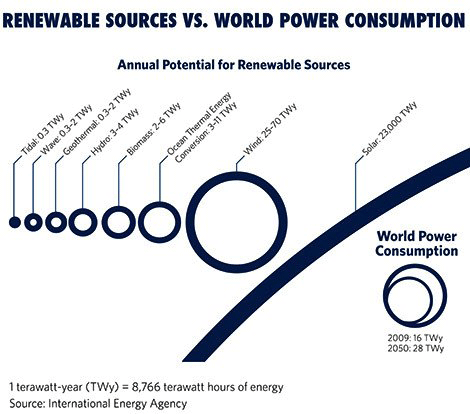
The potential is amazing. The solar energy hitting the state of Texas each month is greater than the total amount of energy the Texas oil and gas industry has ever produced.
Importantly, while sunshine is free, the solar panels needed to collect the energy in that sunshine and convert it into electricity are not. However, solar panels today are over 100 times cheaper (per watt) than they were in 1977. Since 2011, the cost of solar panels has dropped by approximately 60 percent, and growth has also been a big part of the stimulus for the cost drops. It is a virtuous circle. The growth curve for the solar panel market over the past few years is steep and resembles that of a plant shooting out of the earth toward the sun!
Solar power is now cheaper than retail electricity for millions of households. In the developed world, it can save countless homeowners tens of thousands of dollars. Meanwhile, all across the developing world, solar power is actually cheaper than power generated from fossil fuels. Just as many people in the developing world leapfrogged from no phones to cell phones, these populations will leapfrog from no electricity to electricity from solar panels.
The cost of wind power came down much earlier than the cost of solar power. In many regions of the world, wind power is currently the cheapest form of renewables-based electricity available–and also cheaper than electricity generated from coal, natural gas, nuclear power and oil, even if related health and environmental costs, which are staggering in themselves, are not taken into account. And costs continue to fall. The cost of wind turbines has fallen by approximately 29 percent since 2008.
In 2012, more wind power capacity was installed in the US than for any other power source. Wind is also routinely at the top of the global charts for annual power capacity additions.
Democratizing the Energy System
One of the major implications of solar power growth, electric vehicle growth and wind power growth to some extent (wind turbines are great additions to farms and small communities) is that they are essentially democratizing our energy system. They decentralize ownership and provide more societal power and more money to common citizens and small businesses. They create more energy independence and security for families, cities and nations, which I believe will ultimately contribute to greater peace in the world.
Also, there has got to be some positive psychological effect from people realizing that they are no longer burning the bones of dinosaurs (amongst other fossils!) for their energy needs, but are instead using renewable sources of energy such as sunlight and wind. http://cleantechnica.com/2014/04/27/communicating-renewable-energy-revolution/
New Zealand helps Pacific island nations go solar
 NZ Lends A Solar Helping Hand In Pacific Nations http://www.energymatters.com.au/index.php?main_page=news_article&article_id=4277 New Zealand is supporting the construction of the Pacific’s largest solar panel array in Samoa and also providing a helping hand for other Pacific Nations to pursue clean energy.
According to New Zealand’s Foreign Minister, Murray McCully, the country is working in partnership with the Government of Samoa, the European Union and the Asia Development Bank to increase renewable energy in Samoa.
Part of the project includes the construction of 2.2 MW installation at the Apia Sports Complex, a smaller array on the rooftop of one of the gymnasiums at the Complex; plus another solar power system in Salelologa, Savaii.
“Renewable energy is a strong focus of New Zealand’s support to developing countries. The investments in Samoa reflect commitments made at the Pacific Energy Summit in Auckland last year,” Mr McCully said.
Elsewhere in the Pacific, New Zealand has been assisting in Tuvalu where 95 percent of electricity is currently gained from diesel generation.
New Zealand has funded the construction of four small scale solar-hybrid systems on the Islands of Niutao, Nanumanga, Nanumea and Vaitupu; which will provide 90 per cent of the islands’ electricity needs and improve continuity of service.
Last week, New Zealand also entered into a partnership with the European Union (EU), and Tuvalu to continue this work
“This in an excellent example of New Zealand’s cooperation with the EU on renewable energy and the sort of practical projects we can deliver in partnership with Pacific countries,” Mr McCully says.
On Kiribati’s Kiritimati Island, which also has a heavy reliance on imported diesel fuel for electricity generation, New Zealand and the EU have entered into an agreement to allow for greater technical cooperation relating to renewable energy project development on the island.
Many Pacific nations are low-lying and particularly threatened by sea level rises spurred on by global warming; so the shift from fossil fuels is as much about survival and setting an example for the rest of the world to follow as it is about saving money.
Renewable energy financing deal for home-owners
 Google, SunPower announce joint renewable energy financing deal Renewable Energy Focus 24 April 2014 Pair teams up to finance $250 million in residential solar lease projects
According to the agreement, Google will commit up to $100 million, with SunPower committing approximately $150 million. Thousands of homeowners are expected to finance solar power systems through SunPower solar leases as a result of this program, joining approximately 20,000 Americans already leasing from SunPower……
…..This agreement represents Google’s 16th renewable energy investment and its third residential rooftop solar investment. Overall, Google has invested more than $1 billion in renewable energy projects on three continents and across a range of technologies. Together, these projects can generate more than 2GW — enough electricity each year to power approximately 500,000 U.S. homes. http://www.renewableenergyfocus.com/view/38121/google-sunpower-announce-joint-renewable-energy-financing-deal/
Scotland shows the way to community cash from renewable energy

 Scotland helps communities earn cash from onshore wind turbines by ClickGreen staff. Published Fri 25 Apr 2014 Scotland’s Energy Minister Fergus Ewing has announced a fresh set of principles designed to maximise community benefit from onshore renewable energy developments.
These principles will help the Scottish Government deliver the 500 megawatts of community and locally owned renewables target by 2020.
The finalised Good Practice Principles for Community Benefit from Onshore Renewable Developments have now been published, following a period of consultation.
The key principle is the promotion of a national community benefits package rate equivalent to at least £5,000 per Megawatt per year, index linked to inflation for the operational lifetime of the development. So for example, a 20 Megawatt windfarm of eight turbines will generate at least £100,000 a year for the local community.
Another key component of the guidance encourages renewable energy developers to submit information on potential community benefits as early in the development process as possible. This is considered a vital step in allowing time for the community to consider properly and to develop ideas for implementation of the community benefit package.
In addition, as part of the principles Mr Ewing has announced that Government will work in partnership with Scottish Renewables to set up a short-term industry working group to develop guidance to encourage community investment in commercial renewables schemes. This is with a view to maximising the opportunity for communities to invest directly in local commercial schemes. To date communities involved in benefit schemes have reaped over £5.6 million for local projects and developments…….http://www.clickgreen.org.uk/news/national-news/124523-scotland-helps-communities-cash-in-with-onshore-wind-turbines.html
$10 billion renewable energy investment by GE Energy Financial Services
GE bankrolls $10bn renewables http://renews.biz/65461/ge-bankrolls-10bn-renewables/ United States-based GE Energy Financial Services has exceeded $10bn in renewable energy investment commitments worldwide, including $8bn in wind power projects.
The financing agency expects it will continue to invest more than $1bn annually in wind, solar and other renewable energy projects, its fastest-growing energy sector and one that often facilitates sales of GE’s energy technology.
“Our rapid growth in renewable energy investments benefits not only GE’s customers and shareholders but society at large,” said GE Energy Financial Service CEO David Nason.
“These benefits will increase as we execute on a robust pipeline of prospective new investments that provide excellent risk-adjusted returns, serve as a catalyst for the growth of GE’s industrial energy business, and provide customer value.”
GE’s renewable energy projects represent 17GW of generating capacity. Of the more than $10bn in cumulative equity and debt investment commitments, $8bn are in more than 12GW of wind farms and $1.7 billion are in 1GW of solar power installations, with the balance in other renewables.
The projects span 16 countries and 28 states, helping 18 states meet their renewable portfolio standards. The developments create an estimated 10,000 direct US jobs, according to National Renewable Energy Laboratory and GE modeling.
GE capital is working in southern California to complete the 550MW Desert Sunlight solar power project, which uses GE power inverters and is already producing more than 375MW.
It’s also building wind farms in Ireland, Nebraska, Illinois and Texas. The wind farms under construction or completed use more than 4,400 GE turbines.
Electricity from new wind and solar at half the cost of from new nuclear
 Wind and solar generation half the cost of nuclear REneweconomy, By Sophie Vorrath on 23 April 2014 New-build wind and solar energy systems can generate electricity for up to 50 per cent cheaper than new nuclear power plants, a German study has found.
The research, commissioned by German think tank Agora Energiewende, compares feed-in tariffs for new nuclear in the UK with FiTs for renewables in Germany, and finds that nuclear and carbon capture and storage (CSS) – a technology not yet available in Europe – are both more expensive than wind and solar as energy strategies for preventing climate change.
Released this week, the study also investigates the costs of “complete power systems” using natural gas power as flexible peak load back-up – something nuclear power plants need to achieve a generation capacity that makes them economically viable, and solar and wind farms need to make up for weather-affected intermittency.
The study concludes that, “even today and under conservative assumptions,” a reliable power system based on solar PV, onshore wind and gas would be around 20 per cent cheaper than a system based on nuclear power and gas – a cost gap that was likely to widen as renewables became even more competitive……. http://reneweconomy.com.au/2014/wind-and-solar-generation-half-the-cost-of-nuclear-95493
Warren Buffett dumped Small Modular Nuclear Reactor project, went for solar power instead
As nuclear power dies, solar rises By Denis Hayes and Scott Denman April 22, 2014 (CNN) “………Ironically,  Warren Buffett, arguably the world’s greatest capitalist, has emerged as the poster child for this dramatic shift. In June 2013, Buffett’s MidAmerican utility threw in the towel after a failed three-year legislative battle to require Iowa electric customers to foot the bill for the design and construction of a prototype small modular reactor. Mainstream groups like AARP vigorously opposed that fiscally imprudent investment. Earlier, MidAmerican canceled another proposed reactor in Idaho on the grounds it was not worth the money.
What’s significant about this about-face on nuclear by the highly regarded “Oracle of Omaha” is that Buffett instead decided to install656 large wind turbines at a cost of $1.9 billion in Iowa, and has gone “all-in” with multibillion dollar bets on utility-scale wind and solar power and other renewable energy facilities throughout the West. Not just Wall Street wizards are shifting investment outlooks and strategies. Regulators and industry officials alike exude confidence that this is the era for solar, wind and other green energy technologies. In August 2013, John Wellinghoff, then chairman of the Federal Energy Regulatory Commission, observed that “solar is growing so fast it is going to overtake everything … It could double every two years.”
In his annual State of the Union address in January, President Obama highlighted this auspicious trend by praising solar’s rapid growth, announcing that, “every four minutes, another American home or business goes solar. …”
While nuclear has flat-lined in the marketplace, statistics demonstrating solar’s growth actually underestimate the total contribution to our country’s electrical supply from solar. This is because nonutility and small-scale — residential and commercial rooftop — photovoltaic systems don’t show up as electric generation in the industry’s statistics. The utilities that compile generation statistics view rooftop solar electricity, used on site, not as power generation but as a reduction in demand! If it’s not sold by a utility, it’s not “real” power.
In fact, one of the authors built a six-story office building in Seattlethat produced more electricity on its roof last year than it used. If this can be done in Seattle, the cloudiest major city in the contiguous 48 states, it can be done anywhere.In 2013, America, and the world, crossed the threshold to a sustainable, ultimately nonnuclear, carbon-free energy future. While much remains to be done and there is a long way to go, this Earth Day is especially meaningful and inspiring for those of us who have spent our careers pursuing this essential goal. We can see the clear outline of a sustainable energy future that our children, our economy and our planet can live with. http://edition.cnn.com/2014/04/22/opinion/hayes-denman-solar-power/
Renewable energy in Pacific Islands – promoted by New Zealand and European Union
New Zealand, EU push ahead with renewable energy initiatives in Pacific http://www.shanghaidaily.com/article/article_xinhua.aspx?id=213961 Apr 22,2014 WELLINGTON, (Xinhua) — A joint New Zealand-European Union (EU) mission will tour four Pacific island countries this week to assess progress on renewable energy projects, New Zealand Foreign Affairs Minister Murray McCully announced Tuesday.
The tour follows up on the Pacific Energy Summit in New Zealand in March last year and the launch of the European Union-New Zealand Energy Access Partnership to fund renewable energy projects in the region. The summit’s aim was to move Pacific nations closer to achieving 50 percent of their electricity from renewable means and 635 million NZ dollars (545.02 million U.S. dollars) was secured for Pacific energy projects.
“This mission is an opportunity to see the progress being made on renewable energy initiatives in Samoa, Tuvalu, Kiribati, and the Cook Islands, and to meet with the Pacific governments and organizations to discuss opportunities for further cooperation,” McCully said in a statement. “Representatives from the World Bank, the Asian Development Bank and the International Renewable Energy Agency are also joining the mission to gain further insight into the potential for sustainable energy across the Pacific,” he said.
“Renewable energy is a strong focus of our support to developing countries and we are committed to working with partners like the European Union to deliver clean, safe and reliable energy projects.”
European Commissioner Andris Piebalgs, who will accompany McCully on the mission, said the EU projects included solar panels installed to renewable provide electricity in Apia, extending the availability of reliable electricity with solar panels for Tuvalu’ s outer islands, and agreeing with the Asian Development Bank to construct six photovoltaic power plants in the Cook Islands.
In Kiribati, Piebalgs would also launch a barge that would protect Tarawa’s beaches from silt build-up and open a laboratory dedicated to monitoring and responding to environmental diseases.
Both projects were necessary to mitigate the effects of climate change in Kiribati, Piebalgs said in a statement.
The rise and rise of solar power: the fall and fall of nuclear
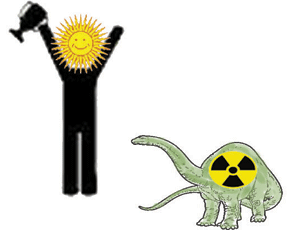 As nuclear power dies, solar rises By Denis Hayes and Scott Denman April 22, 2014 (CNN) – At long last, this Earth Day we celebrate the true dawn of the Solar Age. That sunrise is hastened, here and abroad, by the slow demise of the once-touted “too-cheap-to-meter” Atomic Age of nuclear power.
As utilities find nuclear power less and less cost effective, new solar photovoltaic installations in the United States are springing up. New solar installations in 2013 reached a record 4.2 gigawatts, bringing the total to 10. On average, one gigawatt of solar photovoltaics powers 164,000 U.S. homes. That means power for 1.6 million homes.
Worldwide, in 2013, solar power installations grew by 38 gigawatts, from 96 to 134. According to the World Nuclear Industry Status Report 2013, in the preceding year, 45 gigawatts of wind and 32 gigawatts of solar power were installed worldwide, compared with a net addition of just 1.2 gigawatts of nuclear.
Hastening this energy revolution is the nuclear industry’s Achilles heel: an aging, dangerous reactor fleet that is increasingly uncompetitive and new reactor designs that are too expensive to build.
Last year, utilities permanently shuttered five more reactors, lowering the number of operating units in the United States to fewer than 100 for the first time in two decades. Utility owners canceled at least nine planned upgrades of existing reactors, deeming the investments no longer economically justifiable.
Additionally, nine planned new nuclear reactors were axed in 2013, an indication of how rapidly things have changed. Just five years ago, utilities applied for licenses to construct at least 27 new reactors. By the close of 2013, only four of those reactor projects were still alive……. http://edition.cnn.com/2014/04/22/opinion/hayes-denman-solar-power/
Koch brothers and fossil fuel lobbies out to kill renewable energy
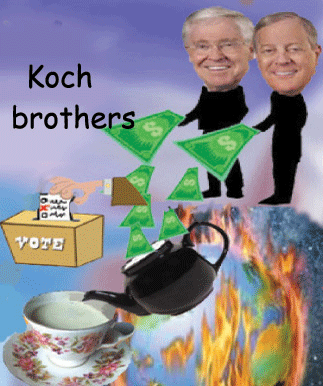 Koch Brothers, Conservatives & Oil Companies Lobby States Using Renewable Energy Sources: Alternative, Solar Power And Environmentalism Gaining Popularity Latin Post, By Shawn Raymundo (staff@latinpost.com) 20 April 14, As more and more states are beginning to utilize solar energy and adapt other clean green energy solutions, conservative lobby groups and oil tycoons have aggressively started pushing back against alternative energy.
The Koch brothers, anti-tax activist Grover Norquist and a number of powerful companies in the nation have started running campaign ads in Arizona, Kansas and North Carolina that paint renewable energy as a greedy bad guy, according to the Los Angeles Times.
With the help of solar power companies, environmentalists are battling back against big oil companies and their lobbyists over states that have implemented two types of energy policies: net metering and renewable energy requirements.
Net metering allows homeowners or businesses that have solar panels installed on roofs to sell back extra electricity to the power grid at attractive rates. The other policy requires utility companies to generate at least 10 percent of renewable energy, the Times reported. The majority of states in the U.S. have begun operating under at least one of the two policies if not both. The only states to not use net metering or generate power from renewable energy are Alabama, Idaho, Mississippi and Tennessee.
South Dakota and Texas are the only two states without metering programs but generate a percentage of their power from renewable energy, according to the Times………
The power industry fears that as more people install solar panels, less money is being paid to maintain transmission lines, substations and computer systems that many people rely on……
Edison Electric Institute, an advocacy group for the power industry, warned power companies that renewable energy policies could irrevocably damage the industry. The institute issued a report that stated, “it may be too late to repair the utility business model” if electric companies do not take action.
Christine Harbin Hanson, a spokeswoman for Americans for Prosperity, the advocacy group funded by billionaire industrialists Charles and David Koch, told the Times in an email that “state governments are starting to wake up” and challenge renewable energy polices.
“These green energy mandates are bad policy,” Hanson said. http://www.latinpost.com/articles/10814/20140420/koch-brothers-conservatives-oil-companies-lobby-states-using-renewable-energy-sources-alternative-solar-power-and-environmentalism-gaining-popularity.htm
A city that produces 4 times more energy than it consumes – solar Sonnenschiff
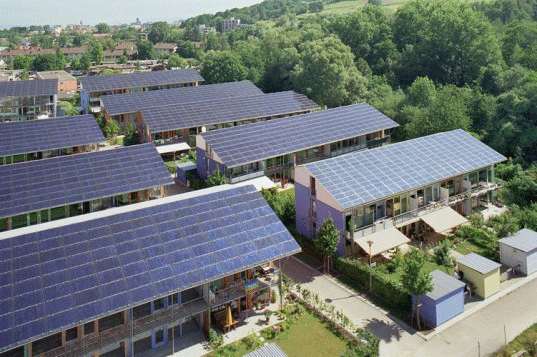
Sonnenschiff: Solar City Produces 4X the Energy it Consumes http://inhabitat.com/sonnenschiff-solar-city-produces-4x-the-energy-it-needs/ by Andrew Michler, 07/27/11 Sonnenschiff solar city in Freiburg, Germany is very much net positive. The self-sustaining city accomplishes this feat through smart solar design and lots and lots of photovoltaic panels pointed in the right direction. It seems like a simple strategy — but designers often incorporate solar installations as an afterthought, or worse, as a label. Designed by Rolf Disch, the Sonnenschiff (Solar Ship) and Solarsiedlung (Solar Village) emphasize power production from the start by smartly incorporating a series of large rooftop solar arrays that double as sun shades. The buildings are also built to Passivhaus standards, which allows the project to produce four times the amount of energy it consumes!
Renewable energy – Ukraine’s road to energy independence
 Renewables seen as Ukraine’s road to energy independence from Russia http://rt.com/business/ukraine-seeks-renewable-energy-396/ April 18, 2014 As a way of becoming less reliant on Russian conventional energy Ukraine is talking to US investors who want to put money into alternative energy like wind and solar.
“Russia’s aggression towards Ukraine indeed brought energy security concerns to the fore,” as Bloomberg quotes Olexander Motsyk, Ukraine’s ambassador to the US said at a renewable-energy conference in Washington on Thursday. “I strongly believe the time has come for US investors to discover Ukraine, especially its energy.”
To get away from Russian natural gas as the primary source for heat and electric power, Ukraine seeks wants to invest in biomass heat plants, wind and solar power.
US and European officials have been trying to find ways to help Ukraine limit its dependence, including the possibility of US approval to export liquefied natural gas.
Vadym Glamazdin, the managing director of the Energy Industry Research Center (EIRC) suggests heating in Ukraine accounts for about 40 percent of all gas imported from Russia. This could be replaced with renewable energy within three to five years.
According to his words by 2030, renewables could account for about 15 percent of Ukraine’s electricity supply, currently it is only 2 percent.
The EIRC research shows that the most likely and adoptable form of renewable energy for Ukraine are biomass and biogas, as the nation’s network of electric-power lines and substations can’t easily adjust to the addition of significant amounts of wind and solar energy.
“The resources are there,” now the major challenge is to attract investment, Todd Foley, a senior vice president for policy and government relations at the American Council on Renewable Energy said.
One biomass plant could replace 24,000 natural gas boilers EIRC officials said.
A sort of a comeback for renewable energy loan guarantees in USA
Loan Guarantees for U.S. Renewables Making a Comeback, National Geographc by Pete Danko on April 17, 2014 Federal loan guarantees for renewable energy, which spurred the development of massive projects like the recently completed Ivanpah Solar Electric Generating System in California – and roiled the 2012 elections – are emerging from hibernation.
More than two years after closing the last such loan guarantee, the U.S. Department of Energyannounced on Wednesday that it intends to make up to $4 billion available “for innovative renewable energy and energy efficiency projects located in the U.S. that avoid, reduce, or sequester greenhouse gases.”
The announcement sets the stage for the DOE to offer support for projects that incorporate one or more of five broad technology types [PDF]:
- “advanced grid integration and storage,” a key need in getting more intermittent renewable energy on the grid;
- “drop-in biofuels,” which could directly replace conventional fossil fuels in cars, planes and ships and function within the current distribution system;
- “waste-to-energy,” where waste gases and discarded materials are used in commercial-scale energy production;
- “enhancement of existing facilities,” such as adding power-production to existing dams that don’t have it;
- and “efficiency improvements,” a catchall that could range from residential building improvements to the recovery of energy from curtailed renewable energy systems……….
“The Loan Program Office portfolio is strong,” Reicher said. “You have a piece of this as a taxpayer, and it’s doing quite well.”
The portfolio is heavy with solar – the DOE notes that it backed the first five 100-megawatt-plus photovoltaic plants to go online in the United States – but will move into new realms now. That’s good news for companies like Wisconsin-based Virent, a developer of advanced biofuels technology……http://energyblog.nationalgeographic.com/2014/04/17/loan-guarantees-for-u-s-renewables-making-a-comeback/
1 This Month
Chernobyl: The Lost Tapes – A good documentary on Chernobyl on SBS available On Demand for the next 3 weeks– https://www.sbs.com.au/ondemand/tv-program/chernobyl-the-lost-tapes/2352741955560

of the week–London Campaign for Nuclear Disarmament

Tell the Ukrainian Government to Drop Prosecution of Peace Activist Yurii Sheliazhenko
To see nuclear-related stories in greater depth and intensity – go to https://nuclearinformation.wordpress.com
-
Archives
- April 2026 (152)
- March 2026 (251)
- February 2026 (268)
- January 2026 (308)
- December 2025 (358)
- November 2025 (359)
- October 2025 (376)
- September 2025 (257)
- August 2025 (319)
- July 2025 (230)
- June 2025 (348)
- May 2025 (261)
-
Categories
- 1
- 1 NUCLEAR ISSUES
- business and costs
- climate change
- culture and arts
- ENERGY
- environment
- health
- history
- indigenous issues
- Legal
- marketing of nuclear
- media
- opposition to nuclear
- PERSONAL STORIES
- politics
- politics international
- Religion and ethics
- safety
- secrets,lies and civil liberties
- spinbuster
- technology
- Uranium
- wastes
- weapons and war
- Women
- 2 WORLD
- ACTION
- AFRICA
- Atrocities
- AUSTRALIA
- Christina's notes
- Christina's themes
- culture and arts
- Events
- Fuk 2022
- Fuk 2023
- Fukushima 2017
- Fukushima 2018
- fukushima 2019
- Fukushima 2020
- Fukushima 2021
- general
- global warming
- Humour (God we need it)
- Nuclear
- RARE EARTHS
- Reference
- resources – print
- Resources -audiovicual
- Weekly Newsletter
- World
- World Nuclear
- YouTube
-
RSS
Entries RSS
Comments RSS
 nuclear-news