California leads in its commitment to renewable energy
California Successfully Emphasizes Renewable Energy Commitment The Desert Sun, Morris Beschloss, September 8, 2014 Over the years, California has justifiably claimed the exalted position of originator of new ideas in fashion, entertainment, social media, and even electric cars. The state’s Silicon Valley is the shining symbol of the world’s breakthrough communications technology.
But now it seems that a significant escalation of solar energy and, to a lesser extent, “wind” is lending credibility to the once improbable California campaign to generate one-third of its power from renewable resources by 2020. This now realizable objective is personified by “NextEra Resources’ Blythe Solar Project” by the U.S. Department of the Interior.
Although originally eclipsed by the 1,000 megawatt photovoltaic farm originally proposed, conceivably the largest solar project in the world, the implementation of “Blythe” will generate enough power to service 485,000 homes, and reduce gas emissions by 400,000 metric tons per year.
California now leads the nation in cumulative solar electricity capacity, and was number one in solar capacity added last year. The windmills in Southern California’s San Gorgonio Pass are also setting new records as are the geothermal plants along the southern edge of California’s Salton Sea……..it is encouraging to see that America’s most populous state (California, with 12.5% of the nation’s population), is regaining its rightful place as the visionary of the United States’ bright future…….http://www.desertsun.com/story/money/industries/morrisbeschlosseconomics/2014/09/08/california-successfully-emphasizes-renewable-energy-commitment/15281441/
New law promotes solar energy in South Carolina
With New Law, South Carolina Sets a Foundation for More Solar Energy The Energy Collective Jim Pierobon 8 Sept 14 Another state in the Southeast U.S. is recognizing the economic and environmental benefits of solar energy as commissioners, utilities and stakeholders in South Carolina are ironing out details of a new solar law that enables third-party leasing and contemplates the state’s two investor owned-utilities utilities, collectively, installing an estimated 300 megawatts (MW) of renewable energy by 2021, up from about 8 megawatts currently.
South Carolina joins North Carolina and Georgia in showing it can begin to turn a new leaf to toward cleaner energy development. The new law is the South Carolina Distributed Energy Resource Program Act (S.B. 1189), which lawmakers in both the House and Senate passed unanimously and Gov. Nikki Hale (R), signed into law in June. Curiously, she waited until August to start promoting it.
The state’s two large investor-owned utilities – South Carolina Electric & Gas and Duke Power (including the former Progress Energy) – have the option to opt in, or out, of the program. If they opt in, they’ll get full rate recovery for meeting at least 2% of their five-year average peak power demand from renewable sources, most of which will likely be solar. If they opt out, no rate recovery for whatever path they pursue.
At this writing there appeared to be a significant and growing amount of public and lawmaker pressure to opt in. It was that public pressure that had been building for years which kicked off serious deliberations leading to the new law, according to Kenneth Sercy, Utility Regulation Specialist, and Hamilton Davis, Climate and Energy Director, at the South Carolina Coastal Conservation League, one of the bill’s biggest backers.
“What you’ve seen here is growing public interest in policies that boost investments in clean energy options,” Davis said. “The tide of public opinion is garnering more media coverage and that’s getting the attention of lawmakers.”……http://theenergycollective.com/jimpierobon/484721/new-law-south-carolina-sets-foundation-more-solar-energy
Renewable energy investment going ahead in Turkey
TURKEY INVESTS IN RENEWABLE ENERGY http://www.dailysabah.com/energy/2014/09/08/turkey-invests-in-renewable-energy ANKARA — Turkey’s investments in renewable energy will account for 15 percent of the 141,000 megawatt capacity increase in Europe expected by 2020, according to a report by the International Energy Agency.
Renewable energy in Europe is expected to grow 0.8 percent annually until 2020, and nearly half of the growth in demand for power will come from Turkey, the report says.
Economic growth, an increase in income per capita, and rapid urbanization are the primary causes of the increasing energy demand in Turkey.
In order to meet some of the power demand in Europe, 141,000 megawatts of capacity increase in renewable energy is expected by 2020, according to the report.
In 2013, Europe produced 1,095 terawatt hours of electricity from renewable energy sources, accounting for 30 percent of total electricity production, the report says. And 1,400 terawatt hours of electricity production from renewables is expected by 2020, and renewables will make up 36.5 percent of total electricity production, the report says. It predicts that wind power will account for 40 percent of the production increase by renewables.
A terrawatt is equivalent to 1,000 gigawatt hours — or 1 trillion watt hours. According to the online Energy Business Review, 1.5 terrawatts is enough to run the London metro system for 10 years.
Germany, the U.K. and Turkey are expected to assume more than half of the renewable electricity production in Europe by 2020, according to the International Energy Agency. Turkey will account for 15 percent of the increase in the use of renewables, including hydro, wind, solar, bioenergy and geothermal, report says.
Turkey’s renewable capacity of 24,300 megawatts in 2013 is projected to reach 38,800 megawatts in 2020.
USA poll finds renewable energy favoured far more than coal, gas, nuclear power
 Energy efficiency, renewable energy rules favored by voters, poll finds, Cleveland.com By John Funk, The Plain Dealer on September 05, 2014 COLUMBUS, Ohio – Ohio voters favor the state’s renewable energy and energy efficiency mandates that Republican lawmakers just put on ice for two years, a new poll suggests.
Commissioned by a coalition of environmental groups and conducted jointly by two national polling companies, one which  works for Republican candidates and the other for Democratic candidates, the poll interviewed 405 registered Ohio voters and has a margin of error of 4.9 percent.
The survey found that voters would favor political candidates by a two-to-one margin who favor more wind and solar energy development over those who think the state’s reliance on coal, gas and nuclear power is adequate. A total of 64 percent favored the green candidates while only 31 percent said they would be more likely to vote for candidates supporting traditional energy production.
The poll also found that 69 percent of voters would favor candidates who believe requiring electric utilities to help customers use less electricity would save ratepayers money, while just 23 percent would vote for candidates who argue that such mandated efficiency programs cost ratepayers more than they save.
Other key findings include:
– Democrats and independents, 82 percent and 61 percent respectively, favor candidates who would push for clean energy, while Republican voters are split evenly at 47 percent in favor and 47 percent opposed.
– A majority of voters, whether Democrat, Independent or Republican, like the idea of gradually requiring utilities to generate or at least sell more and more power generated by wind, solar and other renewable technologies. About 87 percent of Democratic voters said they favored such renewable growth, 70 percent of independents and 56 percent of Republicans said they were in favor.
– The end of coal-fired power plants is blowing in the wind. Three quarters of all those surveyed said they favored cleaner sources of energy and 91 percent said they supported diversifying how electricity is generated.
—- Everyone loves the idea of energy efficiency, at least generally speaking. A total of 85 percent of Republican voters said they strong support energy efficiency, 81 percent of Democrats and 73 percent of independents.
– Large majorities of those surveyed said they favored policies that would make residential rooftop solar more affordable. They also support job training programs for wind and solar installers………
The survey was designed and conducted by pollsters at Public Opinion Strategies, the largest Republican polling company in the nation, and by Fairbank, Maslin, Maullin,, Metz & Associates, a national Democratic opinion research company. The two companies have conducted joint research projects for political campaigns and businesses in 42 states. http://www.cleveland.com/business/index.ssf/2014/09/energy_efficiency_renewable_en.html
Dubious future for nuclear plants like Palisades, as renewabl energy becomes ever cheaper
With renewable energy growing and coal shrinking, what’s the future of nuclear plants like Palisades? Michigan Live, By Julie Mack | jmack1@mlive.com on August 28, 2014 KALAMAZOO, MI “…..The jury is still very much out on how nuclear power fits into the picture, which leaves the long-term viability of Palisades Nuclear Plant near South Haven in question……. very possible the supply glut of natural gas and the increasing focus on renewables means those sectors will edge out nuclear as the go-to options for new power production.
Mark Cooper, an analyst for the Institute for Energy and the Environment at the Vermont Law School, maintains the proposed federal clean-energy standards won’t help the financial viability of the U.S. nuclear industry, which last opened a plant in 1989……
“Old nuclear reactors suffer from the fact that they’re not particularly efficient,” he said. “The day after the (clean-energy) announcement, those old plants were just as inefficient as the day before.
“In the dynamic state of the energy markets, if you’re not growing, you’re dying,” Cooper said. “And nuclear is not growing. … It’s going extinct.”…..
Meanwhile, renewable energy in Michigan is getting a boost from a 2008 state law that requires Michigan-based utilities to have renewables as 10 percent of their power production by the end of 2015.
“The cost of renewables will drop like a rock once they reach economies of scale,” Cooper said. In fact, the U.S. Department of Energy is projecting that wind-generated power will be more cost-efficient than coal and nuclear and even some types of natural gas plants by 2019……..
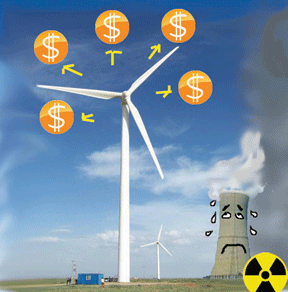 While solar power remains on the high end, wind is more economical than coal and nuclear, and some types of natural-gas plants.
Wind provided 2.4 percent of Michigan’s electricity in 2013, according to the American Wind Energy Association. That’s up from 1 percent in 2012, and is enough electricity to power 300,000 Michigan households, the AWEA says.
The AWEA estimates Michigan has the potential to produce about 59,000 megawatt hours of electricity through wind power. That’s more than half of the state’s current consumption of electricity.
Shift at Consumers Energy
Consumers Energy, the dominant provider of electrical power in Southwest Michigan, seems to be casting its lot with natural gas and renewables…….. http://www.mlive.com/news/kalamazoo/index.ssf/2014/08/pros_and_cons_of_electrical_po.html
SunFarmer shows the way, with off grid electricity powering health clinics
More Than A Light Bulb: How Clean Energy Is Powering Health Clinics Beyond The Grid http://cleantechnica.com/2014/08/26/light-bulb-clean-energy-powering-health-clinics-beyond-tthe-grid/August 26th, 2014 by Vrinda Manglik It is hard to overstate the effect that access to reliable electricity can have on people’s lives in rural communities worldwide.
That’s why we are so supportive of interventions like off-grid clean energy that not only put power directly in people’s hands, but do it in a time frame that matters: now, not decades from now. That’s something traditional grid extension and centralized power plants simply can’t do. Despite the important leg up off-grid clean energy provides these communities, we’ve heard some concerns that these interventions can only be used to provide lighting and supplies like light bulbs. This couldn’t be further from the truth.
To help us understand what kinds of resources these companies are powering with clean energy, we turned to SunFarmer, a US- and Canada-based non-profit organization, to learn more about off-grid companies powering health clinics.

SunFarmer is a pretty unique organization. As a non-profit, it has learned important lessons all off-grid companies should live by, including not to give things away for free. That’s why SunFarmer employs a rent-to-own business model that specifically seeks to empower local companies to deliver clean energy services to hospitals and health clinics. SunFarmer’s value to these companies is simple, but big: it unlocks crucial financing. Given how hard financing is to come by in this market, that’s incredibly important.
In addition, SunFarmer provides ever critical after-sales service in the form of technical assistance, quality assurance, and system maintenance — while local partners lead on project management. SunFarmer is also developing a monitoring and control platform to track the levels of energy production, observe the system’s battery performance, and communicate any issues (including energy theft) to health clinic staff. All of these critical data points prove that the next big frontier for these markets is data analytics.
But why should SunFarmer target large consumers, like health clinics, when most organizations working in this clean energy market start with small household needs — including lighting and mobile phone charging?
The answer is simple: the founders of SunFarmer were moved by the negative effect unreliable power has on 300,000 healthcare facilities worldwide. These critical public health care providers suffered from hours of power shortages and cuts that were keeping them from doing their job — saving lives.
When hospitals or health clinics lack reliable power, they can’t refrigerate vaccines. They can’t perform surgeries. Babies are delivered by flashlights or candlelight. Health clinic staff with SunFarmer projects have described the difference between delivering babies in darkness versus light, noting, “Previously, delivery was difficult using flashlights held in the mouth as they could neither see clearly nor could give instructions.” Continue reading
Solar power increase at California’s State owned facilities

 More State-Owned Facilities In California Going Solar http://www.energymatters.com.au/index.php?main_page=news_article&article_id=4458 25 Aug 14 Two solar power installations totaling 3.22 megawatts have recently been completed at a state prison and state hospital in California.
The Department of General Services (DGS) managed systems are installed at Pleasant Valley State Prison (1.22MW) and Coalinga State Hospital (2MW).
“State agencies manage approximately 1,700 facilities that use about $200 million worth of electricity and natural gas every year,” said DGS Director Fred Klass. “Efficient operation of state facilities, including on-site renewable energy generation, is critical to achieving Governor Brown’s climate goals.”
In 2012, Governor Edmund G. Brown Jr. issued a sweeping executive order directing state agencies to slash their greenhouse gas emissions by 10% by 2015 and 20% by 2020, as measured against a 2010 baseline.
The order calls upon state government to slash mains-grid energy purchases for state-owned buildings by at least 20 percent by 2018.
The order also directs new State buildings and major renovations beginning design after 2025 be constructed as Zero Net Energy facilities; with an interim target for 50% of new facilities beginning design after 2020 to be Zero Net Energy.
Pleasant Valley State Prison is one of a dozen jails in California now using solar power. The Department of Corrections and Rehabilitation says its use of solar will avoid an estimated 61,000 tonnes of greenhouse gas emissions this year and will save taxpayers approximately $78 million in electricity costs over the next two decades.
The DSH-Coalinga array is expected to generate 24 percent of the hospital’s electricity requirements during its first year.
Both projects have been executed under a Power Purchase Agreement (PPA). Under a PPA, a solar provider installs the system via third party financing and the electricity generated by the array is sold to the host facility at a competitive rate. The host facility is not required to pay any up-front costs.
DSG says state agencies will have around 38MW of installed solar capacity by the end of this year.
UN and Denmark help boost Renewable Energy Technology Transfer between China and Ghana and Zambia
 New initiative boosts Renewable Energy Technology Transfer between China and Ghana and Zambia with UNDP and Danish Development Assistance as catalysts Jakarta Post BEIJING, Aug. 19, 2014 /PRNewswire/ — A milestone partnership was forged today inBeijing between China, Denmark, Ghana, Zambia and UNDP with the signing of a project agreement for Renewable Energy Technology Transfer.
This project is one of the first examples of triangular South-South cooperation betweenChina and Africa with support from a donor. Its objective is to ensure that Chinese renewable energy technologies are optimally responding to priorities and needs inGhana and Zambia, and critical skills are also transferred and developed to make the technologies actually work on the ground. This approach will have a tremendous impact on increasing access to energy for the rural poor in the two countries, and for other developing countries interested in such cooperation withChina in the future.
The project is part of the UNDP-China agreement for Strengthened Partnership signed in 2010 to promote South-South cooperation through innovative programmes. “UNDP is pleased to embark on this cooperation and is committed to making projects more impactful and more sustainable by providing ‘software’ support with the transfer of renewable energy technologies, rather than just relying on the traditional hardware of equipment or infrastructure,” said Xu Haoliang, UN Assistant Secretary-General, UNDP Director of the Regional Bureau ofAsia and Pacific
The Government of Denmark provided funding for the initial formulation of the project and a contribution of29.25 million DKK, equivalent of US$ 5.4 million, to UNDP for its implementation inGhana and Zambia. This implementation will be led by the Government of the two countries with the Ministry of Sciences and Technology as the Chinese counterpart institution, and support from the UNDP offices inBeijing, Accra and Lusaka……..
The project will help with achieving the objective of Sustainable Energy for All (SE4ALL) of the UN Secretary- GeneralBan Ki-Moon by increasing access to energy through off-grid and community-based electrification. Support will not be in the form of hardware transfer but instead will focus on creating conditions required to make adoption of renewable energy technologies more effective, removing barriers and strengthening local capacities to respond to national priorities and meet local needs. ……
UNDP partners with people at all levels of society to help build nations that can withstand crisis, and drive and sustain the kind of growth that improves the quality of life for everyone. On the ground in 177 countries and territories, we offer global perspective and local insight to help empower lives and build resilient nations.www.undp.org http://prnw.cbe.thejakartapost.com/news/2014/new-initiative-boosts-renewable-energy-technology-transfer-between-china-and-ghana-and-zambia-with-undp-and-danish-development-assistance-as-catalysts.html
Wind energy shown to be much more scalable than nuclear energy.
Which Is More Scalable, Nuclear Energy Or Wind Energy? Forbes, 22 Aug 14 Answer by Mike Barnard, Senior Fellow – Wind, E&PI,on Quora,
China is the true experiment for maximum scalability of nuclear vs wind. It has a tremendous gap between demand and generation. It can mostly ignore democracy and social license for nuclear. It is building both wind and nuclear as rapidly as possible. It has been on a crash course for both for about the same period of time. It has bypassed most of the regulatory red tape for nuclear.
So how is it doing?
- China turned on just over 16 GW of nameplate capacity of wind generation in 2013 according to the Global Wind Energy Council.
- Over the four years of 2010 to 2014, China managed to put 4.7 GW of nuclear intooperation at the Qinshan Phase II, Ling Ao Phase II, Ningde, Hongyanhe and Yangjiang plants. This is not their stated plans for nuclear, which had them building almost double this in 2013 alone and around 28 GW by 2015, but the actual plants put into production. The variance between the nuclear roadmap and nuclear reality in China is following the trajectory of nuclear buildout worldwide: delays, cost overruns, and unmet expectations.
- Modern wind turbines have a median 40.35% capacity factor and exceed 50% in the best wind resources according to the US National Renewable Energy Laboratory (NREL) who track the actuals on this sort of thing.
- Taking similarly sourced numbers for nuclear capacity factor from the Nuclear Energy Institute, we see 90.9% capacity factors for nuclear reactors. These are apples-to-apples statistics from the same country.
Running the math, that’s about 6.5 GW of real capacity of wind energy in one year vs 4.3 GW of real capacity for nuclear over four years. That’s roughly six times more real wind energy capacity than nuclear per year. 2014 might be better than average as perhaps 2 GW have been made operational this year. We’ll see what reality brings as wind energy is being expanded rapidly as well. So far nuclear is losing the race badly.
No other geography is capable of building as much nuclear per capita as China is. In the most pro-nuclear geography in the world with the most relaxed regulatory regime, the nuclear industry is being outstripped by the wind industry…………http://www.forbes.com/sites/quora/2014/08/22/which-is-more-scalable-nuclear-energy-or-wind-energy/
Wind energy takes over, as 4 nuclear power plants shut down
4 Nuclear Power Plants Shut Down; Wind Power Steps In Clean Technica August 16th, 2014 by Jake Richardson Wind power in the UK is helping to fill the void left by the shuttering of four nuclear reactors. One reactor was found with a defect on its boiler spine, so EDF Energy decided to shut it down, along with three others. It is expected they will be offline for about two months. (EDF is a French utility responsible for managing many nuclear reactors. It stands for Electricity de France.) The reactor with the potential boiler spine issue is at Heysham-1 plant in Lancashire. Another was shut down at Heysham as well. The remaining two that were taken offline are at Hartlepool. The UK energy supply should not suffer from the nuclear shut downs.
“Demand is low at this time of year, and a lot of wind power is being generated right now,” explained National Grid. In fact, the UK just set a new summer record for wind powergeneration, “According to figures from trade association RenewableUK, wind reached its maximum output at 10pm on Sunday night, delivering an average of 5.0GW of power over the hour and meeting 17 per cent of national demand.”…….
One of the small ironies about wind power filling in somewhat for nuclear reactors is that wind is criticized for being intermittent.
This is a very minor point, but there seems to be some slight discrepancies in the reporting about the reactor shut downs. The UK-based Financial Times reported that all four were shut down. The UK-based Guardian say they were to be shut down. The New York Timesreported that one was shut down in June, and that it had recently been decided by EDF to shut down three more. http://cleantechnica.com/2014/08/16/4-nuclear-power-plants-shut-wind-power-steps/
Storage for renewable energy is not a big problem, as pro-nukes claim it is
Is Storage Necessary for Renewable Energy? (includes videos) Engineering .com Tom Lombardo August 17, 2014 Physicist and energy expert Amory Lovins, chief scientist at The Rocky Mountain Institute, recently released a video in which he claims that renewable energy can meet all of our energy needs without the need for a fossil fuel or nuclear baseload generation. There’s nothing unusual about that – many people have made that claim – but he also suggests that this can be done without a lot of grid-level storage. Instead, Lovins describes a “choreography” between supply and demand, using predictive computer models models to anticipate production and consumption, and intelligent routing to deliver power where it’s needed. This “energy dance,” combined with advances in energy efficiency, will allow us to meet all of our energy needs without sacrificing reliability.
Report highlights rapid increase in solar energy systems
Solar System Installations Increasing Fast Clean Technica August 4th, 2014 by Worldwatch Institute Originally published on Worldwatch Institute.
New analysis by the Worldwatch Institute examines global trends in the solar power sector
Washington, D.C.—The year 2013 saw record-breaking growth for solar electricity generation as the photovoltaic (PV) and concentrated solar thermal power (CSP) markets continued to grow. With over 39 gigawatts installed worldwide, the PV solar market represented one-third of all newly-added renewable energy capacity, write Worldwatch’s Max Lander and Climate and Energy Intern Xiangyu Wu in the Worldwatch Institute’s latest Vital Signs Online trend (www.worldwatch.org).
Solar PV installations nearly matched those of hydropower and, for the first time, outpaced wind additions. Even though photovoltaic systems continue to dwarf CSP capacity, the CSP market also had another year of impressive growth. By the end of 2013, a total of 19 countries had CSP plants installed or under construction.
Consumption of power from PV and CSP plants increased by 30 percent globally in 2013 to reach 124.8 terawatt-hours. Europe accounted for the majority of global solar power consumption (67 percent), followed by Asia (23.9 percent) and North America (8.1 percent). Worldwide, solar consumption equalled 0.5 percent of electricity generation from all sources……….
Country Highlights from the Report:
- China installed 12.9 gigawatts of PV, the most ever installed in one year by any country. The country’s momentous expansion was fueled largely by its feed-in tariff (FIT) program, which supports large, grid-connected utility-scale projects as well as distributed generation projects. However, grid connections are struggling to keep up with the rapid pace of China’s PV deployment.
- Europe installed close to 11 GW of PV. This represented the second annual decline in installations after peaking at 22.3 GW in 2011. In Germany, a reduction of FIT rates and an increase in regulations for utility-scale projects contributed to the fall in installations.
- North America added 5.2 GW of PV. The United States installed the third most PV worldwide, with 4.8 GW.
- In Central and South America, solar development has been sluggish. Despite power consumption more than doubling in 2013, the region still accounts for a small fraction of the world’s solar power.
- The Middle East and Africa had little PV activity, with the exception of Israel and South Africa, which added 420 MW and 75 MW, respectively. http://cleantechnica.com/2014/08/04/solar-system-installations-increase-significantly/
Renewable enegy already viable – and the myth of storage necessity
We Don’t Need a Huge Breakthrough to Make Renewable Energy Viable—It Already Is The idea that renewable energy can’t handle the load is a myth, says Amory Lovins http://www.smithsonianmag.com/smart-news/we-dont-need-huge-breakthrough-make-renewable-energy-viable-it-already-180952254/?no-ist By Colin Schultz August 5, 2014 From the windy plains to the sunny southwest, energy companies around the U.S. are investing heavily in renewable energy production. More than half of the energy production equipment being planned for installation in the next few years is renewable. Yet despite the environmental and economic sense of renewable energy, the public conception still lingers that wind and solar and other renewable tech will never be able to quite handle the job. After all, do we expect factories and homes to go dark when the sun sets or the wind falters?
The storage necessity myth: how to choreograph high-renewables electricity systems
In the video above, physicist and environmentalist Amory Lovins explains how renewable energy should be able to keep the electricity flowing just fine. We won’t need any big technological breakthroughs in batteries or storage technology, he says, or any other huge breakthroughs. All we’ll really need is good management and a diverse array of renewable energy production equipment.
Amory Lovins is the co-founder of the Rocky Mountain Institute, a think tank working on energy and resource use issues. This video was based on a presentation Lovins gave at the 2014 TED conference.
Wind power – te renewable solution for energy needs in dry Jordan
Jordan turns to wind power in search of renewable energy, Al Monitor, 5 Aug 14 Jordan is carrying out a project to use wind power in Tafila province in the south of the country. The project’s energy production is around 117 megawatts per hour, generating 400 gigawatt hours yearly. The Jordan Wind Project Company (JWPC) will provide the necessary supply for the Jordan Electric Power Company (JEPCO) to carry out the project’s commercial execution in mid-2015, with an estimated cost of around $285 million. JWPC is a joint project between InfraMed (50%), Masdar in Abu Dhabi, UAE (31%) and EP Global Energy (19%). The cost of generating electricity from wind power is estimated at around $120 for every megawatt hour, which is significantly lower than conventional sources of electric power………
The Tafila wind farm project is the first of its kind in Jordan and the region in which a private company uses wind power to generate energy. The project includes installing 38 turbines (3 MW per turbine). The strategy adopted by the energy sector of Jordan aims at having renewable energy rise to 10% of the total energy and reach 8%-10% of the consumed electricity in Jordan by 2020. The Tafila wind farm is expected to generate electricity with a cost 25% lower than thermal energy, which would lower CO2 emissions by 40,000 tons per year.

The Ministry of Energy and Mineral Resources is working on launching a second wind-power project. Last week, the ministry signed a contract with the Spanish company Elecnor for a project designed to generate wind-power energy in Maan [south of the capital, Amman.] The available information shows that this project is going to be funded by the Gulf grant program, Kuwait Fund for Economic Development. On this project as well, the Arab funds create a transparency for contracting and covering expenses……http://www.al-monitor.com/pulse/business/2014/08/jordan-wind-power-project-energy-consumption.html#
Germany reaches record in share of renewable energy
 Renewable energy share reaches record high in Germany, PV Magazine 31. JULY 2014 New installations coupled with favorable climatic conditions helped boost the share of renewables to a record 28.5% in the first half of 2014. The share of renewable energy in gross domestic energy consumption is expected to rise to a record high of 28.5% in the first half of 2014, according to a preliminary survey by the German Association of Energy and Water Industries (BDEW).
The construction of new renewable installations coupled with favorable climatic conditions helped boost the share of renewables to record levels by mid-year. In the first half of 2013, the renewables share of gross domestic energy consumption was at 24.6%.
Producing 18.3 billion kilowatt hours, photovoltaic power generation increased by 27.3%, while wind grew by 21.4% to 31 billion kilowatt hours. Biomass energy generation increased 5.2% to 22 billion kilowatt hours in the period……..
Energy generation by conventional plants on decline
The production by conventional power plants is declining significantly, BDEW reported……..
Gas and electricity consumption saw a general decline in the period: Natural gas consumption amounted to 445.7 billion kilowatt hours, down some 20% from 555.5 billion. The BDEW attributed the drop to significantly warmer weather in 2014, which lowered overall heating demand, especially compared to the very cold first half of 2013. A decline in production in Germany’s chemical industry likewise contributed to lower gas use. Adjusted for temperature, natural gas consumption still fell nearly 7%.
Electricity consumption in the period dropped 5% to 268 billion kilowatt hours, down from 282 billion a year ago, due mainly to the mild weather.
1 This Month
Chernobyl: The Lost Tapes – A good documentary on Chernobyl on SBS available On Demand for the next 3 weeks– https://www.sbs.com.au/ondemand/tv-program/chernobyl-the-lost-tapes/2352741955560

of the week–London Campaign for Nuclear Disarmament

Tell the Ukrainian Government to Drop Prosecution of Peace Activist Yurii Sheliazhenko
To see nuclear-related stories in greater depth and intensity – go to https://nuclearinformation.wordpress.com
-
Archives
- April 2026 (152)
- March 2026 (251)
- February 2026 (268)
- January 2026 (308)
- December 2025 (358)
- November 2025 (359)
- October 2025 (376)
- September 2025 (257)
- August 2025 (319)
- July 2025 (230)
- June 2025 (348)
- May 2025 (261)
-
Categories
- 1
- 1 NUCLEAR ISSUES
- business and costs
- climate change
- culture and arts
- ENERGY
- environment
- health
- history
- indigenous issues
- Legal
- marketing of nuclear
- media
- opposition to nuclear
- PERSONAL STORIES
- politics
- politics international
- Religion and ethics
- safety
- secrets,lies and civil liberties
- spinbuster
- technology
- Uranium
- wastes
- weapons and war
- Women
- 2 WORLD
- ACTION
- AFRICA
- Atrocities
- AUSTRALIA
- Christina's notes
- Christina's themes
- culture and arts
- Events
- Fuk 2022
- Fuk 2023
- Fukushima 2017
- Fukushima 2018
- fukushima 2019
- Fukushima 2020
- Fukushima 2021
- general
- global warming
- Humour (God we need it)
- Nuclear
- RARE EARTHS
- Reference
- resources – print
- Resources -audiovicual
- Weekly Newsletter
- World
- World Nuclear
- YouTube
-
RSS
Entries RSS
Comments RSS
 nuclear-news