Headlines – today on Renewable Energy
Governor Signs Bill Setting Hawaii’s Renewable Energy Goal At 100%
MP to generate 20000MW renewable energy by 2020
Times of India12 June 15
-
BHOPAL: Madhya Pradesh will generate 20,000MW renewable energy by year 2020 and renewable energy projects in the state will be
Grid powered 50% by renewable energy without the use of batteries.
Systems flexible enough to accommodate the ups and downs of solar and wind production can be made by adjusting the power at millions of homes and businesses on a minute-by-minute or even second-by-second basis. This approach requires no new hardware, some control software and a bit of consumer engagement.
Massive balancing act..……This is an enormous challenge to grid operators in this region. Massive fluctuations in power require equally massive storage devices that can charge when the wind is blowing, and discharge during periods of calm.
Now, the balance of supply and demand for power is primarily done by generating more power rather than storage.
Grid operators draw on what is called the balancing reserves obtained from fossil fuel generators or hydro plants, when available. These power plants ramp up and down their output in response to a signal from a grid balancing authority. This is just one of many ancillary services required to maintain a reliable grid.
Many states are now scrambling to find new sources of ancillary services, and the federal government is also searching for incentives: Federal Energy Regulatory Commission (FERC) orders 745, 755 and 784 are recent responses by a government agency to create financial incentives for responsive resources to balance the grid.
Are batteries the solution?
Storage is everywhere, but we have to think beyond electricity…………..
Through local intelligence – in the form of a chip on each device or a home computer for many devices – the collection of one million pools in Florida can be harnessed as massive batteries. Through one-way communication, each pool will receive a regulation signal from the grid operator. The pool will change state from on to off based on its own requirements, such as recent cleaning hours, along with the needs of the grid. Just as in the office building, each consumer will be assured of desired service.
Pools are, of course, just one example of a hungry but flexible load.
On-off loads such as water pumps, refrigerators or water heaters require a special kind of intelligence so that they can accurately erase the variability created from renewable generation. Randomization is key to success: To avoid synchronization (we don’t want every pool to switch off at once), the local intelligence includes a specially designed “coin-flip”; each load turns on or off with some probability that depends on its own environment as well as the state of the grid.
It is possible to obtain highly reliable ancillary service to the grid, while maintaining strict bounds on the quality of service delivered by each load. With a smart thermostat, for example, indoor temperature will not deviate by more than one degree if this constraint is desired. Refrigerators will remain cool and reliable, and pools will be free of algae………
Today, about 750,000 homeowners in Florida have signed contracts with utility Florida Power & Light, allowing them to shut down pool pumps and water heaters in case of emergencies. How can we expand on these contracts to engage millions of homeowners and commercial building operators to supply the virtual storage needed? Recent FERC rules that offer payments for ancillary services for balancing the grid are a valuable first step in providing incentives.
It is possible that little incentive is required since we are not subjecting consumers to any loss of comfort: it is the pool or fridge that provides flexibility, and not the homeowner.
A sustainable energy future is possible and inexpensive with a bit of intelligence and flexibility from our appliances. https://theconversation.com/could-one-million-smart-pool-pumps-store-renewable-energy-better-than-giant-batteries-41937
June 11 Renewable Energy News
Startup’s new idea – free EV charging for the masses.
San Francisco startup Volta believes charging an electric car in public should be free, at least for the driver.
http://www.sfgate.com/business/article/Startup-s-new-idea-Free-EV-charging-for-the-6317331.php &http://www.dailyclimate.org/t/-1762574135413030477
R** Record boost in new solar power continues massive industry growth.UK leads European solar energy expansion to help renewables overtake output of nuclear power as industry leaders hail ‘tipping point’ for the technology
A record amount of solar power was added to the world’s grids in 2014, pushing total cumulative capacity to 100 times the level it was in 2000.
http://www.theguardian.com/environment/2015/jun/09/record-boost-in-new-solar-power-continues-massive-industry-growth &http://www.dailyclimate.org/t/-6200967183475772551
Europe’s largest green wall
Saturday 6 June 2015 10:17AM
A UK power company has created the largest living wall in Europe – the massive vertical garden wraps the external walls of the National Grid headquarters creating more than 11,000 sq metres of green space. That’s a lot of happy birds and bees. While more and more architects some people dead against them – we find out why.http://www.abc.net.au/radionational/programs/blueprintforliving/segment/6417820
Nuclear power production beaten by renewable energy in 2014 and beyond
Overall, utility-scale solar is expected to drive growth, due to its increased cost competitiveness. In the rooftop sector, self-consumption is said to be becoming the “backbone” of distributed PV development………
Read the full SolarPower Europe report.
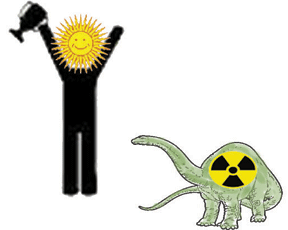 Renewables outpace nuclear in 2014 European power generation, PV Magazine 09. JUNE 2015 BY: BECKY BEETZ Last year was said to be a benchmark for renewable energy, with renewables producing more power in Europe than nuclear for the first time. In yet another glittering solar industry report, SolarPower Europe further calculates cumulative solar capacity could reach 540 GW, globally, by 2020, with a record 40 GW installed in 2014. China is set to “frame global growth.
SolarPower Europe, formerly the European Photovoltaic Industry Association (EPIA) has released its “Global Market Outlook for Solar Power 2015-2019.” In the report, the association notes the “key” role solar has played in helping the renewable energy industry overtake nuclear power for the first time in Europe……
Price declines The “massive” price declines have help solar become a cost-competitive energy source, including a 75% drop in PV system prices in the past decade. As such, it should be viewed as a “low risk investment” by the financial community, says SolarPower Europe…….
Geographical spread Marking a significant change from just three years ago, China (10.6 GW in 2014), Japan (9.7 GW) and the U.S. (over 6.5 GW) are leading current solar industry growth, with the U.K. forging Europe’s onward path. Of the 40 GW installed in 2014, Europe accounted for just 7 GW, 2.4 of which were deployed in Britain, while Germany added just 1.9 GW and France 927 MW. Despite this, Europe still leads in terms of cumulative installed capacity, at 88 GW.
The U.K. is set to keep the European solar crown for another year – something no one would have believed just a couple of years ago. “The success of the U.K., set to be the largest European market again in 2015, reinforces the evidence that solar power is a versatile and cost-efficient energy source in any climate,” continues Schmela.
Also of note is Korea, whose solar market doubled to see a cumulative capacity of 900 MW at the end of 2014 – similar to that of Australia. South Africa, which has seen an enormous amount of activity recently, also boasts a capacity of 800 MW. Canada, Taiwan, Thailand, the Netherlands and Chile also added nearly 500 MW, respectively.
Interestingly, there is a “perfect balance” between utility-scale and distributed solar installations globally, said SolarPower Europe, at around 20 GW each in 2014. However, when you look at individual markets, like Denmark, Austria, Belgium and Switzerland, for example, they are comprised almost entirely of residential and commercial installations.
Overall, utility-scale solar is expected to drive growth, due to its increased cost competitiveness. In the rooftop sector, self-consumption is said to be becoming the “backbone” of distributed PV development………
Read the full SolarPower Europe report. http://www.pv-magazine.com/news/details/beitrag/renewables-outpace-nuclear-in-2014-european-power-generation_100019768/#ixzz3cbXGDbsk
Sunshine and seawater to power farms in the desert
 Desert farms could power flight with sunshine and seawater, The Conversation, John Mathews Professor of Strategic Management, Macquarie Graduate School of Management at Macquarie University, 9 June 15 “…….what if you could grow biofuels on land nobody wants, using just seawater and sunlight, and produce food at the same time?
That’s just what a new project in Abu Dhabi is seeking to do. TheIntegrated Seawater Energy and Agriculture System, or ISEAS, will grow sustainable food and aviation fuel in the desert, using seawater and sunshine, in a way that is eminently transferable to similar arid regions around the world.
The project was announced in January 2015 and is now under construction……..
Energy, water and food problems frequently compound each other, each making the others more difficult to resolve.
Examples abound: think of wasteful irrigation coming up against water limits and threatening reductions in food production. But there are some projects that turn the issue around and bring water, energy and food issues into positive relations, each strengthening the others.
One example of this is the Sundrop Farms project in South Australia, on which I previously wrote on The Conversation, where abundant sunshine and seawater are used to produce electric power and fresh water to cultivate greenhouse crops like tomatoes.
The Sundrop Farms project is moving ahead, and has won substantial financial support from the global venture capital firm KKR Continue reading
Unlike the nuclear industry – it’s all happening in renewable energy
Record boost in new solar power continues massive industry growth
UK leads European solar energy expansion to help renewables overtake output of nuclear power as industry leaders hail ‘tipping point’ for the technology http://www.theguardian.com/environment/2015/jun/09/record-boost-in-new-solar-power-continues-massive-industry-growth
U.S. Could Have 100 Percent Renewable Energy by 2050
Nature World News-9 June 15
R & D Magazine-9 June 15
Highly Cited-Gizmag-10 hours ago
Saudi Arabia aiming to be the Saudi Arabia of renewable energy
Saudi Arabia: an unlikely ally in the march towards renewable energy, Guardian, Molly Scott Cato, 5 June 15 The oil-rich kingdom’s enthusiasm for renewables has nothing to do with saving the planet from climate change and everything to do with economic dominance “……..How striking, therefore, to learn that the Saudi oil minister, Ali al-Naimi, is predicting that within just 25 years we could no longer need fossil fuels. This, from a representative of a country that has done more than most to block progress in climate negotiations.
Of course, this announcement has little, if anything, to do with a newly discovered yearning to save the planet from climate change; it has everything to do with economics. Saudi Arabia finds itself in the fortunate position whereby it can effortlessly switch from dominating the energy market of the 20th century through oil to dominating the 21st century with renewables. Al-Naimi believes that solar power will benefit the economy even more than fossil fuels. The evidence for this is that global investment in renewables jumped 16% in 2014, with solar attracting over half the total funding for the first time, driven by a 80% decline in manufacturing costs for solar in the last six years……..
Far from being a curse that concentrates power in the hands of an elite, renewables work most effectively when in community ownership. Energiewende(energy transformation) in Germany has shown this to be the case. Here, local ownership of renewables has provided a dramatic economic payback to investing communities.
The end game of climate change was always going to be a tussle between the vested interests of the past, using the wealth and power of the fossil fuel era to defend their assets, and the visionary supporters of the new clean energy technologies. The powerhouse states of the fossil era look set to overtake us on the path to a renewable energy future, while we continue to live under a finance curse inflicted on us by a government deeply attached to the finance industry. Saudi Arabia’s motivation may not be protecting the planet from climate change, or indeed improving community control over energy production, but it might just become a useful ally in the transformation towards a new energy era. http://www.theguardian.com/commentisfree/2015/jun/04/saudi-arabia-ally-renewable-energy-oil-rich
The irrestistible appeal of home controlled electricity – with solar energy storage
What is certain is that the electricity equation will look very different in a few short years, and it looks like, for the first time in many years, that ordinary consumers will hold a bit more of the power
How home energy storage is going to change the way we think about power, Adelaide Now, CAMERON ENGLAND SUNDAY MAIL (SA) MAY 31, 2015 WHEN Elon Musk launched the Tesla Power Wall earlier this month, it was done in true Silicon Valley style.
The charismatic chief executive enters stage right, sans tie, and makes a pronouncement that his new product will change the world — cue rapturous applause from the audience and because this is the United States, whooping.
The thing about Musk’s pronouncement is that it’s most likely true.
It might not necessarily be his company — critics are divided as to whether Tesla will be the market leader it’s portraying itself as — but home and business energy storage is soon to change the way energy utilities, homes and governments think about power……..
Batteries allow homes and especially businesses to employ “peak shaving” — if power prices spike, flick over to using your own solar power and save money, or if the grid power is cheap, suck it out and sell it back later at a higher price.
Or simply save up the solar power your rooftop panels produce during the day for use in the evening, when your demand might be higher……..

Tesla Power builds on the Tesla Motors technology — relatively standard lithium ion batteries with smart software to help them interact with the grid. The initial interest has been huge. The company recently reported early orders of 50,000 to 60,000 batteries, or as Musk put it, “It’s like crazy off-the-hook”.
Effectively the company is sold out until the middle of next year and its huge new factory will not be big enough to keep up with demand.
At $US3000 for the battery and $US7000 installed with solar panels (US prices) the system makes it economic for houses to become much less dependent on grid power.
UBS estimates that in Australia, the system would pay itself back in six years.
But Tesla is not the only game in town — although it almost certainly has the best PR machine. Continue reading
Latest renewable energy news
 Renewable energy: The green light is finally on
- Anirudh Bhattacharyya, Hindustan Times May 29, 2015 http://www.hindustantimes.com/anirudhbhattacharyya/renewable-energy-the-green-light-is-finally-on/article1-1352832.aspx
Cheap solar lights up poor Indonesian communities
Kopernik is an Indonesian-based non-profit organisation introducing cheap and clean solar lighting to poor communities.
Perth wave energy project producing power and fresh water
Carnegie Wave Energy based in Perth is a world leader in wave energy technology. In 2014 the company began deployment of three wave energy converters at the Garden Island naval base off the coast near Perth. Large buoys rise and fall with passing waves. Each is tied by rope to the sea floor. As waves pass, the buoys rise, the ropes tighten and extremely high pressure is created in a water-based fluid. This is piped to shore where the pressure powers water desalination and the production of electricity. This technology, known as CETO, has application for small coastal towns and remote islands where oil or diesel is often used in generators. The Perth project is the first demonstration of a complete grid-connected CETO system anywhere in the world. http://www.abc.net.au/radionational/programs/scienceshow/perth-wave-energy-project-producing-power-and-fresh-water/6507450
Renewable Energy Headlines 30 May 15

Christina Macpherson’s websites & blogs
Sorry – I am finding it oo much to properly cover where it is all really at! – RENEWABLE ENERGY!
Renewable energy hasn’t been this big since wood
Greentech Media-28 May 2015
Can Your City Commit to 100% Renewable Energy?
Small scale energy revolution in India’s slums – from Australia solar company
Australian solar company Pollinate Energy brings light to slums of India ABC Foreign Correspondent By South Asia correspondent Stephanie March 26 May 15 With indoor air pollution from kerosene lamps and stoves the second largest cause of death in India, one company, founded by Australians, has come up with a solution to the problem.
Every night in the sprawling shanty towns of the country of 1.2 billion people, the air fills with dense, black smoke.
“We used to get oil from the market and pour it into the lamp and light it; the house used to get full of soot and dirt,” said Abdul, a slum-dweller in Bangalore who lives in a hut made of wooden board and tarpaulin.
That was until Abdul bought a portable solar light from a company called Pollinate Energy, founded by five young Australians.
“After we got this solar lamp a lot of things improved,” Abdul said. “Now we don’t worry that there will be a fire.”
There are 400 million people in India who do not have access to electricity. Many of them live in the thousands of slums found in the country’s cities.
“They’re people who’ve come from rural places to the city to find work, usually in construction sites or as rag pickers, and to make a life for themselves,” Pollinate Energy co-founder Kat Kimmorley said.
“They are sort of like the modern day pharaoh slaves building this next new empire that we all … take for granted that is just coming up before our eyes and yet [is] completely ignored and sort of invisible to the state here.”
Pollinate Energy employs locals to go tent to tent to sell the solar lights.
The lights cost about $30 each — a lot of money for people who earn a few dollars a day. The company allows customers to pay in instalments.
“For most of the people we work with in these urban slums, when we provide a solar light, every time I sell it I think this is the same type of investment as for a plasma screen TV in Australia,” Ms Kimmorley said.
More mobile phones than toilets in India
The lights are popular — the company has sold more than 7,000, and is expanding to two more Indian cities. And that is partly because they double as a phone charger.
“We discovered that the customers would pay double what they would pay for a solar light for a solar-powered phone charger,” Ms Kimmorley said.
“So it is just testament to the fact that it is not just what we think would improve peoples’ lives but also what keeping up with the Joneses means in an urban slum. It’s having a mobile phone and being able to charge that mobile phone,” she said.
The uptake of mobile phones in India has been huge — there are more mobile phones than there are toilets.
The team at Pollinate believes solar lights can follow the same path………http://www.abc.net.au/news/2015-05-26/solar-energy-brings-light-to-slums-of-india/6495912
News on renewable energy
May 22, 2015: Focus on Renewable Energy, Green Buildings to Spur Demand for Building Integrated PV BIPV Takes on the Dual Role of Both Building Envelope Material and Power Generator SAN JOSE, Calif. — The annual installed capacity of building integrated photovoltaics (BIPV) is projected to exceed 11 GW by 2020, driven by the increasing focus on renewable energy and the green building movement in the construction sector, according to a new report by Global Industry Analysts Inc.
BIPV refers to photovoltaic products such as solar panels and modules that are integrated into traditional building materials. http://www.achrnews.com/articles/129658-may-22-2015-focus-on-renewable-energy-green-buildings-to-spur-demand-for-building-integrated-pv
Talk by the world’s biggest oil exporter of giving up fossil fuels and embracing solar and wind energy adds momentum towards a global climate change deal
http://www.theguardian.com/environment/damian-carrington-blog/2015/may/22/saudi-arabias-solar-for-oil-plan-is-a-ray-of-hope
Headlines on renewable energy
 Sorry – can’t keep up with all the great renewable energy developments. Here are a few headlines:
This Company Is Leading the Charge to Expedite Renewable Energy Stefanie Spear | May 19, 2015 http://ecowatch.com/2015/05/19/building-energy/
Hawaii pushes ambitious renewable energy effort ExtremeTech-18 May 2015Hawaii has become the first state to mandate a move to 100%renewable energy. In a 74-2 vote by the Hawaiian legislature, lawmakers have …
Green bonds – a powerful way to develope green energy?
Green bonds, a fast-growing money game with the clout to develop clean energy, await an umpire, EE News, Benjamin Hulac, E&E reporter ClimateWire: Thursday, May 14, 2015
When he chaired the Federal Communications Commission from 1993 to 1997, Reed Hundt studied the swift expansion of the nation’s telecommunications system that made the United States among the most advanced nations in the field and sparked investment overseas.
Between 1996 and 2013, broadband companies invested more than $1.3 trillion in telecom infrastructure domestically, according to the broadband industry’s trade group.
About 32 percent of the world’s population — 84 percent and 21 percent of residents in developed and developing nations, respectively — now has mobile broadband connections, according to the United Nations.
Hundt believes the same experience could be repeated in developing clean energy to cope with global climate change.
Borrowed money paid for the communications boom, Hundt explained, speaking yesterday at an energy efficiency conference in Washington, D.C. He added that world leaders should apply the same method to fund the renewable energy market.
“Everything in communications has been purchased with debt,” he said, holding up an iPhone and describing how rapidly mobile phones have spread internationally.
The portion of the business world devoted to renewable energy resembles the telecom industry in the 1980s, said Hundt, now the CEO of the Coalition for Green Capital, a nonprofit working to drive renewable investment by creating so-called green banks.
“I think that we’re in the really early days,” he said during a panel talk on green bonds, adding that a “total, radical, disrupting overhaul” of the energy sector must be accomplished with a massive lending market and robust debt securitization…………..http://www.eenews.net/stories/1060018552
Renewable energy racing ahead – nuclear power declining
It’ s harder to find real new about nuclear power, than it is for renewable energy. Renewable energy is the future, and this website should, theoretically, be following the excitinfg developments in both large and small-scale wind and solar developments.
However – it IS “nuclear-news” – so from now on, I’m concentrating on the more strictly “nuclear” issues, and just pointing to headlines and brief notes for that other topic – however tantalising its news:
 RENEWABLE ENERGY:
California’s Renewable Energy Plan Will Save $51 Billion a Year by Andrew Burger on Friday, May 15th, 2015 California’s new renewable energy target, proposed by Gov. Jerry Brown during his inaugural address in January, is not only achievable: It would result in as much as $51 billion in annual savings for the state’s residents, according to an analysis by Strategen Consulting that “quantifies the economic and societal impacts” of the governor’s proposed goals.
Ahead of schedule when it comes to meeting a current goal of sourcing 33 percent of electricity from renewable sources by 2020, Gov. Brown proposes raising the state’sRenewables Portfolio Standard (RPS) target up a big notch – to 50 percent by 2030…….http://www.triplepundit.com/2015/05/ca-govs-renewable-energy-plan-will-save-51b-year/
UK Renewable Energy Investment And Generation Surges In 2014, Clean Technica May 15th, 2015 by Joshua S Hill A new report shows that renewable energy investment in the United Kingdom hit a record high in 2014, with electricity generated from renewables increasing by 20% as well.
In fact, in 2014, not only did renewable energy investment hit a record of £10.7 billion, but renewable jobs increased by 9% as well…..http://cleantechnica.com/2015/05/15/uk-renewable-energy-investment-generation-surges-2014/
Renewable energy storage will end capacity payments Capacity payments and fossil energy can be made redundant by electric cars, writes Teodora Serafimova. The European Commission recognises the important role energy storage technologies will have to play in the future energy system, both in its Energy Security Strategy of May 2014 as well as in its more recent Energy Union strategy. Bellona has long been convinced of the necessity of energy storage in the face of a rapidly growing share of renewables in the energy mix. With such storage technology quickly materialising, notably from the electric car industry, it’s time to take stock of the changes this will bring.
Energy storage does not only hold the potential for us to make better use of renewable power, but in doing so it also allows us make less use of fossil power. Being less dependent on fossil power erodes the case for subsidies like capacity payments keeping this industry alive.
Energy storage technologies, such as compressed air storage and batteries, can store low-cost renewable energy when the system experiences oversupply, then release this energy to the grid when it is more needed, such as at night in the case of solar or when the output of wind power falls below demand.
In short, energy storage gives renewable energy the flexibility it currently lacks. ……http://www.euractiv.com/sections/transport/renewable-energy-storage-will-end-capacity-payments-314609
1 This Month

of the week – Shut Down Drone Warfare!


Tell the Ukrainian Government to Drop Prosecution of Peace Activist Yurii Sheliazhenko

Petition to revoke the licensing of the Near Surface Nuclear Disposal Facility (NSDF) at Chalk River. https://www.ourcommons.ca/petitions/en/Petition/Details?Petition=e-7247
To see nuclear-related stories in greater depth and intensity – go to https://nuclearinformation.wordpress.com
-
Archives
- April 2026 (114)
- March 2026 (251)
- February 2026 (268)
- January 2026 (308)
- December 2025 (358)
- November 2025 (359)
- October 2025 (376)
- September 2025 (257)
- August 2025 (319)
- July 2025 (230)
- June 2025 (348)
- May 2025 (261)
-
Categories
- 1
- 1 NUCLEAR ISSUES
- business and costs
- climate change
- culture and arts
- ENERGY
- environment
- health
- history
- indigenous issues
- Legal
- marketing of nuclear
- media
- opposition to nuclear
- PERSONAL STORIES
- politics
- politics international
- Religion and ethics
- safety
- secrets,lies and civil liberties
- spinbuster
- technology
- Uranium
- wastes
- weapons and war
- Women
- 2 WORLD
- ACTION
- AFRICA
- Atrocities
- AUSTRALIA
- Christina's notes
- Christina's themes
- culture and arts
- Events
- Fuk 2022
- Fuk 2023
- Fukushima 2017
- Fukushima 2018
- fukushima 2019
- Fukushima 2020
- Fukushima 2021
- general
- global warming
- Humour (God we need it)
- Nuclear
- RARE EARTHS
- Reference
- resources – print
- Resources -audiovicual
- Weekly Newsletter
- World
- World Nuclear
- YouTube
-
RSS
Entries RSS
Comments RSS
 nuclear-news