Record $329BN GLOBAL INVESTMENT IN 2015 in RENEWABLE ENERGY
 CLEAN ENERGY DEFIES FOSSIL FUEL PRICE CRASH TO ATTRACT RECORD $329BN GLOBAL INVESTMENT IN 2015, Bloomberg New Energy Finance, JAN 14, 2016

View this press release in PDF.
2015 was also the highest ever for installation of renewable power capacity, with 64GW of wind and 57GW of solar PV commissioned during the year, an increase of nearly 30% over 2014.
London and New York, 14 January 2016 – Clean energy investment surged in China, Africa, the US, Latin America and India in 2015, driving the world total to its highest ever figure, of $328.9bn, up 4% from 2014’s revised $315.9bn and beating the previous record, set in 2011 by 3%.
The latest figures from Bloomberg New Energy Finance show dollar investment globally growing in 2015 to nearly six times its 2004 total and a new record of one third of a trillion dollars (see chart on page 3), despite four influences that might have been expected to restrain it.
These were: further declines in the cost of solar photovoltaics, meaning that more capacity could be installed for the same price; the strength of the US currency, reducing the dollar value of non-dollar investment; the continued weakness of the European economy, formerly the powerhouse of renewable energy investment; and perhaps most significantly, the plunge in fossil fuel commodity prices.
Over the 18 months to the end of 2015, the price of Brent crude plunged 67% from $112.36 to $37.28 per barrel, international steam coal delivered to the north west Europe hub dropped 35% from $73.70 to $47.60 per tonne. Natural gas in the US fell 48% on the Henry Hub index from $4.42 to $2.31 per million British Thermal Units.
Michael Liebreich, chairman of the advisory board at Bloomberg New Energy Finance, said: “These figures are a stunning riposte to all those who expected clean energy investment to stall on falling oil and gas prices. They highlight the improving cost-competitiveness of solar and wind power, driven in part by the move by many countries to reverse-auction new capacity rather than providing advantageous tariffs, a shift that has put producers under continuing price pressure.
“Wind and solar power are now being adopted in many developing countries as a natural and substantial part of the generation mix: they can be produced more cheaply than often high wholesale power prices; they reduce a country’s exposure to expected future fossil fuel prices; and above all they can be built very quickly to meet unfulfilled demand for electricity. And it is very hard to see these trends going backwards, in the light of December’s Paris Climate Agreement.”
Looking at the figures in detail, the biggest piece of the $328.9bn invested in clean energy in 2015 was asset finance of utility-scale projects such as wind farms, solar parks, biomass and waste-to-energy plants and small hydro-electric schemes. This totalled $199bn in 2015, up 6% on the previous year.[1]
The biggest projects financed last year included a string of large offshore wind arrays in the North Sea and off the coast of China. These included the UK’s 580MW Race Bank and 336MW Galloper, with estimated costs of $2.9bn and $2.3bn respectively, Germany’s 402MW Veja Mate, at $2.1bn, and China’s Longyuan Haian Jiangjiasha and Datang & Jiangsu Binhai, each of 300MW and $850m………
National trends
China was again by far the largest investor in clean energy in 2015, increasing its dominance with a 17% increase to $110.5bn, as its government spurred on wind and solar development to meet electricity demand, limit reliance on polluting coal-fired power stations and create international champions.
Second was the US, which invested $56bn, up 8% on the previous year and the strongest figure since the era of the ‘green stimulus’ policies in 2011. Money-raising by quoted ‘yieldcos’, plus solid growth in investment in new solar and wind projects, supported the US total……..http://about.bnef.com/press-releases/clean-energy-defies-fossil-fuel-price-crash-to-attract-record-329bn-global-investment-in-2015/
Renewable energy can dramatically cut emissions – International Renewable Energy Agency
Some of those changes are already underway. Global clean energy investment attracted a record $329bn last year, according to a report released on Thursday by Bloomberg New Energy Finance.
The report noted the rise in clean energy investment came despite the drop in oil prices.

Rapid switch to renewable energy can put Paris climate goals within  reach http://www.theguardian.com/environment/2016/jan/16/rapid-switch-to-renewable-energy-can-put-paris-climate-goals-within-reach
Increasing renewables to 36% of the global energy mix by 2030 would provide about half emissions reductions needed to hold warming to 2C, says International Renewable Energy AgencyGuardian, Suzanne Goldenberg, 16 Jan 16
Countries can deliver on the promises of the historic Paris climate change agreement by rapid scaling up wind and solar power to 36% of the global energy mix by 2030, an international energy gathering will be told on Saturday.
The International Renewable Energy Agency (Irena) meeting in Abu Dhabi – the first major global gathering since Paris – is seen as an important test of countries’ readiness to put those plans into action.
Nearly 200 countries agreed to keep warming below 2C, and work towards a 1.5C limit, during the Paris climate negotiations last month. Some 187 put forward plans to cut greenhouse gas emissions.
Now comes the hard part, government officials admit: making good on those promises by translating emissions cutting targets into policies, and expanding access to clean energy technologies.
Irena said those goals were within reach – if countries move fast. Scaling up renewable energy to 36% of the global energy mix by 2030 would provide about half of the emissions reductions needed to hold warming to 2C. Energy efficiencycould make up the rest.
“The Paris agreement set a long-term vision for the deep reduction of global emissions and the need to decarbonise the energy sector,” Adnan Amin, Irena’s director general said in a prepared statement. “The Irena assembly must now take the next steps and establish a blueprint for action to meet our climate goals and set the world on a path to a sustainable energy future.”
In an effort to spur countries to action, an Irena report released on Saturday found doubling the share of renewables by 2030 would increase global GDP by up to 1.1% or about $1.3tn, and provide jobs for more than 24 million in the renewable sector.
The United Nations climate chief, Christiana Figueres, has said repeatedly she was looking to the Paris agreement to send a clear signal to the business community of a shift away from a fossil-fuel driven economy.
Some of those changes are already underway. Global clean energy investment attracted a record $329bn last year, according to a report released on Thursday by Bloomberg New Energy Finance.
The report noted the rise in clean energy investment came despite the drop in oil prices.
Irena officials said they hoped that the Paris climate accord would add momentum to the shift.
“We are not seeing climate change action as a cost, but starting to see it in terms of opportunities,” said Angela Kallhauge, Irena’s climate change officer.
Solar is the solution for economic growth in rural locations
Solar: The Catalyst for Economic Growth and Improved Health in the World’s Most Rural Locations http://www.huffingtonpost.com/cathy-zoi/solar-the-catalyst-for-economic-growth_b_8919532.html?utm_hp_ref=green&ir=Green&utm_content=buffer9ceee&utm_medium=social&utm_source=twitter.com&utm_campaign=buffer, Cathy Zoi , 15 Jan 16
Late last year my colleagues and I visited a remote village in rural Rajasthan, India. We were greeted by village leaders offering fresh flower garland necklaces while a joyous collection of enthusiastic, young boys beat drums and tins of all sizes in the background. Following a few moments of warm “Namastes,” we were escorted up the path to a terrace adjacent to the village’s central building where we participated in a town hall meeting. To discuss what? Bringing electricity for the first time to this community of 400 families.
Solar is the solution. Solar panels are the fastest-to-deploy, most cost-effective and cleanest electricity option available to bring electricity to villages like this one and provide essential, basic services, including clean water, pumps, light, refrigeration, and connectivity. To many of us in developed countries, the simple concept of light is taken for granted. Flip a switch, right? In many parts of the developing world there are no “switches” – to get light, you must burn diesel or kerosene, both of which produce harmful emissions. In fact, kerosene lamps lead to 1.5 million deaths per year– more than five times the annual malaria deaths. Simply replacing those kerosene lamps with solar-powered lamps would save more lives than eliminating malaria.
My company, SunEdison Frontier Power, is in the business of building solar-powered mini-grids in villages like this one. We design, construct and operate rural utilities that offer communities light, water pumping, phone charging, refrigeration, connectivity and other modern amenities. Children can study at night. Water can be purified. Medicines and food can be kept cold. Businesses can expand their operating hours. While this has terrific community benefits, both in terms of human health and the economy, it isn’t charity. The villagers and local businesses – in this case a flour mill and several shops – pay us for the power they consume. And at the town hall meeting in Rajasthan that day, there was overwhelming support for doing just that: the town agreed that the solar-powered mini-grid should be built. We will be starting construction early next year.
Access to non-polluting electricity in the developing world is mission-critical for enabling health and preventing disease, as well as in facilitating commerce. Over 1.3 billion people are completely without power; another billion have electricity for just a few hours a day. The economic upshot is clear: a recent International Monetary Fund report names “severe” electricity shortages as a significant contributor to Sub-Saharan Africa’s reduced economic growth. The sooner the developing world gains greater access to cost-effective clean energy, the quicker these issues will be alleviated. And it all starts with solar power.
In many remote areas, solar power is now more cost effective than diesel or kerosene. With solar now cheaper than kerosene, we can eradicate kerosene lamp deaths and remove the health impacts of burning fuel inside and around homes. By offering cost-effective electricity we can deliver other essential services and catalyze the growth of local economies – without waiting for power plants and transmission lines to be built. It takes only a few months to power a village with a solar mini-grid, whereas extending the electrical grid frequently takes several years.
Just as remote areas leapfrogged wire phone lines for mobile phones, solar can leapfrog the old way of providing electricity by skipping the capital-intensive, centralized power plants and long-distance transmission infrastructure. Solar has been used for decades, often paired with batteries, for a range of remote applications, from telephone stations on mountain tops to villagers requiring water pumping. Today a local solar mini-grid can help provide reliable internet services as well, supporting businesses, clinics, schools and families.
As a global society it is in our collective best interest for the developing world to “develop” in a way that is economically and environmentally sustainable. We want to improve health, build economies and save lives. We want to do this as fast, effectively and cheaply as possible. Looking at the numbers, these objectives add up to solar as an answer. As countries continue to work through the best ways to address climate change, we are hopeful that they realize that reducing greenhouse gas emissions needn’t mean stifling growth or compromising health in developing economies. The opposite is true. Reducing carbon, improving health, enabling commerce and securing access to clean energy are not mutually exclusive; they are in fact, inextricably intertwined.
Census shows rapid growth of solar industry jobs in USA
 USA National Solar Jobs Census 2015 Released http://www.energymatters.com.au/renewable-news/solar-jobs-census-em5291/ January 13, 2016
The U.S. solar workforce grew to a total of nearly 209,000 last year; adding more than 35,000 workers – the third consecutive year in which growth exceeded 20%.
The Solar Foundation’s National Solar Jobs Census 2015 states the workforce has increased by 123% since 2010.
“The solar industry has once again proven to be a powerful engine of economic growth and job creation,” said Andrea Luecke, President and Executive Director of The Solar Foundation. ” Our Census findings show that one out of every 83 new jobs created in the U.S. over the last 12 months was in the solar industry – 1.2% of all new jobs.”
The USA’s solar workforce is now three times the number employed in the coal mining industry and also larger than the oil and gas extraction industry.
Last year, solar industry employment grew 12 times faster than the overall US workforce.
In addition to direct employment, the US solar industry supports an additional 610,650 ancillary jobs throughout the supply chain.
When the first Census was run in 2010, the USA had installed 929MW of solar capacity that year. Last year, 7,430MW of capacity was added.
The installation sector represented the bulk of jobs in the US solar industry in 2015.
Installation – 119,931
Manufacturing – 30,282
Sales and distribution – 24,377
Project development – 22,452
All others – 11,816
Employment in all sectors grew in 2015, with the exception of solar manufacturing. However, manufacturing jobs are expected grow by 3,800 positions in 2016; supported by industry construction activity.
Approximately 90% of all solar workers are 100% dedicated to solar activities; a percentage that has been effectively unchanged since 2013.
Jobs in the solar industry continue to pay above the median wage of all occupations in the USA.
Looking ahead, a further 14.7% increase in positions is expected this year – an extra 30,000 jobs – bringing the total of U.S. solar workers to 239,625 by the end of 2016. It could perhaps be even higher as Census data collection was completed before the extension of the 30% Federal Investment Tax Credit (ITC) was announced.
The sixth annual National Solar Jobs Census can be viewed in full here (PDF).
It’s becoming the ‘new normal’ across the globe – renewable energy
 No2 NuclearPower January 2016 “……….Something incredible is happening right now across the globe. Achieving 100% clean energy is becoming “the new normal” in the fight to solve climate change. What’s driving this trend is a flowering of ambition. Cities across the globe are demonstrating what it means to lead with ambition. In Paris at the Climate Summit for Local Leaders, the largest-ever global gathering of local leaders focused on climate change, 1,000 mayors issued a declaration which states: “We—the undersigned mayors, governors, premiers, and other local government leaders—commit collectively to support ambitious long-term climate goals such as a transition to 100% renewable energy in our communities.” ………
Australian Aboriginal company to launch portable solar system, and storage
The products are being launched at Tandanya Aboriginal Cultural centre in Adelaide on Wednesday 2 September. Ms Oberon said Adelaide was chosen for the launch because of the council’s Sustainable City Incentive Scheme, which provides up to $5000 towards the cost in installing solar PV storage across the residential, business, education and community sectors. Funding for the program also has financial support from the South Australian government.
“We felt it was important to acknowledge the South Australian government and the City of Adelaide for such a forward-looking and innovative scheme,” Ms Oberon said.
The company is also hoping other state governments and councils will be encouraged to take up the idea of supporting the uptake of renewable energy storage.
The company’s core mission is based on the fundamental Aboriginal approach of stewardship of the earth and its resources. This means needing to shift out of high-emissions fossil-fuel derived energy.
 Aboriginal-owned energy company one-upping Tesla By Willow Aliento, The Fifth Estate Friday 8 January 2016 The renewable energy storage game is about to be disrupted, with Australian Aboriginal-owned company AllGrid Energy announcing the launch of WattGrid, a new 10kWh solar energy storage system it says is around 30 per cent cheaper than the Tesla Powerwall.
Customers also don’t have to wait until 2016. Spokeswoman for AllGrid, Deborah Oberon, said the company expected to be making its first deliveries in the next two to three months.
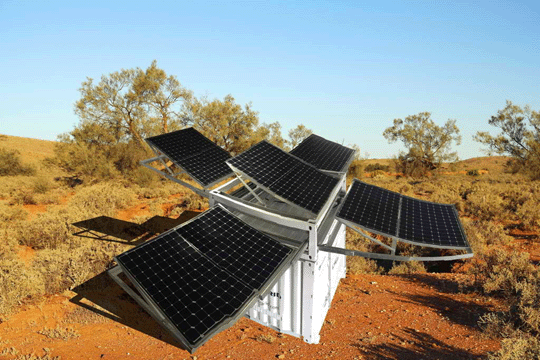
The $11,999 WattGrid unit comprises an aluminium cabinet containing tubular lead acid gel batteries, and a hybrid 5kW solar inverter with battery management system that has load share capability with the grid and uninterrupted power supply capability.
The unit is also accompanied by a software app, WattsHappening, that allows users to view real-time information and interface with the system.
Beta testing has shown the unit can help solar owners maintain an energy supply profile that can be matched to the demand profile, potentially rendering drawing grid power unnecessary.
The Queensland-based company is also releasing another product it has developed, the PortaGrid. This is an independent unit comprising solar panels, storage, UPS, inverter and outlets that is suitable for remote and off-grid locations, as well as emergency situations.
The units can be supplied with an inbuilt weather station that will automatically close up the panels in the event of a severe weather hazard such as a cyclone.
The AllGrid company is an alliance between two established firms, Consolidated Industrial Holdings, which operates across the energy efficiency, engineering design and technology sectors, and DICE Australia, an Aboriginal-owned and Aboriginal-operated company in the electrical contracting and general construction services sector………
The products are being launched at Tandanya Aboriginal Cultural centre in Adelaide on Wednesday 2 September. Ms Oberon said Adelaide was chosen for the launch because of the council’s Sustainable City Incentive Scheme, which provides up to $5000 towards the cost in installing solar PV storage across the residential, business, education and community sectors. Funding for the program also has financial support from the South Australian government.
“We felt it was important to acknowledge the South Australian government and the City of Adelaide for such a forward-looking and innovative scheme,” Ms Oberon said.
The company is also hoping other state governments and councils will be encouraged to take up the idea of supporting the uptake of renewable energy storage.
The company’s core mission is based on the fundamental Aboriginal approach of stewardship of the earth and its resources. This means needing to shift out of high-emissions fossil-fuel derived energy.
“It is so important for everyone to shift to renewable energy,” Ms Oberon said.
All the intellectual property involved in the products is owned by the AllGrid business.
Currently the company has one manufacturing facility established in Brisbane where the various parts, some of them manufactured offshore to AllGrid’s specifications, will be assembled by a predominantly Indigenous workforce.
Ms Oberon said if demand in South Australia was great enough, the company would also look to establish a plant in Adelaide.
The PortaGrid product is already attracting interest, she said, with the company in discussions with National Parks about supplying the units for remote sites that currently rely on diesel generators.
“The applicability worldwide of the technology is just enormous,” Ms Oberon said, “particularly in developing countries.”
Talks are underway with a number of groups that are currently running leadership programs with Indigenous people in other nations and setting up training programs in renewable energy for the local peoples.
The company is also investing heavily in research and development………
AllGrid has committed to directing a percentage of all company profits into creating and supporting training and employment programs for Indigenous Australian young people. http://www.eco-business.com/news/aboriginal-owned-energy-company-one-upping-tesla/
Russia has potential to be very competitive in renewable energy market
 Russia can be one of the most energy-competitive areas based on renewables, EurekAlert, 30 d3ec15 LAPPEENRANTA UNIVERSITY OF TECHNOLOGY A fully renewable energy system is achievable and economically viable in Russia and Central Asia in 2030. Researchers from Lappeenranta University of Technology (LUT) modelled a renewable energy system for Russia and Central Asia. Results show that renewable energy is the cheapest option for the continent and can make Russia a very energy competitive region in the future.
According to the research, a 100 percent renewable energy system for Russia and Central Asia would be roughly 50 percent lower in cost than a system based on latest European nuclear technology or carbon capture and storage. Renewable energy covers electricity and industrial natural gas demand, not, for example, transport or heating.
“We think that this is the first ever 100% renewable energy system modelling for Russia and Central Asia. It demonstrates that Russia can become one of the most energy-competitive regions in the world”, emphasises professor Christian Breyer, co-author of the study.
Moving to a renewable energy system is possible due to the abundance of various types of renewable energy resources in the area. This then enables the building of a Super Grid, which connects different energy resources of the researched area……..
The research was done as part of Neo-Carbon Energy research project, which has previously shown that a renewable energy system is also economically sensible in North-East Asia, South-East Asia, South America and Finland. http://www.eurekalert.org/pub_releases/2015-12/luot-rcb123015.php
Potential for solar energy to rapidly develop innovative technologies
 Solar power has lots of headroom to make it stronger, cheaper and global, Climate Wire, Umair Irfan, E&E reporter, December 17, 2015
First of a two-part series. Read part two here.
On paper, the amount of sunlight hitting the Earth in one hour could fulfill humanity’s energy needs for a year, an equation that’s hard to ignore.
However, harnessing more of this vast potential remains a major challenge, since the sun has to compete with coal, oil and natural gas — fuels that are abundant and cheap and retain substantial political support in many parts of the world, including the United States……
Though policy and market forces drive the spread of all forms of energy, for solar power, improving the technology remains an open frontier. To this end, researchers are looking at where they can improve the devices that turns the sun’s rays into electricity in hopes of staving off diminishing returns in performance……
Besides bringing efficiency up, the other main research thrust is drawing prices down. The biggest driver for solar energy deployment is cost, according to many analysts, and that’s what drove the sector’s blossoming over the past few years.
“The industry has achieved a hundredfold decrease in prices,” Kurtz said. “There is opportunity to bring those prices down even more.”
The race to lighter, thinner and more concentrated
Much of this price drop has come from economies of scale and a drop in prices of semiconductors. “In general, the semiconductor is the most expensive part of the module,” she said.
The majority of the world’s solar panels use polycrystalline silicon as their semiconductor. For a long time, solar panels using this material were costly, until Chinese manufacturers flooded the market around 2010…….
Earlier this year, researchers at the Massachusetts Institute of Technology published a 322-page study titled “The Future of Solar Energy.” Among its key findings, authors reported that silicon photovoltaics are a mature technology but they have intrinsic performance limits, so public research dollars should go toward breakthrough technologies instead of incremental gains…….
“Efficiency is helpful because any gain in efficiency helps reduce all area-related costs (glass, racking, roof/land space, installation labor, etc.) but it is not the only way of addressing costs,” said Justin Baca, senior director of research for the Solar Energy Industries Association, in an email. “The efficiency question is a science question, but most solutions to solar challenges right now are engineering and regulatory solutions.”
In the competition for the next generation of clean energy, Kurtz said it’s not a winner-take-all race. The market may still have room for all of these strategies. “These different photovoltaic products also have different characteristics,” she said. “I think it’s a mistake to focus on the winners and losers.”
Tomorrow: What the solar market wants.
Twitter: @umairfan Email: uirfan@eenews.net http://www.eenews.net/stories/1060029627
UK govt prioritising nuclear, gas, oil, but removing support for renewables
Government U-turn on renewables shows gas, oil and nuclear are still favourites

 Now is not the time to pull the plug on supporting renewable energy. A few years of vital subsidies cannot make up for a century of support for fossil fuels. Guardian, Alasdair Cameron, 20 Dec 15
The entire global energy system is undergoing a clean revolution. The old certainties of centralised power and fossil fuels are falling apart before our eyes. In Paris last week world leaders set legally binding targets to decarbonise their economies in order to keep temperature rises at a maximum of 2C. The future is almost here.
It’s a future that is necessary and one that presents the economic opportunity of the century. Bloomberg NEFs New Energy Outlook for 2015 estimates that renewables alone will see more than $8tn of investment in the coming years with $3.7tn in solar alone.
Until recently the UK seemed to understand this, however imperfectly. In the second quarter of this year, the UK got 25% of its electricity from renewables and is aiming for 30% by 2020. The last two governments deserve credit for that.
Costs have fallen, with the latest ground-mounted solar and onshore wind now cheaper than new nuclear , and offshore wind – where the UK is a world leader – is not far behind.
The government’s line is that it’s time to pull the plug on supporting renewable energy – as if a few years of vital subsidies can make up for a century of economic and infrastructural support for fossil fuels. Renewable energy, like most industries, needs some government support to get going, and to realise the best results. Think of the tax breaksand research grants still given to oil and gas, the direct subsidies for nuclear, the publicly-funded roads that facilitate cars, or the national space programmes that eventually brought us the mobile phone.
The argument that this U-turn is about protecting consumers’ bills simply does not hold. Cuts to rooftop solar announced on Thursday will save just 0.9% off a yearly bill, by 2020.
Many of the alternatives the government is turning to are actually more expensive than renewables – Hinkley Point C would cost consumers twice the current wholesale price of electricity. And the single best thing that would cut bills – insulating homes – has seen just about all public support scrapped.
Strong wind power takes over New York’s electricity as nuclear station shut down
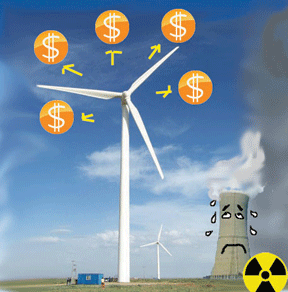 Wind Rescues New York Power After Nuclear Plant Shutdown Naureen Malik , Bloomberg, December 16, 2015 A nuclear reactor that supplies Manhattan unexpectedly went offline Monday night, though you wouldn’t know it to look at power prices.
The Indian Point 3 plant, 27 miles (43 kilometers) north of New York City, automatically shut down at 7 p.m. because of an electrical disturbance, owner Entergy Corp. said in an e-mailed statement late Monday. The last time that happened,spot power more than doubled. Tuesday, wind turbines in the state came to the rescue, running close to capacity and compensating for the loss of the reactor.
While renewables make up a small portion of U.S. generating capacity, wind and solar have subdued prices and at times curtailed the need for plants that rely on coal and natural gas. Meanwhile, Entergy is facing political and economic pressure as Governor Andrew Cuomo seeks to shut the plant while power prices in December head for the lowest monthly average on record.
Spot wholesale power for New York City fell $27.34, or 56 percent, to $21.33 per megawatt-hour in the hour ended at 1 p.m. compared with the same period Monday, according to grid data compiled by Bloomberg……..http://www.bloomberg.com/news/articles/2015-12-15/wind-rescues-new-york-power-prices-after-nuclear-plant-shutdown
Battery storage for solar now a very big deal
This huge deal is the latest evidence that the battery revolution has arrived, WP By Chris Mooney December 15 At the Paris climate change conference earlier this month, all eyes were on some massive announcements in the solar and wind energy space — including plans in Africa to install 300 gigawatts of renewable energy capacity across the continent by the year 2030. A gigawatt is a billion watts — and this would be nearly double the electricity capacity that the continent currently supports.
Less noticed, however, is that a key enabling technology for solar — and for the future of clean energy — is also starting to grow: Energy storage. When solar systems are connected with batteries or other forms of storage, they can cease to be dependent upon whether the sun is shining and how strong its rays are at a given moment. Rather, solar energy can be stored and used at a later time. Including at night.
And now AES, a large energy company headquartered in Arlington, Va., has announced a very large deal in the battery space. It is gaining access to 1 gigawatt-hour worth of lithium ion batteries from Seoul-based LG Chem, a chemicals giant that also has a strong business in making lithium ion batteries for electric and hybrid electric vehicles. The batteries will be deployed in AES’s Advancion platform, which provides large scale grid energy storage to utility companies.
Power – in this case, a gigawatt – refers to the amount of electricity that can be discharged instantaneously. But when it comes to batteries, what’s also important is how long the battery can operate — its energy. Thus, 1 gigawatt hour would refer to the capacity to discharge that much power for one hour — but it could also refer to the ability to discharge 250 megawatts (or million watts) for four hours.
Either way, that’s a very large amount of batteries. For comparison, GTM Research recently forecast that the U.S. will deploy a record 192 megawatts of energy storage in 2015.
But for now, the biggest business for batteries isn’t in the home, where they can serve a backup role in the event of an outage or pair with a rooftop solar system; it’s on the grid, where there is a constant need to be able to manage shifting electricity demand at different times of the day. Batteries that can switch on automatically at key moments can provide a major grid service, which is why they’re seeing more and more demand.
Thus, AES is in effect packaging lots of batteries, provided by LG Chem, into large systems that large power companies can purchase and then install or integrate on the grid wherever they need this new capacity. AES directly advertises its batteries as the “complete alternative” to “peaking power plants.”
France sets up Europe’s biggest solar farm: it’s cheaper than nuclear power station
 New French solar farm, Europe’s biggest, cheaper than new nuclear, Reuters, 1 Dec 15 CESTAS, FRANCE French energy group Neoen on Tuesday inaugurated a 300 megawatt (MW) solar farm, Europe’s biggest, which will produce power at a price below that of new nuclear plants.
Built on a 250-hectare site south of Bordeaux, the plant will provide power for 300,000 people and cost 360 million euros. It will sell power at 105 euros per megawatt-hour (MWh) for 20 years, well below the cost of power from new nuclear power reactors.
“We will deliver power at an extremely competitive price, similar to wind power, and at any rate cheaper than the cost of power from new nuclear plants,” Neoen Chief Executive Xavier Barbaro told reporters on Tuesday…….
Barbaro said the facility’s solar panels are not oriented toward the south, but on an east-west axis, which allows them to produce three to four times more power for the same surface area.
The east-west orientation also allows the panels to produce more power early in the morning and late in the afternoon, which corresponds more closely to French power demand patterns…..
Barbaro said Neoen’s Bordeaux solar plant shows that solar photovoltaic can be highly economical in terms of geographical footprint.
He also said while the solar panels are Chinese made, they make up only a minority part of the investment and that the main costs are related to construction, engineering, cabling and electrical equipment, for which there are many competitive French suppliers.
Neoen has said it aims to install 1,000 MW of capacity by 2017, about half in France.
(Reporting by Claude Canellas; writing by Geert De Clercq, editing by David Evans) http://www.reuters.com/article/2015/12/01/us-climatechange-summit-france-solar-idUSKBN0TK5GW20151201#e7rJbmSSCOht6lPU.97
We can get all our electricity from the sun: dispelling the myths from the nuclear lobby
Goodbye fossil fuels, goodbye nuclear. We can ‘Get it from the Sun’ – all of it!, Ecologist Keith Barnham
30th November 2015 New research shows that wind and solar can meet 80% of Germany’s power demand, with biogas and hydropower providing the balance, writes Keith Barnham. And if Germany can do it, so can other countries, many of them even more easily – with no need for fossil fuels or nuclear power. COP21 should raise its ambitions and commit to a 100% renewable electricity future, everywhere.
There is general agreement world-wide that an a 100% renewably powered world would be a desirable objective, and that the renewable technologies are particularly well suited to provide the energy needed in the countries most vulnerable to climate change.
There is also a clear scientific consensus that renewable electricity generators emit the lowest greenhouse gases: at least nine times less than the lowest fossil fuel generators and in some cases 40 times less.
There are, however, powerful lobbies that argue that the renewables are too unreliable; expanding too slowly; and too expensive to supply the world’s electricity needs. Without, that is, significant help from the technologies the lobbyists are paid to represent – be they fossil fuel or nuclear.
Here is the evidence, some of it new and unexpected, that the lobbyists’ arguments at a variance with the realities. Two projects in Germany, under the collective name of Komikraftwerk (combined-power plant) have clearly demonstrated that the reliability objection is a myth. Continue reading
France to spend billions on African renewable energy projects
 COP21: France to spend billions on African renewable energy projects Guardian, 1 Dec 15
François Hollande tells Paris climate summit that his government will double investments in wind, solar and hydropower to €2bn France plans to spend billions of euros in renewable energy and other environmental projects in its former west African colonies and across Africa over the next five years, President François Hollande said on Tuesday.
Africa produces little of the greenhouse gases such as carbon dioxide, produced by burning fossil fuels, linked by scientists to rapid climate change. But it is particularly vulnerable to a changing climate, as much of its population is poor, rural and dependent on rain-fed agriculture.
Hollande told a conference on Africa, held as part of climate change talks in Paris, that his government would double investments in renewable energy generation, ranging from wind farms to solar power and hydroelectric projects, across the continent to €2bn between 2016 and 2020……..
African leaders want the biggest polluting nations to commit to financing as part of contributions to an internationally administered Green Climate Fund, that hopes to dispense $100bn a year after 2020 as a way to finance the developing world’s shift towards renewables. http://www.theguardian.com/environment/2015/dec/01/cop21-france-to-spend-billions-on-african-renewable-energy-projects
Only politics stands in the way of a renewable energy powered world – new report
The World Could Run Entirely On Wind, Solar, And Hydro Power By 2050 http://www.fastcoexist.com/3053676/the-world-could-run-entirely-on-wind-solar-and-hydro-power-by-2050
We can fully get rid of fossil fuels quickly, if countries can just find the political will.
In a few decades, the world could be powered by nothing but wind, water, and sunlight. That’s the conclusion of a new study released just before world leaders head to Paris to strike a climate deal. “These are basically plans showing it’s technically and economically feasible to change the energy infrastructure of all of these different countries,” says Mark Z. Jacobson, director of the Atmosphere/Energy Program at Stanford University, who worked with University of California colleagues to analyze energy roadmaps for 139 countries [on original]
The researchers crunched numbers to see how much energy each country would need by 2050—including electricity, transportation, heating and cooling, industry, and agriculture—and then calculated how renewable energy could cover those needs, where it could go, and how much it would cost.
“People who are trying to prevent this change would argue that it’s too expensive, or there’s just not enough power, or they try to say that it’s unreliable, that it will take too much land area or resources,” Jacobson says. “What this shows is that all these claims are mythical.”
Renewable energy is already cheap and will get cheaper. Even now, Jacobson says, wind is the cheapest electricity in the U.S., costing just 3.5 cents a kilowatt-hour (unsubsidized) compared to 6 to 8 cents for natural gas. That’s not including health and climate benefits: The study estimates that shifting infrastructure would save 4 to 7 million lives a year of people who would have died from air pollution—deaths that cost the world around 3% of the global GDP.
Shifting to renewables would create 20 million more jobs than those lost in the fossil fuel industry. Energy prices would stabilize, since renewables don’t use a commodity fuel. Decentralizing power would reduce the risk of both terrorism at power plants and outages from storms. Countries could become energy independent, eliminating a major cause of global conflict. Four billion people who don’t have reliable (or, in some cases, any) access to energy today would have power.
The study lays out a timeline of how the shift could happen. By 2020, countries would stop building new coal, natural gas, or nuclear plants (or biomass, which the researchers don’t consider a good alternative). New home appliances like stoves and heaters would be electric, not gas. By 2025, new cargo ships, trains, and buses would be electrified. Cars and trucks would get there by 2030. Eventually, by 2050, the transition would be complete.
It sounds simpler than we’ve led to believe. And that’s because the catch, of course, is political: Countries will have to decide to make the shift. If they do, though, it could actually work.
1 This Month

of the week – Shut Down Drone Warfare!


Tell the Ukrainian Government to Drop Prosecution of Peace Activist Yurii Sheliazhenko

Petition to revoke the licensing of the Near Surface Nuclear Disposal Facility (NSDF) at Chalk River. https://www.ourcommons.ca/petitions/en/Petition/Details?Petition=e-7247
To see nuclear-related stories in greater depth and intensity – go to https://nuclearinformation.wordpress.com
-
Archives
- April 2026 (114)
- March 2026 (251)
- February 2026 (268)
- January 2026 (308)
- December 2025 (358)
- November 2025 (359)
- October 2025 (376)
- September 2025 (257)
- August 2025 (319)
- July 2025 (230)
- June 2025 (348)
- May 2025 (261)
-
Categories
- 1
- 1 NUCLEAR ISSUES
- business and costs
- climate change
- culture and arts
- ENERGY
- environment
- health
- history
- indigenous issues
- Legal
- marketing of nuclear
- media
- opposition to nuclear
- PERSONAL STORIES
- politics
- politics international
- Religion and ethics
- safety
- secrets,lies and civil liberties
- spinbuster
- technology
- Uranium
- wastes
- weapons and war
- Women
- 2 WORLD
- ACTION
- AFRICA
- Atrocities
- AUSTRALIA
- Christina's notes
- Christina's themes
- culture and arts
- Events
- Fuk 2022
- Fuk 2023
- Fukushima 2017
- Fukushima 2018
- fukushima 2019
- Fukushima 2020
- Fukushima 2021
- general
- global warming
- Humour (God we need it)
- Nuclear
- RARE EARTHS
- Reference
- resources – print
- Resources -audiovicual
- Weekly Newsletter
- World
- World Nuclear
- YouTube
-
RSS
Entries RSS
Comments RSS
 nuclear-news