Germany 2016: Expanding renewables, stagnating decarbonisation
 nu Clear News, Mar 16 . “……….Despite some short-term market and industry disruptions, the Energiewende policy has been largely successful in achieving its stated goals, and public support remains strong. As reported in a January 2016 by Agora Energiewende, a Berlin-based energy think tank from 2012 to 2015, public sentiment in Germany has been strongly supportive of the Energiewende, with 90% saying it is important or very important.
Solar powered airport for South Africa
 Africa gets its first solar-powered airport By Milena Veselinovic, for CNN March 4, 2016 (CNN) South Africa has ramped up its green credentials by unveiling the continent’s first solar-powered airport.
Located halfway between Cape Town and Port Elizabeth, George Airport will meet 41% of its energy demand from a brand new 200 square meter solar power plant built on its grounds.
The facility, which was officially launched last week, has 3,000 photovoltaic modules, and will gradually increase capacity to deliver 750Kw power when it reaches full production…….
The airport serves the Western Cape town of George which lies in the heart of the scenic Garden Route, famous for its lush vegetation and lagoons which are dotted along the landscape.
It handles over 600,000 passengers a year, many of them tourists, but it’s also a national distribution hub for cargo such as flowers, fish, oysters, herbs and ferns.
The clean energy initiative follows in the footsteps of India’s Cochin International airport — the world’s first entirely solar powered airport, and Galapagos Ecological Airport, built in 2012 to run solely on Sun and wind power.
Around 635 million people, or 57% of the population, are estimated to live without power on the continent, with that number climbing to 68% in Sub-Saharan Africa.
Last year, a UK start-up collaborated with Shell to build a solar-powered soccer pitch in the Nigerian city of Lagos, but governments are also increasingly harnessing the Sun’s energy for major infrastructure projects.
Last month, Morocco switched on what will be the world’s largest concentrated solar plant when it’s completed. It is predicted to power one million homes by 2018. In Rwanda, a $23.7 million solar plant has increased the country’s generation capacity by 6% and lighting up 15,000 homes. http://edition.cnn.com/2016/03/04/africa/george-airport-solar-south-africa/index.html?utm_source=twitter&utm_medium=post&utm_term=africa,airport,solar,renewables&utm_campaign=greenpeace&__surl__=IgNX8&__ots__=1457298969501&__step__=
An unforgettable year for solar power in USA
 Solar energy is poised for an unforgettable year, WP, By Chris Mooney March 2 New statistics just released by the U.S. Energy Information Administration suggest that in the coming year, the booming solar sector will add more new electricity-generating capacity than any other — including natural gas and wind.
EIA reports that planned installations for 2016 include 9.5 gigawatts of utility-scale solar — followed by 8 gigawatts (or 8 billion watts) of natural gas and 6.8 gigawatts of wind. This suggests solar could truly blow out the competition, because the EIA numbers are only for large or utility-scale solar arrays or farms and do not include fast-growing rooftop solar, which will also surely add several additional gigawatts of capacity in 2016.
In other words, U.S. solar seems poised for not just a record year but perhaps a blowout year. Last year, in contrast, solar set a new record with 7.3 gigawatts of total new photovoltaic capacity across residential, commercial, and utility scale installations.
“If actual additions ultimately reflect these plans, 2016 will be the first year in which utility-scale solar additions exceed additions from any other single energy source,” says EIA……….
“2016 is going to be a huge year, and then we’re going to continue to see big years over the next 5,” he [Nathan Serota, a solar industry analyst with Bloomberg New Energy Finance] said. Granted, solar could still face some headwinds, particularly from the competition offered by extremely low natural gas prices.
In the grand scheme, the tax credits for solar, as well as an extension of the production tax credit for wind, could serve as a kind of “bridge” into an era in which the Obama administration’s Clean Power Plan is operating — or at least, so the current administration hopes. Granted, that depends on whether that plan survives its current legal challenges.
A recent report from the National Renewable Energy Laboratory found that due to the tax credit extensions, the U.S. will add 53 additional gigawatts of renewable energy capacity by the year 2020. https://www.washingtonpost.com/news/energy-environment/wp/2016/03/02/solar-energy-is-poised-for-an-unforgettable-year/
Global Boom in Wind Power, led by China and USA
 China, U.S. Lead Global Boom in Wind Power, Climate Central, By Bobby Magill
March 2nd, 2016 Wind power had a big year worldwide in 2015 as China became the leader in wind power production capacity while the U.S. kept its top spot in electricity actually produced from wind turbines, according to new data released by the Global Wind Energy Council.
Low-carbon energy sources such as wind and solar power are critical to countries seeking to meet climate goals set forth in the Paris climate agreement struck in December. The pact aims to keep global warming to below 2°C (3.6°F)……..
“Wind power is leading the charge in the transition away from fossil fuels,” GWEC Secretary General Steve Sawyer said in a statement.
“The Chinese government’s drive for clean energy, supported by continuous policy improvement, is motivated by the need to reduce dependence on coal, which is the main source of the choking smog strangling China’s major cities, as well as growing concern over climate change,” the statement said.
No other country came close to China’s level of wind development growth last year. But while China is seeing the biggest wind turbine building boom, the U.S. is better at actually producing electricity from its turbines, generating more wind power than any other country last year.
The U.S. generated 190 million megawatt-hours of wind power in 2015, powering about 17.5 million homes. China clocked in at 185.1 megawatt hours, followed by Germany at 84.6, according to American Wind Energy Association data released Monday……
AWEA chief Tom Kiernan said the U.S. is on its way to generating 20 percent of its electricity from wind power by 2030. http://www.climatecentral.org/news/china-us-lead-global-wind-power-boom-20089
Cornwall, UK, gets wind farm without any govt funding- community energy!
 “The benefits of the Big Field wind farm are too great for it not to go ahead just because subsidies are being withdrawn. Being community-owned will ensure that the economic benefit of the wind farm can be retained locally and re-invested in Cornwall.”
Good Energy promises UK’s first subsidy-free  windfarm, http://www.theguardian.com/environment/2016/mar/02/good-energy-promises-uks-first-subsidy-free-windfarm Guardian, Fiona Harvey, 3 Mar 16
Green power company believes it can build onshore windfarm in Cornwall with local people helping finance it, despite government scrapping subsidies. The UK’s first onshore windfarm to be built without government subsidy is now under planning in Cornwall, to be financed in part by the local community.
The Big Field windfarm, near Bude, will consist of 11 turbines, none of more than 125m in height to the tip of the blade, and provide electricity for 22,000 homes. Its backers hope it will point the way to further such projects, after the damages to the onshore wind industry caused by the reversal of policy on government support for clean energy.
Likely to cost about £30m to build and install, Big Field is planned by the green power company Good Energy. While other wind and solar farms have been cancelled or left in limbo by the government’s scrapping of incentives for onshore wind, the company decided instead to try to raise funds locally to support the installation.
An initial application for planning permission for the turbines was filed under the previous subsidy regime. However, that was blocked, and with the withdrawal of government support for onshore wind, the plan looked at an end.
Good Energy revived its prospects with a new project that would use the same number of turbines, of the same size, but with 50% more generation capability, because of changes to the turbine technology.
The revised scheme will only go ahead if planning permission is granted, but the company is hopeful that the support of local residents in agreeing to co-finance the project will help to tip the balance. The inquiry will start in April and, if the green light is given, the windfarm could be operational in 2018.
Bill Andrews, who lives close to the site, said: “This is a very welcome development. A lot of my neighbours already support this wind farm, and giving local people the chance to invest in the project would mean the community will see even more of the benefit.”
The abrupt alterations to government support for wind and solar energy have caused severe disruption in the UK’s renewable energy industries. Thousands of jobs have been lost, companies forced to close, projects mothballed or abandoned, and future developments left in doubt.
Onshore wind technology has tumbled in price in recent years, a factor the government used to justify its withdrawal of support, but the economics of energy generation are complex. Ministers have also introduced new rules to make it more difficult to construct renewable energy projects, and increased subsidies to the fossil fuel industries through the “capacity market”.
Juliet Davenport, chief executive of Good Energy, said: “The benefits of the Big Field wind farm are too great for it not to go ahead just because subsidies are being withdrawn. Being community-owned will ensure that the economic benefit of the wind farm can be retained locally and re-invested in Cornwall.”
Good Energy said it was too early to decide how much of its own money and how much the local community would be expected to put into the project, or what returns investors could expect. However, if successful, it hopes this could provide a new blueprint for small onshore wind farms.
Solar power powers up; London – with World’s biggest floating solar farm
World’s biggest floating solar farm powers up outside London Five years in planning and due to be finished in early March, more than 23,000 solar panels will be floated on the Queen Elizabeth II reservoir near Heathrow and used to generate power for local water treatment plants, Guardian, Fiona Harvey 29 Feb 16 On a vast manmade lake on the outskirts of London, work is nearing completion on what will soon be Europe’s largest floating solar power farm – and will briefly be the world’s biggest.

But few are likely to see the 23,000 solar panels on the Queen Elizabeth II reservoir at Walton-on-Thames, which is invisible to all but Heathrow passengers and a few flats in neighbouring estates.
“This will be the biggest floating solar farm in the world for a time – others are under construction,” said Angus Berry, energy manager for Thames Water, which owns the site. “We are leading the way, but we hope that others will follow, in the UK and abroad.”
Five years in planning and due to be finished in early March, the £6m project will generate enough electricity to power the utility’s local water treatment plants for decades. The energy will help provide clean drinking water to a populace of close to 10 million people in greater London and the south-east of England, a huge and often unrecognised drain on electricity, rather than nearby homes.
Why put solar panels on water? The answer, according to Berry, is that the water is there, and might as well be used for this purpose. Floating panels, covering only about 6% of the reservoir, will have no impact on the ecosystem, he says……..
A similar floating solar farm with around half the capacity of the Thames Water project is being built by water company United Utilities on a reservoir near Manchester. Construction of an even bigger farm – at 13.7MW more than twice the QEII farm – is underway on a reservoir in land-scarce Japanand due to finish in 2018.
Putting solar panels on the water for the QEII scheme has not required planning permission, though big arrays of similar panels on land require official sanction. The government has decided to ban farmers who put solar arrays on agricultural land from receiving EU subsidies for the land.
More than 23,000 solar panels will be floated by developer Lightsource Renewable Energy at the reservoir near Walton-on-Thames, representing 6.3MW of capacity, or enough to generate the equivalent electricity consumption of about 1,800 homes………http://www.theguardian.com/environment/2016/feb/29/worlds-biggest-floating-solar-farm-power-up-outside-london
How solar energy can turn lives around in nuclear-devastatedFukushima
Adorable Japanese couple devastated by Fukushima turn lives around with solar http://www.greenpeace.org/international/en/news/Blogs/makingwaves/this-adorable-japanese-farming-couple-lost-th/blog/55657/

Eventually though, they decided to return.
“We have cattle and chickens and we had to come back to feed them. We couldn’t leave them and go elsewhere,” they told us in 2012.
But apart from dealing with the aftermath of such a tragic accident they also had to deal with the future of their farming business – their customer base fell due to fears of contaminated produce, and they even thought about giving up on farming.
But instead of letting the nuclear accident shape them, they knew they had to move forward – for themselves, for their community and for their children’s future.
In 2013 they opened up an organic shop, “Esperi” in the agricultural town of Miharu, Fukushima Prefecture. Their intention was to help revitalise the area and create a community space where people could gather and help each other in 2013. After all, the name “Esperi” means “hope” in Esperanto.
But this wasn’t enough. So in October 2015, the couple launched the Solarise Fukushima crowdfunding project to install solar panels on the rooftop of their shop. Their aim? “Hope to spread life with solar energy from Miharu town, Fukushima”.
Before they knew it people around Japan and the rest of the world began contributing to their crowd funding project, and about a month later they achieved their target of around 1.5 mil JPY (about 13,500 US). Messages from crowd funding supporters gave them the encouragement they needed, especially as they felt “forgotten”.
Greenpeace Japan helped launch the project, and in January 2016 solar panels were installed on the Esperi rooftop.
When the Greenpeace International radiation investigation team first met the couple in April 2011, Mrs Okawara said:
“Fukushima people are a bit naive. For a long time, we did not have money, and just accepted the plan of nuclear power plants. But for the future of our children it would be a shame if we didn’t continue organic farming and take drastic action.”
In 2012 Fukushima Prefecture pledged to switch to 100% renewable energy by 2040. But the policies that the Japanese government are currently promoting is heading in the opposite direction.
In order to achieve a sustainable, reliable and affordable electricity system, the Japanese government urgently needs to change course and streamline its actions. It needs to put the interests of people before those of the utilities and stop wasting efforts on restarting nuclear plants, stop investments in coal power plants that lock in climate destruction, and an set ambitious renewable energy target.
For many people in Fukushima, their biggest wish is for a life without nuclear energy and a future powered by clean, safe renewable energy. Esperi is a tangible testament to the community’s future – it’s our hope. Ai Kashiwagi is an energy campaigner at Greenpeace Japan.
In 10 years – 100% renewable energy is doable
 100% Renewable Energy: What We Can Do in 10 Years Yes! Magazine It will take at least three decades to completely leave behind fossil fuels. But we can do it. And the first step is to start with the easy stuff. Richard Heinberg Feb 22, 2016
If our transition to renewable energy is successful, we will achieve savings in the ongoing energy expenditures needed for economic production. We will be rewarded with a quality of life that is acceptable—and, perhaps, preferable to our current one (even though, for most Americans, material consumption will be scaled back from its current unsustainable level). We will have a much more stable climate than would otherwise be the case. And we will see greatly reduced health and environmental impacts from energy production activities.
But the transition will entail costs—not just money and regulation, but also changes in our behavior and expectations. It will probably take at least three or four decades, and will fundamentally change the way we live.
Nobody knows how to accomplish the transition in detail, because this has never been done before. Most previous energy transitions were driven by opportunity, not policy. And they were usually additive, with new energy resources piling onto old ones (we still use firewood, even though we’ve added coal, hydro, oil, natural gas, and nuclear to the mix).
Since the renewable energy revolution will require trading our currently dominant energy sources (fossil fuels) for alternative ones (mostly wind, solar, hydro, geothermal, and biomass) that have different characteristics, there are likely to be some hefty challenges along the way.
Therefore, it makes sense to start with the low-hanging fruit and with a plan in place, then revise our plan frequently as we gain practical experience. Several organizations have already formulated plans for transitioning to 100 percent renewable energy. David Fridley, staff scientist of the energy analysis program at the Lawrence Berkeley National Laboratory, and I have been working for the past few months to analyze and assess those plans and have a book in the works titled Our Renewable Future. Here’s a very short summary, tailored mostly to the United States, of what we’ve found.
Level One: The Easy Stuff Continue reading
Huge savings in planned solar energy project for Marshall Islands
Big solar project aims to save Marshall Islands millions of dollars, Marianas Variety, 22 Feb 2016 By Giff Johnson – For Variety MAJURO — A large-scale solar project that would slash the need for diesel imports for power generation in the Marshall Islands is being considered by two big donor agencies, said the new President of the country, Dr. Hilda Heine.
Although the carbon output of the Marshall Islands is virtually non-existent when compared to developed nations, Heine said Friday her country wants to “walk the talk” on climate by reducing its carbon footprint.
The planned solarization of Jaluit, Wotje and Rongrong islands will dramatically change their energy status from 100 percent reliance on diesel-powered electricity to a 90 percent solar-10 percent diesel mix. This is projected to save the government $1 million in annual subsidy. Ebeye Island, which has a 20 percent of the Marshall Islands population of 55,000, is to convert 35 percent of its grid power to solar, with a 12-acre array of solar panels being installed on a neighboring island. This will slash the Ebeye utility firm’s fuel bill by over $1 million a year, a cost now subsidized by the government………http://www.mvariety.com/regional-news/83935-big-solar-project-aims-to-save-marshall-islands-millions-of-dollars
Nuclear power being beaten globally by wind energy
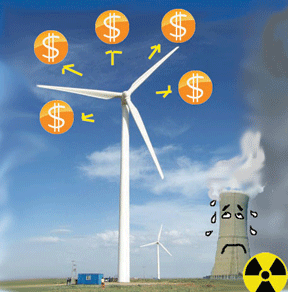 Global wind power capacity tops nuclear energy for first time, Japan Times, 20 Feb 16 The capacity of wind power generation worldwide reached 432.42 gigawatts (GW) at the end of 2015, up 17 percent from a year earlier and surpassing nuclear energy for the first time, according to data released by global industry bodies.
The generation capacity of wind farms newly built in 2015 was a record 63.01 GW, corresponding to about 60 nuclear reactors, according to the Global Wind Energy Council based in Brussels. The global nuclear power generation capacity was 382.55 GW as of Jan. 1, 2016, the London-based World Nuclear Association said…….
Wind power is the leading energy source in the transition from fossil fuels to renewables, the wind energy council said as it released the data last week.
China led all other countries in wind energy generation capacity with 145.10 GW. Beijing is promoting wind power to shift from coal and other fossil fuels to combat air pollution and global warming.
Coming in second behind China is the United States with 74.47 GW, followed by Germany with 44.95 GW, then India with 25.09 GW and then Spain with 23.03 GW. Japan produced 3.04 GW. http://www.japantimes.co.jp/news/2016/02/20/national/global-wind-power-capacity-tops-nuclear-energy-for-first-time/#.VsoiRX197Gh
Busting the obsolete “baseload” myth, and other myths that hold back renewable energy
 nuClear News No 82 Feb 16 Towards 100% Renewables As Shadow Secretary of State for Energy and Climate Change, Lisa Nandy, re-iterates the myth that nuclear power is an “important as part of the energy mix [if] we’re going to meet the commitments we made in Paris” we investigate how the UK could move to a 100% renewable energy system. Although Nandy says she is not happy with the Hinkley deal she says “we know we will need nuclear power as part of the mix”, but is she right? (1)
World’s largest solar plant to be switched on in Morocco
Morocco to switch on first phase of world’s largest solar plant Desert complex will provide electricity for more than 1 million people when complete, helping African country to supply most of its energy from renewables by 2030 Guardian, Arthur Neslen 5 Feb 16 Morocco’s king will switch on the first phase of a concentrated solar power plant on Thursday that will become the world’s largest when completed.
The power station on the edge of the Saharan desert will be the size of the country’s capital city by the time it is finished in 2018, and provide electricity for 1.1 million people.

Noor 1, the first section at the town of Ouarzazate, provides 160 megawatts (MW) of the ultimate 580MW capacity, helping Morocco to save hundreds of thousands of tonnes of carbon emissions per year.
“At around 2pm, the king will press a button, the parabolic mirrors will start turning, the heat will begin to turn the turbines and the plant will come to life,” said Maha el-Kadiri, a spokeswoman for Masen, Morocco’s renewable energy agency……..
After it is switched on, the plant will initially provide 650,000 local people with solar electricity from dawn until three hours after sunset.
“It is a very, very significant project in Africa,” said Mafalda Duarte, the manager of Climate Investment Funds (CIF), which provided $435m (£300m) of the $9bn project’s funding. “Morocco is showing real leadership and bringing the cost of the technology down in the process.”
The north African country plans to generate 42% of its energy from renewables by 2020, with one-third of that total coming from solar, wind and hydropower apiece.
Morocco hopes to use the next UN climate change conference, which it hosts in November, as the springboard for an even more ambitious plan to source 52% of its energy from renewable sources by 2030.
“Between now and [the next conference], many projects will have come to light and we will prove that we can match our energy demands with renewables,” the country’s energy minister, Abdelkader Amara, said at a meeting during the Paris climate summit in December……..
Such a move would have regional implications. CIF estimates that if international banks and governments deployed another 5GW of solar energy, electricity production costs could fall by 14%. Scaling that up to 15GW would cut costs by 44%…….http://www.theguardian.com/environment/2016/feb/04/morocco-to-switch-on-first-phase-of-worlds-largest-solar-plant
France’s plan for 1,000 kilometers of road paved with solar panels

 France to pave 1,000 kilometers of road with solar panels http://inhabitat.com/france-to-pave-1000-kilometers-of-road-with-solar-panels/?newgallery=true by Lucy Wang In a major step forward for green energy, the French government has announced plans to installsolar photovoltaic panels on 1,000 kilometers (621 miles) of road over the next five years. The goal is to supply renewable power to 5 million people—or about 8 percent of the French population. The solar roadways will use Wattway panels, a photovoltaic technology unveiled last October by the major French civil engineering firm Colas. According to Ségolène Royal, France’s minister of ecology and energy, the “Positive Energy” project will be funded by raising taxes on fossil fuels, a decision Royal says is “natural” given the low prices of oil.
Renewabl eenergy is winning the world – University expert
World is embracing clean energy, says expert http://www.sciencedaily.com/releases/2016/02/160201123053.htm Source: University of Exeter
- Summary:
- An expert argues that investment in renewable electricity now outstrips that in fossil fuels, and that increasing numbers of policies to improve the efficiency of energy use and to make energy systems more flexible are pointing to a global momentum in the adoption of sustainable energy systems.
- Renewable, energy efficient and flexible electricity sources are being adopted by policy makers and investors across the globe and this is sign of optimism in the battle against climate change, a University of Exeter energy policy expert is suggesting.
In a journal article published in Nature Energy, Professor Catherine Mitchell from the University’s Energy Policy Group argues that investment in renewable electricity now outstrips that in fossil fuels, and that increasing numbers of policies to improve the efficiency of energy use and to make energy systems more flexible are pointing to a global momentum in the adoption of sustainable energy systems.
“While the world is still dependent on fossil fuels, because energy systems have long lives, it has got to the point where more than half of global electricity system investment is in renewables rather than fossil fuels investment. It is a sign that globally we have moved our public policy discourse and investor preferences from the old ‘dirty’ energy system to a clean one,” she said.
The adoption of renewable electricity by a few countries like Denmark and Germany in the 1990s, has led to improved understanding of energy system operation and a fall in prices which has had a knock on effect. A few countries, like the UK, remain dominated by conventional energy systems but most are supporting the move to sustainable energy systems.
“They are just trying to act as good global neighbours and have realised that meeting their climate change reduction commitments is no longer as expensive as they thought, and it helps, rather than makes worse, the security of their energy systems, ” added Professor Mitchell, who us based at the University’s Penryn Campus in Cornwall.
While the changing discourse is welcome, Professor Mitchell stresses that the challenge of climate change has not yet been met and that policy statements need to be backed up with firm action
-
“The recent United Nations meeting on climate change in Paris and its agreements has led to strong support for individual country’s sustainable energy policies. However, these statements need to be backed up with appropriate governance — policies, institutions, incentives and energy system rules — to make sure they are implemented and are successful.”
Momentum is increasing towards a flexible electricity system based on renewables by Catherine Mitchell is published in Nature Energy.
Story Source:
The above post is reprinted from materials provided by University of Exeter.Note: Materials may be edited for content and length. Journal Reference:
- Catherine Mitchell. Momentum is increasing towards a flexible electricity system based on renewables. Nature Energy, 2016; 1 (2): 15030 DOI: 10.1038/nenergy.2015.30
New research shows USA could economically cut emissions by 80% with wind and solar energy
But that might not be the case anymore. New research suggests it might actually be feasible to use solar and wind power across the United States. In fact, researchers propose a new model that could cut emissions by up to 80 percent by 2030 from 1990 levels, without developing new technologies or raising prices.
How would it work? Power from solar, wind, and other existing technologies would all contribute to a grid across the continental United States to share the burden of power production. That combination would make it economically feasible to cut carbon emissions significantly in the electricity sector, according to a study published Monday in the journalNature.
……The trick, according to this model, is to use multiple power sources together on the national scale.
National Oceanic and Atmospheric Administration, NOAA, scientists built this model based on the weather system. Some regions, like the southwest, might be particularly sunny. Others, like the Dakotas, might have just the right wind conditions.
“If you can trade power over the whole US at the same time, then there’ll always be someplace that’s generating power like crazy,” study co-lead author Alexander MacDonald tells the Monitor. …..
MacDonald adds that it will be up to policymakers and the people. “Our job is to show that there is a system that is possible with existing technology, technology available right now.”
It could all hinge on that political will, Jeff Deyette, assistant director of energy research at the Union of Concerned Scientists, who was not involved in the study, tells the Monitor. He explains that creating a national scale power system would “require a major shift in how we transmit and distribute power across the country.” Currently, the electricity sector is largely controlled by regional transmission organizations. To employ the system proposed by the NOAA researchers, discussion would have to happen on the federal level too. “I think it comes down to the political will to make it happen,” Mr. Deyette says……
With new systems like these, all hope is not lost. “Technological advances can take us a long way toward solving the climate crisis,” Deyette says. This new model “is certainly a very strong positive step in the right direction.”http://www.csmonitor.com/Science/2016/0129/Could-wind-solar-slash-carbon-emissions-affordably
1 This Month



26 September – International Day for the Total Elimination of Nuclear Weapons


PLEASE OPPOSE HR 8255 AND S.3639 – bills would accelerate satellite deployment, with no environmental review or safeguards – https://ncstd5li.quorum.us/campaign/169331/
To see nuclear-related stories in greater depth and intensity – go to https://nuclearinformation.wordpress.com
-
Archives
- September 2026 (257)
- August 2026 (330)
- July 2026 (355)
- June 2026 (287)
- May 2026 (306)
- April 2026 (356)
- March 2026 (251)
- February 2026 (267)
- January 2026 (308)
- December 2025 (358)
- November 2025 (359)
- October 2025 (375)
-
Categories
- 1
- 1 NUCLEAR ISSUES
- business and costs
- climate change
- culture and arts
- ENERGY
- environment
- health
- history
- indigenous issues
- Legal
- marketing of nuclear
- media
- opposition to nuclear
- PERSONAL STORIES
- politics
- politics international
- Religion and ethics
- safety
- secrets,lies and civil liberties
- spinbuster
- technology
- Uranium
- wastes
- weapons and war
- Women
- 2 WORLD
- ACTION
- AFRICA
- Atrocities
- AUSTRALIA
- Christina's notes
- Christina's themes
- culture and arts
- Events
- Fuk 2022
- Fuk 2023
- Fukushima 2017
- Fukushima 2018
- fukushima 2019
- Fukushima 2020
- Fukushima 2021
- general
- global warming
- Humour (God we need it)
- Nuclear
- RARE EARTHS
- Reference
- resources – print
- Resources -audiovicual
- Weekly Newsletter
- World
- World Nuclear
- YouTube
-
RSS
Entries RSS
Comments RSS
 nuclear-news