Electric vehicles not green if they’re fuelled by nuclear power
 Disadvantages lurk in push for nuclear power http://www.thestar.com/autos/2016/03/18/disadvantages-lurk-in-push-for-nuclear-power.html
Electric cars are only as eco-friendly as the fuel powering our electricity grid, By: Peter Gorrie the Star, Mar 18 2016 I’ve recently focused on electric vehicles, especially Ontario’s steps to promote them with more charging stations and bigger incentives. The tone generally has been that the moves are positive, helping to pave the way for greater use of electric vehicles as part of a greener, more sustainable future.
But EVs are only as green as the electricity that powers them. If it comes from coal-burning generating stations, they can be responsible for more toxic and greenhouse-gas emissions than internal combustion engines.With stations fuelled by oil or natural gas, it might be a wash. Things are supposed to improve as you travel along the scale from nuclear power to hydro, and then, in the best case, wind, solar and other renewable sources. Ontario claims to be on the greenest end of the spectrum, since most of our electricity comes from hydro and nuclear generation, and we no longer burn coal.
Not so fast.
A few weeks ago, Premier Kathleen Wynne, in an unsuccessful bid to boost the Liberal candidate in the Whitby-Oshawa byelection, announced a $13 billion refurbishment of the Darlington nuclear generating station.
A similar amount is to be spent on the Bruce Nuclear station near Kincardine on the shores of Lake Huron.
What’s wrong with this?
- Nuclear power is far from pollution-free. It creates toxic greenhouse-gas emissions as uranium is mined, shipped and processed, and the plants are built, operated and dismantled.
- It raises safety issues, particularly from radiation releases. That danger is acknowledged by the Canadian Nuclear Safety Commission, which now requires that potassium iodide pills — to reduce the threat of thyroid cancer after radiation exposure — be distributed to everyone within 10 km of nuclear plants, and available to anyone within 50 km.
- Despite decades of expensive research, there’s still no consensus on how and where to store the most radioactive waste from these facilities.
- The plan to store low- and medium-level waste at the Bruce site is raising concern all around the Great Lakes.
- The $26 billion estimate for the two Ontario refurbishments is a lot of cash. Worse, the actual total will likely be far higher, given the history and apparent inevitability of cost overruns. Construction and refits at Darlington and Bruce have ranged from 50 to 350 per cent over budget. Even taking inflation into account, the overruns are substantial.
All this makes nuclear power dangerous, uncertain and very expensive.
Many reports suggest alternatives — including conservation, hydro, and renewables such as wind, solar and biofuels — could ensure we have the electricity we need, at far less cost and risk. They say EVs, with their ability to store electricity and level fluctuations in supply and demand, could be part of a solution.
It’s at least worth an objective, open look. But pouring so much into nuclear power kills the chance to even consider other options. Sadly, while renewables spark growth and jobs elsewhere, that’s the route we’re on. We need to stop and examine all the choices
Which brings us back to EVs. They can only be considered truly green if they’re fuelled by the greenest-possible power sources, which is what we should demand.
Singapore cutting emissions by tapping the sun
MAR 18, 2016 Singapore plans to curb its greenhouse gas emissions by 2030 and is moving to meet the target by tapping more of the sun’s energy.
Solar power usage here has gone up almost 30-fold since 2009, statistics from the Energy Market Authority (EMA) show.
Total installed solar photovoltaic capacity rose from 1.5MW in 2009 to 43.8MW at the end of last year. “This is the equivalent of powering around 14,000 four-room HDB flats for a year,” an EMA spokesman said. There are now 886 solar installations here, most of which are for non-residential use, for instance, at the Singapore Sports Hub…….http://www.straitstimes.com/singapore/cutting-emissions-by-tapping-the-sun
Renewable energy effective in stalling greenhouse gas emissions – International Energy Agency (IEA)

 Surge in renewable energy stalls world greenhouse gas emissions
Falling coal use in China and the US and a shift towards renewable energy globally saw energy emissions level for the second year running, says IEA, Guardian, John Vidal, 17 Mar 16, Falling coal use in China and the US and a worldwide shift towards renewable energy have kept greenhouse gas emissions level for a second year running, one of the world’s leading energy analysts has said.
Preliminary data for 2015 from the International Energy Agency (IEA) showed that carbon dioxide emissions from the energy sector have levelled off at 32.1bn tonnes even as the global economy grew over 3% .
Electricity generated by renewable sources played a critical role, having accounted for around 90% of new electricity generation in 2015. Wind power produced more than half of all new electricity generation, said the IEA.
The figures are significant because they prove to traditionally sceptical treasuries that it is possible to grow economies without increasing climate emissions.
“The new figures confirm last year’s surprising but welcome news: we now have seen two straight years of greenhouse gas emissions decoupling from economic growth. Coming just a few months after the landmark COP21 agreement in Paris, this is yet another boost to the global fight against climate changem” said IEA director, Fatih Birol.
The two largest emitters, China and the US, both reduced energy-related emmisions in 2015. In China, they declined 1.5%, as coal use dropped for the second year running and in the US they declined 2%, as a large switch from coal to natural gas use in electricity generation took place.
However, these declines were offset by increasing emissions in most other Asian developing economies and the Middle East, said the IEA…….
A seperate report by the European Environment agency (EEA) shows that the EU-wide share of renewable energy has increased from 14.3% in 2012 to 15% in 2013. This allowed the EU to cut its demand for fossil fuels by 110m tonnes of oil equivalent in 2013. This, said the EEA, is the equivalent of a gross reduction of CO2 emissions of 362m tonnes in 2013. http://www.theguardian.com/environment/2016/mar/16/surge-in-renewable-energy-stalls-world-greenhouse-gas-emissions
India’s massive bet on solar power is paying off
India’s big move into solar is already paying off CNN Money by Huizhong Wu @CNNTech March 7, 2016: India’s massive bet on solar power is paying off far earlier than anticipated.
The price of solar power has plummeted in recent months to levels rivaling that of coal, positioning the renewable source as a viable mainstream option in a country where 300 million people live without electricity.
And that could turn out to be a conservative forecast. At a recent government auction, the winning bidder offered to sell electricity generated by a project in sunny Rajasthan for 4.34 rupees (6 cents) per kilowatt hour, roughly the same price as some recent coal projects.
“Solar is very competitive,” said Vinay Rustagi of renewable energy consultancy Bridge to India. “It’s a huge relief for countries like India which want to get more and more solar power.”
Prime Minister Narendra Modi has made access to electricity a top priority, and has set the goal of making 24-hour power available to all 1.3 billion Indians. Currently, even India’s biggest cities suffer from frequent power outages…..http://money.cnn.com/2016/03/07/technology/india-solar-energy-coal/index.html
Climate action a winner for USA with clean energy and transport policies
Clean energy is win-win for the US, Climate News Network, March 13, 2016, by Tim Radford Simply implementing its Paris climate conference commitments on reducing greenhouse gas emissions could save the US billions of dollars – and save hundreds of thousands of lives.
LONDON, 13 March, 2015 − Scientists have worked out how the US could save as many as 300,000 lives by 2030, and get a tenfold return on its investments at the same time.
It’s simple. All the nation has to do is what it promised to do at the Paris climate conference last December − launch clean energy and transport policies, reduce greenhouse gas emissions by two-thirds or more, and pursue the international goal of keeping global warming to below 2°C.
Drew Shindell, professor of climate sciences at Duke University, North Carolina, and colleagues report in Nature Climate Change that the climate policies agreed by 195 nations at the latest UN summit on climate change deliver a winning scenario for the most powerful nation on Earth.
If the US pursued the switch to electric cars and renewable energy, hundreds of thousands of premature deaths could be prevented − not just by containing global warming and limiting the extent of climate change, but by the consequent reduction in soot, aerosols and ozone, all of which are pollutants with consequences for health.
Implementation costs
And although such policies would cost considerable sums to implement, the money saved in the long run would exceed expenditure by between fivefold and tenfold. Even in the short term, benefits of up to $250 billion a year are likely to exceed implementation costs.
“Achieving the benefits, however, would require both larger and broader emissions reductions than those in current legislation or regulations,” the scientists warn………..
The clean energy policies would prevent 175,000 premature deaths by 2030, with 22,000 fewer annually thereafter. Clean transport policies could prevent 120,000 premature deaths by the same year, and about 14,000 annually thereafter.
Calculations like these are based on a wide range of assumptions, and so are the potential rewards. Near-term national benefits could be anything from $140 billion a year to $1,050bn by 2030, but the Duke scientists settle on a likely figure of $250bn. Altogether, by 2030, the US would have saved $1,200bn under their proposals.
But if other countries do the same thing, the benefits would begin to multiply with the decades. Those benefits, the scientists say, would roughly quintuple, and could be 10 times larger than implementation costs.
“The US has pledged to markedly reduce emissions that cause warming, but has left many details to be determined later,” the scientists say − which is why they constructed their own emissions scenarios………
The proposals sound like a win-win offer. But the Duke scientists are aware of the problems. Their suggestions go twice as far as policies yet to be implemented in the US Clean Power Plan, and the costs of implementation would not be fairly spread.
They end on a note of realism: “Most benefits would accrue to society at large, whereas businesses that could face economic losses would not directly benefit from decreased emissions.
“These misaligned economic incentives between the welfare of individual companies and that of society at large create substantial implementation barriers.” − Climate News Network http://climatenewsnetwork.net/clean-energy-is-win-win-for-the-us/
Mark Diesendorf debunks the nuclear “baseload” myth: renewable energy can do it better!
 Dispelling the nuclear ‘baseload’ myth: nothing renewables can’t do better! Ecologist 10th March 2016 The main claim used to justify nuclear is that it’s the only low carbon power source that can supply ‘reliable, baseload electricity’, writes Mark Diesendorf – unlike wind and solar. But not only can renewables supply baseload power, they can do something far more valuable: supply power flexibly according to demand. Now nuclear power really is redundant.
We have all heard the claim. We need nuclear power because, along with big hydropower, it’s the only low carbon generation technology that can supply ‘reliable baseload power’ on a large scale……
Underlying this claim are three key assumptions. First, that baseload power is actually a good and necessary thing. In fact, what it really means is too much power when you don’t want it, and not enough when you do. What we need is flexible power (and flexible demand too) so that supply and demand can be matched instant by instant.
The second assumption is that nuclear power is a reliable baseload supplier. In fact it’s no such thing. All nuclear power stations are subject to tripping out for safety reasons or technical faults. That means that a 3.2GW nuclear power station has to be matched by 3.2GW of expensive ‘spinning reserve’ that can be called in at a moments notice.
The third is that the only way to supply baseload power is from baseload power stations, such as nuclear, coal and gas, designed to run flat-out all the time whether their power is actually needed or not. That’s wrong too.
Practical experience and computer simulations show it can be done………
The assumption that baseload power stations are necessary to provide a reliable supply of grid electricity has been disproven by both practical experience in electricity grids with high contributions from renewable energy, and by hourly computer simulations.
In 2014 the state of South Australia had 39% of annual electricity consumption from renewable energy (33% wind + 6% solar) and, as a result, the state’s base-load coal-fired power stations are being shut down as redundant. For several periods the whole state system has operated reliably on a combination of renewables and gas with only small imports from the neighbouring state of Victoria.
The north German states of Mecklenburg-Vorpommern and Schleswig-Holstein are already operating on 100% net renewable energy, mostly wind. The ‘net’ indicates trading with each other and their neighbours. They do not rely on baseload power stations.
A host of studies agree: baseload power stations are not needed…..
For countries that are completely isolated (e.g. Australia) or almost isolated (e.g. the USA) from their neighbours, hourly computer simulations of the operation of the electricity supply-demand system, based on commercially available renewable energy sources scaled up to 80-100% annual contributions, confirm the practical experience.
In the USA a major computer simulation by a large team of scientists and engineers found that 80-90% renewable electricity is technically feasible and reliable (They didn’t examine 100%.) The 2012 report, Renewable Electricity Futures Study. Vol.1. Technical report TP-6A20-A52409-1 was published by the US National Renewable Energy Laboratory (NREL). The simulation balances supply and demand each hour.
The report finds that “renewable electricity generation from technologies that are commercially available today, in combination with a more flexible electric system, is more than adequate to supply 80% of total U.S. electricity generation in 2050 while meeting electricity demand on an hourly basis in every region of the United States.”
Similar results have been obtained from hourly simulation modeling of the Australian National Electricity Market with 100% renewable energy (published by Ben Elliston, Iain MacGill and I in 2013 and 2014) based on commercially available technologies and real data on electricity demand, wind and solar energy. There are no baseload power stations in the Australian model and only a relatively small amount of storage. Recent simulations, which have yet to be published, span eight years of hourly data.
These, together with studies from Europe, find that baseload power stations are unnecessary to meet standard reliability criteria for the whole supply-demand system, such as loss-of-load probability or annual energy shortfall.
Furthermore, they find that reliability can be maintained even when variable renewable energy sources, wind and solar PV, provide major contributions to annual electricity generation, up to 70% in Australia. How is this possible?
Fluctuations balanced by flexible power stations………
in all the flexible, renewables-based approaches set out above, conventional baseload power stations are unnecessary. In the words of former Australian Greens’ Senator Christine Milne: “We are now in the midst of a fight between the past and the future”.
The refutation of the baseload fairy tale and other myths falsely denigrating renewable energy are a key part of that struggle.
Dr Mark Diesendorf is Associate Professor of Interdisciplinary Environmental Studies at UNSW Australia. Previously, at various times, he was a Principal Research Scientist in CSIRO, Professor of Environmental Science and Founding Director of the Institute for Sustainable Futures at University of Technology Sydney, and Director of Sustainability Centre Pty Ltd.
Books: Sustainable Energy Solutions for Climate Change and Climate Action: A campaign manual for greenhouse solutions. http://www.theecologist.org/News/news_analysis/2987376/dispelling_the_nuclear_baseload_myth_nothing_renewables_cant_do_better.html
The very rapid pace of solar energy growth in USA
The US Solar Market Is Growing Ridiculously Fast http://www.motherjones.com/blue- marble/2016/03/us-solar-market-growing-ridiculously-fast By Tim McDonnell Mar. 9,At the end of 2015, the solar industry experienced something of a Christmas miraclewhen Congress unexpectedly extended a package of vital tax credits for renewable energy that were set to expire. Overnight, 2016 went from looking like it was certain to be a bust to looking like one of the biggest growth years on record.
New analysis from the energy market research firm GTM paints a picture of the awesome year solar installers in the United States have ahead of them. GTM predicts solar installations to jump 119 percent in 2016, adding 16 gigawatts of new solar by year’s end. (For reference, in 2011 there were only 10 gigawatts of solar installed total across the country.) Most of that is utility-scale solar farms, with the remainder coming from rooftop panels on homes and businesses.
This clean energy boost isn’t just a boon for the industry; as a result of the tax credit extension, greenhouse gas savings from solar and wind installations could add up by 2030 to the equivalent of taking every car in the country off the road for two years, a recent study found.
Wind power prices dropping below nuke re-build costs in Ontario.
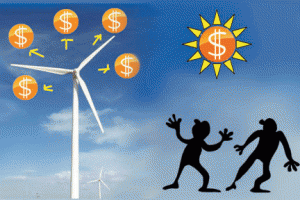 Ontario Clean air Alliance 10 Mar Angela Bischoff, 11 Mar 16 Today Ontario’s Independent Electricity System Operator (IESO) announced that it has signed five contracts with private sector companies for wind power at costs ranging from 6.45 to 10.55 cents per kWh.
According to Ontario Power Generation (OPG), the cost of electricity from a re-built Darlington Nuclear Station will be 7 to 8 cents per kWh. However, every nuclear project in Ontario’s history has gone massively over budget – on average by 2.5 times. If history repeats itself, the cost of electricity from re-built Darlington reactors will be 15 cents per kWh . That would make even solar power acquired through the new Large Renewable Procurement (LRP) process competitive with nuclear.
And, of course, solar and wind companies are on the hook for any cost overruns on their projects, unlike OPG which expects provincial electricity ratepayers and taxpayers to still pick up the tab for its inevitable cost overruns.
Also, renewable energy costs are projected to continue to fall rapidly so by the time the IESO undertakes its next LRP round a year from now, we will likely see even greater savings over costly and slow nuclear re-build projects. In fact, what the current LRP round has told us is that the Ontario government should be steering toward the off ramps for nuclear re-build projects as quickly as possible given the astonishing – and continuing — decline in green energy prices.
If we are smart, we will combine energy efficiency and water power imports from Quebec with made-in-Ontario renewable energy to build a much more cost effective, responsive and responsible electricity system for Ontario.
Britain: Nuclear threat to renewables
 We have previously reported assertions by Dr Dave Toke that spending on Hinkley Point C would obliterate spending on renewables, because of the way the Levy Control Framework is organised. (19) At the moment it looks as though the UK will miss its European target which requires us to produce around 30% of our electricity supplies from renewable resources –about 108TWh in 2020 rising to 141TWh in 2030. The current Government doesn’t appear to have any ambition to go beyond this low level of renewable supply
 nuClear News Mar 16[excellent graphs on original] The Government’s National Policy Statement (NPS) on Energy, published in July 2011, foresaw a need for 113 Gigawatts (GW) of electricity generating capacity in 2025 compared with 85GW now. 59GW of this would be new capacity, of which 33GW would need to be renewable energy, mostly wind, to meet commitments to the European Union. This would leave 26GW for industry to determine. At the time there was 8GW of non-renewable capacity under construction leaving a balance of 18GW still to be determined. The Government said it wanted a substantial portion of this to be nuclear. (1)
Germany 2016: Expanding renewables, stagnating decarbonisation
 nu Clear News, Mar 16 . “……….Despite some short-term market and industry disruptions, the Energiewende policy has been largely successful in achieving its stated goals, and public support remains strong. As reported in a January 2016 by Agora Energiewende, a Berlin-based energy think tank from 2012 to 2015, public sentiment in Germany has been strongly supportive of the Energiewende, with 90% saying it is important or very important.
Solar powered airport for South Africa
Africa gets its first solar-powered airport By Milena Veselinovic, for CNN March 4, 2016 (CNN) South Africa has ramped up its green credentials by unveiling the continent’s first solar-powered airport.
Located halfway between Cape Town and Port Elizabeth, George Airport will meet 41% of its energy demand from a brand new 200 square meter solar power plant built on its grounds.
The facility, which was officially launched last week, has 3,000 photovoltaic modules, and will gradually increase capacity to deliver 750Kw power when it reaches full production…….
The airport serves the Western Cape town of George which lies in the heart of the scenic Garden Route, famous for its lush vegetation and lagoons which are dotted along the landscape.
It handles over 600,000 passengers a year, many of them tourists, but it’s also a national distribution hub for cargo such as flowers, fish, oysters, herbs and ferns.
The clean energy initiative follows in the footsteps of India’s Cochin International airport — the world’s first entirely solar powered airport, and Galapagos Ecological Airport, built in 2012 to run solely on Sun and wind power.
Around 635 million people, or 57% of the population, are estimated to live without power on the continent, with that number climbing to 68% in Sub-Saharan Africa.
Last year, a UK start-up collaborated with Shell to build a solar-powered soccer pitch in the Nigerian city of Lagos, but governments are also increasingly harnessing the Sun’s energy for major infrastructure projects.
Last month, Morocco switched on what will be the world’s largest concentrated solar plant when it’s completed. It is predicted to power one million homes by 2018. In Rwanda, a $23.7 million solar plant has increased the country’s generation capacity by 6% and lighting up 15,000 homes. http://edition.cnn.com/2016/03/04/africa/george-airport-solar-south-africa/index.html?utm_source=twitter&utm_medium=post&utm_term=africa,airport,solar,renewables&utm_campaign=greenpeace&__surl__=IgNX8&__ots__=1457298969501&__step__=
An unforgettable year for solar power in USA
Solar energy is poised for an unforgettable year, WP, By Chris Mooney March 2 New statistics just released by the U.S. Energy Information Administration suggest that in the coming year, the booming solar sector will add more new electricity-generating capacity than any other — including natural gas and wind.
EIA reports that planned installations for 2016 include 9.5 gigawatts of utility-scale solar — followed by 8 gigawatts (or 8 billion watts) of natural gas and 6.8 gigawatts of wind. This suggests solar could truly blow out the competition, because the EIA numbers are only for large or utility-scale solar arrays or farms and do not include fast-growing rooftop solar, which will also surely add several additional gigawatts of capacity in 2016.
In other words, U.S. solar seems poised for not just a record year but perhaps a blowout year. Last year, in contrast, solar set a new record with 7.3 gigawatts of total new photovoltaic capacity across residential, commercial, and utility scale installations.
“If actual additions ultimately reflect these plans, 2016 will be the first year in which utility-scale solar additions exceed additions from any other single energy source,” says EIA……….
“2016 is going to be a huge year, and then we’re going to continue to see big years over the next 5,” he [Nathan Serota, a solar industry analyst with Bloomberg New Energy Finance] said. Granted, solar could still face some headwinds, particularly from the competition offered by extremely low natural gas prices.
In the grand scheme, the tax credits for solar, as well as an extension of the production tax credit for wind, could serve as a kind of “bridge” into an era in which the Obama administration’s Clean Power Plan is operating — or at least, so the current administration hopes. Granted, that depends on whether that plan survives its current legal challenges.
A recent report from the National Renewable Energy Laboratory found that due to the tax credit extensions, the U.S. will add 53 additional gigawatts of renewable energy capacity by the year 2020. https://www.washingtonpost.com/news/energy-environment/wp/2016/03/02/solar-energy-is-poised-for-an-unforgettable-year/
Global Boom in Wind Power, led by China and USA
 China, U.S. Lead Global Boom in Wind Power, Climate Central, By Bobby Magill
March 2nd, 2016 Wind power had a big year worldwide in 2015 as China became the leader in wind power production capacity while the U.S. kept its top spot in electricity actually produced from wind turbines, according to new data released by the Global Wind Energy Council.
Low-carbon energy sources such as wind and solar power are critical to countries seeking to meet climate goals set forth in the Paris climate agreement struck in December. The pact aims to keep global warming to below 2°C (3.6°F)……..
“Wind power is leading the charge in the transition away from fossil fuels,” GWEC Secretary General Steve Sawyer said in a statement.
“The Chinese government’s drive for clean energy, supported by continuous policy improvement, is motivated by the need to reduce dependence on coal, which is the main source of the choking smog strangling China’s major cities, as well as growing concern over climate change,” the statement said.
No other country came close to China’s level of wind development growth last year. But while China is seeing the biggest wind turbine building boom, the U.S. is better at actually producing electricity from its turbines, generating more wind power than any other country last year.
The U.S. generated 190 million megawatt-hours of wind power in 2015, powering about 17.5 million homes. China clocked in at 185.1 megawatt hours, followed by Germany at 84.6, according to American Wind Energy Association data released Monday……
AWEA chief Tom Kiernan said the U.S. is on its way to generating 20 percent of its electricity from wind power by 2030. http://www.climatecentral.org/news/china-us-lead-global-wind-power-boom-20089
Cornwall, UK, gets wind farm without any govt funding- community energy!
 “The benefits of the Big Field wind farm are too great for it not to go ahead just because subsidies are being withdrawn. Being community-owned will ensure that the economic benefit of the wind farm can be retained locally and re-invested in Cornwall.”
Good Energy promises UK’s first subsidy-free windfarm, http://www.theguardian.com/environment/2016/mar/02/good-energy-promises-uks-first-subsidy-free-windfarm Guardian, Fiona Harvey, 3 Mar 16
Green power company believes it can build onshore windfarm in Cornwall with local people helping finance it, despite government scrapping subsidies. The UK’s first onshore windfarm to be built without government subsidy is now under planning in Cornwall, to be financed in part by the local community.
The Big Field windfarm, near Bude, will consist of 11 turbines, none of more than 125m in height to the tip of the blade, and provide electricity for 22,000 homes. Its backers hope it will point the way to further such projects, after the damages to the onshore wind industry caused by the reversal of policy on government support for clean energy.
Likely to cost about £30m to build and install, Big Field is planned by the green power company Good Energy. While other wind and solar farms have been cancelled or left in limbo by the government’s scrapping of incentives for onshore wind, the company decided instead to try to raise funds locally to support the installation.
An initial application for planning permission for the turbines was filed under the previous subsidy regime. However, that was blocked, and with the withdrawal of government support for onshore wind, the plan looked at an end.
Good Energy revived its prospects with a new project that would use the same number of turbines, of the same size, but with 50% more generation capability, because of changes to the turbine technology.
The revised scheme will only go ahead if planning permission is granted, but the company is hopeful that the support of local residents in agreeing to co-finance the project will help to tip the balance. The inquiry will start in April and, if the green light is given, the windfarm could be operational in 2018.
Bill Andrews, who lives close to the site, said: “This is a very welcome development. A lot of my neighbours already support this wind farm, and giving local people the chance to invest in the project would mean the community will see even more of the benefit.”
The abrupt alterations to government support for wind and solar energy have caused severe disruption in the UK’s renewable energy industries. Thousands of jobs have been lost, companies forced to close, projects mothballed or abandoned, and future developments left in doubt.
Onshore wind technology has tumbled in price in recent years, a factor the government used to justify its withdrawal of support, but the economics of energy generation are complex. Ministers have also introduced new rules to make it more difficult to construct renewable energy projects, and increased subsidies to the fossil fuel industries through the “capacity market”.
Juliet Davenport, chief executive of Good Energy, said: “The benefits of the Big Field wind farm are too great for it not to go ahead just because subsidies are being withdrawn. Being community-owned will ensure that the economic benefit of the wind farm can be retained locally and re-invested in Cornwall.”
Good Energy said it was too early to decide how much of its own money and how much the local community would be expected to put into the project, or what returns investors could expect. However, if successful, it hopes this could provide a new blueprint for small onshore wind farms.
Solar power powers up; London – with World’s biggest floating solar farm
World’s biggest floating solar farm powers up outside London Five years in planning and due to be finished in early March, more than 23,000 solar panels will be floated on the Queen Elizabeth II reservoir near Heathrow and used to generate power for local water treatment plants, Guardian, Fiona Harvey 29 Feb 16 On a vast manmade lake on the outskirts of London, work is nearing completion on what will soon be Europe’s largest floating solar power farm – and will briefly be the world’s biggest.

But few are likely to see the 23,000 solar panels on the Queen Elizabeth II reservoir at Walton-on-Thames, which is invisible to all but Heathrow passengers and a few flats in neighbouring estates.
“This will be the biggest floating solar farm in the world for a time – others are under construction,” said Angus Berry, energy manager for Thames Water, which owns the site. “We are leading the way, but we hope that others will follow, in the UK and abroad.”
Five years in planning and due to be finished in early March, the £6m project will generate enough electricity to power the utility’s local water treatment plants for decades. The energy will help provide clean drinking water to a populace of close to 10 million people in greater London and the south-east of England, a huge and often unrecognised drain on electricity, rather than nearby homes.
Why put solar panels on water? The answer, according to Berry, is that the water is there, and might as well be used for this purpose. Floating panels, covering only about 6% of the reservoir, will have no impact on the ecosystem, he says……..
A similar floating solar farm with around half the capacity of the Thames Water project is being built by water company United Utilities on a reservoir near Manchester. Construction of an even bigger farm – at 13.7MW more than twice the QEII farm – is underway on a reservoir in land-scarce Japanand due to finish in 2018.
Putting solar panels on the water for the QEII scheme has not required planning permission, though big arrays of similar panels on land require official sanction. The government has decided to ban farmers who put solar arrays on agricultural land from receiving EU subsidies for the land.
More than 23,000 solar panels will be floated by developer Lightsource Renewable Energy at the reservoir near Walton-on-Thames, representing 6.3MW of capacity, or enough to generate the equivalent electricity consumption of about 1,800 homes………http://www.theguardian.com/environment/2016/feb/29/worlds-biggest-floating-solar-farm-power-up-outside-london
1 This Month

of the week – Shut Down Drone Warfare!


Tell the Ukrainian Government to Drop Prosecution of Peace Activist Yurii Sheliazhenko

Petition to revoke the licensing of the Near Surface Nuclear Disposal Facility (NSDF) at Chalk River. https://www.ourcommons.ca/petitions/en/Petition/Details?Petition=e-7247
To see nuclear-related stories in greater depth and intensity – go to https://nuclearinformation.wordpress.com
-
Archives
- April 2026 (103)
- March 2026 (251)
- February 2026 (268)
- January 2026 (308)
- December 2025 (358)
- November 2025 (359)
- October 2025 (376)
- September 2025 (257)
- August 2025 (319)
- July 2025 (230)
- June 2025 (348)
- May 2025 (261)
-
Categories
- 1
- 1 NUCLEAR ISSUES
- business and costs
- climate change
- culture and arts
- ENERGY
- environment
- health
- history
- indigenous issues
- Legal
- marketing of nuclear
- media
- opposition to nuclear
- PERSONAL STORIES
- politics
- politics international
- Religion and ethics
- safety
- secrets,lies and civil liberties
- spinbuster
- technology
- Uranium
- wastes
- weapons and war
- Women
- 2 WORLD
- ACTION
- AFRICA
- Atrocities
- AUSTRALIA
- Christina's notes
- Christina's themes
- culture and arts
- Events
- Fuk 2022
- Fuk 2023
- Fukushima 2017
- Fukushima 2018
- fukushima 2019
- Fukushima 2020
- Fukushima 2021
- general
- global warming
- Humour (God we need it)
- Nuclear
- RARE EARTHS
- Reference
- resources – print
- Resources -audiovicual
- Weekly Newsletter
- World
- World Nuclear
- YouTube
-
RSS
Entries RSS
Comments RSS
 nuclear-news