Solar leading the charge in Mexico’s clean energy push BN Americas By Adam Critchley – Tuesday, December 27, 2016 Mexico’s installed solar capacity is expected to increase 20-fold by 2019 to 5.4GW, the energy ministry (Sener) said.
Key growth drivers are two supply auctions held in March and September, which will result in 1,691MW and 1,853MW being added, respectively.
Solar dominated the September auction, accounting for 54% of electric power sold and 53% of clean energy certificates (CEC) issued. It was followed by wind with 43% of power and 41% of CECs. Hydroelectric and geothermal accounted for 3% of power and 2% of CECs, respectively.
Mexico’s solar PV capacity is expected to grow 275% this year, or by 390MW, US consultancy GTM Research has said.
Mexico’s installed clean energy capacity grew 6.3% year-on-year in June to 20.2GW, and these types of sources now account for 28.4% of the country’s energy generation mix, Sener said.
Growth has so far been led by wind and co-generation. Wind power capacity is expected to triple over the coming years, largely due to the development of the projects awarded contracts in this year’s auctions. Wind power capacity is expected to total 2,456MW by the end of 2018 and 3,857MW by the end of 2019.
No wonder that the nuclear lobby is in a panic to spread its spin all over the world. Their lies, about curing climate change with Small Nuclear and Big Nuclear, remain lies, no matter how fervently the nuclear industry and its media acolytes repeat them.
The nuclear panic is on, because genuinely clean energy, (and energy conservation), are developing so fast, ever cheaper and more efficient, that it’s becoming evident that New Nuclear doesn’t stand a chance.
Renewable energy is inexorably becoming cheaper, even without subsidies. Wind energy is the cheapest form of new electricity generation available today. Solar power is on the way to beating even wind. Compared to nuclear, both forms are fast to set up, and provide many more and cleaner, jobs.
The media usually ignore decentralised renewable energy. Yet small solar and wind systems are already becoming the dominant form of new energy production. (It’s quite laughable to see the Small Modular Nuclear Reactor (SMR) lobby pushing their propaganda all over, while literally millions of solar rooftop panels go up every day. )
This month, this website will bring a focus onto the fast-growing renewable energy movement.
In 2017 the nuclear lobby lies should not prevail.
In a world where a jury acquitted O J Simpson of a double murder, and a nation elected Donald Trump for President, it is more important than ever, for lies and dishonest spin top be exposed.
Dec 10th 2016 THAT solar panels do not emit greenhouse gases such as carbon dioxide when they are generating electricity is without question. This is why they are beloved of many who worry about the climate-altering potential of such gases. Sceptics, though, observe that a lot of energy is needed to make a solar panel in the first place. In particular, melting and purifying the silicon that these panels employ to capture and transduce sunlight needs a lot of heat. Silicon’s melting point, 1,414°C, is only 124°C less than that of iron.
Silicon is melted in electric furnaces and, at the moment, most electricity is produced by burning fossil fuels. That does emit carbon dioxide. So, when a new solar panel is put to work it starts with a “carbon debt” that, from a greenhouse-gas-saving point of view, has to be paid back before that panel becomes part of the solution, rather than part of the problem. Observing this, some sceptics have gone so far as to suggest that if the motive for installing solar panels is environmental (which is often, though not always, the case), they are pretty-much useless.
Wilfried van Sark, of Utrecht University in the Netherlands, and his colleagues have therefore tried to put some numbers into the argument. As they report in Nature Communications, they have calculated the energy required to make all of the solar panels installed around the world between 1975 and 2015, and the carbon-dioxide emissions associated with producing that energy. They also looked at the energy these panels have produced since their installation and the corresponding amount of carbon dioxide they have prevented from being spewed into the atmosphere. Others have done life-cycle assessments for solar power in the past. None, though, has accounted for the fact that the process of making the panels has become more efficient over the course of time. Dr Van Sark’s study factors this in.
Panel games To estimate the number of solar panels installed around the world, Dr Van Sark and his team used data from the International Energy Agency, an autonomous intergovernmental body. They gleaned information on the amount of energy required to make panels from dozens of published studies. Exactly how much carbon dioxide was emitted during the manufacture of a panel will depend on where it was made, as well as when. How much emitted gas it has saved will depend on where it is installed. A panel made in China, for example, costs nearly double the greenhouse-gas emissions of one made in Europe. That is because China relies more on fossil fuels for generating power. Conversely, the environmental benefits of installing solar panels will be greater in China than in Europe, as the clean power they produce replaces electricity that would otherwise be generated largely by burning coal or gas.
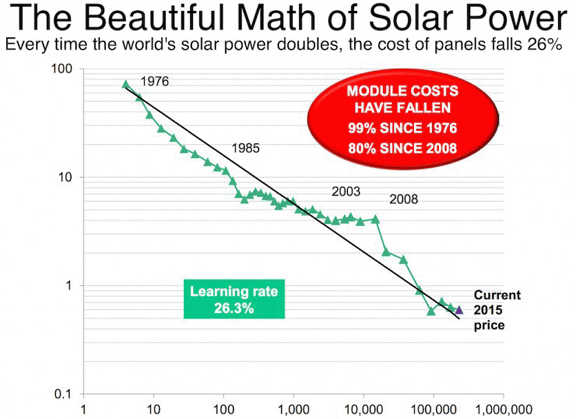
Once the team accounted for all this, they found that solar panels made today are responsible, on average, for around 20 grams of carbon dioxide per kilowatt-hour of energy they produce over their lifetime (estimated as 30 years, regardless of when a panel was manufactured). That is down from 400-500 grams in 1975. Likewise, the amount of time needed for a solar panel to produce as much energy as was involved in its creation has fallen from about 20 years to two years or less. As more panels are made, the manufacturing process becomes more efficient. The team found that for every doubling of the world’s solar capacity, the energy required to make a panel fell by around 12% and associated carbon-dioxide emissions by 17-24%.
The consequence of all this number-crunching is not as clear-cut as environmentalists might hope. Depending on the numbers fed into the model, global break-even could have come as early as 1997, or might still not have arrived. But if it has not, then under even the most pessimistic assumptions possible it will do so in 2018. After that, solar energy’s environmental credentials really will be spotless.
World Energy Hits a Turning Point: Solar That’s Cheaper Than Wind Emerging markets are leapfrogging the developed world thanks to cheap panels. by Tom Randall December 15, 2016,
A transformation is happening in global energy markets that’s worth noting as 2016 comes to an end: Solar power, for the first time, is becoming the cheapest form of new electricity.
This has happened in isolated projects in the past: an especially competitive auction in the Middle East, for example, resulting in record-cheap solar costs. But now unsubsidized solar is beginning to outcompete coal and natural gas on a larger scale, and notably, new solar projects in emerging markets are costing less to build than wind projects, according to fresh data from Bloomberg New Energy Finance.
The chart below [on original] shows the average cost of new wind and solar from 58 emerging-market economies, including China, India, and Brazil. While solar was bound to fall below wind eventually, given its steeper price declines, few predicted it would happen this soon.
“Solar investment has gone from nothing—literally nothing—like five years ago to quite a lot,” said Ethan Zindler, head of U.S. policy analysis at BNEF. “A huge part of this story is China, which has been rapidly deploying solar” and helping other countries finance their own projects.
Half the Price of Coal
This year has seen a remarkable run for solar power. Auctions, where private companies compete for massive contracts to provide electricity, established record after record for cheap solar power. It started with a contract in January to produce electricity for $64 per megawatt-hour in India; then a deal in August pegging $29.10 per megawatt hour in Chile. That’s record-cheap electricity—roughly half the price of competing coal power.
“Renewables are robustly entering the era of undercutting” fossil fuel prices, BNEF chairman Michael Liebreich said in a note to clients this week.
Storage – the missing link NuClear News No 91, Jan 2017 Bloomberg New Energy Finance (BNEF) predicts a six-fold increase in investment in energy storage to $8.2bn (£6.7bn) by 2024, and to $250bn (£197bn) by 2040. This massive growth in energy storage will create a “fundamentally different” global power system. This energy storage ‘megashift’ is already beginning to gather pace. The battery market has seen breath-taking levels of growth from utilities over the past 12 months, while non-utilities are increasingly realising that lithium-ion or flow storage systems can act as the perfect accompaniment to onsite renewable energy installation. (11)
Paul Massara, former CEO of RWE nPower, is now CEO of North Star Solar, a new solar PV + battery home energy system start-up. He says that lithium ion batteries for electrical storage are getting cheaper and cheaper, and PV + battery packages are now cost effective in the UK with the right financing package. Cheap, ubiquitous electrical energy storage will lead to a very different world and may change the focus of many of today’s energy policy debates. It is likely to help reduce peak demand, and allow renewables to provide a much higher percentage of electricity demand, especially if they are cheaper than alternative forms of low carbon electricity such as nuclear or fossil fuel with carbon capture and storage. (12)
North Star Solar has set up a joint scheme with the former colliery town of Stanley in Co Durham to offer in-home batteries and solar panels for free to all the town’s 35,000 households. Paul Massara says the combination of rooftop panels, a lithium battery and energy-efficient LED light bulbs will immediately cut power bills by 20%. (13)
The £19m ‘Big Battery’ installed at a sub-station in Leighton Buzzard, Bedfordshire has completed a two-year trial and successfully shown that power storage has the potential to be both technically and commercially viable. (14)
Camden Council has teamed up with Islington and Waltham Forest Councils to deliver a pilot programme to test the potential benefits of solar panels and energy storage systems for residents at risk of fuel poverty. The ’24/7 Solar’ initiative is being part-funded by national fuel poverty charity National Energy Action. The aim of the trial is to see if there is evidence that integrated solar and storage technologies can effectively reduce the energy bills of fuel poor households. (15) Meanwhile in Edinburgh and surrounding towns several housing associations have been working with Sunamp to install solar PV and heat storage ‘batteries’. Surplus solar generated electricity can be diverted to the heat battery and used for hot water or central heating when required later. (16) And in Orkney where renewable energy generators are often curtailed due to the constraints on the distribution of electricity around the Orkney grid, yet fuel poverty levels are at 63%, a new project, launched by Heat Smart Orkney Ltd, is aiming to divert unused renewable energy into affordable heat. (17) The Scottish Government has given a new 400-MW pumped-storage hydro power plant in Dumfriesshire permission to go ahead. (18)
Solar power is expected to be the cheapest form of energy (not just electricity) everywhere in the world by around 2030. Cheap solar panels and advances in storage technology are transforming the world. By 2030 or 2040 solar will be the cheapest way to generate electricity, indeed any form of energy EVERYWHERE. The proportion of global electricity provided by solar is likely to grow from 2% now to at least 50% by 2030. We can see the cost of batteries coming down in price dramatically, but turning surplus solar electricity generating during the summer into something we can put into natural gas networks will probably come soon. Generating hydrogen from water and, using microbes, combining it with carbon dioxide to form methane is the simplest way to do this. (19)
Even offshore wind costs are falling. Swedish utility Vattenfall has agreed to build a giant offshore wind farm in Denmark that would sell power for €49.50 per MWh. Vattenfall has broken its own previous record of €60 per MWh. Once the cost of transmission is included this works out at around £75.50/MWh compared with £100.50/MWh for Hinkley Point C (once inflation has been added to the £92.50 at 2012 prices). (20) http://www.no2nuclearpower.org.uk/nuclearnews/NuClearNewsNo91.pdf
Wind farms play key role in cutting carbon emissions, study finds https://www.eurekalert.org/pub_releases/2016-12/uoe-wf120916.phpUNIVERSITY OF EDINBURGH: WIND FARMS HAVE MADE A SIGNIFICANT IMPACT IN LIMITING CARBON EMISSIONS FROM OTHER SOURCES OF POWER GENERATION IN GREAT BRITAIN, A STUDY SHOWS.
Power from wind farms prevented the creation of almost 36 million tonnes of greenhouse gas emissions from sources such as coal and gas, in a six-year period – the equivalent of taking 2.3 million cars off the road, analysis of nationwide output shows.
The figures from 2008-2014, analysed in the most accurate study of its kind to date, suggest that a greater investment in wind energy could help meet Scottish and UK government targets for carbon emissions reduction.
Engineers from the University of Edinburgh analysed National Grid figures for the power generated by various sources including wind, coal and gas. Their data detailed generator energy output figures for every half hour, creating a comprehensive picture of how demand over time was met by power from the various sources.
Their study improves on previous estimates because it uses real, rather than estimated, energy output figures and takes into account the inefficiency of individual conventional generators, researchers say. The calculations are complex because energy demand is met from a mix of sources at any one time, and when output from wind turbines increases, a number of different conventional sources may need to decrease their outputs.
The study demonstrates that government estimates for carbon savings underestimated the benefits from wind farms. Over the six year period, 3.4 million more tonnes of greenhouse gases were saved than thought – the equivalent of taking an extra 220,000 cars off the road.
Engineers say their methodology could be applied to give accurate estimates of possible future emissions savings for energy developers, planners and policymakers. They suggest wind power generation could play an increasingly important role in the future energy mix, which could also include carbon capture and storage, marine and nuclear power.
The study, published in Energy Policy, was supported by the Engineering and Physical Sciences Research Council.
Dr Camilla Thomson, from the University of Edinburgh’s School of Engineering, who led the study, said: “Until now, the impact of clean energy from wind farms was unclear. Our findings show that wind plays an effective role in curbing emissions that would otherwise be generated from conventional sources, and it has a key role to play in helping to meet Britain’s need for power in future.”
State power utility Eskom is dragging its feet on honoring government-brokered deals with private renewables companies. Its refusal to purchase 250 megawatts of power from wind and solar projects has left its Irish and Saudi Arabian suppliers fuming and in limbo. More than scuppering the deals, Eskom’s actions, critically, threaten to undermine the gains made by the country’s green energy program, which many have come to hail as the shining beacon of a renewables-based future . On the Fieldstone Africa Renewable Index or FARI, South Africa’s ranking has plummeted off the charts entirely, prompting concerns amongst investors over green energy’s future in the country. Its decline is ironic given the rainbow nation had topped the continent-wide list just four months ago.
India has just built the world’s largest solar plant in record time The nation’s push for solar power is gaining steam. Scroll In Ananya Bhattacharya, qz.com At the end of November, the country turned on the world’s largest solar power plant spanning 10 km sq in Kamuthi in the state of Tamil Nadu. It packs 648 megawatts of power – nearly 100 more than California’s Topaz Solar Farm, which was previously the largest solar plant at a single location. At full capacity, the Kamuthi plant can provide enough electricity to power around 150,000 homes.
Ta’u island in American Samoa will rely on solar panels and Tesla batteries as it does away with diesel generators, Guardian Eleanor Ainge Roy, 28 Nov 16, A remote tropical island has catapulted itself headlong into the future by ditching diesel and powering all homes and businesses with the scorching South Pacificsun.
NucClear News No 90 , 26 Nov 16 A new report from a think-tank called E3G, which aims to accelerate the transition to a lowcarbon economy, says the Government needs to deliver new low carbon generation capacity as cheaply as possible. The UK will need new capacity capable of producing around 150TWh (terawatt hours = 1,000 million kWh) per year of electricity by 2030 – around half of all current output. All plausible scenarios imply that this can only be achieved by deploying a significantly increased volume of renewable generation – likely to be around 50GW, predominantly from a combination of onshore and offshore wind and solar PV.
The E3G report says there is an increasing body of evidence that the system integration costs of renewable generation are low and that the power system can operate securely and at least cost with more than 50% of electricity demand being met from variable renewable sources. System integration costs are predicted to remain less than £10/MWh which means that not only is it possible to securely operate the power system with high levels of renewable generation, but it also represents the cheapest option. E3G shows that under the current trajectory onshore wind will be at least 22% cheaper than nuclear with offshore wind and solar PV providing savings in excess of 4% and 8% respectively, and savings will probably be even greater as the flexibility of the electricity system improves.
The important conclusion from this E3G study is that the cheapest way to decarbonise the power system involves large volumes of variable renewable generation even when taking system integration costs into account. (1)
Renewable costs keep falling
In fact researchers at Citi, a global investment bank, think that paying for energy could soon become a thing of the past. Cheaper storage and smart data analytics may soon make solar and wind energy available to consumers in some parts of the world – completely for free. (2)
Even the government now expects solar and wind power to be cheaper than new nuclear power by the time Hinkley Point C is completed. And Business Secretary, Greg Clark, has admitted that fears that intermittent renewables would jeopardise Britain’s ability to keep the lights on have been overblown. (3) An unpublished report by the energy department shows that it expects onshore wind power and large-scale solar to cost around £50-75 per megawatt hour (MWh) of power generated in 2025. New nuclear is anticipated to be around £85-125/MWh, in line with the guaranteed price of £92.50/MWh that the government has offered Hinkley’s developer, EDF. On previous forecasts, made in 2010 and 2013, the two renewable technologies were expected to be more expensive than nuclear or around the same cost. This is the first time the government has shown it expects them to be a cheaper option. The figures were revealed in a National Audit Office (NAO) report on nuclear in July. “The [energy] department’s forecasts for the levelised cost of electricity of wind and solar in 2025 have decreased since 2010. The cost forecast for gas has not changed, while for nuclear it has increased,” the NAO said. (4)
Onshore Wind Costs
In Europe onshore wind has become one of the most competitive sources of new electricity. Mott MacDonald estimated in 2011 that costs would fall to around £52-55/MWh by 2040 compared with £83-90/MWh in 2011. (5) But according to Bloomberg New Energy Finance (BNEF) new onshore windfarms were the cheapest way for a power company to produce electricity in Britain by 2015 with costs dropping to £55/MWh. (6) The trade body, Scottish Renewables, has shown that costs could be cut by a further 20% if government, industry and regulators work together to make sure we can use the latest generation of turbines on suitable sites, reduce grid charges, and deploy energy storage technologies. (7)
Solar Power
Sustainability expert, Chris Goodall, author of new book called “The Switch” (8), says cheap solar panels and advances in storage technology are about to transform the world. By 2030 or 2040 solar will be the cheapest way to generate electricity, indeed any form of energy EVERYWHERE. At the rate of growth that we are seeing at the moment of 35-45% per year solar will grow from providing 2% of global electricity to at least 50% by 2030. We can see the cost of batteries coming down in price dramatically. Turning surplus solar electricity generating during the summer into something we can put into natural gas networks is what we should be looking at in the UK. Generating hydrogen from water and, using microbes, combining it with carbon dioxide to form methane is the simplest way to do this. The era of fossil fuels is drawing to a close. (9)
Offshore wind
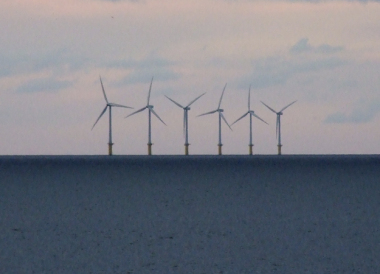
Earlier this year DONG Energy of Denmark, the world’s largest offshore wind company, won a bid to build two wind farms 22 kilometres off the Dutch coast. The company says power will be produced for less than any other offshore scheme to date. It is estimated that when the scheme is fully operational, electricity will cost €72.70 per megawatt hour (MWh) and €87 MWh when transmission costs are included. (10)
At the time this was described as the cheapest offshore wind electricity in the world: “beyond even the most optimistic expectations in the market.” (11) Since then Swedish utility Vattenfall has agreed to build a giant offshore wind farm in Denmark that would sell power for €49.50 per MWh. Vattenfall has broken its own previous record of €60 per MWh.
Greenpeace has produced the chart below [on original] to show the cost of offshore wind power compared with the cost of Hinkley Point C. The UK’s cheapest offshore windfarm will produce power at roughly £120 per MWh, which is far more than the projects being built in Denmark and the Netherlands. Part of the reason for that is that those governments cover transmission costs, so in the name of fairness Greenpeace adds £25 per MWh. And then to address offshore wind’s intermittency, you’ve got to add another £7.6 per MWh — according to the UK government’s top climate advisers to cover the cost of the ‘balancing’the system. (12)
So we can see that the latest Vattenfall bid is coming in at £75.50/MWh compared with £100.50/MWh for Hinkley Point C. (The £92.50/MWh strike price agreed for Hinkley Point C was index-linked at 2012 prices so £8/MWh has been added to allow for inflation.)
Energy Efficiency
Research out by sustainability expert, Chris Goodall, shows a business and government drive to promote switching of homes, street lights and offices to energy efficient LED light bulbs would see a huge reduction in the UK’s electricity demand for lighting – more than two Hinkley nuclear plants’ worth of electricity. Lighting is responsible for nearly a third (29%) of total winter peak electricity demand – a complete switch would halve that. Switching entirely to LEDs in homes will save about 2.7 GW of peak winter demand; street lighting 0.5 GW; offices and commercial buildings 4.5 GW.
An expenditure of about £62 in an average house, replacing about 21 of the bulbs in living areas would cut electricity bills by at least £24 per year. This could be done relatively quickly and the total cost of partially upgrading all UK homes to energy-efficient LED lights would be around £1.7 billion. The price of LED light bulbs is falling over time and they cost just £1.60 each at major retailers. Aside from saving money for the householder directly, the government would conservatively save £65 million per year on capacity market payments from this action in houses and more elsewhere in street lighting and commercial sector. (13)
There are good reasons for using investment in energy efficiency as a vehicle to stimulate the economy – the macroeconomic benefits of public energy efficiency programmes have been illustrated by economists time and time again. For instance Verco and Cambridge Econometrics estimate that if delivered as part of a major infrastructure investment programme for £1 invested by government £3.20 is returned through increased GDP resulting in increased employment of up to 108,000 net jobs per annum. A recent study by Frontier Economics calculates that an energy efficiency infrastructure programme could generate £8.7 billion of netbenefits to the economy.
We know from the German KfW loan scheme that public subsidies for energy efficiency are more than offset by the increase in tax revenues and savings in welfare spending due to lower unemployment. Now is the time to do this in the UK, according to Jan Resnow at the Science Policy Research Unit at Sussex University. The economic uncertainty caused by the Brexit vote will prevail for some time until Britain’s new status becomes clearer. At the same time, there will be no energy efficiency programme for the able-to-pay sector after 2017 and funds for fuel poverty alleviation are falling short of what is required to achieve the target. The economic evidence is clear – energy efficiency provides a golden opportunity for an economic stimulus in the UK. (14) http://www.no2nuclearpower.org.uk/nuclearnews/NuClearNewsNo90.pdf
Solar energy is currently marginal in the Nordic nation, accounting for less than 0.1 percent of electricity production. Sweden relies mostly on hydropower (39 percent) and nuclear power (36 percent). The finance ministry said in a statement that the production of solar electricity for own use would be entirely exempt from taxes. Electricity providers would meanwhile only be taxed 500 kronor (51 euros) per megawatt hour, which is a 98-percent reduction from the current level.
“This makes fast investments possible,” Social Democratic Finance Minister Magdalena Andersson said.
The proposal is likely to be adopted by parliament, with the centre-right opposition having criticised the minister for her lack of ambition with regards renewable energy investments.
The move must also be approved by the European Commission in Brussels, which aims to boost the EU’s share of renewable energy to at least 20 percent of consumption.
In October, the Swedish energy market regulator had estimated that in order to reach the target of 100 percent renewable energy, the share of solar electricity would have to rise to between five and 10 percent.
Unit of Colas SA designed solar panels that embed into roads
Work progressing on larger test site in northern France
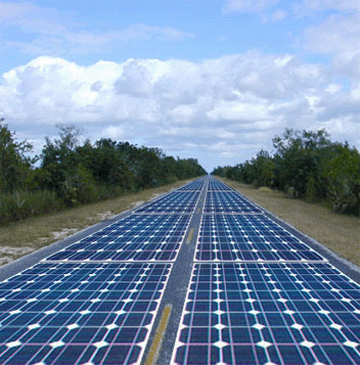
Electric avenues that can transmit the sun’s energy onto power grids may be coming to a city near you.A subsidiary of Bouygues SA has designed rugged solar panels, capable of withstand the weight of an 18-wheeler truck, that they’re now building into road surfaces. After nearly five years of research and laboratory tests, they’re constructing 100 outdoor test sites and plan to commercialize the technology in early 2018.“We wanted to find a second life for a road,” said Philippe Harelle, the chief technology officer at Colas SA’s Wattway unit, owned by the French engineering group Bouygues. “Solar farms use land that could otherwise be for agriculture, while the roads are free.”
As solar costs plummet, panels are being increasingly integrated into everyday materials. Last month Tesla Motors Inc. surprised investors by unveiling roof shingles that double as solar panels. Other companies are integrating photovoltaics into building facades. Wattway joins groups including Sweden’s Scania and Solar Roadways in the U.S. seeking to integrate panels onto pavement.
To resist the weight of traffic, Wattway layers several types of plastics to create a clear and durable casing. The solar panel underneath is an ordinary model, similar to panels on rooftops. The electrical wiring is embedded in the road and the contraption is topped by an anti-slip surface made from crushed glass.
A kilometer-sized testing site began construction last month in the French village of Tourouvre in Normandy. The 2,800 square meters of solar panels are expected to generate 280 kilowatts at peak, with the installation generating enough to power all the public lighting in a town of 5,000 for a year, according to the company.
For now, the cost of the materials makes only demonstration projects sensible. A square meter of the solar road currently costs 2,000 ($2,126) and 2,500 euros. That includes monitoring, data collection and installation costs. Wattway says it can make the price competitive with traditional solar farms by 2020.
The electricity generated by this stretch of solar road will feed directly into the grid. Another test site is being used to charge electric vehicles. A third will power a small hydrogen production plant. Wattway has also installed its panels to light electronic billboards and is working on links to street lights.The next two sites will be in Calgary in Canada and in the U.S. state of Georgia. Wattway also plans to build them in Africa, Japan and throughout the European Union.“We need to test for all kinds of different traffic and climate conditions,” Harelle said. “I want to find the limits of it. We think that maybe it will not be able to withstand a snow plow.”The potential fragility joins cost as a potential hurdle.“We’re seeing solar get integrated in a number of things, from windows in buildings to rooftops of cars, made possible by the falling cost of panels,” Bloomberg New Energy Finance analyst Pietro Radoia said. “On roads, I don’t think that it will really take off unless there’s a shortage of land sometime in the future.”’
Unlike many other developing countries, around 99% of all Chinese households already have access to the grid.
Solar PV can help China’s poorest, China Dialogue Suzanne Fisher Murray 23.11.2016 中文版本In Anhui villages are hooking up to the grid to generate income and power, writes Suzanne Fisher-Murray The residents of Yuexi county, a mountainous area in eastern China, must have thought it was their lucky day when they heard they had been selected for China’s new solar poverty alleviation project.
The 382,000 residents are some of the poorest in the country, living below the poverty line of 2,300 yuan (about US$1 per day). This was the key criteria for their selection in the project, which is part of China’s 13th Five-Year-Plan, the roadmap for the nation’s development from 2016 to 2020.
The project is being piloted in Yuexi county, Anhui province before being rolled out across the country. Villagers identified as living below the poverty line will have rooftop solar panels rated at 3-5 kilowatts installed on their roofs and become shareholders in village solar power stations with a generating capacity of around 60-100 kilowatts. The aim is for the solar panels to earn each family 3,000 yuan (around US$430) in extra income each year. Local farmers could also earn additional income by leasing out non-arable lands or maintaining the solar farms.
So far, 182 villages (with 30,000 residents) in the county have been identified as eligible for the project. Construction has begun at a staggering pace: 57 solar parks were built in 2015, with the remaining 125 expected to be finished this year.
Unlike many other developing countries, around 99% of all Chinese households already have access to the grid.
Each household will use the solar electricity generated for their own purposes. This will reduce energy bills and any surplus electricity will be sold back to the grid. Families will also have shared ownership of the solar parks, splitting 40% of the profits between them, with the remaining 60% going to pay back loans and park construction fees. This means that once the solar panels are installed, households and villagers could begin to see the benefits quickly.“It will take more time before we know the impact of the project,” warned Yixiong Kang from China Carbon Futures Asset Management Company, which is overseeing the financial and technical aspects of the project.
“But it could have a huge impact. We are talking about the poorest families. They basically have nothing in their houses that use electricity [because they can’t afford to pay the bills].” The extra income they’ll earn could change that. “If you want to change the living standards of people, sometimes it’s not enough to just give them electricity. Electricity – that’s just a power supply. They need greater help,” he added.
Aside from the direct profits, the villagers would also likely benefit from subsidies paid to solar generation projects in China. The rates are set to go down in 2017 due to a solar power generation surplus, but, if paid, will also help increase the villagers’ profits. The village level solar stations will also be part of a Chinese emissions trading programme which is currently being established. The village solar stations that have certified emissions reductions certificates could trade 1000 kWh of their clean energy to replace one tonne of carbon dioxide emissions on the carbon trading scheme.
Thanks to plummeting unit costs, solar energy will be a crucial source of power for many countries working to meet their climate objectives by 2030.
Projects like Morocco’s Noor-Ouarzazate solar power plant, a $625 million solar rooftop project in India and a recent record solar auction in Zambia underscore how solar is being embraced rapidly as the energy of the future.
Multilateral development banks like the World Bank Group (WBG) can help client countries develop their solar resources, make projects less risky, provide access to low-cost capital for power plants and improve transmission and distribution infrastructure.
Washington, Nov. 10, 2016 – Once a distant possibility, solar power is a game changer for developing countries that are swiftly embracing this clean, renewable source of energy to close their electricity access gaps and meet climate change mitigation goals.
Just the past year is a clear sign of that shift.
For the first time, renewable sources of energy have overtaken coal in terms of cumulative installed power capacity in the world. In 2015, an all-time record 153 gigawatts (GW) of capacity was added through renewables, with photovoltaic solar – which includes mini-grids and rooftop solar systems – accounting for nearly a third (49 GW) of the addition, according to the International Energy Agency. In other words, about half a million solar panels were installed every day around the world last year.
That number is growing. In fact, global electricity capacity from renewable sources of energy is projected to increase by 42 percent, or 825 GW, by 2021, with solar power expected to play a major role in reaching that goal.
Morocco, where climate experts and policymakers from around the world are gathered this week for COP22, is a prime example of this transformation. Earlier this year, the Moroccan king inaugurated the first facility of the largest concentrated solar power (CSP) complex in the world with support from the World Bank, the Climate Investment Funds (CIF) and other partners. Once it is fully operational, the plant will produce enough energy for more than one million Moroccan households.
The North African country is not alone in the shift to solar, which is helping developing countries reduce their reliance on conventional fuels like coal and oil, and boost the share of renewables in their energy mix.
Take the International Solar Alliance, for example. In June, the WBG signed an agreement with the alliance, consisting of 121 countries led by India to collaborate on increasing solar energy use around the world and helping the alliance mobilize $1 trillion in solar investments by 2030.
Seeing the potential of solar in India, the World Bank also pledged $1 billion in planned initiatives to help the South Asian country take sustainable, clean, climate-friendly electricity to millions of its people. This includes a $625 million projectapproved in June to install solar panels on rooftops around the country, supported by a $125 million co-financing loan from the CIF.
In neighboring Bangladesh, 18 million people now have access to electricity thanks to solar home systems that were installed as part of a World Bank project. In the country’s remote islands like Monpura, where extending the electricity grid would be impossible, standalone solar mini-grids are powering up entire communities and businesses, like that of welder Abdulrahim Hawlader.
Previously dependent on a diesel generator, Hawlader says solar power has transformed his business and boosted his income.
“We just turn on the switch and it (machinery) works,” he said. “Because of lower costs, we are making more profits.”
In Bolivia, families that live in remote areas without access to the power grid are turning to solar home systems to meet their electricity needs.
The expansion of off-grid lighting products and services have provided more than 26 million people access to modern energy services through the WBG’s Lighting Global, Lighting Africa, Lighting Asia and Lighting Pacific programs.
And in some countries where private investors hesitate to enter because of perceived risks, the WBG’s Scaling Solar program facilitates competitive auctions and offers standardized documents, financial guarantees and pre-approved financing to alleviate investors’ concerns and make these markets more attractive.
A recent auction in Zambia organized by Scaling Solar set record low prices of 6 cents a kilowatt hour for solar power generation, the lowest to date in Africa and among the lowest recorded globally. It paves the way to take electricity to thousands of Zambians in desperate need.
The applications of solar technology seem boundless. A solar plane recently made history after making a trip around the world entirely on solar power, without using any aviation fuel. An airport in Cochin, India became the world’s first of its kind to be powered fully by solar energy, followed by another in South Africa. Worldwide, companies are producing slick, new designs for solar roofs, windows and even floating solar panels to harness the sun’s power.
A confluence of favorable market forces, including cheaper-than-ever prices and technology, have encouraged the take-up of solar by private investors and countries alike. Solar PV costs have dropped nearly 60 percent since 2010 and are as low as 6 to 8 cents per kilowatt hour today, according to IRENA. They are projected to fall a further 60 percent in the next decade.
Under the WBG’s Climate Change Action Plan, $25 billion in private financing will be mobilized for clean energy in developing countries over the next five years, with another 30 gigawatts of renewable energy added either through direct investment or investments in enabling infrastructure by 2020.
Projects are already under consideration in many countries with WBG support focused on access to the right combination of financing, and technical and advisory expertise to help them succeed with their solar objectives and break down existing barriers.
These barriers include the lack of adequate transmission and distribution infrastructure, absence of affordable and effective storage solutions, weak enabling environments (including a lack of solar-friendly policies and regulation) and high upfront capital costs. A universal uptake of solar power is also nearly impossible without private investment in the sector.
The WBG is working to increase private interest in markets where investors may have otherwise hesitated to enter on their own, with a suite of financial guarantees and instruments and help on technical, policy and regulatory aspects – all designed to strengthen confidence and draw investment in solar technology well into the future.
The Obama administration has announced a broad range of global clean energy initiatives and investments, including financing in India and El Salvador, off-grid grants in Africa and a new report on the market for access to efficient appliances.
The slate of announcements includes committing $125 million in financing for renewable energy projects through the Overseas Private Investment Corporation.
The funding is a small drop compared to the $11 billion the United States has invested from 2010-2015 alone in international clean energy finance, according to the Department of Energy.
Dive Insight:
While President-elect Trump’s looming presidency has worried many over the future of the clean energy technology, the Obama administration is not slowing down on global decarbonization goals.
The White House continues its progressive moves on energy efficiency, global clean energy and decarbonization, last week issuing a lengthy overview of new initiatives. Among them:
A partnership between the U.S. Agency for International Development (USAID), the Department of State and the Department of Energy’s National Renewable Energy Laboratory to identify “a pipeline of clean energy entrepreneurs in developing countries.”
Providing $4 million in awards to eight household solar firms under the Power Africa Scaling Off Grid Grand Challenge, totaling a $36 million investment to empower entrepreneurs and investors in sub-Saharan Africa.
Announcing more than $11 million raised for the deployment of efficient off-grid technologies globally through the Efficiency for Access Coalition;
Launching a partnership to bring more efficient appliances tor rural Indian villages; and
And supporting the first Solar Decathlon competition in Africa.
The USAID-State partnership with the National Laboratories aims to expand the geographic reach of the next annual Industry Growth Forum in April 2017. “This is one of the nation’s premier clean energy investment event to connect early stage companies with capital,” the White House said.So far, companies participating in the NREL Growth Forum have raised over $5 billion in financing.
Last week, the White House also released a report detailing the status of global markets for off-grid energy and the U.S. government’s role in developing those markets. In the past decade, the market has “grown exponentially” to give millions access to basic energy services.
According to the report, worldwide there are over 20 million households powered by solar home systems, and another 6 million are connected to renewables-based mini-grids or small wind turbines.








 U.S. Department of Energy




 nuclear-news