WHY SOLAR WILL BE BUILT INTO OUR FUTURE CITIES http://circulatenews.org/2017/01/solar-will-built-future-cities/ SEB EGERTON-READ · JANUARY 19, 2017


Solar power and other renewable energy sources are increasingly affordable as technologies continues to become more efficient and effective, and the opportunities to scale solutions brings costs down even further. As much as the transition from a fossil-fuel based economy to one powered by renewables is becoming more widely recognised, what is sometimes lost is just how rapid the change has been. Furthermore, it appears the next natural step is a renewable energy source inspired transformation of the way in which we design our future buildings and cities.
During the last six years in the US alone, “solar power has exploded into the energy sector with the kind of industrial vigour not seen since the 1950s”, wrote David Beckham in GreenBiz earlier this month. In 2010, the US had the equivalent of one gigawatt of solar generation capabilities, for perspective on what that means in terms of power demands, Disney Land uses roughly that amount every two weeks – it’s also less than the Doc needed to get the DeLorean running again in Back to the Future! Capacity has ballooned to 30 gigawatts of solar power generation at the beginning of 2016 and is continuing to grow at a rapid pace, mostly thanks to the lowering of costs with the average solar cell now costings $0.35 per watt, compared with around $4 in 2016, all while increasing efficiency by 20%.
Throw in increased volatility in fossil fuel prices – especially oil – and diminishing efficiency gains for non-renewable based technologies, and it should come as no surprise that there is increasing investment and innovation into solar power, not to mention demand, where more panels were installed in the US during 2016 than the previous 38 years combined. Furthermore, digital advances are enabling better understanding and control of complexity and data, a huge advantage for less consistent natural sources of power like solar and wind.
The flexibility of renewables enables designers and architects to adopt a new way of thinking and there are now a growing number of examples where the potential opportunities of integrating energy production into the design of buildings and cities from the outset are being exploited.
Joining up built environment construction and design with renewable energy to create a more diverse, distributed and resilient system of power production integrated directly into cities offers the possibility of producing a holistic solution to individual challenges, the AMIE prototype, produced by Oak Ridge National Laboratory (ORNL), which integrates solar panels, into a connected home and electric vehicle is one great recent example.
Photovoltaic technologies designed for integration into building components produced by corporates like Californian-based Solaria, who have developed especially effective solar tech so that they can produce glass that can be used in typical window openings, is fully see through and generates electricity, are predicted to become increasingly common. Indeed, the level of development and scale of Solaria itself may surprise some.
“Architectural solar” is still in relative infancy, but if anything can be learned by the growth of solar power generation, which few would have expected to be economically viable by 2016 looking at the 2010 landscape, it is that technology with potential can and will be developed exceptionally quickly in a context where there is demand for the solutions it provides. The ORNL experiment and current solutions sold by Solaria may only be a beginning, but anticipating rapid evolution looks like a good bet.
January 21, 2017
Posted by Christina Macpherson |
2 WORLD, renewable |
Leave a comment
Liebreich and McCrone: The shift to ‘base-cost’ renewables: 10 predictions for 2017 By Michael Liebreich and Angus McCrone on 20 January 2017 “………… The good news is that renewable energy has – at least on a levelized cost of electricity, or LCOE, basis – clearly achieved the long-awaited goal of grid competitiveness. More than that, in many countries it now undercuts every other source of new generating capacity, sometimes by very considerable margins.
Last year saw unsubsidized price records of $30 per megawatt-hour for a wind farm in Morocco and $29.10 for a solar plant in Chile. These must be the lowest electricity prices, for any new project, of any technology, anywhere in the world, ever. And we are still going to see further falls in equipment prices.
Super-low-cost renewable power – what we are now calling “base-cost renewables” – is going to force a revolution in the way power grids are designed, and the way they are regulated…….
Putting super-cheap, “base-cost” renewable power at the heart of the world’s grids in this way will require a revolution in the way the electricity system is regulated. Renewable power’s progress to date has been achieved mainly by subsidizing or mandating its installation, while forcing the rest of the system to provide flexibility, within otherwise unchanged regulatory environments and power market rules. The additional system costs have been material but generally affordable.
That has taken renewable energy to 20, 30 or 40 percent of supply in many markets. ……..
………1. GLOBAL INVESTMENT TO STRUGGLE…….
2. GROWTH SPURT FOR BATTERIES, SMART METERS………
3. SOLAR INSTALLATIONS FALL IN CHINA BUT RISE WORLDWIDE…….
4. WIND BLOWS SIDEWAYS……
5. COAL AND OIL RALLIES PETER OUT……..
6. U.S. GAS PRICES REMAIN FIRM…..
7. EVS BREAK THE MILLION VEHICLE MILESTONE……
8. CORPORATE RENEWABLE ENERGY ON A TEAR….
9. RESILIENCE AND SECURITY RECEIVE OVERDUE ATTENTION…..
10. THE CLIMATE DEBATE HEATS UP – AGAIN……. https://about.bnef.com/blog/liebreich-shift-base-cost-renewables-10-predictions-2017/
January 21, 2017
Posted by Christina Macpherson |
2 WORLD, renewable |
Leave a comment
6.4 million Americans now work in the traditional energy and the energy efficiency sector, which added more than 300,000 net new jobs in 2016, or 14 percent of the nation’s job growth.
“This report verifies the dynamic role that our energy technologies and infrastructure play in a 21st century economy,” said DOE Senior Advisor on Industrial and Economic Policy David Foster. “Whether producing natural gas or solar power at increasingly lower prices or reducing our consumption of energy through smart grids and fuel efficient vehicles, energy innovation is proving itself as the important driver of economic growth in America, producing 14 percent of the new jobs in 2016.”
The solar industry is particularly shining bright.
“Proportionally, solar employment accounts for the largest share of workers in the Electric Power Generation sector,” the report, released on Jan. 13, states. “This is largely due to the construction related to the significant buildout of new solar generation capacity.” Overall, the U.S. solar workforce increased 25 percent in 2016.
According to the report, solar—both photovoltaic and concentrated—employed almost 374,000 workers in 2016, or 43 percent of the Electric Power Generation workforce. This is followed by fossil fuels, which accounts for 22 percent of total Electric Power Generation employment, or 187,117 workers across coal, oil and natural gas generation technologies.
Wind generation is seeing growth in employment with a 32 percent increase since 2015. The wind industry provides the third largest share of Electric Power Generation employment with 102,000 workers at wind firms across the nation.
The reason behind this growth in the solar sector is due to the high capacity additions in both distributed and utility-scale photovoltaic solar, the report said. In fact, construction and installation projects represented the largest share of solar jobs, with almost four in ten workers doing this kind of work, followed by workers in solar wholesale trade, manufacturing and professional services.
In a sign of promise for the booming industry, solar employers reported that they expect to increase employment by 7 percent this year.
Solar is becoming the cheapest form of electricity production in the world, according to statistics from Bloomberg New Energy Finance. Last year was the first time that the renewable energy technology out-performed fossil fuels on a large scale.
January 20, 2017
Posted by Christina Macpherson |
employment, renewable, USA |
Leave a comment
Saudi Arabia to focus on solar, wind in $US50bn clean energy plan REneweconomy By Ilias Tsagas on 18 January 2017 PV Magazine Speaking yesterday at an Abu Dhabi’s Sustainability Week (ADSW) event, Saudi Arabia’s energy, industry and mineral resources minister Khalid Al-Falih announced a new grand energy plan for the country. The new program is set to commence in a few weeks’ time, when Saudi Arabia’s government will launch the first round of bidding for a new renewable energy tender, energy minister Al-Falih announced at the World Future Energy Summit 2017 (WFES) in Abu Dhabi.
The energy minister did not, however, provide any details regarding the capacity that will be auctioned in the tender.
He did inform the attendants that Saudi Arabia’s new master program for the energy sector will require between USD 30 to 50 billion investment, which will need to come via the private sector.
Solar and wind power will be the preferred technologies in the auctions, but geothermal and waste projects will also be considered, just with a smaller role to play.
Saudi Arabia, OPEC’s biggest oil producer, is aiming for renewable energy installations, primarily of solar and wind, of 9.5 GW by 2023, but this is just the starting point, the country’s energy minister told the ADSW.
By 2030, the country will generate 70 percent of its electricity from natural gas and 30 percent from renewables and other sources, promised Al-Falih.
“Other resources” include nuclear power plants, of which plans for two nuclear reactors totaling 2.8 GW are currently in the early stages of consideration and planning…….. http://reneweconomy.com.au/saudi-arabia-to-focus-on-solar-wind-in-us50bn-clean-energy-plan-35690/
January 20, 2017
Posted by Christina Macpherson |
renewable, Saudi Arabia |
Leave a comment
Tesla building world’s largest rooftop solar farm on $5B NV gigafactory http://www.constructiondive.com/news/tesla-building-worlds-largest-rooftop-solar- farm-on-5b-nv-gigafactory/434022/ Kim Slowey@kimslowey
Dive Brief:
Dive Insight:
Another energy-saving strategy at the gigafactory, according to 2015 statements from JB Straubel, Tesla’s chief technical officer, was to eschew natural gas pipelines in the structure’s design so that there could be no future possible concessions regarding the company’s no-emissions policy.
Construction on the Nevada gigafactory — expected to be fully functional in 2018 — is progressing, and battery production is already underway. It is widely believed that the solar panels Tesla will use to build its rooftop solar farm will come from SolarCity, which Tesla purchased last year. Soon after the acquisition, Tesla CEO Elon Musk announced that SolarCity would begin to market a relatively low-cost solar roof shingle that mimicked the look of high-end slate and terra cotta roofs, removing the aesthetic barrier of traditional, industrial-looking solar shingles and panels.
Tesla’s solar ambitions, however, extend far beyond the U.S. and solar rooftops. In November, TechCrunch reported that Tesla and SolarCity were behind a solar microgrid project — funded by the Environmental Protection Agency, the Department of the Interior and the American Samoa Economic Development Authority — that aims to eliminate the island’s reliance on costly diesel generators by providing 72 hours of full power from a solar array that recharges with seven hours of sunlight.
January 16, 2017
Posted by Christina Macpherson |
renewable, USA |
Leave a comment
King CONG vs. Solartopia, The Progressive December 5, 2016, Harvey Wasserman “………Some 10,000 arrests of citizens engaged in civil disobedience have put the Diablo nuclear reactors at ground zero in the worldwide No Nukes campaign. But the epic battle goes far beyond atomic power. It is a monumental showdown over who will own our global energy supply, and how this will impact the future of our planet.
On one side is King CONG (Coal, Oil, Nukes, and Gas), the corporate megalith that’s unbalancing our weather and dominating our governments in the name of centralized, for-profit control of our economic future. On the other is a nonviolent grassroots campaign determined to reshape our power supply to operate in harmony with nature, to serve the communities and individuals who consume and increasingly produce that energy, and to build the foundation of a sustainable eco-democracy…….
with this dangerous and dirty power have come Earth-friendly alternatives, ignited in part by the grassroots movements of the 1960s. E.F. Schumacher’s Small Is Beautiful became the bible of a back-to-the-land movement that took a new generation of veteran activists into the countryside.
Dozens of nonviolent confrontations erupted, with thousands of arrests. In June 1978, nine months before the partial meltdown at Three Mile Island, the grassroots Clamshell Alliance drew 20,000 participants to a rally at New Hampshire’s Seabrook site. And Amory Lovins’s pathbreaking article, “Energy Strategy: The Road Not Taken,” posited a whole new energy future, grounded in photovoltaic and wind technologies, along with breakthroughs in conservation and efficiency, and a paradigm of decentralized, community-owned power.
As rising concerns about global warming forced a hard look at fossil fuels, the fading nuclear power industry suddenly had a new selling point. Climate expert James Hansen, former Environmental Protection Agency chief Christine Todd Whitman, and Whole Earth Catalog founder Stewart Brand began advocating atomic energy as an answer to CO2 emissions. The corporate media began breathlessly reporting a “nuclear renaissance” allegedly led by hordes of environmentalists.
But the launch of Peaceful Atom 2.0 has fallen flat.
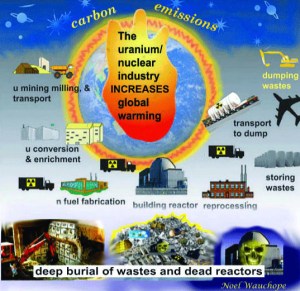 As I recently detailed in an online article for The Progressive, atomic energy adds to rather than reduces global warming. All reactors emit Carbon-14. The fuel they burn demands substantial CO2 emissions in the mining, milling, and enrichment processes. Nuclear engineer Arnie Gundersen has compiled a wide range of studies concluding new reactor construction would significantly worsen the climate crisis.
Moreover, attempts to recycle spent reactor fuel or weapons material have failed, as have attempts to establish a workable nuclear-waste management protocol. For decades, reactor proponents have argued that the barriers to radioactive waste storage are political rather than technical. But after six decades, no country has unveiled a proven long-term storage strategy for high-level waste.
For all the millions spent on it, the nuclear renaissance has failed to yield a single new reactor order. New projects in France, Finland, South Carolina, and Georgia are costing billions extra, with opening dates years behind schedule. Five projects pushed by the Washington Public Power System caused the biggest municipal bankruptcy in U.S. history. No major long-standing green groups have joined the tiny crew of self-proclaimed “pro-nuke environmentalists.” Wall Street is backing away.
Even the split atom’s most ardent advocates are hard-pressed to argue any new reactors will be built in the United States, or more than a scattered few anywhere else but China, where the debate still rages and the outcome is uncertain……..
Where once it demanded deregulation and a competitive market, the nuclear industry now wants re-regulation and guaranteed profits no matter how badly it performs.
The grassroots pushback has been fierce. Proposed bailouts have been defeated in Illinois and are under attack in New York and Ohio. A groundbreaking agreement involving green and union groups has set deadlines for shutting the Diablo reactors, with local activists demanding a quicker timetable. Increasingly worried about meltdowns and explosions, grassroots campaigns to close old reactors are ramping up throughout the United States and Europe. Citizen action in Japan has prevented the reopening of nearly all nuclear plants since Fukushima.
Envisioning the “nuclear interruption” behind us, visionaries like Lovins see a decentralized “Solartopian” system with supply owned and operated at the grassroots………

[In Germany] the transition is succeeding faster and more profitably than its staunchest supporters imagined. Wind and solar have blasted ahead. Green energy prices have dropped and Germans are enthusiastically lining up to put power plants on their rooftops. Sales of solar panels have skyrocketed, with an ever-growing percentage of supply coming from stand-alone buildings and community projects. The grid has been flooded with cheap, green juice, crowding out the existing nukes and fossil burners, cutting the legs out from under the old system.
In many ways it’s the investor-owner utilities’ worst nightmare,………
The revolution has spread to the transportation sector, where electric cars are now plugging into outlets powered by solar panels on homes, offices, commercial buildings, and factories. Like nuclear power, the gas-driven automobile may be on its way to extinction.
Nationwide, more than 200,000 Americans now work in the solar industry, including more than 75,000 in California alone. By contrast, only about 100,000 people work in the U.S. nuclear industry. Some 88,000 Americans now work in the wind industry, compared to about 83,000 in coal mines, with that number also dropping steadily.
Once the shining hope of the corporate power industry, atomic energy’s demise represents more than just the failure of a technology. It’s the prime indicator of an epic shift away from corporate control of a grid-based energy supply, toward a green power web owned and operated by the public.
As homeowners, building managers, factories, and communities develop an ever-firmer grip on a grassroots homegrown power supply, the arc of our 128-year energy war leans toward Solartopia.
Harvey Wasserman’s Solartopia! Our Green-Powered Earth is at solartopia.org. His Green Power & Wellness Show is at prn.fm. He edits nukefree.org. http://www.progressive.org/news/2016/12/189107/king-cong-vs-solartopia
January 14, 2017
Posted by Christina Macpherson |
opposition to nuclear, renewable, USA |
Leave a comment
 Wyoming bill would bar utilities from using wind or solar energy http://www.digitaljournal.com/news/environment/wyoming-bill-would-bar-utilities-from-using-wind-or-solar-energy/article/483604 Wyoming bill would bar utilities from using wind or solar energy http://www.digitaljournal.com/news/environment/wyoming-bill-would-bar-utilities-from-using-wind-or-solar-energy/article/483604
While it may be hard to believe, nine lawmakers in Wyoming have introduced a bill that would forbid utilities from providing any electricity to the state that comes from large-scale wind or solar energy projects by 2019.
SENATE FILE NO. SF0071 details the Electricity Production Standard for the state of Wyoming, and it’s a real doozy. It is being sponsored by two state senators and seven state representatives, all Republicans, of course.
Inside Climate News is calling the bill an attack on clean energy in Wyoming, and possibly the nation. And what’s really absurd is that it is coming at a time when the cost of using clean energy sources has plummeted across the country, as we seek to remedy the impacts of climate change.
There are only six permissible resources allowed for the generation of electricity in the state, coal, natural gas, hydroelectric, something called a “net metering” system, nuclear power and oil. Wind and solar are not included with the exception that they are for individual use only, reports the Star Tribune.
Utility companies are mandated to use the approved sources to meet 95 percent of the state’s electricity needs by 2018 and 100 percent of the state’s power needs by 2019. Bottom line — using power from utility-scale wind, solar and other renewable projects would be outlawed under this legislation. Now utility companies can sell electricity generated by wind or solar power outside the state without paying a penalty. But they will be charged a fine of $10.00 per kilowatt hour if they give any electricity to state residents.
Wyoming’s dependence on coal
You could believe it when I say many of the lawmakers backing the bill are from top coal-producing counties in the state. Coal production has been the backbone of Wyoming’s economy since the 1970s and has provided the most stable source of tax revenues for the state over the past four decades.
And the proposed legislation is a last ditch effort to save a coal industry that has already been crippled because of plummeting oil, gas and coal prices over the past few years. This is one reason it was so important that Donald Trump win the election in November. With Trump, there was a very good chance that regulations would be rolled back, energizing the coal industry in the state.
Trump’s energy platform is primarily about deregulation, including a promise to kill the Clean Power Plan, which is under consideration by the courts. Under the plan, coal production in Western states would fall by 155 million tons between 2015 and 2040. And two-thirds of that coal comes from the Powder River Basin in northern Wyoming and Montana, according to a story in the Star Tribune in October 2016.
|
|
|
|
January 14, 2017
Posted by Christina Macpherson |
politics, renewable, USA |
Leave a comment
 “Our analysis suggests that solar could now infringe on gas’ market share and in some cases challenge its peak margins, and that gas and renewables collectively will continue to gain market share at the expense of coal and nuclear,”
Levelized cost of energy survey shows wind, natural gas cementing economic edge SNL, 06 January 2017 By Lucas Bifera
A survey of levelized cost of energy, or LCOE, studies illustrates that onshore wind and combined-cycle gas have secured their place as the lowest-cost energy resources, with utility-scale solar not far behind.
Often used as a barometer for estimating the cost at which certain generation technologies can be deployed on an economic basis, LCOE has become a mainstay for policymakers, analysts and industry groups as a reference when comparing costs and benefits of various technologies on the grid.
Incumbent technologies like combined-cycle gas, onshore wind, utility-scale solar photovoltaic, nuclear and coal are uniformly included in studies…….the emergence of a cluster around onshore wind and combined-cycle gas across the different studies indicates an economic consensus, one that highlights the cost effectiveness of renewables on an unsubsidized basis and role of combined-cycle gas as the preeminent baseload resource.
“The demands of a developed economy will continue to require both traditional and alternative energy sources as the technologies driving renewable energy evolve,” observed George Bilicic, vice chairman and global head of power, energy & infrastructure group at Lazard, an investment bank that releases a widely-cited LCOE study each year.
But on an unsubsidized basis, renewables remain competitive across all studies, and in the case of the Bloomberg New Energy Finance analysis, wind resources in Texas have become the cheapest source of power across North and South America, consistent with Lazard’s finding that wind has a low end range of $32/MWh in the Midwest and $36/MWh in Texas.
“Wind capital costs will go up because they are building higher towers, but LCOE values will fall because they have better capacity factors,” said Josh Rhodes, postdoctoral fellow at the Webber Energy Group and co-author of a study from The University of Texas at Austin’s Energy Institute.
“I think we will see a major deployment of solar and wind to come online by [the end of] 2019 in order to take advantage of the full ITC and PTC,” Rhodes noted, looking outward.
Onshore wind and utility-scale solar additions appear poised to outstrip additions of natural-gas fired ……… the Energy Information Administration’s recent 2017 Annual Energy Outlook, which projects that between 2018 and 2022, as much as 54.2 GW of wind could come online, in addition to 13.4 GW of solar photovoltaic capacity.
Combined, that projected capacity is more than 40 times the amount of projected advanced natural gas-fired capacity projected in the same study, which EIA estimates at 1.6 GW.
“Our analysis suggests that solar could now infringe on gas’ market share and in some cases challenge its peak margins, and that gas and renewables collectively will continue to gain market share at the expense of coal and nuclear,” Guggenheim added. http://www.snl.com/web/client?auth=inherit&mkt_tok=eyJpIjoiWlRsaU0yUXhZMkV3TnpjNCIsInQiOiJGZnRMT045UWllTkRYNzZsSDE1YWFJMXE0M0lQU2F1QnN6Z25jM2hoZlFpNDhwNFFSRzIyTnI1cDdyUW14c2hKXC9keStFV2JvenljcVVFT2Ztc3gxck12WElPXC9WMGVlQWNMbjNJcklpalltM01OTUN2ckRsQktyWlFLTFRcL0VrVyJ9#news/ar
January 14, 2017
Posted by Christina Macpherson |
business and costs, renewable, USA |
Leave a comment
 How Did 2016 Fare For U.S. Energy Employment?
According to the DOE’s second annual report tracking these employment trends, 6.4 million Americans now work in the “traditional energy and energy efficiency industries,” which added over 300,000 net new jobs in 2016 – representing 14% of the nation’s job growth. The report describes “traditional energy” jobs as those in “electric power generation and fuels” and “transmission, distribution and storage,” both of which include include “fossil, nuclear, and renewable energy sources and their value chains,” the report explains. In addition, “energy efficiency” jobs are described as those covering the “production of energy-saving products and the provision of services that reduce end-use energy consumption.” The report notes that energy efficiency jobs increased by 133,000 jobs for a total of 2.2 million.
The agency says its “2017 U.S. Energy and Employment Report (USEER)” uses information from surveys to over 30,000 employees in energy sectors and tracks “dramatic growth” in several key sectors of the U.S. economy in 2016. The report also uses secondary data from the U.S. Department of Labor.
For wind power specifically, the industry employs a total of 101,738 workers, which represents a 32% increase since 2015, the report says. The largest share of wind employment lies in construction, which accounts for 37% of the workforce. Manufacturing and wholesale trade follow at 29% and 14%, respectively.
“Wind means opportunity and job security for over 100,000 Americans,” comments Tom Kiernan, CEO of the American Wind Energy Association. “The Department of Energy’s new jobs data underscore the incredible impact of wind power in creating American jobs. Wind workers directly contribute to our nation’s energy independence and economic success story. We’re especially proud of helping America’s veterans find well paying jobs after their service – employing them at a rate that is 50 percent higher than the national average.”
For solar, the report says U.S. Department of Labor data does not adequately capture the true employment numbers: The data “dramatically underestimates” how many workers are employed in the solar sector, which, the DOE report says, includes 373,807 Americans who “spend some portion of their time working to install, distribute or provide professional services to solar technologies.” Like wind, construction/installation represents the biggest employment share, followed by “wholesale trade, manufacturing and professional services.”
“This report verifies the dynamic role that our energy technologies and infrastructure play in a 21st-century economy,” says David Foster, the DOE’s senior advisor on industrial and economic policy. “Whether producing natural gas or solar power at increasingly lower prices or reducing our consumption of energy through smart grids and fuel-efficient vehicles, energy innovation is proving itself as the important driver of economic growth in America, producing 14 percent of the new jobs in 2016.”
USEER examines four sectors of the economy – electric power generation and fuels; transmission, wholesale distribution and storage; energy efficiency; and motor vehicles – which cumulatively account for almost all of the U.S.’ energy production and distribution system and roughly 70% of U.S. energy consumption, according to the DOE.
By looking at such a wide portion of the energy economy, the agency says, USEER can provide the public and policymakers with a clearer picture of how changes in energy technology, systems and usage are affecting the economy and creating or displacing jobs……… The full report can be found here. http://nawindpower.com/how-did-2016-fare-for-u-s-energy-employment
January 14, 2017
Posted by Christina Macpherson |
employment, renewable, USA |
Leave a comment
 New York Bets On Renewables To Replace Indian Point Nuclear Plant https://cleantechnica.com/2017/01/13/new-york-bets-renewables-replace-indian-point-nuclear-plant/ January 13th, 2017 Originally published on Think Progress. By Jeremy Deaton
New York governor Andrew Cuomo announced plans this week to close the Indian Point nuclear power plant, which supplies electricity to New York City and surrounding areas. The plant’s two working reactors — which account for roughly 10 percent of the state’s power generation — are slated to go offline in 2020 and 2021, more than a decade ahead of schedule.
Nuclear power plants represent a range of risks, from hazardous radioactive waste to a full-scale meltdown. They also supply the bulk of America’s zero-carbon electricity. In laying out its carbon-cutting goals, the Environmental Protection Agency assumed that existing nuclear power plants would continue to hum and buzz for decades to come. But cheap natural gas is digging into the profits of America’s aging nuclear power plants, pressuring them to close ahead of schedule.
Some states, like Illinois, have thrown a lifeline to nuclear, subsidizing struggling plants, lest they be replaced by carbon-spewing natural gas. New York, by contrast, is betting that the hole created by Indian Point’s closure will be filled with solar, wind, and hydropower.
In a statement, Cuomo said the plant’s closure won’t drive up emissions “at the regional level.” Given New York’s ambitious climate policies, he might be right.
This week, Cuomo called for states belonging to the Northeast carbon trading program to further limit carbon pollution. He also announced that New York would cut carbon emissions by an additional 30 percent by 2030. As part of its energy plan, New York will require 50 percent of its power to come from renewables by 2030.
To help integrate renewables, New York is remaking its power grid, incentivizing utilities to advance distributed energy — rooftop solar panels, community solar arrays and microgrids. It’s also building power lines to supply New York City with wind and hydroelectric power generated upstate. Cuomo promised that new hydropower and improved transmission would largely fill the gap left by Indian Point. He’s said the shift will come “at a negligible cost to ratepayers.”
You may be wondering why New York isn’t maximizing zero-carbon power, building out wind, solar, and hydropower while maintaining its nuclear reactors. More zero-carbon power means less natural gas. Less natural gas means less climate change.
Advocates and policymakers are trying to perform triage on environmental threats. With climate change, there is a high probability of a global disaster in the future. With nuclear power, there is low probability of a local disaster in the present. How we should balance these risks is the subject of vigorous debate.
In the years following the Three Mile Island disaster, the United States stopped building nuclear power plants, in part because new projects were met with fierce local opposition. This left the door open for carbon-intensive coal and natural gas. Now, New York is trying to wean its way off nuclear without repeating the same mistake.
The Indian Point power plant presents a range of risks. Last year, it was discovered that a leak at the power plant was turning groundwater radioactive, though reportedly not enough to threaten human health. Experts are most concerned about the possibility of nuclear meltdown or a terrorist attack. The people who planned the 9/11 attacks had initially floated targeting nuclear power plants in addition to the World Trade Center and the Pentagon. Indian Point offers a prime target for terrorists. The plant lies less than 40 miles from Midtown Manhattan.
What should replace Indian Point? Unlike wind turbines and solar panels, gas-fired power plants can provide energy on demand. But, gas-fired power plants generate carbon dioxide and other pollutants, putting vulnerable New Yorkers in harm’s way.
“Western Queens already produces a majority of the electricity for the New York metropolitan area and has the high asthma and emphysema rates to prove it,” New York State Sen. Michael Gianaris (D) said in a statementissued in response to the planned closure of Indian Point. “Make no mistake, I will vigorously fight any efforts to build new power plants in already over-saturated communities.”
Cuomo is putting his money on clean, resilient renewable energy, but New York can’t transform its energy grid overnight. It will take decades to run the state on wind, solar, and hydropower alone, and that transition depends on smart public policy.
Renewables thrive where policies nurture their growth. That’s why New Jersey generates more solar power than Texas. And it’s why New York can shutter an important nuclear power plant and realistically expect to curb carbon emissions at the same time.
Its slate of climate policies could serve as a model for other states looking to wean off fossil fuels and nuclear energy both. And it has already begun: Just this week, Cuomo announced a new offshore wind project that will generate enough electricity to power more than 18,000 homes.
January 14, 2017
Posted by Christina Macpherson |
renewable, USA |
Leave a comment
Delays of years in construction times and the doubling of costs, are the new normal, while the prices of low-carbon alternatives, wind and solar, which can be deployed in weeks rather than decades, have continued to fall. It is now clear that solar farms and wind turbines produce cheaper power than new nuclear will ever be able to. In some cases even old nuclear stations are so costly to run that new wind and solar are cheaper.
Nuclear Revival Looks Bleak as Solar and Wind Costs Continue to Drop http://www.ecowatch.com/nuclear-revival-bleak-2188785870.html Climate News Network By Paul Brown, 12 Jan 17
The prospects for expansion of the nuclear industry worldwide look worse in 2017 than at any time since the first atom stations were built in the 1950s.
Toshiba, the giant Japanese company that owns the American reactor designer Westinghouse, is the latest company to face financial difficulties due to unforeseen cost overruns and delays that run into billions of dollars.
Westinghouse Electric’s troubles began after it bought construction contractor CB&I Stone & Webster and then had to write down the value of the acquisition by billions of dollars because of problems with building four new reactors for U.S. utilities.
Nuclear Problems
Électricité de France (EDF), the French company with ambitious plans to build four nuclear reactors in Britain, is in ever-deepening financial difficulties because it has failed to build new stations on time or on budget at Olkiluoto, Finland and Flamanville, in France. It is also embroiled in an ongoing scandal over faulty reactor parts.
Even Rosatom, the state-owned Russian company, keen to expand sales outside its own borders, is pegging back on its building plans at home. Alexander Lokshin, the first deputy director general, said on the company’s website that, because forecasts of energy use growth in Russia have proved to be inaccurate, the company had settled for life extensions of existing plants rather than a large program of building new ones.
While China and India continue to press ahead with nuclear projects, both countries are putting ever-greater effort into renewables, which provide much quicker returns. China has cut back on nuclear plans, but is continuing to build both its own home-grown designs and two reactors of EDF’s new design, which are still under construction although they should already be in operation.
South Korea seems to be the one bright spot for the industry. It now has 25 working reactors and is building more—including exporting four to be built at Barakah in the United Arab Emirates.
So while there are still plenty of reactors planned or under construction, they appear to be running late and over budget or are in countries where state ownership and subsidy props up the industry and disguises its flaws.
The industry is in most trouble in countries where nuclear has to compete on price with renewables and gas. Raising enough capital to build a nuclear station at market rates is no longer possible without state subsidy. In the European Union and the U.S., where a “free market” in electricity is supposed to prevail, government moves to boost the nuclear industry are increasingly controversial.
However, there are unlikely to be any bankruptcies. The governments of Japan, France and Britain will bail out these flagship companies because they employ far too many voters to let them fail. In addition, closing existing nuclear stations rapidly is technically difficult and would cause serious blackouts in France and possibly some neighboring countries.
But hopes of a nuclear renaissance now appear to be a pipe dream. This is partly because western companies have apparently failed to design new nuclear power stations that can be built on time and on budget.
Delays of years in construction times and the doubling of costs, are the new normal, while the prices of low-carbon alternatives, wind and solar, which can be deployed in weeks rather than decades, have continued to fall. It is now clear that solar farms and wind turbines produce cheaper power than new nuclear will ever be able to. In some cases even old nuclear stations are so costly to run that new wind and solar are cheaper.
Future of the Industry
The outcome of all this financial turmoil for the future of the industry is difficult to predict. It is probable that stations long under construction in the U.S., Finland, France and China, and due to be finished in the next two years, will be completed if no new technical problems arise. Starting them up will probably be a political rather than an economic decision.
But whether these companies embark on planned new constructions is the real issue. EDF continues with plans to build four European Pressurised Reactors in England, two at Hinkley Point in western England, which are supposed to be completed by 2025, and two more at Sizewell, east of London, where plans are still at the consultation stage. How the deeply indebted company will raise the finance for these projects is not clear.
Toshiba’s financial plight puts another British project, the plan to build three Westinghouse AP1000 reactors in north-west England, in jeopardy. With the company’s debts close to its value in equity, the company credit rating has been lowered. It is hard to see who will put up the enormous capital required to finance the building of three new reactors with designs that already have a dubious record on building times and cost overruns.
These seven giant reactor projects are the first of 10 planned for Britain. So far there has not been the slightest hint from either the companies or the UK government that the plans might need revision. Time will tell whether anyone will come up with the $50 billion in capital needed to build them.
January 13, 2017
Posted by Christina Macpherson |
2 WORLD, business and costs, renewable |
Leave a comment
 Global Photovoltaic Installation Market to Grow Nearly 11% through 2018 http://www.solarnovus.com/global-photovoltaic-installation-market-to-grow-nearly-11-through-2018_N10603.html 12 January 2017– Transparency Market Research announces the release of a new report titled “Solar Photovoltaic (PV) Installation Market Global Industry Analysis, Size, Share, Growth, Trends and Forecast, 2012 2018”. According to the report, the global solar photovoltaic installation market is anticipated to expand at a 10.70% CAGR from 2012 to 2018 to reach a value of US$145.9 bn by 2018.
Solar photovoltaic is an excellent source of renewable energy that presents higher efficiency output. This is a key factor driving the solar photovoltaic installation market. In addition, wide range of applications in different sectors, the rising awareness regarding the reduction of carbon footprint, government initiatives and schemes, low cost of installation and maintenance, and constantly evolving technologies have also driven the global solar photovoltaic installation market over the years. Asia Pacific presents strong potential for growth, according to the report. On the down side, limited life of batteries, wet climate in certain regions deteriorating the quality of solar panels, revised feed in tariffs, irregular intensities of solar radiations, and oversupply conditions in certain regions are some of the major challenges that the solar photovoltaic installation market faces.
In order to give readers a better understanding of the scope and dynamics of the solar photovoltaic installation market, the report studies the overall market by segmenting it on the basis of grid type, application, technology, and geography. Based on grid type, the solar photovoltaic installation market is bifurcated into off-grid solar PV and grid-connected solar PV. By technology, the market is segmented into thin film solar PV, crystalline silicon solar PV, and others such as organic solar PV and concentrator PV.
On the basis of application, the solar photovoltaic installation market is categorized into utility scale, commercial, and residential solar PV systems. The use of solar photovoltaic installations in the commercial and residential sectors has risen substantially over the past few years, with major installations in hotels, offices, and hospitals.Geographically, the global solar photovoltaic installation market is divided into Europe, the Middle East, and Africa (EMEA), Asia Pacific, North America, and the Rest of the World. Europe currently dominates the worldwide solar photovoltaic installation market. Asia Pacific is anticipated to witness considerable growth over the next three years owing to rising demand for solar PV systems in countries such as Japan, China, and India.
The research report features a detailed section on the competitive landscape of the solar photovoltaic installation market. Key players are identified and reviewed based on key criteria such as business overview, financial standing, recent developments, and business strategies. With the help of SWOT analysis, the strengths, weaknesses, opportunities, and threats of the major players are discussed. In addition, Porter’s Five Forces give readers a clear understanding of the impact of buyers, suppliers, competitors, substitutes, and new entrants on the overall vendor landscape.
The noteworthy players competing in the global solar photovoltaic installation market include Yingli Green Energy Holding Co. Ltd., Solar World AG, Trina Solar Ltd., Sun Power Corporation, Suntech Power Holding Co. Ltd., Jinko Solar Holding Company Ltd. Corporation, Schott Solar AG, Canadian Solar Inc., First Solar Inc., Solar Frontier Ltd., and Sharp Corporation.
January 13, 2017
Posted by Christina Macpherson |
2 WORLD, business and costs, renewable |
Leave a comment
Solar power to rise from Chernobyl’s nuclear ashes, Guardian, Kieran Cooke, 12 Jan 17
Chinese companies plan to spend $1bn building a giant solar farm on land contaminated by the nuclear disaster in Ukraine, reports Climate News Network It was the worst nuclear accident in history, directly causing the deaths of 50 people, with at least an additional 4,000 fatalities believed to be caused by exposure to radiation.
The 1986 explosion at the Chernobyl power plant in Ukraine also resulted in vast areas of land being contaminated by nuclear fallout, with a 30-kilometre exclusion zone, which encompassed the town of Pripyat, being declared in the area round the facility.
Now two companies from China plan to build a one-gigawatt solar power plant on 2,500 hectares of land in the exclusion zone to the south of the Chernobyl plant.
Ukrainian officials say the companies estimate they will spend up to $1bn on the project over the next two years…….
Radiation that escaped as a result of the explosion at Chernobyl reached as far away as the mountains and hills of Wales in the UK, and a substantial portion of the radioactive dust released fell on farmlands in Belarus, north of Ukraine.
Until now, the exclusion zone, including the town of Pripyat, has been out of bounds for most people, with only limited farming activity permitted on lands that are still regarded as contaminated.
Many former residents of the area are allowed back only once or twice a year for visits – to their old homes or to tend their relatives’ graves. …..
As yet, neither the Ukrainians nor the Chinese have disclosed the safety measures that will be adopted during the construction of the solar plant……https://www.theguardian.com/environment/2017/jan/12/solar-power-to-rise-from-chernobyls-nuclear-ashes
January 13, 2017
Posted by Christina Macpherson |
renewable, Ukraine |
Leave a comment
 Renewables Industry ‘More Than Ready’ For N.Y. Nuclear Plant Closure http://solarindustrymag.com/renewables-industry-more-than-ready-for-n-y-nuclear-plant-closure by Joseph Bebon on January 09, 2017 Gov. Andrew M. Cuomo, D-N.Y., has announced the closure of a 2 GW nuclear power plant in New York by April 2021. Renewable energy advocates have applauded the decision and say it provides an opportunity to further bolster solar and wind energy, including offshore wind power, in the state.
According to Cuomo’s announcement, the aging Indian Point Energy Center, located 25 miles north of New York City, has been plagued by numerous safety and operational problems, including faulty bolts and various leaks and fires. After extensive litigation and negotiation, plant operator Entergy Corp. has agreed to end all operations at the facility, with plans to shut down Indian Point Unit 2 as early as April 2020 and Unit 3 in April 2021 – 13 and 14 years earlier than required under the anticipated federal re-licensing terms, respectively.
“For 15 years, I have been deeply concerned by the continuing safety violations at Indian Point, especially given its location in the largest and most densely populated metropolitan region in the country,” says Cuomo in the press release. “I am proud to have secured this agreement with Entergy to responsibly close the facility 14 years ahead of schedule to protect the safety of all New Yorkers. This administration has been aggressively pursuing and incentivizing the development of clean, reliable energy, and the state is fully prepared to replace the power generated by the plant at a negligible cost to ratepayers.”
The release says there will be continued employment at the plant throughout the closure process through 2021, and Entergy has committed to offer plant employees new jobs at other facilities. Furthermore, the state will work with employees to gain access to other job opportunities and worker retraining in the power and utility sectors within New York. Through the New York State Energy Research and Development Authority, the release notes, the state will also offer workers retraining and new skills in renewable technologies, such as solar and wind.
The release says a combination of current and planned resources, including 1 GW of hydropower, will be able to generate more than enough electricity to replace Indian Point’s 2 GW of capacity by 2021. Nonetheless, Anne Reynolds, executive director of the Alliance for Clean Energy New York (ACE NY), emphasizes that the state should avoid relying on more natural gas and instead focus on additional solar and wind power. In a press release, she says the renewables industry is “more than ready” to help fill in the energy gap.
“Governor Cuomo’s 50 percent renewable energy by 2030 mandate has created fertile ground for renewables developers, and they have responded by proposing dozens of projects,” says Reynolds. “There are now 34 wind projects totaling 4,544 MW in the interconnection queue. There are also 27 proposed utility-scale solar projects totaling 583 MW of capacity. This totals to more than twice the current capacity of the two Indian Point reactors.”
“Meanwhile, continuing adoption of rooftop and community solar will also help push New York toward 50 percent, as will development of small hydro and fuel cells,” she says. “These smaller projects add up, providing New Yorkers the opportunity to generate their own power and modernize the grid.”
Reynolds adds, “Offshore wind development is also moving forward. Offshore areas for wind energy development have already been leased by the federal government off Montauk and the Rockaways and off the shores of neighboring states. Development in these areas alone could provide 1,500 to 2,000 MW of capacity to New York. And more offshore areas should be leased in the coming years.”
Liz Gordon, director of the New York Offshore Wind Alliance, comments, “With the Atlantic Ocean off New York featuring some of the best wind resources in the world, offshore wind power is uniquely situated to help meet that downstate demand.”
January 11, 2017
Posted by Christina Macpherson |
renewable, USA |
Leave a comment
Report: Benefits of state renewable energy policies far outweigh costs http://midwestenergynews.com/2017/01/09/report-benefits-of-state-renewable-energy-policies-far-outweigh-costs/ EnergyWire By David Ferris
A new report from the national laboratories examined states’ renewable energy goals and found that, while renewables add costs, they more than make up for it in avoiding pollution and saving water.
For the first time, researchers from the National Renewable Energy Laboratory and Lawrence Berkeley National Laboratory took a look at state renewable energy portfolios and projected their costs and benefits decades into the future, as far as 2050.
Today, 29 states and Washington, D.C., have a renewable portfolio standard. They have been an important engine for the spread of renewable energy sources like solar panels and wind farms. More than half of all renewable energy installations since 2000 have been created to satisfy an RPS, according to the paper.
The study analyzed two scenarios: one where RPSs remain unchanged from where they stand today, and another where they expand to every state and have higher targets.
It’s unknown how realistic the scenarios are, since RPSs find themselves in powerful crosscurrents, with some states on a path to strengthen their standards while others face movements to weaken them.
Just since the paper’s research was completed last July, Michigan has strengthened its renewable portfolio standard, while a watering-down of Ohio’s standard was prevented only by a veto from the governor (Energywire, Dec. 16, 2016; Greenwire, Dec. 27, 2016).
Under existing RPSs, the country will count on renewables for 26 percent of electricity generation by 2030 and 40 percent by 2050. Under the high-RPS scenario, renewables would reach 35 percent by 2030 and 49 percent by 2050, the report found.
Satisfying existing portfolio standards will cost about $31 billion, or about three-quarters of a cent per kilowatt-hour of renewable energy in terms of levelized costs. If renewable standards multiply and strengthen, the study said, costs could range widely, from $23 billion to $194 billion, or from about one-quarter of a cent to 1.5 cents more per kWh.
Meanwhile, emissions of common pollutants — sulfur dioxide, nitrogen oxides and small particles — would drop by between 4 and 5 percent under existing standards, prompting $97 billion in health and environmental benefits. A stronger RPS regime would trigger these pollutants to drop much more, 29 percent, with benefits of $558 billion, the study said.
Greenhouse gas emissions will drop by 6 percent under the existing portfolio standards, with $161 billion in benefits. In the high-RPS scenario, they would decrease by 23 percent and provide a value of $599 billion in avoided costs.
Water, which is used in copious quantities to cool fossil fuel power plants, would see a drop in use as more renewables come online. One megawatt-hour of renewable energy avoids the withdrawal of 3,400 gallons from waterways and the consumption of 290 gallons, the report said. The United States would save the water consumption equivalent of 420,000 homes under the existing portfolio standards and 1.9 million homes under a high-RPS scenario.
In terms of employment, the existing state RPSs would cause the creation of 4.7 million hours of job time, while the more optimistic scenario would spur 11.5 million job-hours. But the overall number of jobs would remain the same, as a gain in renewable-related employment would be offset by the loss of jobs in other parts of the energy industry, the study said.
January 11, 2017
Posted by Christina Macpherson |
renewable, USA |
Leave a comment










 nuclear-news