China cancelling many coal mines, going all out for solar power
In September 2016, China’s cancelled more than 103 under-construction and planned coal-fired power plants, a total of 120 gigawatt hours (GWh) of capacity. In March this year, premier Li Keqiang announced that an additional 50GWh would be shut down or postponed. The coal power stopped in China so far is equivalent to the combined coal power capacity of the UK and Spain. China’s era of one coal-fired station a week is over.
China’s covering a Football field with Solar Panels Every Hour in Quest to End Coal,https://www.juancole.com/2017/05/chinas-covering-football.html | May. 10, 2017 By Janet Xuanli Liao | (The Conversation) | – –
China’s remarkable growth over the past three decades has elevated it to global superpower status. But its economic miracle has also attracted attention for the wrong reasons: the country is now the world’s largest energy consumer, oil importer, and CO₂ emitter. It led to the line that China builds a new coal-fired power station each week being faithfully and unquestioningly repeated. However, this is no longer a fair reflection of the country’s energy situation.
It’s true that China consumes around a quarter of the world’s total primary energy and more than half its coal. This was once a necessity. The “open door” policy to foreign investment that began in the late 1970s led to rapid economic growth and, in turn, a spectacular rise in energy demand. Electricity consumption in China rose from just 232 kilowatt hours (KWh) in 1978 to nearly 6,000 terawatt hours (TWh) today – that is, six thousand billion kilowatt hours – and to keep up with demand, China needed coal.
However, coal as a proportion of China’s energy mix peaked at 75% in the late 1980s and by 2016 it had fallen to 62%, the lowest since the establishment of the People’s Republic in 1949. This was a result of Beijing taking serious measures in recent years to cut coal, in order to reduce domestic pollution and to tackle climate change.
One of these measures was the Top-1,000 Enterprises Energy-Saving Programme. Launched in 2006, the programme targeted the country’s largest energy-consuming firms in sectors like steel, petrochemicals, cement, and textiles. Together, these 1,000 enterprises accounted for a third of the nation’s energy consumption. The programme was quite effective and contributed towards China’s efforts to reduce its energy consumption per unit of GDP.
The government has also taken action to slow the country’s economic growth and set lower annual rate of GDP growth at 6.5% in the 13th Five-Year Plan (2016-2020), against 9-10% in the previous three decades.
Pollution protests
With economic growth slowing and the heaviest polluters being forced to use less energy, coal generation was a natural choice to cut back. By this point, people in China were well aware of the problem with coal. And from the mid-2000s the pollution problem was becoming too serious to ignore, and civil society groups began to protest. Local authorities initially resisted the government’s “war on pollution” but last year brought about some of the worst smog ever recorded in China and the strongest response yet from the central authorities.
In September 2016, China’s cancelled more than 103 under-construction and planned coal-fired power plants, a total of 120 gigawatt hours (GWh) of capacity. In March this year, premier Li Keqiang announced that an additional 50GWh would be shut down or postponed. The coal power stopped in China so far is equivalent to the combined coal power capacity of the UK and Spain. China’s era of one coal-fired station a week is over.
A commitment to cutting emissions
Beijing’s long-standing opposition to international climate change obligations is well-known, at least prior to the 2015 UN conference in Paris. But things are changing. Though China’s coal capacity may yet increase slightly over the next few years, any growth will be dwarfed by planned investment in solar, wind and nuclear.
China is now the world’s largest backer of green energy, accounting for 17% of global investment in the sector. According to Greenpeace, it installed an average of more than one wind turbine every hour of every day in 2015. It also covered the equivalent of one soccer field with solar panels every hour, action that may allow China to meet its 2020 goals for solar installation two years ahead of schedule. By 2030 it is hoped that cleaner energy will help reduce China’s CO₂ emissions by 54% from 2010 levels.
This is good news because the inescapable fact is that efforts to mitigate climate change are doomed to fail if the Chinese do not get on board. Compared with other countries, China still has a long way to go. Britain, for instance, recently managed a day without coal for the first time in more than 130 years, while other countries have drastically cut their carbon footprint.
However, energy policy is, as with most aspects of Chinese life, more complicated and more susceptible to internal and external pressures than many observers believe. The reaction of the Chinese leadership to these pressures gives us hope that the country can free itself of dirty coal, and that this day may come sooner rather than later.
Janet Xuanli Liao, Senior Lecturer in International Relations and Energy Security Studies, University of Dundee
France’s new Prime Minister says France needs ‘massive’ renewables growth

 France needs ‘massive’ renewables growth, nuclear not only energy solution, says PM http://www.reuters.com/article/france-energy-idUSL8N1IK1T1 May 18 France needs “massive and rapid” growth in renewable energy capacity and nuclear power is not the country’s only energy solution, new Prime Minister Edouard Philippe said on Thursday.
Philippe, who was appointed by newly inaugurated President Emmanuel Macron, used to work as head of public affairs for state nuclear energy group Areva, parts of which are set to be absorbed by EDF, the state power utility which operates the nation’s ageing nuclear power station fleet.
On Wednesday, Macron appointed environmentalist Nicolas Hulot as his environment minister with responsibility for energy matters – a move that hit EDF’s share price.
Nuclear power accounts for about three-quarters of French power generation at present.
France needs “to reach the objectives set out by the President,” Philippe said on France Inter radio. “That means an approach founded on the secure base of nuclear and a rapid, massive and visible development of renewables,” he added.
Philippe also said the government would take a “pragmatic” approach regarding France’s future energy and power supplies. (Reporting by Andrew Callus and Jean-Baptiste Vey; Editing by Sudip Kar-Gupta)
LEGO goes 100% renewables, UK goes for off-shore wind
Business Green 17th May 2017 LEGO Group has today become the latest global brand to announce it has met a 100 per cent renewables goal, confirming that the opening of the Burbo Bank Extension wind farm means it has ‘balanced’ its annual power demand with electricity from renewable sources. The toy manufacturing giant confirmed the inauguration of the 258MW offshore wind farm in Liverpool Bay means the company’s annual power use is now matched by output from projects it has invested in.
It added that the goal had been met three years ahead of schedule. LEGO Group’s parent company KIRKBI A/S holds a 25 per cent stake in the Burbo Bank Extension project, alongside a 25 per cent stake held by Danish pension fund PKA and a 50 per cent stake held by developer DONG Energy. The company said the project meant LEGO has invested DKK6bn
($895m) in delivering two offshore wind farms over the past four years and has supported the development of more than 160MW of renewables capacity since 2012. http://www.businessgreen.com/bg/news/3010256/lego-breezes-past-100-per-cent-renewables-goal-thanks-to-uk-offshore-wind-farm
 Bloomberg 16th May 2017 Scottish judges paved the way for as much as 10 billion pounds ($13 billion) to be invested in offshore wind power by overturning a ruling that said projects may kill too many birds. Planning permission should move
forward at four wind farms being developed by SSE Plc, Mainstream Renewable Power Ltd., Fluor Corp. and SDIC Power Holdings Co., according to the ruling by three judges at the Inner House at the Court of Session in
Edinburgh on Tuesday.
They said a judge in the Outer Court was wrong to revoke consent in July for the wind farms, that may create as much as 2.3 gigawatts of new capacity off Scotland’s east coast. The earlier ruling asserted that Scottish ministers didn’t properly assess how the projects would threaten migratory seabirds such as the puffin.
Mainstream said it would now seek to develop the 2 billion pound Neart Na Goithe offshore wind farm as quickly as possible, according to a separate statement. The project has a contract with the U.K. government for a subsidy of 114 pounds a megawatt hour. https://www.bloomberg.com/news/articles/2017-05-16/scottish-offshore-wind-may-get-13-billion-lift-from-bird-ruling
Edie 17th May 2017 The planet’s biggest and most powerful wind turbines have begun generating electricity off the Liverpool coast, cementing Britain’s reputation as a world leader in the technology. Danish company Dong Energy has just finished installing 32 turbines in Liverpool Bay that are taller than the Gherkin skyscraper, with blades longer than nine London buses.
Dong Energy, the windfarm’s developer, believes these machines herald the future for offshore wind power: bigger, better and, most importantly, cheaper. Each of the 195m-tall turbines in the Burbo Bank extension has more than twice the power capacity of those in the neighbouring Burbo Bank windfarm completed a decade ago. “That shows you something about the scale-up of the industry, the scale-up of the technology,” said Benjamin Sykes, the country manager
for Dong Energy UK.
The project is the first time the 8MW turbines have been commercially used anywhere in the world, which Sykes hailed as a “very important milestone” for the sector. https://www.edie.net/news/10/Mersey-feat–world-s-biggest-wind-turbines-go-online-near-Liverpool/
Bloomberg 16th May 2017 Scotland was so bullish about becoming Europe’s wind energy hub its politicians fell out with a brash real-estate developer and reality TV star called Donald Trump. Five years on, Trump’s ambitions have taken him to the White House.
But instead of the 950 offshore turbines Scotland envisioned by the end of 2017, it has only 63 because of legal battles, geographical challenges and caps on government aid. The swooshing blades out at sea were a pivotal part of the nationalist-led Scottish government’s goal to get 100 percent of the nation’s electricity from renewable sources by 2020. It was supposed to be a growth area in what would be Europe’s newest state, along with turning Scotland into the Saudi Arabia of marine energy.
Despite four offshore wind projects getting the go-ahead this week, more targets have been missed than met and U.K. subsidies have been cut. With Scottish independence back in the political mix ahead of the June 8 election and the
economy in pain, the plans are under scrutiny again. “People overestimated the likely scale of deployment,” said Niall Stuart, chief executive of the Glasgow-based trade association Scottish Renewables. The whole of the U.K. was over-confident about the prospects for offshore wind, he said. “Clearly it’s nothing like the most optimistic scenario.” https://www.bloomberg.com/news/features/2017-05-16/how-is-a-watch-made-from-scratch
World’s biggest wind turbines now generating power off UK coast
Thirty-two of the world’s largest wind turbines are up and generating power in new offshore wind project off the UK coast.
http://reneweconomy.com.au/worlds-biggest-wind-turbines-now-generating-power-off-uk-coast-60315/
Wales moves towards energy self-sufficiency with renewables
Utility Week 17th May 2017, Plaid Cymru has pledged to cut the energy bills of customers in Wales by establishing a Welsh energy company. In its manifesto for the general election, published today (17 May), the nationalist party said the proposed energy company would channel the profits from Wales’ abundant renewable energy into cutting the cost of Welsh consumers bills.
Plaid proposes that the energy company would also support a shift in Wales to decentralised and distributed energy networks. The manifesto also pledges that Plaid would increase energy generation from renewable sources, including the delivery of tidal lagoons in Swansea Bay, Cardiff and Colwyn Bay.
The Welsh nationalists would transfer responsibility over Welsh energy generation to the National Assembly in Cardiff with the goal of achieving self-sufficiency in electricity generation from renewables. http://utilityweek.co.uk/news/Plaid-Cymru-pledges-to-create-Welsh-energy-company/1303042
France Gets EU Approval For 3 Schemes To Develop 17 Gigawatts Of Renewable Energy.
 Clean Tech 12th May 2017 The European Commission has approved France’s request to develop three separate schemes that are intended to support the development of more
than 17 gigawatts worth of new renewable energy capacity. The European Commission, the legislative body of the European Union, on May 5 approved three separate schemes for the development of small-scale onshore wind, solar, and sewage gas installations in France, which would allow France to develop more than 17 gigawatts (GW) of renewable energy capacity.
The onshore wind scheme will have a provisional budget of €1 billion per year, and will grant support for 15 GW of new capacity over the next 10 years. The projects are intended to be small projects, taking the form of what is called a premium on top of the market price, or in French, complement de remunération, providing support to operators of small-scale onshore installations of less than 6 wind turbines that themselves are no more than 3 megawatts (MW) in capacity….
https://cleantechnica.com/2017/05/12/france-can-move-forward-three-schemes-develop-17-gw-renewable-energy/
France’s nuclear company EDF buys majority stake in wind power developer
 Energy Live News 15th May 2017, EDF’s renewable arm has confirmed plans to buy a majority stake in an onshore wind power developer. EDF Energies Nouvelles said it has reached a full and final agreement with the shareholders of FUTUREN to buy a 67.2% interest in the company. FUTUREN has operations in France, Germany, Italy and Morocco and currently operates around 745MW of assets in those countries….. http://www.energylivenews.com/2017/05/15/edf-to-buy-majority-stake-in-onshore-wind-developer/
100% Renewables for Britain’s Tesco
 FT 14th May 2017 Tesco seeks to secure all of its electricity from renewable sources by 2030. Tesco is to turn its back on fossil fuels and ramp up its use of solar panels as the UK supermarket makes an ambitious pledge to cut its greenhouse gas emissions in line with the toughest goals of the Paris climate accord.
Tesco says it will cut its emissions in line with the more ambitious 1.5C target, partly by securing 100 per cent of its electricity from renewable sources such as solar panels by 2030 and by pushing its
suppliers to become greener. Tesco’s goals will require big investments in renewable power because about 65 per cent of its emissions come from electricity needed for its distribution centres and 6,500 stores around the world.
Refrigeration gases account for 15 per cent of the company’s emissions, according to Kené Umeasiegbu, Tesco’s head of climate change. Another 12 per cent comes from its delivery vehicles; 7.5 per cent from heating and 0.5 per cent from business travel…. https://www.ft.com/content/536fb55a-374e-11e7-bce4-9023f8c0fd2e
Wind power providing jobs and energy in America’s Heartland

This was the first time a North American grid operator supplied a majority of its electricity from wind, powering millions of households. “Now we have the ability to reliably manage greater than 50%,” said Bruce Rew, vice president of operations, Southwest Power Pool (SPP). “It’s not even our ceiling.”
SPP understands the power of wind. They aren’t alone.
The CEO of Great River Energy Inc., which supplies 28 electric co-ops in Minnesota, recently said that “wind is quickly becoming the new base load, and to be viable going forward, all other sources must be flexible enough to be supplemental to the wind.”
ndeed, in 2016 wind topped hydroelectric as the #1 U.S. renewable energy in total capacity, enough to power 24 million homes. Wind capped a second straight year installing more than 8,000 megawatts and exceeded both natural gas and solar in new U.S. utility-scale capacity for 2015-2016 combined, the Federal Energy Regulatory Commission reported.
Wind is winning in energy markets because of its proven reliability and market-beating cost, which fell 66% since 2009. It’s now the cheapest source of new electric-generating capacity across much of the nation, attracting utilities such as Xcel Energy and MidAmerican Energy, and corporate buyers including Amazon, Google, Home Depot and GM.
Wind isn’t just becoming a major contributor to U.S. power – it’s a rapidly expanding base for U.S. jobs. Every year, the wind industry as a whole now supports more than 30 U.S. jobs for every new wind turbine, according to analysis of new economic impact data by Navigant Consulting. A modern wind turbine takes 18 full-time U.S. jobs to develop, manufacture, transport and construct, and creates 44 years of full-time employment, including long-term operations and maintenance, over its lifetime.
Nationwide, wind powers 102,500 jobs, driving economic development in the rural Midwest, Rust Belt and all 50 states. By 2020, projected wind-related jobs will rise to a quarter million, including jobs in communities surrounding wind farms and factories. Today, U.S. wind counts more than 1,000 utility-scale projects, 52,000 wind turbines and 500 factories.
That’s good news for America’s heartland, where wind power has arrived in a big way. Wind has bipartisan backing from large majorities because it’s delivering for Americans – in their wallets, workplace and homes:……https://www.forbes.com/sites/realspin/2017/05/10/wind-is-the-new-power-in-americas-heartland/#29e27e2c31a5
Yes, solar and wind ARE killing nuclear power, but not killing grid reliability
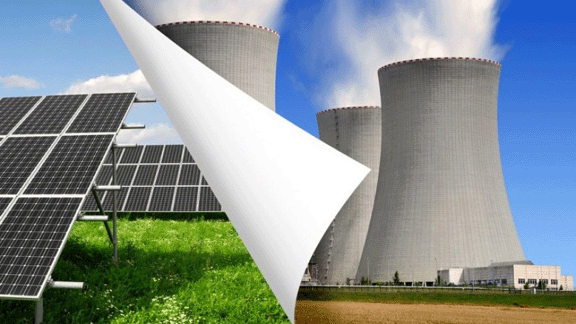 Are solar and wind really killing coal, nuclear and grid reliability? The Conversation, Joshua D. Rhodes, Postdoctoral Researcher of Energy, University of Texas at Austin, Professor of Mechanical Engineering and Deputy Director of the Energy Institute, University of Texas at Austin, Graduate Research Assistant, University of Texas at Austin, Research Associate, Energy Institute, University of Texas at Austin May 12, 2017
 Some energy analysts responded with confusion, as the subject has been extensively studied by grid operators and the Department of Energy’s own national labs. Others were more critical, saying the intent of the review is to favor the use of nuclear and coal over renewable sources.
So, are wind and solar killing coal and nuclear? Yes, but not by themselves and not for the reasons most people think. Are wind and solar killing grid reliability? No, not where the grid’s technology and regulations have been modernized. In those places, overall grid operation has improved, not worsened………
Wind and solar are making older generators less viable because their low, stable prices and emissions-free operation are desirable. And they aren’t hurting grid reliability the way critics had assumed because other innovations have happened simultaneously…….
How do renewables affect the bid stack? Renewable sources such as wind, solar and hydro have no fuel costs – sunlight, wind and flowing water are free. That means their marginal operational cost is near zero; the cost is essentially the same to operate one megawatt of wind as compared to the cost of operating 10 megawatts of wind since generators don’t need to buy fuel. That means as more wind and solar farms are installed, more capacity is inserted at the cheapest end of the bid stack.
This insertion pushes out other generators such as nuclear, natural gas and coal, causing some of them to no longer be dispatched into the grid – that is, they don’t supply power into the grid (or get paid). So as more renewables are installed, power markets dispatch fewer conventional options. And, because the marginal cost of these new sources is almost free, they substantially lower the cost for electricity. This is great news for consumers (all of us) as our bills decrease, but bad news for competitors (such as coal plant owners) who operate their plants less often and are paid less when the plants do operate.
What does all this mean? Natural gas and renewables are affecting coal in two ways. Natural gas is a direct competitor with coal because both can be dispatched – turned on – when a grid operator needs more power. That is helpful for grid reliability. But, as the cost of natural gas has fallen, coal has become less competitive because it is cheaper to operate a natural gas power plant.
The effect of renewables is slightly different: Wind and solar power are not dispatchable, so they cannot be turned on at a moment’s notice. But, when they do turn on, during windy evenings or sunny days in Texas, they operate at very low marginal cost and thus operate very competitively.
Research at UT Austin shows that while installing significant amounts of solar power would increase annual grid management costs by $10 million in ERCOT, it would reduce annual wholesale electricity costs by $900 million. The result of all this is that renewables compete with conventional sources of power, but they do not displace nearly as much coal as cheap natural gas. In fact, cheap gas displaces, on average, more than twice as much coal than renewables have in ERCOT.
What about nuclear?
Nuclear’s problems are largely self-inflicted. In short: The price to build nuclear is high, so we don’t build many nuclear plants these days. Since we don’t build, we don’t have the manufacturing capability. Since we don’t have the manufacturing capability, the price to build nuclear is high. Since the price to build nuclear is high, we don’t build nuclear these days…so on and so forth.
Today, cheap gas, having already beaten up on coal, is a threat to new nuclear power plants and less efficient, older plants. New natural gas combined cycle power plants can be built for about one-sixth the cost of a new nuclear plant, is almost twice as efficient and you can build them in smaller increments, making them easier to finance.
Market innovation and IT can fix reliability
Because wind energy comes and goes with the weather, it makes grid operators nervous. But wind forecasting has improved dramatically, giving more confidence to those who need to keep the lights on.
And, interestingly enough, the requirements for reserve capacity (backup power for when wind power dips) to manage the grid smoothly went down, not up, over the past few years in Texas, despite rapid growth in wind during Governor Perry’s tenure. That is, the costs for managing variability in the grid decreased……….
there is still more to do – information technology coupled with integrated hardware can help. Consider this: There are 7.7 million smart meters in Texas, most of them residential. We’ve estimated that installing 7 million controllable thermostats for just the households in Texas would cost $2 billion. Residential air conditioning is responsible for about 50 percent of peak demand in Texas in the summer. That means about 30 gigawatts of peak demand in Texas is just from residential air conditioners.
By dynamically managing our air conditioning loads – that is, adjusting thermostats to lower overall demand without impacting people’s comfort – we could reduce peak demand by 10 to 15 GW. That means we might not need $10 billion to $15 billion worth of power plants. Spending $2 billion to avoid $15 billion is a good deal for consumers. In fact, you could give the thermostat away for free and pay each household $700 for their trouble and it would still be cheaper than any power plant we can build.
In the end, Secretary Perry has posed good questions. Thankfully, because of lessons learned while he was governor of Texas, we already have answers: despite concerns to the contrary, incorporating wind and solar into the grid along with fast-ramping natural gas, smart market designs and integrated load control systems will lead to a cleaner, cheaper, more reliable grid.https://theconversation.com/are-solar-and-wind-really-killing-coal-nuclear-and-grid-reliability-76741
France’s Emmanuel Macron to lead the nation to renewable energy, and away from nuclear
New Energy Update, May 10, 2017 French President-elect set to boost sluggish solar growth Emmanuel Macron’s victory in France’s presidential election on May 7 is set to usher in a new wave of renewable energy development, according to his campaign pledges.
Macron pledged to double solar and wind capacity and close all of France’s coal-fired power stations by the end of his five-year term in 2022. He has also pledged to retain laws introduced in 2015 which aim to cut the share of nuclear power from 75% to 50% by 2025. This could equate to the closure of 25 GW of nuclear power capacity and shutdown dates will depend on growth in solar and wind capacity.
French solar capacity currently stands at 7 GW while wind capacity is around 12 GW. Solar and wind development has been hampered by regulatory and administrative hurdles and Macron plans to simplify the authorization process.
The closure of 25 GW of nuclear power capacity would require around 75 GW of new renewable energy capacity, Jefferies analysts Ahmed Farman and Oliver Salvesen said in a research note April 24.
“That looks quite challenging given that in the last 10 years only 18 GW of wind and solar was installed in France,” the analysts said in their note.
Market analysts have highlighted the challenge of shutting down an estimated 25 GW of nuclear power capacity over such a short timeframe while maintaining grid stability. While Macron supports the 2025 nuclear phase-out law, he has not set out a firm position on the phase-out date.
“The lack of a firm position on this issue may be because Mr Macron is well aware that the 2025 target is highly ambitious,” Farman and Salvesen said in their research note.
The 50% nuclear target may instead be reached between 2030 and 2033, a Macron adviser told Bloomberg in a report published April 26. The 50% objective could be reached sooner if ASN, the French nuclear safety authority, imposes tough conditions to extend reactor lifespans from 40 to 50 years, the adviser told Bloomberg.
Some 34 of EDF’s 58 reactors will soon reach 40 years of operations and the ASN will publish its safety report on the proposed lifespan extensions in around 2018.
Macron has said he would decide on the future of these reactors following the ASN’s report. http://analysis.newenergyupdate.com/pv-insider/google-brings-solar-rooftop-mapping-europe-french-president-elect-plans-renewables-boom?utm_campaign=NEP+PV+10MAY17+Newsletter&utm_medium=email&utm_source=Eloqua&elqTrackId=0da3b745bbf445b4a26a08b119c0eb1a&elq=3285a40f49eb42f0a3f4e6cb9d0a3898&elqaid=27829&elqat=1&elqCampaignId=13168
The new Renewable Industrial Revolution- nuclear power is so, so yesterday
 Power of renewables is sweeping the world towards a new revolution, Business Live, 08 MAY 2017 – 05:57 I am not going to write about nuclear power. By the end of this article, you will know why. The global economy is on the cusp of its Fourth Industrial Revolution. And like the previous three, this one will be driven by — quite literally — a concentrated burst of energy. In the early 19th century, the original Industrial Revolution was based on harnessing steam energy; in the late 19th century, the second followed with the employment of electrical energy; in the late 20th century, the third was built on the exploitation of computing energy. And, as will become all too apparent in the coming decade, the fourth will be rooted in renewable energy.
Such supercharged progress is born from mixing the most basic laws in the universe, thermodynamics, with economics. When humanity harnesses a higher form of energy, we are capable of doing much greater amounts of work with it. And much greater wealth results. There is nothing more to it. Nor less.
We are leaving the age when, to generate power, we exploited minerals that we found underneath the earth’s surface: coal, oil, uranium. Henceforth, we will increasingly access assets above the earth’s surface: the sun and the wind, with water and steam in various forms playing supporting roles. And not only is the harnessing of these energy sources essentially renewable, the side-effects in terms of pollution will be next to negligible. The production of these new energies will be extraordinarily safe. And the Fourth Industrial Revolution will be a game-changer because once renewable power capacity is installed, the marginal cost of energy production from it will be close to zero.
How soon will this happen? It is already happening. Trusted Sources estimate that, in 2016, more than 60% of all new energy installations worldwide were in the renewable space. By 2020, they predict that share will be 100%. Thus, within three years, the share of energy generation worldwide attributable to traditional sources will be declining.
Wind power is already having a huge affect in colder countries in the northern hemisphere: Scotland, Denmark and Germany have days when renewables, led by wind, provide all their energy needs. Solar power is starting to be used much more in regions between the 45° north and south latitudes, which embraces virtually all inhabited regions in the southern hemisphere. Our Cape Agulhas is 35° south.
While the whole world will participate in this revolution to varying degrees, industrially it will be driven by China………
Perhaps the most radical breakthrough has been made by using molten salt to absorb energy in the day and release it at night: Spain’s 150MW Andasol solar power station uses this method, doubling the power plant’s operational hours. It has been very successfully employed in Chile’s Atacama Desert, now dubbed the Saudi Arabia of Solar Power. The Karoo is SA’s equivalent of the Atacama.
One of the most extraordinary advantages of solar is that it can easily and cost effectively be installed on a micro scale, making it particularly applicable for emerging markets. A panel can work for just one household and not need to be connected to a grid. This has spawned a supply revolution in regions where grid coverage is patchy.
Companies connecting panels to mobile payment systems have flourished: Kenya’s M-Kopa is but one example. And the results of this have spread into many corners of society: one estimate has it that, because homework can now be done at night, exam results for children living in solar-connected houses have improved 40%. As the immutable laws of thermodynamics dictate, energy is translated into work! New sources of energy that become readily accessible to the poor are what make these industrial advances so revolutionary.
As with all previous industrial revolutions, the breakthrough in harnessing a new energy source spawns myriad secondary developments that are dependent on it. ……
Invariably there are vested interests connected to old energy that will seek to slow this coming revolution. But plans to install old energy capacity in a world fast migrating to renewables is economic lunacy. So, the reason I am not writing about nuclear power should be abundantly clear: it is so, so yesterday. https://www.businesslive.co.za/bd/opinion/2017-05-08-power-of-renewables-is-sweeping-the-world-towards-a-new-revolution/
Latest climate and renewable energy news
 So much news is coming out, particularly about the speedy development of renewable energy, that I cannot keep up. Here are brief notes:
Climate Change
There are diseases hidden in ice, and they are waking up.
Long-dormant bacteria and viruses, trapped in ice and permafrost for centuries, are reviving as Earth’s climate warms.
http://www.environmentalhealthnews.org/t/-995200128361634098
Increased scrutiny of climate-change models should be welcomed.
The apparent slowdown in global warming has provided a spur for better understanding of the underlying processes.
http://www.environmentalhealthnews.org/t/-995200128361634093
Modest climate change bill draws sponsors from both sides of the aisle.
A small but increasingly vocal group of Republicans is embracing the reality of global warming and taking small steps to press the issue in Congress.
http://www.dailyclimate.org/t/-995200128361634108
Health and climate change
The World Health Organisation’s director-general describes climate change as ‘the fifth horseman’ of the apocalypse, as doctors are encouraged to speak out more about illness and death caused by extreme weather.
https://www.thesaturdaypaper.com.au/2017/05/06/health-and-climate-change/14939928004580
Is Climate Changing Cloud Heights? Too Soon to Say
A new analysis of 15 years of NASA satellite cloud measurements finds that clouds worldwide show no definitive trend during this period toward decreasing or increasing in height. The new study updates an earlier analysis of the first 10 years of the same data that suggested cloud heights might be getting lower.
http://www.enn.com/climate/article/51190
Medical scientists report on the impact climate change is having on health.
John Abraham The Guardian
As a climate scientist, I spend time and energy studying how fast the Earth is warming and what is causing the warming.
http://www.dailyclimate.org/t/-995200128361633609
Clive Hamilton
We continue to plan for the future as if climate scientists don’t exist. The greatest shame is the absence of a sense of tragedy
https://www.theguardian.com/environment/2017/may/05/the-great-climate-silence-we-are-on-the-edge-of-the-abyss-but-we-ignore-it
‘We must leave Earth in 100 years’
THE world’s smartest man says the future of humanity requires us to colonise another planet – and we have to do it soon.
http://www.news.com.au/technology/science/stephen-hawking-warns-that-humans-must-leave-earth-in-100-years/news-story/4b979ea1ab2d0fe6f3eb68f45b0d25c0
Bangladesh coal plant could cause 6,000 early deaths.
A giant coal-fired power plant approved by Bangladesh could drastically worsen air pollution for millions and cause the early deaths of 6,000 people over its lifetime, Greenpeace said Friday.
http://www.environmentalhealthnews.org/t/-995200128361632465
Could towing icebergs to hot places solve the world’s water shortages?
The idea of towing an iceberg from Antarctica to the UAE sounds fantastical, but might not be entirely beyond the realms of plausibility
https://www.theguardian.com/environment/2017/may/05/could-towing-icebergs-to-hot-places-solve-the-worlds-water-shortage
We would need 1.7 Earths to make our consumption sustainable.
The U.S. is the second least sustainable country in the world. Trump could make it even worse.
http://www.environmentalhealthnews.org/t/-995200128361633432
Ingenuity in laboratories worldwide is harnessing microbes, water and hot air to produce different types of renewable energy from greenhouse gas.
http://www.environmentalhealthnews.org/t/-995200128361632292
Following Recent Surge, Wind Now Generates 5.5 Percent of U.S. Electricity
The U.S. wind energy industry experienced its fastest first-quarter growth since 2009, installing 2,000 new megawatts of capacity — enough to power about 500,000 homes — on its way to producing 5.5 percent of the country’s electricity.
http://www.enn.com/energy/article/51187
Germany’s record of renewable energy: only 15% from fossil fuels and nuclear last weekend
 Germany breaks renewables record with coal and nuclear power responsible for only 15% of country’s total energy http://www.independent.co.uk/news/world/europe/germany-renewable-energy-record-coal-nuclear-power-energiewende-low-carbon-goals-a7719006.html
Electricity prices fell to negative figures for several hours on Sunday, as renewable sources fed so much power into the grid that supply exceeded demand Charlotte England @charlottengland, 5 May 17, Germany has broken a new record for renewable energy, with low-carbon sources nearly obliterating coal and nuclear power last weekend.
Coal use fell to an all-time low, with public broadcaster Deutsche Welle reporting that on 30 April coal-fired power stations were only operational between three and four in the afternoon and produced less than eight gigawatts of energy, well below their maximum output of about 50 gigawatts.
“Most of Germany’s coal-fired power stations were not even operating on Sunday,” Patrick Graichen of Agora Energiewende told Australian news site RenewEconomy.
“Nuclear power sources, which are planned to be completely phased out by 2022, were also severely reduced.”
Mr Graichen added that days like Sunday would be “completely normal” by 2030 thanks to the government’s continued investment in the Energiewende initiative.
Germany announced in May 2011 that it plans to shut down all its nuclear power plants by 2022, in addition to nearly eliminating fossil fuel power..
The country’s ambitious energy transition aims for at least 80 per cent of all power to come from renewables by 2050, with intermediate targets of 35 to 40 percent share by 2025 and 55 to 60 percent by 2035.
The EU as a whole is also striving to meet stringent sustainable energy targets, albeit more modest ones than Germany.
While the bloc is on course to meet 2020 goals of 20 per cent of energy from renewable sources, the UK is lagging behind.
MPs on the Energy and Climate Change Committee warned the Government last year that, on its current course, the UK will fail to achieve its 2020 renewable energy targets — to provide for 15 per cent of its energy needs from renewable sources
Germany’s record 85% renewables over weekend
Graph of the day: Germany’s record 85% renewables over weekend [good graphs] REneweconomy By Giles Parkinson on 4 May 2017 Germany achieves a record level of 85 per cent renewable energy generation on April 30 – part of the May 1 long weekend – with wind and solar providing significant lifts in output and along with biomass and hydro almost completely sidelining hard coal plants.
Patrick Graichen of Agora Energiewende Initiative, which provided these graphs, says a combination of breezy and sunny weather in the north and warm weather in the south saw Germany’s May 1 holiday weekend powered almost exclusively by renewable resources.
“Most of Germany’s coal-fired power stations were not even operating on Sunday April 30th, with renewable sources accounting for 85 per cent of electricity across the country,” he said. “Nuclear power sources, which are planned to be completely phased out by 2022, were also severely reduced.
Graichen says days like April 30 would be “completely normal” by 2030, as the federal government’s Energiewende (energy transition) initiative continues to add value to the wealth of resources invested in it……..http://reneweconomy.com.au/graph-of-the-day-germanys-record-85-renewables-over-weekend-60743/
1 This Month

of the week – Shut Down Drone Warfare!


Tell the Ukrainian Government to Drop Prosecution of Peace Activist Yurii Sheliazhenko

Petition to revoke the licensing of the Near Surface Nuclear Disposal Facility (NSDF) at Chalk River. https://www.ourcommons.ca/petitions/en/Petition/Details?Petition=e-7247
To see nuclear-related stories in greater depth and intensity – go to https://nuclearinformation.wordpress.com
-
Archives
- April 2026 (68)
- March 2026 (251)
- February 2026 (268)
- January 2026 (308)
- December 2025 (358)
- November 2025 (359)
- October 2025 (376)
- September 2025 (257)
- August 2025 (319)
- July 2025 (230)
- June 2025 (348)
- May 2025 (261)
-
Categories
- 1
- 1 NUCLEAR ISSUES
- business and costs
- climate change
- culture and arts
- ENERGY
- environment
- health
- history
- indigenous issues
- Legal
- marketing of nuclear
- media
- opposition to nuclear
- PERSONAL STORIES
- politics
- politics international
- Religion and ethics
- safety
- secrets,lies and civil liberties
- spinbuster
- technology
- Uranium
- wastes
- weapons and war
- Women
- 2 WORLD
- ACTION
- AFRICA
- Atrocities
- AUSTRALIA
- Christina's notes
- Christina's themes
- culture and arts
- Events
- Fuk 2022
- Fuk 2023
- Fukushima 2017
- Fukushima 2018
- fukushima 2019
- Fukushima 2020
- Fukushima 2021
- general
- global warming
- Humour (God we need it)
- Nuclear
- RARE EARTHS
- Reference
- resources – print
- Resources -audiovicual
- Weekly Newsletter
- World
- World Nuclear
- YouTube
-
RSS
Entries RSS
Comments RSS
 nuclear-news