Renewables beating coal energy in Germany
The shift marks progress as Europe’s biggest economy aims for renewables to provide 65 percent of its energy by 2030 in a costly transition as it abandons nuclear power by 2022 and is devising plans for an orderly long-term exit from coal.
The research from the Fraunhofer organisation of applied science showed that output of solar, wind, biomass and hydroelectric generation units rose 4.3 percent last year to produce 219 terawatt hours (TWh) of electricity. That was out of a total national power production of 542 TWh derived from both green and fossil fuels, of which coal burning accounted for 38 percent.
Green energy’s share of Germany’s power production has risen from 38.2 percent in 2017 and just 19.1 percent in 2010.
Bruno Burger, author of the Fraunhofer study, said it was set to stay above 40 percent this year.
“We will not fall below the 40 percent in 2019 because more renewable installations are being built and weather patterns will not change that dramatically,” he said……….https://www.weforum.org/agenda/2019/01/renewables-overtake-coal-as-germanys-main-energy-source?utm_source=Facebook%20Videos&utm_medium=Facebook%20Video
Solar power for 97 Spanish grand hotels

 Observer 30th Dec 2018 Spain’s state-owned chain of paradores, the grand hotels often housed in ancient castles and monasteries, has announced that all 97 of its establishments will use only electricity from renewable sources from the start of the new year.
The 90-year-old chain said the decision to switch to green electricity had been made for both environmental and symbolic
reasons. “Paradores is a company that supports sustainable tourism in every sense of the word,” said its chair, Óscar López Águeda. “What’s more, as a public company, we also want to set an example when it comes to investments that encourage energy saving and responsible consumption.”
https://www.theguardian.com/world/2018/dec/30/spain-paradores-solar-power-pledge
Renewable energy getting a boost after the failure of VC Summer Nuclear Plant expansion
|
Utility customers on the hook for the project had received nine unique electricity bill increases, equal to about $27/month, a factor in South Carolina to having the highest average monthly bills in the United States. As part of the fallout, the parties involved are being pushed hard by politicians and voters to change their ways. On November 30th, general council of the South Carolina Electric & Gas Company (SCANA), also representing Dominion Energy, notified the Public Service Commission of South Carolina, that it supports a certain set of renewable energy supporting policies as part of the ongoing negotiations. The policies are focused on renewables and energy storage gaining consistent access to the market. The regulations mainly aim to create a consistent set of variables – avoided costs, ten year PPAs, hourly pricing, consistent interconnection standards – that will allow developers of solar power projects to better model probability of successful projects. This is not the first time that failed nuclear power plants have been followed by solar. The above images [on original] are of the 1 MW solar power plant that is running at the Chernobyl Nuclear Power plant in Ukraine. The large structure in the background is the $1.5 billion 31,000 ton concrete sarcophagus to cover the still burning nuclear melt down. The Phipps Bend Nuclear Power Plant in Surgoinsville, Tennessee sat abandoned since it was cancelled in 1981, 36 years ago. As of July 5, 2017 it began generating solar electricity as United Renewable Energy completed a 1 MW solar power plant (main article image) When Duke Energy Florida cancelled the Levy Nuclear Plant at a cost of $800 million in already collected fees from consumers, the electric utility announced plans to satiate the public with 700 MWac of solar power, plus at least 50 MW of grid-tied batteries, grid modernization projects, and 500 electric vehicle charging areas. |
|
Residential batteries ready to compete with fossil fuels and nuclear in Germany
Sonnen: Residential batteries ready to compete with fossil fuels and nuclear in Germany Energy Storage, 14 Dec 18 , Batteries in private households will be now able to perform the “same tasks as a conventional power plant”, across the whole of Germany, the CEO of Sonnen has said, following a ruling that opens up grid services markets to the company’s devices.
Sonnen last week announced that it has obtained pre-qualification to enter Germany’s Primary Control Reserve market by grid operator TenneT for its battery energy storage units installed across the country. Primary Control Reserve is a form of frequency regulation, keeping the grid to within acceptable boundaries of its optimum 50Hz operating frequency……….
If every solar home in Germany – there are around 1.5 million at present – was equipped with a SonnenBatterie, the power capacity would add up to 4.5GW, with an energy capacity of 15GWh. Such systems, connected to the virtual battery, or virtual power plant (VPP), could replace four large thermal power plants, equivalent to the entire capacity currently being used for PCR across the entire European continent.
The possibility for scaling up the model, in other words, “is one large step towards a clean and decentralised energy structure,” Ostermann said………https://www.energy-storage.news/news/sonnen-residential-batteries-ready-to-compete-with-fossil-fuels-and-nuclear
REPLACING NUCLEAR WITH RENEWABLES WOULD SAVE FRANCE $44.5 BILLION
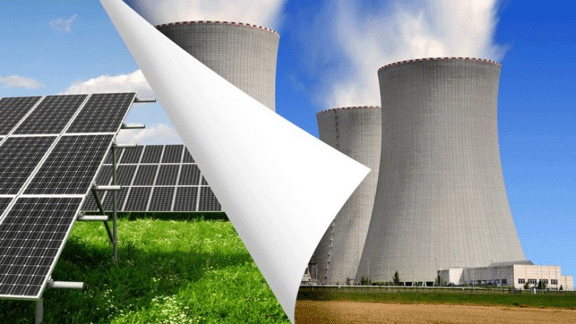
 Futurism, 13 Dec 18 The French government just announced a plan to power 95 percent of the country with solar and wind energy by 2060. And by doing so, the government would spend about $44.5 billion (39 billion euros) less than it would if it maintained its current energy infrastructure.
To get there, the government would need to cancel plans to construct 15 new nuclear power plants, and instead replace its aging nuclear reactors with renewable infrastructure over the next several decades, according to a new report published Monday by the French environmental agency.
The report details how France could increase its dependence on solar and wind energy over time, gradually shutting down nuclear power plants to make room for renewables.
But doing so will still be costly: the report suggests that developing these new power plants as well as the necessary infrastructure to support them will cost the government $1.45 trillion (1.28 trillion euros) over the next 42 years. That’s a huge investment, but it’s still much cheaper than maintaining the status quo and replacing the country’s aging nuclear power plants with more modernized reactors…….. https://futurism.com/the-byte/nuclear-plants-renewable-energy-france
Germany a leading solar power producer, despite its low hours of sunshine
https://germanyworks.ft.com/energy/german-solar-power-is-a-sunrise-market/
Scotland’s wind power output over 100%
 WIND output in Scotland has broken through the 100% threshold for the first
time with 109% of total electricity demand being met from renewables, according to new data. Figures from Weather Energy, part of a wider European project, show electricity generated by wind in November was enough to power nearly 6 million homes – a new record for Scotland.
In another milestone, wind production outstripped total electricity demand on 20 out of 30 days. Gina Hanrahan, head of policy at environmental group WWF Scotland, welcomed the contribution made by wind: “Wind power breaking through the magic 100% threshold is truly momentous. For months output has flirted around the 97% mark, so it’s fantastic to reach this milestone. “It’s also worth noting that 20 out of 30 days wind production outstripped demand.
https://www.thenational.scot/news/17286749.scottish-wind-power-output-breaks-100-output-milestone/
Hungary plans for 100% renewable energy, phasing out coal
Open Access Government 28th Nov 2018 , Following yet another hike in the European Union’s emissions trading
system (ETS) in its fight against climate change, Hungary has announced
that it aims to phase out its use of coal and be fully reliant on renewable
energy sources by 2030.
https://www.openaccessgovernment.org/hungary-plans-to-ditch-coal-by-2030-and-become-fully-reliant-on-renewable-energy/55057/
Solar and wind fuels emit no carbon, but “low carbon” nuclear fuel- it’s a lie! theme for November 18
Solar and wind energy both flow directly to the generating system.

Not only are these fuels carbon-free, but, unlike nuclear, they leave no wastes
Only one step in that uranium-nuclear chain is low emission – though all nuclear lobbyists claim that this step is “no emission” – the reactor’s operation. BUT – Carbon-14 is produced in coolant at boiling water reactors (BWRs) and pressurized water reactors (PWRs). It is typically released to the atmosphere in the form of carbon dioxide at BWRs, and methane at PWRs.
UK could be running solely on zero carbon renewable in summer months 2050.
 Business Green 2nd Nov 2018 The UK power market will be able to withstand huge volumes of new renewable
generation coming on line according to new research, which suggests the
country could be running solely on zero carbon power during the summer
months by 2050.
explores what happens to the UK power market as it transitions to a high
level of renewable power. Aurora modelled a 2050 scenario where power
demand has risen by two-thirds from today, thanks to the rise of EVs, and
the grid now boasts 130GW of nuclear, wind and solar generation capacity.
effectively lead to zero-carbon summers for the UK electricity grid under
this scenario, according to Aurora. But such large volumes of renewable
power would also “fundamentally alter” the workings of the power market,
with price crashes in the summer months as green power generation soars.
https://www.businessgreen.com/bg/news/3065602/aurora-er-uk-could-enjoy-zero-carbon-summer-power-by-2050
€45 billion renewables investment opportunity in France, with its new energy policy
“Clean Energy D.C. Act” – would lead Washington DC to 100% renewable energy by 2032

Green Matters 24th Oct 2018, Lawmakers in Washington D.C. are proposing one of the nation’s most
aggressive plans to cut carbon emissions. The “Clean Energy D.C. Act”
would roll out the strongest renewable electricity standard in the United
States, making the nation’s capital a world leader on climate change and
put them on an accelerated timeline to 100 percent renewable energy by
2032.
“This bill provides the bold action needed to match the urgency of
the climate crisis. It builds on the Clean Energy D.C. plan and the
District’s 12-year legacy of clean energy and green building policy
achievement, again blazing a path for other cities to follow,” said Cliff
Majersik, Executive Director of the Institute for Market Transformation in
a statement. https://www.greenmatters.com/renewables/2018/10/24/19LG2w/dc-climate-bill-2030
Egypt’s renewable energy project – going for the green economy

Image processed by CodeCarvings Piczard ### FREE Community Edition ### on 2017-10-20 17:00:50Z | http://piczard.com | http://codecarvings.com
largest solar power plant in the world early this year, RT reported on Friday. Reporting the remarks of Egyptian official Hassan Abaza, RT said that the superpower plant was built in the city of Aswan, southern Egypt.
economy” is a mechanism to achieve sustainable development. https://www.middleeastmonitor.com/20181027-egypt-builds-largest-solar-power-plant-in-the-world/
Washington DC pushes 100% renewable energy bill
 https://reneweconomy.com.au/washington-dc-pushes-100-renewable-energy-bill-48151/
Cheap flexibility from storage, demand-side response and distributed renewable energy generation poses a “huge threat” to the nuclear industry
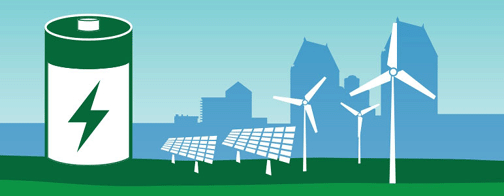
Tom Grimwood Speaking at a conference held by Aurora Energy Research in London yesterday (11 October), Davey said the falling costs of such technologies raise “serious questions” about the government’s pursuit of new nuclear plants.“There’s no doubt storage and flexibility pose a huge threat to nuclear industry,” he told the audience. “Nukes are expensive; take a hell of a long time to build. In ten years, where are we going to be with storage and flexibility?
“I think it’s going to be cheap as chips and have variations we don’t even know about today, because so much is evolving. The energy revolution is going apace.”
“That has to ask serious questions of the nuclear strategy which the government is pursuing”.
Davey hailed the government and Ofgem’s smart systems and flexibility plan as the “best thing” he’d seen in terms of policy since leaving office in 2015.
However, he added: “I don’t see much movement. And I’m not saying it’s because it’s easy… But we really need to be moving forward on that to give people better markets and contracts that are more investible… I think we could do a lot better.”
He continued: “If you had better policy you might be able to answer this question of do we keep a big centralised system, investing in lots of big centralised assets, or do we have more of a hybrid system.
“And we’ve gone to a hybrid system a little bit without thinking it all through but for good reasons. Solar took off much quicker than people thought, for example, and the capacity brought on peakers which weren’t really in the picture.
“We’ve now got that hybrid system and my worry is no one’s really thinking that through strategically.”
Davey also raised concerns over the influence of large generators on policy and regulatory decisions: “My worry is that the lobbying power of the big centralised generators… is a bit bigger than those of us who think a lot of the future is in the decentralised sector.
“If I have political message to people, it’s to really think that through because I think we’ve seen in some of the network code debates and elsewhere a politics which is very much in favour of centralised generators.”
Speaking to Utility Week in early 2017, the chief executive of UK Power Reserve, Tim Emrich, accused the Connection and Use of System panel of being unduly influenced by incumbents after the industry body recommended drastic cuts to the triad avoidance payments available to small-scale distributed generators.
The changes were approved by Ofgem later in the year. https://utilityweek.co.uk/cheap-chips-flexibility-poses-huge-threat-nuclear/
1 This Month



Shut down the radiation-damaged Heysham nuclear reactors now
To see nuclear-related stories in greater depth and intensity – go to https://nuclearinformation.wordpress.com

Say No to NASA’s Reckless Nuclear Reactor on the Moon
Say No to NASA’s Reckless Nuclear Reactor on the Moon
-
Archives
- October 2026 (256)
- September 2026 (339)
- August 2026 (330)
- July 2026 (355)
- June 2026 (287)
- May 2026 (306)
- April 2026 (356)
- March 2026 (251)
- February 2026 (267)
- January 2026 (308)
- December 2025 (358)
- November 2025 (359)
-
Categories
- 1
- 1 NUCLEAR ISSUES
- business and costs
- climate change
- culture and arts
- ENERGY
- environment
- health
- history
- indigenous issues
- Legal
- marketing of nuclear
- media
- opposition to nuclear
- PERSONAL STORIES
- politics
- politics international
- Religion and ethics
- safety
- secrets,lies and civil liberties
- spinbuster
- technology
- Uranium
- wastes
- weapons and war
- Women
- 2 WORLD
- ACTION
- AFRICA
- Atrocities
- AUSTRALIA
- Christina's notes
- Christina's themes
- culture and arts
- Events
- Fuk 2022
- Fuk 2023
- Fukushima 2017
- Fukushima 2018
- fukushima 2019
- Fukushima 2020
- Fukushima 2021
- general
- global warming
- Humour (God we need it)
- Nuclear
- RARE EARTHS
- Reference
- resources – print
- Resources -audiovicual
- Weekly Newsletter
- World
- World Nuclear
- YouTube
-
RSS
Entries RSS
Comments RSS

